‘Nicholas II. Portraits’ in FULL COLOUR!
CLICK ON THE LINK BELOW TO ORDER FROM AMAZON
BOOK DESCRIPTION
Large format 8-1/2″ x 11″ hard cover and paperback editions, with 178 pages + 200 Colour and black & white photographs
SECOND EDITION, FEATURING 185 FULL COLOUR PHOTOS!
I am pleased to announce the publication of my latest book Nicholas II. Portraits, in both hard cover and paperback editions. This is my first hard cover book and my first book featuring full colour photographs.
Originally published in 2019, with 140 pages with 175 black and white photos, this new expanded edition features more pages and more photographs: 180 pages + more than 200 photos, including 185 FULL COLOUR and 30 black & white!
Nicholas II. Portraits explores a century of portraits of Russia’s last emperor and tsar, through the eyes of pre-revolutionary and contemporary Russian, and foreign artists.
This unique title – the first book of its kind ever published on the subject – features an introduction, as well as a series of short articles, and richly illustrated, including many full-page, with detailed and informative captions.
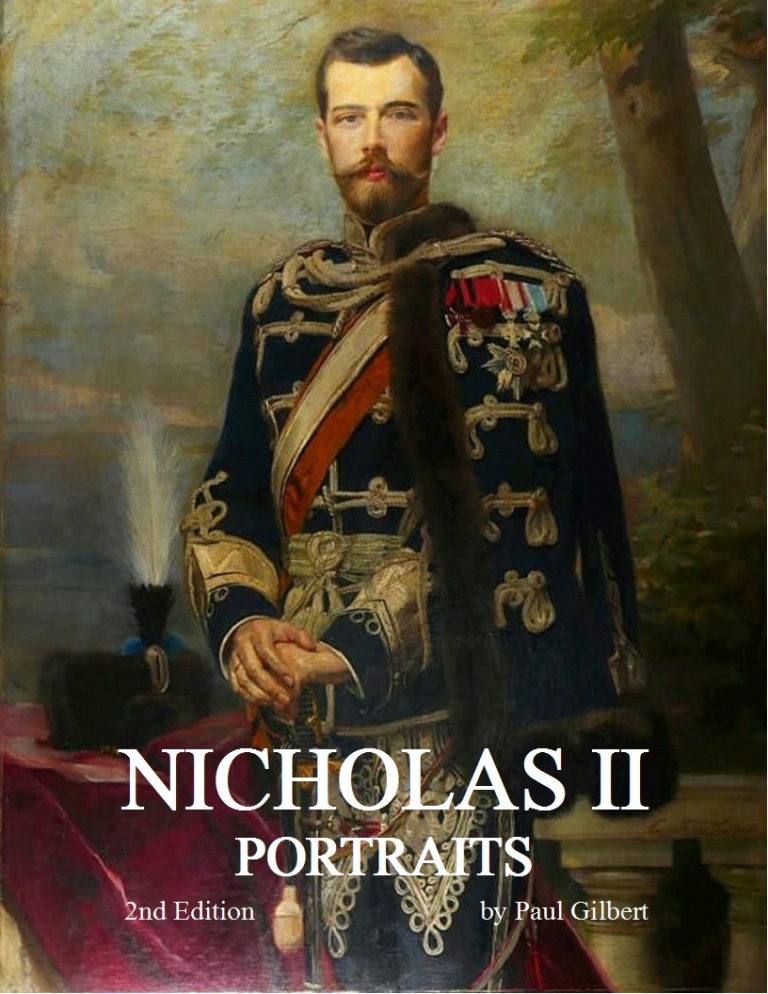
The cover features a portrait of Tsesarevich and Grand Duke Nicholas Alexandrovich (1889), the future Emperor Nicholas II, by the artist Baron Ernst Friedrich von *Lipgart (1847-1932).
* Lipgart painted a whole gallery of portraits of Nicholas II, my book features 10 of them – all in COLOUR!
The Emperor is depicted in the uniform of the Prussian 8th Hussar Regiment, of which he was appointed an Honourary Chief in 1889, his cape is decorated with the Royal Prussian Order of the Black Eagle.
The painting hung from 1890 to 1995 in the former dining room of Neuhaus Castle, directly opposite the portrait of Elector Clemens August of Bavaria. The officers of the 8th Hussar Regiment established a club for their meetings here and in the adjacent premises. The Prussian regiment was stationed at Neuhaus and Paderborn castle from 1851 to 1919. Following the end of World War I, the regiment was disbanded.
From the Collection of the Museum of the House of Bavarian History in Regensburg, Bavaria.
The articles include: Serov’s Unfinished 1900 Portrait of Nicholas II; A Nun’s Gift to Russia’s New Tsar. The Fate of a Portrait; Galkin’s Ceremonial Portrait of Nicholas II Discovered; among others!
Famous portraits and their respective artists are all represented, including Serov, Repin, Lipgart, Tuxen, Bakmanson, Becker, Bogdanov-Belsky, Kustodiev, and many others.
The last section of the book is dedicated to the works of contemporary Russian artists, who have painted outstanding portraits of Nicholas II since the fall of the Soviet Union in 1991.
AVAILABLE EXCLUSIVELY FROM AMAZON WORLDWIDE!
© Paul Gilbert. 10 December 2021


 Nicholas II
You must be logged in to post a comment.