Those who served the Tsar: Alexander Spiridovitch (1873-1952)
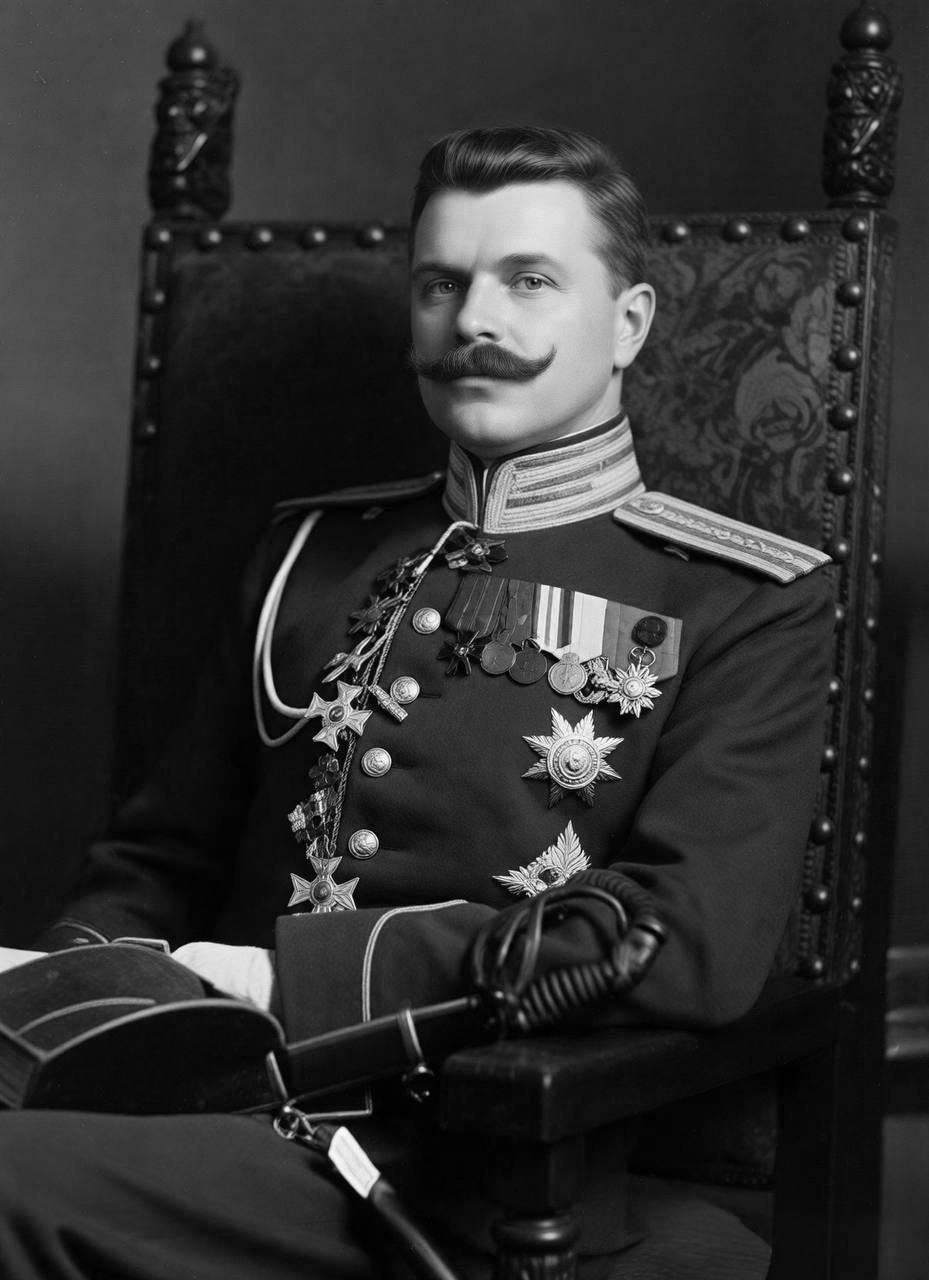
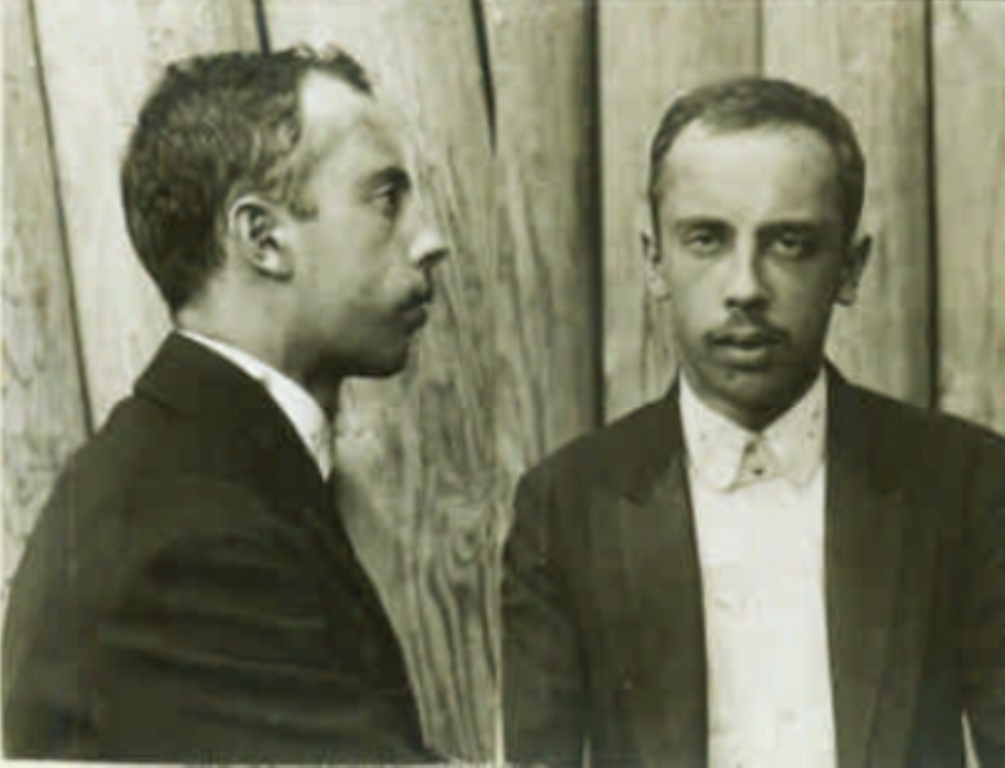
PHOTO: Alexander Ivanovich Spiridovich (1873-1952)
In 1906 Alexander Ivanovich Spiridovich was handpicked by Emperor Nicholas II to serve as his personal security chief, the position he served faithfully from 1906-1916. He was also responsible for the security of the tsar’s residences. He was a nan of honour, and one of the few men whom the Tsar put complete trust. Throughout his distinguished career, Spiridovich served his Sovereign faithfully and with honour.
He was born on 17th (O.S. 5th) August 1873 in the town of Kem, Arkhangelsk Province into the family of a hereditary nobleman. His father, Ivan Matveevich Spiridovich, was an officer of the border guard, his mother, Anna Alexandrovna, came from the family of the fabulist I. A. Krylov.
Alexander graduated from the Nizhny Novgorod Cadet Corps (1891) and the Pavlovsk Military School (1893), from where he was released as a second lieutenant in the 105th Orenburg Infantry Regiment. He was later promoted to lieutenant of the regiment. In 1899 he was transferred to the Separate Corps of Gendarmes
In 1900 he went to Moscow, where he was seconded to the Department for the Protection of Public Safety and Order, usually called the Guard Department and commonly abbreviated in modern English sources as the Okhrana [a secret police force of the Russian Empire and part of the Imperial police department under the Ministry of Internal Affairs], where he served under the command of Sergei Vasilyevich Zubatov[1] (1864-1917).
In 1902, he was appointed head of the Taurida security department in Simferopol in Crimea and in 1903, with the rank of captain, he took up the post of head of the Kiev security department. On 13th May 1903, he arrested the head of the combat organization of the Socialist-Revolutionaries, Grigory Gershuni[2], in Kiev. He was later promoted to lieutenant colonel.
On 28th May 1905, Spiridovitch was seriously wounded by his former secret collaborator, the Social Democrat P. M. Rudenko, after which he spent several months in treatment. On26th June, he was seconded to the staff of the Separate Corps of Gendarmes.
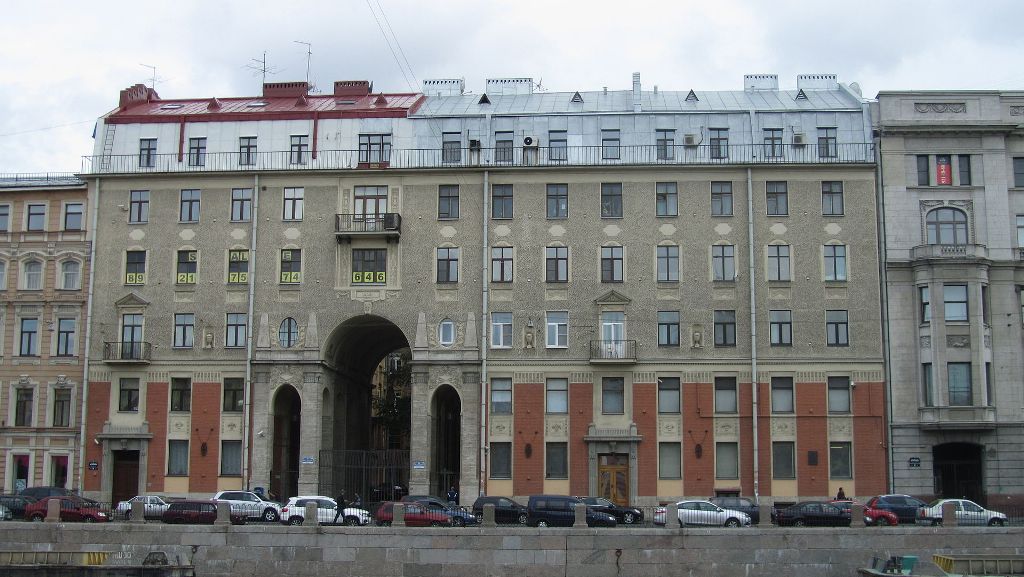
PHOTO: Tolstoy House, one of the residences
of Alexander Spiridovitch in St. Petersburg
At the beginning of 1906, Alexander was seconded to the palace commandant Dmitri Feodorovich Trepov[3] (1850-1906) and appointed head of the palace Security Agency. In 1907, he organized the protection of Emperor Nicholas II and his Family during a trip to the Finnish skerries. For distinction in service, Alexander Spiridovitch was promoted to colonel.
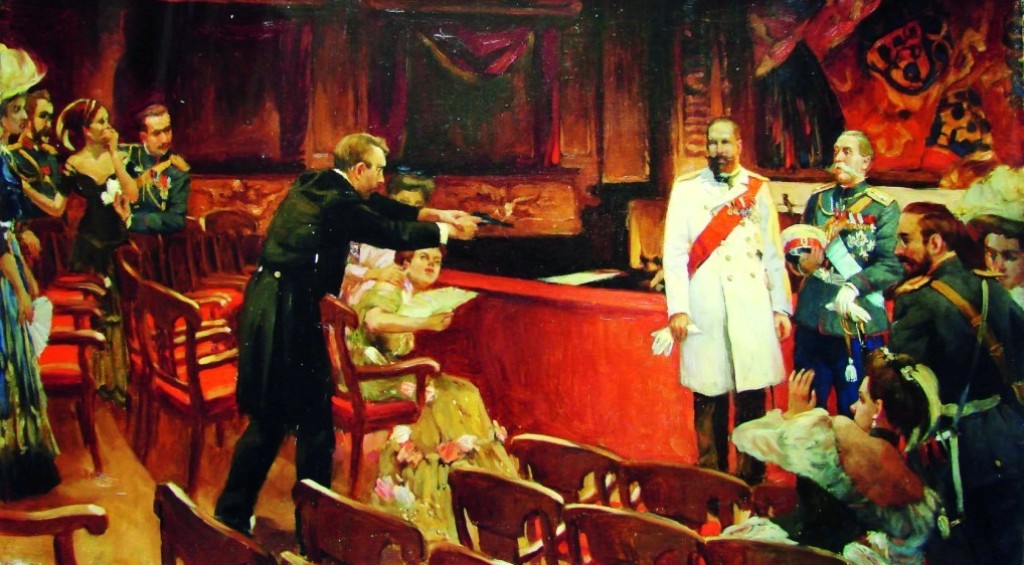
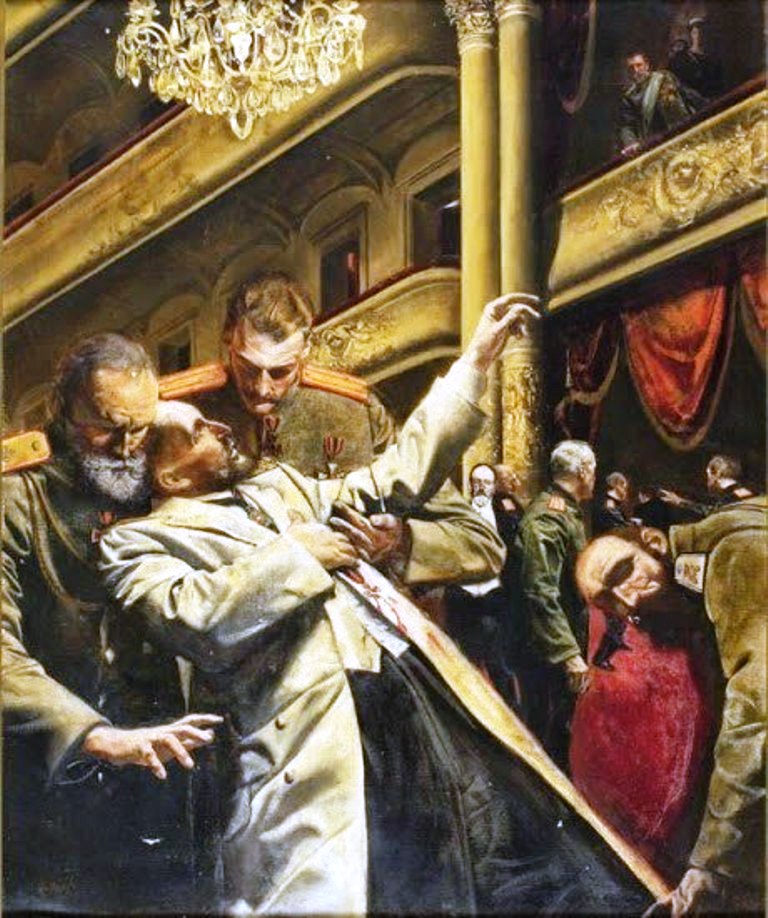
After the assassination of Prime Minister Pyotr Stolypin in 1911, Spiridovitch was involved in the investigation on charges of not taking measures to protect the chairman of the Council of Ministers, and, although his career was considered already over, he did not lose the trust of Nicholas II and was not relieved of his post. In 1913, the criminal case was terminated by the personal order of Nicholas II.
During the First World War, Alexander accompanied Nicholas II on all trips. In 1915, he was promoted to major general for distinguished service. He organized the protection of Nicholas II at the Headquarters of the Supreme Commander-in-Chief at Mogilev. On 15th August 1916, Alexander Spiridovitch was appointed mayor of Yalta in Crimea.
During the February 1917 Revolution, Spiridovitch arrived in Petrograd [4], where he was arrested by the Provisional Government, held in the Peter and Paul Fortress and interrogated by the Extraordinary Investigation Commission. In early October 1917, he was released from prison on bail in October.
In 1920 he emigrated to France. He was a member of the Russian Monarchist Party in Paris. In 1926, he participated as a delegate from France in the Russian Congress Abroad. While living in emigration, he gave numerous public lectures on the history of the Russian revolutionary movement and the struggle against it, as well as lectures on Emperor Nicholas II and his family.
During his years in exile, Alexander Spiridovitch published several books on these topics and his own memoirs, including Les Derniers années de la cour de Tsarskoïe Selo, Paris, Payot, 1928; Histoire du terrorisme russe, 1886-1917, Paris, Payot, 1930 and Raspoutine 1863-1916, Paris, 1936.
In 1950, at a meeting with the American Sovietologist Isaac Don Levine (1892-1981), he recognized as authentic a document proving that Joseph Stalin (1878-1953) was an agent of the Tsarist police.
In 1950, Spiridovitch moved to the United States, where he died in 1952 at the age of 78. He was buried at the Novo-Diveevo Cemetery – the largest the largest Russian Orthodox cemetery outside of Russia, situated in Rockland County, New York. His personal archives are today in the collection of Yale University.
NOTES
[1] Zubatov committed suicide during the February Revolution of March 1917 after hearing the news of the Emperor’s abdication.
[2] Grigory Andreyevich Gershuni (1870-1908) was a Russian revolutionary and one of the founders of the Socialist-Revolutionary Party. In February 1904, Gershuni was tried by a military court in St Petersburg and received a death sentence, which later was reduced to life imprisonment at a hard labour camp by Tsar Nicholas II.
[3] Trepov was Head of the Moscow police, Governor-General of St. Petersburg with extraordinary powers, and Assistant Interior Minister with full control of the police. His attempts to restore order were overwhelmed by the revolution of 1905; he retained influence with Nicholas II, when appointed as the Commandant of the Imperial Palace.
[4] In Petrograd [St. Petersburg] Spiridovitch lived in the Tolstoy House at 15-17 Troitskaya Street (now Rubinstein Street) and at 54 Fontanka Embankment in apartment 333
***
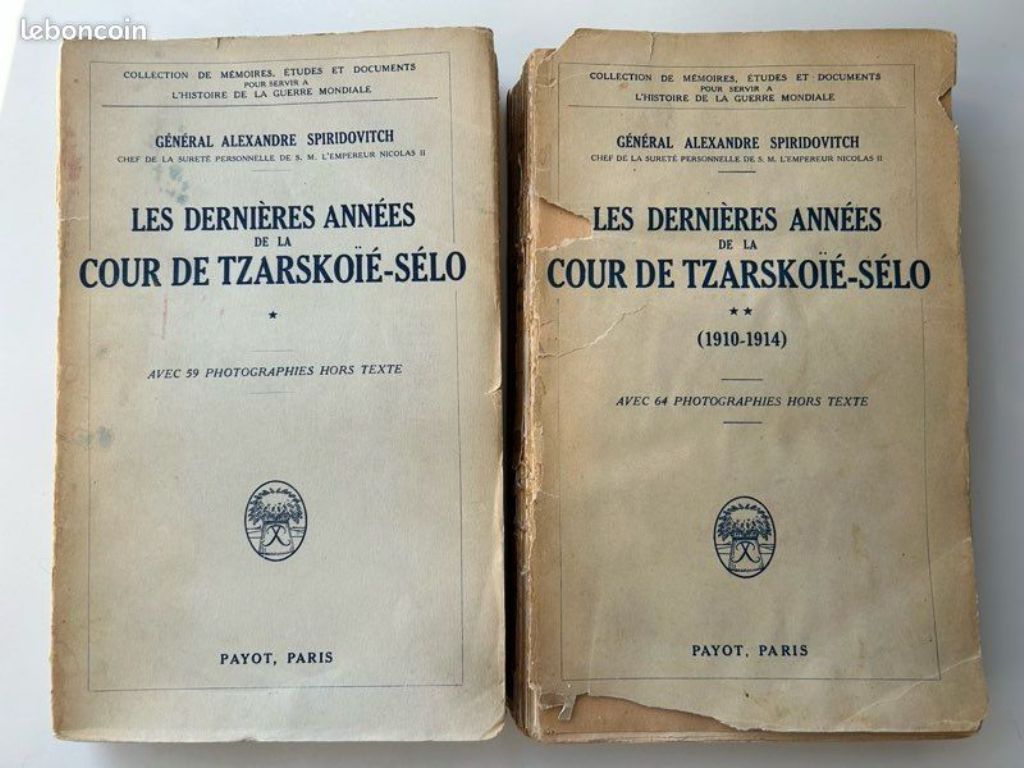
PHOTO: the first French language editions of Alexander
Spiridovitch’s memoirs, published by Payot Paris
LAST YEARS OF THE COURT AT TSARSKOE SELO – 2 Volumes
by Alexander Spiridovitch
BOOK DESCRIPTION
Originally published in French in 1928, this is the FIRST ENGLISH LANGUAGE EDITION of both volumes – a MUST read for any one interested in the life and reign of Emperor Nicholas II.
Alexander Ivanovich Spiridovitch (1873-1952) was handpicked by Emperor Nicholas II to serve as his personal security chief from 1906-1916. He was also responsible for the security of the tsar’s residences.
His memoirs offer a rare eye-witness glimpse into the private world of the last tsar and his family and their day to day life. Thanks to his eye for detail, he Alexander Palace and Livadia Palace in detail, the Imperial yacht Standart and journeys through the Finnish fjords and to Livadia in the Crimea.
Spiridovitch writes candidly about his impressions of Emperor Nicholas II and family, as well as the grand dukes and grand duchesses. He also writes about his investigation of Grigorii Rasputin.
Spiridovitch and his men were highly recognized for their counter-terrorist work. His memoirs reveal the numerous plots to assassinate Nicholas II and other members of the Imperial family by terrorist groups working within Russia.
Spiridovitch was a pillar of honesty and trust, articulate, and intelligent, loyal to God, the Tsar and Mother Russia. He was truly a gentleman beyond reproach. His memoirs offer one of the most honest accounts of the character and personality of Tsar Nicholas II and life at the Russian Imperial Court in its twilight years.
*You can order this title from most AMAZON outlets, including
the United States, United Kingdom, Ireland, Canada, Australia,
France, Germany, Spain, Italy, Netherlands, Belgium, Poland, Sweden,
Brazil, Mexico and Japan
*Note: prices are quoted in local currencies
***
CLICK ON THE LINKS BELOW TO ORDER FROM AMAZON
LAST YEARS OF THE COURT AT TSARSKOE SELO
Volume 1
1906-1910
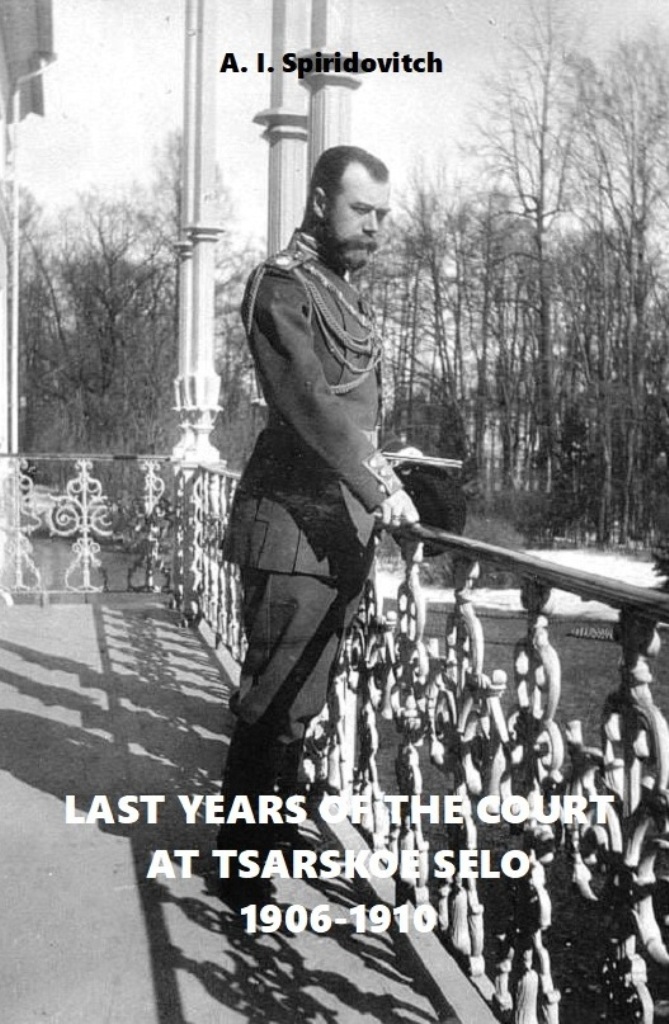
Volume I – 1906-1910, with 458 pages + 59 black & white photographs
CLICK HERE TO ORDER THE HARD COVER EDITION – PRICE $30.00
CLICK HERE TO ORDER THE PAPERBACK EDITION – PRICE $25.00
***
LAST YEARS OF THE COURT AT TSARSKOE SELO
Volume 2
1910-1914
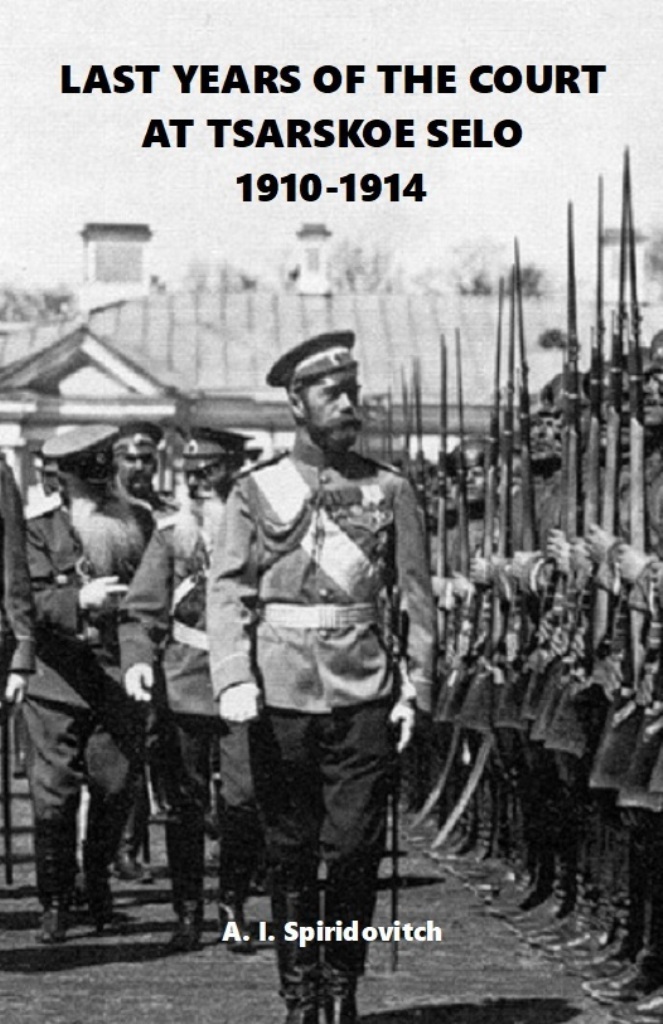
Volume II – 1910-1914, with 480 pages + 65 black & white photographs
CLICK HERE TO ORDER THE HARD COVER EDITION – PRICE $30.00
CLICK HERE TO ORDER THE PAPERBACK EDITION – PRICE $25.00
OTHER PUBLICATIONS
The third volume of Alexander Spiridovitch’s memoirs cover the years 1914-1916. This book is only available in French and Russian.
In 1935, Spiridovitch also published a book about Grigorii Rasputin (1863-1916): from Russian documents and the author’s private archives » (published in 1935). It is a detailed biography based on his direct knowledge of the Russian Imperial Court. This book is only available in French and Russian.
© Paul Gilbert. 9 May 2026


You must be logged in to post a comment.