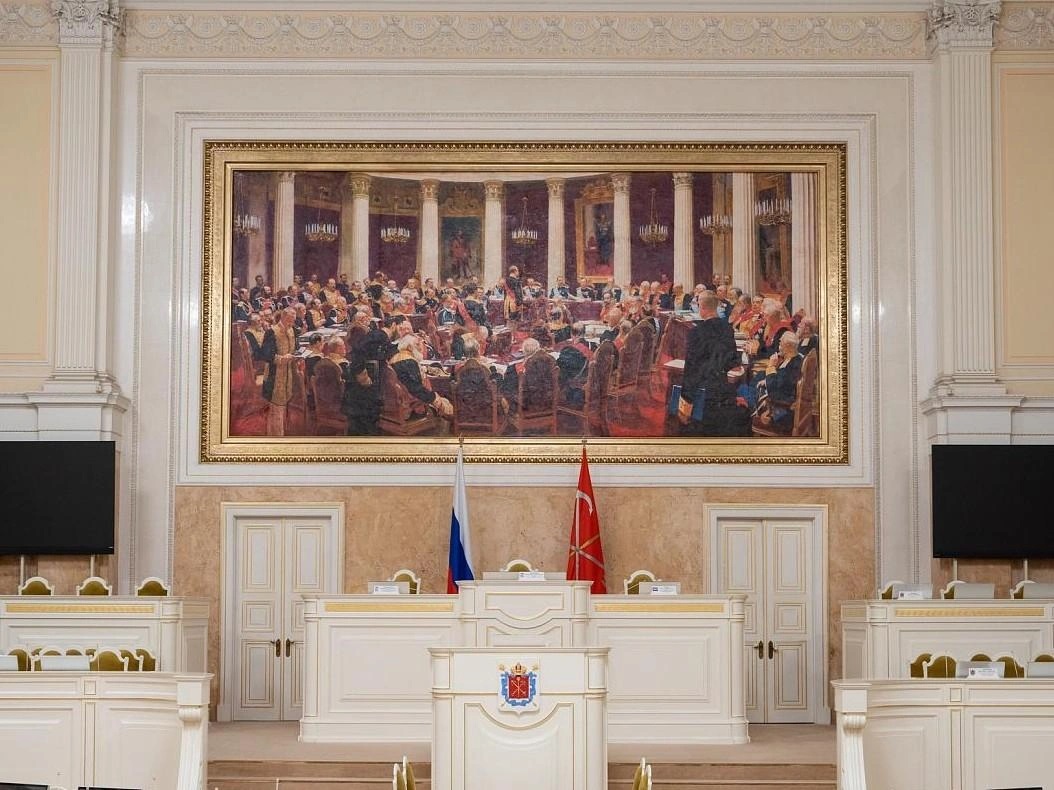
PHOTOS: in December 2024, a copy of “The Ceremonial Meeting Of The State Council 7 May 1901” by Ilya Repin, was installed in the Great Hall of the Mariinsky Palace in St. Petersburg
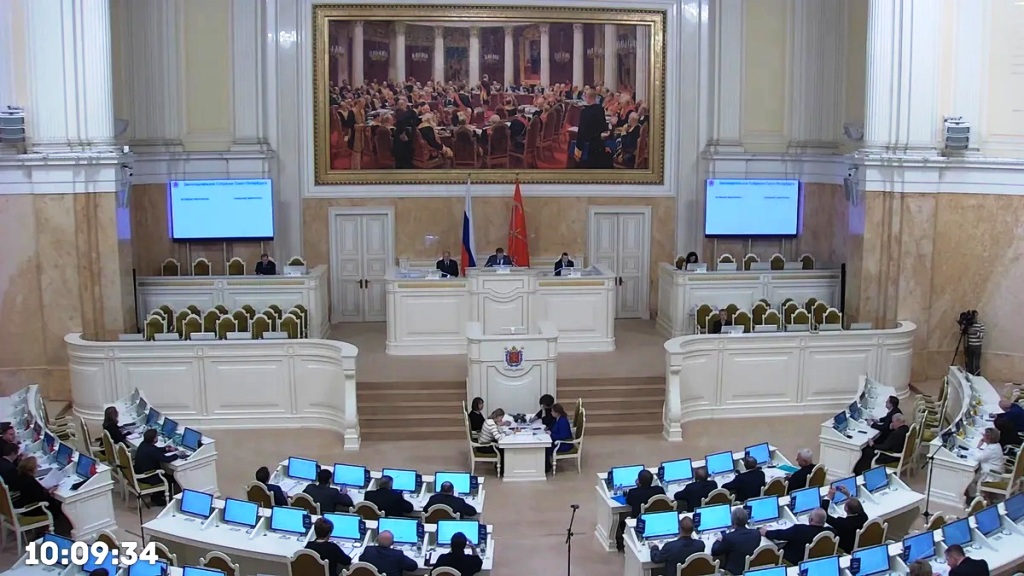
One of the most iconic paintings which reflects the splendour of the Russian Empire has to be “The Ceremonial Meeting Of The State Council 7 May 1901”, by Ilya Yefimovich Repin (1844-1930). A copy of the great Russian artist’s masterpiece was recently installed in the Great Hall of the Mariinsky Palace in St. Petersburg. The palace has been the site of the Legislative Assembly of Saint Petersburg since 1994.
An exact copy of Repin’s painting was a gift from the St. Petersburg artist Oleg Lukyanov for the 30th anniversary of the city parliament. “We thank Oleg Lukyanov, and the director of the State Russian Museum Alla Manilova for this wonderful gift,” said Speaker Alexander Belsky at the opening of the legislature on 4th December 2024.
The chairman of the Legislative Assembly also noted that specialists worked on the painting for more than two months, while the final touches took an additional six days. An exact copy of the canvas is made in the technique of “urban fresco”, which makes it possible to achieve full compliance with the original painting.
Ilya Repin’s masterpiece was first presented to the public in St. Petersburg on 4th January 1904. The painting depicts Emperor Nicholas II and members of the State Council after the emperor read out a charter in honour of the centenary of the establishment of the Indispensable Council (the predecessor of the State Council).
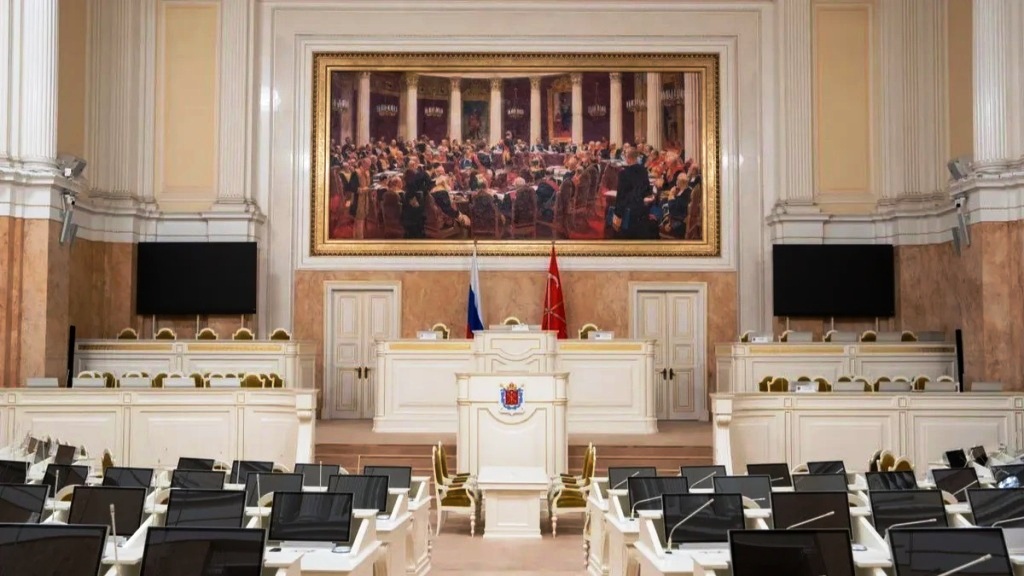
PHOTOS: two views of copy of “The Ceremonial Meeting Of The State Council 7 May 1901” by Ilya Repin, was installed in the Great Hall of the Mariinsky Palace, in St. Petersburg
***
A brief history of Repin’s masterpiece
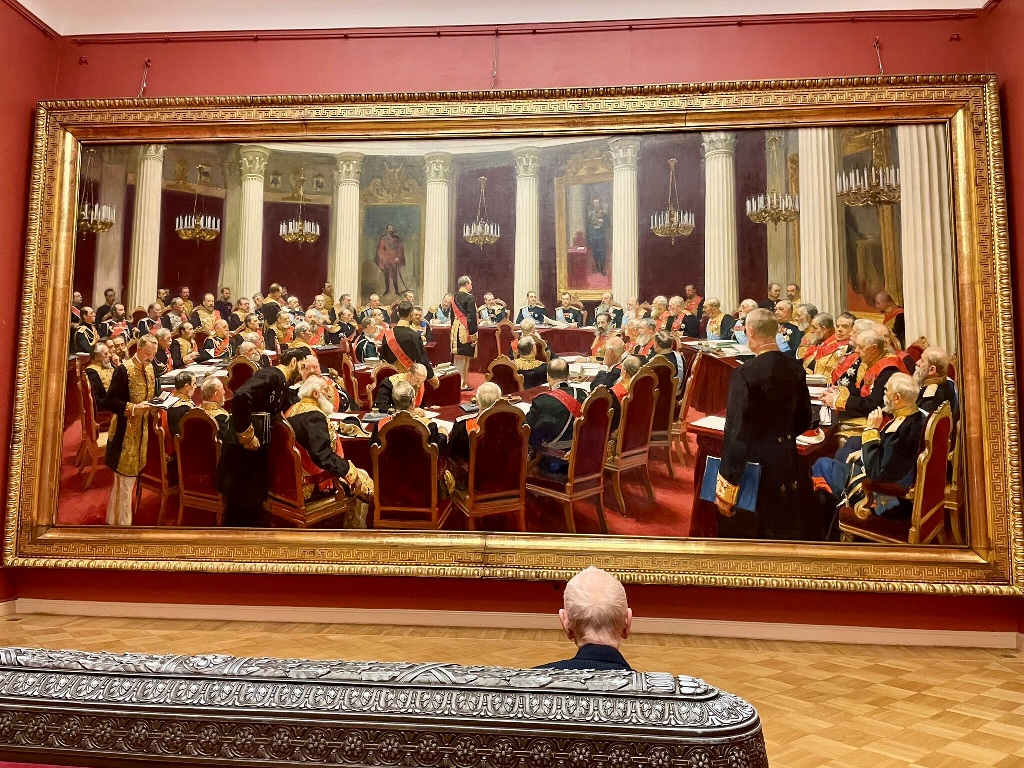
PHOTO: the original “The Ceremonial Meeting Of The State Council 7 May 1901” by Ilya Repin, today hangs in the State Russian Museum in St. Petersburg. The canvas is so large, that it takes up an entire wall, in a hall dedicated to Repin’s masterpiece.
The original “The Ceremonial Meeting Of The State Council 7 May 1901” by Ilya Repin, has been in the collection of the State Russian Museum since 1938. The canvas is so large, that it takes up an entire wall, in a hall dedicated to Repin’s masterpiece.
It is among the most significant and largest paintings from the collection of the State Russian Museum: the large-format canvas measuring 4 by 8 meters [ 13 ft. by 26 ft.].
Painted under a state order, the painting truly conveys the splendor of the Russian Empire. More than a century ago, the political and bureaucratic elite in uniforms attend a solemn meeting in the Round Hall of the Mariinsky Palace. Secretaries are carrying anniversary medals, the future Minister of Internal Affairs Vyacheslav Plehve is standing in front of Tsar Nicholas II, who has finished reading a charter on the occasion of his 100th anniversary. The canvas was created specifically for the Mariinsky Palace, where meetings of the State Council were held.
“The Ceremonial Meeting Of The State Council 7 May 1901” is a collective portrait featuring no less than 81 figures. It was painted one hundred and twenty one years ago (1903), in which Repin was paid a large fee. The customer of the canvas, Emperor Nicholas II, was pleased with the result.
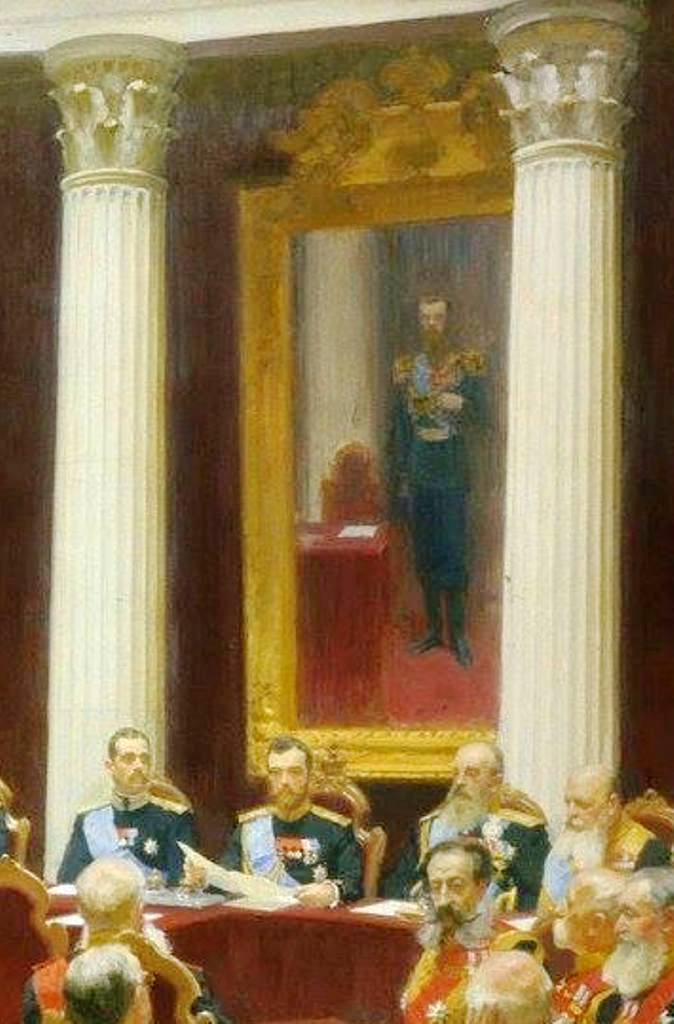
PHOTO: detail from Repin’s painting, which shows Emperor Nicholas II seated between two pillars, under a ceremonial portrait of himself – also by Ilya Repin – painted in 1895. His brother Grand Duke Mikhail Alexandrovich is seated to his right, and Grand Duke Mikhail Nikolayevich (1832-1909), who served as Chairman of the State Council, from 1881 to 1905, is seated to his left.
Founded in 1801 by Emperor Alexander I (1777-1825), the State Council celebrated its centenary with a ceremonial sitting in the Round Hall of the Mariinsky Palace in St. Petersburg on 7th May 1901. All the members of the State Council and the State Chancellery attended in full-dress uniform. Emperor Nicholas II and senior members of the Imperial Family are flanked by their ministers. Repin painted the scene from behind the chairs on the right (next to the columns.
He rapidly sketched the original modello on a canvas on which the perspective of the hall had already been marked out, working from a previously selected point. The artist later turned this study into a large picture with the help of two students from the Imperial Academy of Arts: Boris Kustodiev (1878-1927) and Ivan Kulikov (1875-1941). Every member of the State Council is depicted in natural and diverse poses, with strong physical resemblances.
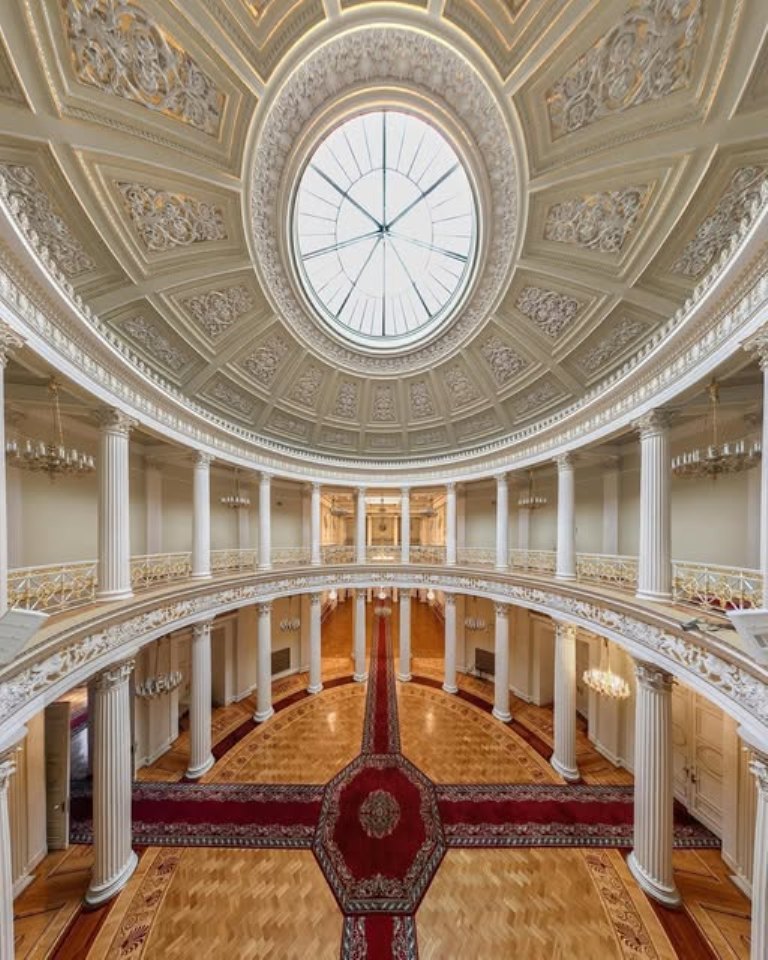
PHOTO: the Round Hall in the Mariinsky Palace, as it looks today
***
Ilya Yefimovich Repin (1844-1930)
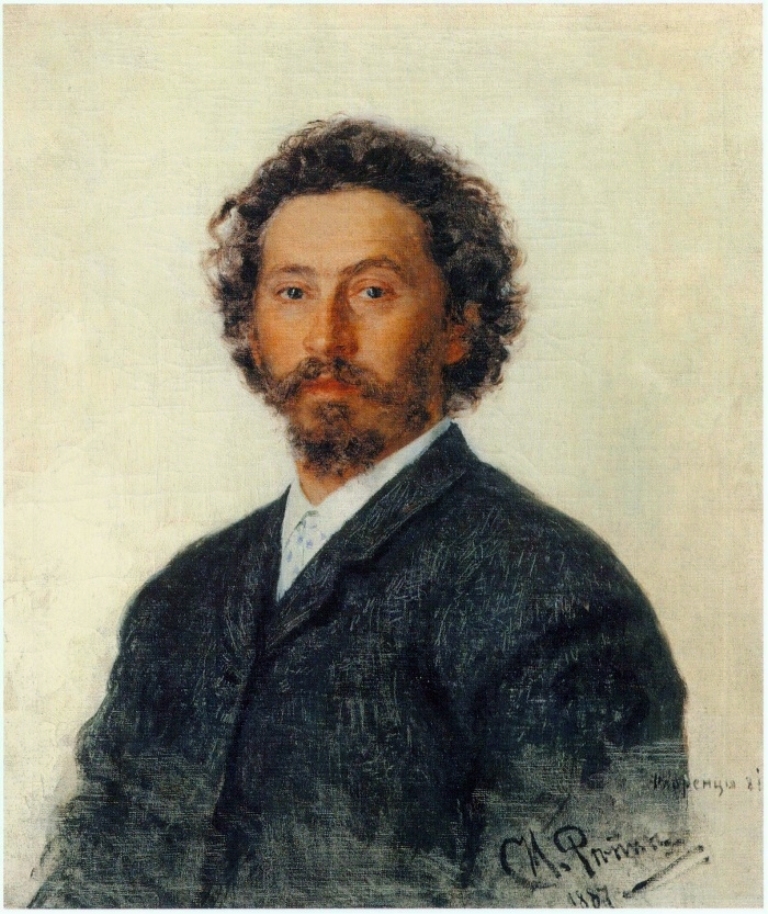
Self-portrait (1887
From the Collection of the State Tretyakov Gallery (Moscow)
Ilya Yefimovich Repin (1844-1930) was a Ukrainian-born Russian painter. He became one of the most renowned artists in Russia in the late 19th to early 20th centuries. His works can be seen today in some of Russia’s most famous museums, including the Tretayakov Gallery in Moscow, the State Russian Museum in St. Petersburg, and the artist’s country estate of Penates, near St. Petersburg, among many others.
Following the ascension of Nicholas II to the throne in 1894, Repin painted a number of ceremonial portraits of the new Emperor. One of these, painted especially for the State Duma in 1905, was lost (among many others) following the February and October 1917 Revolutions.
It is interesting to note that Repin, who was an anti-monarchist, didn’t seem to mind being paid handsomely for the numerous ceremonial portraits and other commissioned paintings by Emperor Nicholas II. One of his most famous works, is The Wedding of Nicholas II and Alexandra Feodorovna (1894), which today hangs in the State Hermitage Museum in St. Petersburg.
Repin warmly welcomed the February 1917 Revolution, which overthrew the autocratic monarchy and proclaimed a republic, an event for which he was very happy. Shortly after the October Revolution of 1917, Repin would regret his support of the overthrow of the monarchy. After Lenin and the Bolsheviks launched the first Red Terror, Repin abruptly changed the bias of his work from anti-monarchist to anti-Bolshevik.
Repin died on 29th September 1930, at the age of 86, and was buried at his country estate Penates, in Kuokkala, now Repino, St Petersburg. His home is now a museum and a UNESCO World Heritage Site.
© Paul Gilbert. 8 December 2024
 Nicholas II
You must be logged in to post a comment.