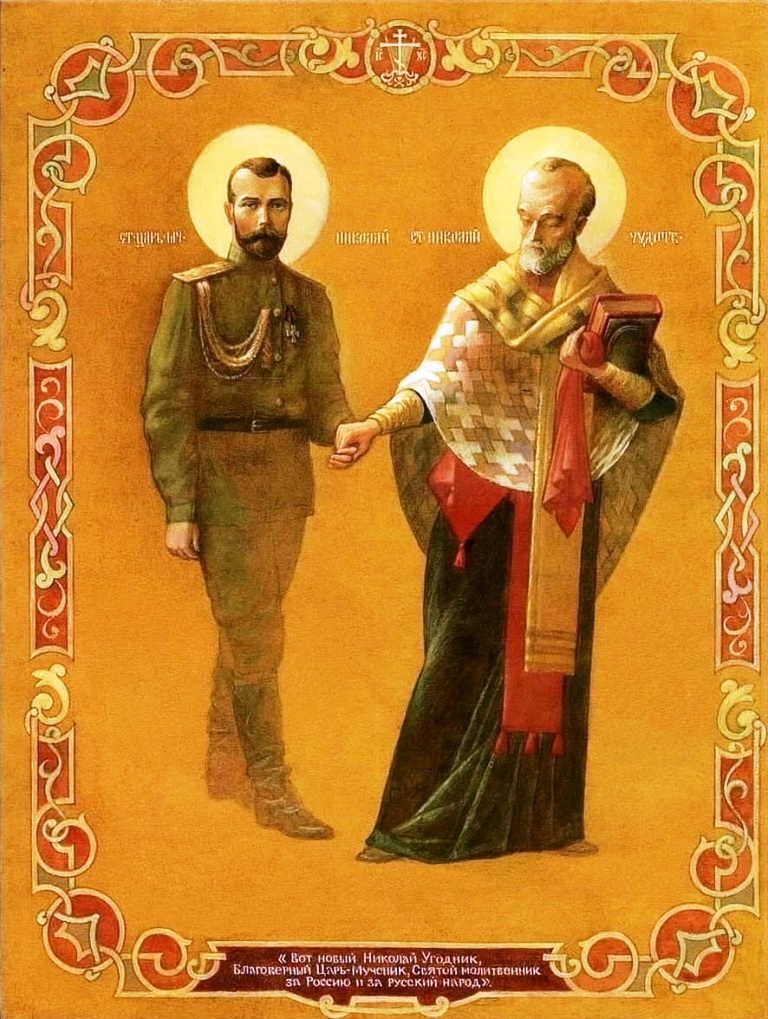
PHOTO: contemporary icon depicting the Holy Tsar-Martyr Nicholas II and Saint Nicholas of Myra – aka Nicholas the Wonderworker (born 270- died 343 A.D.)
Today – 19th (O.S. 6th) December – the Russian Orthodox Church celebrates the name day of Emperor Nicholas II. The Tsar’s patron saint is Saint Nicholas of Myra – aka Nicholas the Wonderworker (born 270- died 343 A.D.).
Upon his birth on 19th (O.S. 6th) May 1896, the future Emperor and Tsar of Russia received the traditional Romanov name – “Nikolai” (Nicholas). His name can be attributed to “naming a male after an uncle” (a custom which dates from the Rurik dynasty), in which Nicholas was named in memory of his father’s elder brother and mother’s fiancé, Tsesarevich Nikolai Alexandrovich (1843-1865), who died at the age of 21. The names, patronymics, and namesake saints of the Tsesareviches themselves (Nicholas of Myra) and their fathers (Alexander Nevsky) coincided. The Holy Tsar-martyr Nicholas II’s name day is marked on 6th December according to the Old Style Julian calendar, the day on which St. Nicholas the Wonderworker died.
Nicholas the Wonderworker was a Christian saint, Archbishop of Myra in Lycia (Byzantium). He is revered as a miracle worker, considered the patron saint of sailors, merchants and children.
A patron saint is a person who has special meaning, and is often represented in pictures, icons, or statues. Most Orthodox Christians have a patron saint, and they usually receive this saint on the day of their baptism.
Russians celebrate name days separately from birthdays. Celebrations range from the gifting of cards and flowers to full-blown celebrations similar to birthday parties. Such a celebration begins with attendance at the divine services marking that day (in the Russian tradition, the All-Night Vigil and Divine Liturgy), and usually with a festive party thereafter. The Russian Imperial Family followed the tradition of giving name day gifts.
Before the October Revolution of 1917, Russians regarded name days as important as, or more important than, the celebration of birthdays, based on the rationale that one’s baptism is the event by which people become “born anew” in Christ. 
Nicholas II took particular joy in celebrating his name day, and recorded his memories in his diary . . .
From the diary of Emperor Nicholas II of 19th (O.S. 6th) December 1915:
“Sunday. It was strange and pleasant to spend my name day at home! We attended mass. The whole family arrived for breakfast; We sat in the small library at three tables. Then we went to Alexei and sat with him…”
From the diary of Emperor Nicholas II of 19th (O.S. 6th) December 1916:
“We got up early and in the morning the congratulations began. Walking back from the church, I greeted the units that celebrate their holidays today. The report, under Shuvaev, was short. A lot of people were eating breakfast. I received gifts from Alix and the children…”
From the diary of Emperor Nicholas II of 19th (O.S. 6th) December 1917:
“My name day was spent calmly and not following the example of previous years. A moleben [prayer service] was served at 12 o’clock. The soldiers of the 4th regiment in the garden, who were on guard, all congratulated me, and I congratulated them on their regimental holiday. I received three pies and sent one of them to the guard.” [The Imperial Family were living under house arrest in Tobolsk at the time, it would be Nicholas’s last name day – Ed.]
In 1885, the future Emperor Nicholas II], was presented with an unusual icon of his heavenly patron St. Nicholas the Wonderworker. The icon was painted by Grigory Zhuravlev, who had no arms or legs, but used his teeth to paint the image.
For decades the icon sat hidden away in the vast funds of the State Hermitage Museum in St. Petersburg. In recent years, the provenance of the icon was discovered in 2023, thanks to the help of a local historian, Alexander Malinovskiy.
© Paul Gilbert. 19 December 2024
 Nicholas II
You must be logged in to post a comment.