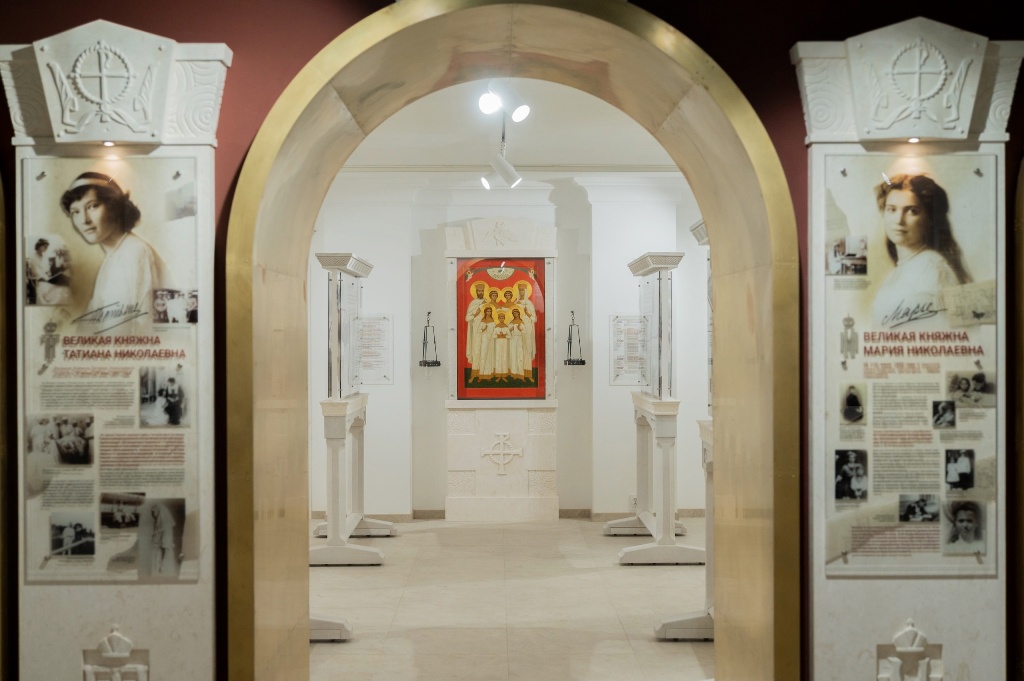
PHOTO: entrance to the exhibition which takes up the entire ground floor of the
recently constructed Church of the Holy Royal Passion-Bearers in Dno
On 26th December 2024, a new museum dedicated to Emperor Nicholas II and his family was officially opened and consecrated in the Church of the Holy Royal Passion-Bearers in the Russian city of Dno, situated 114 km from Pskov.
Recall that on the same day, a new monument to the Holy Royal Passion-Bearers was unveiled and consecrated on the grounds of the church.
Metropolitan Matthew of Pskov and Porkhov performed the rite of consecration of the museum to the Royal Passion-Bearers. The museum takes up the entire ground floor of the church. Admission to the museum is FREE to all!
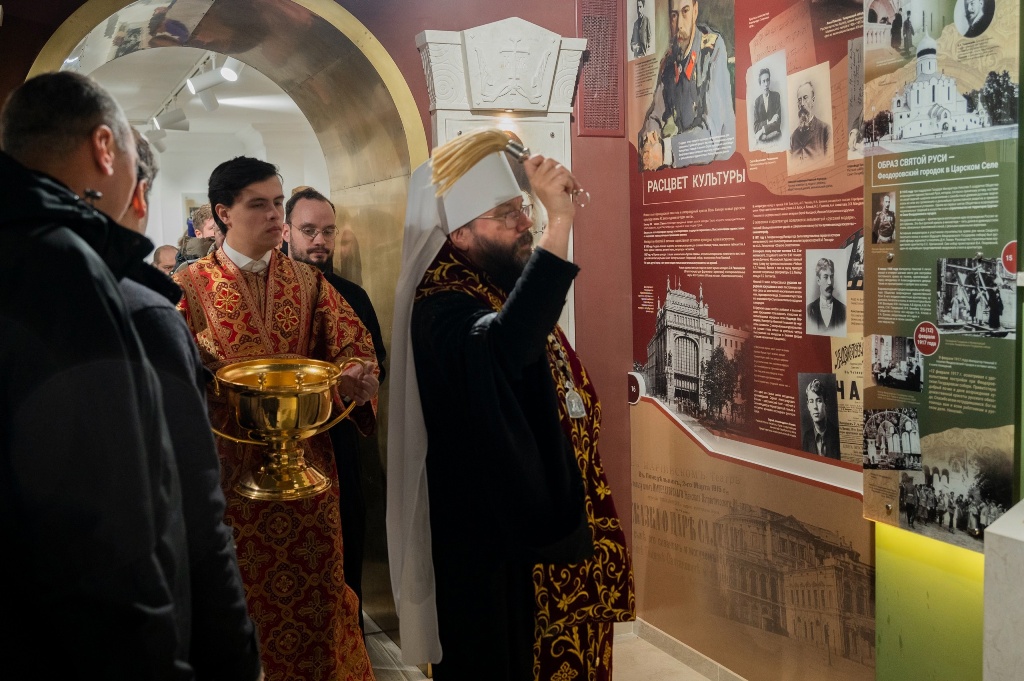
PHOTO: His Eminance performs the rite of consecration of the museum to the Royal Passion-Bearers
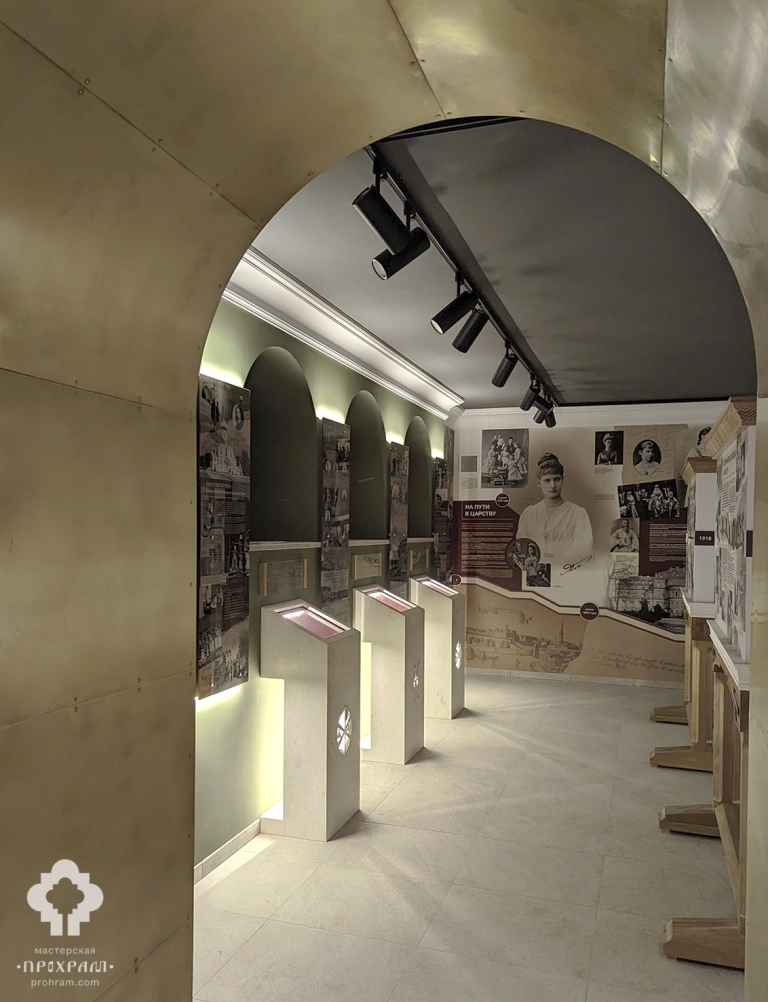
The interiors of the museum are a wonderful example of modern exhibition spaces, designed in the Neo-Russian Style [aka the Russian Revival Style], characteristic of the early twentieth century and beloved by Russia’s last Tsar.
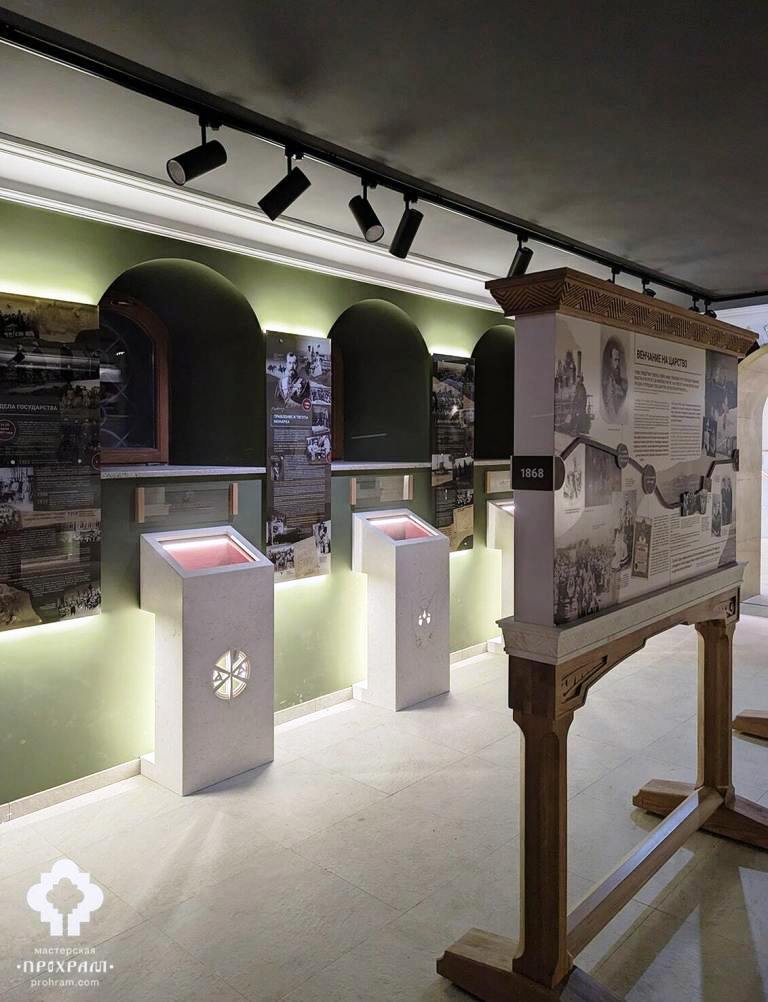
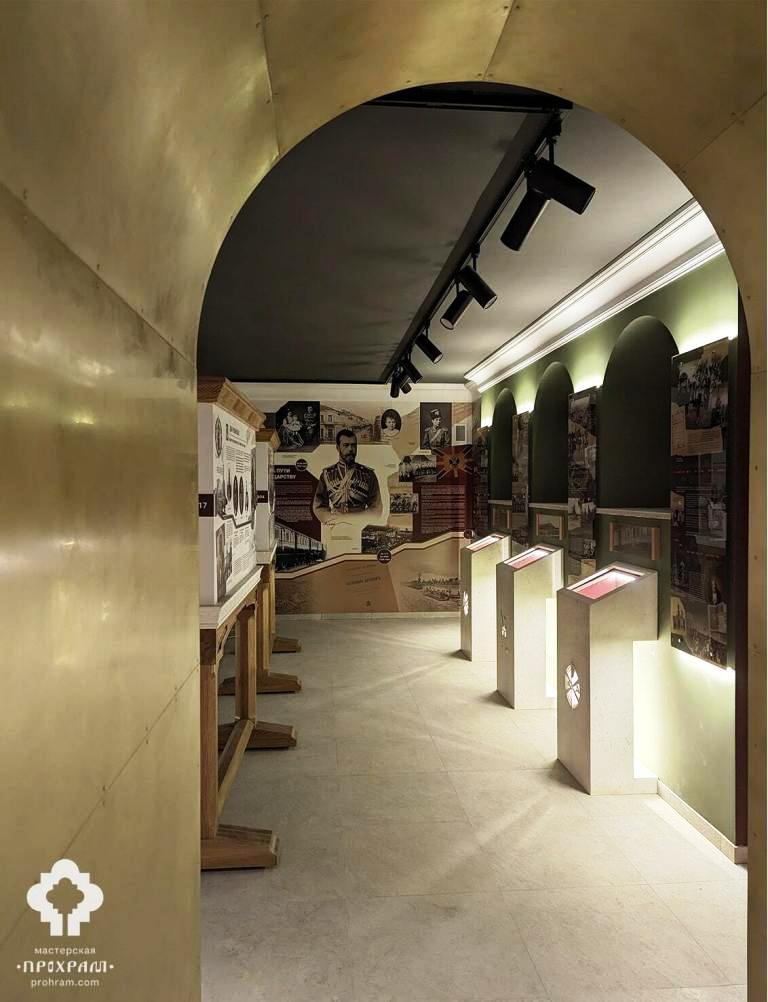
The museum is divided into two halls. The first hall, which is painted burgundy-green, combined with dim lighting. Burgundy is the colour of the Imperial Porphyry, green is the colour of the monk. In this hall, the exposition explores the life of the Imperial Family from Emperor Nicholas II’s and Empress Alexandra Feodorovna’s childhood to the tragic vents of 1917. Two stands describe the history of the House of Romanov – from the calling to the throne of Mikhail Feodorovich in 1613 and to the death and martyrdom of Nicholas II 305 years later.
Archival photographs and documentary materials, diary entries, testimonies of contemporaries, statements by prominent public and church figures reveal in detail the life of the Imperial Family. They tell about their service to Russia, their close family relations, and the historical context of the events of the late 19th and early 20th centuries. In addition, the exposition explores the cultural, scientific, and political life of the Russian Empire during the era of Nicholas II.
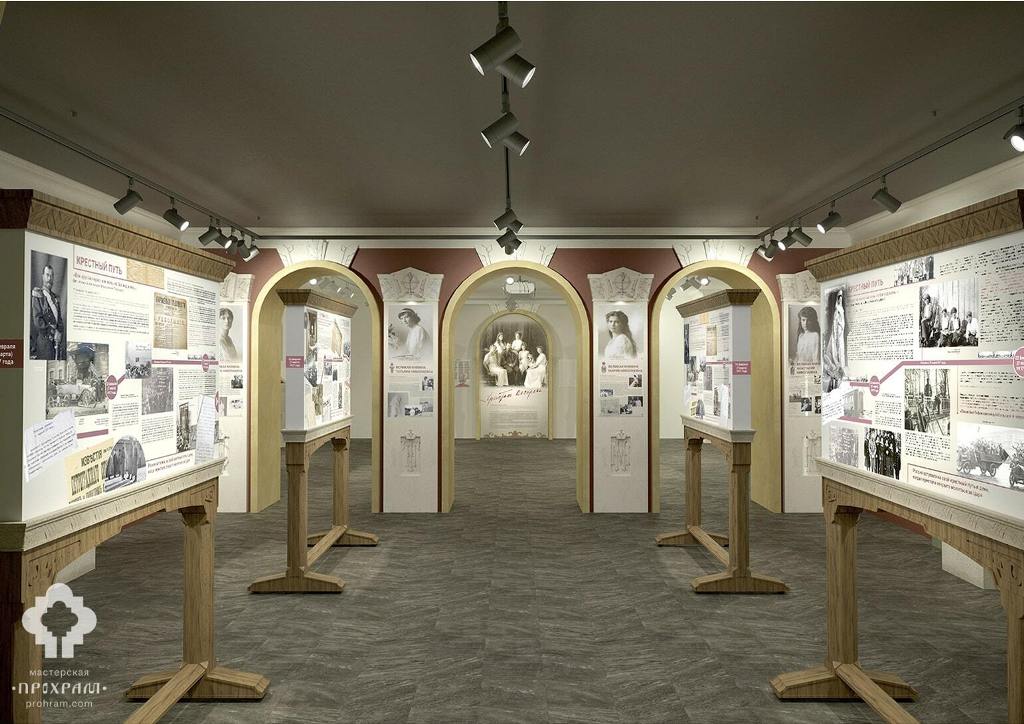
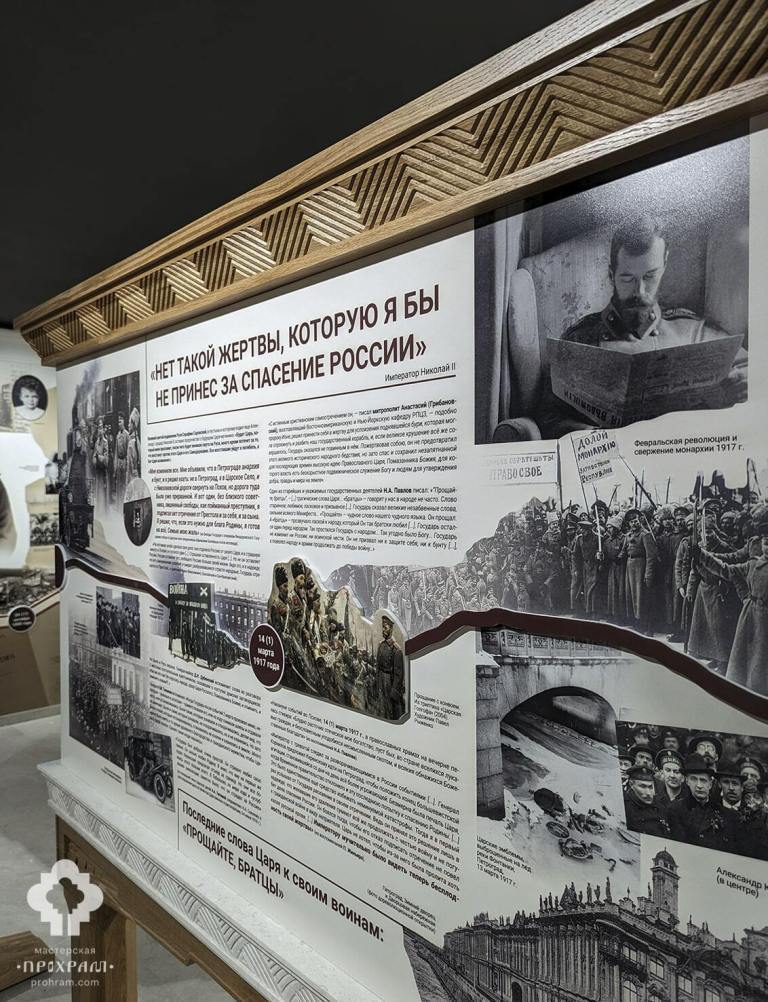
PHOTOS: four double-sided mobile stands display documents and
photos which explore the life of Emperor Nicholas II and his family
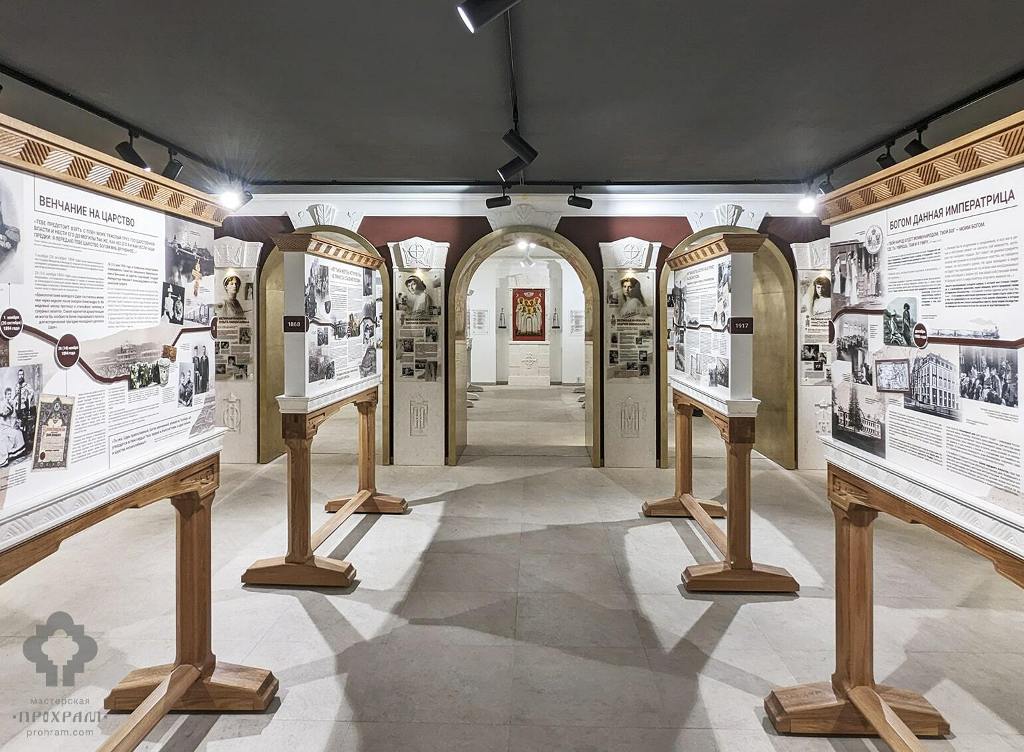
The photographs and documents are displayed on four double-sided mobile stands on small wheels with stoppers. At the northern and southern walls there are carved white-stone lecterns with carvings, under which relics of the era of Emperor Nicholas II are placed. In the eastern part of the hall there is a passage through three brass decorative arches which leads to the White Hall. Between the arches, there are four kiot stands made of white stone with carvings (initials), glass, lighting and a carved finial, dedicated to the Grand Duchesses Olga, Tatiana, Maria and Anastasia Nikolaevna. The ceiling is dark, with diffused and directional track lighting.
In the White Hall there is information about the Way of the Cross of the Imperial Family – the period from the events at the Dno station, the Tsar’s abdicated in March 1917, to the murder of Nicholas II and his entire family on 17th July 1918 in Ekaterinburg and the subsequent history of the veneration and glorification of the Imperial Family as saints. Extensive textual and illustrative material makes it possible to speculatively walk this path together with the Royal Passion-Bearers, to come into spiritual contact with the last year of their lives, to see the light of the Paschal victory in the darkness of the Ipatiev House.
CLICK on the photos below to enlarge and see in greater detail . . .
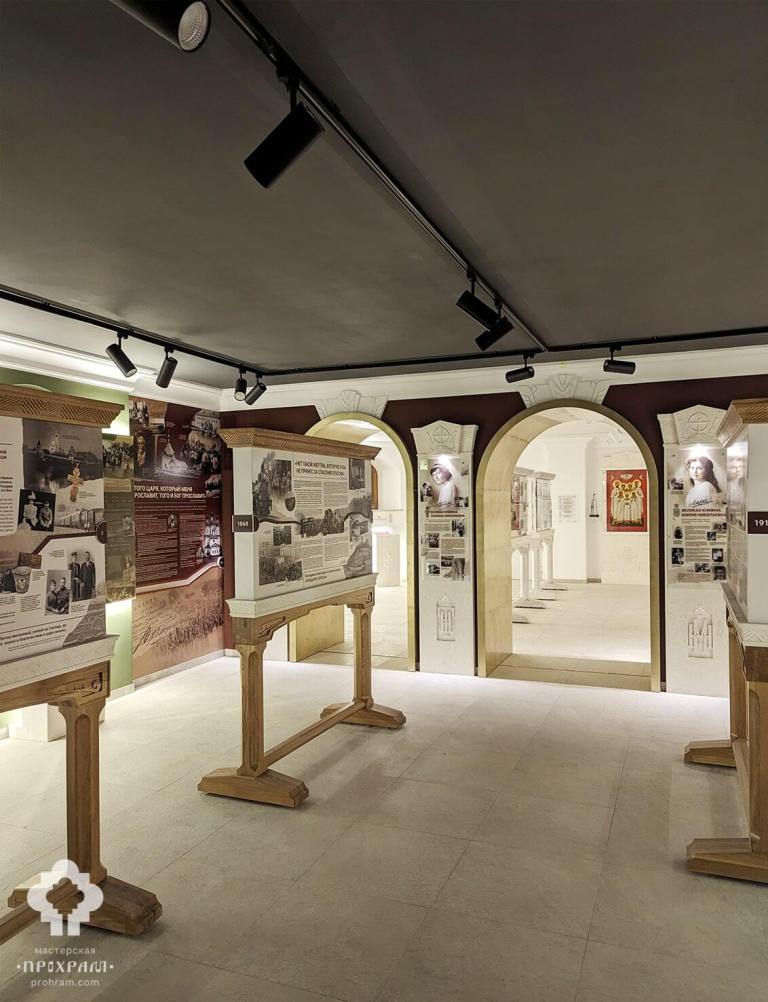
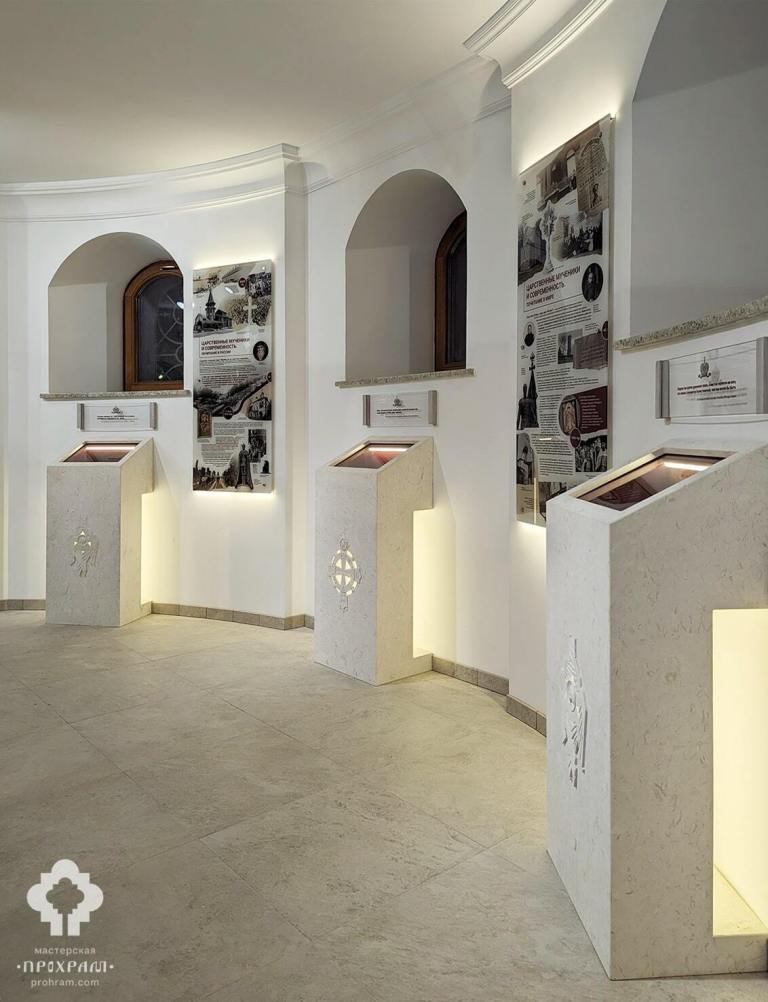
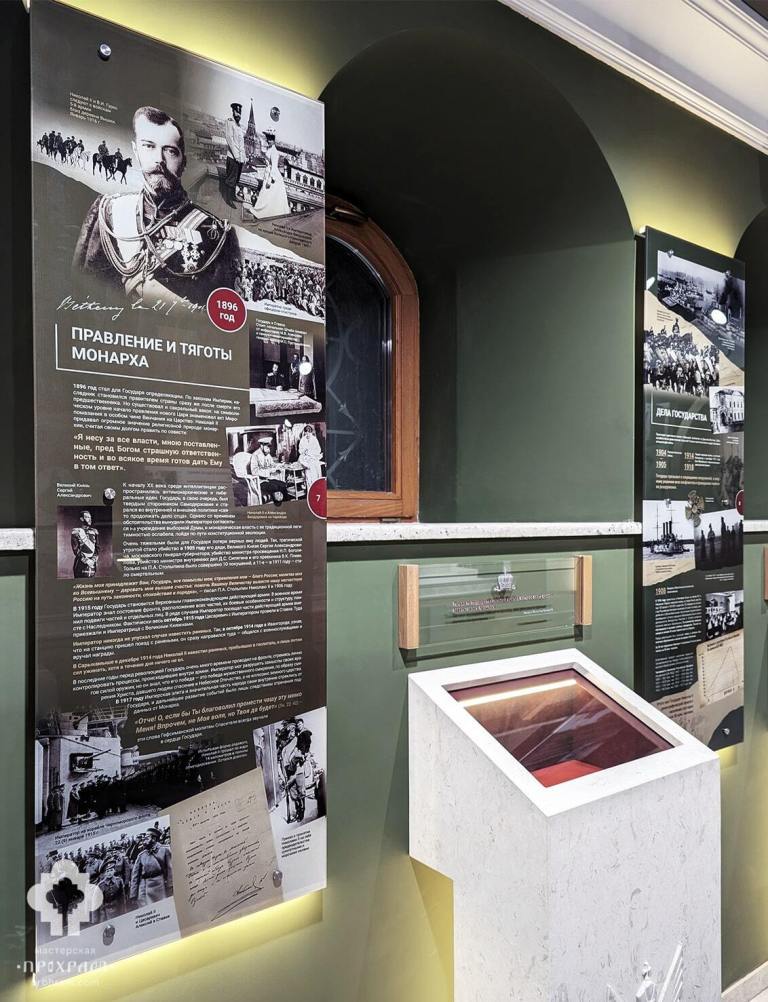
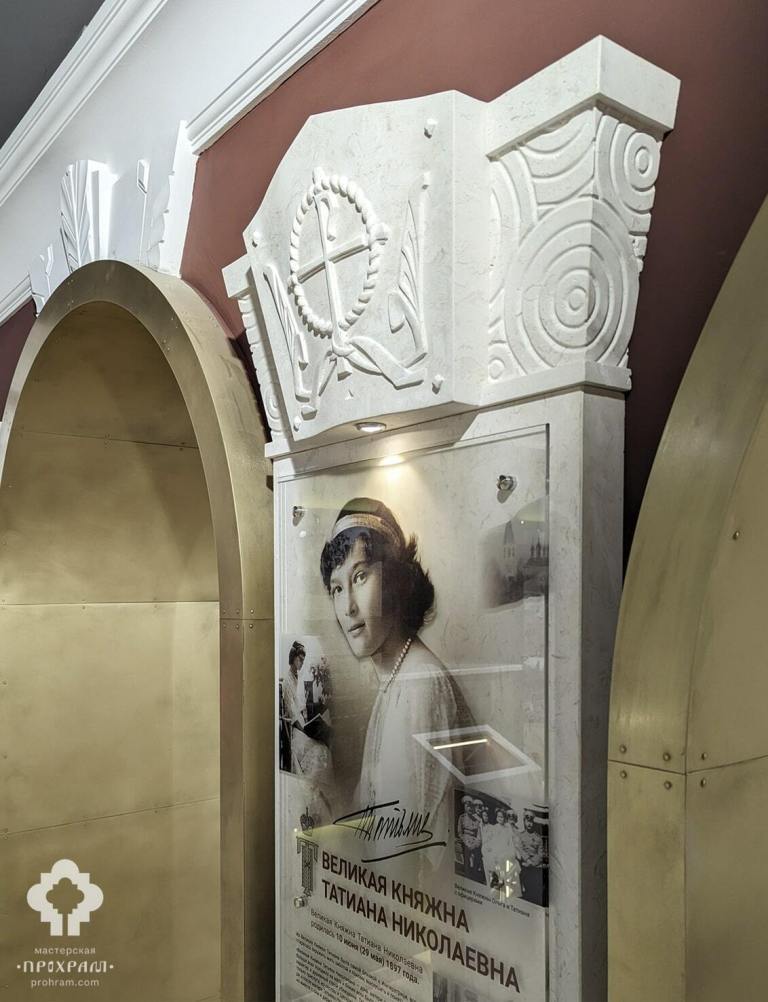
Also in the White Hall there are stands dedicated to the faithful retainers, who voluntarily followed the Imperial Family into exile and shared their sufferings, showing an example of loyalty to duty; stands dedicated to the Grand Duke Sergei Alexandrovich, the Venerable Martyr Grand Duchess Elizabeth Feodorovna, the Alapaevsk Martyrs, who were murdered by the Bolsheviks the day after the Imperial Family; two kiot stands dedicated to Tsesarevich Alexei Nikolaevich; and stands dedicated to the memory, glorification and modern veneration of the Holy Royal Martyrs.
The hall is crowned by a large carved icon case with an icon of the Royal Martyrs, visible from the very entrance to the burgundy-green hall. The saints are depicted in white robes with a reference to the apocalyptic image of martyrs overcoming earthly sufferings and faithful to Christ (Revelations 6:9-12).
The White Hall is also used as a venue for small gatherings. The 4 white stands can be rrolled to the sides, thereby freeing up the central space of the hall. Attached to the ceiling in this room is a screen that can be opened in the eastern part of the hall, with a projector at the entrance to the burgundy-green hall. Folding chairs which are stored in the adjoining utility room, provide for guests attending lectures, films and other events.
CLICK on the photos below to enlarge and see in greater detail . . .
The museum is a project of love and deepest respect to the Holy Royal Martyrs and their feat on the Cross, which formed the basis of the feat of faith of all the New Martyrs and Confessors of the Russian Church and the preservation of the Holy Russian spirit in the 20th and early 21st centuries.
The opening of the new museum in Dno is the fourth such museum in Russia dedicated to Emperor Nicholas II and his family, the other three are the Museum of the Holy Royal Family in the Tsarsky Cultural and Educational Center, situated in the Patriarchal Compound of the Church on the Blood (Ekaterinburg); the Museum of the Family of Emperor Nicholas II (Tobolsk); and the Museum in Memory of Emperor Nicholas II and His Family (Kotelniki-Moscow).
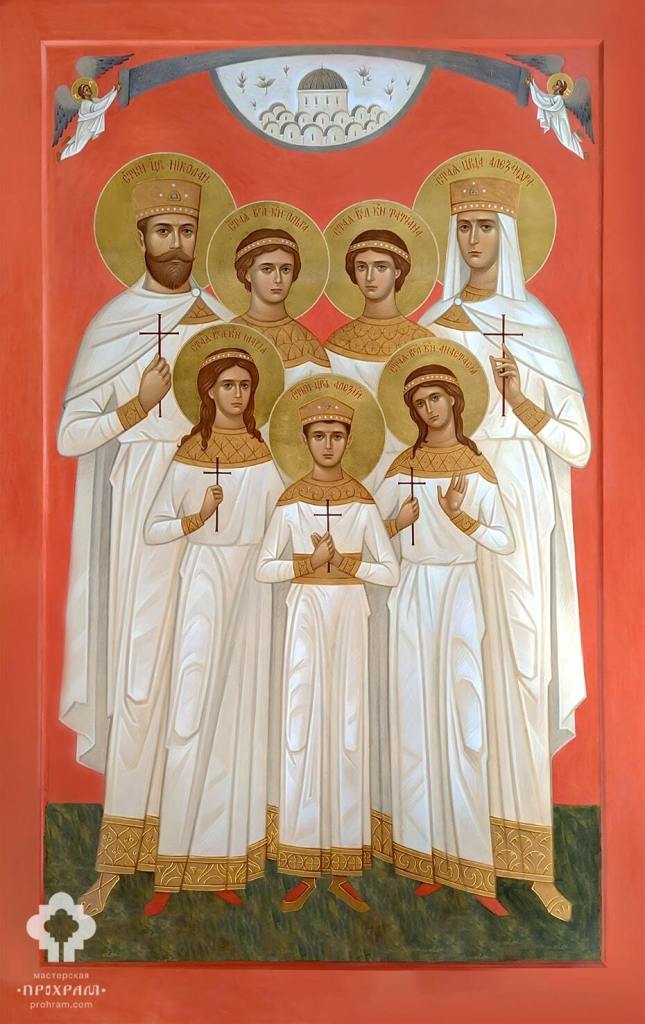
PHOTO: icon of the Royal Martyrs in the White Hall
© Paul Gilbert. 9 January 2025
 Nicholas II
You must be logged in to post a comment.