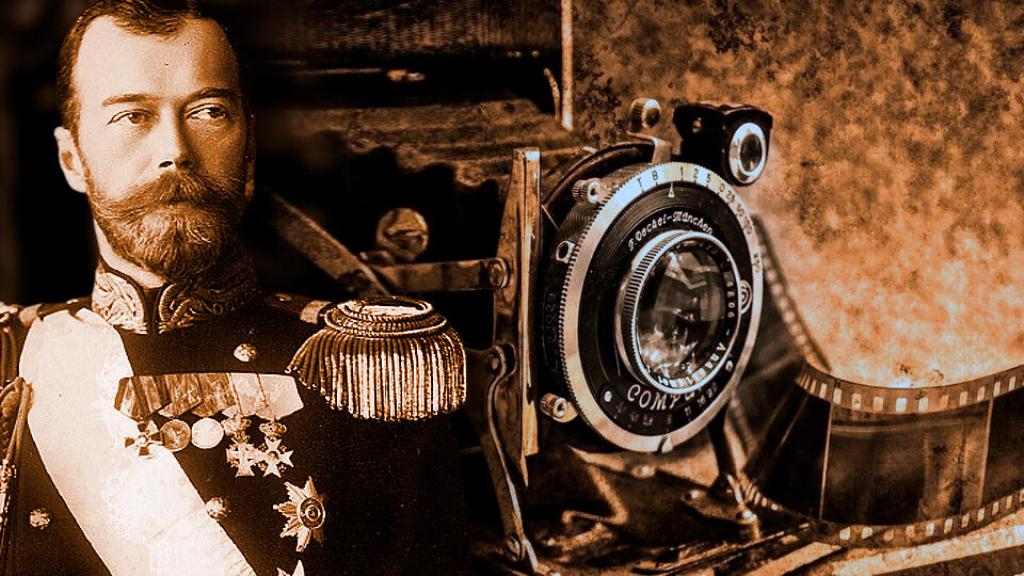
Shortly after his Coronation at Moscow in May 1896, Emperor Nicholas II acquired a new camera, for which he began photographing himself and his family. It was also at this time that he began placing his snapshots of family members in his diaries and compiled his first photo album.
Among the many albums of Romanov family photographs held in the Russian archives, at least two of them were Emperor Nicholas II’s personal photo albums, in which he personally selected and pasted the photos.
Nicholas II was a keen amateur photographer. It is widely known that his wife and children all shared his passion, but it is thanks to him that we can enjoy such a vast collection of photographs taken by the Emperor himself and by members of his family, in addition to those taken by official photographers. These photographs not only give us an official portrait of Russia’s last Emperor and Tsar, but also a pictorial record of his private life and reign.
Nicholas II took pictures throughout his life, leaving to posterity a collection of photographs astonishing in their breadth and variety. It is a collection which allows us to study him in all his guises: Emperor, husband and father. As GARF managing director and researcher Alia Iskhakovna Barkovets notes: “Everyone who looks at these photographs will see the last Tsar of Russia in their own way. One feeling, however, unites us: these photographs attract us because in them we see a human life. And regardless of the time and tragedy that separates us from that life, we can comprehend it and identify with it.”
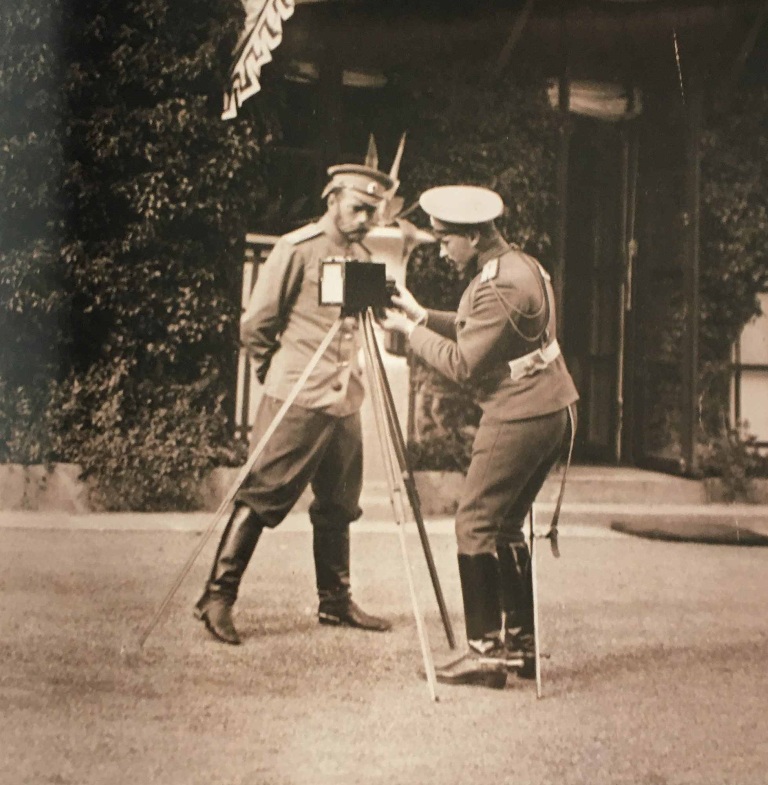
In 1925, the enormous archive of documents and photographs of Nicholas II and his family were transferred to the New Romanov Archive, which formed the basis of the Archive of the October Revolution, and was renamed The Department of the Fall of the Old Regime. It was Joseph Stalin who ordered the Romanov archives closed and sealed. They were even off limits to historians, unless for propaganda purposes. Up until the fall of the Soviet Union in 1991, these private documents and photographs lay effectively untouched.
While it is known that Nicholas II started to take amateur photographs, it is not known where and when the Emperor acquired his first camera, but his personal accounts for November 1896 contain an entry about a payment to the firm ‘London Stereoscopic & Photographic Co,’ for photographic accessories amounting to £9 British pound sterling. In December of the same year an invoice from the owner of a warehouse for photographic and optical accessories in St. Petersburg was paid for 25 roubles to cover photographic work, two boxes of film and a camera cover.
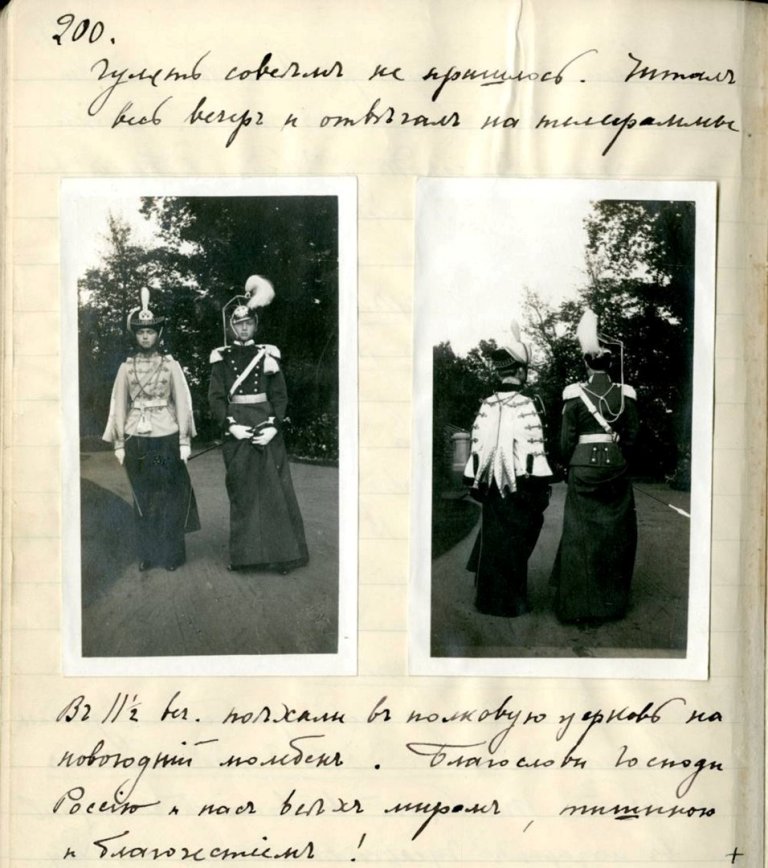
PHOTO: a page from the diary of Nicholas II, dated 31st December 1913, featuring two photos of his eldest daughters Olga and Tatiana, wearing their respective regimental uniforms.
That Nicholas himself glued photographs into albums is shown by a diary entry 29th October 1896: “Fussed with some photographs, singling them out for gluing into the big album”. It is apparent that he among the members of his family was mostly concerned with their presentation, also ensuring that each photograph was captioned with date and place, all handwritten by the Emperor himself.. This favourite pastime “calmed him and brought him into a state of mental equilibrium,” says Barkovets.
Beginning in 1896, small amateur photographs began to appear in the pages of his diary alongside the entries. In almost every diary after this year the Emperor illustrated various entries with his own photographs.
Nicholas II’s private album for 1900-1901 is particularly interesting as it highlights the growing confidence of his skills as a photographer. Nicholas had obtained a special camera which allowed panoramic pictures to be taken. The Emperor’s passion for taking panoramic photographs included those of ships, his beloved Standart, and above all, the Crimean countryside and the architecture of Livadia Palace. Although the artistic merit of these photographs is questionable, their historic significance is undeniable.
In August 1917, when the Imperial Family was exiled from Tsarskoye Selo to Tobolsk and later Ekaterinburg, they took with them a camera of the ‘panorama company Kodak from the Karpov shop . . . along with instructions, and two boxes containing 33 negatives’. These items were found after the murder of the Imperial Family in Ekaterinburg at the apartment of Mikhail Letemin, the guard for the Ipatiev House, during a search by the investigator Alexei Nametkin on 6th August 1918. As well as the items found at the Ipatiev House, three reels of Kodak film were recovered from the stoves and rubbish at the Popov house, where the guards of the Imperial Family were accommodated. So, what were these photos? Who took them? Why were they destroyed? Perhaps they contained the last photographic images of the final days of the Imperial Family, or were they destroyed to conceal evidence which the murderers did not want to fall into the hands of monarchists, the Whites or the Western press? Sadly, we will never know!
In conclusion, Alia Barkovets adds: “the photographs from the Tobolsk period of the family’s house arrest are missing from the State Archive, but a few pictures survive in private collections. There are no known photographs of the Imperial Family during their house arrest in Ekaterinburg. If we believe the evidence of of the guard Mikhail Letemin, Nicholas’s camera was stolen by him from the Ipatiev House after the murder of the Imperial Family. Whether or not it contained film we can only surmise.”
***
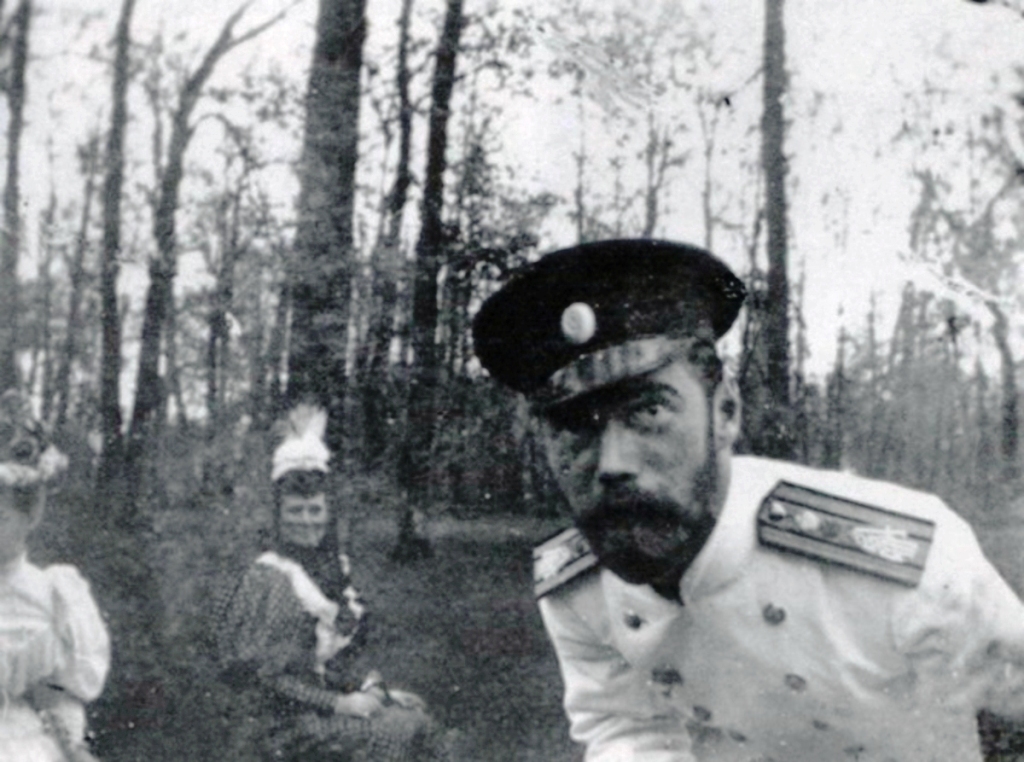
Nicholas II was among a handful of famous Russians, who took “selfies”.
The first ‘selfie’ in history was taken by American photographer Robert Cornelius – he took a photo of the reflection of himself in a storefront. That happened in 1839, but the process of taking photos then was very different from the modern one.
A polished silver plate, treated with iodine vapors, was put into a camera obscura and then developed over hot mercury and dipped into a solution of salts – not the easiest of processes.
The tides turned with the emergence of Kodak cameras, designed to be used by non-professionals. Photography didn’t require serious training anymore and gradually turned into a mass hobby. The amount of ‘selfies’ rose dramatically. Russians were also involved.
In this photo, we see the Tsar posing for a “selfie” with his Kodak camera, much to the amusement of his mother Dowager Empress Maria Feodorovna seen seated behind him in this [sadly] grainy image. Year and location unknown.
© Paul Gilbert. 19 August 2022 [Updated 24 June 2025]
 Nicholas II
You must be logged in to post a comment.