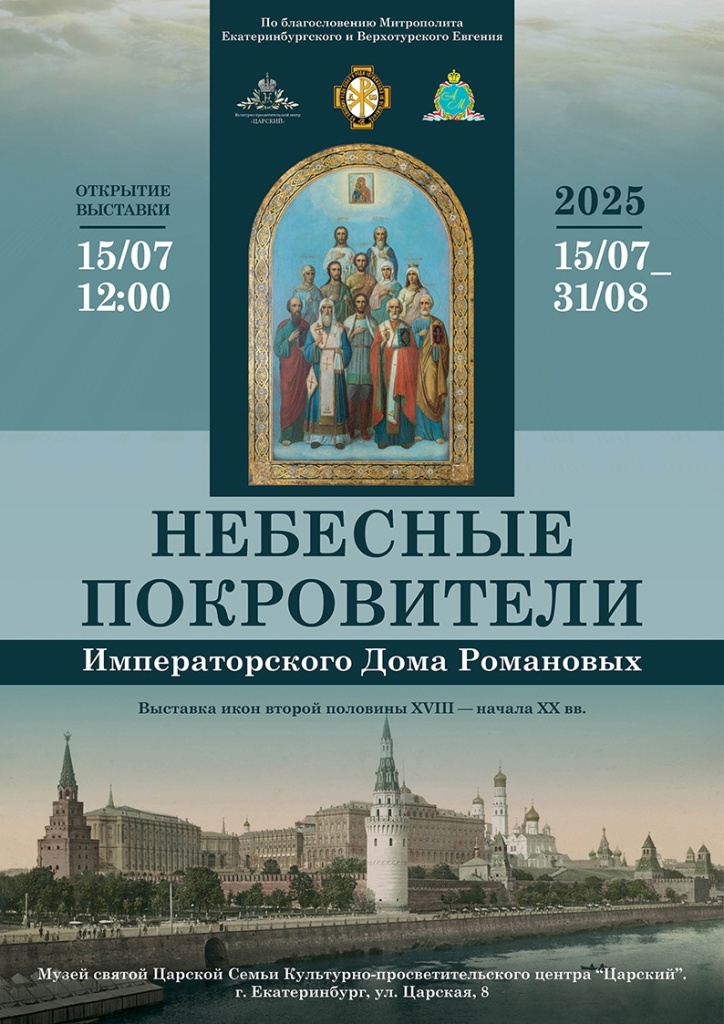
Emperor Nicholas II is well known for his piety and devotion to the Russian Orthodox Church. As part of the Tsar’s Days-2025, a collection of rare icons of the 17th to early 20th centuries, which are stored in church and private collections, will be brought to Ekaterinburg. The exhibition presents icons of the patron saints of the Romanov dynasty, which were commissioned by the Russian emperors.
The icons will be on display at the exhibition “Heavenly Patrons of the House of Romanov” which opens on 15th July 2025, to the Museum of the Holy Tsar’s Family, situated on the second floor of the Patriarchal Compound of the Church on the Blood.
This event was organized by the Altai Diocese together with the Ekaterinburg and Altai branches of the Imperial Orthodox Palestine Society and the Russian Academy of Arts. This is the first time that the Ural capital has hosted such an exhibition.
The organizers of the exhibition shared the history of the exposition:
For more than three hundred years, Russia was under the rule of the Romanov dynasty. The Romanovs’ coming to power is associated with a prayer at the Miraculous Icon of the Mother of God “Feodorovskaya” and was marked by the overcoming of the Time of Troubles. Under the Romanovs, the country acquired the status of an Empire, profound political transformations were carried out, feudalism was replaced by capitalist relations, the peasantry gained freedom, economic and social reforms were implemented, and the population increased. The reign of the Romanovs ended with another time of troubles, in 1917. On 15th (O.S. 2nd) March 1917, the day of the abdication of Nicholas II , the Reigning Icon of the Mother of God was revealed to a peasant woman in Kolomenskoye. Many believe the reappearance of the icon was an indication that the Virgin Mary was displeased with Russia for dethroning Tsar Nicholas II during the February 1917 Revolution.
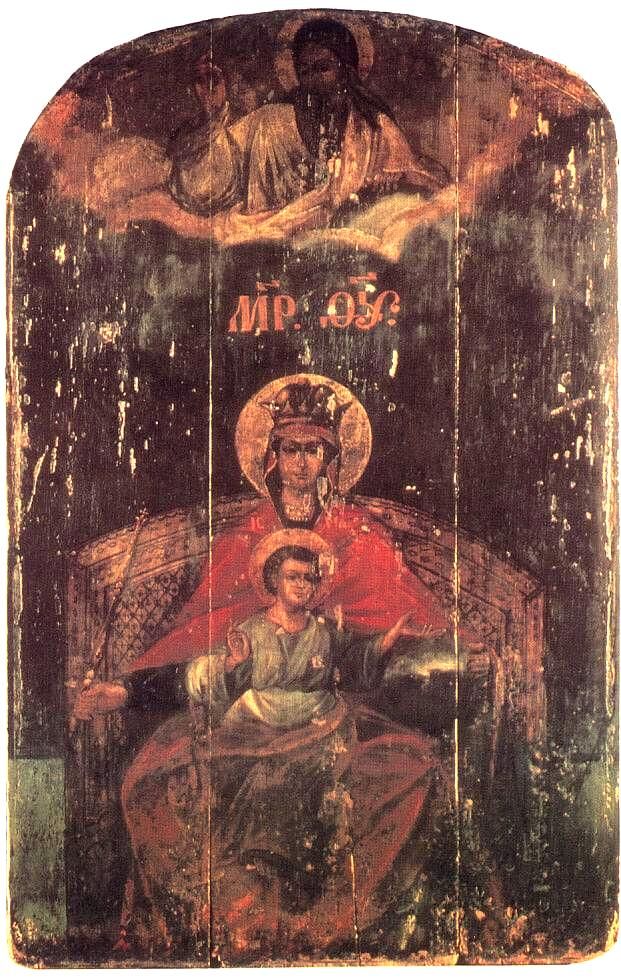
PHOTO: The original Reigning Icon of the Mother of God in the
Church of Our Lady of Kazan, Kolomenskoye (near Moscow)
According to Byzantine origins, the life of the Imperial Family in Russia was largely determined by Orthodox traditions. The Russian monarchs, following the Byzantine ones, were called God’s anointed. There was a corresponding rite of enthronement, which was performed in the main Assumption Cathedral of the Moscow Kremlin. Solemn events, anniversaries and other holidays of the Emperor’s family were interwoven into the church rites. In churches, Diving Liturgies, public prayers and bell ringing were performed. For these occasions, special icons were ordered, on which the patron saints of representatives of the Imperial Family were painted. Such icons were made for the birth of grand dukes, for the wedding of heirs to the throne, enthronement and anniversaries. If an assassination attempt or accident occurred, and the respective member(s) of the Imperial Family were spared, then praise was given to God throughout the country, thanksgiving prayers were served, chapels and churches were built, or appropriate icons with selected saints were ordered. Moreover, for most people, the tsar was God’s anointed, and therefore, there was a prayer for the well-being of the tsar and his family members. And what is prayer without an icon? This is how new images were born.
After 1917, the Church and the monarchy became the main enemies of the new Bolshevik and later Soviet governments. The heritage of Russia was destroyed with special zeal, and it is not surprising that today such icons have become a rarity, which makes the exhibition a unique event for the spiritual life of the Sverdlovsk region – once a bastion of Bolshevism – and for Russia. The exhibition encourages a new look at the pages of the history of the ruling House of Romanov, which has so significantly influenced the history and modernity of Russia.
In addition, visitors will see the icons of the Most Holy Trinity of the late 19th and early 20th centuries, selected saints, the Intercession of the Most Holy Theotokos, the image of Prince Vladimir Equal-to-the-Apostles of 1888, the version of which was painted specifically for the 900th anniversary of the Baptism of Rus. Particular attention should be paid to the long-suffering Job – he could have been a personal icon of the last Russian Tsar Nicholas II.
The exhibition “Heavenly Patrons of the Imperial House of Romanov” runs from 15th July to 31st August 2025, at the the Tsarsky Cultural and Educational Center, situated in the Patriarchal Compound of the Church on the Blood.
© Paul Gilbert. 11 July 2025
 Nicholas II
You must be logged in to post a comment.