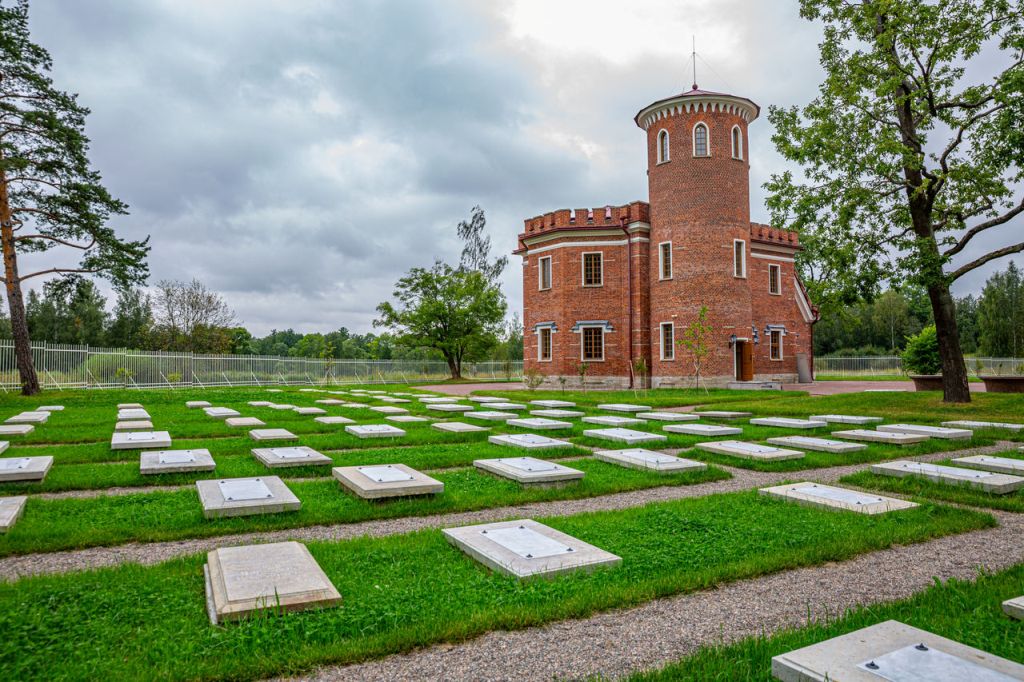
PHOTO: Pensioner’s Stable Pavilion and Horse Cemetery at Tsarskoye Selo
The Tsarskoye Selo State Museum-Reserve has announced the completion of restoration work in the Pensioners’ Stable Pavilion and the adjacent 19th-century cemetery, where more than 120 horses of the Russian emperors are buried.
Click HERE to read my article Pensioner’s Stable Pavilion and Horse Cemetery at Tsarskoye Selo to open end of 2025, which includes photos and drawings, published on 24th May 2025
Guided tours (in Russian only) of the complex will be offered to visitors beginning 30th August, on weekends only. The route includes a talk on the history of the Pensioner’s Stable Pavilion, followed by a rour of the world’s first Imperial Horse cemetery and the nearby Imperial Farm [Note: restoration was completed in January of this year].
The restoration work has been ongoing since 2019 at the expense of the museum’s extra-budgetary funds. During this time, the general layout of the site was restored, the bases of the tombstones were restored and the gravestones were returned to their historical places. According to archival data, the museum staff established the names of the horses buried in each grave, and craftsmen recreated the lost plates with inscriptions.
In the building of the Pensioner’s Stable, façade and general construction work was carried out, utilities were laid and carpentry fillings were restored. The museum has begun work on the creation of a permanent exhibition dedicated to imperial horses, which is scheduled to open in the spring of 2026. Among the exhibits is a decorative harness for Tsesarevich Alexei Nikolaevich’s favourite donkey, presented by King Victor Emmanuel III to Emperor Nicholas II, during the latter’s visit to Italy in October 1909.
The Pensioner’s Stable was built in 1827-1830 according to the project of the architect and landscape designer Adam Menelaws (1753-1831), to serve as a “retirement home” for horses that had left the service of their Imperial masters “due to old age and illness”.
The first burial dates back to 1834, the last to 1915. Horses of the emperors of the 19th century are buried in the adjacent cemetery, including animals from the stables of Emperors Alexander I, Nicholas I, Alexander II and Alexander III.
The horses belonging to Emperor Nicholas II, which are buried in the cemetery, include his gray gelding “Serko“, presented to Tsesarevich Nikolai Alexandrovich (future Emperor Nicholas II) in 1890. In 1901, Emperor Nicholas II’s favourite horse “Bluebell”, from 1875, died at the age of 30. After her death, Nicholas II issued an edict for “Bluebell” to be buried in the Imperial Horse Cemetery.
During the Great Patriotic War, the Pensioner’s Pavilion was slightly damaged, but in the following decades it fell into a terrible state of neglect and disrepair, as did the Imperial Horse Cemetery. The repair of individual slabs on the graves was carried out in the early 2000s with the financial support of the French writer and horse specialist Jean-Louis Gouraud [b.1943]. Restoration work was interrupted during the COVID pandemic. The museum has since carried out comprehensive restoration at its own expense.
© Paul Gilbert. 25 August 2025
 Nicholas II
You must be logged in to post a comment.