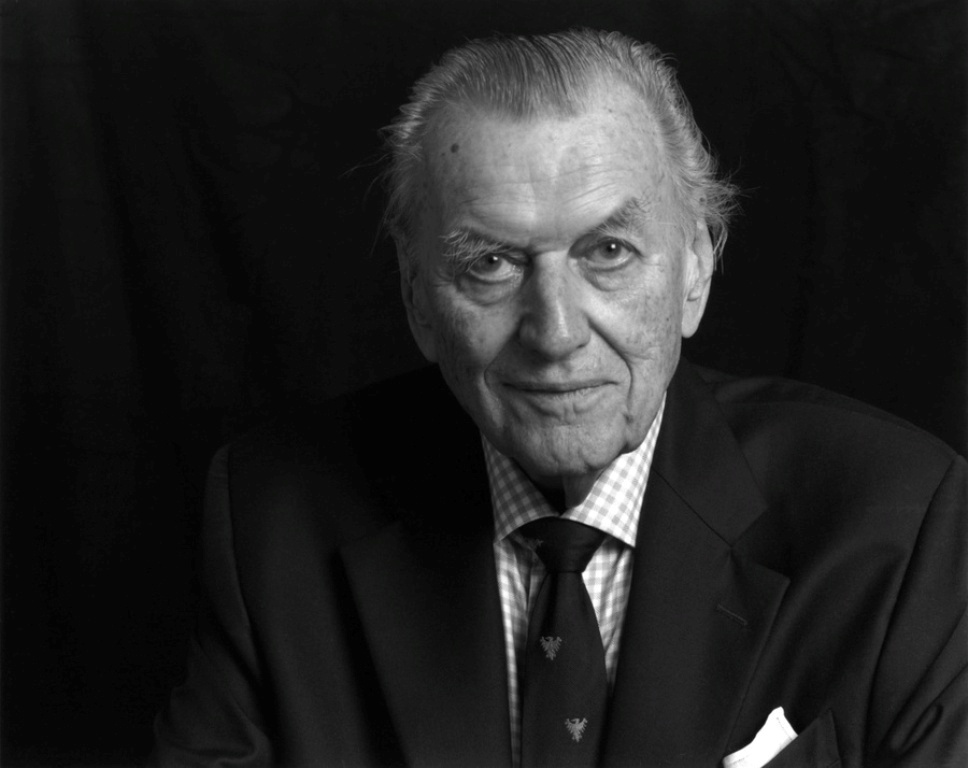
Prince Nicholas Romanovich Romanov
1922-2014
On this day – 15th September 2014 – Prince Nicholas Romanovich Romanov died in Bolgheri, Tuscany, Italy at the age of 91. Following the death of his cousin Prince Vladimir Kirillovich in 1992, Nicholas became his rightful successor as Head of the House of Romanov.
Prince Nicholas was born on 26th September 1922 in Cap d’Antibes near Antibes on the French Riviera. He was the eldest son of Prince of the Imperial Blood Roman Petrovich (1896-1978) and his wife Princess Praskovia Dmitrievna (née Countess Sheremeteva, 1901-1980).
Nicholas Romanovich belonged to the third branch of the first line of the House of Oldenburg-Russia (House of Holstein-Gottorp-Romanov, itself descended from the first branch of the House of Holstein-Gottorp). These three branches are all descended from the first branch of the House of Oldenburg. He is a direct descendant of Emperor Nicholas I (1796-1855).
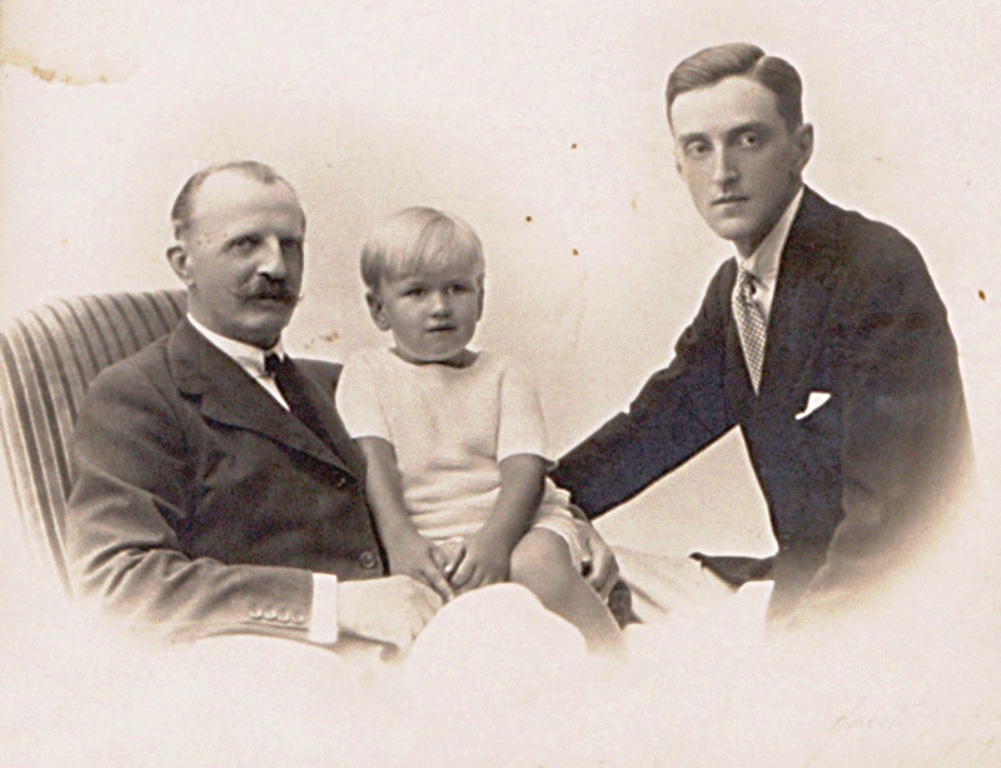
PHOTO: Three generations: Prince Nicholas Romanovich Romanov with his grandfather (left) Grand Duke Peter Nikolaevich, and his father Prince Roman Petrovich (right)
Childhood, boyhood and youth
As children, Prince Nicholas Romanovich and his brother Dmitri Romanovich were immersed in a Russian atmosphere. he received a private education from Father Zossima, this monk taught him the old Russian school curriculum. Despite their exile, Prince Roman Petrovich and his wife raised their two sons in the Russian spirit, in their daily lives. The brothers observed the Old Style Julian calendar, and the religious holidays of the Russian Orthodox Church.
Nicholas did part of his studies in France, but he aspired to a career in the Italian navy as an officer. To realize his dream, his parents used their close ties to the Italian royal house (his paternal grandmother, Princess Militza of Montenegro, was the sister of Helen of Montenegro, the wife of Victor Emmanuel III of Italy). His grandmother made the necessary arrangements with the members of the House of Savoy. Nicholas Romanovich left his family to continue his studies in Italy, where he was taught by the retired Italian officer, Captain Tommaso Surdi. After completing his studies, the prince would be admitted to the Italian Naval School in Livorno. Suffering from short-sightedness, the prince had to abandon his career in the navy. During the Second World War the Italian fleet suffered terribly, incurring great losses, according to the prince, this myopia may have saved his life.
In 1936, his family moved to Italy, Nicholas Romanovich did classical studies, he graduated in 1942. From his early childhood the prince spoke Russian and French, later he learned English and Italian, his tutor, Marcel Berlinger taught him Latin and ancient Greek.
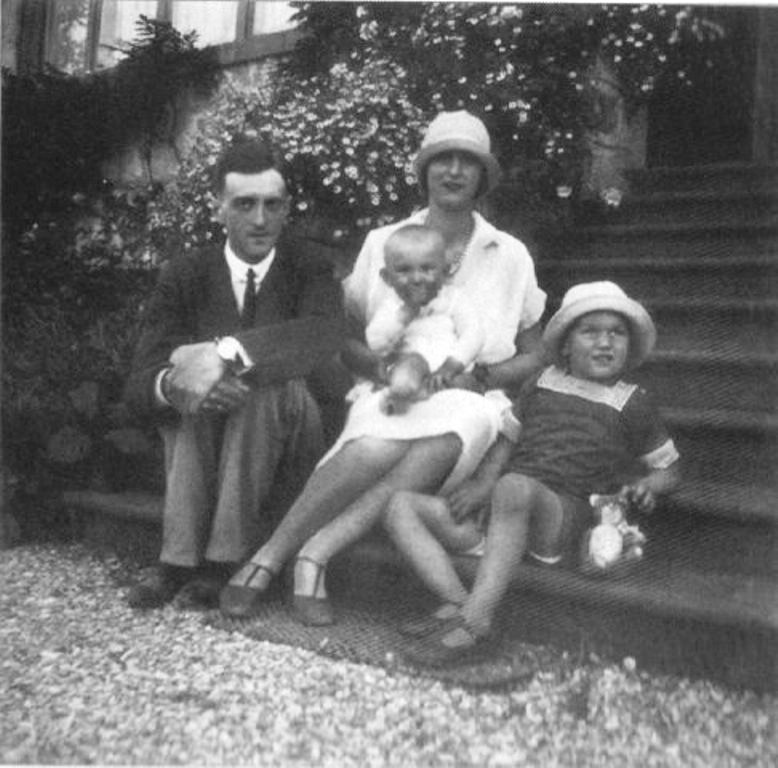
PHOTO: Prince of the Imperial Blood Roman Petrovich with his wife Princess Praskovia Dmitrievna and children Prince Dimitri (seated on his mother’s lap) and Prince Nicholas (right). Antibes, France. Late 1920s.
World War II and the post-war years
During the Fascist occupation of Rome, members of Nicholas Romanovich’s family lived under the constant threat of deportation, especially the prince’s paternal grandmother, Militza of Montenegro, who found refuge in a convent, and then in Vatican City. The prince’s family resided at the Villa Marlia near Lucca in Tuscany. In September 1943, surrounded by carabinieri, Nicholas and his family were taken to Rome, where they lived for the duration of the war. On 8th September 1943, Italy signed the armistice, and the prince’s family was present at the Villa Savoia (residence of the King and Queen of Italy) and witnessed the departure of Victor Emmanuel III and Queen Elena from Italy. In turn, the members of the prince’s family left Villa Savoia and lived clandestinely for more than nine months.
After the liberation of Rome by the Allies, Nicholas Romanovich was employed in one of the Allied agencies, the Psychological Warfare Branch. When World War II ended, the prince found a job with the United States Information Service (USIS). In 1946, Nicholas and his family moved to Egypt, where the prince held a few odd jobs, but wishing to return to Italy to continue his university studies, Nicholas considered his stay in Egypt as a period of rest. Between 1947 and 1948, the Turkish tobacco trade gave the prince a certain financial ease, he was also employed by an insurance company.
In 1950, Nicholas decided to return to Europe. On the way to Geneva, the prince stopped in Rome, where he met his future wife. Prior to his marriage, he was employed by the British Austin Motor Company, working with the firm’s representative in Italy, Colonel Andrew Constable-Maxwell.
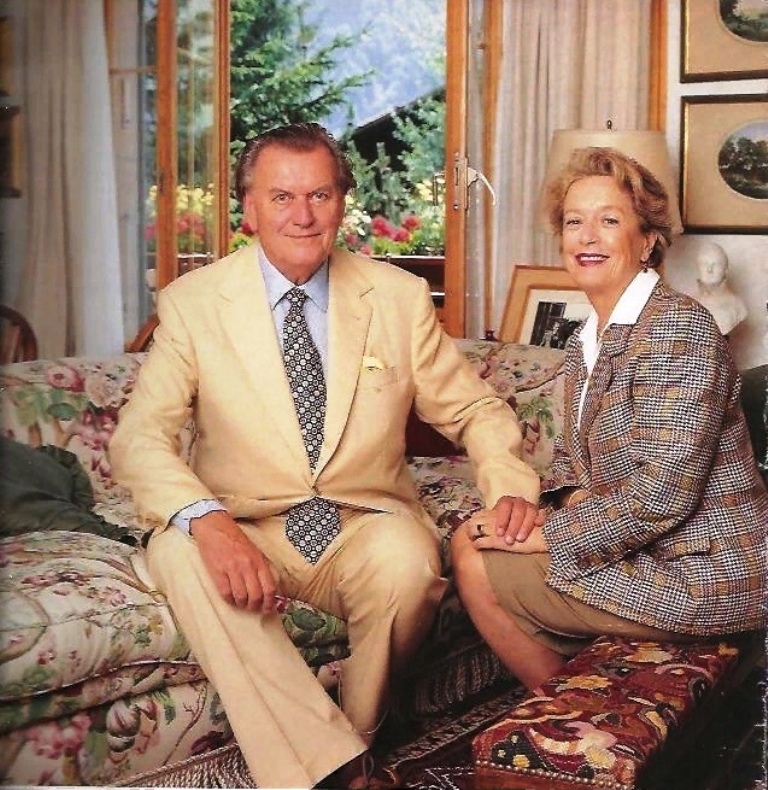
PHOTO: Prince Nicholas Romanovich and his wife Countess Sveva della Gherardesca
Marriage and children
Nicholas Romanovich married Sveva della Gherardesca (b. 1930) on 21st January 1952 in St. Michael the Archangel Church (Russian Orthodox) in Cannes, France, while a civil marriage took place on 31st December 1951 in Florence, Italy. The prince’s wife belonged to the famous Tuscan family della Gherardesca, her father, Count Walfredo della Gherardesca was one of the descendants of Count Ugolino (Ugolin), a character in Dante’s Divine Comedy. Her mother was and the Marchioness Nicoletta de Picolellis.
Prince Nicholas and his wife had three daughters:
- Natalia Nikolaevna (b. 1952), who married Giuseppe Consolo (b. 1948) in 1973, and had two children;
- Elisabeth Nikolaevna (b. 1956), who married Mauro Bonacini (b. 1950) in 1982, and had two children;
- Tatiana Nikolaevna (b. 1961), who married Gian Battista Alessandri (b. 1958) in 1983, divorced in 1988, remarried Giancarlo Tirotti (b. 1947), and had one child.
In 1982, Prince Nicholas and his wife moved to Rougemont, a small mountain village in the canton of Vaud, Switzerland. The couple lived there for seven months every year, usually in the winter. During the rest of the year they stayed in Italy with their daughters.
In January 1955, Nicholas’s brother-in-law died accidentally, and Nicholas Romanovich became the manager of his wife’s Tuscan estate. Between 1955 and 1980, the prince became a breeder of the Chianina cattle breed, some of these cattle were exported to Canada, he was also a winegrower.
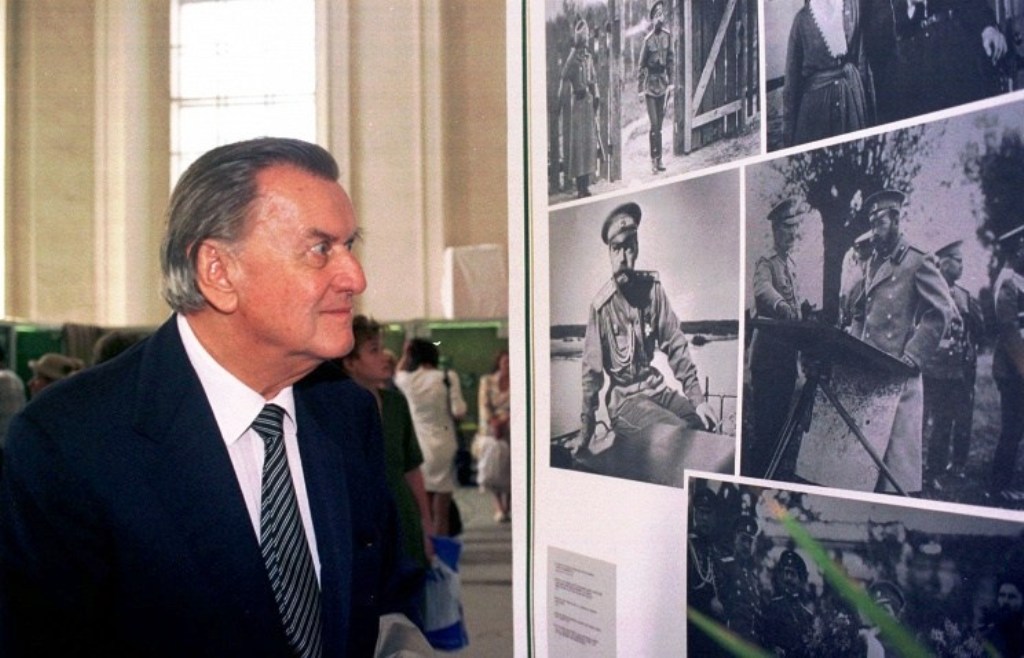
PHOTO: Prince Nicholas Romanovich Romanov visiting
Saints Peter and Paul Cathedral in St. Petersburg
Heartbeat from a non-Russian throne
During a BBC(Russia) interview in May 2006, Prince Nicholas Romanovich (1922-2014) confirmed that in 1942, Fascist Italy wanted to make him king of Montenegro, but he refused.
“In 1942 I was only 20 years old” – said Prince Nicholas – “I did not like Mussolini or the Nazis, even if I were a Montenegrin, I would still refuse.”
“More than 60 years have passed since then. I remember being at home in Rome. My father called me and said: “The Italian Minister of the royal court, the Duke of Aquarelle will arrive soon. He wants to talk with you.”
“I asked what he wanted. Father replied: “You will see.” When the minister arrived at the house, I was of course curious to know what he wanted. I was friends with his sons.”
“The minister approached me and said: “The Montenegrin throne is at your disposal. Give your answer – do you accept or not?”
“This surprised me very much, especially since my father had not warned me. I answered no. I said that I am not a Montenegrin. I am Russian, and Montenegro does not interest me. Since he was the minister of the Fascist government, I did not want to admit that I wanted to be to a appointed fascist regime.”
NOTE: Prince Nicholas Romanovich’s grandmother Grand Duchess Militsa Nikolaievna (1866-1951) was the Montenegrin Princess Milica Petrović-Njegoš, daughter of King Nicola I of Montenegro (1841–1921). [She married Grand Duke Peter Nikolaevich (1864-1931) of Russia on On 26 July 1889]
“The minister then told my father that I was already over 16 years old, that I was a dynastic adult, and that he had no right to refuse this wonderful gift offered to his son. My father also refused.”
And so Montenegro was left without a king …
“When the First Great War ended” – added Prince Nicolas – “Montenegro was under the occupation of the Austro-Hungarian armies. My great-grandfather, King Nicola, was forced to leave his country.”
“And when, at the end of the war, attempts to reorganize Europe began, Montenegro was left without its strongest patron, which was Russia . . . Tsarist Russia.”
“The Montenegrin king was left without patronage, and the Montenegrin kingdom disappeared from the world map.”
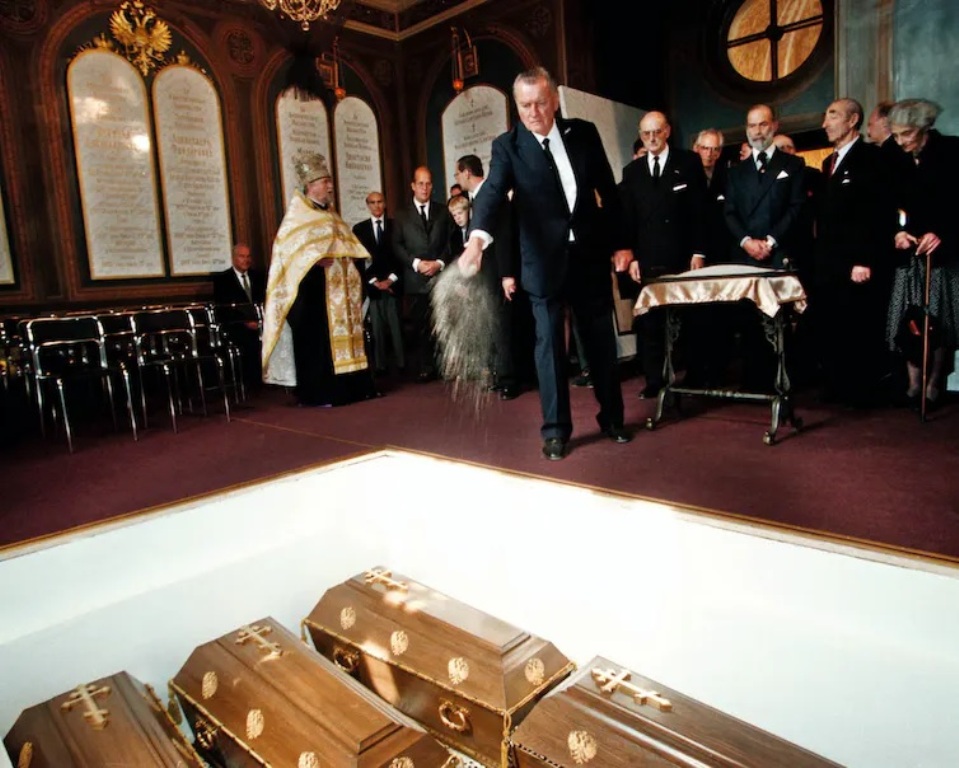
PHOTO: the Head of the House of Romanov Prince Nicholas Romanovich throws a handful of earth into the grave of Emperor Nicholas II and his family. St. Petersburg, 17th July 1998
Head of the House of Romanov
After the sale of his Tuscan farm, Nicholas began to gather information about the Romanov family in order to write a biography. At the same time, the prince painted watercolours depicting the fictitious operation of a battleship of the Russian Imperial Navy in the Mediterranean, and he affixed to them legends written in his own hand. This work, on the advice of his friend Masolino d’Amico, was presented to a publisher, it was published in 1988 by the publisher the Italian publisher Mondadori, This work was entitled Storia di una corazzàta Tonda [Tr. History of the Tonda battleship].
The interest shown by Prince Nicholas in the country of his ancestors and the changes that had taken place in Russia led the media, particularly television, who pursued him constantly for interviews. As a result, Nicholas gave more than one hundred interviews during his lifetime. In addition, he has appeared in documentaries about Russia’s last Tsar, and has given many lectures on Russia and the Romanov family.
It was Prince Roman Petrovich, who came up with the idea of a family association of the Romanovs in the mid-1970s. It was not until 1979, however, that the Romanov Family Association was officially created. Prince Dmitri Alexandrovich served as it’s first president and Nicholas as vice-president. When Prince Vasili Alexandrovich became president in 1980, Nicholas remained vice-president. In 1989, after the death of Vasili Alexandrovich, Prince Nicholas was elected the new president. It should be noted that Princess Maria Vladimirovna has never joined the Romanov Family Association, nor did her late father Prince Vladimir Kirillovich.
The Romanov Family Association was an organization whose goal was to strengthen the connection between the descendants of the House of Romanov, who were living now scattered across the globe. The association exists to the present day.
The official position of the Romanov Family Association is that the rights of the family to the Russian Throne were suspended when Emperor Nicholas II abdicated for himself and for his son Tsesarevich Alexei in favour of his brother Grand Duke Michael Alexandrovich who then deferred ascending the Throne until a Constituent Assembly ratified his rule. Michael did not abdicate but empowered the Provisional Government to rule.
Following the death of Prince Vladimir Kirillovich on 21 April 1992, Prince Nicholas Romanovich became his rightful successor and rightful Head of the House of Romanov. He was elected pretender to the throne of Russia on 31st December 1992, by members of the Russian Imperial Family in exile, against his cousin the Princess (known as the “Grand Duchess”) Maria Vladimirovna.
In June 1992, the prince visited Russia for the first time, and further visits followed. From 1998, Nicholas Romanovich visited Russia once a year. In July 1998, as head of the House of Romanov, Prince Nicholas Romanovich, attended the ceremonies held on the occasion of the funeral of the last Tsar Nicholas II of Russia in St. Petersburg.
Prince Nicholas led more than 50 Romanov descendants at the funeral of Emperor Nicholas II and his family in St. Petersburg, on 17th July 1998. The writer of this obituary was also in St. Petersburg for this historic event, and it was the one and only time that I met in person both Princes Nicholas and Dmitri Romanovich in person. The meeting took place in the lobby of the Astoria Hotel, and although it was nothing more than a handshake, an introduction and an exchange of a few words. I recall Prince Nicholas smiling and shaking my hand when I told him I had come from Canada for the funeral. I was struck by the warmth and sincerity of this brief encounter. I was even invited to travel on the special coaches which had been arranged to transport the more than 50 Romanov descendants[1] from the Astoria to the SS Peter and Paul Cathedral for the funeral.
As head of the Romanov family, Prince Nicholas was also present at the reburial of the remains of the Dowager Empress Maria Feodorovna in Russia in September 2006. Prince Nicholas and his brother Prince Dmitri had been responsible for lobbying the Danish royal family and the Russian President Vladimir Putin to allow the transfer of the Dowager Empress’s remains to Russia so they could be buried alongside her husband Emperor Alexander III.
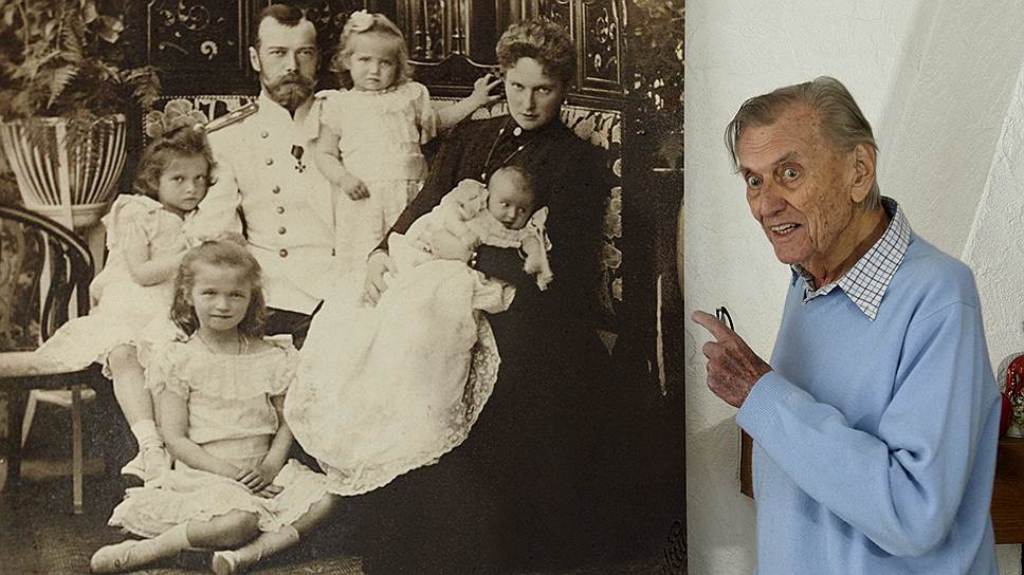
PHOTO: an elderly Prince Nicholas Romanovich remains one of
the most highly respected descendants of the Romanov Dynasty
Prince Nicholas Romanovich died in Bolgheri. Tuscany on 15th September 2014, aged 91. His funeral was held on 17th September 2014, at the Church of Saints Jacob and Christopher in Bolgheri. The funeral ceremony was performed by two priests, one from the Roman Catholic Church, the other from the Holy Great Martyr Catherine of the Moscow Patriarchate. At the foot of the coffin lay a wreath of flowers of the Russian tricolor, as well as numerous wreaths and fresh flowers. The condolences of Russian President Vladimir Putin were conveyed to the family of the deceased by Russian Ambassador to the Vatican Alexander Avdeev. A telegram of sympathy signed by the speaker of the State Duma of the Russian Federation Sergei Naryshkin was also read. Prince Nicholas was then interred in the crypt of the Counts della Gherardesca, the burial site of his wife’s family, at the Basilica of St. Francis in Pisa in Tuscany.
Prince Nicholas was survived by his wife, their three children, five grandchildren and three great-grandchildren.
Memory Eternal! Вечная Память!
In 2022, Russian historian Ivan Matveev published a biography Хранитель истории династии. Жизнь и время князя Николая Романова / Keeper of the History of the Dynasty. The Life and Time of Prince Nicholas Romanov.
© Paul Gilbert. 15 September 2025
NOTES:
[1] The only Romanov descendants who did not take part in the funeral ceremonies were Princess Maria Vladimirovna, her son George and her mother Princess Leonida Georgievna (1914-2010). The reason being, that none of them (even to this day) recognize the Ekaterinburg Remains, as those of Emperor Nicholas II, his wife, and their five children. Lord have Mercy!
 Nicholas II
You must be logged in to post a comment.