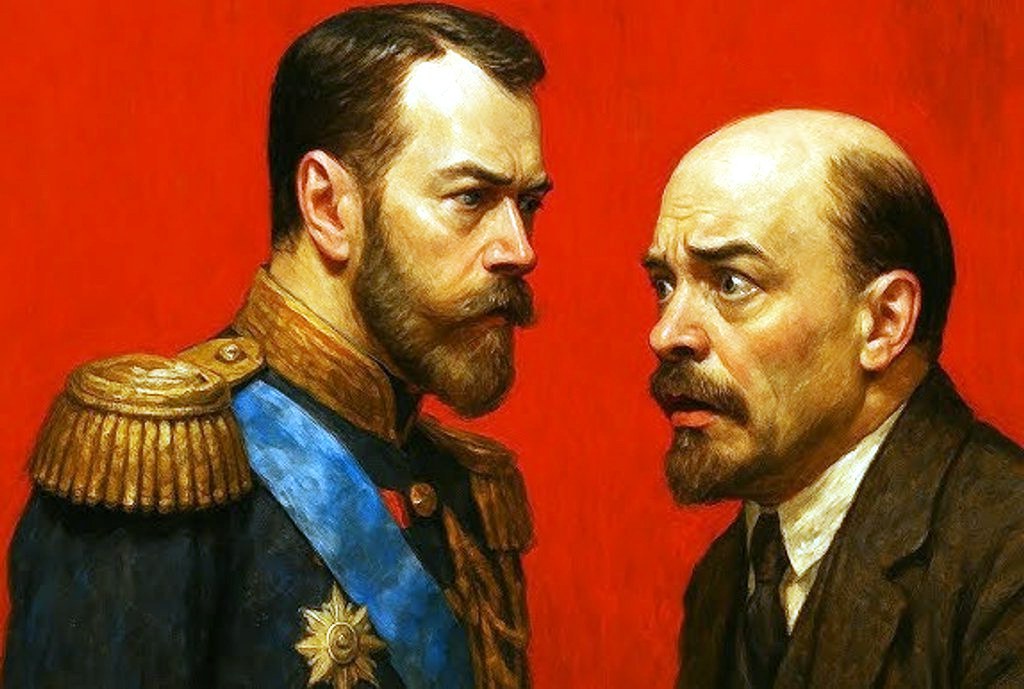
The question of whether Nicholas II was right with his desire for reform or Vladimir Lenin with his revolutionary ideology is at the heart of the debate about the fate of Russia in the early 20th century. Emperor Nicholas II, tried to modernize the country through gradual reforms, preserving its traditional foundations and monarchical system. Lenin, on the other hand, advocated a radical breakdown of the old order and the construction of a socialist society through revolution.
In this article, I argue that Nicholas II’s reform-based approach was more correct and patriotic, as he sought stability and prosperity for Russia, while Lenin’s revolutionary ideas led to chaos, civil war, and tragedy, including the deception and murder of the Imperial Family.
Nicholas II: Reforms for the Sake of Stability and Prosperity
Nicholas II, who ascended the throne in 1894, inherited an empire that faced the challenges of modernization, social tensions, and domestic and external threats. His reign was far from perfect, but the Tsar sincerely sought reforms that would strengthen Russia, preserving its national identity and unity.
Economic and social reforms
Under the leadership of Nicholas II, Russia experienced significant economic growth. At the beginning of the 20th century, the country was one of the world’s leaders in industrialization. The construction of the Trans-Siberian Railway linking the east and west of the Russian Empire was completed, promoting trade and mobility for Russians. Industrial production doubled, and Russia became the largest exporter of grain. These achievements show that the Tsar saw the future of the country in economic development and modernization.
The key reform was Pyotr Stolypin’s agrarian reform, which began in 1906. It was aimed at creating a class of independent peasant landowners, which would strengthen agriculture and social stability. Nicholas II supported these measures, realizing that a strong economy and a satisfied peasantry were the basis of a stable state. The reforms were gradual to avoid upheavals, which testifies the foresight of the Tsar.
Political transformations
Nicholas II, despite his commitment to autocracy, made political concessions after the revolution of 1905. The Manifesto of 17th October 1905 introduced the State Duma, laying the foundations of a constitutional monarchy. Although the Duma had limited powers, it was a step toward democratization, showing the Tsar’s willingness to adapt to new realities. His reforms were aimed at preserving the unity of the country, avoiding radical upheavals that could split society.
Protection of traditions and faith
Nicholas II saw Orthodoxy and traditions as the basis of Russian identity. He supported the construction of churches and monasteries, strengthening the spiritual unity of the people. His reforms did not seek to destroy the historical heritage, but on the contrary, used it as a foundation for modernization. This made his approach patriotic, as he cared about preserving the culture of Russia.
Peacekeeping
Nicholas II initiated the Hague Conference of 1899, which was the first step towards international norms of warfare. This demonstrated his desire for peace and stability, which was especially important in the context of growing global conflicts. His efforts earned him a nomination for a Nobel Peace Prize in 1901. Even during the First World War, the Tsar personally participated in the management of the army, showing devotion to duty and country.
Lenin: Revolution for the Sake of Utopia
Vladimir Lenin, on the contrary, advocated a radical destruction of the existing order. His Marxist ideology demanded a revolution that would destroy the monarchy, the church, and capitalism, replacing them with the dictatorship of the proletariat. However, his actions led to disastrous consequences, proving that the revolutionary path was wrong.
Destruction instead of creation
The October Revolution of 1917, led by Lenin, overthrew the Provisional Government and led to a civil war (1917-1922) which claimed millions of lives. The nationalization of industry and collectivization destroyed the economy, causing hunger and poverty. Unlike the reforms of Nicholas II, which strengthened the economy, Lenin’s policy led to devastation. For example, the surplus-appropriation plundered peasants, which caused mass discontent and uprisings, such as the Kronstadt uprising in March 1921.
Red Terror and deception
Lenin sanctioned the first Red Terror, aimed at the destruction of “class enemies.” Thousands of innocent civilians, were executed or sent to gulags. Nicholas II, on the contrary, sought to avoid mass repressions, even during the February 1905 Revolution. Moreover, Lenin played a key role in the tragedy of the last Tsar and his family. The Imperial Family were held under house arrest and then shot in Ekaterinburg in 1918 on the direct order of Lenin. In the Bolshevik leader’s mind, as long as the Tsar, or any member of his family were left alive, they posed a threat to the new order and their reign of terror and repression.
Loss of territories
The Brest-Litovsk Peace Treaty of 1918, signed by Lenin, was humiliating for Russia. Huge territories, including Ukraine and the Baltic states, were given to Germany, which weakened the country. Nicholas II, even during the First World War, fought to preserve territorial integrity. When he took command of the Russian armed forces in August 1915, no further Russian territories were lost to the enemy. Lenin, on the other hand, sacrificed national interests for the sake of preserving his power, which can hardly be called patriotic.
Destruction of traditions
Lenin, as an atheist, declared war on Orthodoxy, destroying churches and persecuting and murdering thousands of members of priests, monks and nuns. This undermined the spiritual foundations of Russia, which Nicholas II defended. Lenin’s revolution rejected the historical legacy, replacing it with a utopian ideology that did not take into account the cultural and national characteristics of the country.
Who was right?
Nicholas II’s reform-based approach was correct, as he sought to modernize Russia without destroying its foundations. His reforms in the economy, agriculture, and politics (among others) were aimed at gradual development that could have led to prosperity had it not been for the revolutionary upheavals of 1917 and 1918.
The Tsar cared about the people, traditions and international prestige of the country, which makes his actions patriotic. His love for Russia was so deep, that he abdicated the throne, in order to save both his family and Russia from further bloodshed. His actions clearly emphasized his sacrifice.
Lenin, on the other hand, chose the path of revolution, which turned into chaos, civil war and the death of millions of innocent victims. His policies destroyed the economy and culture, and the deception and murders of the Imperial Family became symbols of his immoral approach. Popular support for Nicholas II frightened Lenin, as it threatened his power, which led to the regicide in Ekaterinburg.
Lenin, by destroying everything for the sake of a utopian idea, led Russia to disaster. Blackmail, deception and murder of Russia’s last Tsar only confirm that his methods were not only erroneous, but also immoral. History has shown that Nicholas II’s reforms could have made Russia stronger.
© Paul Gilbert. 16 September 2025
 Nicholas II
You must be logged in to post a comment.