
On this day – 30th December [O.S. 17th] 1916 – Grigori Yefimovich Rasputin was assassinated in Petrograd [St. Petersburg].
Love him or hate him, he is best known as the holy man, who befriended the family of Russia’s last tsar Nicholas II, and as a healer for the Tsar’s only son and heir Alexei Nikolaevich, who suffered from haemophilia.
Rasputin was born on 21st January [O.S. 9th January] 1869, to a family of peasants in the Siberian village of Pokrovskoye, situated 93 km [58 miles] east of Tyumen or 162 km [100 miles] southwest of Tobolsk.
He had a religious conversion experience after embarking on a pilgrimage to a monastery in 1897, and has been described as a strannik (wanderer or pilgrim), though he held no official position in the Russian Orthodox Church.
In February 1887, Grigori married a peasant girl named Praskovya Dubrovina. His wife remained in Pokrovskoye throughout Rasputin’s later travels and rise to prominence and remained devoted to him until his death. The couple had seven children, though only three survived to adulthood: Dmitry (b. 1895), Maria (b. 1898), and Varvara (b. 1900).
In November 1905, Rasputin met Emperor Nicholas II and Empress Alexandra Feodorovna. It was Grand Duchess Anastasia and her sister Grand Duchess Militza (wife of Grand Duke Peter Nikolaevna), who introduced Rasputin to Empress Alexandra Feodorovna. Nicknamed jointly “The Black Peril”, in 1909, the sisters lost their influence with the Empress..
In the early morning of 30th December [O.S. 17th] 1916, Rasputin was assassinated by a group of conservative nobles led by Prince Felix Yusupov, Grand Duke Dmitri Pavlovich, and the right-wing politician Vladimir Purishkevich, all of whom opposed his influence over the Imperial couple.
His assailants threw the ’stranniks’ body into the Malaya Nevka River. Rasputin was buried on 2nd January [O.S. 21st December] at a small church that Anna Vyrubova had been building in the Alexander Park at Tsarskoye Selo. His body was exhumed and burned by a detachment of soldiers shortly after the Tsar abdicated the throne in March 1917.
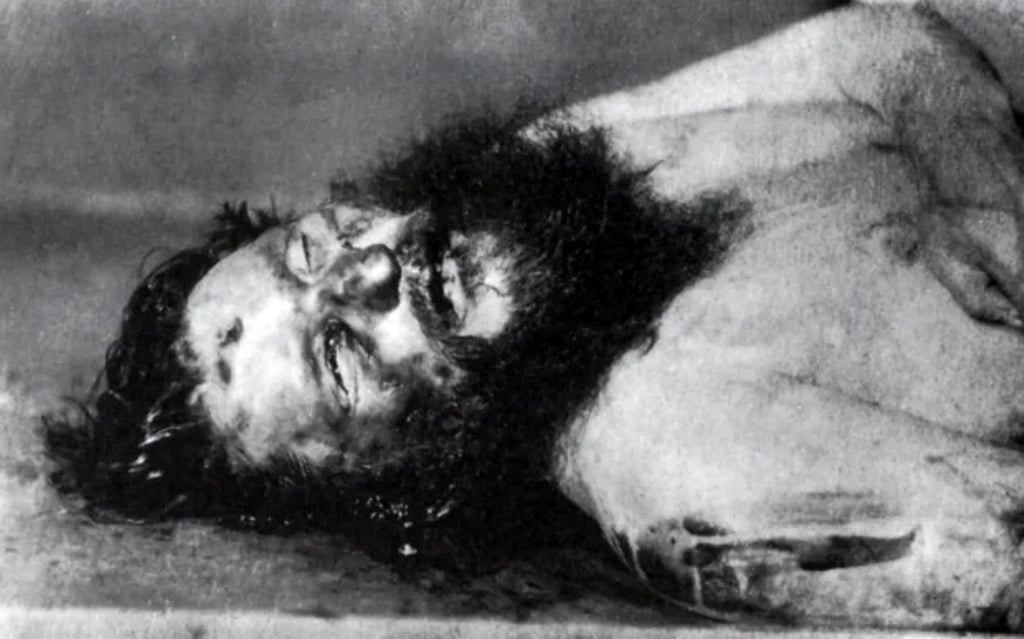
PHOTO: Rasputin’s body, after being pulled from the icy waters of the Malaya Nevka River
Following Rasputin’s assassination, Anna Alexandrovna Taneyeva-Vyrubova (1884-1964), wrote:
“The horror and shock caused by this lynching, for it can be called by no other name, completely shattered the nerves of the family. The Emperor was affected less by the deed itself than by the fact that it was the work of members of his own family. “Before all Russia,” he exclaimed, “I am filled with shame that the hands of my relatives are stained with the blood of a simple peasant.” Before this he had often shown disgust at the excesses of the Grand Dukes and their followers, but now he expressed himself as being entirely through with them all.”
Later, a letter blazing with anger and impudence, signed by nearly all the members of the Imperial Family, was rushed to the Emperor, but his only comment was a single sentence written on the margin: “Nobody has a right to commit murder.”
It was this “single sentence comment” which prompted Dowager Empress Maria Feodorovna to scold her son like a child. In a letter dates 17th February 1917, she wrote to Nicholas: “I am sure you are aware yourself how deeply you have offended all the family by your brusque reply . . . “
Some historians believe that Rasputin’s terrible reputation helped discredit the tsarist government, and thus helped precipitate the overthrow of the Romanov dynasty, which happened a few weeks after he was assassinated.
As Nicholas II said to his relatives with regard to Rasputin’s murder: “No one, has the right to kill!”
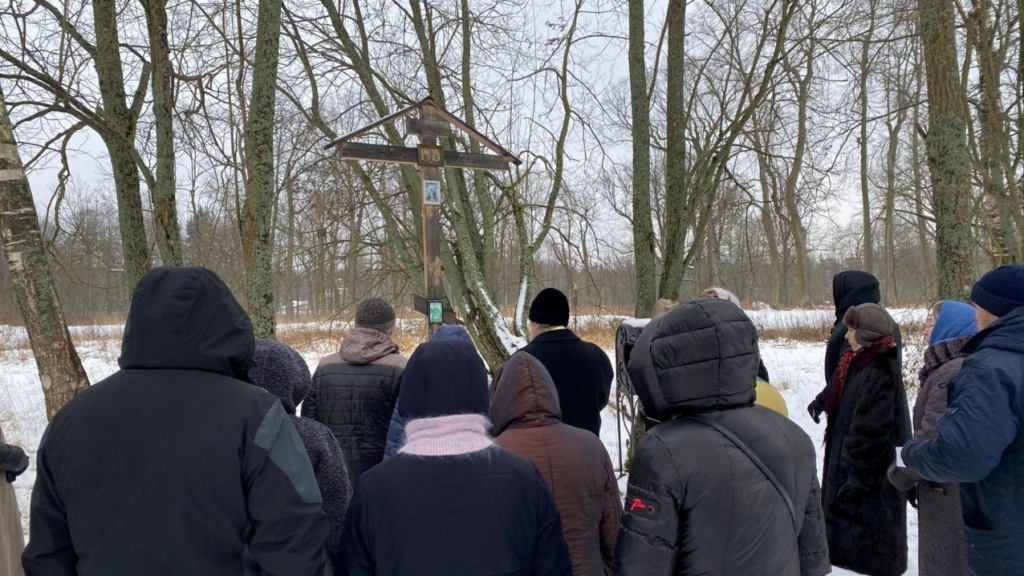
PHOTOS: the alleged first grave of Grigorii Rasputin
in the Alexander Park at Tsarskoye Selo
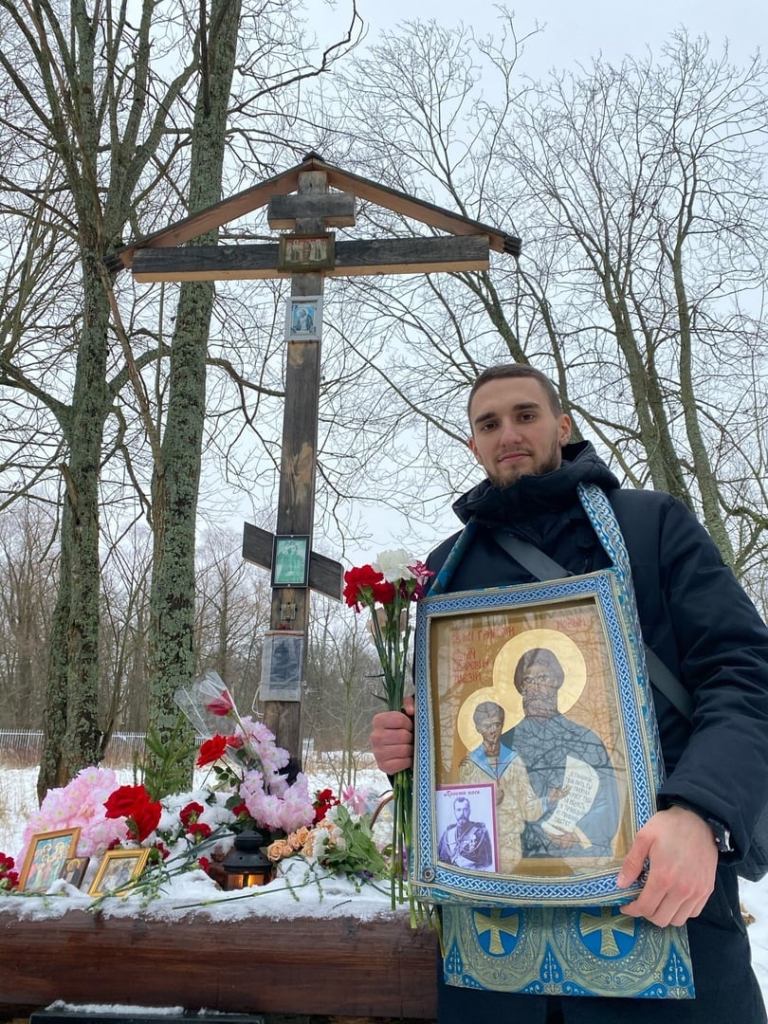
The alleged grave of Grigorii Rasputin at Tsarskoye Selo
In recent years, members and supporters of the Tsar’s Cross Movement gathered at the alleged first grave of Grigorii Rasputin. situated in the Alexander Park at Tsarskoye Selo.
Rasputin was buried here on 2nd January [O.S. 21st December] 1916, at a small church that Anna Vyrubova had been building. Shortly after the Tsar abdicated the throne in March 1917, Rasputin’s body was exhumed and burned by a detachment of soldiers.
The site has been repeatedly vandalized over the years, including September 2012, when vandals cut down the wooden cross, which was later found in the Alexander Park.
During my visits to Tsarskoye Selo over the years, the author of this article has made several attempts to locate the site, however, my efforts have been in vain.
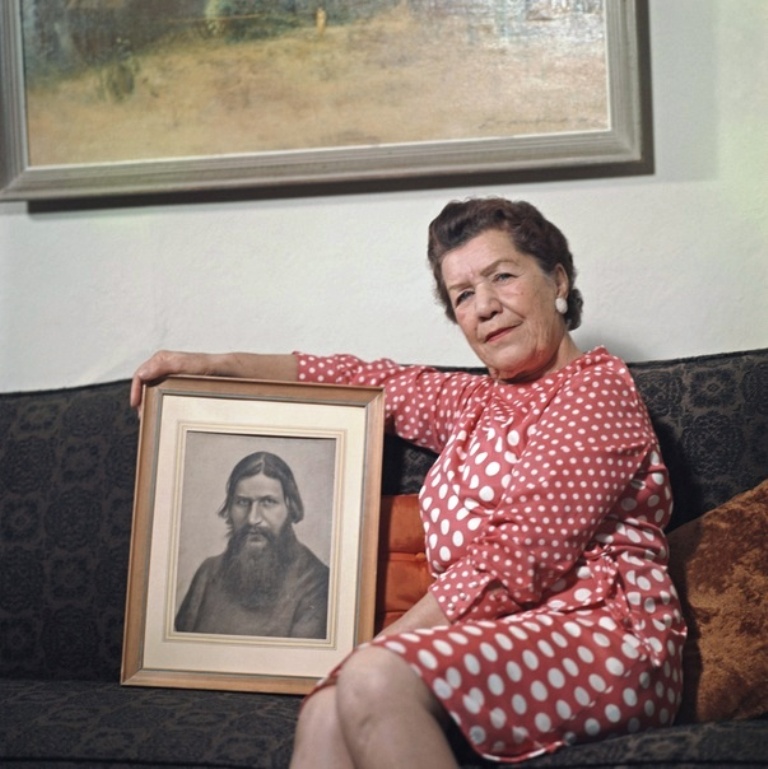
PHOTO: Maria Rasputina in exile, posting with a picture of her father Grigorii Rasputin
Rasputin’s daughter defends her father in exile
Born on 26th March 1898, Matryona (Maria) Grigorievna Rasputina, was the daughter of Grigorii Rasputin (1869-1916) and his wife Praskovya Fyodorovna Dubrovina (1865-1936).
After Prince Felix Yusupov published his memoir Lost Splendour (in 1928) detailing the gruesome death of her father, Maria sued Yusupov and Grand Duke Dmitri Pavlovich in a Paris court for damages of $800,000. She condemned both men as murderers, however, Maria’s claim was dismissed. The French court ruled that it had no jurisdiction over a political killing that took place in Russia.
Maria wrote two memoirs about her father, dealing with Emperor Nicholas II and Empress Alexandra Feodorovna, the attack by Khionia Guseva and her father’s murder on 30th December [O.S. 17th December] 1916. A third memoir, ‘The Man Behind the Myth,’ was published in 1977.
In her three memoirs, she painted an almost saintly picture of her father, insisting that most of the negative stories were based on slander and the misinterpretation of facts by his enemies.
During the last years of her life, Maria lived in Los Angeles, living on Social Security benefits. Her home was in Silver Lake, an area of northwest Los Angeles with a large Russian-American community.
Maria Rasputin died in Los Angeles, California, on 27th September 1977, aged 79. She was buried in Angelus-Rosedale Cemetery.
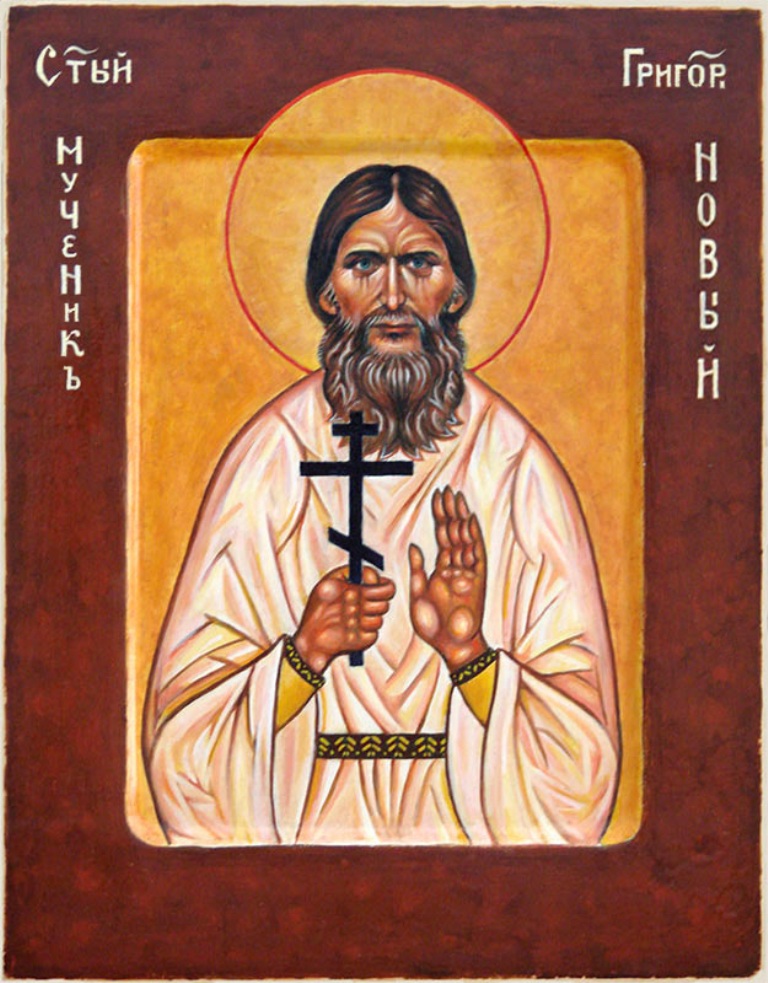
PHOTO: the above image depicts one of numerous non-canonical icons depicting Grigorii Rasputin, however, the strannik is not recognized as a saint by the Russian Orthodox Church Outside Russia (ROCOR) nor the Moscow Patriarchate
Movement to canonize Grigorii Rasputin
In recent years there has been growing support within and outside the Russian Orthodox Church (ROC) advocating for the canonization of Rasputin, viewing him as a genuine holy man and mystic, despite his scandalous reputation and association with the Romanov downfall, with some seeing him as a victim of slander and political intrigue, while the official Church remains hesitant due to his controversial life and negative historical perception.
Proponents emphasize his spiritual influence on the Empress Alexandra Feodorovna, his healing abilities especially for Tsesarevich Alexei Nikolaevich, and his deep piety, suggesting his perceived debauchery was exaggerated or fabricated by enemies.
The Russian Orthodox Church has largely resisted these calls, viewing his lifestyle and scandalous involvement in court politics as disqualifying for sainthood, making him a highly contentious figure even today.
FURTHER READING:
The Prophesies of Grigory Rasputin
In 1912, Grigory Efimovich Rasputin (1869-1916) published a book, in which he writes his prophecies, some of which soon came true, while others have yet to happen.
Putting aside one’s personal views of Rasputin or beliefs in prophecies, let us hope and pray that the unfulfilled predictions of Grigory Efimovich will remain so, otherwise humanity will face truly terrible trials and tribulations.
“Nicholas II should have listened to Rasputin” – Metropolitan Hilarion
The head of the Synodal Department for External Church Relations, Metropolitan Hilarion, believes that Nicholas II should have followed the advice of Grigory Rasputin and not entered the First World War, and thus saved both the monarchy and Russia.
The Real Rasputin?: A Look at His Admirers’ Revisionist History
The editorship of Orthodox Life is troubled by recent signs, even among certain members and clergy of the Russian Orthodox Church Abroad, of a revisionist history taking hold regarding the tumultuous and tragic events of the early 20th century — namely, the controversial and enigmatic figure of Grigory Efimovich Rasputin. We therefore offer this thorough and sober investigation by a respected scholar and historian of the Russian Church. May the question of “the real Rasputin” be finally put to rest, so that without discord and tumult in the Church, we may worthily honor the life and sufferings of the Holy Royal Martyrs and all the New Martyrs and Confessors of Russia, especially in the current and upcoming anniversary years.
© Paul Gilbert. 30 December 2021
 Nicholas II
You must be logged in to post a comment.