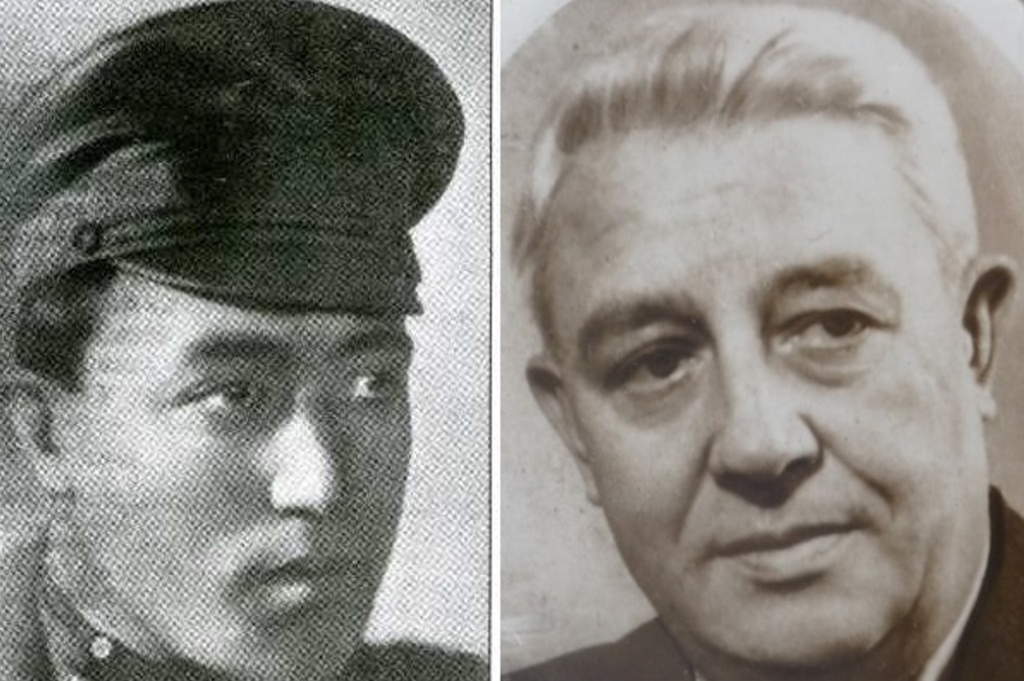
PHOTO: Grigory Petrovich Nikulin as he looked in 1918 and 1950
July 17th 1918, is the date that forever divided Russian history into “before” and “after”. That night, in the basement of the Ipatiev House in Ekaterinburg, the last Russian Emperor Nicholas II and his family were brutally murdered.
From loser to Chekist: the path of the regicide
Grigory Petrovich Nikulin, the future executioner was born in 1894 near Kiev into a poor lower-class family. Life did not work out well for Grigory, as a youth: he did not graduate from school or college, and he was already working hard by the age of 14. Fleeing from his alcoholic and abusive father, he ran away from home and quickly fell under the influence of revolutionary ideas. By 1916, he was already an experienced underground worker at a dynamite factory near Ekaterinburg.
After the February 1917 Revolution, Nikulin came out of the shadows, joined the Russian Social Democratic Labour Party (RSDLP) and became part of the All-Russian Extraordinary Commission (the Cheka). Here he made the acquaintance of Yakov Yurovsky, the future commandant of the Ipatiev House. Cold-blooded and loyal, Nikulin was ideally suited for the role of a guard, and then an executioner.
Nikulin proved his ruthlessness by shooting Prince Vassily Alexandrovich Dolgorukov (1868-1918), who had faithfully followed the Tsar and his family into exile. He was also involved in death of Bishop Hermogenes (Dolganyov) of Tobolsk and Siberia (1858-1918), who was drowned in the Tura River by the Bolsheviks.
A sentence that was waiting in the wings
In the spring of 1964, already being a pensioner and former head of the Moscow Criminal Investigation Department, Nikulin agreed to a radio interview. His story is a chilling protocol of a state sponsored murder.
According to him, the question of the fate of the Tsar was decided at the very top. The Chekist and fellow regicide Filipp Goloshchyokin went to Moscow twice to coordinate with Vladimir Lenin and Yakov Sverdlov. Initially, a public trial was planned, but the approach of the White Army on Ekaterinburg made it necessary to alter their plan. The final decision was made by the Ural Executive Committee of the Regional Council.
On 16th July, Yurovsky, returning from a meeting of the executive committee, announced that the execution would take place that night. Various options were discussed: to kill the prisoners in their sleep or to throw grenades into their rooms. They settled on a firing squad. Under the pretext of the danger of an attack on the house, the Tsar, his family and four faithful retainers were led down to the basement, where they would all be shot. There were to be no survivors.
At about 11 p.m., Botkin was woken up. “Would you be so kind as to awake the family and lead them downstairs.” Meanwhile the regicides assembled in the Ipatiev House to carry out the murders – Medvedev, Yermakov, Yurovsky, Pavel Medvedev and Kabanov – a total of eight people.
It took the family two hours to get ready. When they went down to the basement, they had to carry chairs – for the Empress and the Tsesarevich, who was dreadfully ill and could not stand.
” Alexandra Fedorovna and the heir sat down. Then Comrade Yurovsky, uttered: your friends are advancing on Ekaterinburg and therefore you are sentenced to death. They didn’t even get it, they had no time to react, because Nikolai yelled: “Ah!” and at that time there was a volley! One! Two! Three!”
Following all that, the innocent girl, Princess Anastasia, Demidova, who protected herself from fright with a pillow, and a sick teenager [Alexei] who, according to Nikulin, “tossed and turned for a long time.” They were both shot dead.
The regicide was “finished” in half an hour. The bodies were wrapped in blankets and thrown into the back of a waiting truck parked in the yard. The noise of the engine was supposed to drown out the shots and screams of the women.
“Baltasar was killed . . .”
According to the investigator Nikolai Alekseevich Sokolov (1882-1924), the bodies of the Imperial Family were taken to the forest, where they were desecrated and subsequently destroyed. The regicides themselves were shocked by what they had done. One of them said: “No one will ever find them…”
Nikulin himself sincerely believed that “humanity was shown on our part” and said that “he would be happy” if the Whites did the same to him. Obviously, he understood what a crime he had committed, and what kind of reprisal the embittered officers could have committed against him.
It is interesting to note, that on 20th July 1918, Nikulin accompanied two wagons of the Tsar’s family belongings from Ekaterinburg. They were first delivered to Perm, and after sorting, part of the valuables (silver, gold) along with four thousand poods of gold collected in the banks of the Ural cities were delivered to Moscow by a special train No 3-bis and handed over to the State Depository, the commandant of the train was Yakov Yurovsky, Nikulin was his assistant.
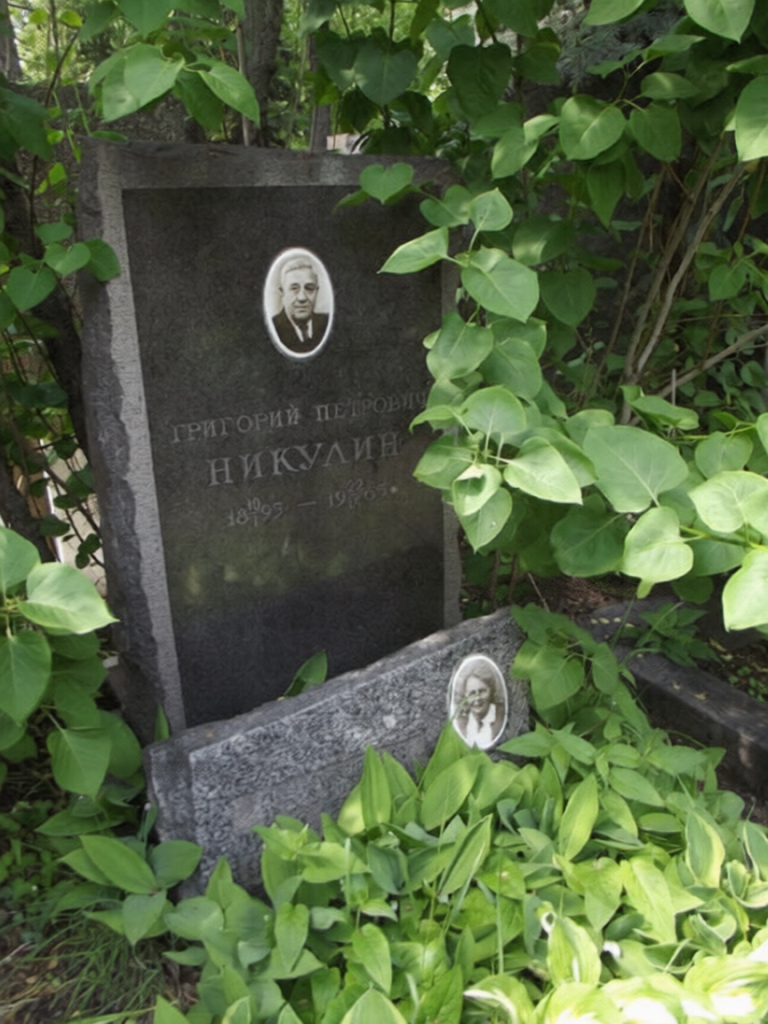
PHOTO: Nikulin’s grave in the Old Bolshevik section
of the Novodevichy Cemetery, Moscow
Grigory Petrovich Nikulin died on 22nd September 1965, at the age of 71. He was buried in the Old Bolshevik section of the Novodevichy Cemetery in Moscow.
Across from Nikulin’s grave is the grave of Boris Yeltsin (1931-2007), President of the Russian Federation from 1991 to 1999. The Ipatiev House was demolished by order of Boris Yeltsin in 1977 while he was leader of the Sverdlovsk Executive Committee.
The Politburo had declared the house not to be of “sufficient historical significance”, however, the real reason was that the Ipatiev House was becoming a shrine for a growing number of faithful, who left candles, made the sign of the Cross and offered prayers to the murdered Tsar and his family.
Given his participation in the regicide, it is nothing short of a miracle that Nikulin’s grave has not been vandalized by those faithful to the memory of Emperor Nicholas II and his family. In recent years, the graves of Pyotr Yermakov in Ekaterinburg and Yakov Yurovsky in Moscow have been vandalized repeatedly.
© Paul Gilbert. 29 January 2026
 Nicholas II
You must be logged in to post a comment.