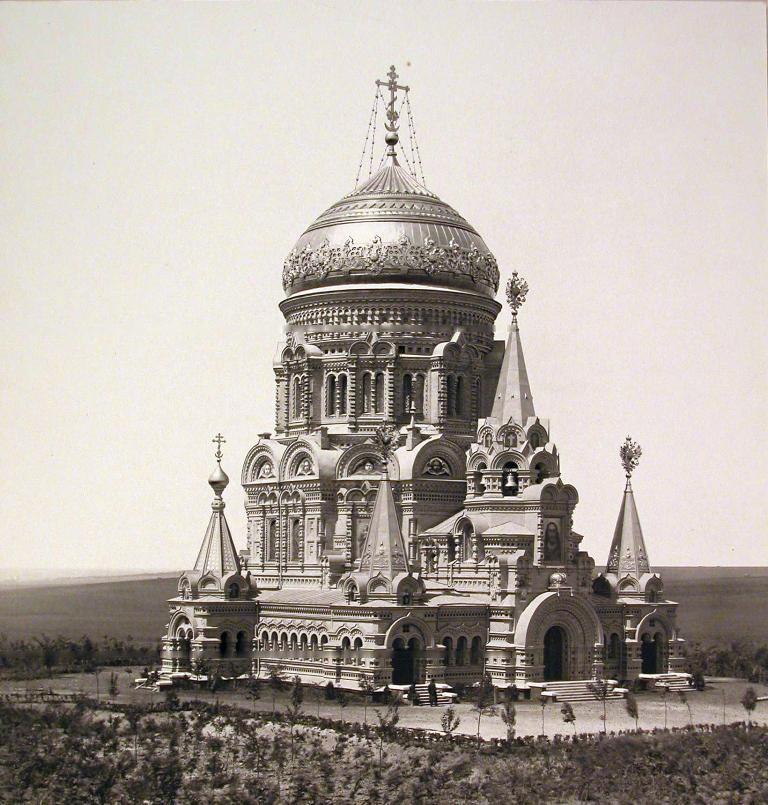
PHOTO: view of the Cathedral of Christ the Saviour at Borki. 1916
During the Bolshevik and later the Soviet war against the Russian Orthodox Church (1920-1980s), thousands of Orthodox churches, cathedrals and monasteries of the Russian Empire were destroyed. Many of these architectural monuments were blown up, their materials were used to construct new buildings. For instance. the marble salvaged from the demolished Cathedral of Christ the Saviour in Moscow in 1931, was used to decorate some of the city’s elaborate Metro stations.
One of the greatest architectural losses of both the Russian Empire and the Russian Orthodox Church is that of the Cathedral of Christ the Savior in Borki, Kharkov Oblast (today, part of eastern Ukraine).
The cathedral was built in 1891-1894 in the village of Borki, on the site of the crash of the Imperial Train on 17th October 1888, in memory of the dead and in honour of the miraculous salvation of the Emperor Alexander III and his family. The majestic cathedral, was designed in the Russian-Byzantine style, by the Russian architect Robert Robertovich Marfeld (1852-1921).
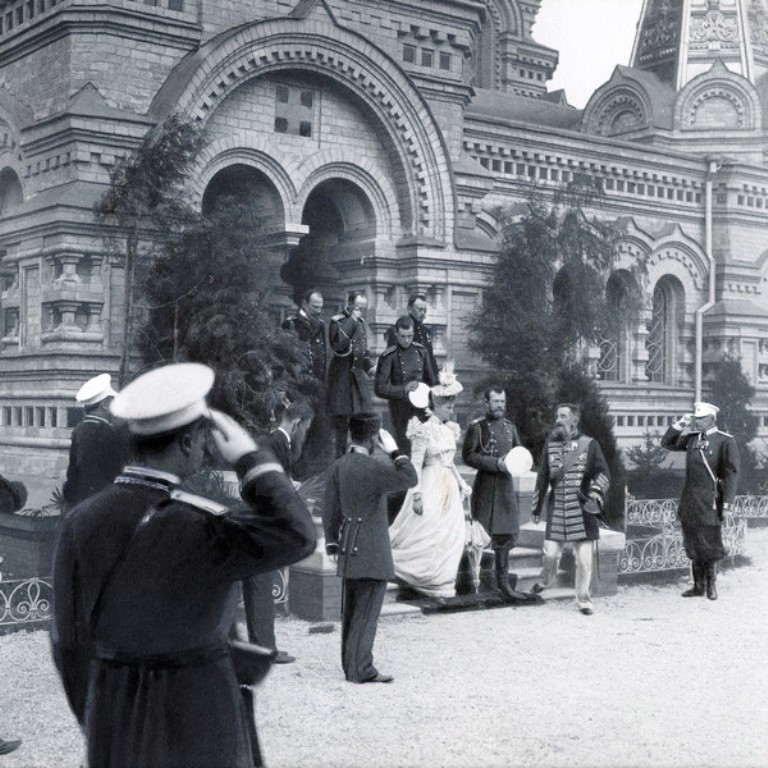
PHOTO: Emperor Nicholas II and Empress Alexandra Feodorovna leaving the Cathedral of Christ the Saviour on 20th August 1898, the day marking the 10th anniversary of the Borki train disaster
History
On 27th April 1889, on the initiative of the Kharkov governor Alexander Ivanovich Petrov (1838/1841—1915), a committee was created to erect a memorial at the site of the crash of the tsar’s train. On 30th May, the committee decided to construct a cathedral in the center of the architectural ensemble, and to erect a chapel on the site of the disaster itself. On the same day, the landowner Apollon Mikhailovich Mernenkov donated the land near the site of the disaster for the construction of the cathedral.
At the time, the crash site of the Imperial Train attracted a lot of people who came to pray at the site, but expressed dissatisfaction with the fact that there was no room for offering thanksgiving prayers for the salvation of the Tsar and his family, Archbishop Ambrose (Klyucharev) of Kharkov and Akhtyrka (1820-1901) and the Venerable Herman of Svyatogorsk (Gregory Ivanovich Klitsa (1816–1890) organized the construction of a wooden church and skete.
In addition, buildings for visitors to the skete, buildings for monastic cells and refectory, and a summer shelter for pilgrims were erected on the land donated by the peasants of the village of Sokolovo, Trees used for the construction of the Old Russian style church came from a pine forest in Moscow, and transported by rail. On 20th August 1889, the opening of the skete and the consecration of a church in honour of the Image of Christ the Saviour Not-Made-by-Hands took place.
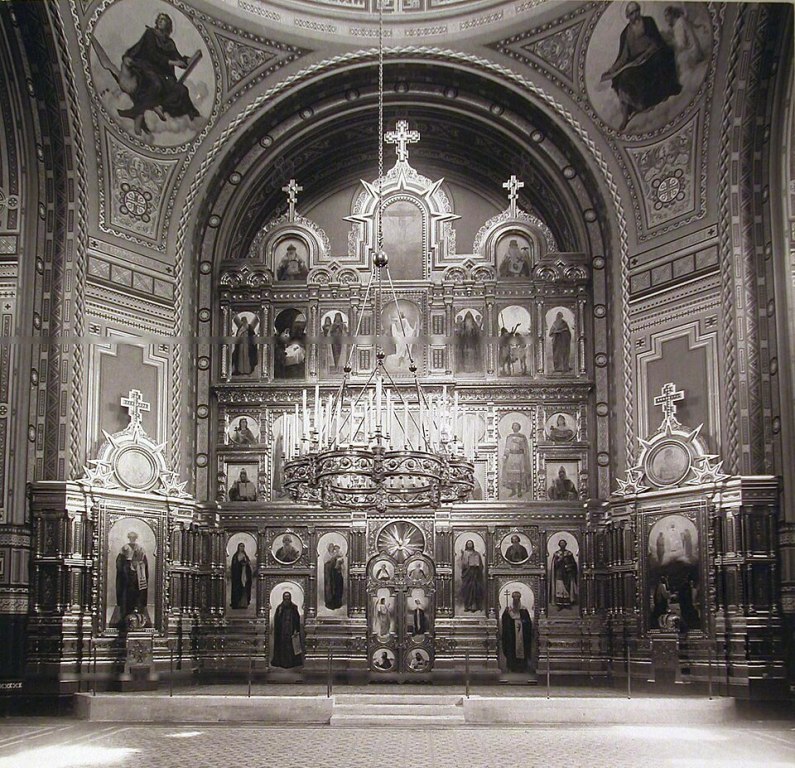
PHOTO: view of the iconostasis of Christ the Saviour at Borki. 1908
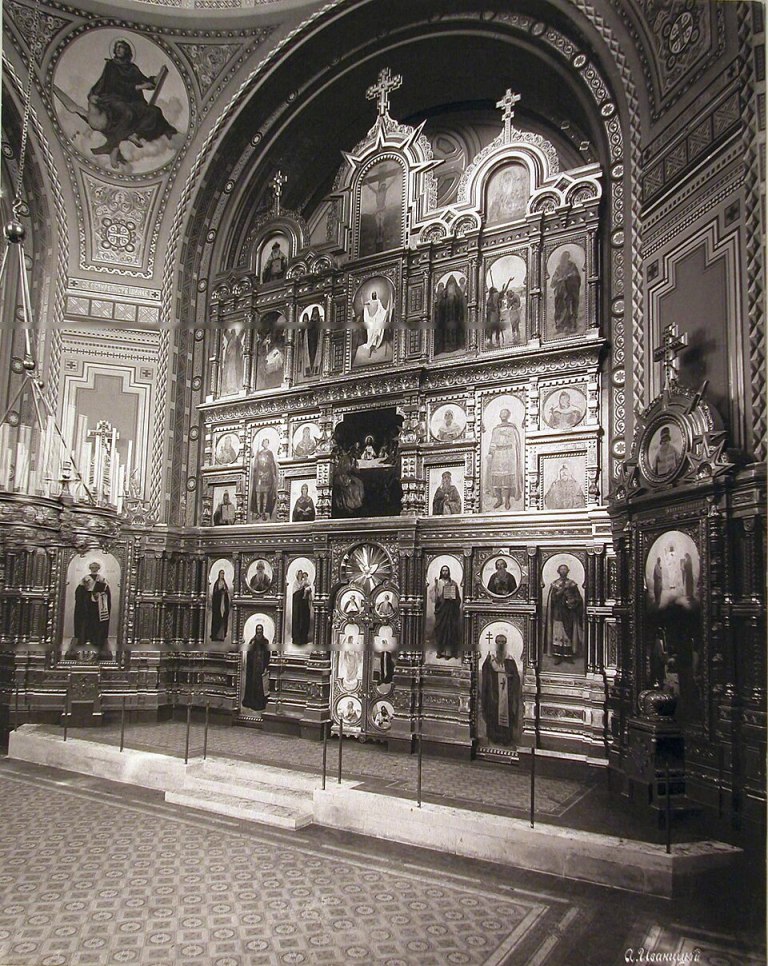
PHOTO: view of the iconostasis of Christ the Saviour at Borki. 1908
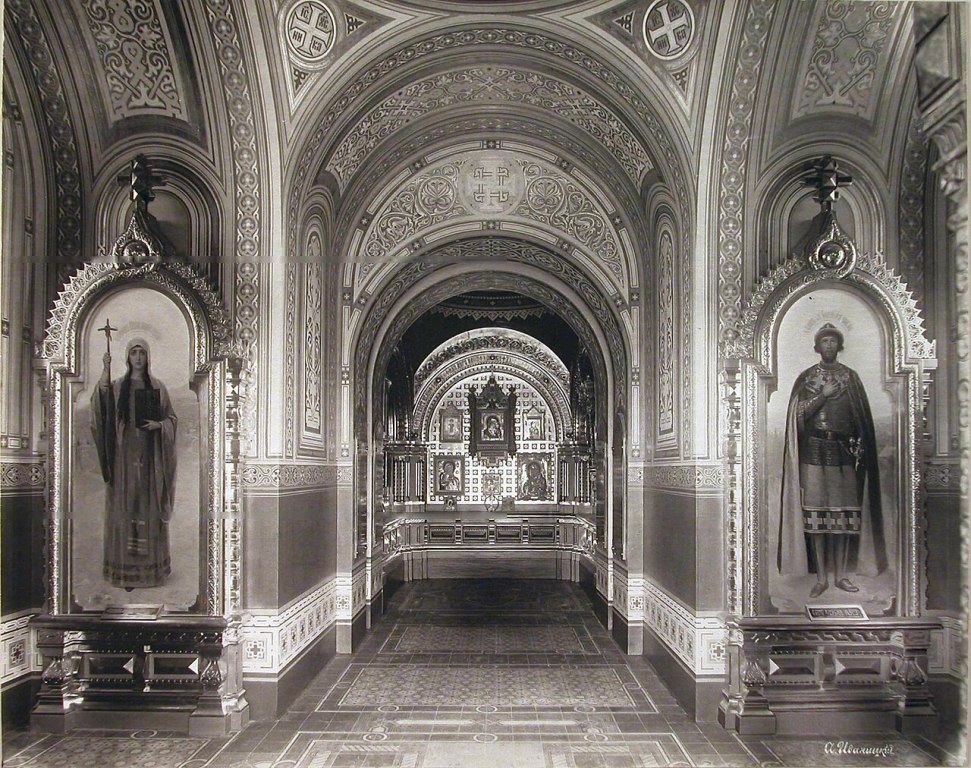
PHOTO: view of the two side chapels of Christ the Saviour at Borki. 1908
The project of the stone Cathedral of Christ the Saviour was developed by Robert Robertovich Marfeld (1852-1921), construction was carried out at the expense of the local manufacturer I. Voronin and numerous donors.
On 21st May 1891, the foundation was laid, the ceremony was attended by Empress Maria Feodorovna, Tsesarevich and Grand Duke Nikolai Alexandrovich [future Emperor Nicholas II] and other members of the Imperial Family.
The cathedral was designed to hold 1400 worshippers. It was a majestic structure, surrounded on three sides by a covered gallery and crowned with a huge golden dome. All the exterior gilding of the cathedral and chapel were made of gold leaf.
The interior of the cathedral was distinguished by simplicity and at the same time elegance. On the right side of the Holy Doors was placed the Image of the Saviour Not-Made-by-Hands, in honour of which the cathedral was erected, and on the left side was an icon of the Mother of God. The Holy Doors were carved from linden wood. On three sides of the church there were extensive choirs.
On 17th October 1891, a chapel was laid at the place where the Imperial Family miraculously came out from under the wreckage of the train. At first, its underground section was erected in the railway embankment, then aboveground, in the form of a tetrahedral tower with a golden dome. The Ministry of Railways at its own expense built two majestic staircases on the slope of the embankment and a platform opposite the cathedral itself.
On 14th July 1894, in the presence of Emperor Alexander III and members of his family, the solemn consecration of the cathedral in the name of Christ the Saviour took place.
A landscaped park was laid out in front of the cathedral, and outdoor lighting was installed. At the place where the Empress tended to the wounded victims of the train crash, a gazebo made of stones and metal was erected.
In 1900, the cathedral complex was transferred to the jurisdiction of the Ministry of Railways. With the money raised by the railway and voluntary donations, a hospital and a home for elderly railway workers were built at the cathedral complex, a parochial school and a public library were opened, as well as a museum dedicated to the events of 17th October 1888.
On 20th August 1898, Emperor Nicholas II, Empress Alexandra Feodorovna along with other members of the Imperial Family visited the Cathedral of Christ the Saviour, on the day marking the 10th anniversary of the Borki train disaster.
In 1908, a monument to Emperor Alexander III was erected next to the cathedral.
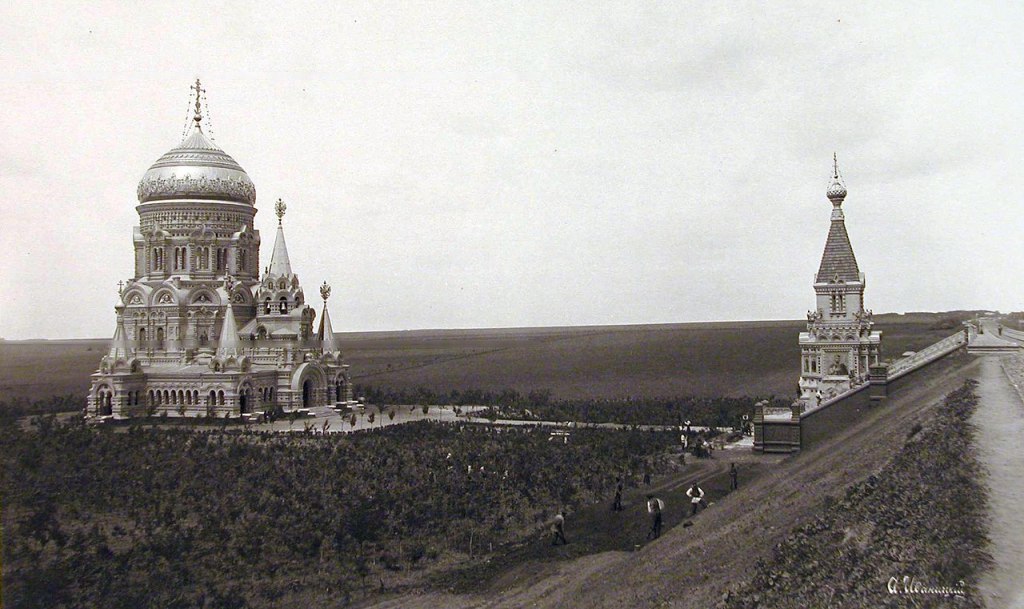
PHOTO: view of the Cathedral of Christ the Saviour at Borki. Only the Chapel of the Saviour (right) has surived to the present day
Destruction
During the Great Patriotic War (1941-45), the cathedral complex was completely destroyed. The Cathedral of Christ the Saviour caught fire, the golden dome collapsed. On 7th September 1943, the cathedral was blown up during the offensive of Soviet troops. It is not known whether it was the Soviets or the Nazis who shelled it. After the war, the ruins of the cathedral were blown up.
Miraculously, only the Chapel of the Saviour, situated some 60 meters from the cathedral survived, although it to was badly damaged during the war. In 1992-1993, the chapel was restored, funded by conations raised by local residents and the Southern Railway. On 27th April 2003, the chapel was consecrated by Bishop Onufriy.
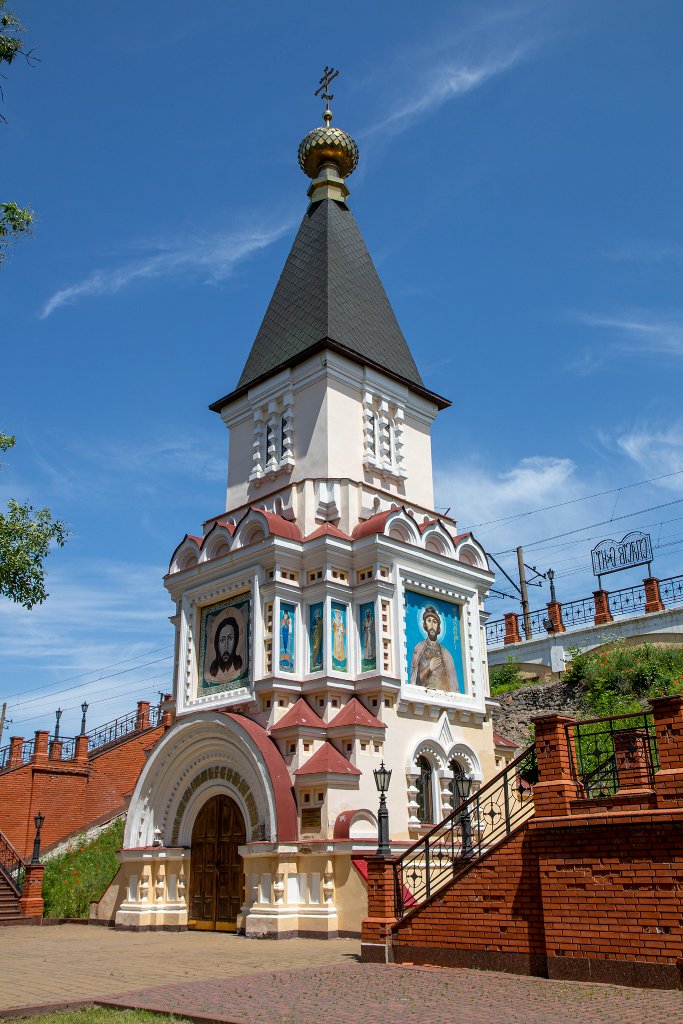
PHOTO: the Chapel of the Saviour at Borki as it looks today
FURTHER READING
Lost Orthodox Churches of Imperial Russia – Part I + 13 PHOTOS
Lost architectural monuments of the Moscow Kremlin + 13 PHOTOS
© Paul Gilbert. 30 January 2026
 Nicholas II
You must be logged in to post a comment.