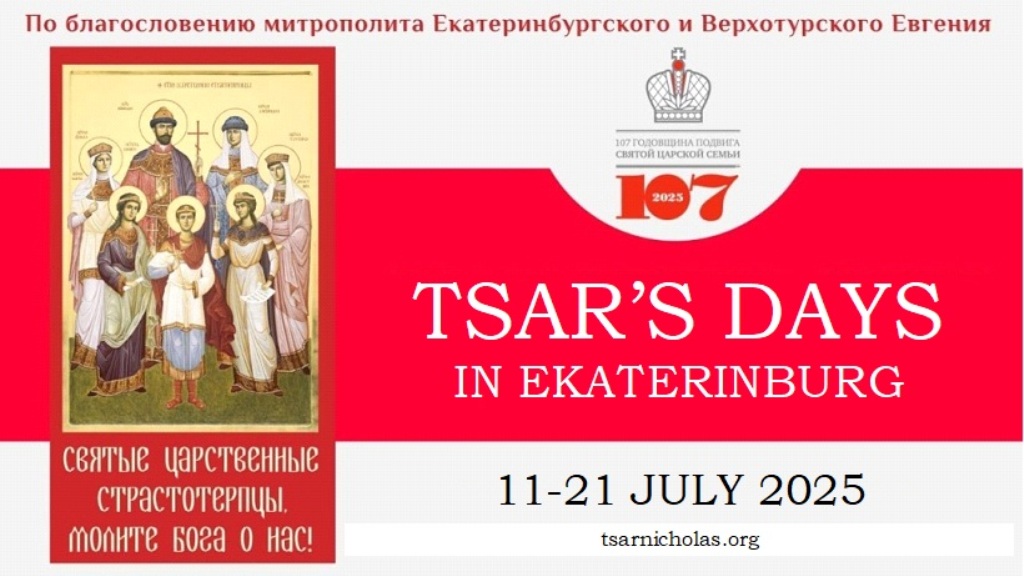
The Ekaterinburg Metropolis are currently preparing for Tsar’s Days – 2025, which will be held in the Ural capital and in Alapaevsk from 11th to 21st July. This year marks the 107th anniversary of the death and martyrdom of Emperor Nicholas II, his family and their four faithful retainers on 17th July 1918. It also marks the 107th anniversary of the death and martyrdom of Grand Duchess Eliabeth Feodorovna and other Romanov family members in Alapaevsk on 18th July 1918.
Metropolitan Evgeny of Yekaterinburg and Verkhoturye noted the importance of the upcoming memorial events, which traditionally bring together tens of thousands of faithful from across Russia and abroad.
The central event of Tsar’s Days is the Divine Liturgy held on the night of 16/17 July, followed by a 21-km [13 miles] Cross Procession, from the Church on the Blood in central Ekaterinburg to the Monastery of the Holy Royal Passion-Bearers at Ganina Yama. for which “the whole of Russia gathers” in the Ural capital.
This years’ Tsar’s Days is part of the 24th International Festival of Orthodox Culture, which will be held over a 10-day period from 11-21 July. Aside from divine services and religious processions, the festival will feature many events in honour of the Holy Royal Martyrs, including bell ringing, concerts and musical evenings, as well as exhibitions and conferences hosted by well-known historians, theologians and authors.
Preparations for the Tsar’s Days are being carried out by the Ekaterinburg Metropolia with the support of the regional and city authorities.
Once again, Porosenkov Log will not included in this year’s Cross Procession. Porosenkov Log is where the remains of the Imperial Family were exhumed in two separate graves in 1991 and 2007 respectively. Due to the fact that the Moscow Patriachate does not yet recognize the Ekaterinburg Remains as those of the Imperial Family. Their official recognition rests with the Bishops’ Council of the Russian Orthodox Church.
The veneration of Nicholas II
The veneration of Nicholas II and his family actually began just days after their murder in July 1918. During the Soviet years, such activity would most certainly have been suppressed, forcing the faithful to honour the Holy Royal Passion-Beaers in secret.
After the fall of the Soviet Union in 1991, everything changed, when in 2000, some 300 faithful gathered at the sight of the Ipatiev House in Sverdlovsk [Ekaterinburg]. In 2002, the first Cross Procession in memory of the Holy Royal Martyrs was held in the Ural capitlal, attracting 3,000 faithful. The procession has been held every year since, the most important being in 2018, the year marking the 100th anniversary of the death and martyrdom of the Imperial Family.
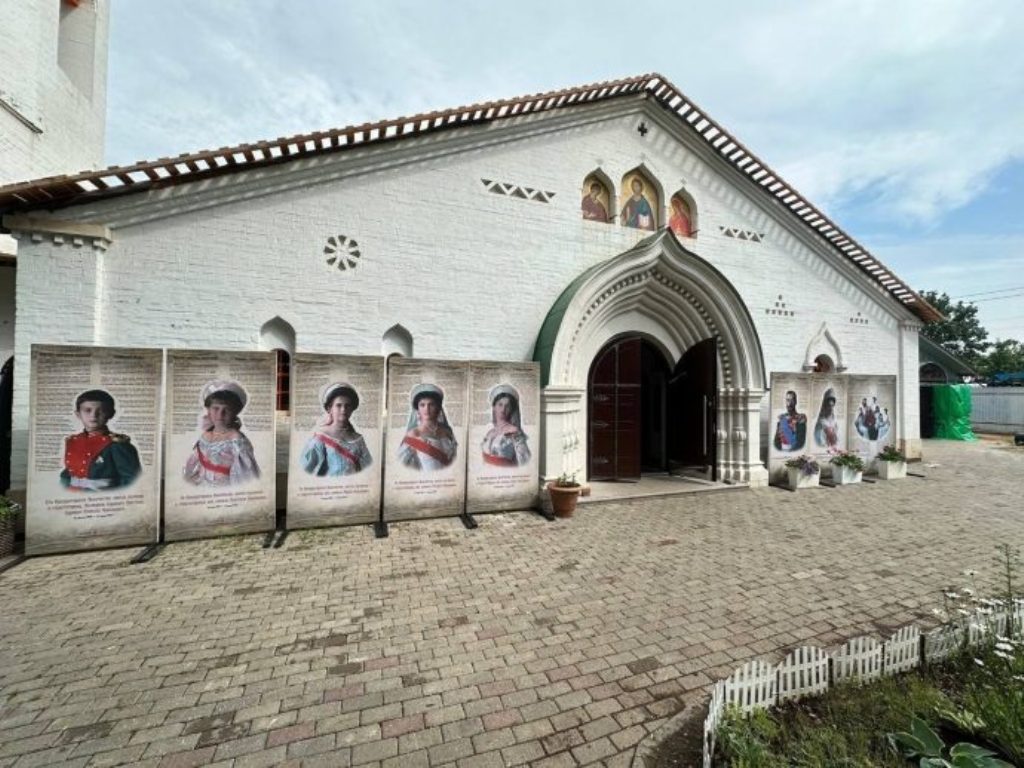
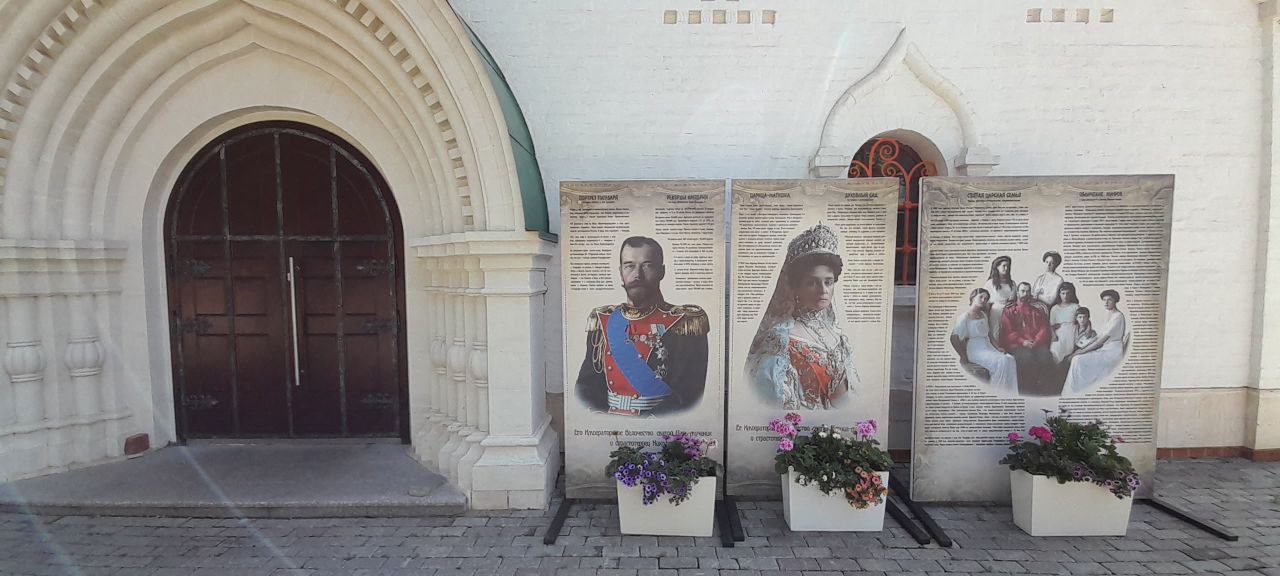
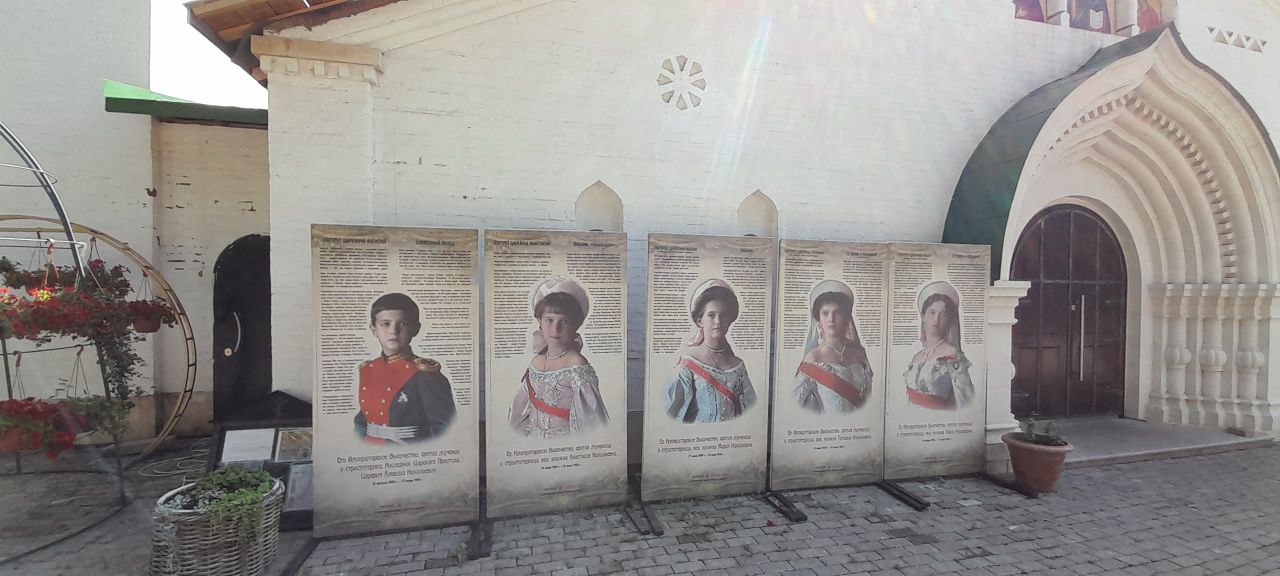
Earlier this month, a unique outdoor exhibit dedicated to Emperor Nicholas II and his family opened on the grounds of the Mironositsky Church [the Church of the Holy Myrrh-Bearing Women] in the Russian city of Istra [Moscow oblast].
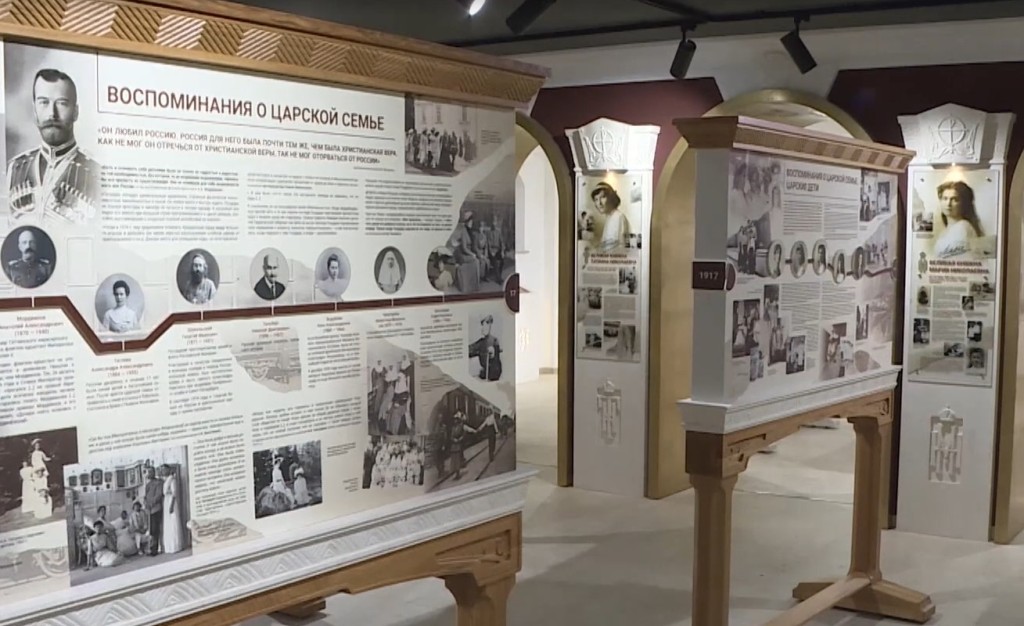
The Tsar’s Crown, featured 8 posters, which provide visitors with a deeper understanding of the life of the Imperial Family during the late 19th and early 20th centuries, and their death and martyrdom.
The exhibition ran until June 15, and has now moved to the St. George Church in the city of Dedovsk.
***
*As I have noted in previous posts, I support any initiative – big or small – to help keep the memory of Nicholas II and his family alive in 21st century Russia – PG
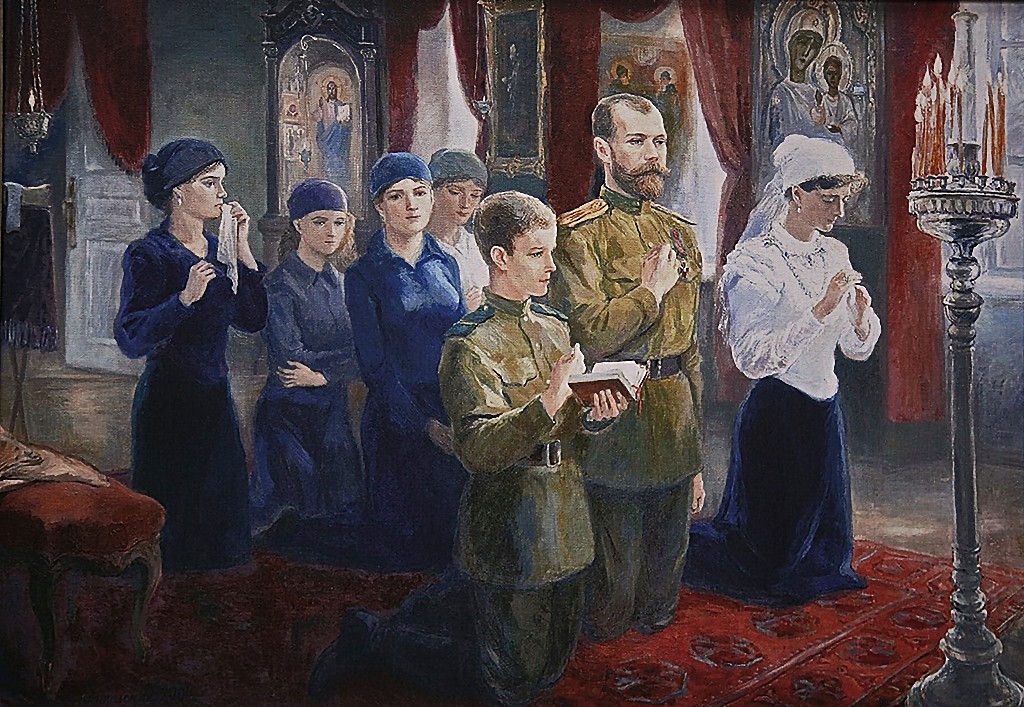
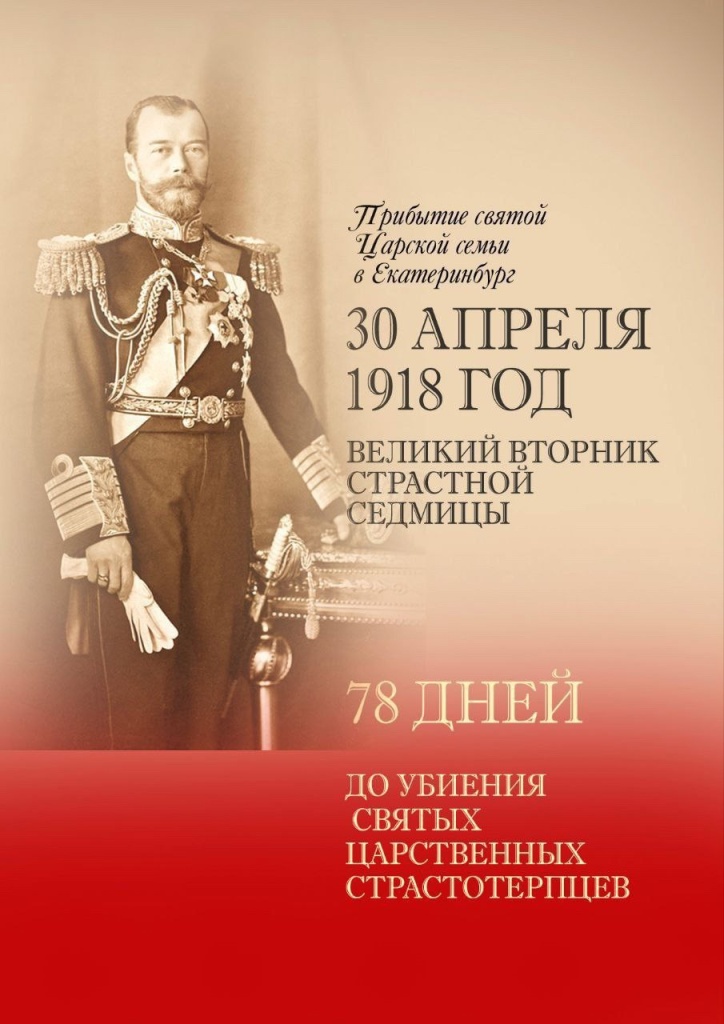
прибытие святой царской семьи в екатеринбуре. 30 април 1918 год. великий вторник старстной седмицы. 78 дней до убиения святых царственных страстотерпцев.
Arrival of the Holy Royal Family in Yekaterinburg. April 30, 1918. Great Tuesday of Holy Week. 78 days before the murder of the Holy Royal Passion-Bearers.
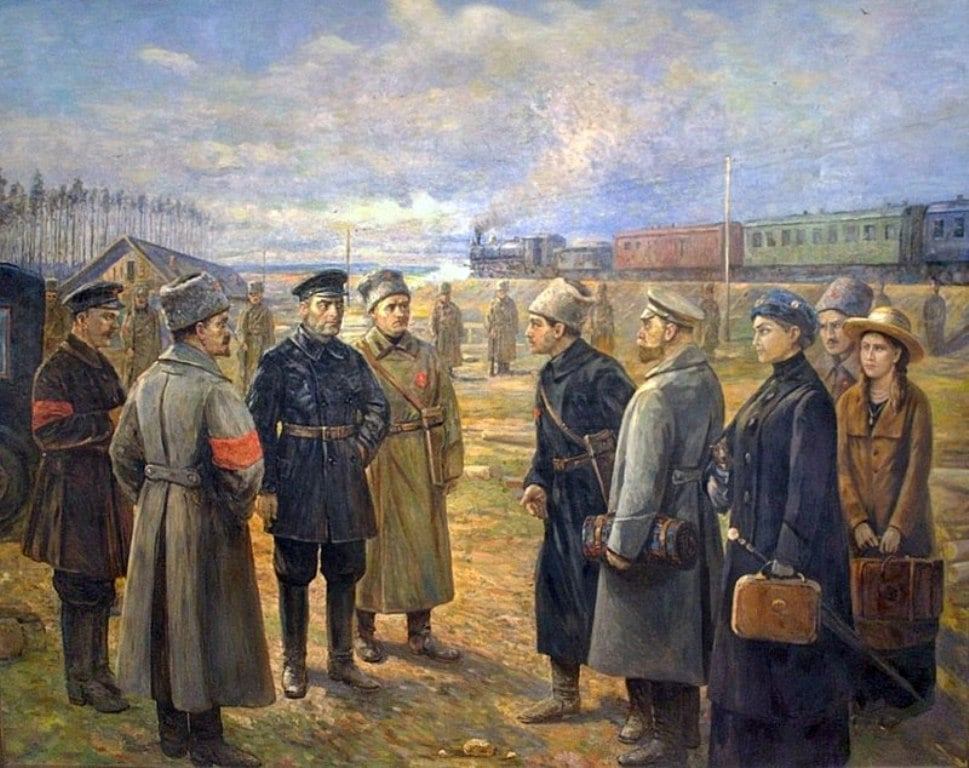
Today marks a very sad anniversary . . . it was on this day – 30th April (O.S. 17th April) 1918, Emperor Nicholas II, Empress Alexandra Feodorovna and Grand Duchess Maria were handed over to the Ural Soviets in Ekaterinburg
Nicholas II wrote the following in his diary:
“At 8.40 we arrived in Ekaterinburg. We stood for three hours in one station. There was a heated dispute between the local commissars and our own. In the end, the first prevailed and the train was moved to another goods terminal. After standing there for an hour and a half, we got off the train. Yakovlev handed us over to the local regional commissar, with whom we drove by motor through empty streets to the accommodation which has been prepared for us—the Ipatiev house. Slowly our people and our things began to arrive, but they would not let Valia through.
“The home is pleasant and clean. We have been given four large rooms. We were not able to unpack our things for a long time, as the commissar, the commandant and the guards captain had not had time to inspect our trunks. Then the inspection was like a customs search, just as strict, right down to the last capsule in Alix’s travelling medicine kit. This annoyed me so much that I expressed my opinion sharply to the commissar. By 9 o’clock we had at last settled in.
“This is how we installed ourselves: Alix, Maria and I together in the bedroom, sharing the dressing room, Demidova in the dining room, Botkin, Chemodurov and Sednev in the hall. The duty officer’s room is by the entrance. In order to go to the bathroom of W.C., it was necessary to go past the sentry at the door of the duty office. There is a very high wooden pallisade built all around the house, about two sajens from the windows, all along there was a line of sentries, in the little garden also.”
PHOTO: “Transfer of the Romanov family to the Ural Soviet” (1927) Artist: Vladimir Nikolayevich Pchelin (1869-1941)
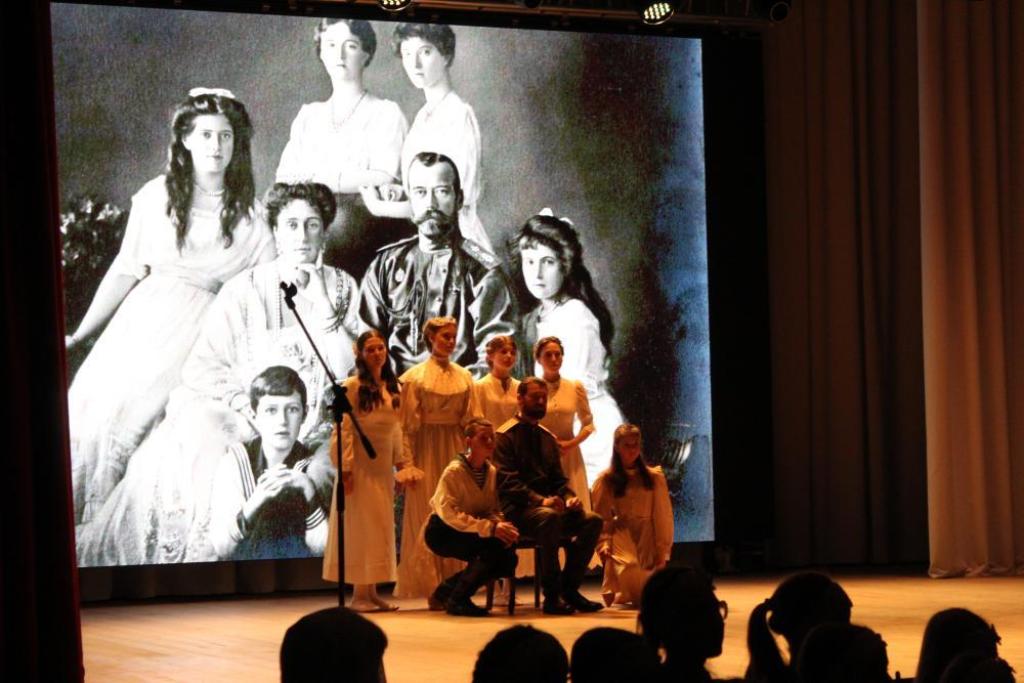
PHOTO: local actors perform the roles of the Imperial Family
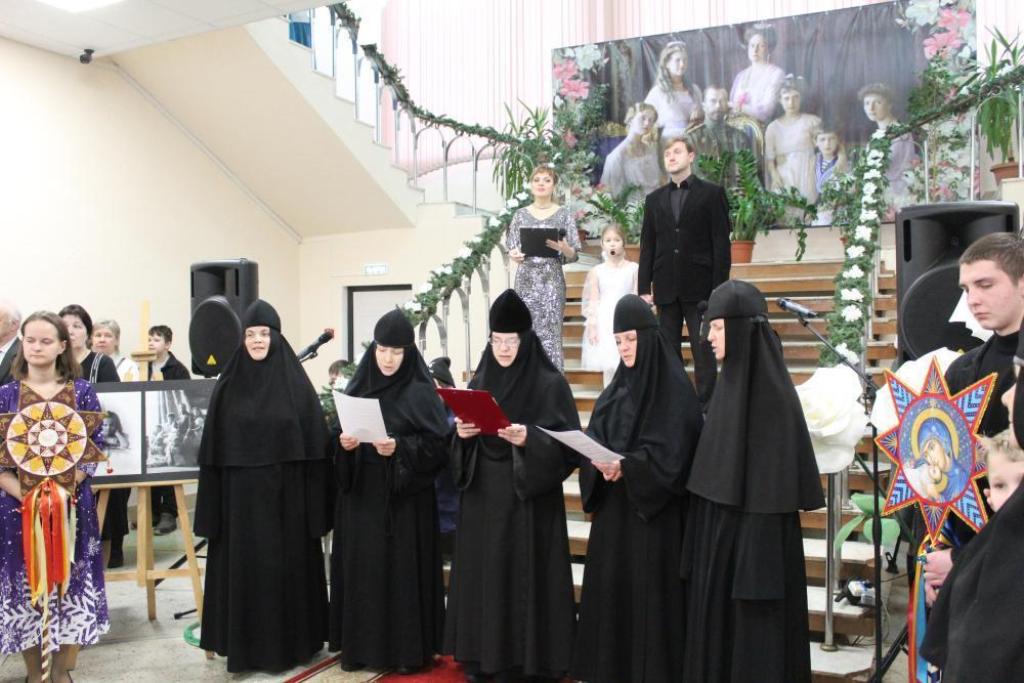
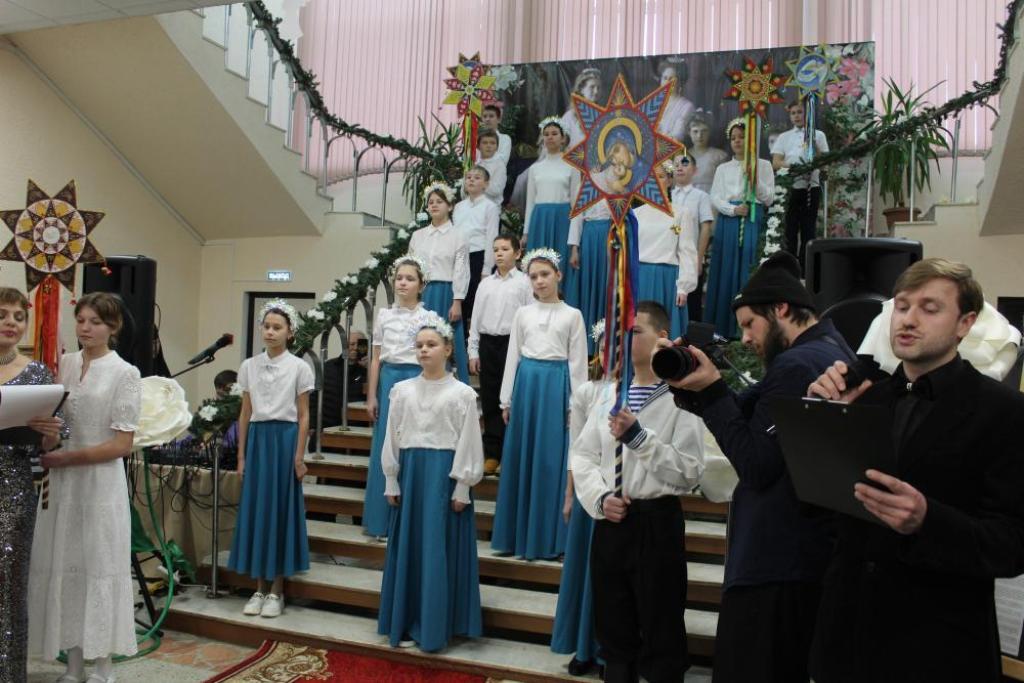
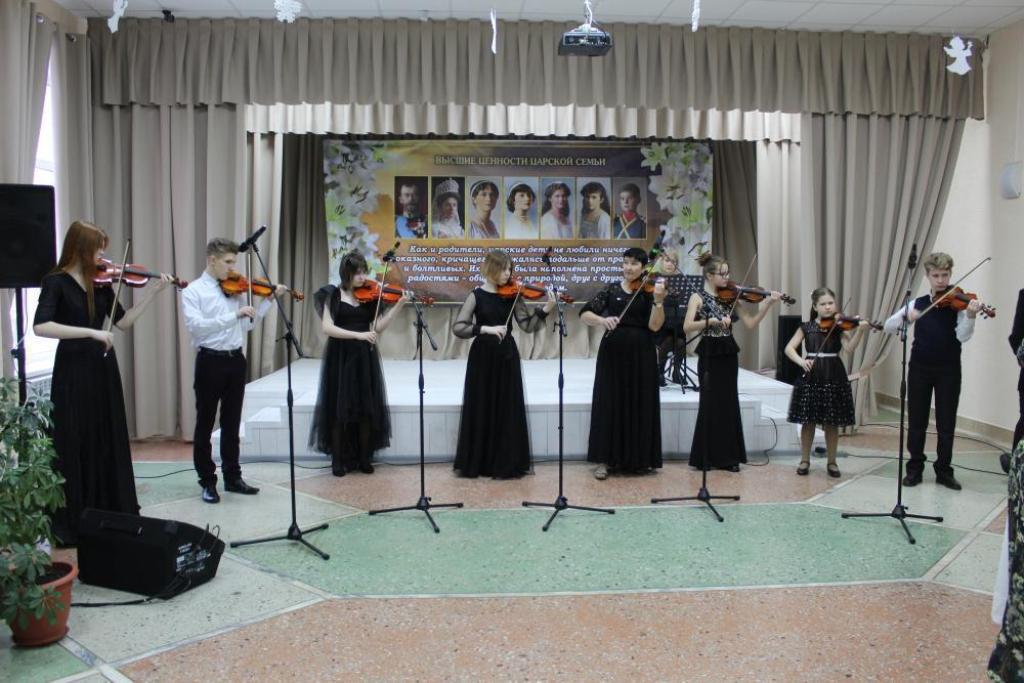
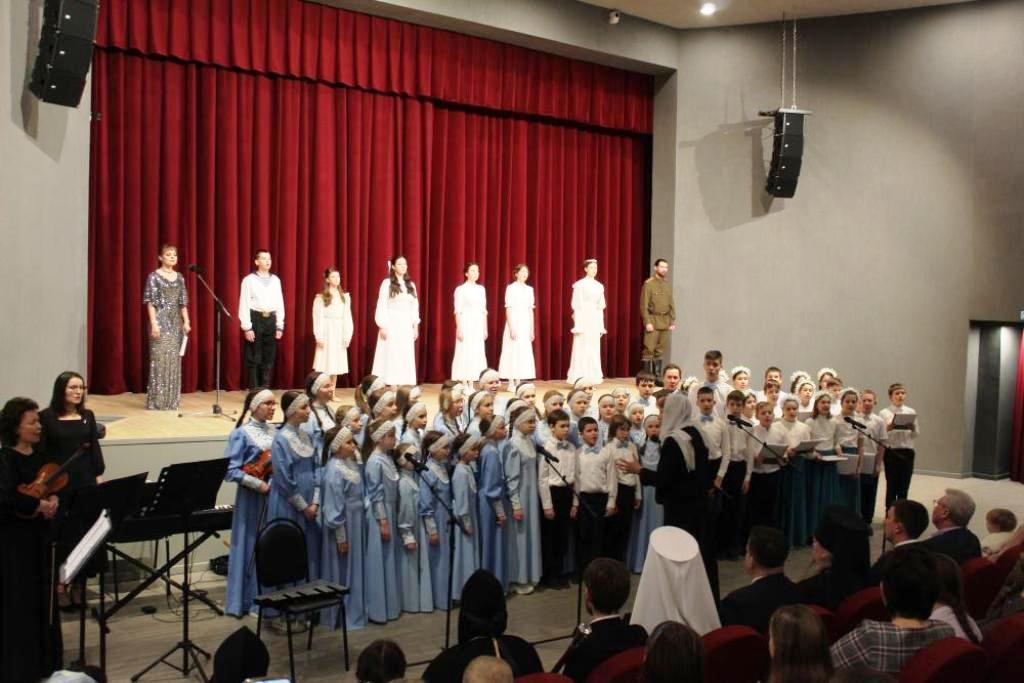
On 11th January 2025, a *Christmas event dedicated to Emperor Nicholas II and his family was held in the House of Culture in the village of Narovchat, Penza Region. Christmas in the Circle of the Tsar’s Family marked the traditions of celebrating the Nativity of Christ in the circle of the family of the Holy Royal Passion-Bearers and Imperial Russia.
* Recall that Orthodox Christians celebrate Christmas on 14th January, according to the Old Style Julian Calendar
The event was organized by the nuns of the Trinity-Scanov Monastery, the pupils of the monastery Sunday School, the pupils of the Bishop’s Children’s Choir of the Penza Diocese and the staff of the Penza Museum of Local Lore.
The guests of honour included Metropolitan Seraphim of Penza and Nizhnelomovsk, Bishop Mitrofan of Serdobsk and Spassky, Minister of Culture and Tourism of the Penza Region Sergey Vyacheslavovich Bychkov, and acting head of the Narovchat district Sergey Viktorovich Skudin.
Guests were greeted in the lobby by the pupils of the Sunday school and the nuns of the Trinity-Skanov Monastery, who sang carols and praises to the newborn Christ child.
On stage the private world of the Imperial Family was revealed. Local actors read aloud the personal letters of Tsar Nicholas and Tsarina Alexandra to each other, which revealed to the audience the tender and loving image of the Imperial Family.
An Imperial Ball was held, which focused on the splendour of the Russian Imperial Court in the early 20th century. Elegantly dressed ladies and gentlemen performed waltzes and polkas to live music of the era – all of which created an inspiring atmosphere of the holiday.
At the end of the solemn event, all participants received gifts from the abbess of the Trinity-Scanov Monastery, Abbess Innocent.
Also during the event, an exhibition of photographs courtesy of the Sretensky Monastery “The Royal Family: Love and Mercy” was opened. The exhibition features photographs reflecting the life and work of the Imperial Family.
In addition, the White Flower Festival was celebrated, which offered guests many skillful crafts made by the nuns, delicious pastries and much more. The tradition of the White Flower Festival was initiated by Empress Alexandra Feodorovna and her children at the beginning of the 20th century.
PHOTO: entrance to the exhibition which takes up the entire ground floor of the recently constructed Church of the Holy Royal Passion-Bearers in Dno
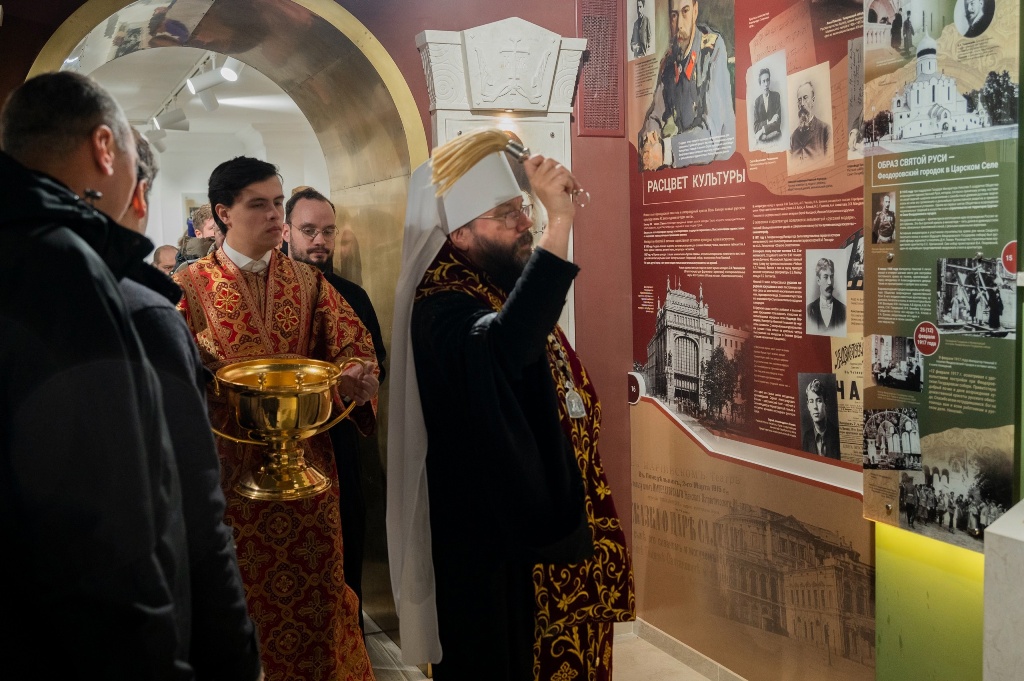
On 26th December 2024, a new museum dedicated to Emperor Nicholas II and his family was officially opened and consecrated in the Church of the Holy Royal Passion-Bearers in the Russian city of Dno, situated 114 km from Pskov.
Metropolitan Matthew of Pskov and Porkhov performed the rite of consecration of the museum to the Royal Passion-Bearers. The museum takes up the entire ground floor of the church. Admission to the museum is FREE to all!
PHOTO: His Eminance performs the rite of consecration of the museum to the Royal Passion-Bearers
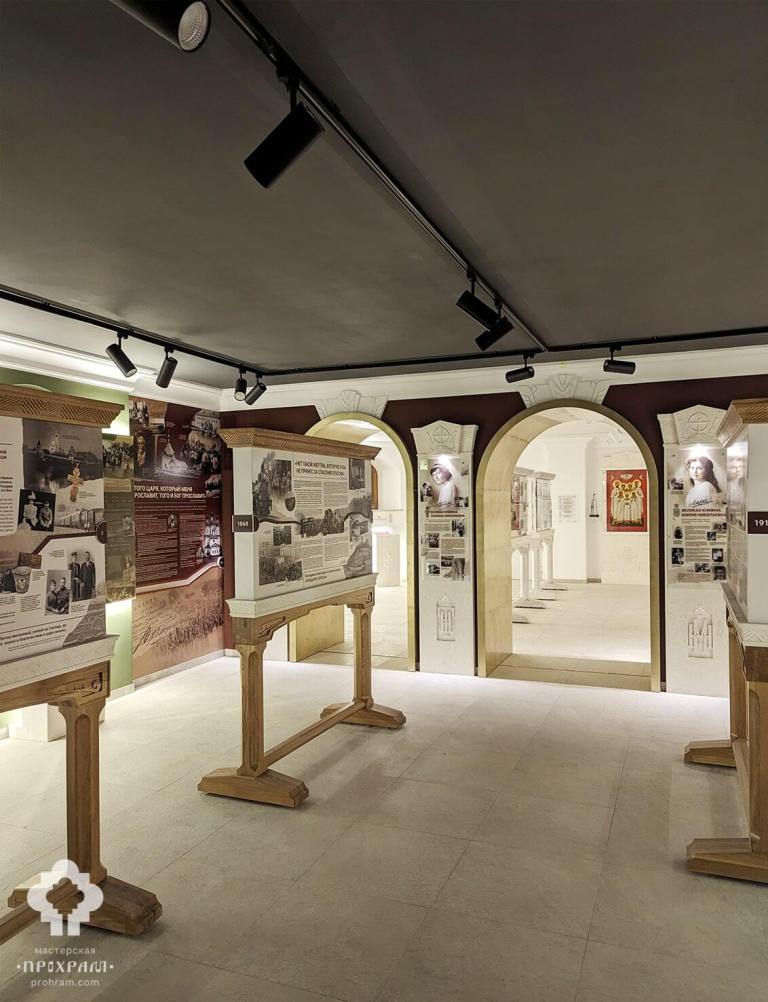
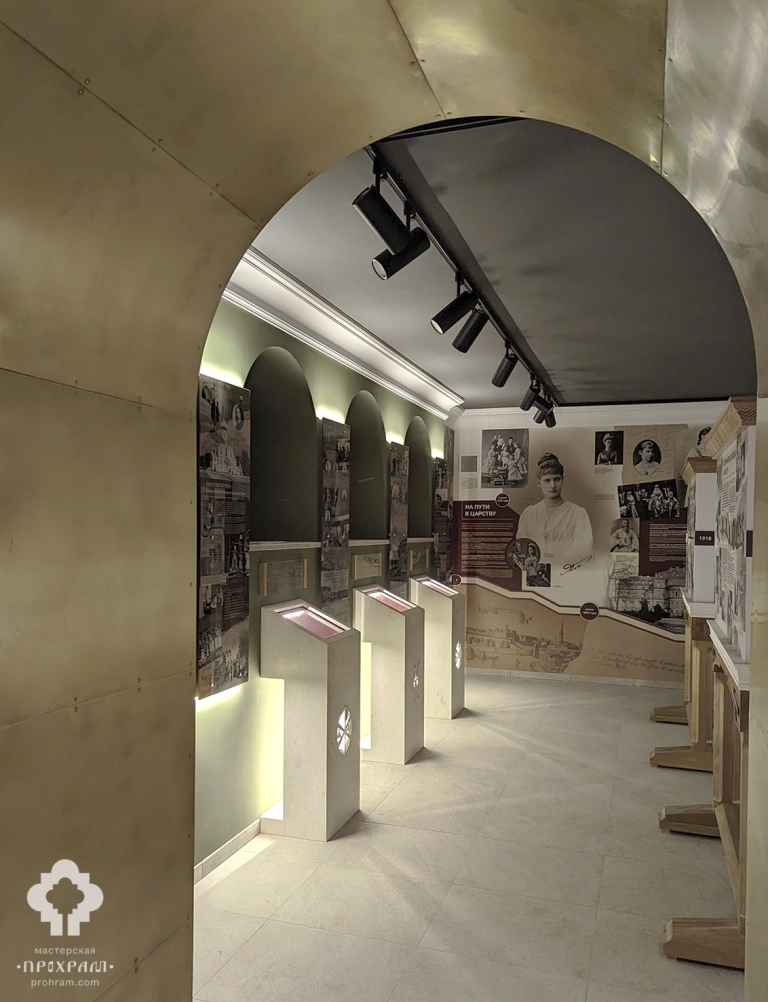
The interiors of the museum are a wonderful example of modern exhibition spaces, designed in the Neo-Russian Style [aka the Russian Revival Style], characteristic of the early twentieth century and beloved by Russia’s last Tsar.
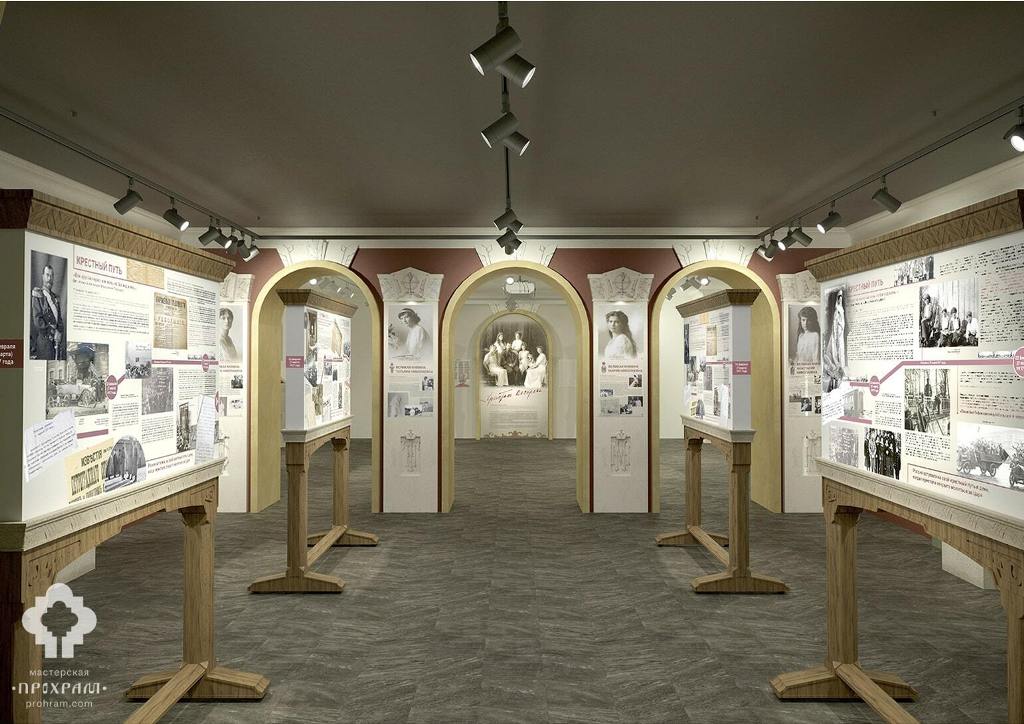
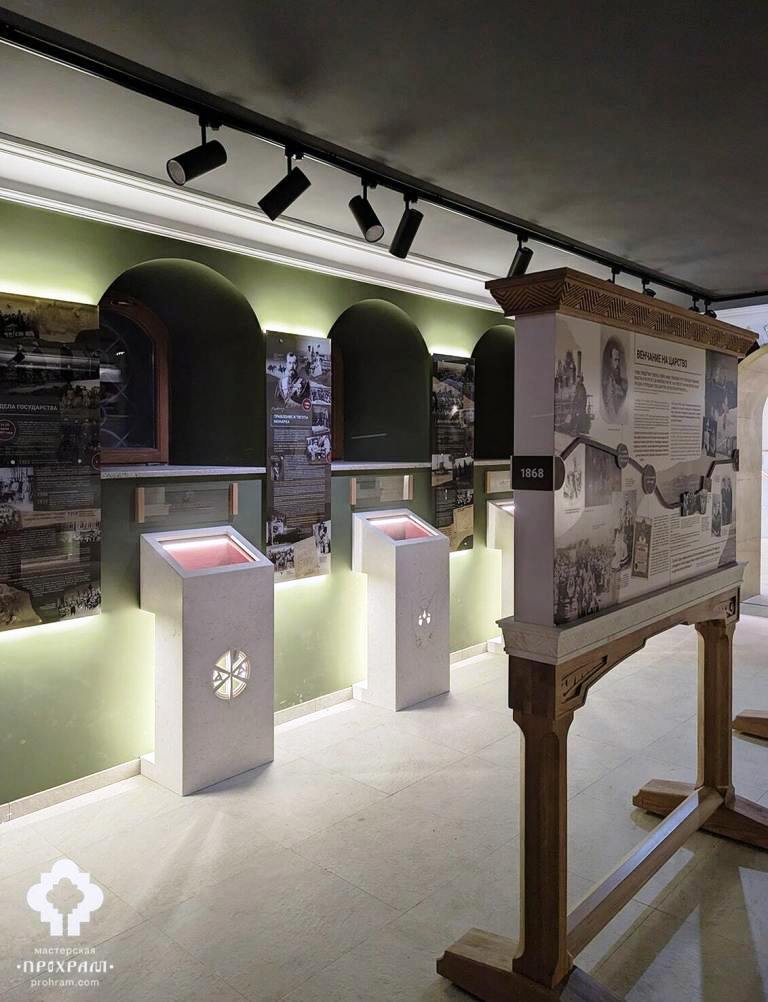
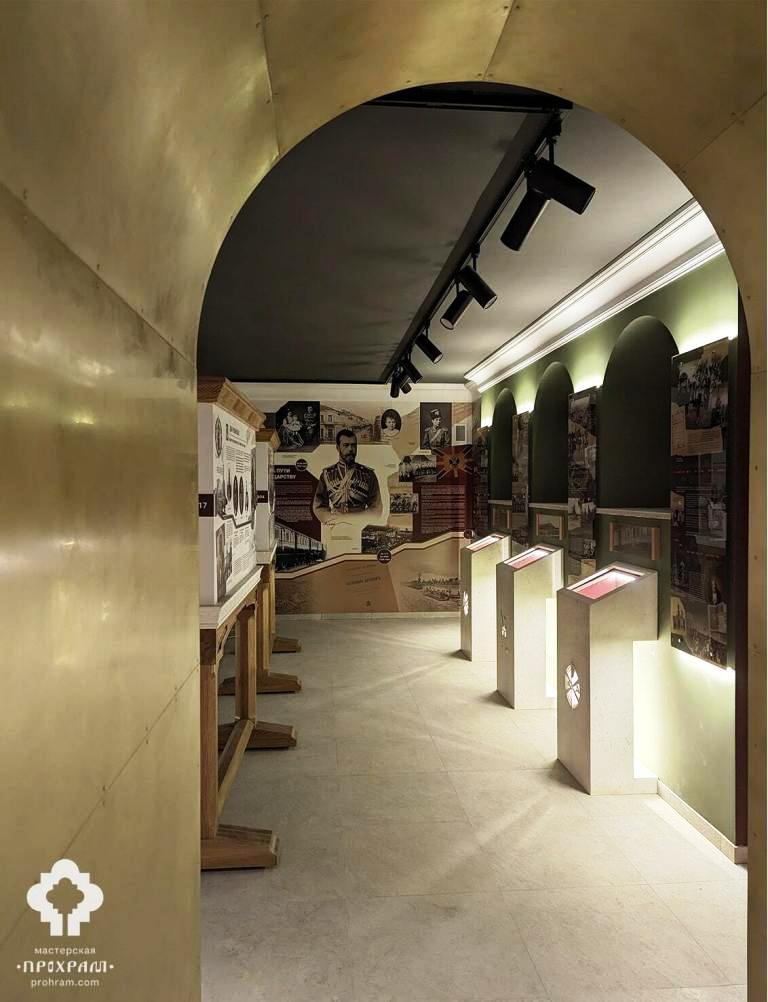
The museum is divided into two halls. The first hall, which is painted burgundy-green, combined with dim lighting. Burgundy is the colour of the Imperial Porphyry, green is the colour of the monk. In this hall, the exposition explores the life of the Imperial Family from Emperor Nicholas II’s and Empress Alexandra Feodorovna’s childhood to the tragic vents of 1917. Two stands describe the history of the House of Romanov – from the calling to the throne of Mikhail Feodorovich in 1613 and to the death and martyrdom of Nicholas II 305 years later.
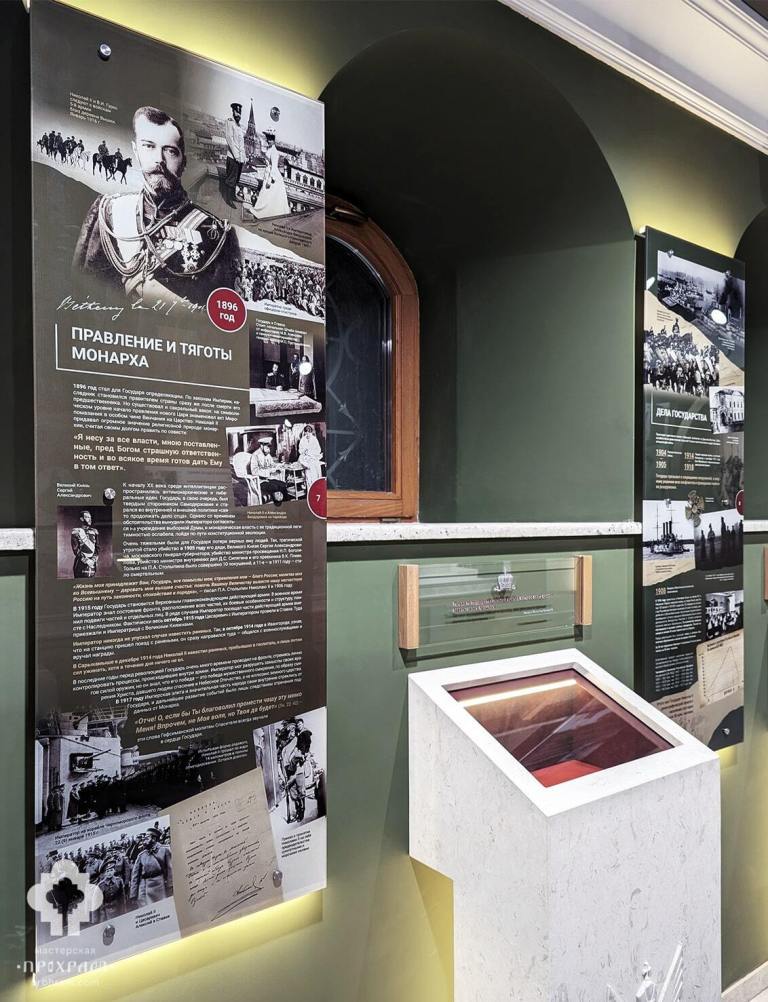
Archival photographs and documentary materials, diary entries, testimonies of contemporaries, statements by prominent public and church figures reveal in detail the life of the Imperial Family. They tell about their service to Russia, their close family relations, and the historical context of the events of the late 19th and early 20th centuries. In addition, the exposition explores the cultural, scientific, and political life of the Russian Empire during the era of Nicholas II.
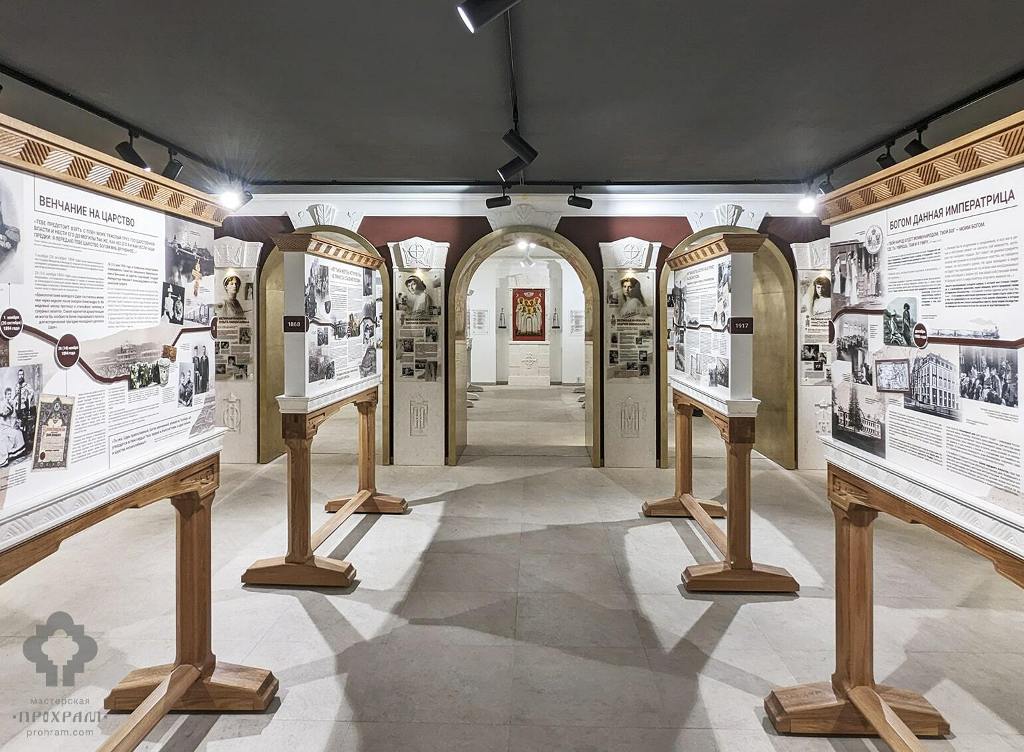
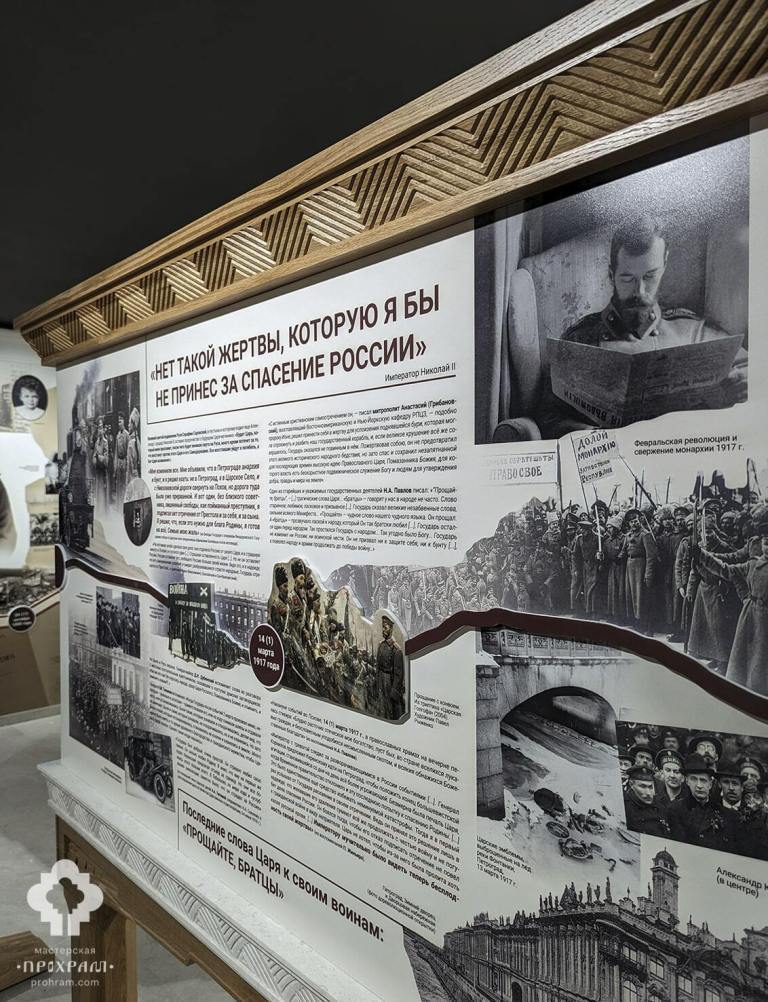
PHOTOS: four double-sided mobile stands display documents and photos which explore the life of Emperor Nicholas II and his family
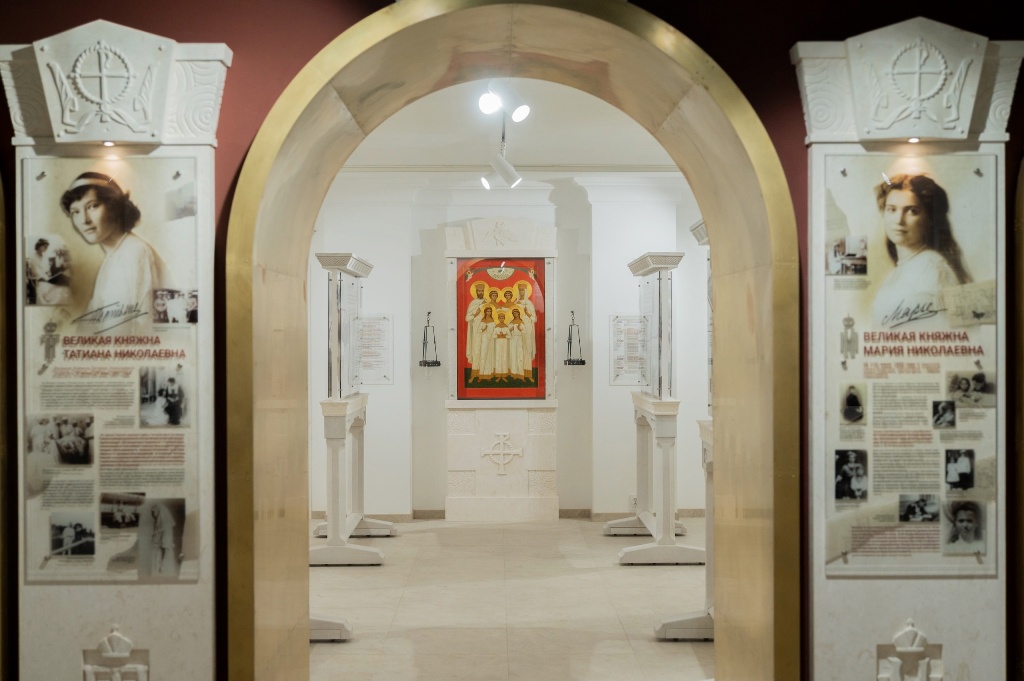
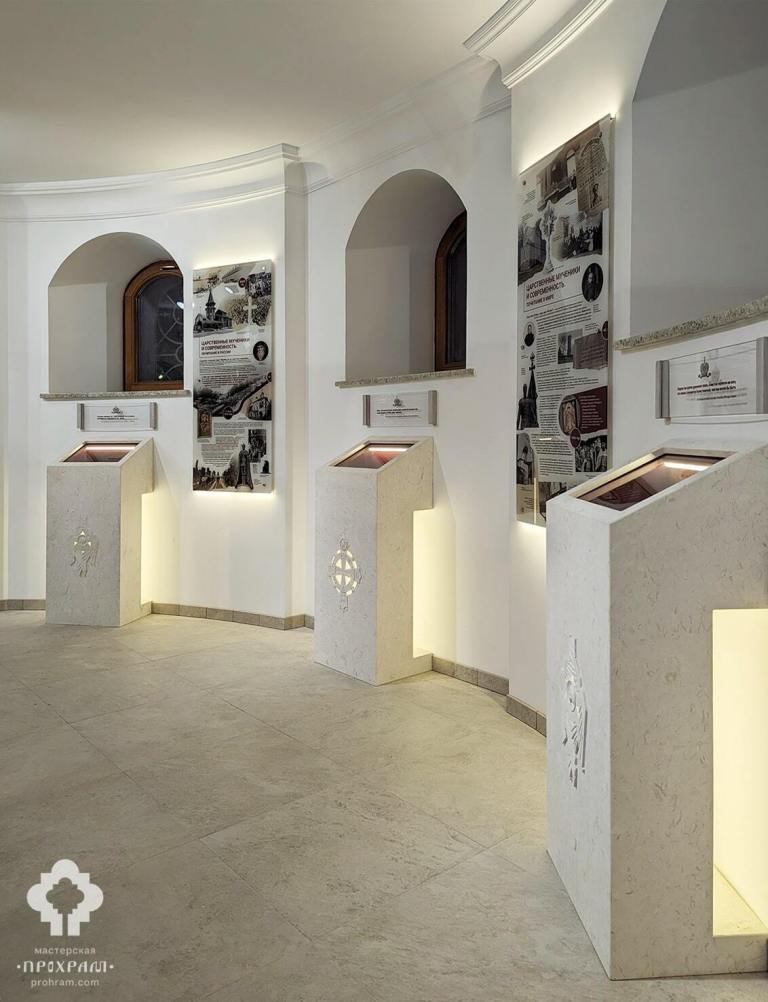
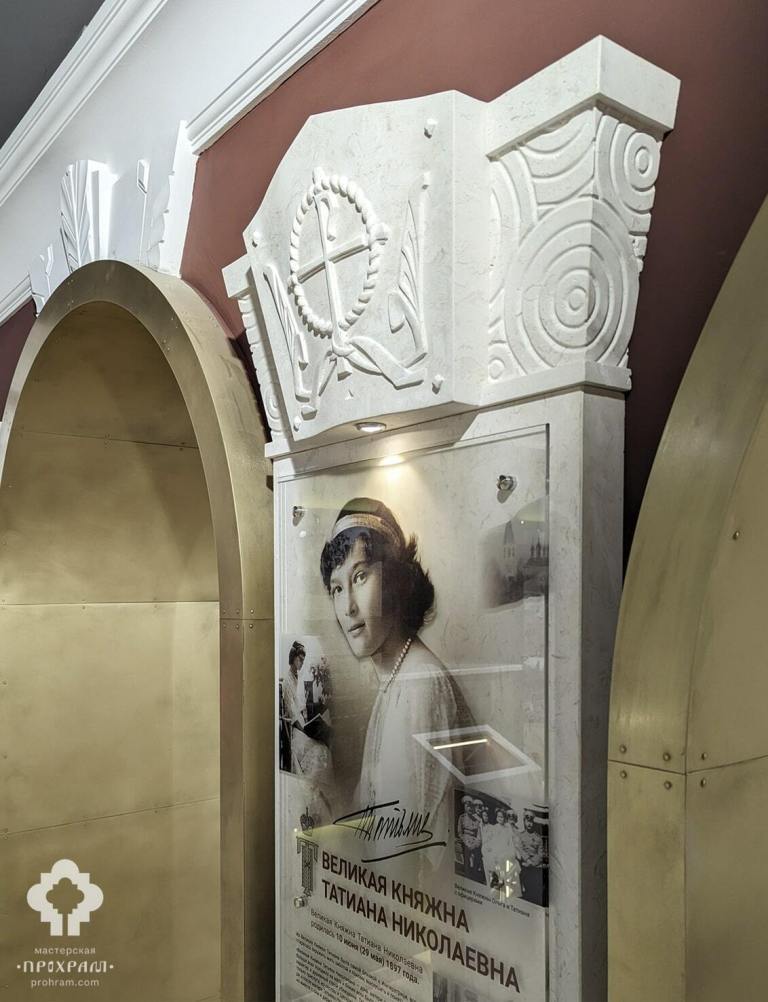
The photographs and documents are displayed on four double-sided mobile stands on small wheels with stoppers. At the northern and southern walls there are carved white-stone lecterns with carvings, under which relics of the era of Emperor Nicholas II are placed. In the eastern part of the hall there is a passage through three brass decorative arches which leads to the White Hall. Between the arches, there are four kiot stands made of white stone with carvings (initials), glass, lighting and a carved finial, dedicated to the Grand Duchesses Olga, Tatiana, Maria and Anastasia Nikolaevna. The ceiling is dark, with diffused and directional track lighting.
In the White Hall there is information about the Way of the Cross of the Imperial Family – the period from the events at the Dno station, the Tsar’s abdicated in March 1917, to the murder of Nicholas II and his entire family on 17th July 1918 in Ekaterinburg and the subsequent history of the veneration and glorification of the Imperial Family as saints. Extensive textual and illustrative material makes it possible to speculatively walk this path together with the Royal Passion-Bearers, to come into spiritual contact with the last year of their lives, to see the light of the Paschal victory in the darkness of the Ipatiev House.
CLICK on the photos below to enlarge and see in greater detail . . .
Also in the White Hall there are stands dedicated to the faithful retainers, who voluntarily followed the Imperial Family into exile and shared their sufferings, showing an example of loyalty to duty; stands dedicated to the Grand Duke Sergei Alexandrovich, the Venerable Martyr Grand Duchess Elizabeth Feodorovna, the Alapaevsk Martyrs, who were murdered by the Bolsheviks the day after the Imperial Family; two kiot stands dedicated to Tsesarevich Alexei Nikolaevich; and stands dedicated to the memory, glorification and modern veneration of the Holy Royal Martyrs.
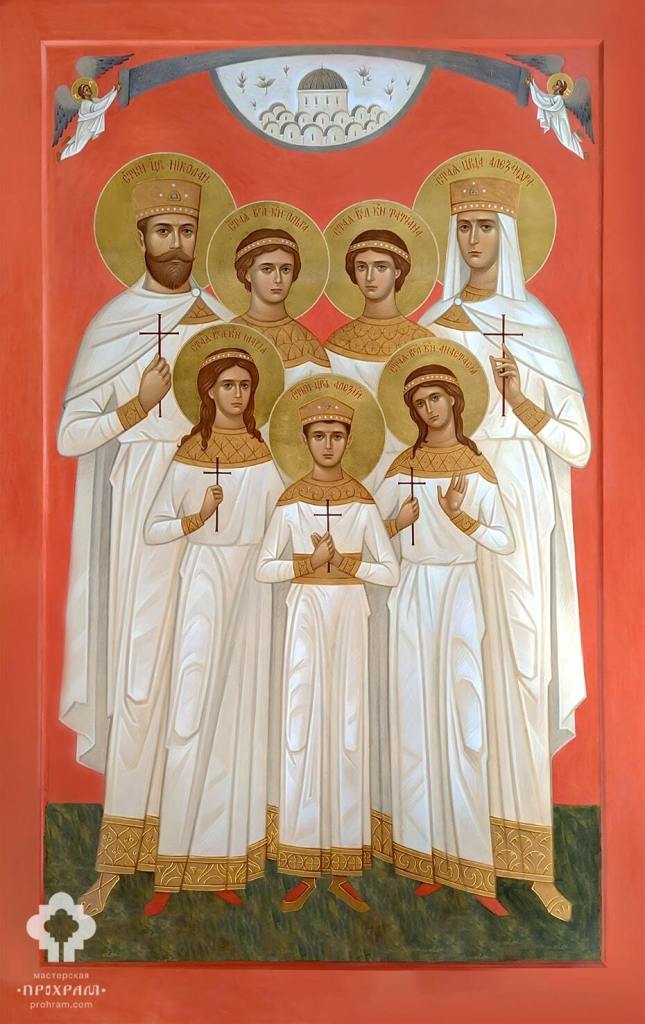
The hall is crowned by a large carved icon case with an icon of the Royal Martyrs, visible from the very entrance to the burgundy-green hall. The saints are depicted in white robes with a reference to the apocalyptic image of martyrs overcoming earthly sufferings and faithful to Christ (Revelations 6:9-12).
The White Hall is also used as a venue for small gatherings. The 4 white stands can be rrolled to the sides, thereby freeing up the central space of the hall. Attached to the ceiling in this room is a screen that can be opened in the eastern part of the hall, with a projector at the entrance to the burgundy-green hall. Folding chairs which are stored in the adjoining utility room, provide for guests attending lectures, films and other events.
CLICK on the photos below to enlarge and see in greater detail . . .
The museum is a project of love and deepest respect to the Holy Royal Martyrs and their feat on the Cross, which formed the basis of the feat of faith of all the New Martyrs and Confessors of the Russian Church and the preservation of the Holy Russian spirit in the 20th and early 21st centuries.
The opening of the new museum in Dno is the fourth such museum in Russia dedicated to Emperor Nicholas II and his family, the other three are the Museum of the Holy Royal Family in the Tsarsky Cultural and Educational Center, situated in the Patriarchal Compound of the Church on the Blood (Ekaterinburg); the Museum of the Family of Emperor Nicholas II (Tobolsk); and the Museum in Memory of Emperor Nicholas II and His Family (Kotelniki-Moscow).
PHOTO: icon of the Royal Martyrs in the White Hall
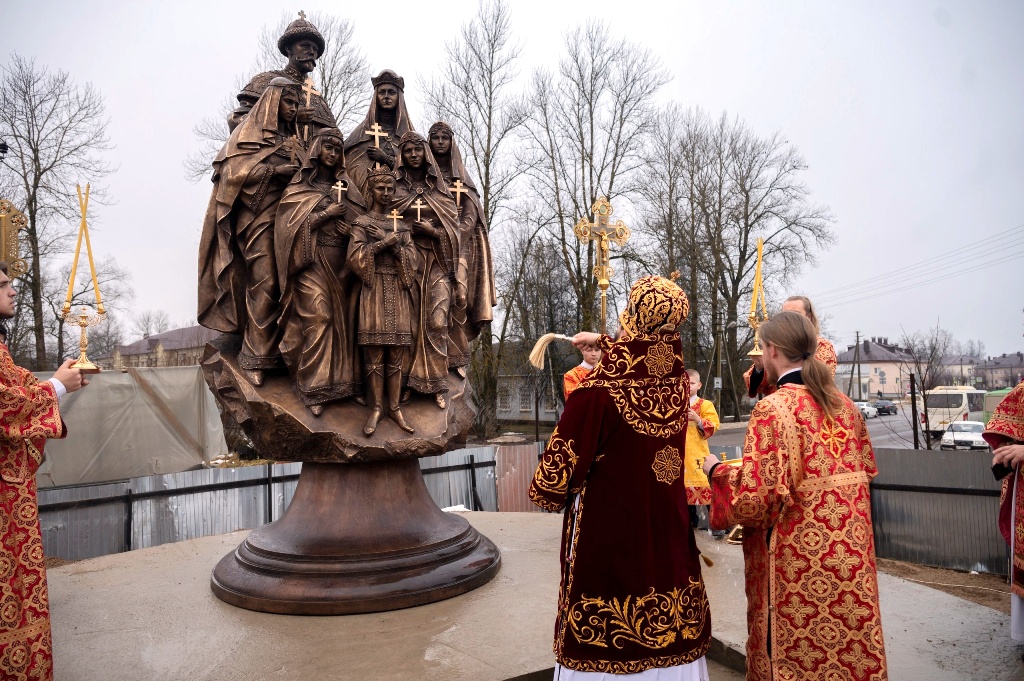
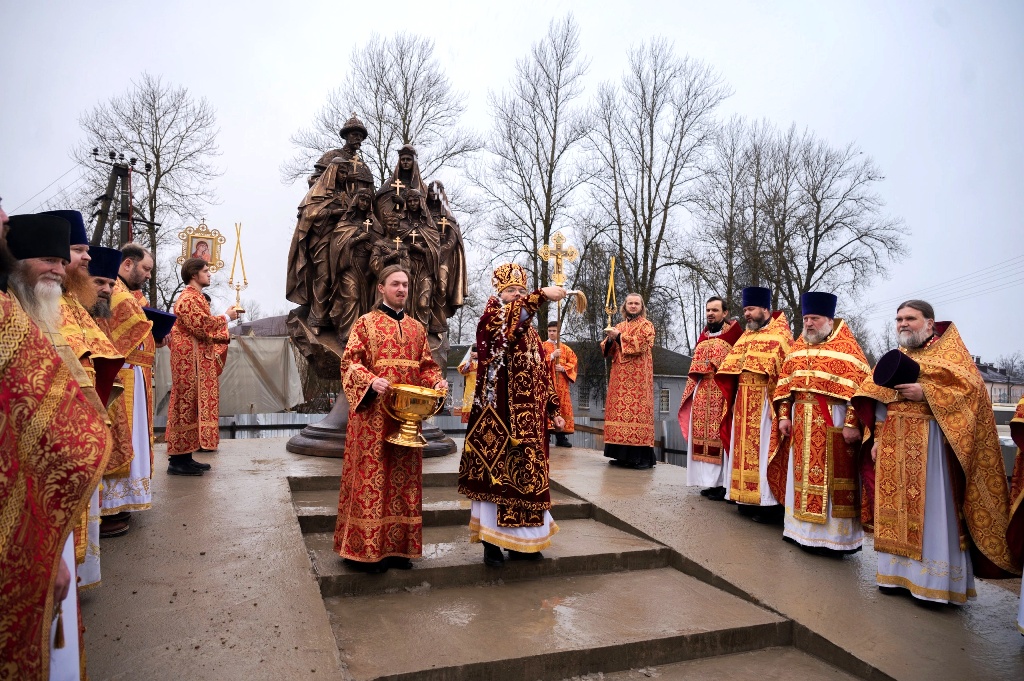
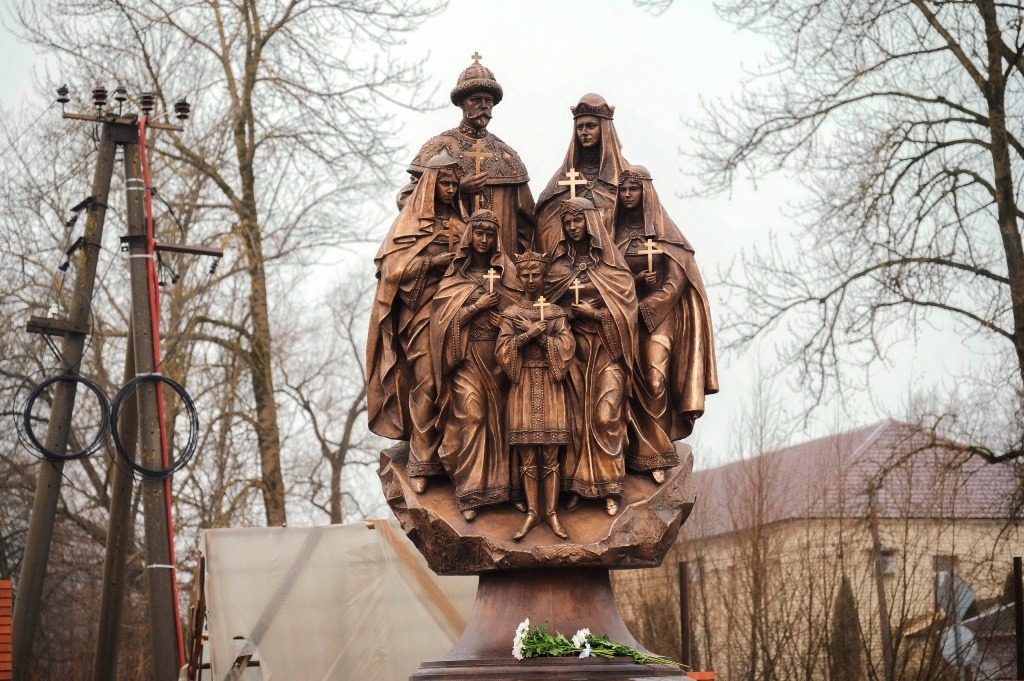
On 26th December 2024, a new monument to Emperor Nicholas II and his family was installed and consecrated on the grounds of the Church of the Holy Royal Passion-Bearers in the Russian city of Dno, situated 114 km from Pskov. In addition, a museum dedicated to the Imperial Family was officially opened and consecrated.
A Divine Liturgy was conducted in the new Church of the Holy Royal Passion-Bearers (constructed in 2023) by Metropolitan Matthew of Pskov and Porkhov.
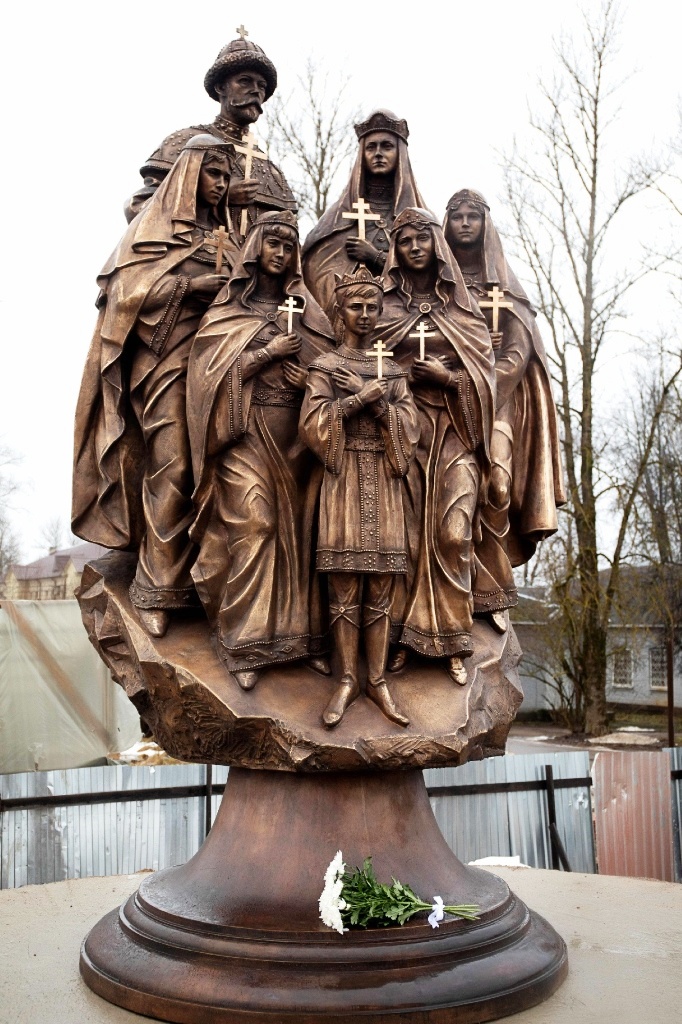
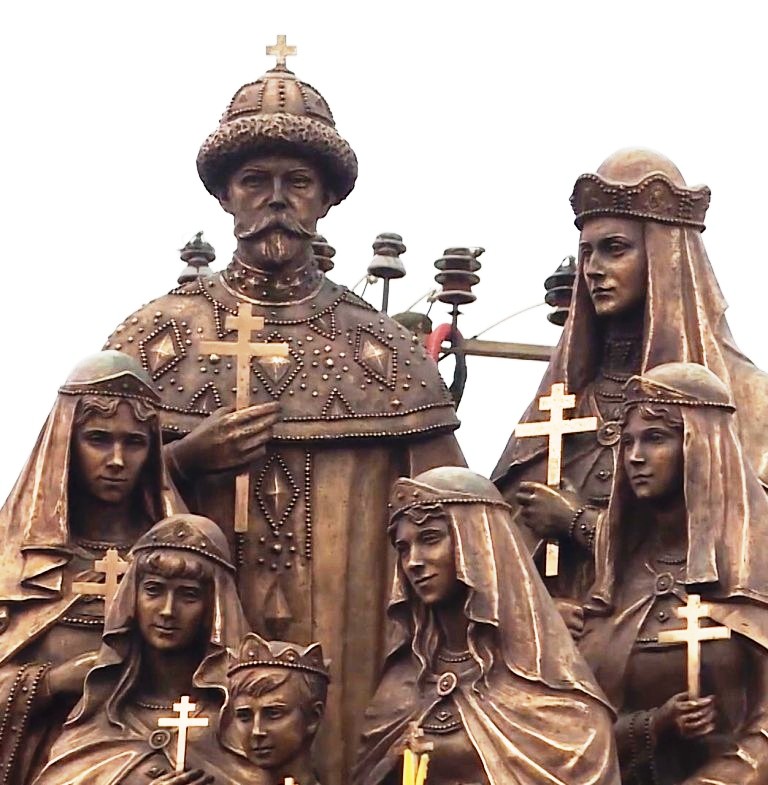
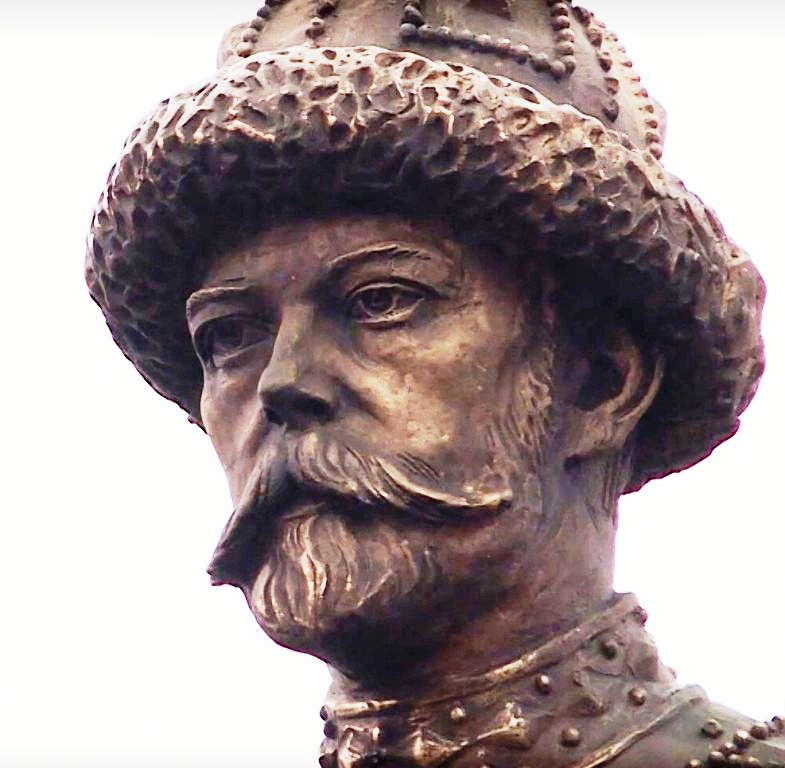
The sculptural composition was made by Moscow sculptor Vladimir Gennadievich Ivanov [b. 1983], and took one year to complete. According to him, the bronze monument weighs three and a half tons, and stands almost four and a half meters [almost 15 feet] in height. Each of the seven members of the Imperial Family is depicted holding a cross.
Recall that the Dno railway station became the penultimate point of the Imperial Train, which was transporting the Tsar to Petrograd on 14th (O.S. 1st) March 1917. From here, Nicholas II was forced to Pskov, where the following day, he signed his abdication from the throne. As Bishop Matthew noted during the opening of the museum in the basement of the church, “these events became a turning point in the history of the country”.
Recall that earlier this month a mural of the pre-war railway station at Dno was recreated on the building of the museum and exhibition center in Dno. The mural was created In memory of Emperor Nicholas II’s historic stop at Dno in March 1917, the day before he abdicated the throne.
I have published nearly 50 titles to date through AMAZON – featuring one of the largest selections of books on Nicholas II, the Romanov dynasty and the history of Imperial Russia.
Please CLICK on the BANNER or LINK above to review my current selection of titles in hardcover, paperback and ebook editions. Listings provide a full description for each title, pricing and a Look inside feature.
NOTE: the English language edition of this book is now available in both hard cover and paperback editions. You can now order this book direct from the following suppliers in the United States:
In addition, you can order this book directly from the publisher in Romania. Books are shipped by mail or courier (DHL). I had NO problem ordering a copy, and received it promptly.
HOW TO ORDER FROM THE PUBLISHER:the order page is a bit confusing, because the actual order instructions located at the bottom of the page are in Romanian. Simply use Google (or similar) to translate, the rest is simply.
Click HERE to order your copy. Scroll down to the bottom of the page. Select ‘COVER TYPE’ – hard cover or paperback. To the left of the ‘ADD TO CART’ button, you must select how many copies you want. Click on ‘VIEW CART’ and ‘CONTINUE TO CHECKOUT’. payment is in Euros, credit cards accepted – PG
***
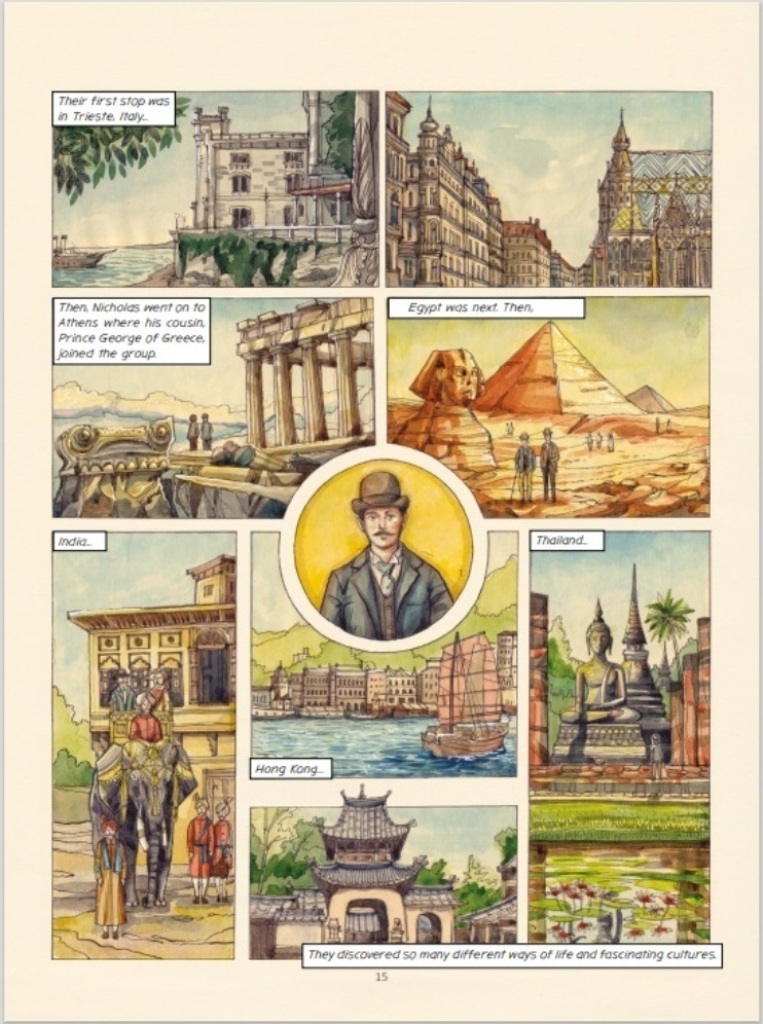
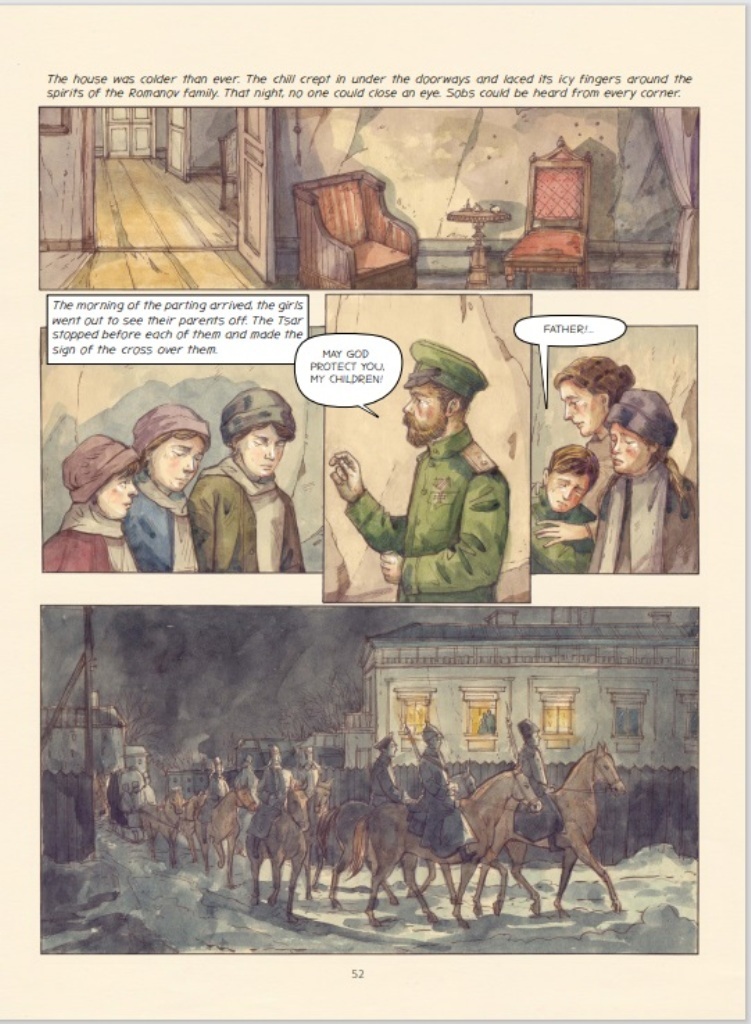
The publishing division of the Diaconești Monastery in Moldavia, Romania, have published an exiting new title: The True Story of the Romanov Family.
Although an abundance of books have been written about the Imperial Family, the present work is an unparalleled graphic study. Drawing from a wealth of historical sources, including memoirs, diaries, letters and scholarly works on the Imperial Family, the publisher has painstakingly recreated key moments in their private and public lives. In addition, eleven Faberge eggs, meticulously painted by Romanian artist Ovidiu Gliga are prominently featured in the book.
The text of the book is complimented by Ovidiu Gliga’s artwork. Over the past four years, the publisher has collaborated closely with this exceptional artist, whose artwork helps envelope the reader. His work for this book is showcased in the video found at the end of this summary. This book has been issued in both English and Romanian editions, in both hard cover and paperback formats.
CLICK on each image below, to enlarge and view page in greater detail
According to the publisher, “this project has been a labour of love, driven by our admiration for these revered saints and our desire to present their lives in a visually engaging format suitable for readers of all ages. We believe it fills a significant void in the literature about the Imperial Family, offering a detailed exploration of their lives and the enduring impact on Russia’s history.”
It is interesting to note, that the monastery’s inspiration for this project was profoundly influence by the popular book The Romanov Royal Martyrs: What Silence Could Not Conceal, published in 2019 by the Mesa Potamos Monastery in Cyprus, which the nuns of the Diaconești Monastery translated into Romanian.
The Romanian-based publisher has prepared a 2-minute English language video, which will give readers a sample of this unique publishing project, including a glimpse of it’s content and Ovidiu Gliga’s beautiful colour illustrations.
CLICK on the red arrow below to start the VIDEO . . .
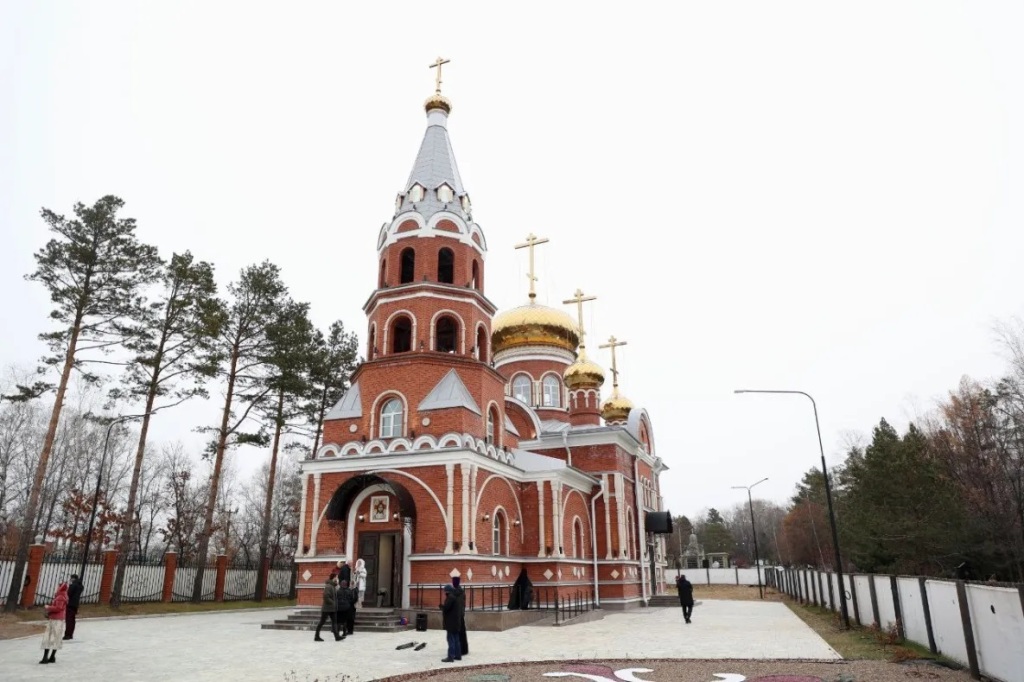
On 4th November 2024, the Church of the Holy Royal Passion-Bearers was consecrated, in the Petropavlovsky (Peter and Paul) Convent – located 60 km from the city of Khabarovsk.
The new Russian Orthodox church is dedicated to the Holy Royal Passion-Bearers[1] – Emperor Nicholas II, Empress Alexandra Feodorovna, their five children and the family’s four faithful retainers, all of whom died a martyr’s death following their brutal murder by the Bolsheviks in Ekaterinburg, on the night of 16/17 July 1918.
The church was consecrated by Metropolitan Artemy of Khabarovsk and the Amur Region. The church is a metochion[2] of the Petropavlovsky (Peter and Paul) Convent.
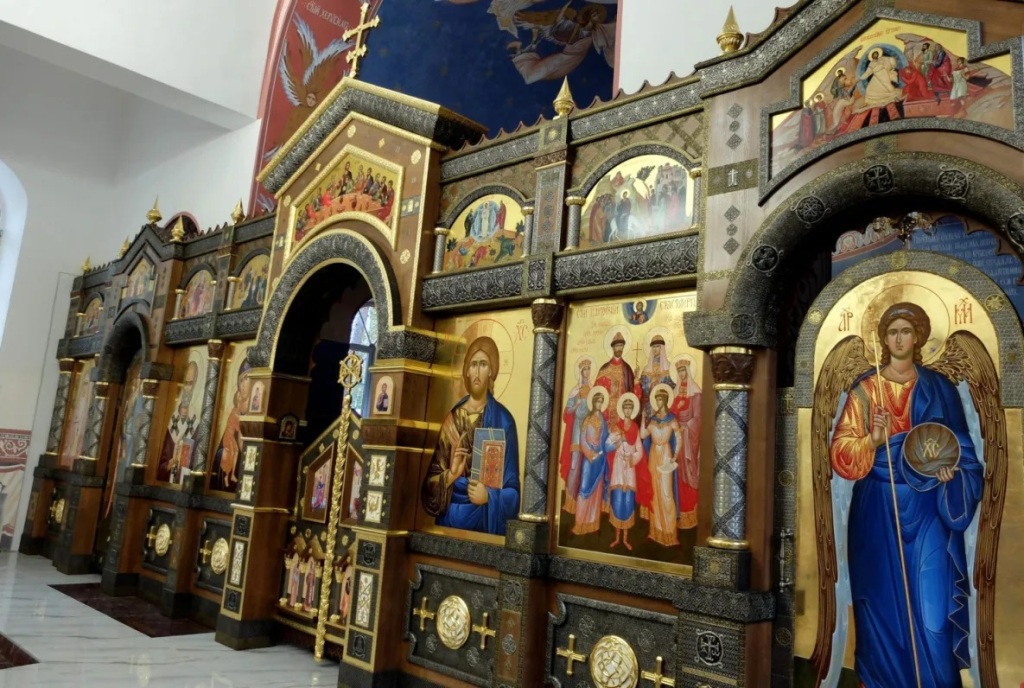
A two-tiered iconostasis was installed, made by Moscow craftsmen, in which a lot of gold leaf was used. The icons were painted by the sisters of the convent, as was the painting for the altar. The main icon in the iconostasis is a unique mosaic icon of the Imperial Family, also handmade by the nuns. Their work was highly praised by specialists of the All-Russian Art and Research Conservation Center, which is considered to be Russia’s foremost authority in the field of the restoration of historical and art monuments.
Construction of the six-domed Church of the Holy Royal Passion-Bearers began in 2018, and was financed thanks to donations of parishioners and local patrons.
PHOTO: the iconostasis features a mosaic icon of the Holy Royal Martyrs (sedond from right)
“From this day on, its doors will be open to everyone who asks for mutual love and respect in the family, raising children in faith and piety, overcoming life’s adversities with firm hope in God,” said Nikolai Shevtsov, Chairman of the Legislative Duma of the Khabarovsk Region. “Let the Church of the Holy Royal Passion-Bearers become such a place for Khabarovsk residents and guests of the capital,” he added.
In this church, many new and original elements have been created, which are not found in the Far East regions of the Russian Federation, in particular, bronze doors ordered from central Russia. The floor in the church is decorated with original mosaics of the Byzantine style. This monastic metochion is the first in the Khabarovsk Region. The abbess of the church is nun Antonia.
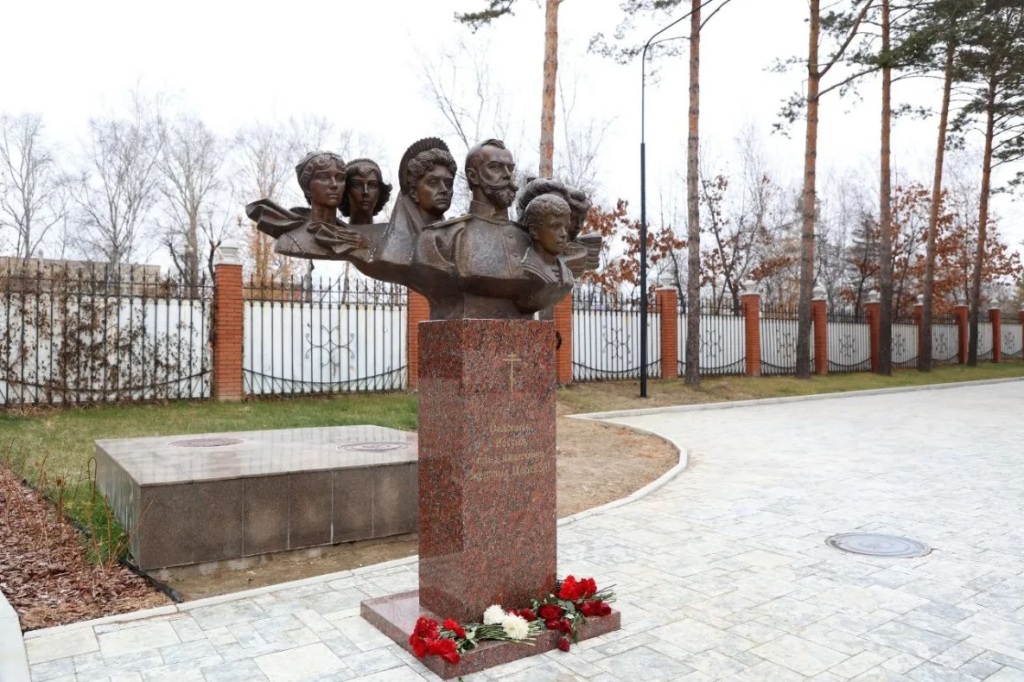
A monument of Nicholas II and his family was installed on the grounds of the church. It was made by the Moscow sculptor Vladimir Lepeshov, a member of the Union of Artists of Moscow and Russia, combining seven busts of members of the family of the last Russian Emperor Nicholas II.
PHOTO: monument to Nicholas II and his family, installed on the grounds of the church
NOTES:
[1] On 1st November 1981, the Imperial Family were canonized as new martyrs by the Russian Orthodox Church Outside Russia (ROCOR).
On 20th August 2000, the the Imperial Family were canonized as passion-bearers by the Moscow Patriarchate.
Passion-bearers are people who face death with resignation, in a Christ-like manner, as distinguished from martyrs, the latter historically killed for their faith. Proponents cited the piety of the Tsar and his family and reports that the Tsarina and her eldest daughter Olga prayed and attempted to make the sign of the cross immediately before they died.
Despite their official designation as “passion-bearers” by the Moscow Patriarchate, they are nevertheless spoken of as “saints” in Orthodox publications, icons, and in popular veneration by the people.
[2] A metochion is an ecclesiastical embassy church within Eastern Orthodox tradition.
CLICK on the above image to watch the VIDEO Researched, written and narrated by Paul Gilbert Duration: 20 minutes. Language: English
Emperor Nicholas II reigned for 22+ years – from November 1894 to February 1917. With his murder, the last Orthodox Christian monarch, along with the thousand-year history of thrones and crowns in Russia, ended, ushering in an era of lawlessness, apostasy, and terror, one which would sweep Holy Orthodox Russia into an abyss which would last more than 70 years.
This new video production is based on the research of project colleague and independent researcher Paul Gilbert, who also narrates this video.
In the first 24 hours of it’s release on YouTube, some 3,000 people had watched the video! Since it’s release in July 2020, it has been viewed by more than 134.000 people.
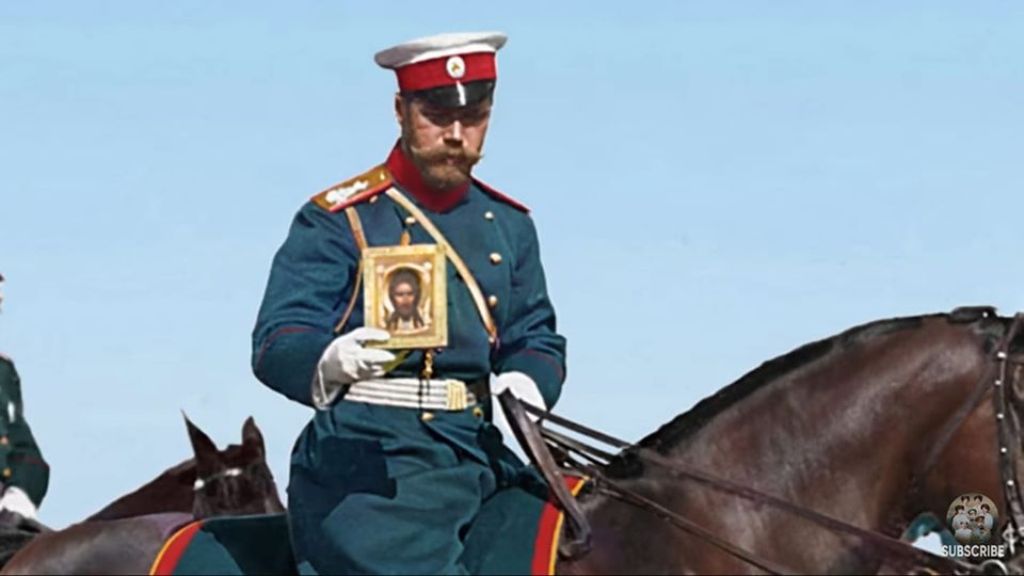
The creators have done a remarkable job of incorporating a wonderful collection of photos – both vintage B&W and colourized by Olga Shirnina (aka KLIMBIM) – historical newsreel film footage and music.
Vintage B&W photo of Nicholas II colourized by Olga Shirnina (aka KLIMBIM)
One viewer noted on social media: “Only 20 minutes long, this is the BEST portrayal of the last Tsar’s Orthodox faith I have ever seen. Very well-made, historical and moving.”
The crowning moment of this video is near the end, which shows film footage of the actual canonization ceremony of Emperor Nicholas II and his family, performed on 20th August 2000 by Patriarch Alexei II (1929-2008) in the Christ the Saviour Cathedral in Moscow. You can hear His Holiness calling out each of the names of the Imperial Family. The footage is extremely moving to watch.
This 20-minute video is presented in the framework of the production of the book The Romanov Royal Martyrs: What Silence Could Not Conceal published by Mesa Potamos Publications in 2019.
The Romanov Royal Martyrs is an impressive 512-page book, featuring nearly 200 black & white photographs, and a 56-page photo insert of more than 80 high-quality images, colourized by the acclaimed Russian artist Olga Shirnina (Klimbim), and appearing here in print for the first time.
I am truly honoured to be a research colleague of this important publishing project. I am most grateful to Father Prodromos Nikolaou and the Holy Monastery of St. John the Forerunner of Mesa Potamos in Cyprus for giving me the opportunity to be a part of this new video which tells the story about Russia’s last Orthodox Christian monarch.
NOTE: my name is now inscribed as a project colleague in the 2nd edition of this book, which also includes several corrections, which I suggested to the publisher after reading the 1st edition – PG
Below, is my second video produced within the framework of the production of the book The Romanov Royal Martyrs: What Silence Could Not Conceal published by Mesa Potamos Publications in 2019. My first video The Conspiracy Against Nicholas II was released in 2018 with more than 32,000 views to date:
CLICK on the above image to watch the VIDEO Researched, written and narrated by Paul Gilbert Duration: 7 min. 36 sec. Language: English
On the night of 16/17 July 2024, on the eve of the Feast Day of the Holy Royal Martyrs[1], the Hierarchal Divine Liturgy was celebrated at the Church on the Blood in Ekaterinburg. This year marks the 106th anniversary of the murder of Emperor Nicholas II, his wife, their five children, and four faithful retainers.
Divine services were held in the Imperial Room[2], were led by the bishops who had arrived in the Ural capitol for Tsar’s Days: Bishop Roman of Rubtsovsk and Aleysk, and Bishop Leonty of Syzran and Shigon.
Concelebrating with the bishops were Archpriest Nikolai Tarantin, head of the protocol service of the Ekaterinburg Diocese, Archpriest Maxim Minyailo, chairman of the diocesan department for Church relations with society and the media, senior priest of the Church on the Blood, and Priest Daniel Ryabinin, head of the diocesan missionary department; Priest Pavel Starkov, head of the Youth Department, spiritual father of St. Simeon’s Orthodox Gymnasium (School); Rector of the Ekaterinburg Theological Seminary, Hieromonk Korniliy Zaitsev, Chief of Staff of the Synodal Diocese of the Ekaterinburg Diocese, Hieromonk Simeon (Seregin), and other clergymen of the Ekaterinburg Diocese.
Traditionally, the Divine Liturgy on the night of 16th July is celebrated with a large crowd of faithful – hundreds of believers prayed in the church.
The hymns of the service were sung by the choir of the Ekaterinburg Theological Seminary under the direction of Anastasia Mukhlynina, a graduate of the seminary’s choir director’s department.
Archpriest Sergiy Alexeev, a cleric of the Holy Trinity Cathedral in Ekaterinburg, addressed the faithful present with a sermon on the pre-communion verse.
Communion on this day was performed from five chalices – many pilgrims arrived in Ekaterinburg to pray at the main services of the Tsar’s Days and honour the memory of the Holy Royal Family.
At the end of the service, Metropolitan Evgeny of Ekaterinburg and Verkhoturye greeted the bishops, clergy and pilgrims who had arrived from across Russia and other countries for the Tsar’s Days.
Metropolitan Evgeny asked everyone to preserve the memory of the Holy Royal Passion-Bearers and to imitate wisdom and strength in the love they showed. At 3:00 p.m., Little Vespers with an akathist to the Holy Royal Passion-Bearers was served in the Church-on-the-Blood, then at 4:30 p.m., the All-Night Vigil began on the square in front of the church, which was led by the Eminent Archpastors. The main service of the Tsar’s Days – the Divine Liturgy – began at midnight, followed by the Royal Cross Procession.
Procession of the Cross to Ganina Yama
In the early morning hours of 17th July 2024, the traditional Royal Cross Procession was held from the Church on the Blood in Ekaterinburg to the Monastery of the Holy Royal Passion-Bearers at Ganina Yama – a 21 km. [13 miles] journey on foot[3]. The Cross Procession was preceded by a Divine Liturgy on the square in front of the church, which was headed by 13 bishops of the Russian Orthodox Church.
An estimated 45,000 faithful took part in this year’s Cross Procession, together with the head of the Ekaterinburg Metropolia, was led by Metropolitan Vikenty of Tashkent and Uzbekistan, head of the Central Asian Metropolitan District, and other archpastors.
Under the repentant Jesus Prayer: “Lord, Jesus Christ, Son of God, have mercy on us!” – the multi-thousand column of believers, clergy and laity from across Russia – covered the distance in about four to five hours. Those who took part in the procession came from every corner of the Russian Federation – from Stavropol to Novosibirsk, from Astrakhan to Arkhangelsk, as well as abroad.
The procession was accompanied by 10 mobile aid groups of the Orthodox Mercy Service and volunteers of the Tsar’s Days.
In the Cross Procession, two Reliquaries were carried, the first Reliquary containing a part of the Belt of the Most Holy Theotokos, which was donated to the Ekaterinburg Diocese, the second Reliquary containing the relics of 14 saints of the Ekaterinburg Metropolia: the Venerable Martyr Grand Duchess Elizabeth Feodorovna, the Venerable Martyr nun Varvara (Barbara) Yakovleva, the Venerable Basilisk of Siberia, the Righteous Simeon of Verkhoturye, the Blessed Cosmas of Verkhoturye, the Venerable Elijah Chebotarev, the Hieromartyr Alexander Malinovsky, the Hieromartyr Arkady Gariaev, Hieromartyr Konstantin Bogoyavlensky, Hieromartyr Lev Ershov, Venerable Arefa Katargin, Hieromartyr Alexis Budrin, Venerable Confessor John (Chevroletin) and Hieromartyr Alexander Adrianov.
The Royal Cross Procession concluded with a moleben to the Holy Royal Passion-Bearers at the Monastery of the Holy Royal Martyrs at Ganina Yama.
The Most Reverend Archpastors, Bishop Evgeny and Bishop Vikenty, thanked the thousands of faithuful who took part in the Royal Cross Procession for their spiritual feat.
Divine Liturgies were celebrated in the seven churches of the monastery, the churches are dedicated to each of the seven members of the Imperial Family. As the day progresssed, more and more pilgrims arrived at the monastery for prayer and reflection.
Holy Royal Passion-Bearers, pray to God for us! Святые Царственные страстотерпцы, молите Бога о нас!
NOTES:
[1] On 1st November 1981, the Imperial Family were canonized as new martyrs by the Russian Orthodox Church Outside Russia (ROCOR).
On 20th August 2000, the the Imperial Family were canonized as passion-bearers by the Moscow Patriarchate.
Passion-bearers are people who face death with resignation, in a Christ-like manner, as distinguished from martyrs, the latter historically killed for their faith. Proponents cited the piety of the Tsar and his family and reports that the Tsarina and her eldest daughter Olga prayed and attempted to make the sign of the cross immediately before they died.
Despite their official designation as “passion-bearers” by the Moscow Patriarchate, they are nevertheless spoken of as “saints” in Orthodox publications, icons, and in popular veneration by the people.
[2] The Imperial Room is situated in the lower church sanctified in honor of the Holy Royal Martyrs. It was established on the site of the room located in the basement of the Ipatiev House, where Emperor Nicholas II, his family, and four retainers were all brutally murdered on the night of 16/17 July 1918.
[3] Once again, Porosenkov Log was not included in this year’s Cross Procession. Porosenkov Log is where the remains of the Imperial Family were exhumed in two separate graves in 1991 and 2007 respectively. Due to the fact that the Moscow Patriachate does not yet recognize the Ekaterinburg Remains as those of the Imperial Family. Their official recognition rests with the Bishops’ Council of the Russian Orthodox Church.
You must be logged in to post a comment.