Nicholas II celebrates Pascha (Easter) 1914 and 1916 + VIDEO
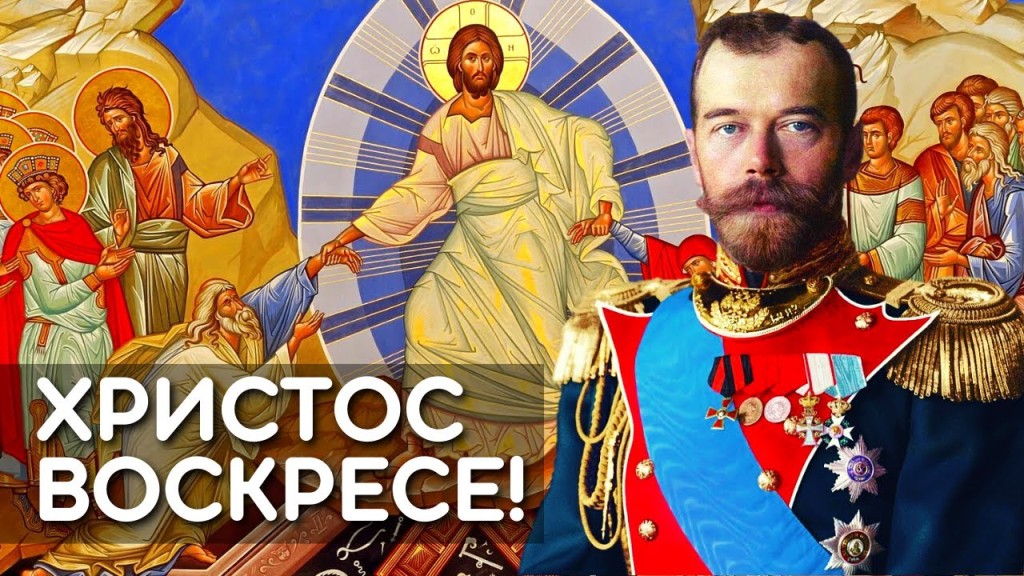
Pascha (Easter) stands as the cornerstone of Orthodox Christian faith, marking the Resurrection of Jesus Christ. The Resurrection is so central to Orthodox Christianity that all elements of the faith revolve around it, making Pascha the most important and joyous celebration of the ecclesiastical year.
“Христос Воскресе / Christ is risen!” With these words, the hearts of all Orthodox Christians are filled with a feeling of ineffable joy and spiritual warmth. The same was true for the Russian Imperial Family, who are now a saints [Russian Orthodox Church Outside Russia] and Passion-Beaers [Moscow Patriarchate of the Russian Orthodox Church].
The Pascha of 1895 was the first for the newly wedded couple. Emperor Alexander III peacefully reposed in the autumn of 1894. His son, the twenty-six year-old Nicholas Alexandrovich, immediately ascended the Russian throne and married the German princess Alice of Hesse on 14th November of the same year. The young Emperor was on the threshold of a different life. A new page of Russian history was unfolding.
The Pascha of April 1918 was the last for the Tsar and his family, three months later, they were to meet their death and martyrdom.
In these two newsreels below, we see the Emperor and his family celebrating Pascha at their Crimean residence Livadia (1914) and at the Headquarters of the Supreme Commander-in-Chief of the Russian Armed Forces in Mogilev (1916) respectively.
VIDEO – duration: 1 minute, 23 seconds with musical background
The music in this newsreel is ‘Христос Воскресе из мертвых!’ Christ is Risen from the Dead!, the main hymn of the Paschal service, recorded in 1909-1912, Moscow. Composer: D. Bortnyansky. Performed by the choir of A. A. Arkhangelsky. Text: “Christ is risen from the dead, trampling down death by death, and giving life to those in the tombs”.
In this newsreel Emperor Nicholas II exchanges khristosovanie (greeting) with officers on the first day of Easter – 6th April 1914 – in the Italian courtyard of the Livadia Palace. The Grand Duchesses Olga, Tatiana, Maria and Anastasia Nikolaevna can be seen standing against the wall.
Every year on the first two days of Pascha, the August Couple exchanged khristosovanie with all the employees of their palace and other ranks who were nearby at that time, as well as with members of deputations from volost elders and Old Believers. The Tsar exchanged khristosovanie with the men, the Empress with the women. The Tsar would exchange the traditional three kisses on alternating cheeks with the men, and the men kissed the Tsarina’s hand, who in turn handed each officer and soldier a porcelain egg.
In 1914, on the first day of Easter, 6th April, the Imperial Family was congratulated by 525 officials, and on the second day, by 893. In 1916, on the first day of Easter, 10th April, some 754 employees, mainly from the Court Department, congratulated Her Majesty at Tsarskoye Selo. On the second day, the Empress was congratulated by 576 officials.
VIDEO – duration: 2 minutes, 59 seconds with musical background
The music in this newsreel is ‘Христос Воскресе из мертвых!’ Christ is Risen from the Dead!, the main hymn of the Paschal service. Performed by the Choir of the St. Vladimir Cathedral in Kiev. Composer Dmitry Stepanovich Bortnyansky . Date of recording: 1914.
The Last Pascha in the Russian Empire was celebrated in April 1916. Less than a year later the Tsar would abdicate the throne ending 300+ years of the Romanov dynasty.
In this newsreel Tsar Nicholas II exchanges khristosovanie (greeting) with His Imperial Majesty’s Own Convoy – the Cossack unit which served as the Tsar’s elite guard, at the Headquarters of the Supreme Commander-in-Chief on the occasion of the feast of Holy Easter. Following behind the Tsar is General Count Alexander Grabbe (1864-1947), who served as the last Commander of His Imperial Majesty’s Own Convoy from 1914 to 1917.
If you look closely, at 00:15 you can see one of the Court photographers readying his camera to photograph the occasion. And at 00:30 you can see standing behind the Tsar, the Minister of the Imperial Court Count Vladimir Frederiks [with his signature long white moustache] and General Vladimir Voeikov, who served as Palace Commandant. Once again, we see the Tsar exchange khristosovanie with the officers, and the traditional three kisses on alternating cheeks with each man. He then hands each officer a porcelain egg. At 2:00 we see the Tsar repeat the khristosovanie with the ranks of soldiers of a regiment. Look at the faces of some of the soldiers, some of who are in awe of seeing their Sovereign.
© Paul Gilbert. 20th April 2025
 Nicholas II
You must be logged in to post a comment.