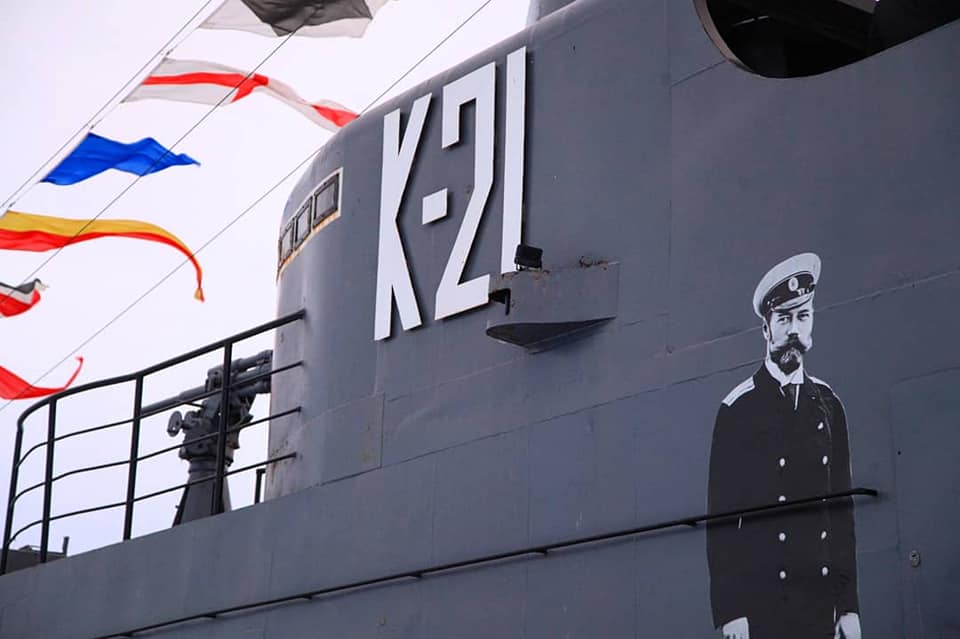
PHOTO: the image of Emperor Nicholas II, the founder of the Russian submarine fleet, depicted on on the Soviet submarine K-21
NOTE: this article was originally published on 19th March 2019, it has been revised and updated with additional facts and information on 19th March 2026 – PG
***
Russia marks the ‘Day of the Submariner’ on 19th March. The date was not chosen by chance – it was on this day in 1906 that Emperor Nicholas II issued a decree, on the classification of a new category of ships for the Russian Imperial Navy – submarines. .
In 2019, the Double-Headed Eagle Society honoured the memory of the founder of Russia’s first submarine fleet, by depicting his image on the Soviet submarine K-21. This honour would have the Bolsheviks and Soviets spinning in their graves!
Launched in 1939, the Soviet submarine K-21 was a K-class submarine of the Soviet Navy during World War II. In the spring of 1981, she was moved to the city of Polyarny, Murmansk Oblast to be converted into a museum ship. After renovations, she was eventually moved to Severomorsk, Russia. The museum was opened in 1983. In the late 1990s, the boat underwent some general repairs. From 2008 to 2009, the museum was further renovated.
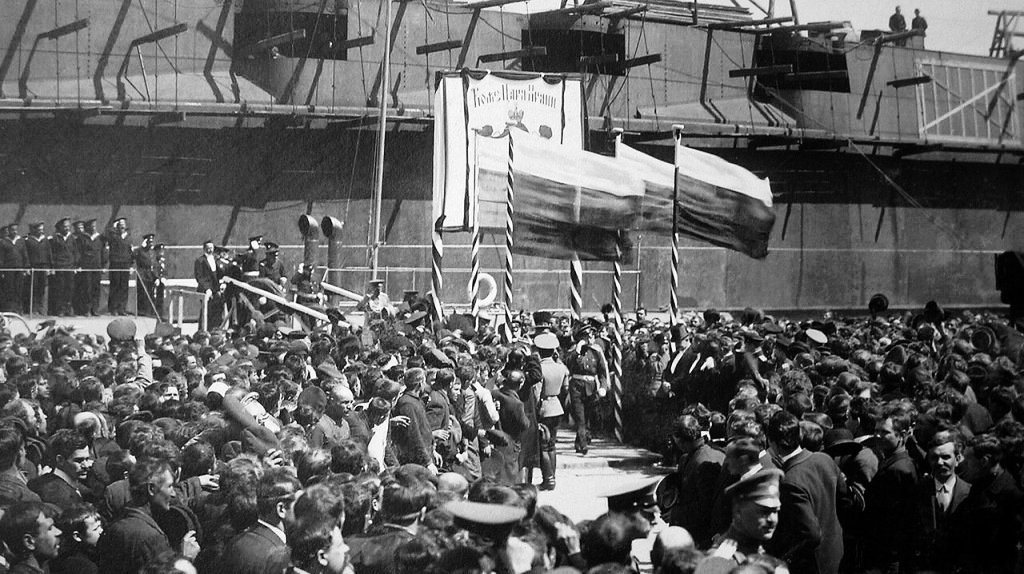
Emperor Nicholas II receives the report of the commander of Russia’s first combat-capable submarine «Дельфин» [Delphin], Captain Mikhail Nikolaevich Beklemishev (1858-1936) at the Baltic Shipyard. St. Petersburg, 1903.
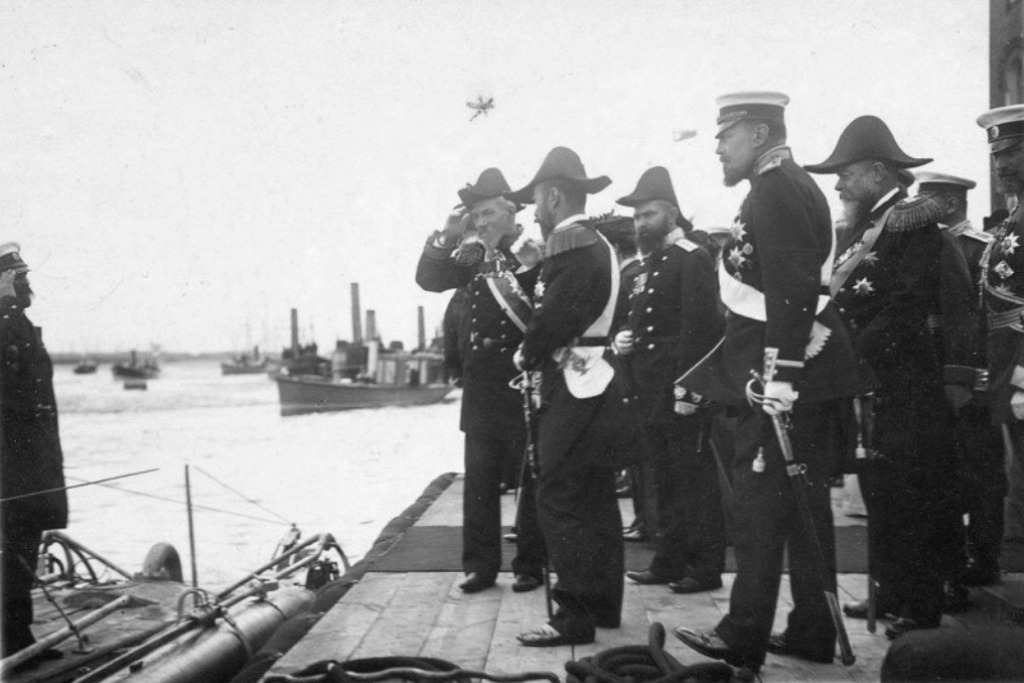
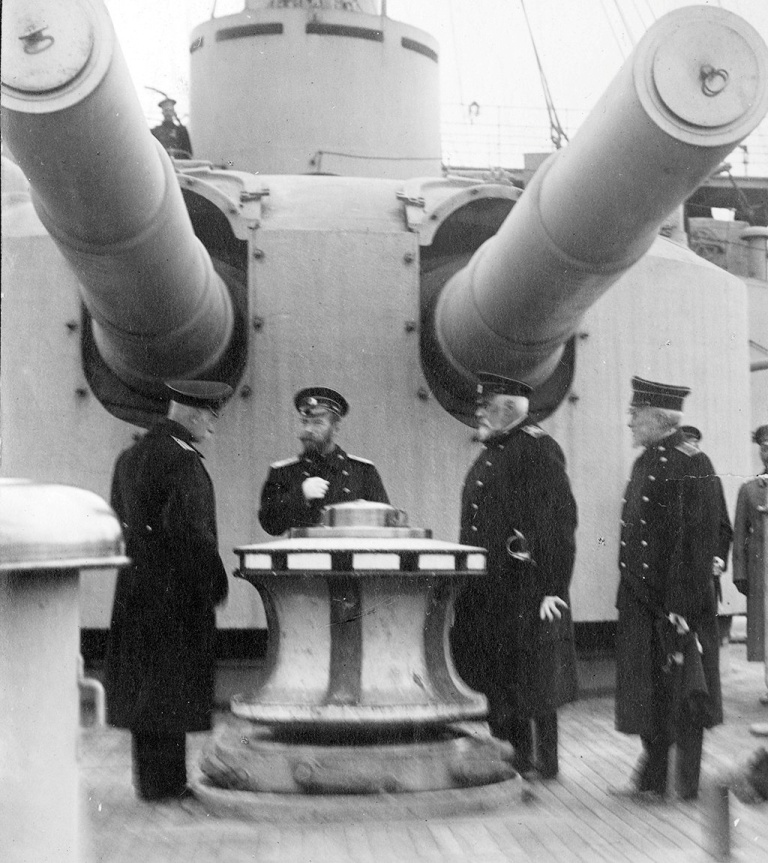
PHOTO: Emperor Nicholas II inspecting the submarine «Нарвал» [Narval]. The battleship «Император Александр III» Emperor Alexander III can be seen in the background. St. Petersburg, 1915
Many historians and writers continue to argue that Nicholas II was “not a progressive Tsar”, and yet his record of reforms speaks for itself. For instance, not only was Nicholas II a naval enthusiast, he played a significant role in the rebuilding and modernization of the Imperial Russian Navy before the First World War. In 1906 he ordered the establishment and development of the Russian submarine fleet.
The Imperial Russian Navy continued to expand during the reign of Nicholas II, regaining its position as the third largest fleet in the world after Britain and France. It had a revival in the latter part of the century, but lost most of its Pacific Fleet along with the Baltic Fleet, both of which were sent to the Far East and subsequently destroyed in the disastrous Russo-Japanese of 1904. The second phase of Nicholas II’s military life was marked by his participation in the reorganization of the navy after the catastrophic Russo-Japanese War.
Today, more than a century after his death, post-Soviet Russia recognizes the contribution of the last Russian Emperor to the development of the country’s underwater fleet.
On 19th (O.S. 6th) March 1906, by decree of Emperor Nicholas II, the Maritime General Staff was organized with the Main Naval Staff, which assumed the functions of the operational body of the Imperial Navy. At first, attention was directed to the creation of mine-laying and a submarine fleet.
Unfortunately, the name of the last emperor in this area of Russia’s military history is unjustly forgotten, thanks to Soviet dogma. From 1903 to 1917, Nicholas II ordered the construction of a total of 78 submarines – including the purchase of 11 foreign made submarines.
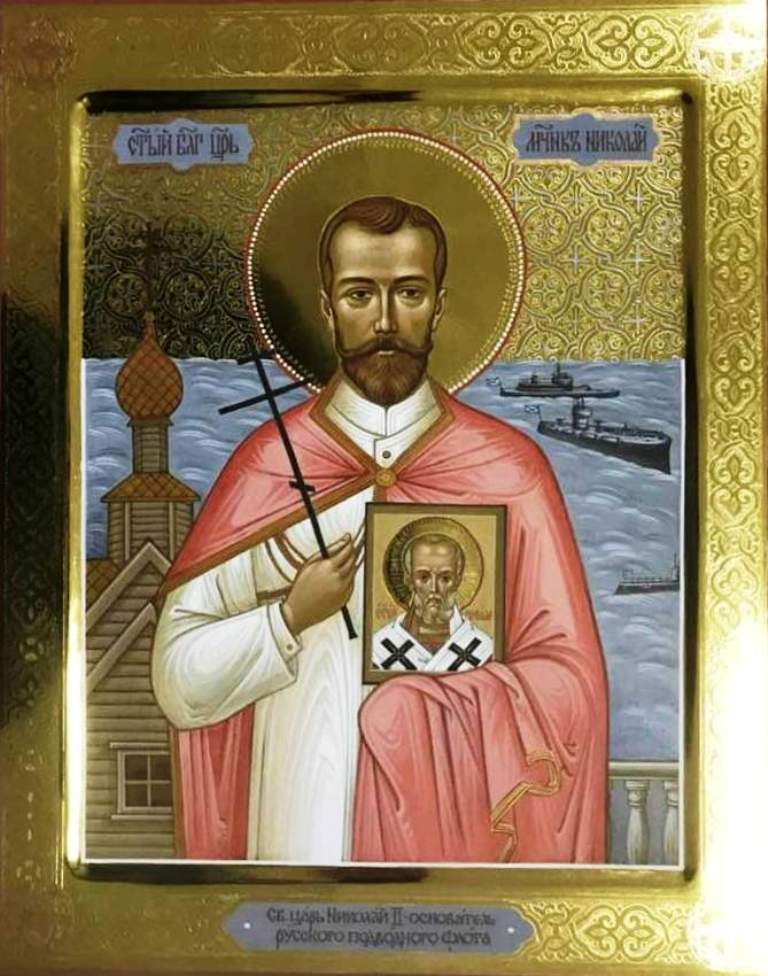
PHOTO: this icon painted in St. Petersburg, by order of modern day submariners of the Russian Federation is dedicated to the founder of the Russian submarine fleet, the Holy Sovereign Emperor Nicholas II.
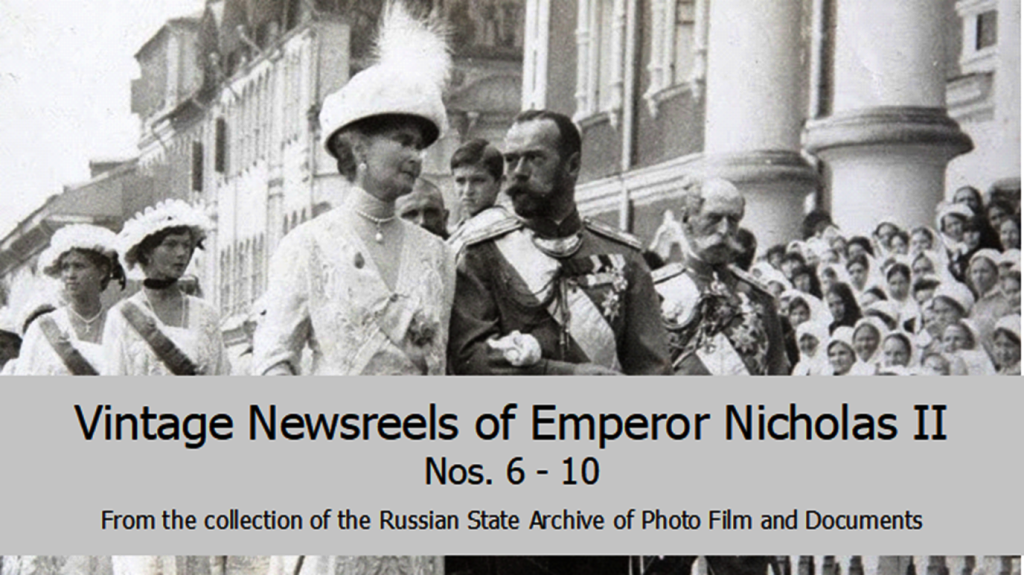
This is the second installment of a new monthly feature to my Nicholas II. Emperor. Tsar. Saint. blog, which showcases the vast collection of vintage newsreels which are now available to watch on YouTube and other online media sources. I have taken the liberty of selecting 5 interesting newsreels which depict Emperor Nicholas II and his family attending events in various cities throughout the Russian Empire.
Many of these newsreels include background music, with tunes of the Russian Empire or Orthodox music. Others are narrated in Russian, however, that should not deter the viewer from watching. You can turn on the English (or other language) subtitles by clicking on Google translate and then turn on the closed captioning [CC] button, found at the bottom of the newsreel. ENJOY!
No. 6 – Nicholas II attends the opening of the Alexander III Museum of Fine Art 1912
Emperor Nicholas II attends the opening of the Alexander III Museum of Fine Arts, later renamed the State Pushkin Museum of Fine Arts, in Moscow. He is accompanied by his mother Dowager Empress Maria Feodorovna, and his four daughters Grand Duchesses Olga, Tatiana, Maria and Anastasia. 13th June [O.S. 31st May] 1912.
Duration: 1 minute, 19 seconds with musical background
***
No. 7 – Emperor Nicholas II in Crimea (Livadia, 1909)
Digitally remastered by the Russian State Film and Photo Archive (RGAKFD). This video features wonderful vintage footage of the old woodern palaces at Livadia. English captions.
Duration: 10 minutes, 348 seconds
***
No. 8 – Nicholas II at the exhibition of Crimean Tatar handicrafts. Yalta
This colourized video depicts Emperor Nicholas II and his family at the exhibition of Crimean Tatar handicrafts, which was held in Yalta, Crimea on 30th September 1913. He is accompanied by his four daughters and retinue.
Duration: 1 minute, 5 seconds with musical background
***
No. 9 – The Imperial Family in Nizhni Novgorod 1913
On 17th May 1913, Emperor Nicholas II and his family visited Nizhny Novgorod. It was just one of many visits to cities and towns across the Russian Empire marking the 300th anniversary of the Romanov Dynasty. This video has been colourized.
Duration: 1 minute, 25 seconds with musical background
***
No. 10 – Emperor Nicholas II’s visit with Emperor Wilhelm II. 1913
In 1913, Nicholas II visited Germany and is greeted by the Kaiser. The two Emperors are shown riding in a horse drawn carriage, flanked by regiments on horseback, crowds cheer along the parade route. An outstanding chronicle of history.
Duration: 1 minute, 51 seconds with musical background
***
Previous Post Featuring MORE Vintage Newsreels of Nicholas II
This is the first installment of a new monthly feature to my Nicholas II. Emperor. Tsar. Saint. blog, which showcases the vast collection of vintage newsreels which are now available to watch on YouTube and other online media sources. I have taken the liberty of selecting 5 interesting newsreels which depict Emperor Nicholas II and his family attending events in various cities throughout the Russian Empire.
Many of these newsreels include background music, with tunes of the Russian Empire or Orthodox music. Others are narrated in Russian, however, that should not deter the viewer from watching. You can turn on the English (or other language) subtitles by clicking on Google translate and then turn on the closed captioning [CC] button, found at the bottom of the newsreel. ENJOY!
No. 1 – Piety of Emperor Nicholas II
This video presents newsreel footage of the Imperial Family from the Russian State Archive of Film and Photo Documents (RGAKFD). These newsreels captures the moments when the Emperor, together with his Family, attends divine services, venerates the cross and icons, participates in processions of the cross and talks with church leaders.
Music: 1 – “Tsar mighty, Tsar sovereign” (lyrics and music by Shchurovsky; 2 – “Many years, Orthodox Russian Tsar!” (both songs are performed by the choir of the Valaam Monastery).
Duration: 3 minute, 13 seconds with musical background
***
No. 2 – Emperor Nicholas II in Smolensk. 31st August 1912
The newsreel opens with the Imperial Train arriving at the railway station in Smolensk, whereby the Emperor walks down the platform to review the honour guard. He is then seen receiving gifts and the traditional bread and salt from local officials and dignitaries.
At 2:39, you will notice a rather plump chap appearing from the right hand side of the screen. This is Prince Vladimir Nikolaevich Orlov (1868-1927), one of Nicholas II’s closest advisors. Between 1906-1915, Orlov headed the Emperor’s Military Cabinet, he also served as the the Emperor’s personal chauffeur. For many years, he was one of Nicholas II’s most trusted aides, however, his negative feelings towards Rasputin, eventually led to his dismissal from the Imperial Court.
Further into the newsreel, we see carriages carrying the Imperial Family arriving at the Cathedral Church of the Assumption. Their visit coincided with events marking the 100th anniversary of the Patriotic War of 1812. Upon leaving the cathedral, they pass by students of the Smolensk Diocesan School. If you watch closely, you will see the dedicated Minister of the Imperial Court, Baron V.B. Fredericks, who constantly shadowed the Emperor.
The newsreel concludes with a view of the Imperial Family, standing on a hill overlooking Smolensk.
Duration: 5 minutes, 54 seconds with musical background
***
No. 3 – French President Raymond Poincare’s State Visit to Russia, 1912-1914
In this newsreel we see Emperor Nicholas II with President Raymond Poincare of France at Krasnoye Selo, the summer military capital of the Russian Empire. We see Empress Alexandra Feodorovna and her daughters getting into some of the fine automobiles which the Emperor was so fond of.
This is followed by a parade of grand dukes and generals on horseback. Empress Alexandra Feodorovna is then seen riding in an open carriage with President Raymond Poincare, the Emperor on horseback riding along side.
Members of the Imperial Family join Poincare in a tent, positioned on a slight hill, where they can witness manoeuvres in honour of the French president’s state visit. Towards the end of the footage, the Empress is seen nodding as soldiers file past the tent and its guests.
Duration: 4 minutes, 19 seconds, no audio
***
No. 4 – Emperor Nicholas II at Revel in 1908
[1] Arrival of the Imperial train in Revel (modern day Tallinn, Estonia). We see Emperor Nicholas II, along with members of his family and retinue walking along the platform
[2] A launch carries the Emperor and his family to the Imperial Yacht ‘Standart’
[3[ Arrival of a train in Revel carrying the Dowager Empress Maria Feodorovna, Queen Olga of Greece, Grand Duchess Olga Alexandrovna, Grand Duke Mikhail Alexandrovich, Prince P.A. Oldenburg, among others
[4] A launch carries the Dowager Empress and members of the Imperial Family to the Imperial Yacht ‘Standart’
[5] The arrival of the British Royal Yacht ‘Victoria and Albert’, carrying King Edward VII and Queen Alexandra at Revel, 27th May 1908
Duration: 8 minutes, 30 seconds with musical background
***
No. 5 – Historic visit to Riga in the summer of 1910 by Emperor Nicholas II
At the beginning of the newsreel we see the Imperial Yacht ‘Standart’ sailing into the harbour. It is one thing to admire the ‘Standart’ in photographs, however, it is only when one views it in a moving image, that one can put into perspective the sheer size of this magnificent “floating palace” – 128 m (420 feet) in length and 5557 tons standard in weight. It was the envy of all the royal houses of Europe and Great Britain.
Nicholas II’s visited Riga with his family for three days – from 3 to 5 July 1910. The Imperial Family arrived for the celebrations marking the 200th anniversary of the capture of Riga from Sweden by Russian troops, making it part of the Russian Empire.
The highlight of the visit was the grand opening and consecration of the monument to Emperor Peter I on the Alexander Boulevard in Riga, which is also featured in this video.
Alexandre Spiridovitch writes about the tsar’s 1910 visit to Riga in his memoirs Last Years of the Court at Tsarskoe Selo Volume II (1910-1914) – first English language edition published in 2017 [now out of print].
Duration: 5 minutes, 1 second with Russian language audio
***
Next Post Featuring MORE Vintage Newsreels of Nicholas II
VIDEO: Vintage newsreel of the Great Pilgrimage of Emperor Nicholas II to Moscow, on May 24-27, 1913. In this video you will hear a unique audio recording of Orthodox hymns for the Transfiguration of the Lord, performed by the Moscow Chudov Choir in 1908. Duration: 3 minutes, 5 seconds
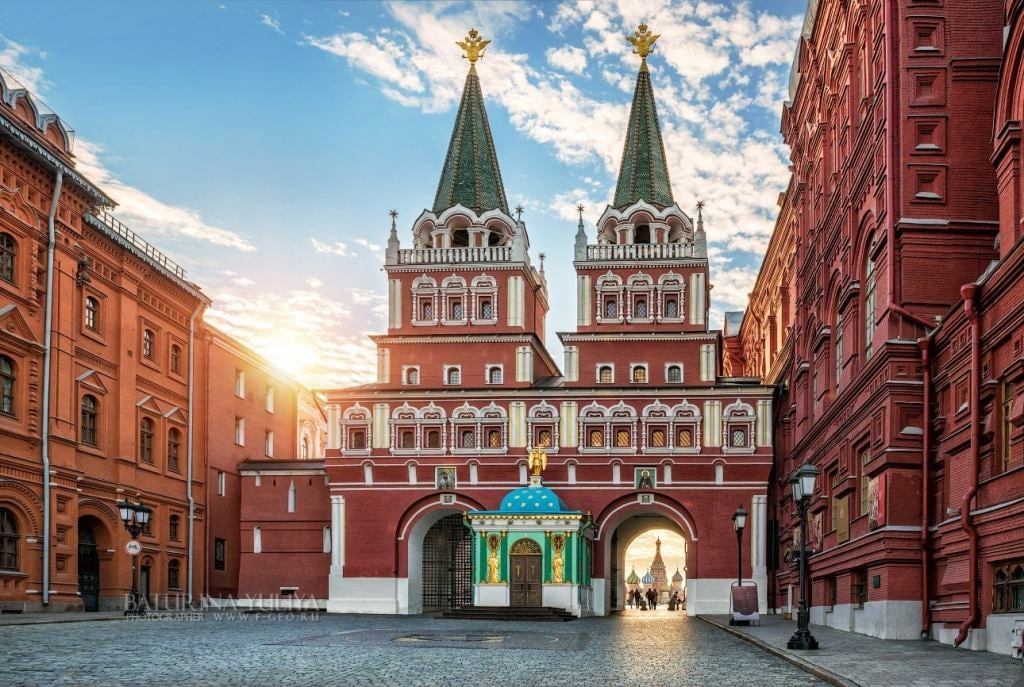
The Iberian or Resurrection Gate is the only remaining gate of the Kitai-gorod[1] in Moscow. It connects the north-western end of Red Square with Manege Square and gives its name to nearby Voskresenskaya Square [Resurrection Square, renamed Revolution Square in 1918].
The gate adjoins the ornate building of the old Moscow Duma [City Hall] to the east and the State Historical Museum to the west.
The first stone gate leading to Red Square was erected in 1535, when the Kitai-gorod wall was being reconstructed in brick. When the structure was rebuilt in 1680, the double passage was surmounted with two-storey chambers crowned by two octagonal hipped roofs similar to the Kremlin towers. An Icon of the Resurrection was placed on the gate facing towards Red Square, from which the gate derives its name.
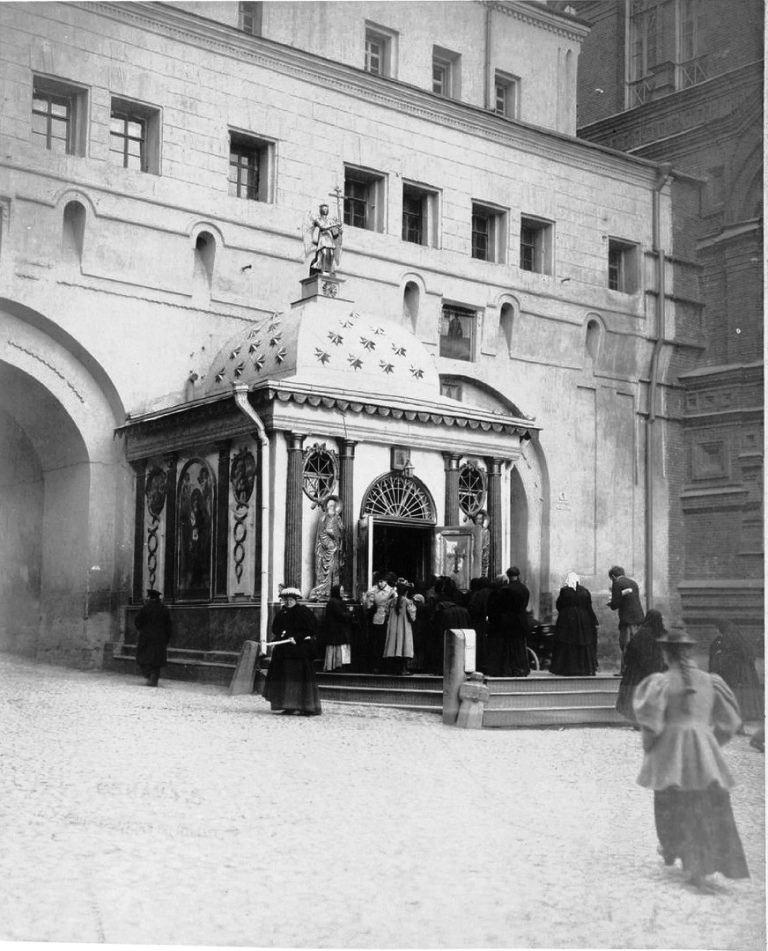
The Iverskaya Chapel
Since 1669, the wooden chapel in front of the gate (facing away from Red Square) has housed a replica of the miracle-working icon of Panaghia Portaitissa (“keeper of the gate”), the prototype of which is preserved in the Georgian Iveron Monastery on Mount Athos. Hence, the name Iversky (Iberian) that stuck both to the chapel and the gate. In 1781, the Nikolo-Perervinsky Monastery constructed a new brick chapel on the spot. The star-splattered cupola of the structure was topped with a statue of an angel bearing a cross.
According to a popular custom, everyone heading for Red Square or the Kremlin visited the chapel to pay homage at the shrine, before entering through the gate. Beggars and outlaws would pray there next to the highest persons, including the Tsar himself. It was here that the rebel Emelyan Pugachev asked the Russian people for forgiveness a few hours before his execution. The tiny ever-overcrowded chapel, with candles burning day and night, figures in works by Leo Tolstoy, Ivan Bunin, Marina Tsvetayeva, and H.G. Wells, to name only a few.
PHOTO: the Iverskaya Chapel. c. 1890s
Nicholas II, like his father preferred Moscow to St. Petersburg. According to French historian Marc Ferro: “Nicholas II preferred Moscow to St. Petersburg because the old city embodied the past, whereas St. Petersburg represented modernity, the Enlightenment and atheism.”
Three of the most notable visits to the Chapel were made on 26th (O.S. 14th) May 1896, on his way to his Coronation; on 25th-26th August 1912 during the celebrations dedicated to the 100th anniversary of the Battle of Borodino; and in May 1913 for celebrations marking the Romanov Tercentennary (1913).
On 5th April 1900, Nicholas wrote to his mother about reaching a landmark in his private spiritual life. A letter to his mother, reveals his strong religious feeling:
“What a joy it is to us, dear Mama, to prepare for Holy Communion here in the Kremlin, with all its various churches and chapels . . . This feeling is now much stronger than it was in 1896, which is only natural. I am so calm and happy now, and everything here makes for prayer and peace of spirit . . . “.
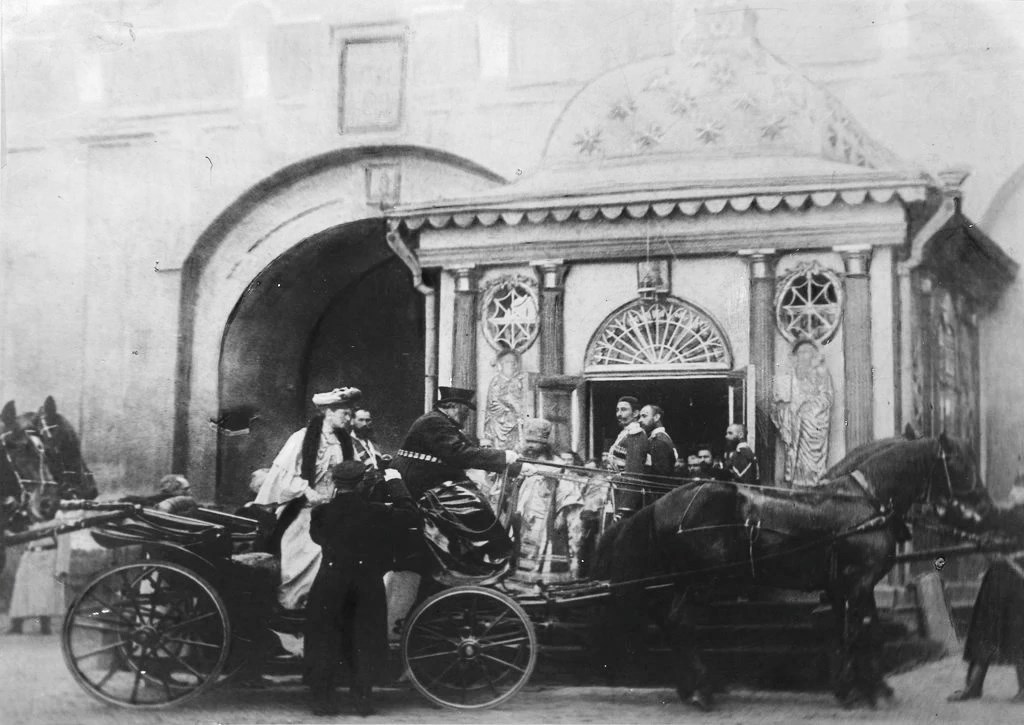
During his reign, Nicholas made numerous visits to the former Russian capital, where he always stopped to pray at the Iverskaya Chapel before crossing Red Square into the Kremlin, where he took up residence in the Grand Kremlin Palace. Moscow’s fervent greeting to their Tsar on each of his visits confirmed his feeling for the city.
Three of the most notable visits to the Iverskaya Chapel were made on 26th (O.S. 14th) May 1896, on his way to his Coronation; on 25th-26th August 1912 during the celebrations dedicated to the 100th anniversary of the Battle of Borodino; and in May 1913 for celebrations marking the Romanov Tercentennary (1913).
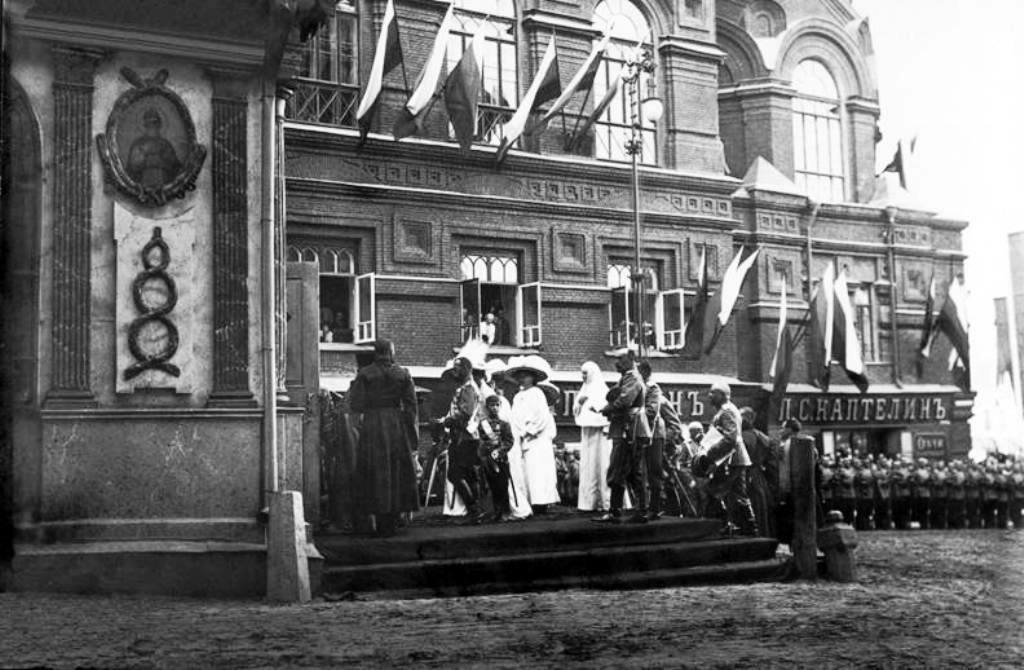
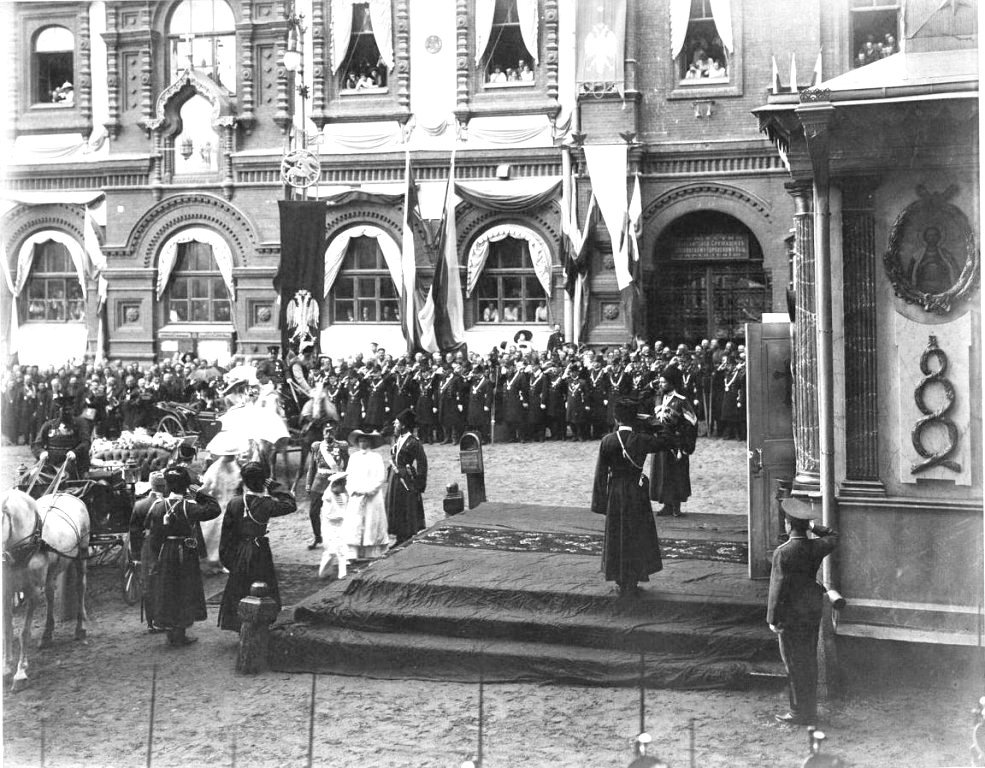
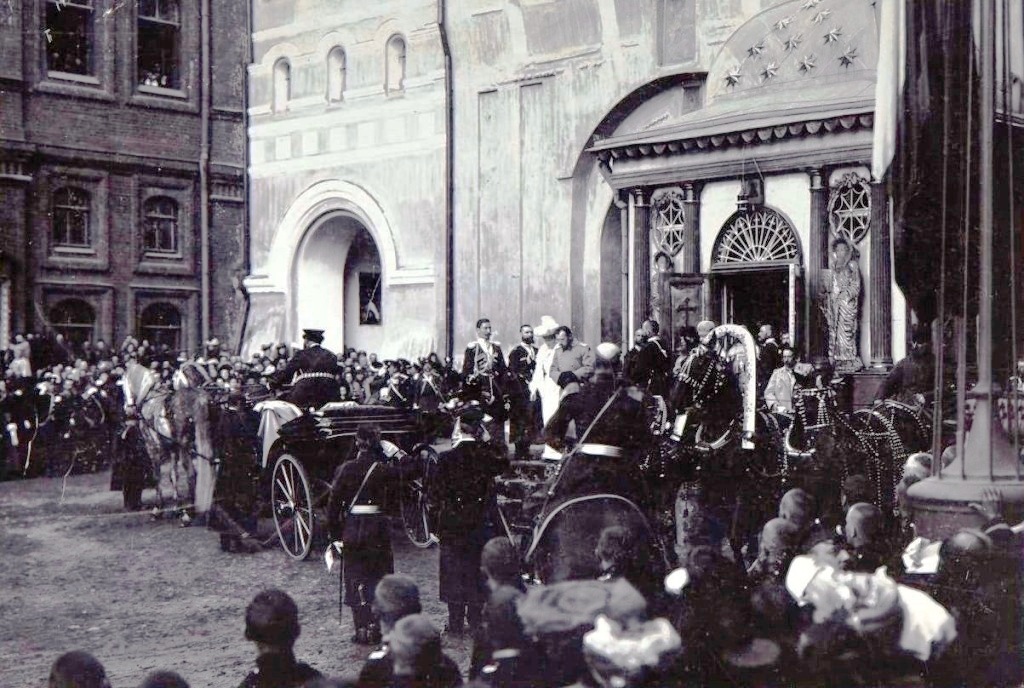
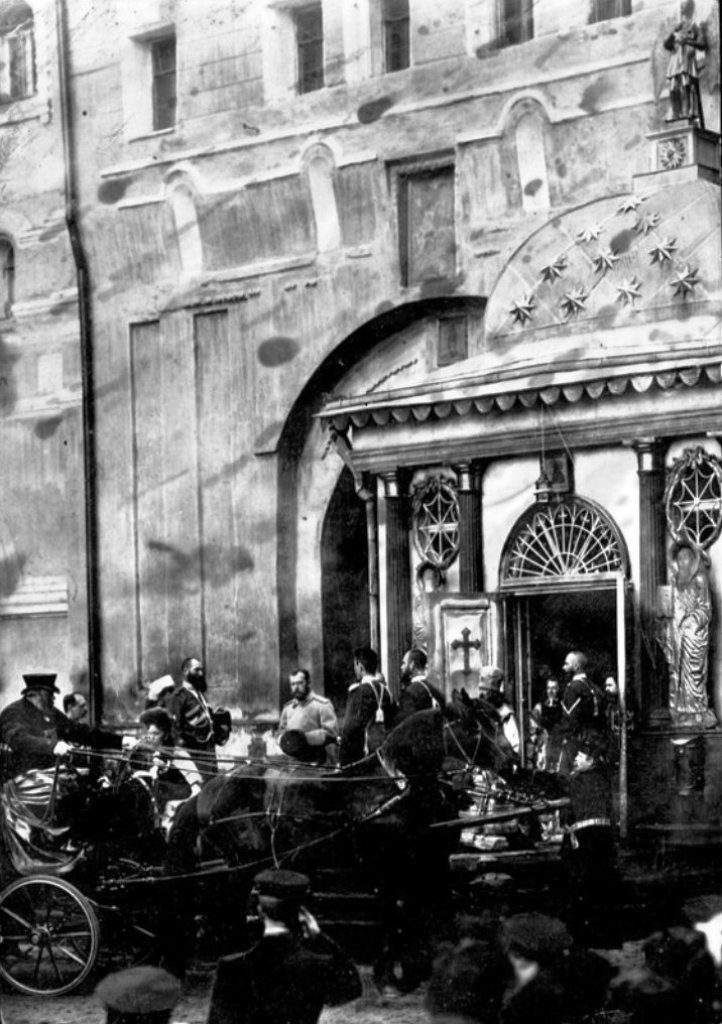
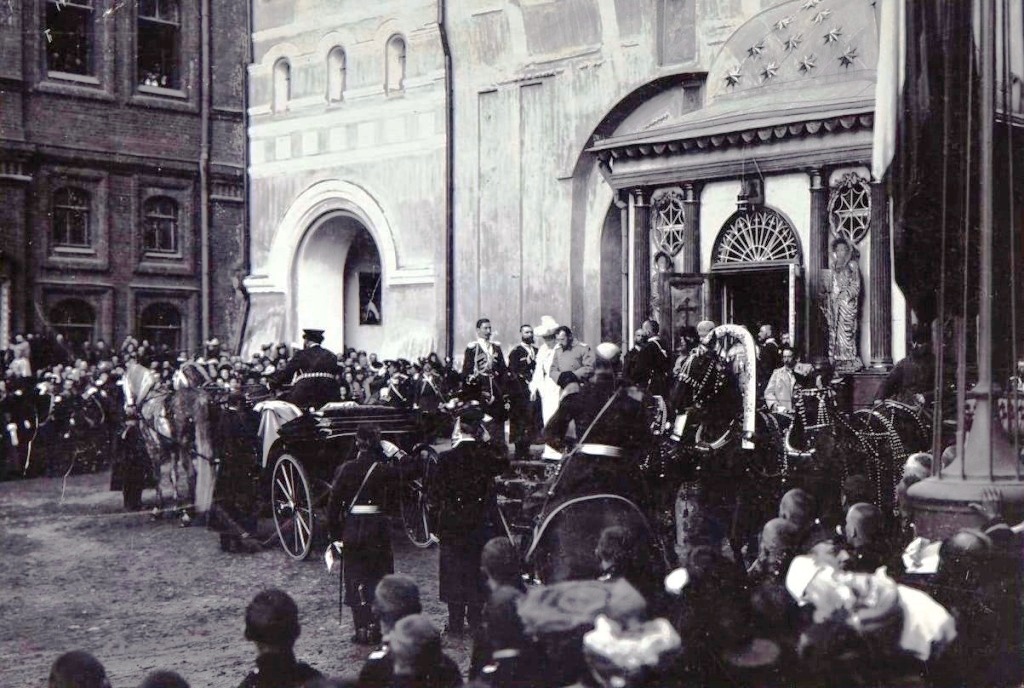
PHOTO: Emperor Nicholas II along with members of his family arrive at the Iverskaya Chapel in Moscow, 1912. Note the curious people watching from the windows of the State Historical Museum in the background. The Tsar is accompanied by his daughters the Grand Duchesses Olga, Tatiana, Maria, Anastasia (all wearing white hats), and his son Tsesarevich Alexei Nikolaevich, as well as the Grand Duchess Elizabeth Feodorovna (wearing a nuns’ habit).
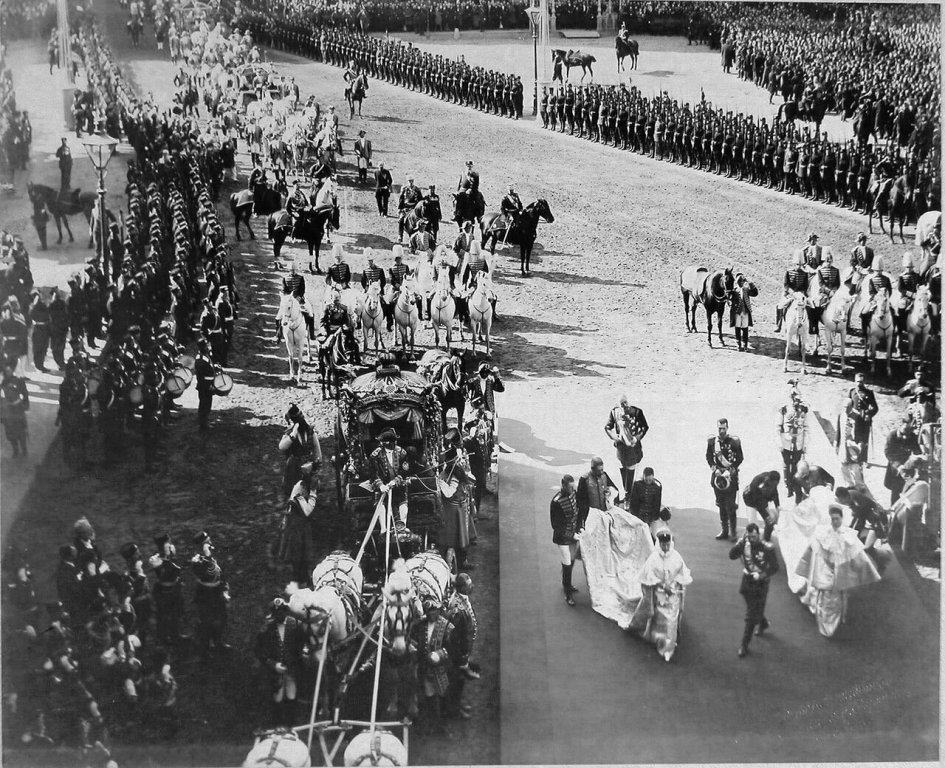
In the above photo, Emperor Nicholas II, Empresses Alexandra Feodorovna and Maria Feodorovna are walking towards the Iverskaya Chapel of the Iberian Mother of God before the crowning of Russia’s last Tsar in the Assumption (Dormition) Cathedral in the Kremlin on 26th (O.S. 14th) May 1896.
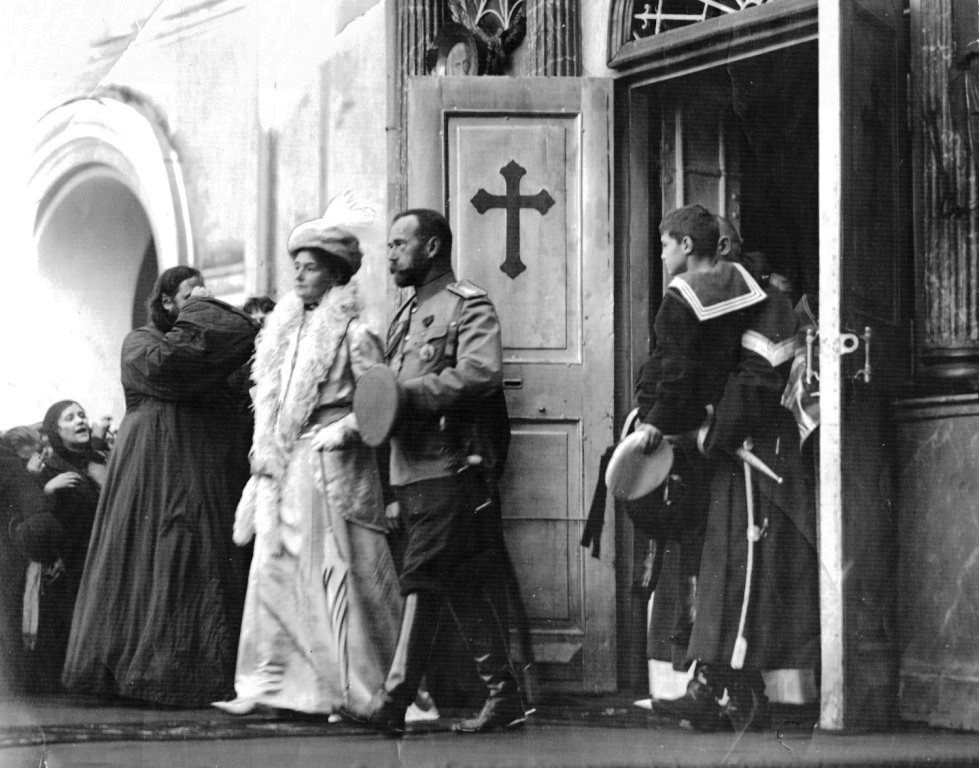
The photos below depict Emperor Nicholas II, Empress Alexandra Feodorovna and their children visiting the Iverskaya Chapel to pray in 1912 and 1913:
PHOTO: Nicholas II, Empress Alexandra Feodorovna and Tsesarevich Alexei Nikolaevich (being carried by the Cossack Alexei Petrovich Pilipenko (1887-1972) leaving the Iverskaya Chapel in Moscow
***
In 1929 the Iverskaya Chapel was demolished, and in 1931 the Resurrection Gate was demolished by order of Soviet leader Joseph Stalin in order to make room for heavy military vehicles driving through Red Square during military parades. Following the dissolution of the Soviet Union, both structures were rebuilt under Moscow mayor Yuri Luzhkov’s[2] leadership, on the site between 1994 and 1995. A new icon of the Iveron Theotokos was painted on Mount Athos to replace the original.
On 4th November 1994, Patriarch Alexi II (1929-2008) consecrated the foundation of both the Iverskaya Chapel and the Resurrection Gate. The Iverskaya Chapel reopened to worshippers on 25th October 1995. Every day, every two hours from eight o’clock in the morning to eight in the evening, prayers are performed in the chapel with the reading of the akathist to the Most Holy Theotokos.
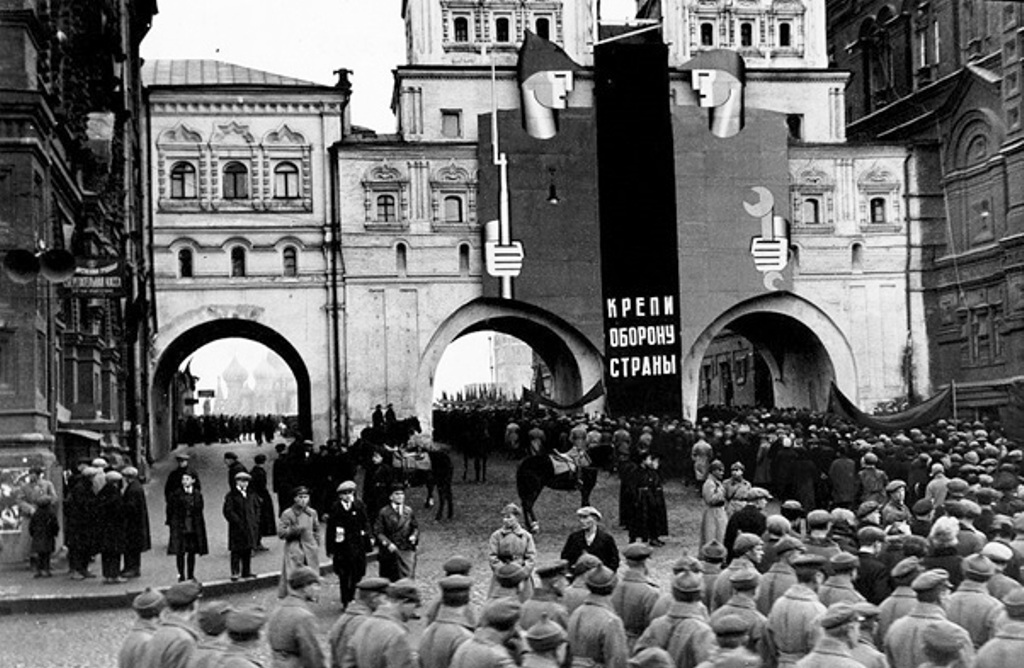
PHOTO: view of the Resurrection Gate in 1931, the Iverskaya Chapel was demolished in 1929
PHOTO: a stunning view of the Iverskaya Chapel and Resurrection Gate – the latter of which leads into Red Square, reconstructed between 1994-95.
NOTES:
[1] The Kitay-gorod was a cultural and historical area, built during the 16th and 17th centuries within the central part of Moscow. During the 1920s and 1930s Stalin ordered Kitay-gorod to be demolished. This wanton act of destruction included 10 chapels, the Cathedral of the Nikolo-Greek Monastery, and two monastery bell towers. The last pre-war victim of Kitay-gorod was the *Cathedral of Our Lady of Kazan, demolished in 1936, which stood on the corner of Nikolskaya Street and the Red Square. *Reconstructed between 1990-1993.
[2] Yuri Mikhailovich Luzhkov (1936-2019) was a Russian politician who served as the Mayor of Moscow from 1992 to 2010. Under Luzhkov’s leadership, the Cathedral of Christ the Saviour, the Cathedral of Our Lady of Kazan, the Resurrection Gate and Iverskaya Chapel were all rebuilt, as well as the construction of Catherine II’s unfinished palace in Tsaritsyno and the reconstruction of the Kolomenskoye Palace of Tsar Alexis (demolished as early as the 18th century).
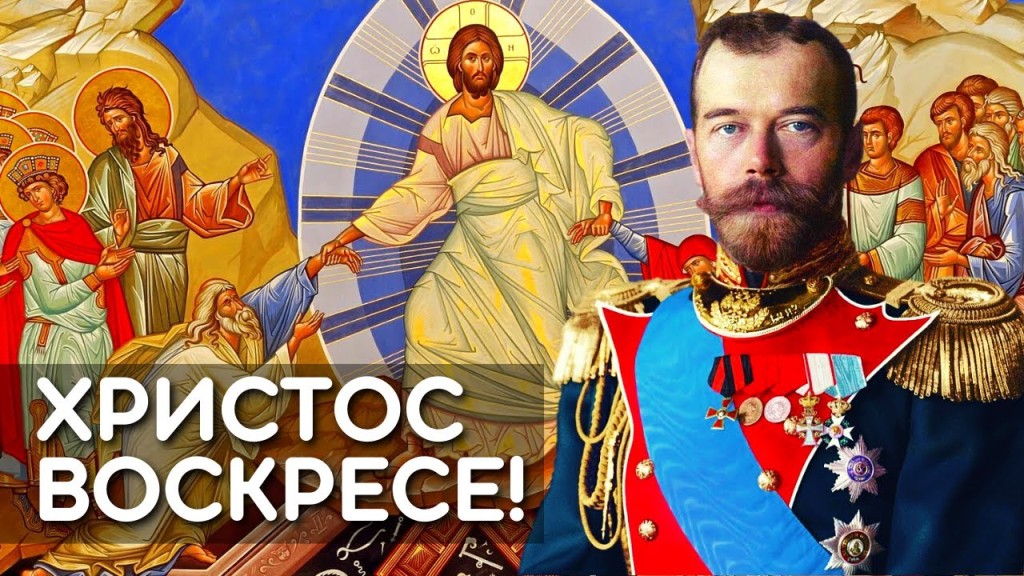
Pascha (Easter) stands as the cornerstone of Orthodox Christian faith, marking the Resurrection of Jesus Christ. The Resurrection is so central to Orthodox Christianity that all elements of the faith revolve around it, making Pascha the most important and joyous celebration of the ecclesiastical year.
“Христос Воскресе / Christ is risen!” With these words, the hearts of all Orthodox Christians are filled with a feeling of ineffable joy and spiritual warmth. The same was true for the Russian Imperial Family, who are now a saints [Russian Orthodox Church Outside Russia] and Passion-Beaers [Moscow Patriarchate of the Russian Orthodox Church].
The Pascha of 1895 was the first for the newly wedded couple. Emperor Alexander III peacefully reposed in the autumn of 1894. His son, the twenty-six year-old Nicholas Alexandrovich, immediately ascended the Russian throne and married the German princess Alice of Hesse on 14th November of the same year. The young Emperor was on the threshold of a different life. A new page of Russian history was unfolding.
The Pascha of April 1918 was the last for the Tsar and his family, three months later, they were to meet their death and martyrdom.
In these two newsreels below, we see the Emperor and his family celebrating Pascha at their Crimean residence Livadia (1914) and at the Headquarters of the Supreme Commander-in-Chief of the Russian Armed Forces in Mogilev (1916) respectively.
VIDEO – duration: 1 minute, 23 seconds with musical background
The music in this newsreel is ‘Христос Воскресе из мертвых!’ Christ is Risen from the Dead!, the main hymn of the Paschal service, recorded in 1909-1912, Moscow. Composer: D. Bortnyansky. Performed by the choir of A. A. Arkhangelsky. Text: “Christ is risen from the dead, trampling down death by death, and giving life to those in the tombs”.
In this newsreel Emperor Nicholas II exchanges khristosovanie (greeting) with officers on the first day of Easter – 6th April 1914 – in the Italian courtyard of the Livadia Palace. The Grand Duchesses Olga, Tatiana, Maria and Anastasia Nikolaevna can be seen standing against the wall.
Every year on the first two days of Pascha, the August Couple exchanged khristosovanie with all the employees of their palace and other ranks who were nearby at that time, as well as with members of deputations from volost elders and Old Believers. The Tsar exchanged khristosovanie with the men, the Empress with the women. The Tsar would exchange the traditional three kisses on alternating cheeks with the men, and the men kissed the Tsarina’s hand, who in turn handed each officer and soldier a porcelain egg.
In 1914, on the first day of Easter, 6th April, the Imperial Family was congratulated by 525 officials, and on the second day, by 893. In 1916, on the first day of Easter, 10th April, some 754 employees, mainly from the Court Department, congratulated Her Majesty at Tsarskoye Selo. On the second day, the Empress was congratulated by 576 officials.
VIDEO – duration: 2 minutes, 59 seconds with musical background
The music in this newsreel is ‘Христос Воскресе из мертвых!’ Christ is Risen from the Dead!, the main hymn of the Paschal service. Performed by the Choir of the St. Vladimir Cathedral in Kiev. Composer Dmitry Stepanovich Bortnyansky . Date of recording: 1914.
The Last Pascha in the Russian Empire was celebrated in April 1916. Less than a year later the Tsar would abdicate the throne ending 300+ years of the Romanov dynasty.
In this newsreel Tsar Nicholas II exchanges khristosovanie (greeting) with His Imperial Majesty’s Own Convoy – the Cossack unit which served as the Tsar’s elite guard, at the Headquarters of the Supreme Commander-in-Chief on the occasion of the feast of Holy Easter. Following behind the Tsar is General Count Alexander Grabbe (1864-1947), who served as the last Commander of His Imperial Majesty’s Own Convoy from 1914 to 1917.
If you look closely, at 00:15 you can see one of the Court photographers readying his camera to photograph the occasion. And at 00:30 you can see standing behind the Tsar, the Minister of the Imperial Court Count Vladimir Frederiks [with his signature long white moustache] and General Vladimir Voeikov, who served as Palace Commandant. Once again, we see the Tsar exchange khristosovanie with the officers, and the traditional three kisses on alternating cheeks with each man. He then hands each officer a porcelain egg. At 2:00 we see the Tsar repeat the khristosovanie with the ranks of soldiers of a regiment. Look at the faces of some of the soldiers, some of who are in awe of seeing their Sovereign.
The only known film-clip of Emperor Nicholas II and Empress Alexandra Feodorovna visiting Queen Victoria is available to view on YouTube. It is the earliest known film of the Tsar and Queen Victoria at Balmoral. The recording lasts only 1 minute and 10 seconds, but is of great historical value.
The film-clip featuring members of the British Royal Family and the Russian Imperial Family was shot on 3rd October 1896 at Balmoral Castle, a favourite residence of Queen Victoria in the Scottish Highlands. It was filmed by William Edward Downey (1829-1915) of W. & D. Downey Studios (London).
In the recording, Queen Victoria can be seen in an open carriage pulled by a pony. In her arms, the Queen holds her favorite Pomeranian “Turi”. The Queen is accompanied by numerous family members and relatives, including her granddaughter, Empress Alexandra Feodorovna [daughter of Princess Alice of Great Britain, later Grand Duchess if Hesse and by Rhine (1843-1878)], and her granddaughter’s husband, Emperor Nicholas II, dressed in a casual three-piece suit and a Homberg felt hat. The procession is completed by the Queen’s favorite, Abdul Karim (1863-1909), who served Her Majesty during the final fourteen years of her reign, gaining her maternal affection over that time.
William Downey showed the film to Queen Victoria at Windsor Castle on 23rd November 1896. For more than a century, the recording had been gathering dust in the archives, it was discovered and shown to the general public in 2013.
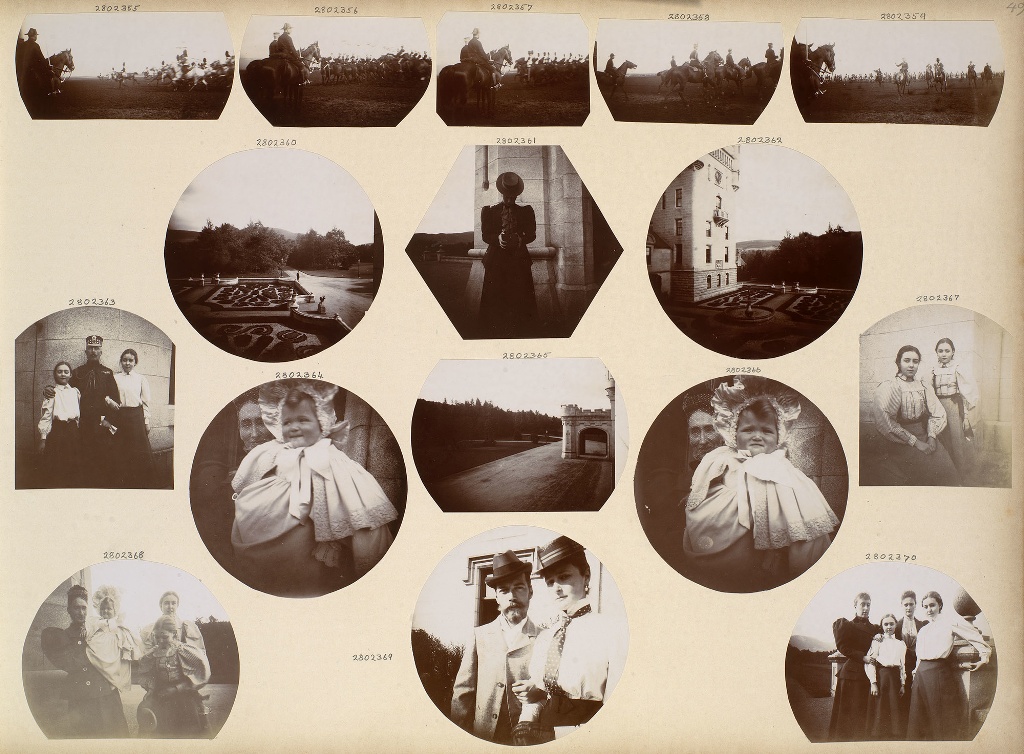
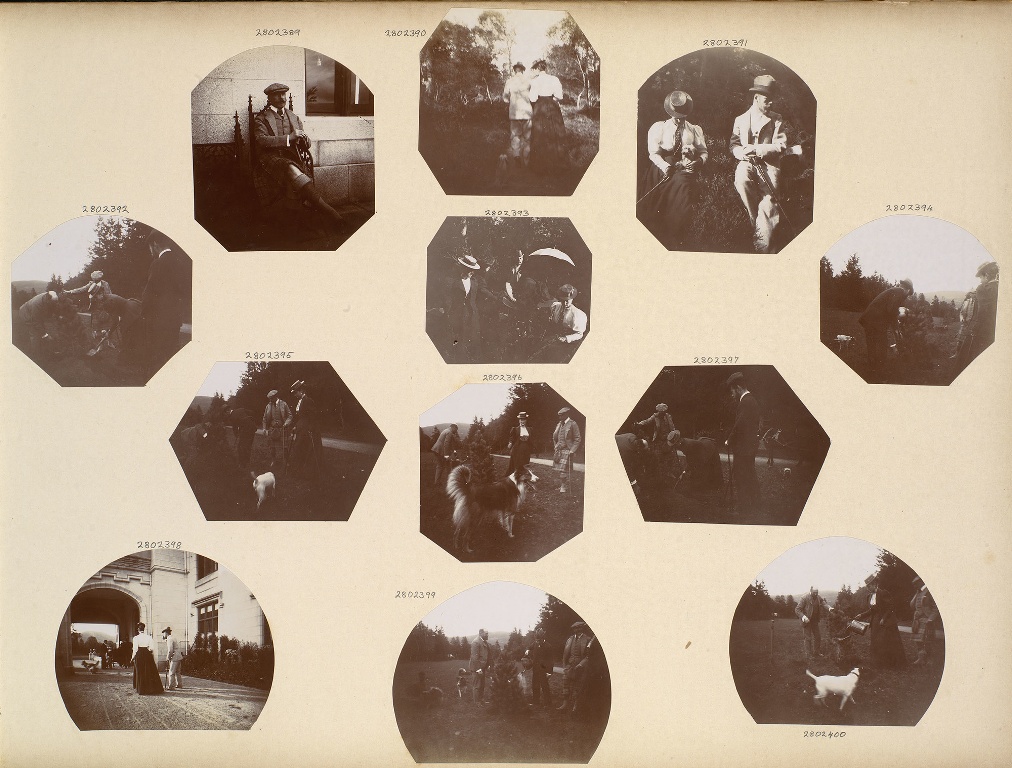
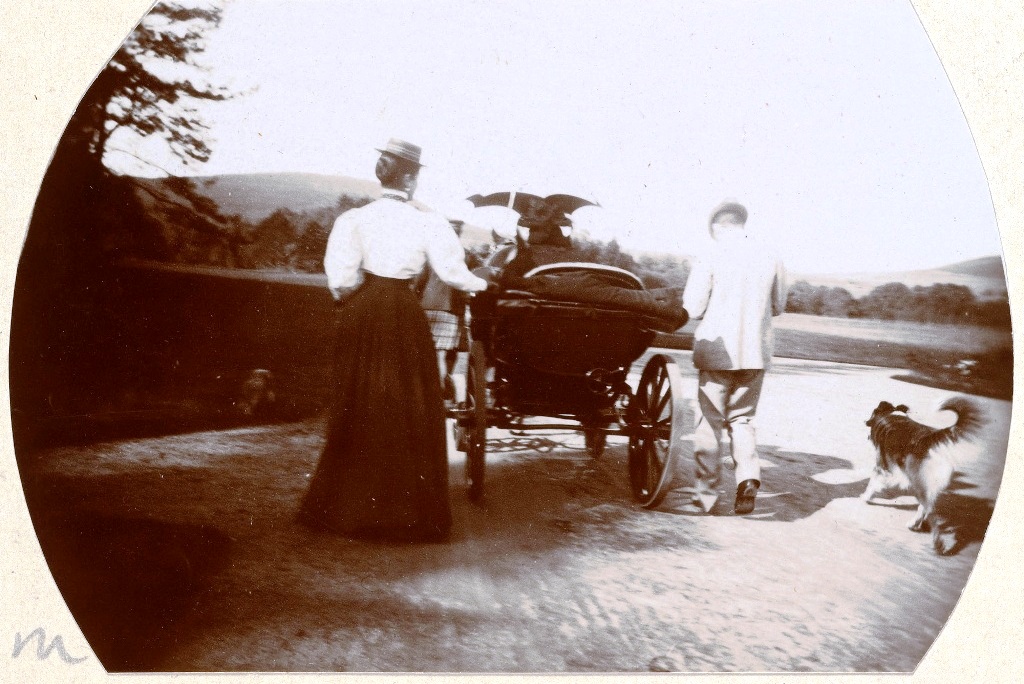
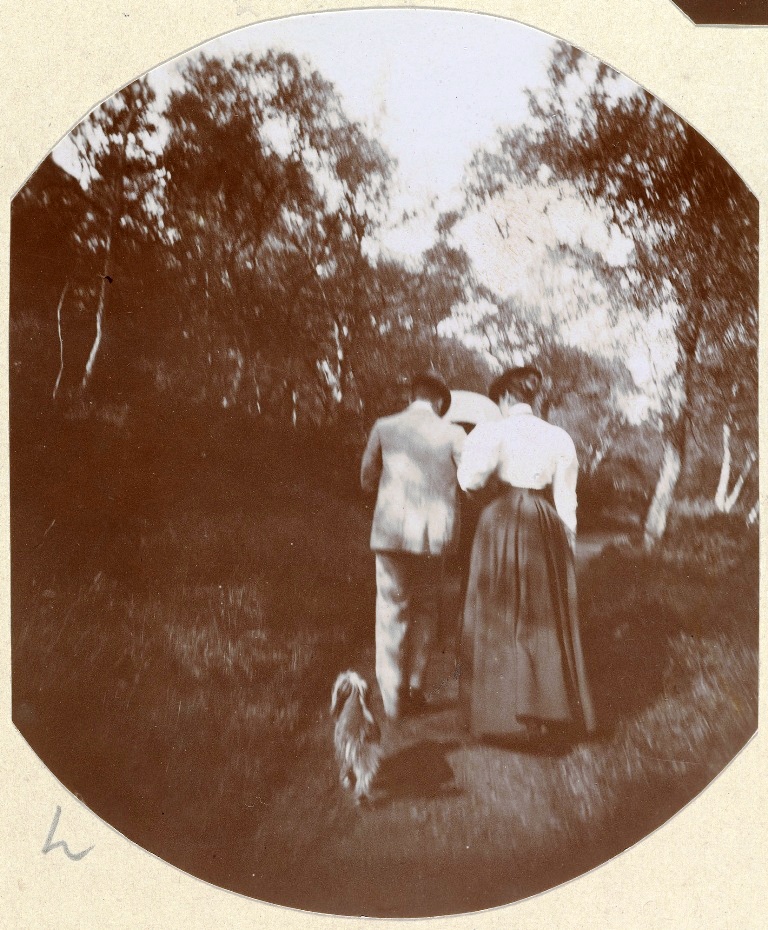
Pages from Princess Alexandra’s Photo Albums (1896) CLICK on each image to enlarge and see photos in greater detail
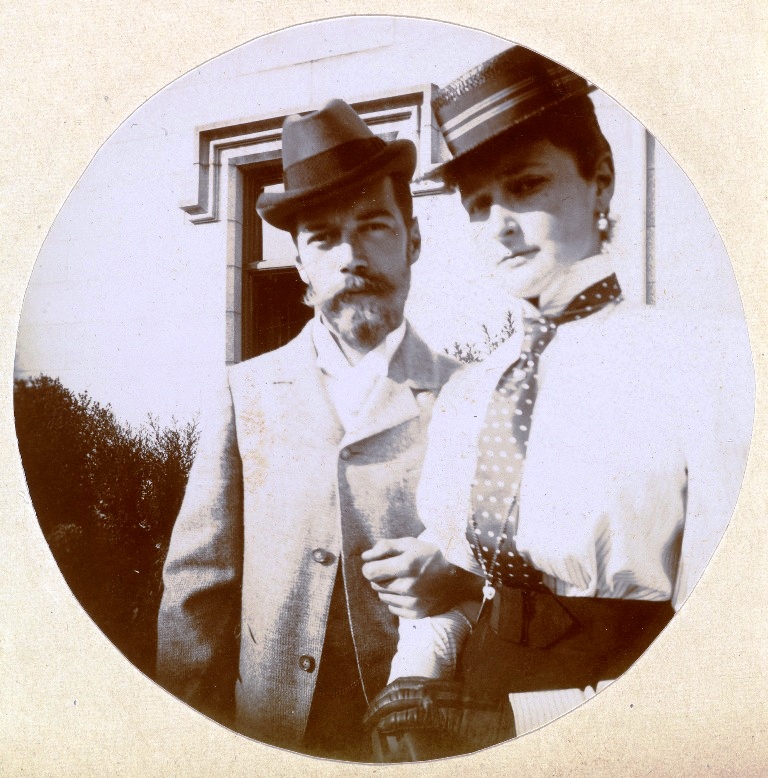
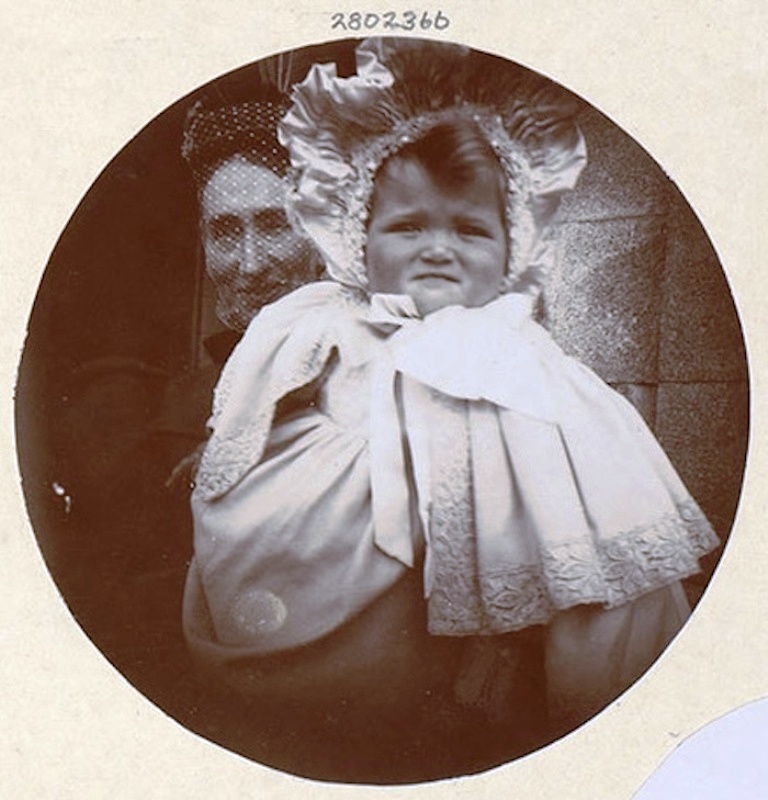
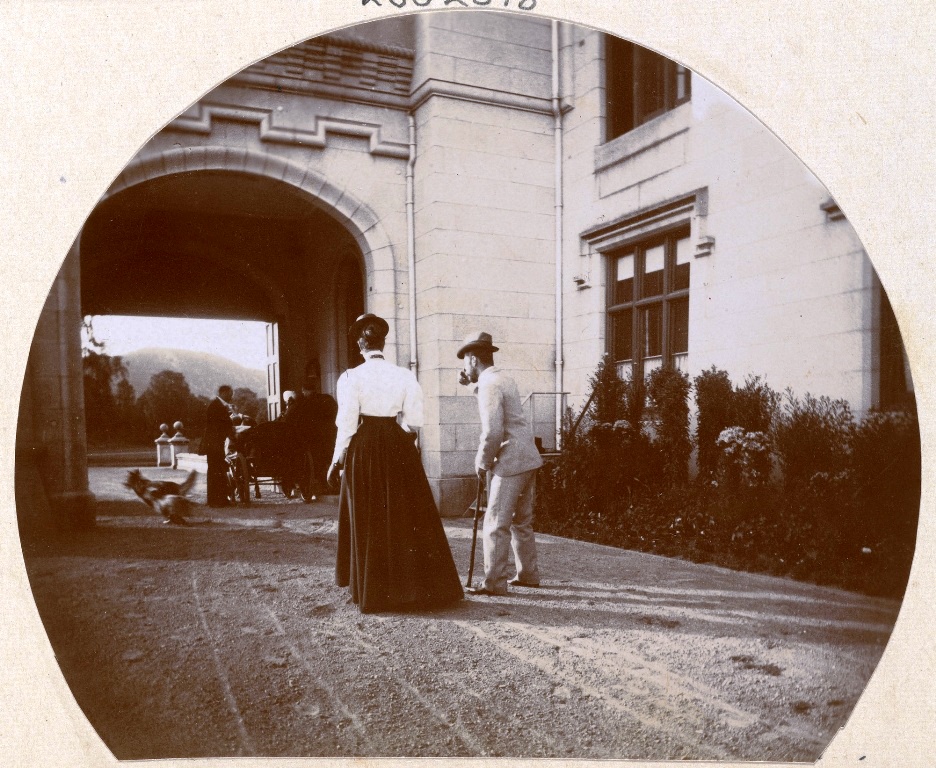
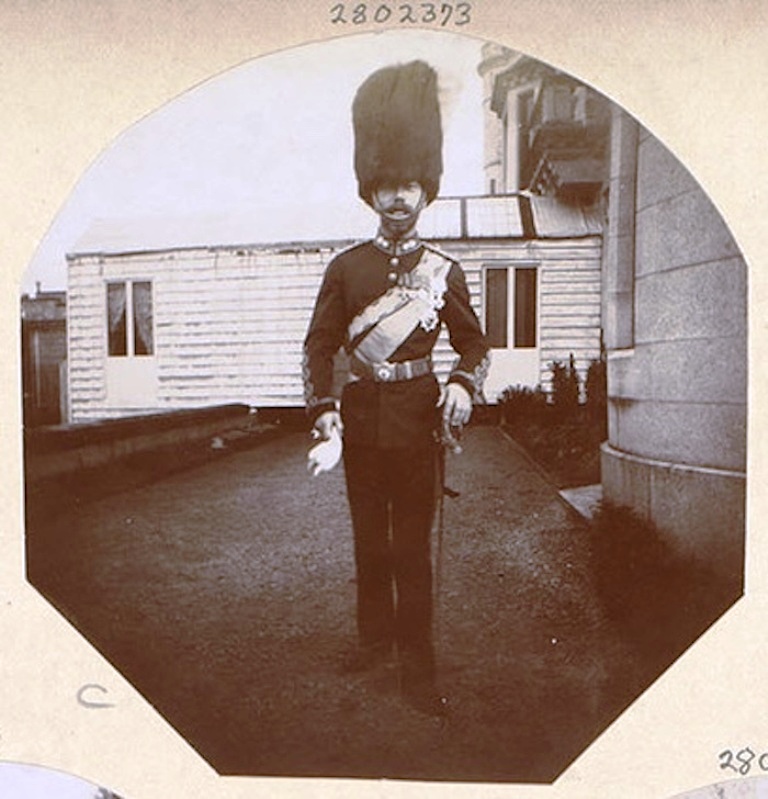
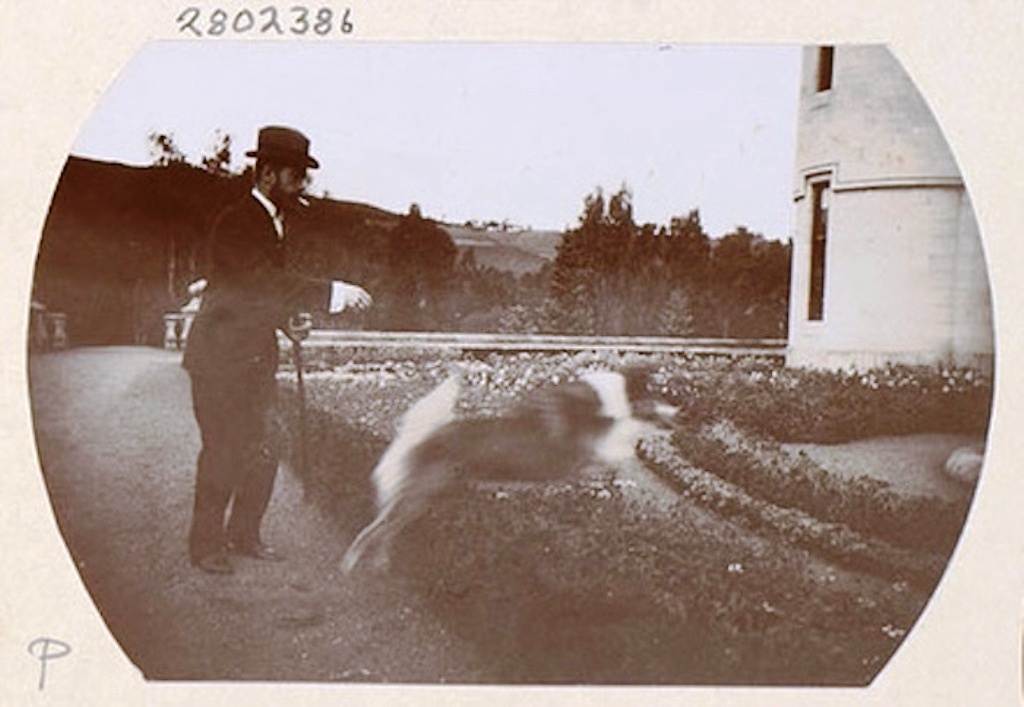
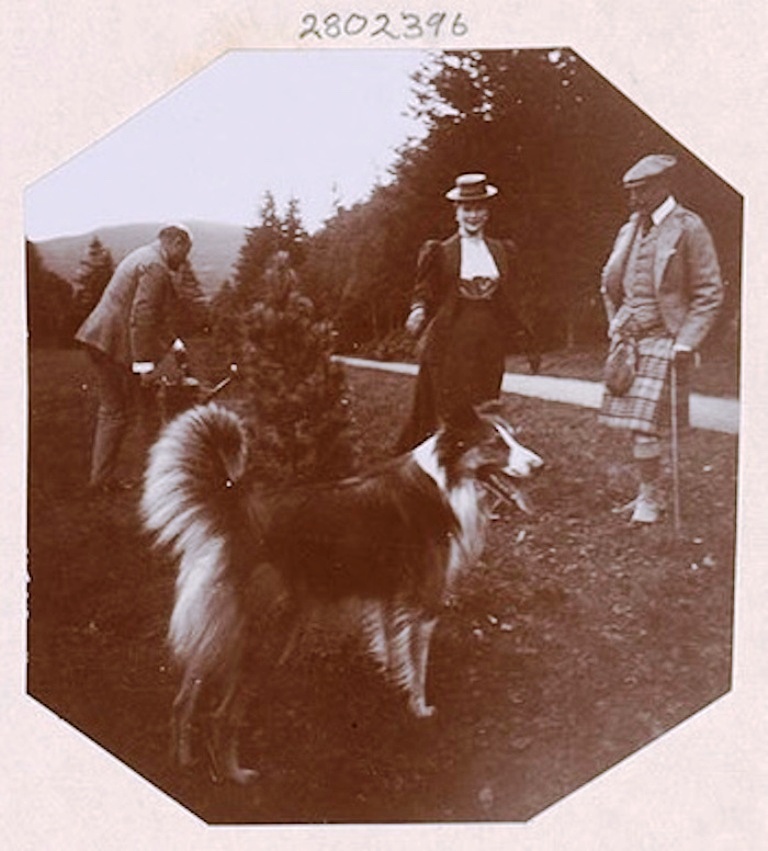
The Royal Foundation of Great Britain also published several pages from the album of Princess Alexandra of Wales [Alexandra of Denmark, 1844-1925] – the daughter-in-law of Queen Victoria and the maternal aunt of Nicholas II. Alexandra was fond of photography and made a detailed album on her nephew’s stay at Balmoral. The photos are round – this was the format produced by the first Kodak cameras.
In the pictures, we see the happy newlyweds and their newborn daughter Olga, about whom the queen said: “A beautiful child, and so big!”
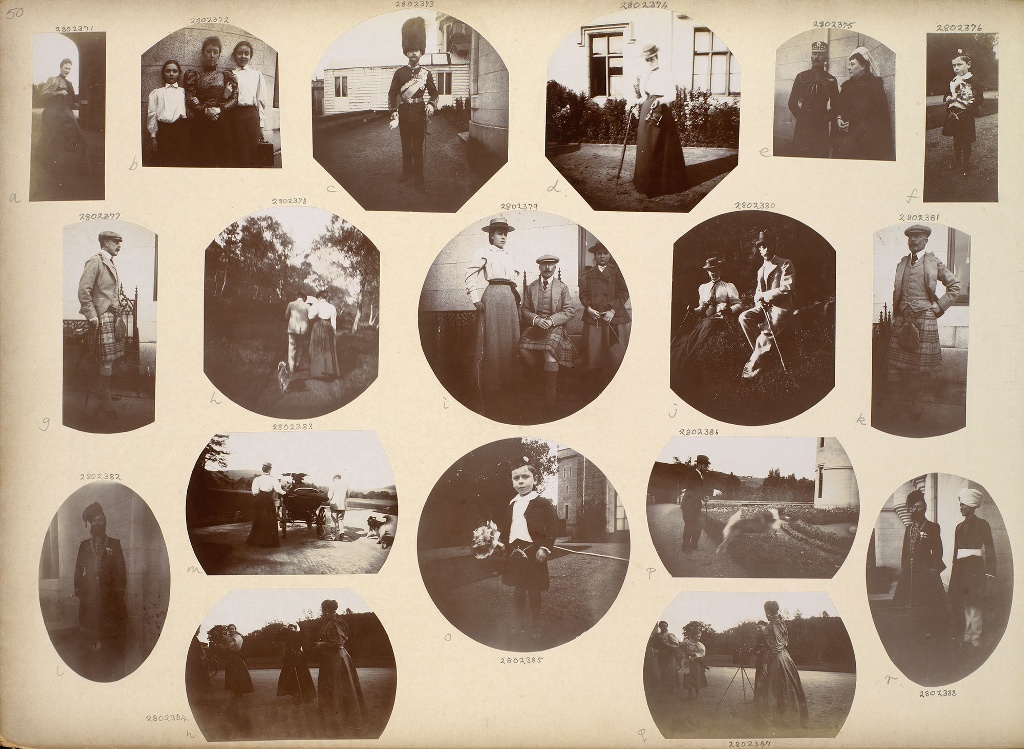
Photos from Princess Alexandra’s Photo Albums (1896) CLICK on each image to enlarge and see photos in greater detail
The Queen talked a lot with Nicholas II about politics, in particular, about the crisis in Turkey, where mass crimes against Armenians had taken place. Over a cup of tea, Nicholas II and Queen Victoria decided the fate of the Ottoman Sultan. And Alexandra Feodorovna told Granny Victoria about her new life in St. Petersburg and her worries about motherhood.
The Queen enjoyed watching the bathing of Olga, whom she described as “a cute fat baby, cheerful and full of life.” Newlyweds Nicholas and Alix walked with their dogs in Balmoral Park – without retinue and without worries. Another photo (see below) depicts Nicholas II in the uniform of Colonel-in-Chief of the 2nd Dragoons (Royal Scots Grays), bestowed upon him by Queen Victoria.
Photos from Princess Alexandra’s Photo Albums (1896) CLICK on each image to enlarge and see photos in greater detail
They took photographs of each other in the courtyard of the castle. Alexandra Feodorovna also had her own camera, but her photos have not been preserved. But we can leaf through the diary of Nicholas II for their visit to Balmoral, in which the Tsar mainly describes his hunting excursions:
“At 9 1/2 we went on a round-up of the famous grouse [hazel grouse] in the mountains near Birkhall and Glenmuick. I killed only two of them, because shooting at these birds is very difficult. We had breakfast in the tent provided by the generosity of Lord Glenesk, where we drank tea in a large company after the hunt. We returned home at 7 1/2. I’m pretty tired of climbing mountains and standing for a long time on NoNo [numbers, i.e. designated positions] inside earthen towers!”
The day of 3rd October (O.S. 21st September) according to Nicholas’s diary was marked not only by a “whirling shooting”, but also by an important symbolic event. Nicholas and Alexander planted a pine tree each in Balmoral Park.
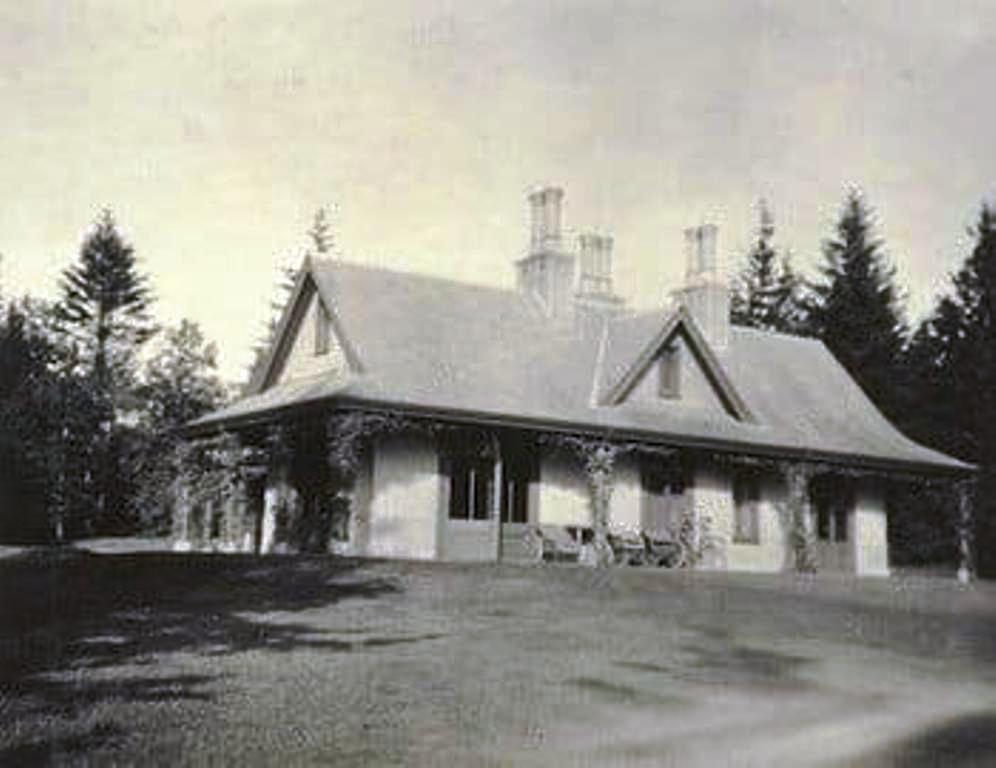
PHOTO: the Garden Cottage at Balmoral (1913)
The Emperor dug a hole with his own hands, covered the roots of the tree with earth and watered the pine tree. Since Balmoral has been carefully maintained and preserved over the years, it is safe to say that the pines more than likely have survived to the present day. There are no special plaques on the trunks, but the Queen wrote in her diary that Nicholas and Alexandra planted pine trees “not far from the Garden Cottage.”
This third video features another tune, which was apparently a favourite of Emperor Nicholas II and his Family. Click on the image above to listen to Осенний сон / Autumn Dream, a waltz. [Duration: 3 minutes, 27 seconds].
The music of the waltz “Autumn Dream” was written by the English pianist and composer Archibald Joyce (1873-1963) in 1908, who wrote a whole series of waltzes loved by listeners and even received the unspoken title of “King of Waltzes”.
In 1909, he came to Russia where he performed concerts, after which “Autumn Dream” immediately gained popularity. A few years later, records were released in huge editions, and “Autumn Dream”, along with other popular works by Joyce, began to be referred to as “old Russian waltzes”.
Several attempts were made to write lyrics to this music. The first to do this was Prince Feodor Nikolaevich Kasatkin-Rostovsky (1875-1940), who dedicated poems to Baroness Olga Nikolaevna Taube. But they did not receive recognition among the public. In the pre-war years, other poets tried to write lyrics to this opera, but the most popular was the version of Vasily Ivanovich Lebedev-Kumach (1898-1949).
NOTE: the translation is not perfect, but it will give you the gist of the lyrics – ENJOY!
The autumn wind blows off the leaves, All nature is full of sadness. Only hope does not die — The heart knows: spring will come.
And sorrows, and bad weather — Everything will pass like autumn rain. There will be joy, there will be happiness, And the warm sun will rise!
You have had enough of crying, maples, birches, You can’t collect old leaves. It’s enough to shed big tears for you, The spring day will come again.
Soon the autumn of separation will pass, The green leaf will grow again, Dear hands will embrace us again, There will be joy, love will come.
Set against the background of this opera are a number of images (some of which have been photoshopped) depicting Emperor Nicholas II and Empress Alexandra Feodorovna set against the autumn colours of the Alexander Park at Tsarskoye Selo. In addition are vintage newsreels and photos of the Imperial Family.
The vocals of this waltz is performed by the famous Russian soloist Irina Krutova, who perform Russian romances and classical music, accompanied by soloists of the State Academic Russian Concert Orchestra. The video was created by Irina Koroteeva (Moscow).
NOTE: Stay tuned for additional videos, featuring more favourite tunes of Nicholas II and his family.
More favourite tunes of Nicholas II and his family:
This second video features another tune, which was apparently a favourite of Emperor Nicholas II and his Family. Click on the image above to listen to Я ехала домой /I was on my way home, a romanice, which tells us a short story through the eyes of Empress Alexandra Feodorovna’s heart. [Duration: 3 minutes, 11 seconds]
The romance “I Was on my way home”, composed by Marie Poiret in 1901 or 1905, is about the love and tenderness of a woman’s heart. The romance became very famous and was part of the repertoire of many performers of the time, including Alexander Vertinsky, Keto Dzhaparidze, Rada Volshaninova, Alla Bayanova among others.
Maria Yakovlevna Poiret (1864-1933) was a Russian dramatic actress, journalist, poet, writer and composer. Her fame has reached our time as the author of several romances, including “I was on my way home”. She also wrote the lyrics to such tunes as “Swan Song”, “I Don’t Want to Die”, as well as to the music of other composers.
NOTE: the translation is not perfect, but it will give you the gist of the lyrics – ENJOY!
I was going home, my soul was full
Unclear for myself, some kind of new happiness.
It seemed to me that everyone with such a fate,
They looked at me with such affection.
I was on my way home… Two-horned moon
I looked out of the windows of the boring car.
The distant annunciation of the morning bells
He sang in the air like a gentle string…
I was driving home, I was thinking about you,
My thought was anxiously both confused and torn.
A sweet slumber touched my eyes.
Oh, if only I had never woken up again…
Set against the background of this romance are a number of images depicting Empress Alexandra Feodorovna riding on the Imperial Train [these images have been photoshopped]. In addition are vintage photos of Nicholas and Alexandra. The vocals of this haunting romance is performed by the popular contemporary Russian singer Irina Krutova. The video was created by Irina Koroteeva (Moscow).
NOTE: Stay tuned for additional videos, featuring more favourite tunes of Nicholas II and his family.
More favourite tunes of Nicholas II and his family:
PHOTO: Emperor Nicholas II on the deck of the Imperial Russian Navy cruiser “Россия / Russia“. 15th Jamuary 1915. Standing to the Emperor’s right is the commander of the Baltic Fleet, Nikolai Ottovich von Essen (1860-1915).
The Chief of Staff of the Guards Troops and Petersburg Military District Lieutenant General Baron A.P. von den Brinken (1859 – 1917) wrote about Nicholas II’s affection for the navy and sailors: “The Tsar, always so kind and gentle, at anyone’s attempt to say something negative against the navy becomes literally furious, thumps his fist on the table, and stops listening”.
Formally established in 1696 under Emperor Peter I (1672-1725), the Imperial Russian Navy served as the navy of the Russian Empire until 1917. It was expanded in the second half of the 18th century and by the early part of the 19th century, it reached its peak strength, behind only the British and French fleets in terms of size.
The navy then went into a period of decline in the first half of the 19th century, due to Russia’s slow technical and economic development. It had a revival in the latter part of the century during the reign of Emperor Nicholas II (1894-1917), but lost most of its Pacific Fleet along with the Baltic Fleet, both of which were sent to the Far East and subsequently destroyed in the disastrous conflict of 1904. The second phase of Nicholas II’s military life was marked by his participation in the reorganization of the navy after the catastrophic Russo-Japanese War.
The Imperial Russian Navy had mixed experiences during the First World War, with Germany generally gaining the upper hand in the Baltic Sea, while Russia established its absolute dominance on the Black Sea. The February Revolution of 1917 marked the end of the Imperial Russian Navy; its officers had mostly aligned with the Tsar, and the sailors split to fight on either side. The surviving ships were taken over by the Soviet Navy when it was established in 1918.
***
VIDEO: vintage newsreels of Nicholas II and the Imperial Russian Navy Duration: 12 minutes with music
The above video presents a collection of vintage newsreels from the Russian State Documentary Film & Photo Archive at Krasnogorsk (RGAKFD), which show Emperor Nicholas II with the Imperial Russian Navy as he reviews the squadrons, talks to the Russian sailors, officers and admirals, and participates in the other naval events.
During the reign of Emperor Nicholas II the Imperial Russian Navy continued to expand in the later part of the 19th century, regaining its position as the third largest fleet in the world after Britain and France. The expansion was notably accelerated under Nicholas II who had been influenced by the American naval theoretician Alfred Thayer Mahan. Russian industry, although growing in capacity, was not able to meet the demands of the burgeoning Imperial Navy and some ships were ordered from Britain, France, Germany, USA, and Denmark. French naval architects in particular had a considerable influence on Russian designs.
At the end of the Russo-Japanese War in 1905, Russia had fallen from being the third greatest naval power to sixth place. It was then that the focus of Russian naval activities shifted back from the Far East to the Baltic. The task of the Baltic Fleet was to defend the Baltic Sea and St Petersburg from Imperial Germany.
On 19th March 1906, by decree of Emperor Nicholas II, the Maritime General Staff was organized with the Main Naval Staff, which assumed the functions of the operational body of the Imperial Navy. At first, attention was directed to the creation of mine-laying and a submarine fleet. In the same year, a new program for naval shipbuilding, the Russian Armed Forces Development and Reform Program, known as the “Small Shipbuilding Program”, which was approved by Emperor Nicholas II on 6th June 1907, began to be developed and actively discussed, but later the amount of appropriations was reduced, and the program itself was renamed the “Distribution of Allocations for Shipbuilding” (before 1911 it was planned to finish the ships already started for the Baltic Fleet – 4 battleships and 3 submarines, as well as a new naval base, and for the Black Sea Fleet – 14 destroyers and 3 submarines) and was partially approved by the State Duma in the spring of 1908.
VIDEO: ships of the Russian Imperial Fleet 1894-1917 Duration: 3 minutes with music
The Bosnian Crisis in 1909 again raised the issue of the expansion of the fleet and new battleships , cruisers, and destroyers were ordered for the Baltic Fleet. It is worth noting that, on the personal orders of Emperor Nicholas II, new battleships were laid, which had previously rejected by the State Duma.
A worsening of relations with Turkey meant that new ships including the Imperatritsa Mariya-class battleships were also ordered for the Black Sea Fleet. The total Russian naval expenditure from 1906-1913 was $519 million, in fifth place behind Britain, Germany, the United States and France.
From 1909, active preparation and discussion of a new shipbuilding program took place. The “Ten Year Shipbuilding Program (1910-1920)” – the so-called “Great Shipbuilding Program”, which in its final version envisaged the construction for the Baltic Fleet: 8 battleships, 4-linear cruisers, 18 destroyers and 12 submarines; for the Black Sea Fleet – 9 Novik type destroyers and 6 submarines; ships for the Pacific Fleet, as well as the rearmament and modernization of several battleships – Tri Sviatitelia, Dvenadsat Apostolov, and Georgii Pobedonosets. The program was approved on 25th March 1910, by Emperor Nicholas II, but was not reviewed by the State Duma until 1911.
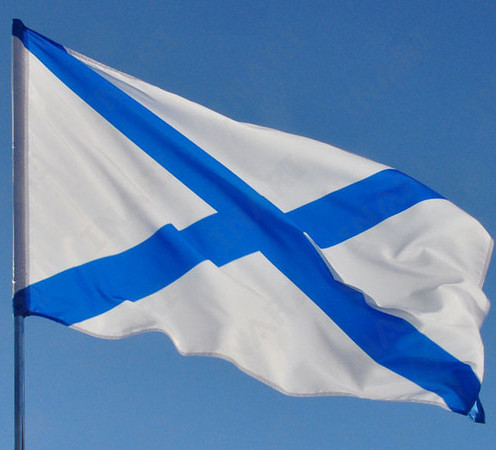
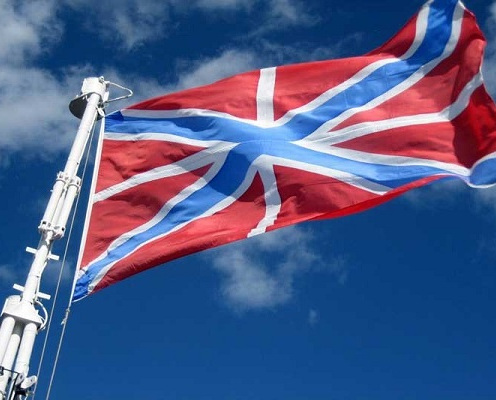
PHOTO: the white and blue ensign or Andreyevsky flag, and the red, blue and white naval jack of the Imperial Russian Navy
The re-armament program included a significant element of foreign participation with several ships (including the cruiser Rurik) and machinery ordered from foreign firms. After the outbreak of World War I, ships and equipment being built in Germany were confiscated. Equipment from Britain was slow in reaching Russia or was diverted to the Western Allies’ own war effort.
By March 1918, the Russian Revolution and the Treaty of Brest-Litovsk made the Germans masters of the Baltic Sea and German fleets transferred troops to support newly independent Finland and to occupy much of Russia, halting only when defeated in the West. The Russians evacuated the Baltic Fleet from Helsinki and Reval to Kronstadt during the Ice Campaign of the Baltic Fleet in March 1918.
The Black Sea was the domain of the Russians and the Ottoman Empire but it was here that the Imperial Russian Navy established its absolute dominance. It possessed a large fleet based in Sevastopol and it was led by two skilled commanders: Admiral Eberhart (1856-1919) and Admiral Kolchak (1874-1920) (who took over in 1916).
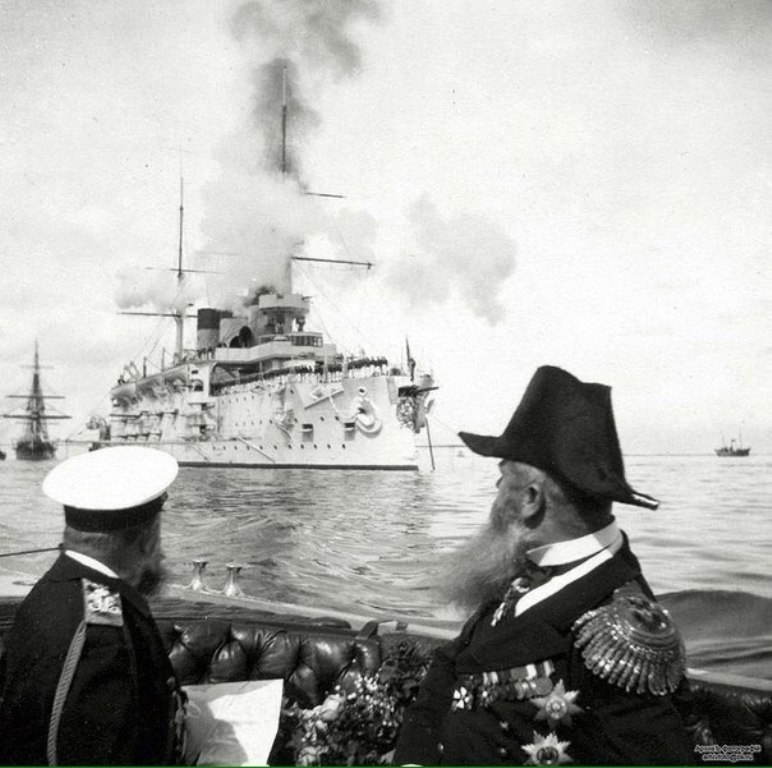
PHOTO: Grand Duke Alexei Alexandrovich and Admiral S.O. Makarov watch the newly constructed battleship Oslyabya, during maneuvers on the Baltic Sea, 1899
After Admiral Kolchak took command (August 1916), the Imperial Russian fleet mined the exit from the Bosporus, preventing nearly all Ottoman ships from entering the Black Sea. Later that year, the naval approaches to Varna were also mined. The greatest loss suffered by the Russian Black Sea fleet was the destruction of the modern dreadnought Imperatritsa Mariya, which blew up in port on 7th October 1916, just one year after it was commissioned. The sinking of the Imperatritsa Mariya was never fully explained; it could have been sabotage or a terrible accident.
The Revolution and subsequent Civil War devastated the Russian Navy. Only the Baltic fleet based at Petrograd remained largely intact, although it was attacked by the British Royal Navy in 1919. Foreign Interventionists occupied the Pacific, Black Sea and Arctic coasts. Most of the surviving Black Sea Fleet warships, with crews loyal to the White Russian movement, became part of Wrangel’s fleet under the control of commander Pyotr Nikolayevich Wrangel (1878-1928) and after evacuating White forces and civilians from the Crimea were eventually interned in Bizerta, Tunisia. Russian sailors fought on both sides in this bloody conflict. The sailors of the Baltic fleet rebelled against harsh treatment by the Soviet authorities in the Kronstadt Rebellion of 1921.
The surviving ships formed the core of the Soviet Navy on its 1918 establishment, though the remnants of Wrangel’s fleet never returned to Russia.
PHOTO: View of the “Боярин / Boyarin” a second-rank protected cruiser built for the Imperial Russian Navy by Burmeister & Wain in Copenhagen, Denmark. Laundced in 1901, the hull featured a magnificent double-headed eagle bearing the monogram of Emperor Nicholas II. She served in the Russian Pacific Fleet and was sunk by a Russian naval mine near the entrance to Port Arthur, Manchuria, just after the start of the Russo-Japanese War.
***
FURTHER READING
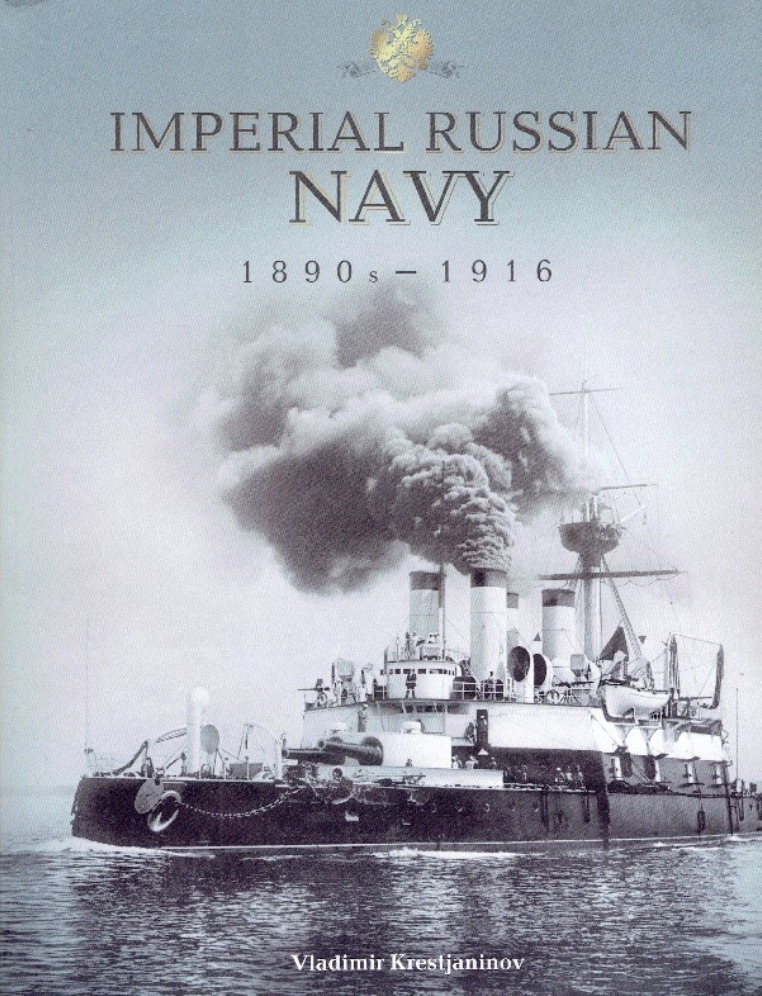
One of my many interests is the Russian Imperial Navy, during the reign of Nicholas II. In 2013, Uniform Press published an excellent book ‘The Imperial Russian Navy 1890s-1916’ by Vladimir Krestjaninov. I highly recommend this title to any one else who shares an interest in this subject.
“Russia has only two true allies,” said Emperor Alexander III, “its army and navy.”
This unique look at the Russian Imperial Navy in photographs from the late 19th and early 20th centuries, features 430 black and white images from archives, museums and private collections. It explores how the Russian Navy’s construction and activities were shaped largely by the interests, opinions and policies of Russia’s last tsar Nicholas II.
It includes a foreword by the author, and chapters such as ‘The Imperial Family and the Navy,’ and eleven other topics. It is interesting to note that the Imperial yachts were under the administration of the Naval Guards Corps.
Large soft cover format with 262 pages. Published by Uniform Press in 2013
NOTE: this article has been updated from it’s original (published on 15th December 2023), with episode No. 5. All 5 episodes are now available in one video, the duration of which is 3 hours and 28 minutes. While the audio is in Russian, you can adjust the settings to translate in English (or other languages), and then turn on the close-captioning for English subtitles – PG (26 November 2024)
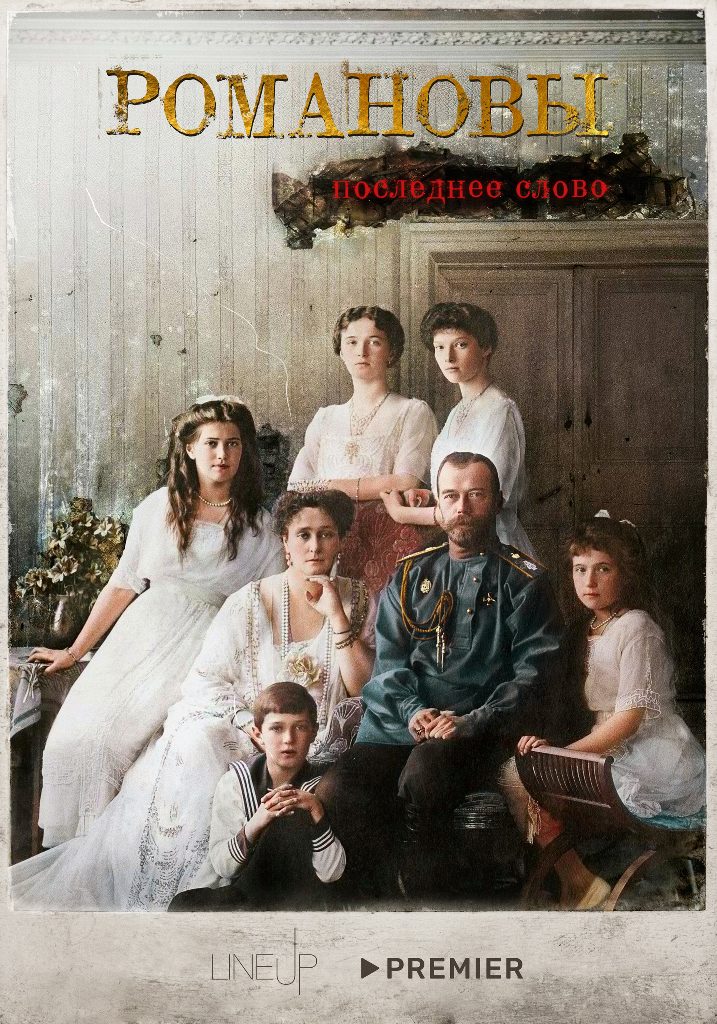
The 5-part series ‘The Romanovs. The Final Word‘, a new Russian-language documentary series is now available to watch on the Russian actor Danil Smirnov’s YouTube page.
In 1964, members of the firing squad Grigory Petrovich Nikulin (1894-1965) and Isai Radzinsky, on the orders of Nikita Khrushchev, recorded their memories of the execution of the Imperial Family in July 1918. These audio recordings were subsequently ordered sealed and stamped “SECRET” and placed in the archives. These important historical recordings are now made public for the first time in the documentary series ‘The Romanovs. The Last Word.’
For the first time, this documentary series reconstructs in detail one of one of the most notorious crimes in 20th century Russian history – the murders of Emperor Nicholas II and his family – based on the memories of the killers. as well as the circumstances of hiding the bodies by a team of executioners. The project was narrated by Sergey Minaev.
***
PLEASE NOTE that this series is currently only available in Russian. I do not know if or when an English language edition will be made available. In the meantime, I will continue to search for the series with English subtitles and update this post – PG
PLEASE NOTE that this series is currently only available in Russian. I do not know if or when an English language edition will be made available. I will continue to search for the series with English subtitles and update this post – PG
I have published nearly 30 titles to date through AMAZON – featuring one of the largest selections of books on Nicholas II, the Romanov dynasty and the history of Imperial Russia.
Please CLICK on the BANNER or LINK above to review my current selection of titles in hardcover, paperback and ebook editions. Listings provide a full description for each title, pricing and a Look inside feature.


 Nicholas II
You must be logged in to post a comment.