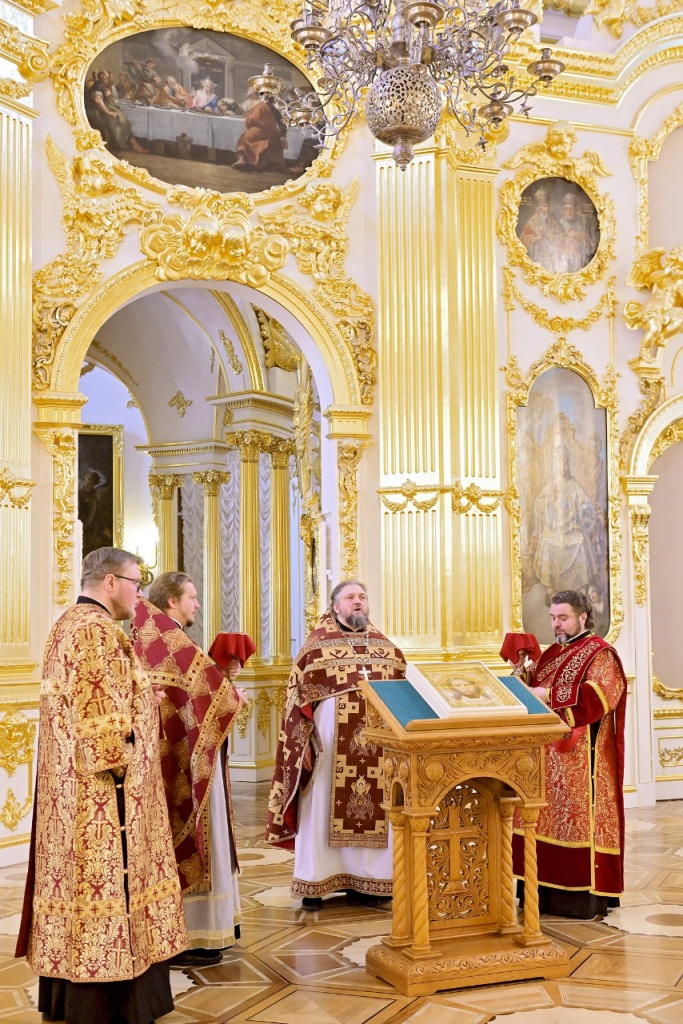
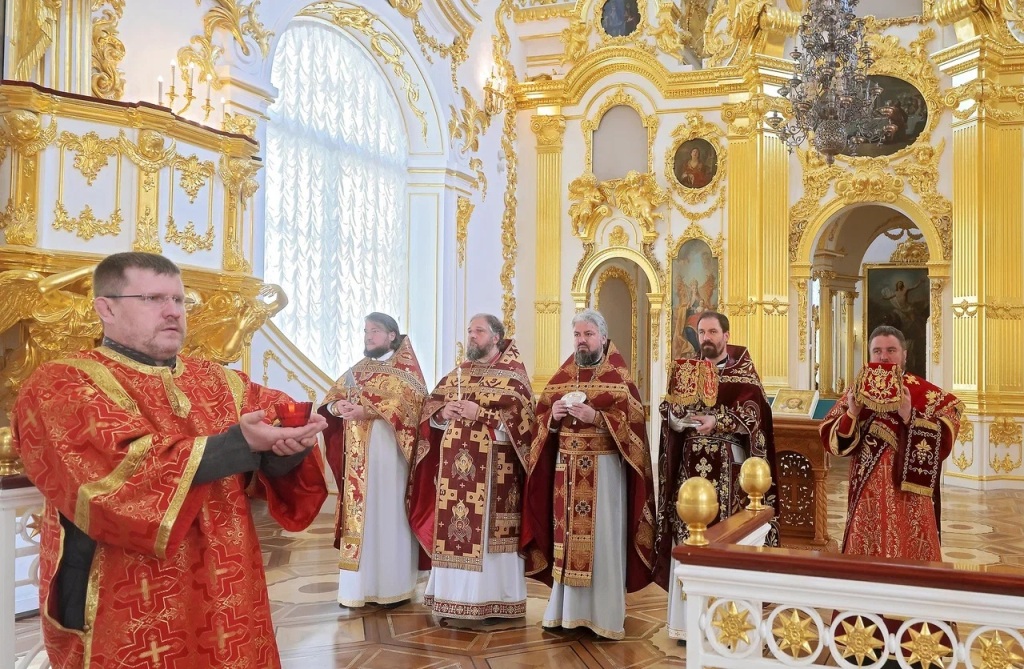
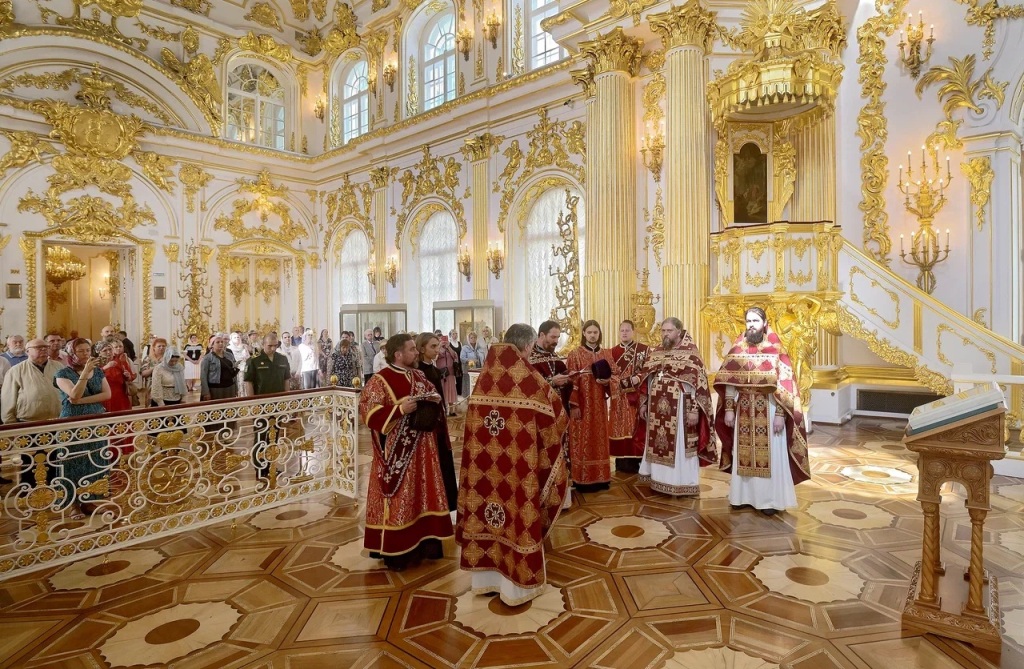
The service was performed by the rector, Hieromonk Mark (Svyatogorov), co-served by the brethren of the Alexander Nevsky Lavra, which is situated in St. Petersburg, and the clergy of the Diocese of St. Petersburg.
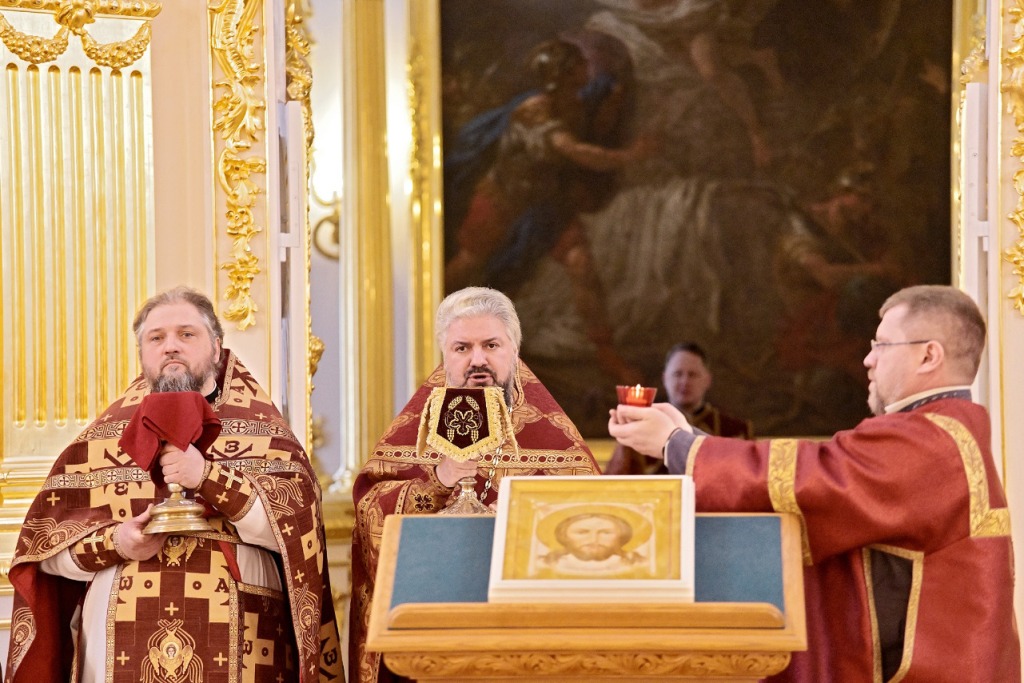
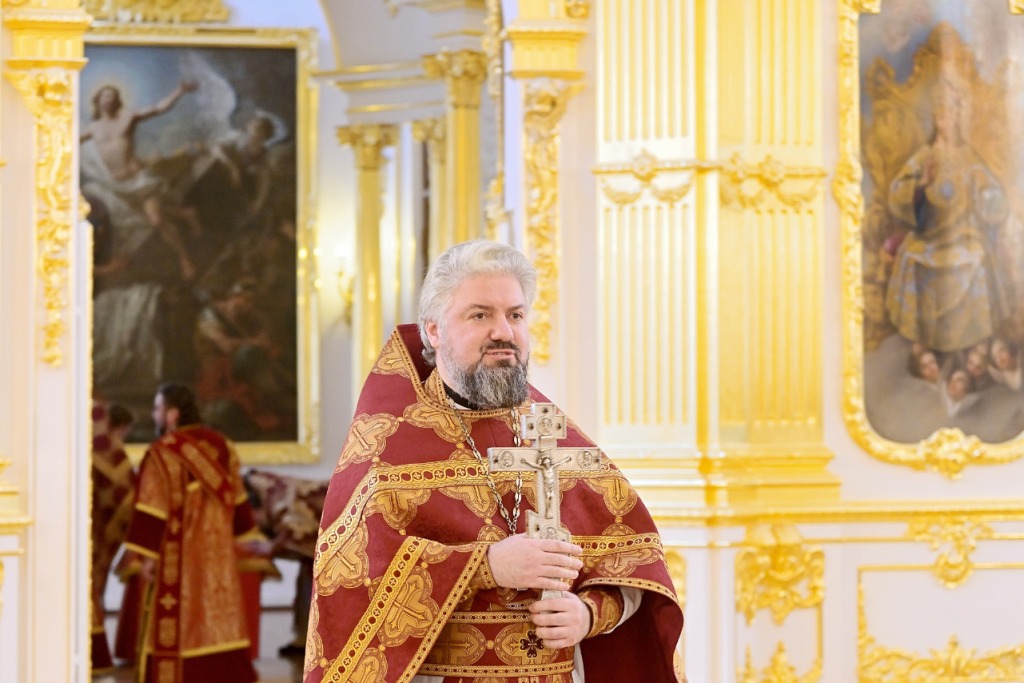
PHOTOS: Hieromonk Mark (Svyatogorov) performing the Divine Liturgy
PHOTOS: Hieromonk Mark (Svyatogorov) performing the Divine Liturgy
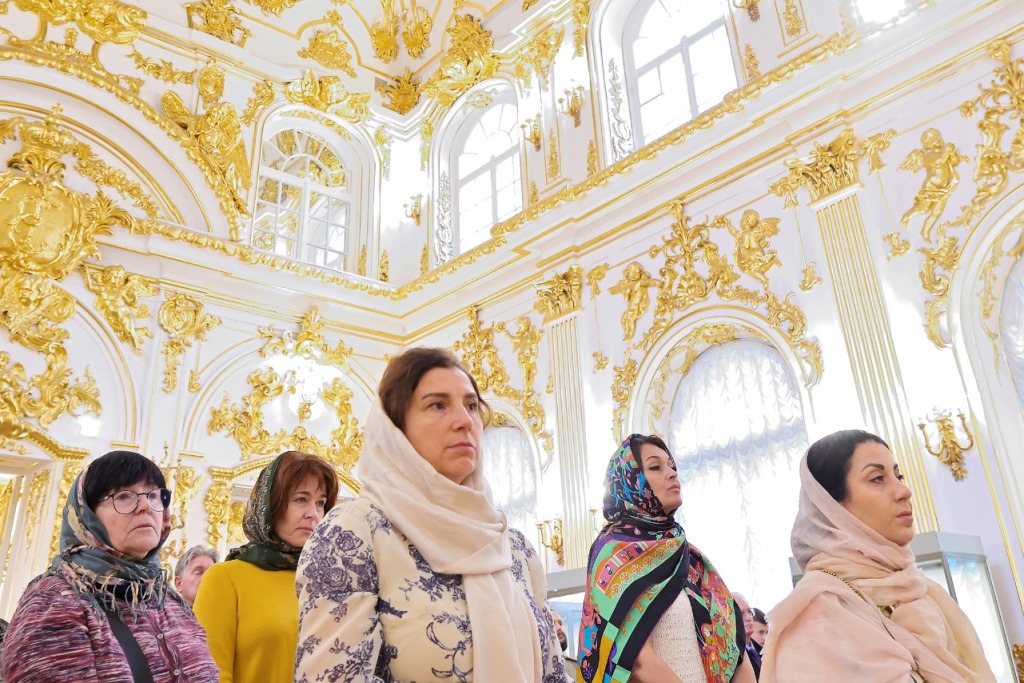
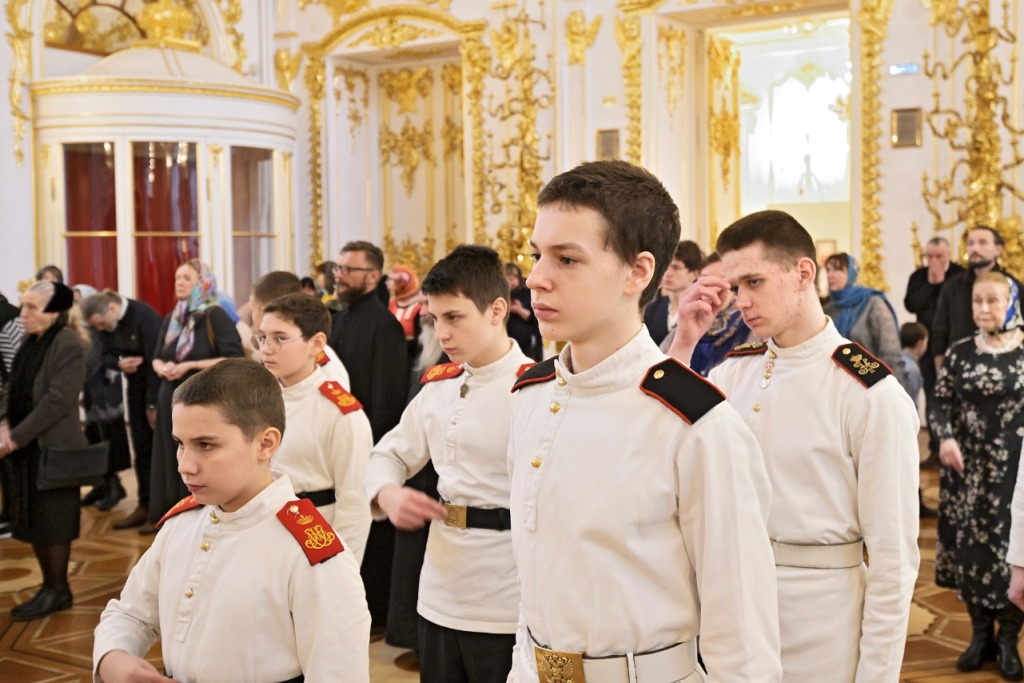
Praying at the service were the Director of the State Hermitage Museum Mikhail Piotrovsky, museum staff and parishioners of the Annunciation Metochion of the Alexander Nevsky Lavra.
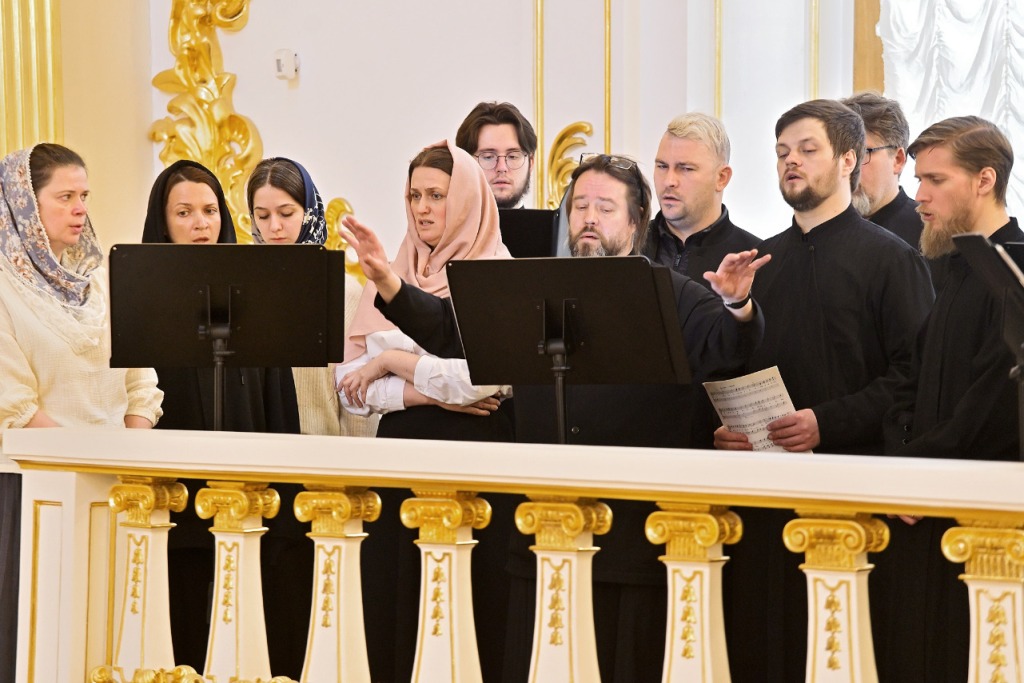
Hymns of the Byzantine tradition were performed by a combined choir of singers under the direction of Alexei Zhukov.
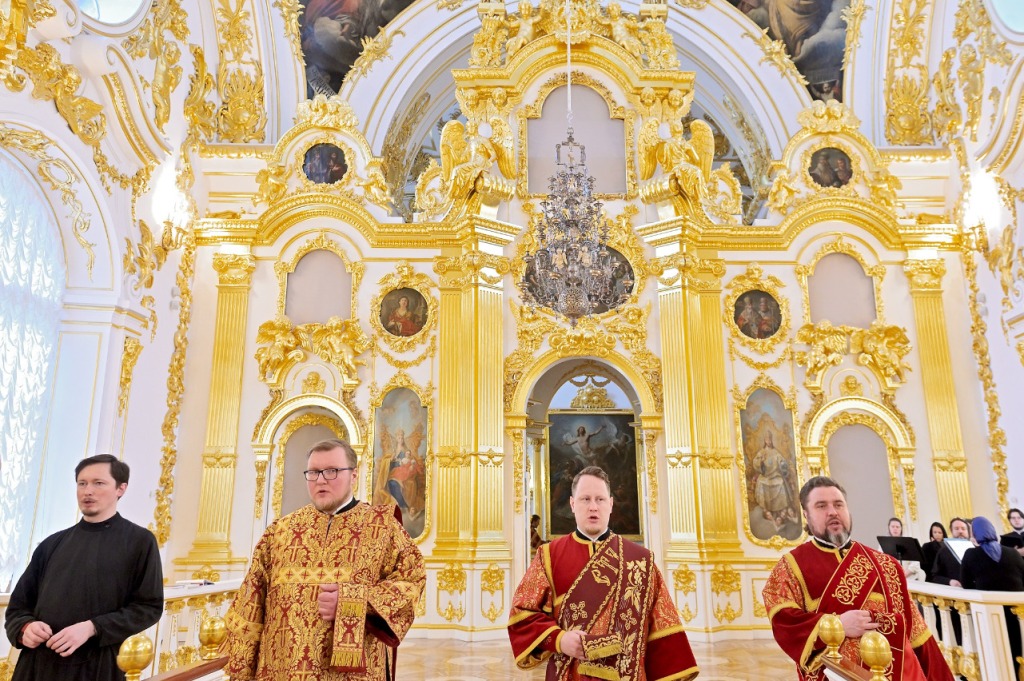
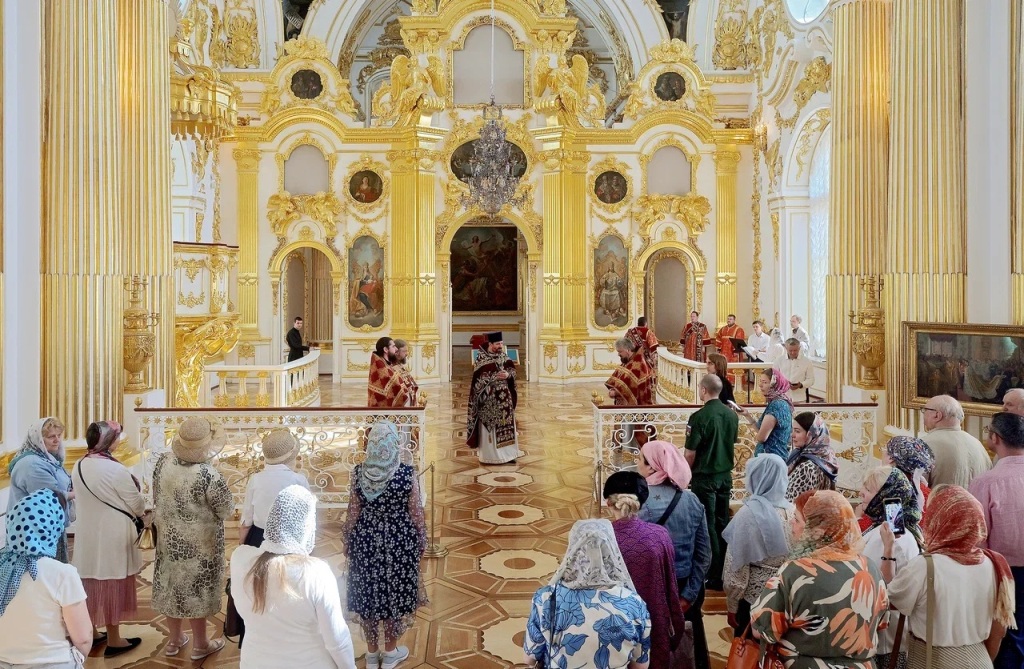
PHOTO: parishioners of the Annunciation Metochion of the Alexander Nevsky Lavra.attend the Divine Liturgy in the Winter Palace church
PHOTO: the choir performs Byzantine hymns for the Diving Liturgy held in the Winter Palace church
“This church remembers various events in our history,” Father Mark said in his sermon. – “Acts of peace were announced here, unfortunately, war was also declared. In this church, in difficult and joyful, difficult and solemn times, the tsar’s thoughts, prayers, and tears were lifted up to God. Here the heirs to the throne were baptized and members of the imperial family were married. Every time we gather here for a divine service, we are all overwhelmed by an extraordinary uplift. We feel a part of the great events of history. We will be grateful that we have the opportunity to serve in this beautiful church, lift up prayers and approach the Holy Mysteries.”
During the kissing of the cross, the choir sang an ancient Christian hymn written in the 4th century by St. Ambrose of Milan, to the music of the court composer Dmitry Bortnyansky, who composed it especially for the Great Church of the Winter Palace.
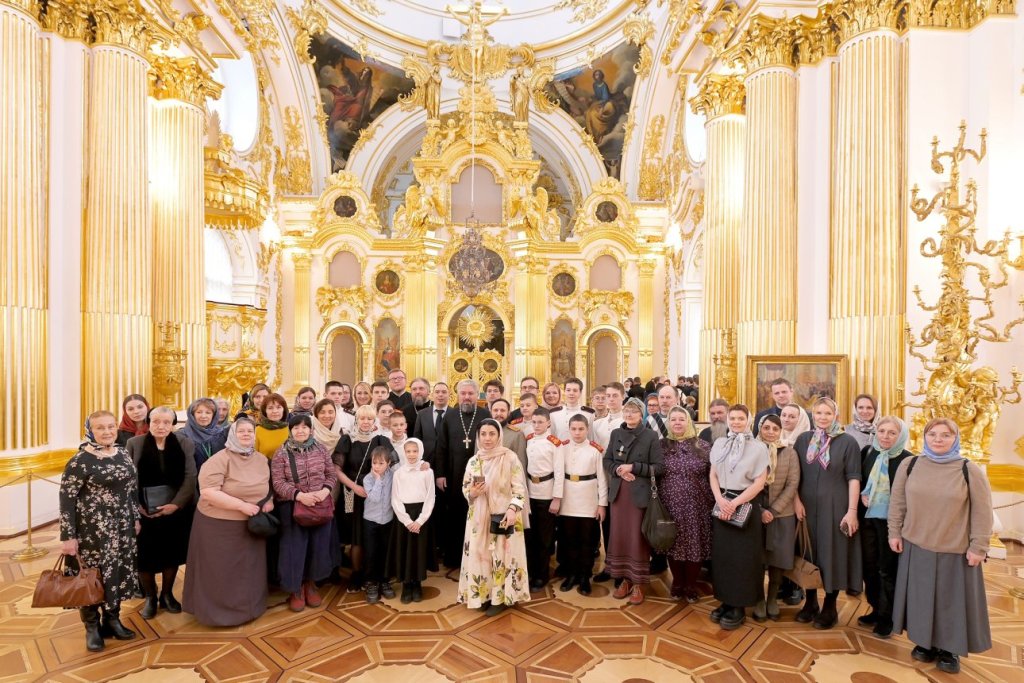
PHOTO: parishoners gather for a group photo following the Divine Liturgy
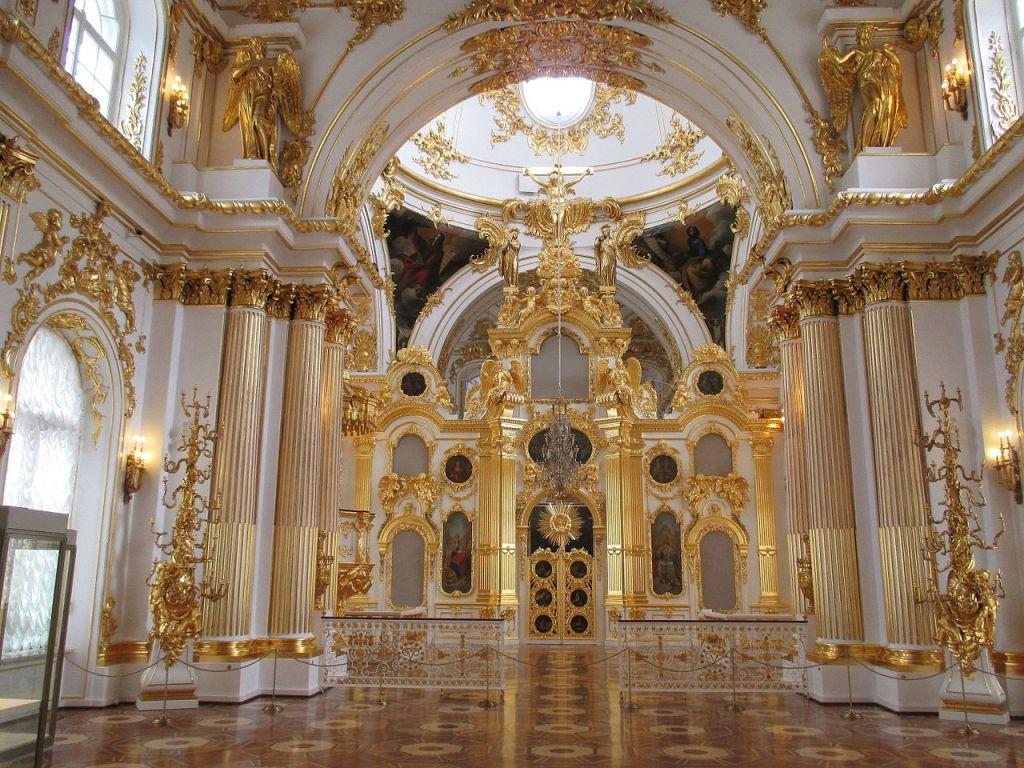
The Church of the Saviour Not Made by Hands [aka the Grand Church] in the Winter Palace was consecrated on 25th July 1763 by Archbishop Gabriel in the name of the image of the Savioir (painted by Theodot Ukhtomsky, 1693), which was located in the prayer room at the altar. After the renovation, it was consecrated again in 1839 by Metropolitan Philaret. The Maltese shrines presented to Emperor Paul I were kept here, and every year they were transferred to the Pavlovsk Cathedral in Gatchina for a month. In October 1917, the church was damaged during the storming of the Winter Palace by the Bolsheviks and was closed in 1918. On 9th December 2014, the Grand Church was opened to visitors after restoration, and on 25th December of the same year, the first Divine Liturgy in 96 years was served. The Church of the Saviour Not Made by Hands was consecrated by the priestly rite.
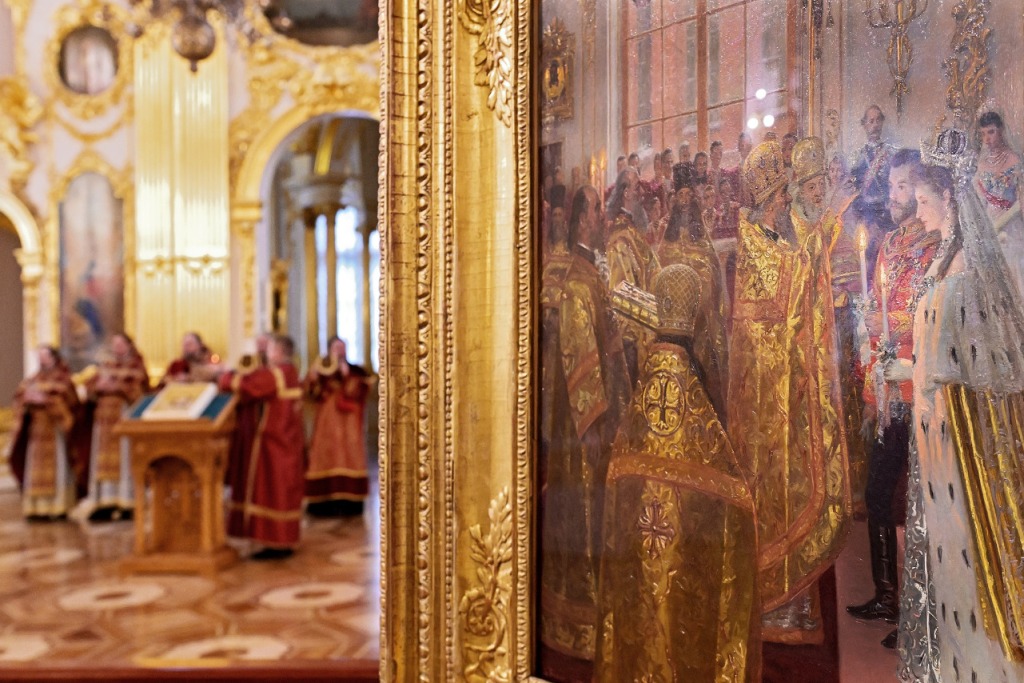
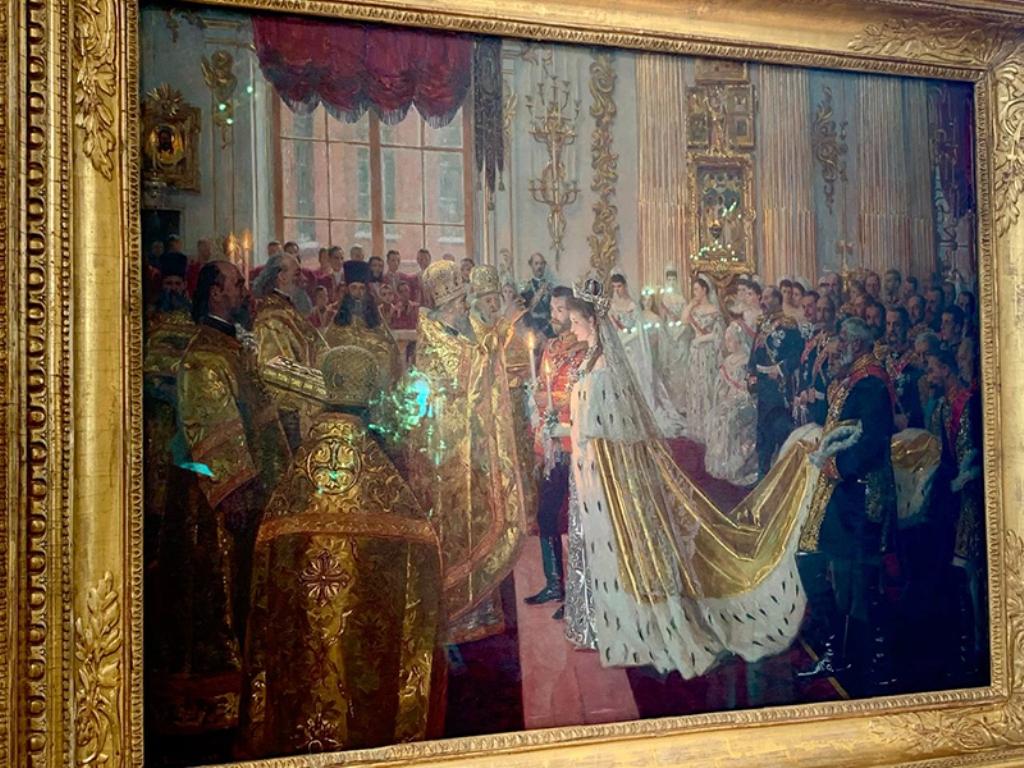
PHOTO: view of the the Church of the Savior Not Made by Hands in the Winter Palace. On the right hangs a painting depicting the wedding of Emperor Nicholas II and Alexandra Feodorovna, painted by Laurits Tuxen.
Recall that on 27th (O.S. 14th) November 1894, the wedding of Emperor Nicholas II and Grand Duchess Alexandra Feodorovna [future Empress Alexandra Feodorovna took place in the Church of the Saviour Not Made by Hands – the home church of the Imperial family – in the Winter Palace
The modest wedding ceremony took place in an atmosphere of deep mourning for the deceased Emperor Alexander III. Due to court mourning, there was no reception, nor honeymoon, with Nicholas and Alexandra going to reside with his mother and brother at the Anichkov Palace in St. Petersburg.
On 17th July 2025, Archpriest Nikita Zverev, the dean of the palace churches, performed the Divine Liturgy in the Church of the Saviour of the Image Not Made by Hands [aka the Great Church of the Winter Palace], situated in the State Hermitage Museum in St. Petersburg.
The service marked the 107th anniversary of the death and martyrdom of Russia’s much slandered Tsar, his family, and their four faithful retainers, all of whom were brutally murdered in Ekaterinburg by members of the Ural Soviet in July 1918.
Archpriest Nikita was co-served by Rector Hieromonk Mark (Svyatogorov), Hieromonk Tikhon (Voronov), Archpriest Maxim Kvasov, Priest Artemy Naumov, and Hierodeacon Ilya (Vasiliev). They were joined by the combined choir of singers of the St. Petersburg diocese.
Among the worshippers were the Director of the State Hermitage Museum in St. Petersburg, Mikhail Borisovich Piotrovsky, and museum staff.
“Passing by the Winter Palace, it is a great happiness to see the dome of this church and to know that prayers are heard here again,” said Father Nikita. – “The history of Russia’s last Tsar and his family began with this church. Everyone who comes here sees on the right a picture depicting the wedding of Nicholas II and Alexandra Feodorovna [see below]. The sacraments were performed in this very church, . . . and now, many years later, we can stand and pray where they once prayed. This temple is of great historic importance, one which is associated with the fate of the Fatherland. I thank the museum staff who have preserved all this to this day. If we do not know our history, remember the tragedy that happened, there can be no happy future for Russia. Let us appreciate what we have, both sorrows and joys, and remember that the Lord will never leave us.”
Recall that the last Russian Emperor, Nicholas II, and his family were shot on the night of 16/17 July 1918, in the basement of the Ipatiev House in Ekaterinburg. On 1st November 1981, they were canonized as new martyrs by the Russian Orthodox Church Outside Russia (ROCOR), and on 20th August 2000, as passion bearers by the Moscow Patriarchate of the Russian Orthodox Church.
And let us not forget the four faithful retainers, who remained with the Imperial family during their house arrest in Tobolsk and Ekaterinburg, and who followed them to their deaths in the Ipatiev House, on 17th July 1918: the valet Aloysius Trupp (1856-1918); the maid Anna Demidova (1878-1918); the cook Ivan Kharitonov (1872-1918); and Dr. Eugene Botkin (1865-1918), canonized in 2016.
PHOTO: Wedding of Nicholas II and Alexandra Feodorovna Painted in 1895 by the Danish artist Laurits Tuxen (1853-1927) From the collection of the State Hermitage Museum, St. Petersburg
The Great Church of the Winter Palace was consecrated on 25th July 1763 by Archbishop Gabriel in the name of the image of the Saviour (painted by Theodot Ukhtomsky, 1693), which was located in the prayer room at the altar. After the 1839 renovation, it was consecrated again by Metropolitan Philaret. The Maltese shrines presented to Emperor Paul I were kept here, and every year they were transferred to the Pavlovsk Cathedral [the Cathedral of the Holy Apostle Paul] in Gatchina for a month.
In October 1917, the church was damaged during the storming of the Winter Palace by the Bolsheviks and was closed in 1918. On 9th December 2014, the Great Church of the Winter Palace was opened to visitors after restoration, and on 25th December of the same year, the first Divine Liturgy in 96 years was served.
PHOTO: Wedding of Nicholas II and Alexandra Feodorovna Painted in 1895 by the Danish artist Laurits Tuxen (1853-1927) From the collection of the State Hermitage Museum, St. Petersburg
NOTE:the following is an excerpt from the original full-length version (researched from Russian sources), which will be published in the No. 14 – Winter 2025 issue of my semi-annual periodicalSOVEREIGN: The Life and Reign of Emperor Nicholas II.The full article will feature expanded text, with more facts and information, and illustrated with additional photos. This issue is scheduled to be released in December 2024 – PG
***
Today 27th (O.S. 14th) November – marks the 130th anniversary of the wedding of Emperor Nicholas II and Grand Duchess Alexandra Feodorovna[1] in St. Petersburg.
It was on this day in 1894, that the ceremony took place in the Church of the Saviour Not Made by Hands [aka the Grand Church] (the home church of the Imperial Family) of the Winter Palace in St. Petersburg.
Plans for the wedding, had originally been set for the spring of 1895, followed by a week of public celebrations. The death of Emperor Alexander III on 2nd November [O.S. 20th October], however, put an end to such plans. The date for the wedding was now scheduled to take place on the birthday of Nicholas II’s mother, Maria Feodorovna, which would allowed for court mourning to be somewhat relaxed.
To announce the historic occasion, a manifesto was issued, proclaiming “In the midst of deep sorrow, with which Our hearts and those of all the faithful sons of Russia are filled, may this day be a bright herald of the people’s hopes for the continuation of God’s mercy to Us in the new reign that has come.”
Invitations were sent out, the dress code was determined. Russian gentlemen had to appear in full regimental uniform, officials had to dress in uniforms, according to the Table of Ranks of Peter the Great. Russian ladies had to appear in ceremonial court dresses, and foreign women were invited to appear in evening dresses, with full awards and jewelry.
The wedding was attended by Nicholas’s mother, the recently widowed Dowager Empress Maria Feodorovna, as well as members of the Russian Imperial Family, which included 14 grand dukes, 6 grand duchesses. In addition, were Kings, Queens, Princes and Princesses from more than a dozen royal houses of Europe: Denmark, Greece, Great Britain, Roumania, Prussia, Oldenburg, Hesse and by Rhine, Saxe Coburg, Mecklenburg, Mecklenburg-Stelitz, Baden, Leuchtenberg, and Saxe-Altenburg.
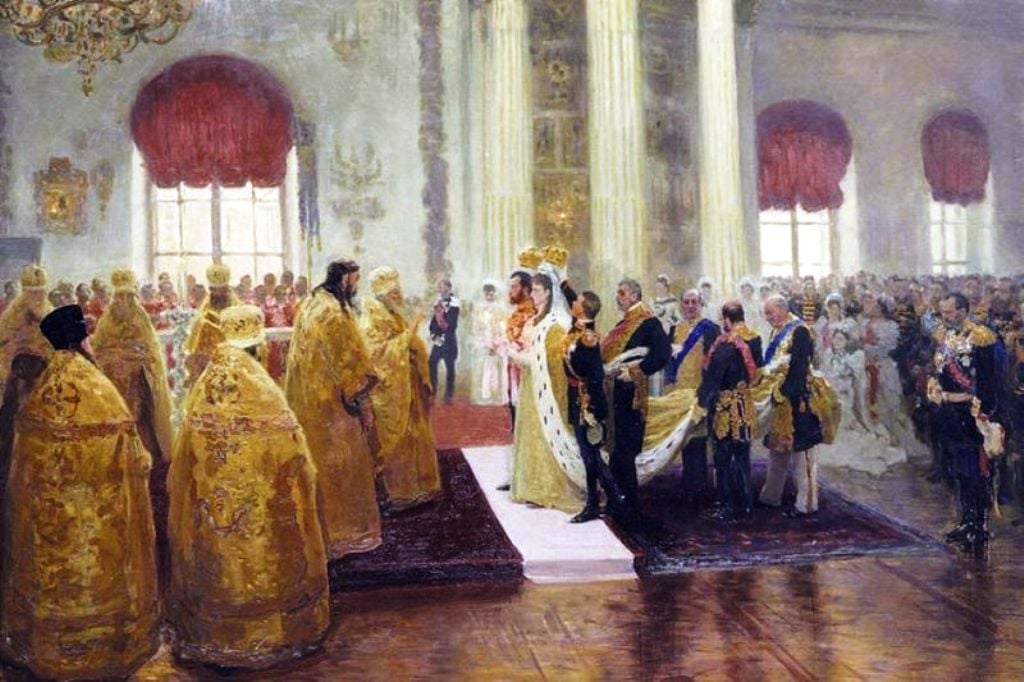
As photography was not permitted during weddings, baptisms, funerals, etc., in Orthodox churches, we only have paintings and illustrations which depict the wedding. This restriction has been somewhat relaxed in more modern times.
PHOTO: Wedding of Nicholas II and Alexandra Feodorovna Painted in 1894 by the Russian artist Ilya Yefimovich Repin (1844-1930) From the Collection of the State Russian Museum, St. Petersburg
On the day of the wedding, in the morning, the Emperor left the Anichkov Palace for the Winter Palace in an open landau, accompanied by his brother, Grand Duke Mikhail. The Dowager Empress went in a closed carriage to the Sergiev Palace – the St. Petersburg residence of Grand Duke Sergei and Grand Duchess Elizabeth, from where she escorted Alexandra Feodorovna to the Winter Palace.
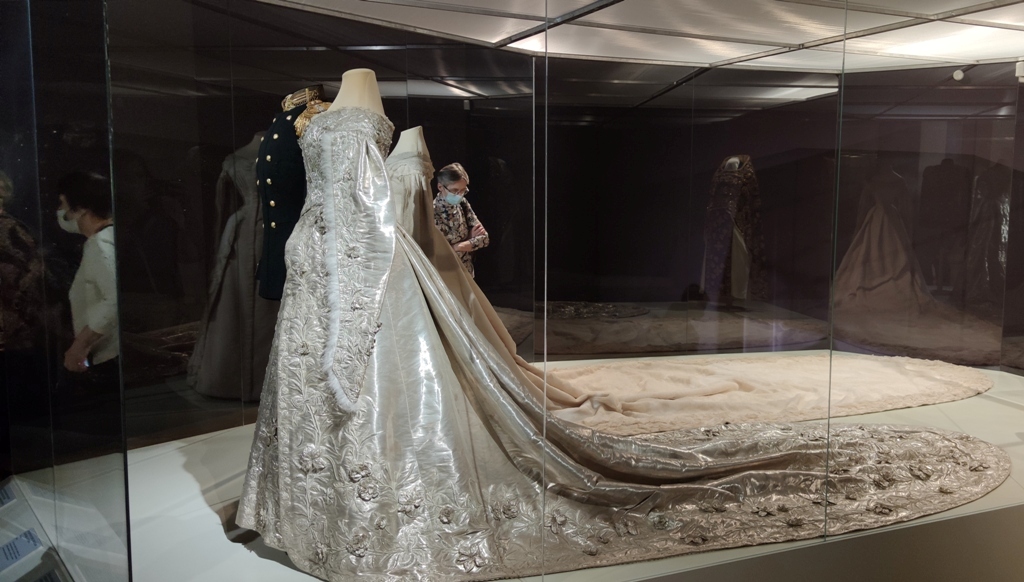
Nicholas Alexandrovich was dressed in the red uniform of a hussar colonel with orders and an orange sash of the Order of Hesse-and-by-Rhine. The bride wore a dress of white silk with silver flowers. Her English Honiton lace veil was created by her maternal grandfather, Prince Albert of Saxe-Coburg and Gotha (1819-1861). This veil was worn at the weddings of the brides mother Princess Alice (1843-1878) and her sisters. Alexandra Feodorovna also wore the traditional Romanov Imperial Wedding Crown, a 475-carat necklace and earrings, which belonged to Catherine the Great. Her ensemble was completed by a golden brocade robe with a long train, lined with ermine. Eyewitnesses at the wedding noted that “she shone with fragile and pure beauty.”
PHOTO: the wedding dress of Alexandra Feodorovna From the Collection of the State Hermitage Museum in St. Petersburg
It is interesting to note, that the wedding dress of Empress Alexandra Feodorovna was based on a sketch made by her sister Grand Duchess Elizabeth Feodorovna. According to tradition, Romanov brides donated their wedding dresses to the church after their wedding. However, Alexandra Feodorovna, chose to keep hers, which is why her wedding dress has survived to this day, and now in the Collection of the State Hermitage Museum in St. Petersburg.
At noon, the procession of the cross to the Church of the Saviour Not Made by Hands [aka the Grand Church], which served as the home church of the Imperial Family began. The cannons of the Peter and Paul Fortress announced the beginning of the ceremony. The procession was led by Dowager Empress Maria Feodorovna, who accompanied her future daughter-in-law. Nicholas Alexandrovich followed behind.
The service was conducted by the imperial confessor and head of the palace clergy, Protopresbyter Ioann Yanyshev (1826-1910). Nicholas II stepped onto the platform, followed by Alexandra Feodorovna. The couple exchanged rings and wedding vows, walked around the lectern, and kissed the cross. After the prayer, Nicholas and Alexandra were declared husband and wife. Church bells rang all over St. Petersburg, while cannons roared from the Peter and Paul Fortress.
Nicholas II recalled that the wedding ceremony was a torment for both him and his young wife: “The thought that our dear, selflessly beloved Papa was not among us, did not leave me during the wedding; I had to exert all my strength not to burst into tears there in the church in front of everyone.”
Thus, the modest wedding ceremony took place in an atmosphere of deep mourning for the deceased Emperor Alexander III. Due to court mourning, there was no reception, nor honeymoon. During the 12 months in which the Imperial Court was in mourning, Nicholas II and Alexandra Feodorovna seldom appeared in public and did not make any journeys. The newly married couple settled together with Dowager Empress Maria Feodorovna in the Anichkov Palace on Nevsky Prospekt in St. Petersburg.
PHOTO: the Church of the Saviour Not Made by Hands 0 the home church of the Imperial Family as it looks today, in the Winter Palace in St. Petersburg
NOTES:
[1] Following her conversion to Orthodoxy, Princess Alix of Hesse and by Rhine took the name Grand Duchess Alexandra Feodorovna, in honour of the Feodorovskaya Icon of the Mother of God, patroness of the Romanov dynasty. While her conversion was completely voluntary, it was required by her marriage to the Emperor as well as her future role as Empress.
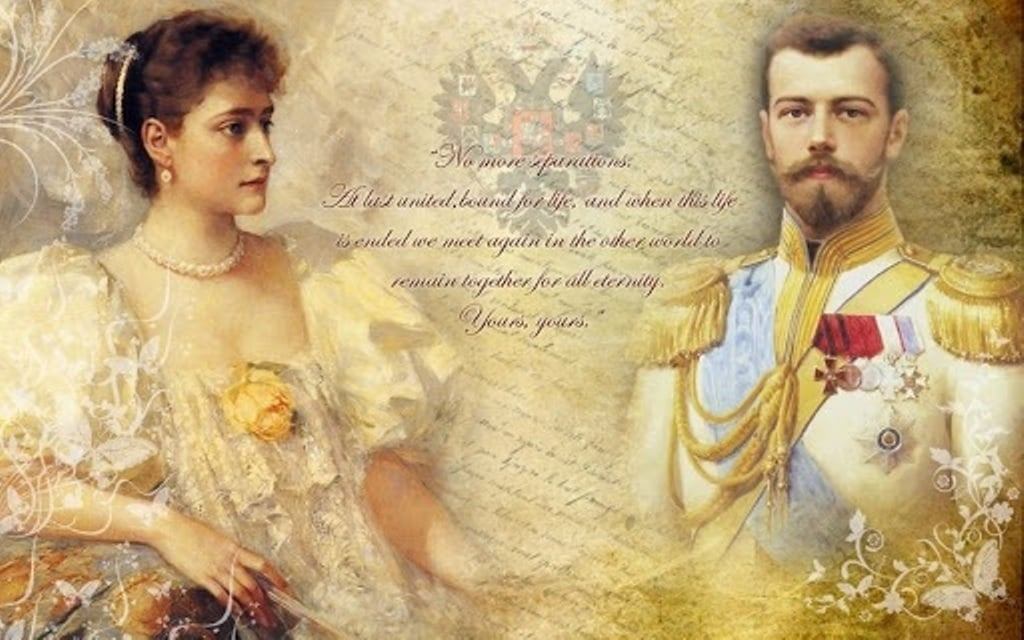
“No more separations. At last united, bound for life, and when this life is ended we meet again in the other world to remain together for all eternity. Yours, yours.”
Prince Ivan Dmitrievich Ratiev (1868-1958) was a Georgian prince and a prominent officer of the Imperial Russian Army. He later served as a high-ranking official at the Winter Palace in St. Petersburg.
Ratiev was born in Oryol on 17th July 1868, into a branch of the Georgian princely house of Ratishvili, which had emigrated to the Russian Empire in 1724. He graduated from the Oryol Cadet Corps and then from the Nicholas Cavalry College. In 1890 he joined the 44th Nizhegorod Dragoon Regiment, deployed in Georgia.
In 1896, he married Ekaterina Irakliyevna, née Princess Gruzinskaya (1872–1917), a great-granddaughter of King Heraclius II of Georgia (1720-1798) and a lady-in-waiting of Empress Alexandra Feodorovna (1872-1918). The couple had two children: Dmitri (1899-1926), and Olga (1902-1987).
PHOTO: Prince Ivan Dmitrievich Ratiev with his wife Ekaterina and their two children Dmitri and Olga
Ratiev retired from army service due to a trauma sustained in a horse race at Tbilisi in 1907. He then studied at Academy of Fine Arts in Paris and, after his return to Russia, worked for the Ministry of the Imperial Court in St. Petersburg. He was assigned to an army cavalry unit of the Winter Palace with the rank of rittmeister [riding master]. By the Imperial Order of 6th December 1913, he was made a lieutenant-colonel of the Imperial Guard cavalry and an acting Police Master of the Winter Palace. Promoted to the rank of colonel in 1916, Prince Ratiev was appointed as a deputy commandant of the Winter Palace in April 1917, two months after the February Revolution overthrew the tsar Nicholas I
It was during the storming of the Winter Palace in October 1917, for which Ratiev is best known. Thanks to his heroic efforts, he managed to save the Imperial Regalia[1] from being looted or destroyed by revolutionary thugs.
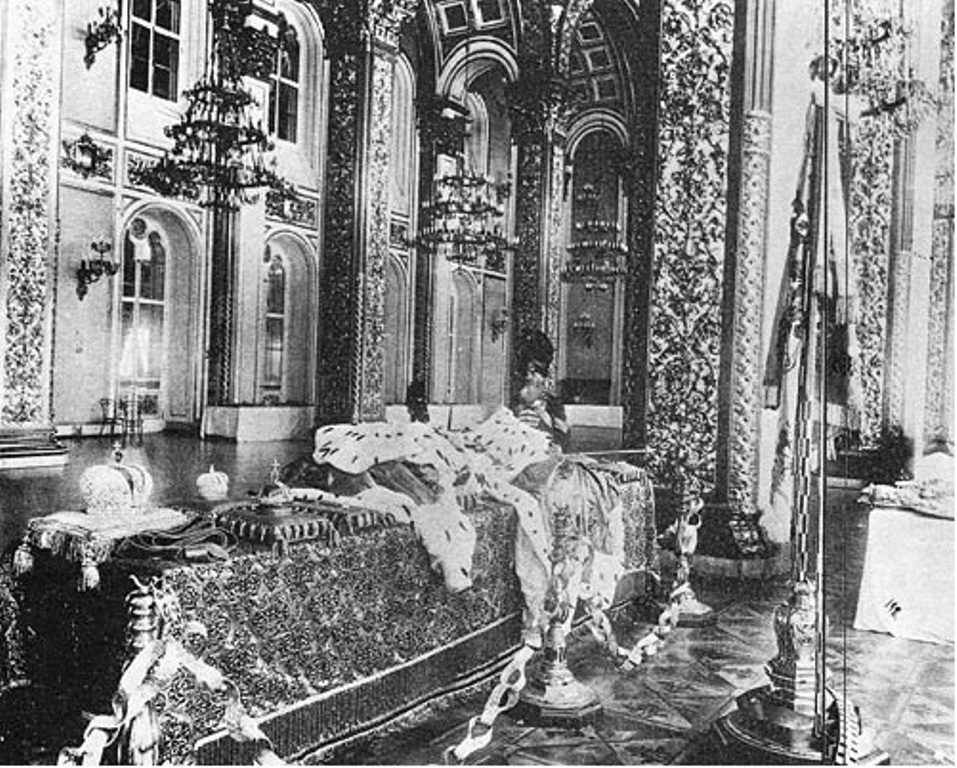
On 7th November (O.S. 25th October) 1917, Ratiev did not flee his post like so many others during these turbulent time, instead he ordered his guards to transfer the Imperial Regalia to safer parts of the Palace. The prince sent his 16-year-old son Dmitri and two of his most trusted grenadiers to guard the secret depository, which, among other precious objects, which included the Russian Imperial Crown adorned with 4936 diamonds, the Orb and the Sceptre incorporating the Orlov diamond.
Upon confronting the revolutionaries, Ratiev negotiated with the Bolshevik leader Vladimir Alexandrovich Antonov-Ovseenko (1883-1938), who oversaw the armed assault of the Palace, which led to successful negotiations to preserve the Imperial Regalia.
PHOTO: The Imperial Regalia: crowns, orb, and sceptre laid out in preparation for the historic crowning of Russia’s last tsar Nicholas II in Moscow on 27th May (O.S. 14th May) 1896
The Soviet leadership publicly expressed their gratitude to Prince Ratiev in the 5th November 1917 edition of Izvestia[2] for his “self-sacrificing efforts to protect and preserve the people’s treasures” and appointed him the chief commandant of the Winter Palace and of all state museums and palaces in the Petrograd district.
In March 1919, Ratiev escorted the “golden echelon”, a train carrying Russia’s gold reserve, following the transfer of the Russian government from Petrograd to Moscow. During the journey, however, Ratiev was pressured into surrendering the train and even being fired upon at Tver. Ratiev retired from the state service shortly thereafter and worked as a translator for various organizations of Moscow for several years.
His subsequent life was marred by the loss of his wife and son, the latter who drowned while swimming in the Moscow River. In March 1924, Ivan Ratiev, his daughter Olga and sister Sophia were arrested on charges of belonging to a “counter-revolutionary monarchist organization.”
Initially, Ratiev was sentenced to five years in the Gulag, however, due to his service in 1917, the sentence was commuted to exile to Ekaterinburg, where the family spent 3 years.
In 1931, Ratiev moved to the Georgian capital of Tbilisi, where he lived as a “state pensioner”. He died on 28th April 1958, at the age of 89.
NOTES:
[1] Before the 1917 Revolution, the Imperial Regalia, which included the Imperial Crown, orb and sceptre, were stored in the Diamond Chamber of the Winter Palace in St. Petersburg. In May 1896. the Imperial Regalia were transported by train and under heavy guard to Moscow, for the Holy Coronation of Emperor Nicholas II. During the First World War, the Imperial Regalia was moved to Moscow and stored in the Armory Chamber of the Kremlin. In 1922, the Soviet Diamond Fund was established. Today, the Imperial Regalia is stored in the Diamond Fund vault (opened in 1967).
[2]Izvestia (“The News”) is a daily broadsheet newspaper founded in February 1917, Izvestia, which covered foreign relations, was the organ of the Supreme Soviet of the Soviet Union, disseminating official state propaganda. It is now described as a “national newspaper” of Russia.
CLICK on the IMAGE above to watch a VIDEO about the Imperial Apartments in the Winter Palace. Duration: 12 minutes, 53 seconds. English subtitles
Please note that this article focuses on specific interiors of Emperor Nicholas II’s private apartments in the Winter Palace, it is part of a larger publishing project I am currently working on, that will feature a more comprehenvive study of this Imperial residence during the reign of Russia’s last Tsar – PG
On his accession, Nicholas II was keen to return to the Winter Palace residence in the capital. The palace architect, Alexander Feodorovich Krasovsky (1848-1918), was entrusted with creating private rooms for the Emperor and his wife, Alexandra Feodorovna. In December 1895 they moved into the Winter Palace and lived there permanently in the winter. Following the events of Bloody Sunday [22nd January (O.S. 9th) 1905], the Imperial Family moved to the Alexander Palace at Tsarskoye Selo, visiting the Winter Palace only for formal ceremonies, banquets and receptions.
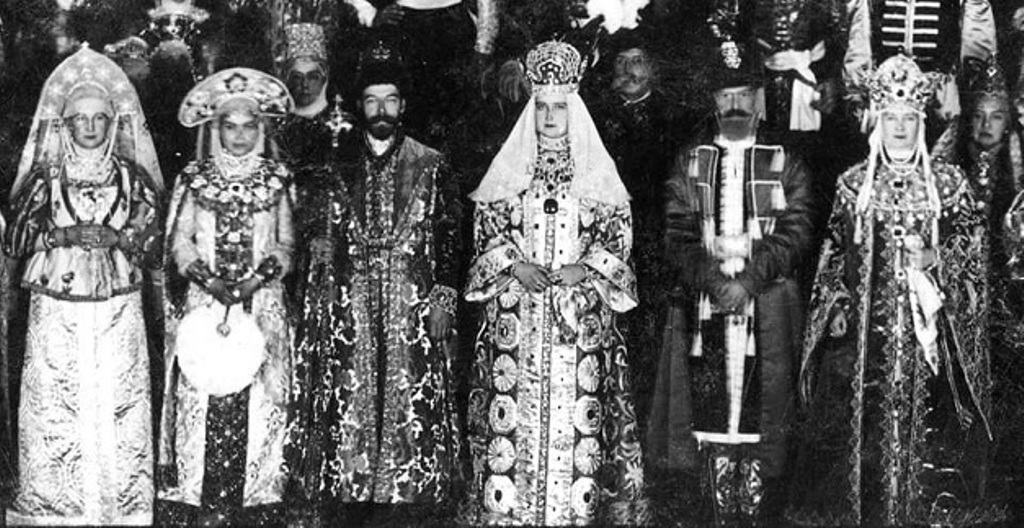
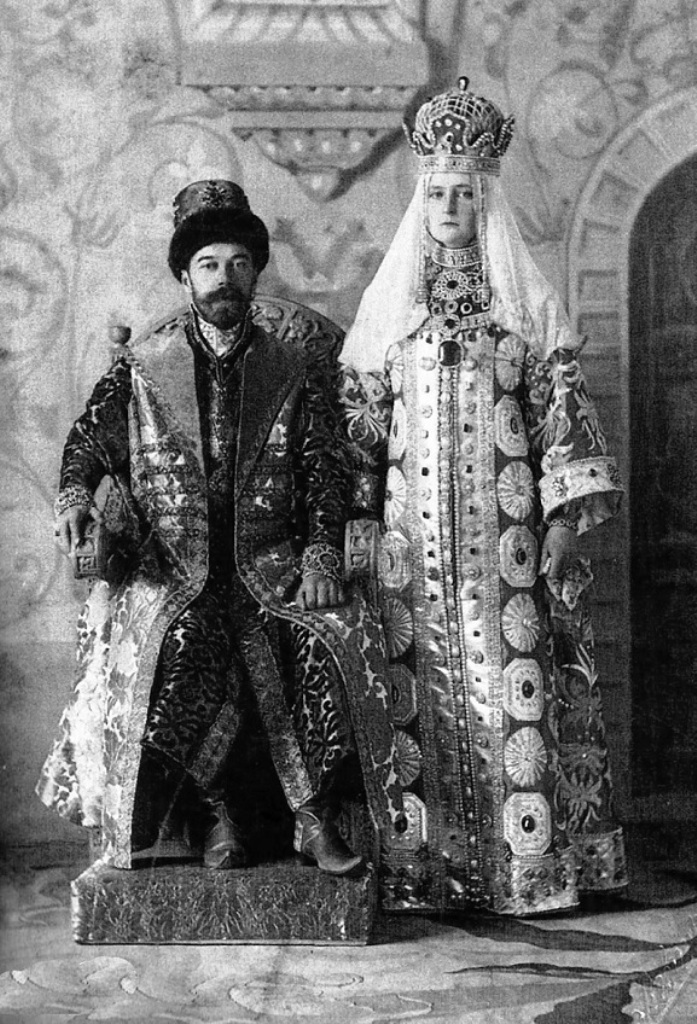
Receptions and balls became rare events. The most famous ball held in the Winter Palace during the reign of Russia’s last Tsar was the luxurious Costume Ball, held in two stages on 11th and 13th February 1903. All the visitors dressed in bejeweled 17th-century style costumes. Nicholas II wore the costume of Tsar Alexei Mikhailovich (1629-1676); while the Empress Alexandra Feodorovna wore the costume of his first wife Tsarina Maria Ilyinichna Miloslavskaya (1624-1669).
It was in 1897, that Emperor Nicholas II approved the project for a new colour of the facades of the Winter Palace. A brick-red hue was chosen, to match the red sandstone colour of the new fence of Her Majesty’s Own Garden. The Emperor’s decision was carried out in 1901 after the construction of the fence of the garden was completed.
PHOTO: view of the north-western corner block of the Winter Palace and Her Majesty’s Own Garden. The door in the center is the Saltykov Entrance, which led to the private apartments of Nicholas II and Alexandra Feodorovna, located on the 2nd floor
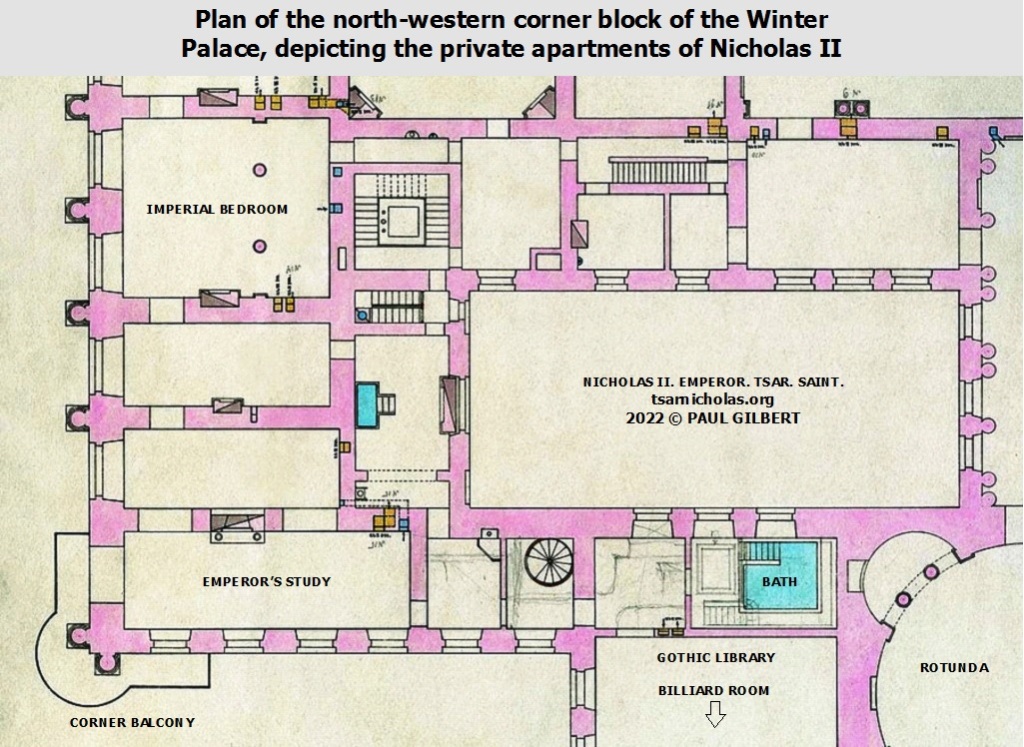
The personal apartments of Nicholas II and his wife were created in the second floor of the north-western corner block, beyond the Malachite Room that was among the state rooms of the palace whose historical appearance was preserved. The rooms which Alexander Bryullov (1798-1877) had decorated for Empress Alexandra Feodorovna (1798-1860) in 1838-39, were converted for Russia’s last Emperor and Empress.
The rooms were a self-enclosed complex, a separate apartment, designed to embody the young couple’s domestic ideal, a cosy, welcoming home. The Emperor’s diaries show that they both devoted much attention to the fitting out of their new apartments. Many of the rooms belonging to Nicholas II were small, narrow, dark and awkward in design, especially the Emperor’s narrow study.
Krasovsky, showed himself to be a master with immense erudition and superb taste. The combination of brilliant historical stylization with Moderne (Art Nouveau) elements made the apartments of the last Russian Emperor’s family a unique work of art. Each room that Krasovsky created was an elegant paraphrasing of the style of a particular historical era.
The second enfilade overlooked the Admiralty, which included the Imperial Bedroom, Nicholas II’s Study, theGothic Library, the Billiard Room, Nicholas II’s private bath, a drawing room, lavatory and a small Checkpoint at the Saltykov staircase. A private garden was created beneath the windows of the Imperial apartments on the site of a former parade ground, surrounded by a high wall topped with decorative iron-grille railings.
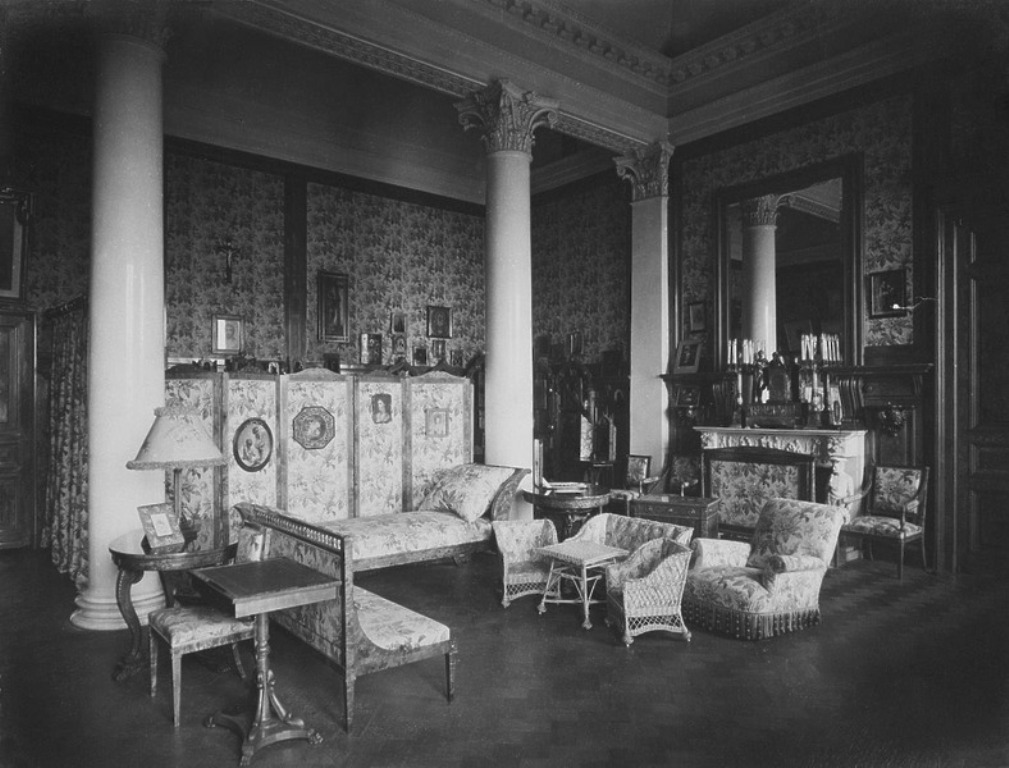
PHOTO: view of the Imperial Bedroom
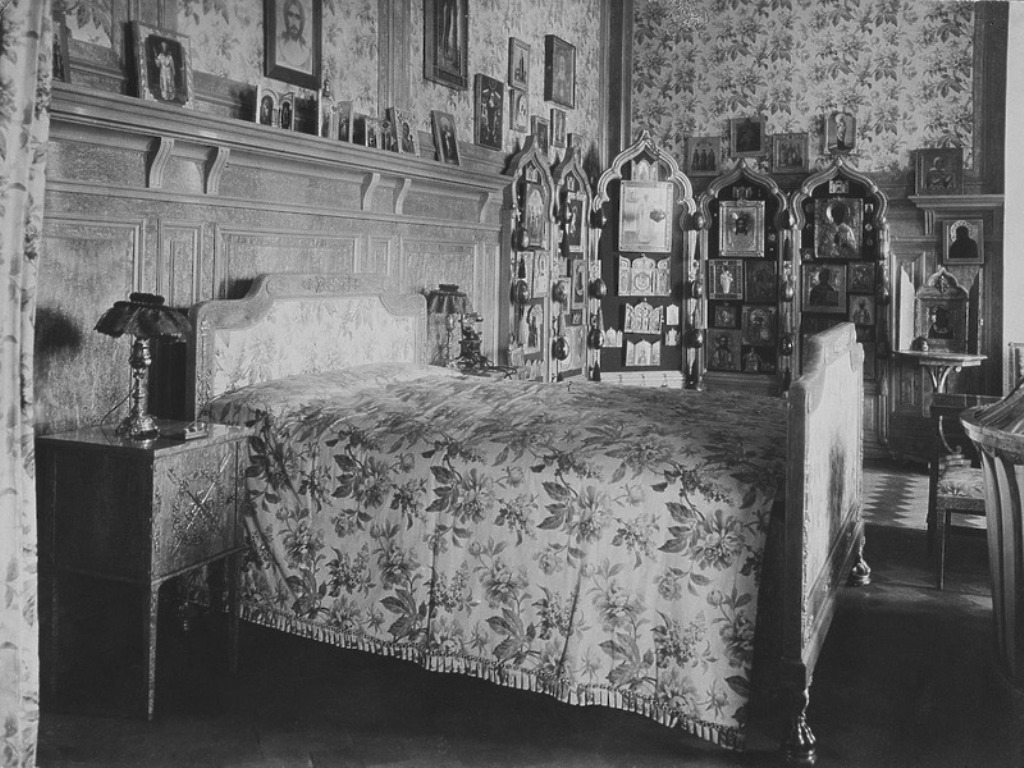
PHOTO: the bed which Nicholas and Alexandra shared, and the icon case
The Imperial Bedroom featured an alcove highlighted by two white stucco columns. The walls were decorated with cretonne, a heavy English cotton fabric featuring red flowers and green leaves. The wall panels and furniture were made of Karelian birch.
A small living room was created in front of a large folding screen which separated it from the alcove. It featured a number of pieces of furniture, including a comfortable sofa and chairs. In addition, where wicker furniture for the children. Alexandra Feodorovna spent many hours here, relaxing on the sofa with a book or needlework, while her children played nearby.
In the alcove, separated from the rest of the room by a folding screen was a large bed – unlike most sovereigns of the day, Nicholas II and his wife shared a bedroom. A large folding icon case – covered with icons – was situated against one wall.
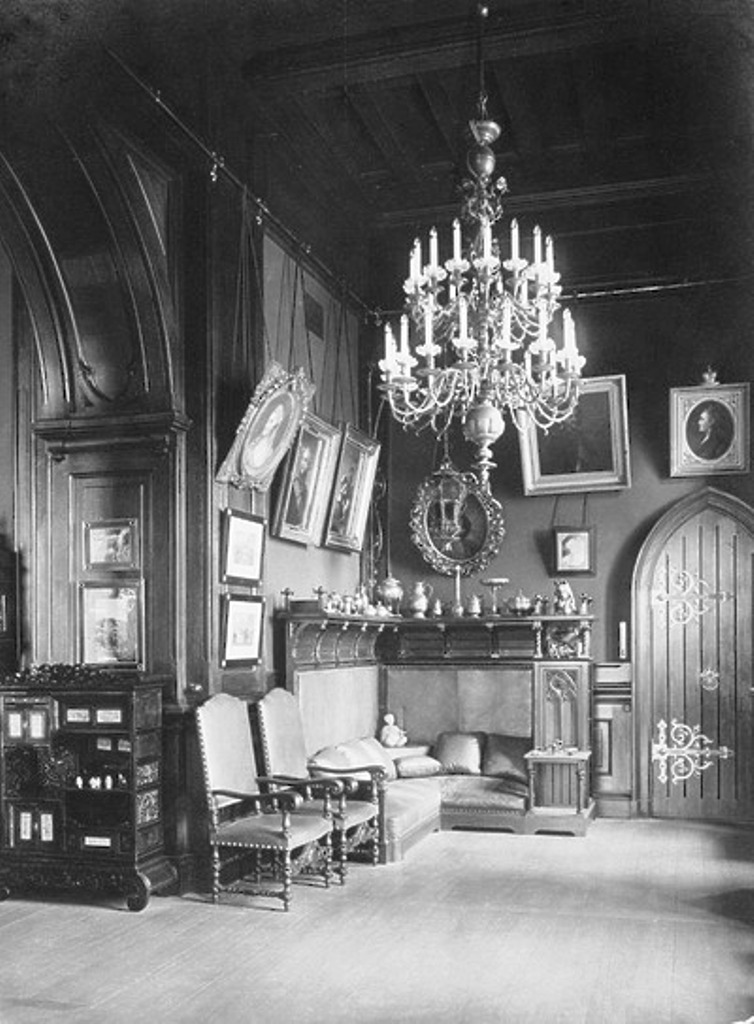
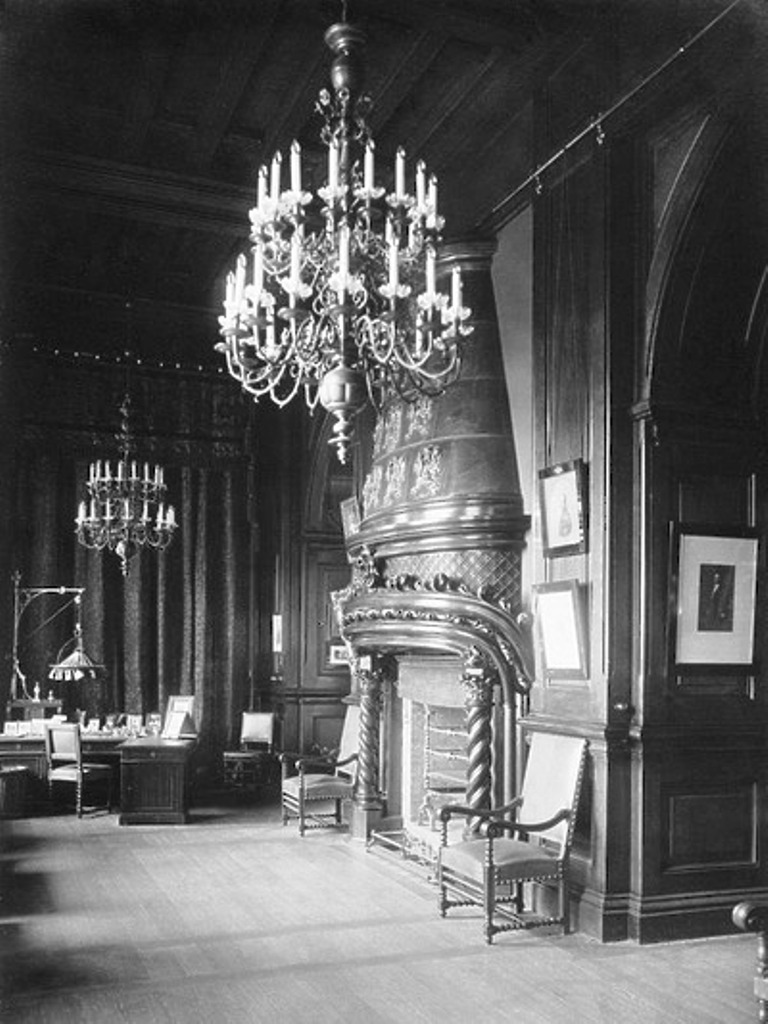
PHOTOS: two views of Emperor Nicholas II’s Study
Nicholas II’s Study was arranged in the English Gothic style, decorated with oak. The beauty of the wood was enhanced by the matte surface of the upper part of the walls, painted in an oak colour and the rich green and yellow silk draperies which decorated the double-windows of the interior. The wall between the two arches was decorated with a huge fireplace, the upper part decorated with coloured tiles.
All the details of the interior and the furniture were enhanced with Gothic-style carvings. An important element in in this interior was the Gothic fireplace embellished with griffons and lions, heraldic figures from the arms of the Romanov House and the Hesse-Darmstadt House, to which the Empress belonged.
The Emperor’s desk was decorated with small busts of his grandfather Emperor Alexander II and great-grandfather Nicholas I, and numeroud framed family photographs. The walls were decorated with portraits of Nicholas II’s ancestors. In another part of room stood a piano, which the Imperial couple often played four hands. In the evenings, after returning from the theater, they often had dinner in front of the fireplace.
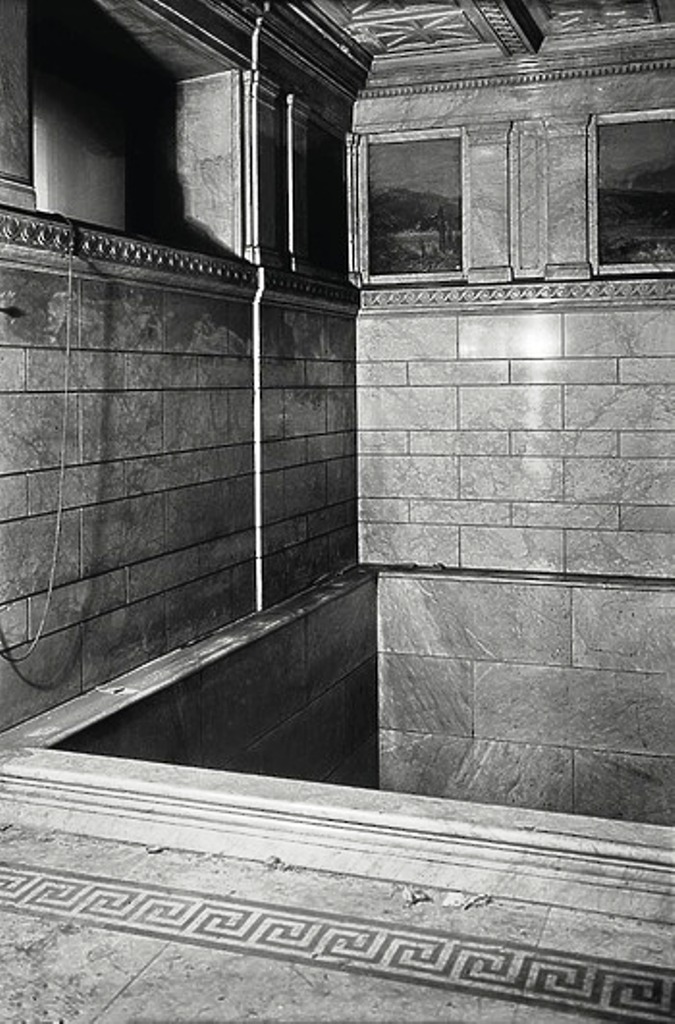
PHOTO: Emperor Nicholas II’s bath, located next to his Study. 1930s
A large marble bath was installed next to the Emperor’s Study. A small staircase connected to the Emperor’s dressing room and his Valet’s room. The pool was a rectangular recess with a marble staircase consisting of 9 steps. There was also an open shower niche and a water closet with a separate door.
In 1898, the size of the pool was increased to a size of 387 [152 in.] x 385 cm [151 in.] and a depth of 159 cm [63 in.]. The architect, Nikolai Ivanovich Kramskoy (1865-1938), who carried out the renovation managed to preserve the original marble wall cladding and frieze design seen in the photo above.
In 1938, Nicholas II’s bath was closed. While some parts of the decoration have been preserved, including the ceiling decoration with the original 19th lamp. It is difficult to ascertain what other elements have been preserved, as this room is today filled from floor to ceiling with shelves on which part of the Hermitage drawing fund is stored.
It is not known, if the bath itself was filled in during the 1930s, or whether it was covered with boards and flooring, just like they did to Nicholas II’s bath in the Alexander Palace at Tsarskoye Selo.
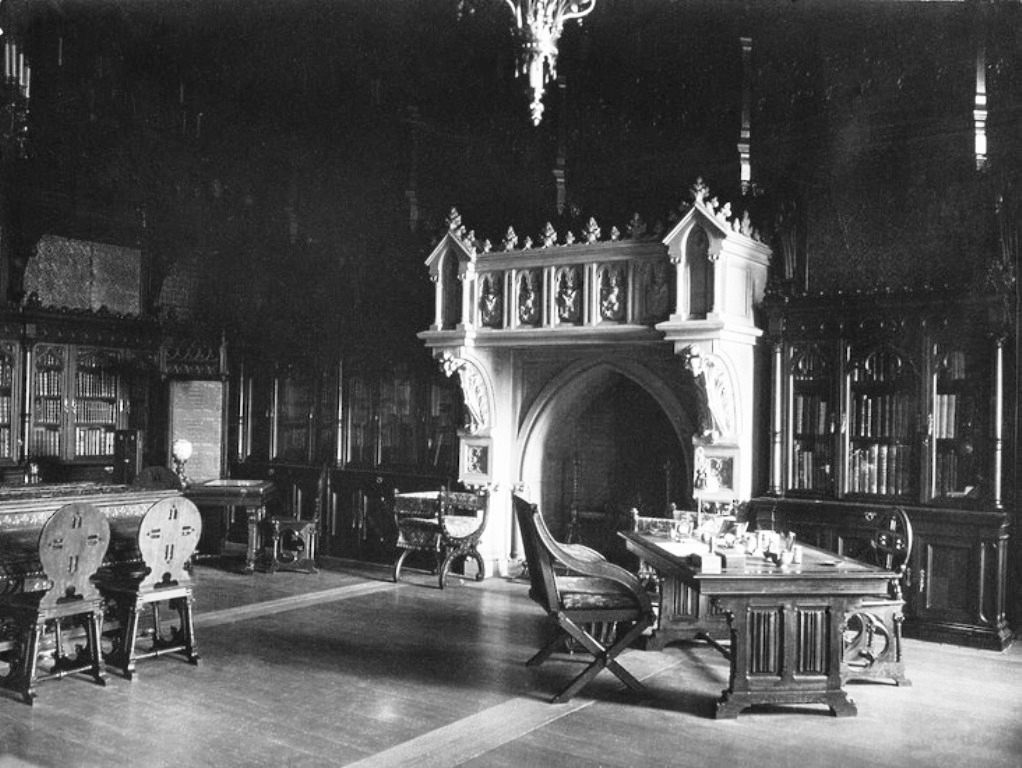
PHOTO: Emperor Nicholas II’s Gothic Library
The Gothic library was the largest room of the suite refurbished for Nicholas II by Krasovsky, who used the same English medieaval style used in the Emperor’s Study. The two-tiered interior, which included the ceiling, the bookcases, the stairs and upper gallery were trimmed with wax-polished walnut. They were decorated with ornaments characteristic of the Gothic style. The walls between the cabinets and the upper gallery were covered with embossed leather. This magnificent decoration was made at the worskhop of Nikolai Fedorovich Svirsky (1851-1915) – supplier to His Majesty’s Imperial Court.
A huge white stone fireplace, reminiscent of a Gothic portal with a frieze dominated the interior. Nicholas and Alexandra liked to spend their evenings reading in front of the fireplace.
Furniture was made in the Gothic style, according to Nabokov’s drawings, which included several tables, the Emperor’s desk in front of the fireplace, chairs and a lectern. A unique smoking table, decorated with gold and diamonds, with a well stocked selection of cigarettes and cigars was a unique addition. In this interior, reminiscent of a medieval hall, the Emperor often received officials.
The interior of the Gothic Library has survived, click HERE to read more about this interior.
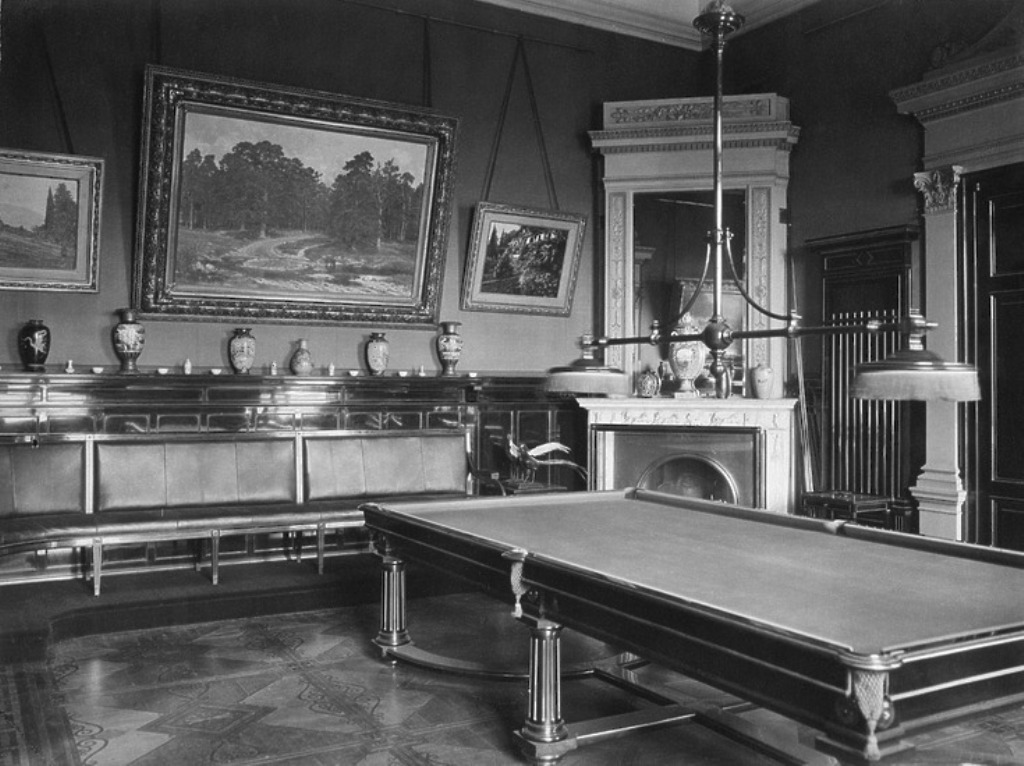
PHOTO: Emperor Nicholas II’s Billiard Room
Nicholas II, like many of his predecessors and relatives loved billiards. Sometimes he played a game or two with his adjutant wing on duty, whose post was in the adjoining Reception Room.
The interior of the Billiard Room was designed in the Neo-Classical style. The doors were framed in the form of portals with pilasters topped with a entablature and acroterium. The classic styled white marble fireplace was decorated with a frieze depicting cupids in chariots. Wall panels, doors and furniture were made of polished mahogany and decorated with copper inserts. Paintings and vases collected by Nicholas II during his Far Eastern journey in 1891-92, decorated the walls and shelves. The parquet floor from the Pompeian Dining Room, created by Alexander Pavlovich Bryullov (1798-1877) in 1838-39, was transferred to this interior.
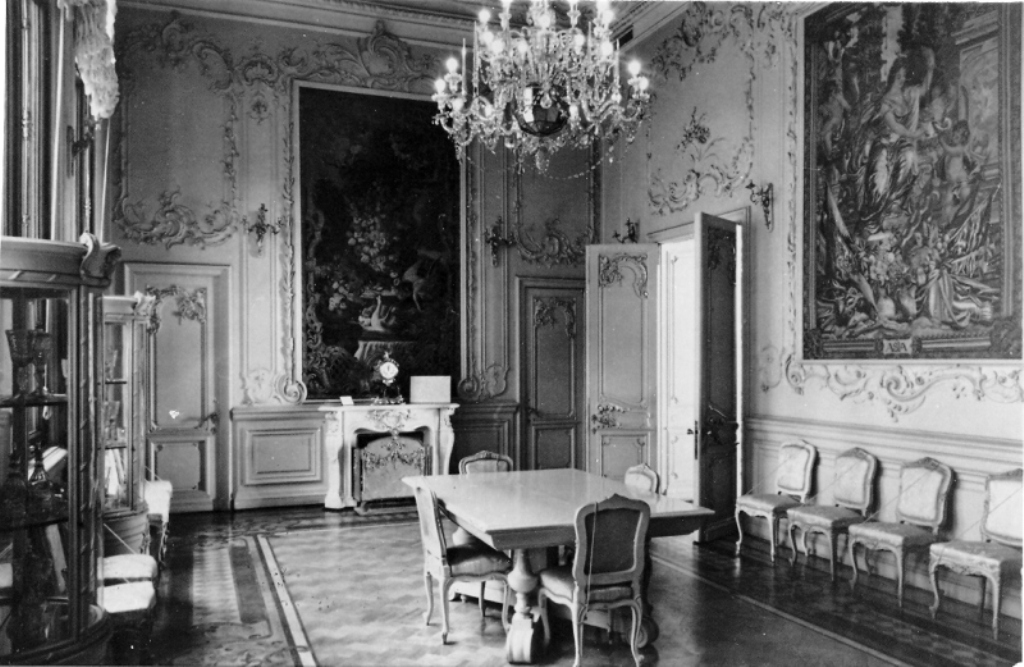
PHOTO: the Small Dining Room
Formerly known as the Pompeian Dining Room, the Small Dining Room was redecorated in 1894–95, by Krasovsky. A rococo plaster-work style was chosen to frame 18th-century St Petersburg tapestries. It was in this room, that Nicholas and Alexandra and their guests gathered for meals. The crystal chandelier was made in England in the 1760s, it was electrified during Nicholas II’s reign.
The hands of the clock on the mantle [seen on the far wall in the photo above] are stopped at 2.10, the time when the ministers of the Provisional Government were arrested in this room, during the early morning hours on 26th October 1917.
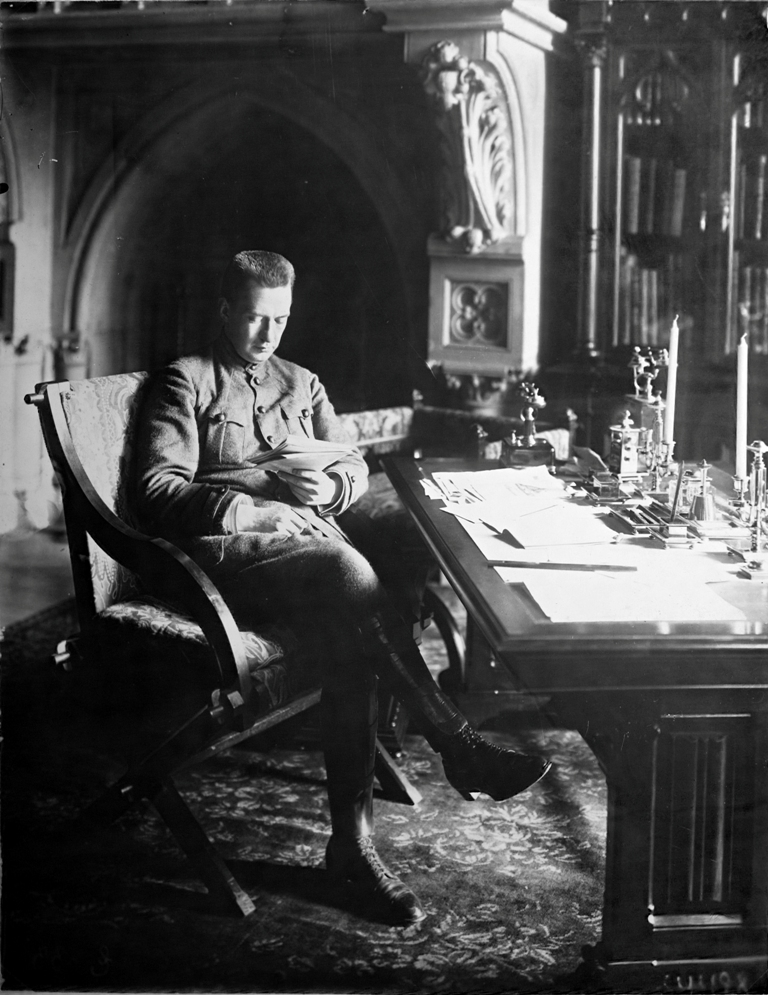
The Winter Palace had been the seat of the Provisional Government since July 1917. It’s leader Alexander Kerensky (1881-1970) wasted little time in acquisitioning the Emperor’s Gothic Library for his own personal use.
Following the Government’s arrest in the Small Dining Room, an eyewitness account records a systematic destruction of the apartments by the Bolsheviks:
“The Palace was pillaged and devastated from top to bottom by the Bolshevik[s]…Priceless pictures were ripped from their frames by bayonets. Packed boxes of rare plate and china…were broken open and the contents smashed or carried off. The library….was forced open and ransacked…..the Tsaritsa’s salon, like all other rooms, was thrown into chaos. The colossal crystal lustre, with its artfully concealed music, was smashed to atoms. Desks, pictures, ornaments—everything was destroyed.”
On 30th October 1917 the Military Revolutionary Committee of the government of the Russian Republic declared the palace “a state museum on a par with the Hermitage”. The palace was given over to the administration of the museum in 1922. In 1923 a programme was initiated under the direction of the architect Alexander Vladimirovich Sivkov (1890-1968) to convert the palace ensemble into a museum complex. This programme included the reconstruction of the Winter Palace that in the post-revolutionary period became known as the Palace of the Arts.
For a brief period following the revolution, the private apartments were open to the public to display the life of the former rulers, as this was the area of the palace where entry had been gained by the revolutionaries, and as a consequence, much had been destroyed so it is hard to know how accurate the depiction of the imperial private lives could have been.
In time the state rooms of the former imperial residence came to be used for exhibitions, while the living rooms and service premises were converted into display rooms, losing their decorations. In 1926, the “Historical Rooms of Emperor Nicholas II” were closed, dismantled and given over to exhibition use.
The only historic interiors which have survived from the time of Nicholas II are the Gothic Library and the Small Dining Room. Sadly, the remaining interiors have not survived and today we only have photographs, architect’s drawings and archive documents which preserve the memory of the former private apartments of Russia’s last emperor and tsar.
I have published more than 50 titles to date through AMAZON – featuring one of the largest selections of books on Nicholas II, the Romanov dynasty and the history of Imperial Russia.
Please CLICK on the BANNER or LINK above to review my current selection of titles in hardcover, paperback and ebook editions. Listings provide a full description for each title, pricing and a Look inside feature.
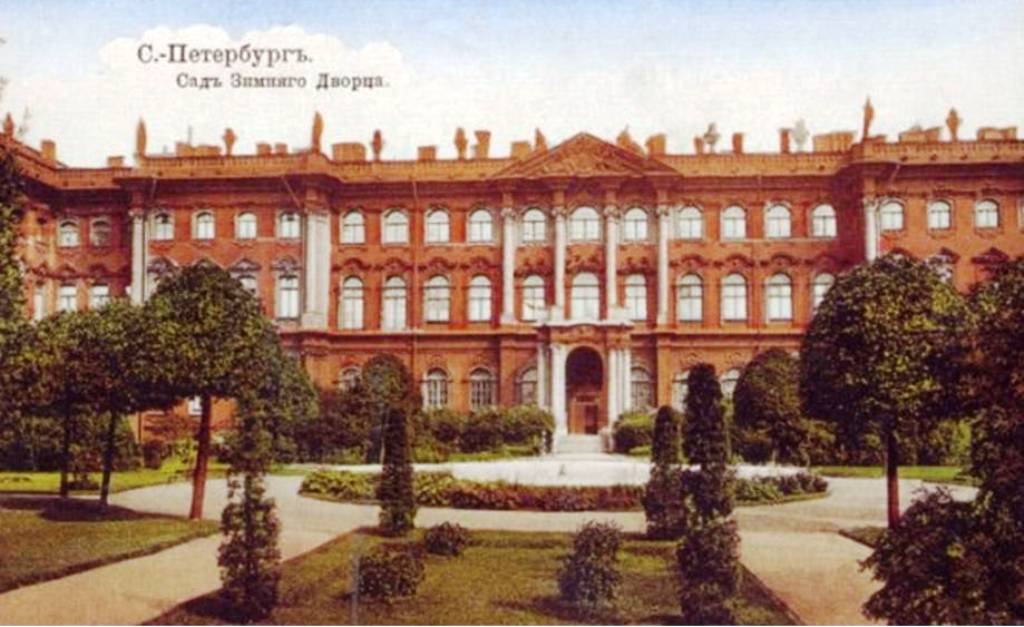
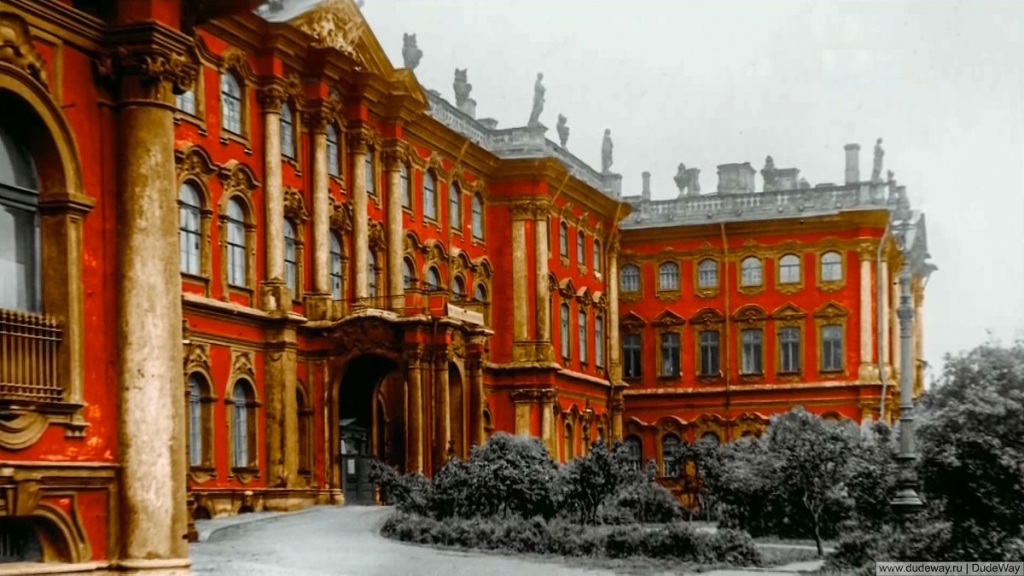
PHOTO: this contemporary colourized view of the western facadeofthe Winter Palace, does not reflect the actual terracotta-red hue, however, it does gives an idea of the palace’s facade, as it lookedin the early 20th century
During its 250+ year history, the Winter Palace in St. Petersburg has been repainted many times, in a variety of ochre colours and various densities. The colour of the facades of the Winter Palace changed radically at the beginning of the 20th century. It was in 1897, that Emperor Nicholas II approved the project for a new colour of the facades of the Winter Palace. A terracota brick-red hue was chosen, to match the red sandstone colour of the new fence of Her Majesty’s Own Garden.
The Emperor’s decision was carried out in 1901 after the construction of the fence of Her Majesty’s Own Garden was completed. In April 1901, the architect Nikolai Ivanovich Kramskoy (1865-1938) presented an estimate for 15,639 rubles. “for the project of painting the Imperial Winter Palace in the colours of the new garden fence”. On the project and estimate he wrote: “Highly approved. I was ordered to start painting immediately!” The tender for repair work was awarded to Kruglov, a contractor who was paid 29,467 rubles, which included “to scrape, grind and clean off the walls of the facades, external and outward, the drum of the dome, towers and chimneys”, and then paint all the indicated areas.
Aside from the Winter Palace, all the buildings on Palace Square were painted in the same brick-red colour, including the 580 m [1,902 ft.] long bow-shaped General Staff Building and the Headquarters of the Guards Corps, which, created a complete ensemble of the historic square.
According to the architects of the time, as a result of the Emperor’s decision, the unique buildings of the Palace Square ensemble, diverse in their construction, contributed to a “unity of perception and merged into a monochrome terracotta-brick colouristic mass”.
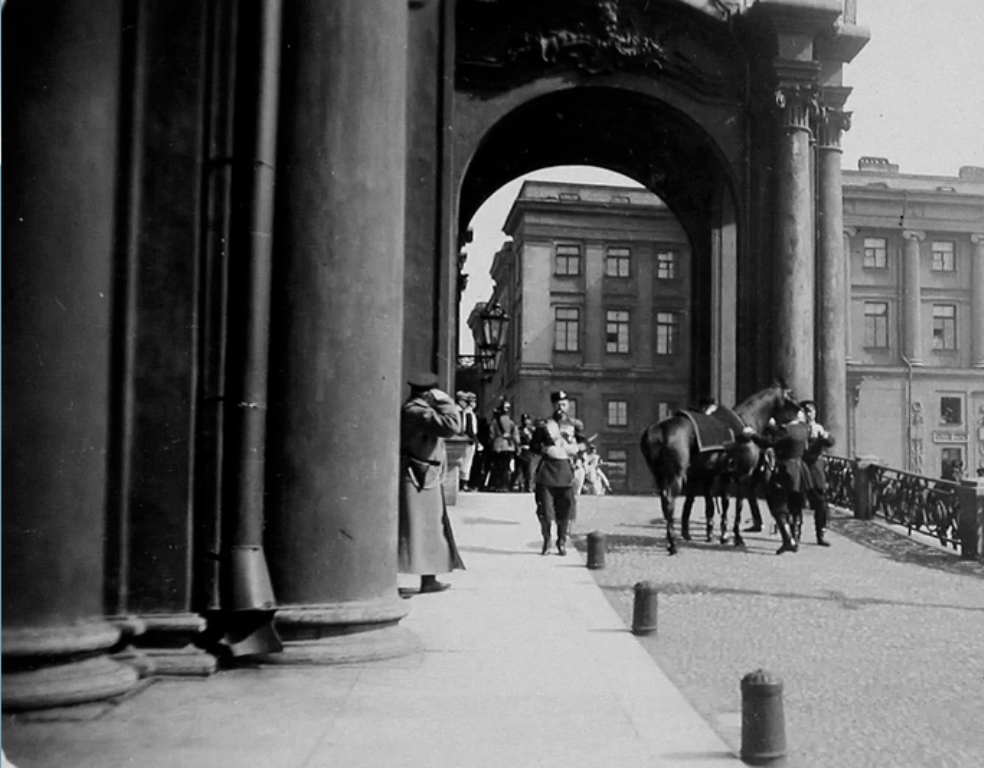
PHOTO: Emperor Nicholas II leaves the Winter Palace (1896). The dark shades on the pillars and canopy reflect the buildings’ terracotta-red hue.
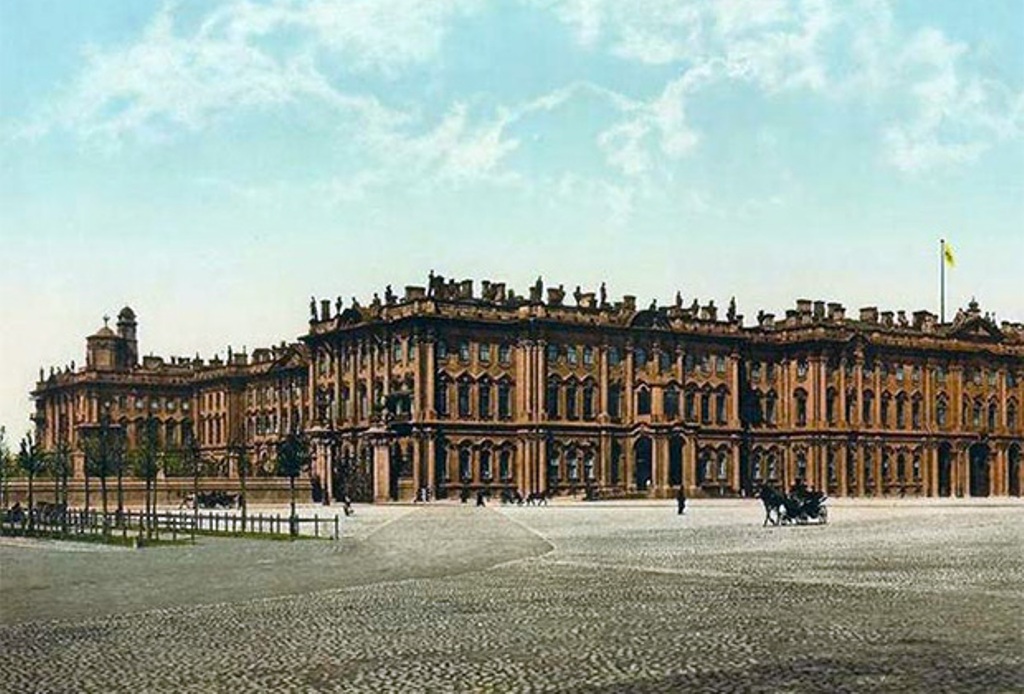
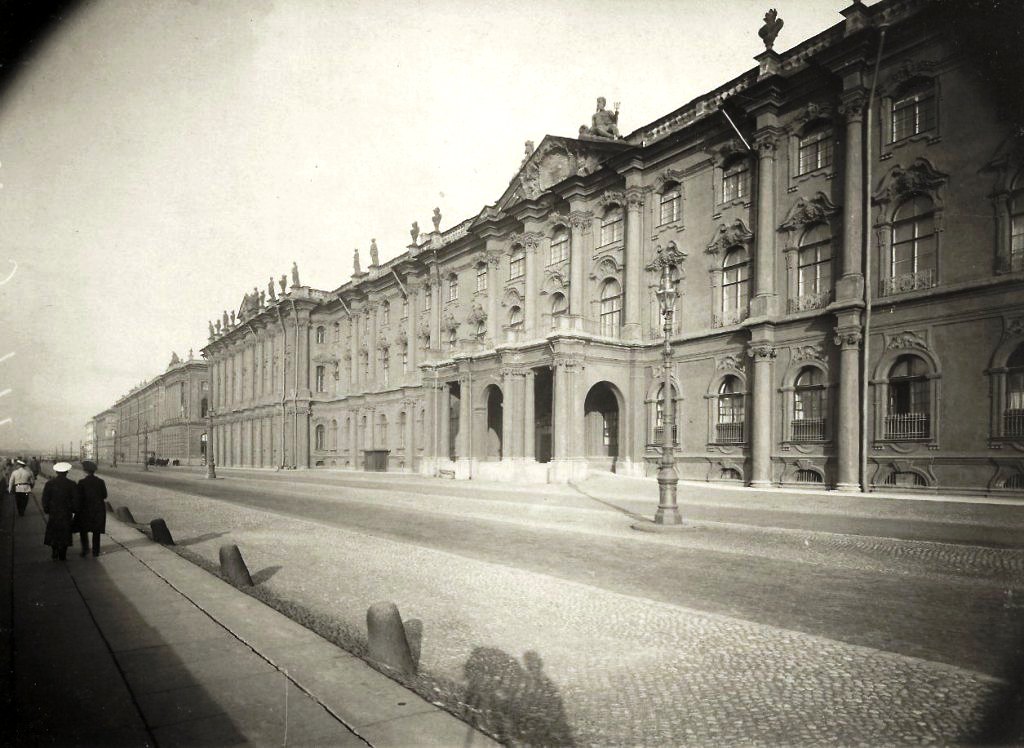
In early 20th century black and white photos, one can clearly see the dark coloured facades of the Winter Palace [see photo above]. In addition, colour postcards [see below] from the time, also provide a good example of the colour.
Not all Petersburgers liked the gloomy brick/terracotta-red façade that had been adopted under Nicholas II. The public turned to the Emperor in an effort to persuade him to change the colour scheme of the Winter Palace. However, Nicholas II rejected their proposals.
Under the last Tsar, the white stone statues were also replaced with dark ones made of copper. Before that, the palace featured yellow-ochre façades in various shades depicted in watercolours, fragments of which have been uncovered during architectural stripping operations.
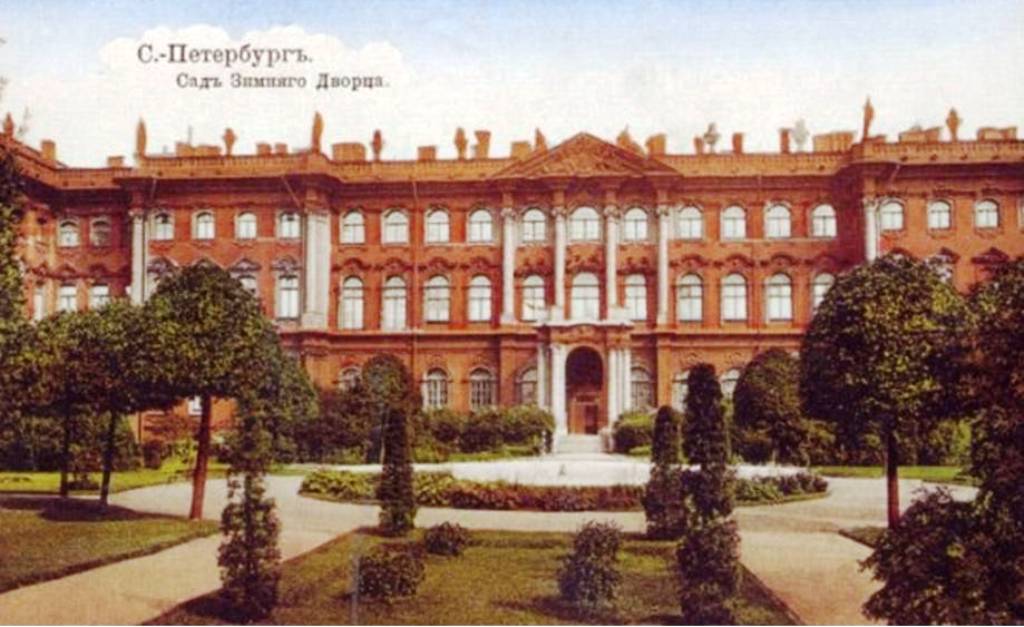
PHOTOS: early 20th century postcards of the Winter Palace
PHOTO: early 20th century postcard of the western facade of the Winter Palace and Her Majesty’s Own Garden. The private apartments of Nicholas II and Alexandra Feodorovna were located in the northwestern part [to the left, but not seen in the photo above] of the palace
In June 1911, Minister of the Imperial Court Count Vladimir Frederiks (1838-1927) expressed his desire that the Imperial Winter Palace be painted in a lighter hue than that of its current colour. The minister requested that samples of the palace colouring, be presented to him in order to approve one of them.
As there were no colour photographs of the Winter Palace as it looked in 1911, we rely on one observer of the time, who provided an idea of the colour of the palace: “The colour scheme differs in its composition from the approved colour scheme of 1901 in a more pinkish colour, but in terms of density of its composition it is denser than the old colour scheme”.
So, in October 1917, the Winter Palace was not “revolutionary red”, but in a somewhat dubious pinkish one. However, even with all these dubious nuances, the monochrome of the palace, was preserved in full.
PHOTO: watercolour of the Winter Palace, painted by the famous Russian artist Alexandre Benois (1870-1960) in 1939, when he was living in exile in Paris. Note that the canopied balconies; the wall and iron grid fencing surrounding Her Majesty’s Own Garden have by now been removed.
The red colour facades of the Winter Palace remained through the revolution and the early Soviet period in the 1930s. Following restoration work on the palace after World War II, it was painted green (turquoise) with the ornaments depicted in white, the standard Soviet colour scheme for Baroque buildings.
In January 2022, the State Hermitage Museum announced that the restoration of the facades of the former Winter Palace is scheduled for 2023. No change of colour scheme is envisaged, but, as with previous restorations, a lighter “pastel” shade of green will be selected in keeping with St Petersburg traditions.
PHOTO: view of the Winter Palace from the Palace Embankment, as it looked in 1913. The dark shades on the buildings’ facade reflect the buildings’ terracotta-red hue.
PHOTO: aerial view of Schloss Wolfsgarten, near Darmstadt
Hidden away from the eyes of most visitors to Wolfgarten in Germany and the State Hermitage Museum in Russia, are two haunting mementoes etched into simple window panes of each of the two former royal residences. Despite revolution, two world wars and palace renovations, these glass windows with inscriptions written by Emperor Nicholas II and Empress Alexandra Feodorovna have miraculously survived to this day.
Wolfsgarten, Germany
Schloss Wolfsgarten is a former hunting seat of the ruling family of Hesse-Darmstadt, located in the German state of Hessen, situated 15 kilometers south of Frankfurt. The hunting lodge was established between 1722 and 1724 by Landgrave Ernst Ludwig of Hesse-Darmstadt. In 1768, Wolfsgarten was abandoned until the 1830s when the grand ducal family began to restore and expand the property. From 1879, Wolfsgarten became a favourite country retreat for Grand Dukes Ludwig IV and his son Ernst Ludwig, brother of Princess Alix, the future Empress Alexandra Feodorovna.
PHOTO: the years marking visits by Nicholas and Alexandra are etched in a window at Schloss Wolfsgarten
In November 1903 Nicholas II and Alexandra Feodorovna visited the *divorced and not yet remarried Grand Duke Ernst Ludwig. It was on this occasion, that the couple updated the record of their visits to Wolfsgarten, by carving the year on a glass window, as they had done on prior visits in 1896 and 1899 respectively. The Imperial couple returned to Wolfsgarten in 1910.
*On 19th April 1894 Ernst Ludwig married his cousin Victoria Melita von Edinburgh, among the European royals and nobility in Coburg. Ernst and Victoria divorced on 21st November 1901. Victoria married Grand Duke Kirill Vladimirovich on 8th October 1905.
On 9th October 1937, Ernest Louis died after a long illness at Schloß Wolfsgarten. He received what amounted to a state funeral on 16 November 1937 and was buried next to his daughter, Elisabeth, in a new open air burial ground next to the New Mausoleum he had built in the Rosenhöhe park in Darmstadt.
PHOTO: contemporary view of the Winter Palace (State Hermitage Museum)
Winter Palace, St. Petersburg
From December 1895, Emperor Nicholas II and Empress Alexandra Feodorovna, resided for periods during the winter in the Winter Palace. They extended and redesigned the rooms which had been prepared for Nicholas, as Tsesarevich two years earlier. The architect Alexander Krasovsky was commissioned to redecorate a suite of rooms in the northwest corner of the palace.
Following the events of Bloody Sunday in 1905, Nicholas II and his family abandoned the Winter Palace in favour of the more private Alexander Palace at Tsarskoye Selo. From this date until the fall of the monarchy, the Winter Palace was used only for formal state occasions.
PHOTO: Alexandra records a memory from March 1902 on a window in her Study
On 25th October 1917, following the Provisional Government’s arrest in the Small Dining Room of the Winter Palace, an eyewitness account records a systematic destruction of the Imperial apartments by the Bolsheviks. The only original interior to have survived to the present is Nicholas II’s Gothic Library. The remainder of the Imperial couple’s private apartments including the bulk of their contents have been lost.
One tiny memento, however, has survived. Hidden from view by a lace curtain in the former Study of Empress Alexandra Feodorovna, a memory was recorded by Alexandra. On 7th March 1902, taking her diamond ring, she etched the following in one of the windows: “Nicky 1902 looking at the Hussars. 7 March”.
In 1926 the former living quarters of the Imperial couple were handed over to the State Hermitage Museum for use as exhibition halls. The same year the décor of the Study was destroyed: the yellow damask wall covering was removed and the vault painting with flowers and garlands was painted over (it has since been restored). The viewing platform in the corner was dismantled, from which the Imperial couple liked to look at the Neva River at different times of the year from “Alix’s window” as Nicholas II used to call it in his diary.
Today, Room 185 houses the exhibition dedicated to the work of the famous St Petersburg furniture maker Heinrich Gambs. On view here are pieces of furniture and objects of decorative and applied art executed in the Classicism style.
CLICK on the VIDEO below, which shows not only the former Study of Alexandra Feodorovna, but also the view from the window, which will give you a better perspective of where the engraved window is exactly:
PHOTO: The Gothic Library of Emperor Nicholas II in the Winter Palace, as it looks today
The Gothic Library of Emperor Nicholas II in the Winter Palace in St. Petersburg, remains one of the most beautiful interiors to have survived to the present day. In addition, the library is the only interior of the Emperor’s private apartments in the Winter Palace to have retained its historical appearance without undergoing any changes.
This library was created in 1894-95 by the Russian architect Alexander Fedorovich Krasovsky (1848 – 1918). Krasovsky embodied the restrained spirit of old English castles: an abundance of wood trim, a ceiling with caissons and openwork chandeliers, bookcases placed along the walls as well as a massive fireplace. For it’s decoration, the architect made extensive use of the English Gothic style.
This interior with its decorative panels of tooled and gilded leather, monumental fireplace and tall windows with tracery carry visitors back to the Middle Ages, thus creating an incredible historical ambiance. It also features a coffered walnut ceiling embellished by quatrefoils. On the desk is a porcelain sculpture portrait of Nicholas II, an identical copy of the original the biscuit porcelain bust of the Emperor completed in 1896 by the Russian sculptor Léopold Bernstamm.
The library was located in a separate wing of the private apartments of Nicholas II. To accommodate the vast library, an upper balustrade and staircase were added. The walls above the bookcases were decorated with panels of embossed gilded leather.
An important element of the interior was the Gothic fireplace decorated with images of griffins and lions – heraldic figures of the family coats of arms of the House of Romanovs and the House of Hesse-Darmstadt, to which the empress belonged.
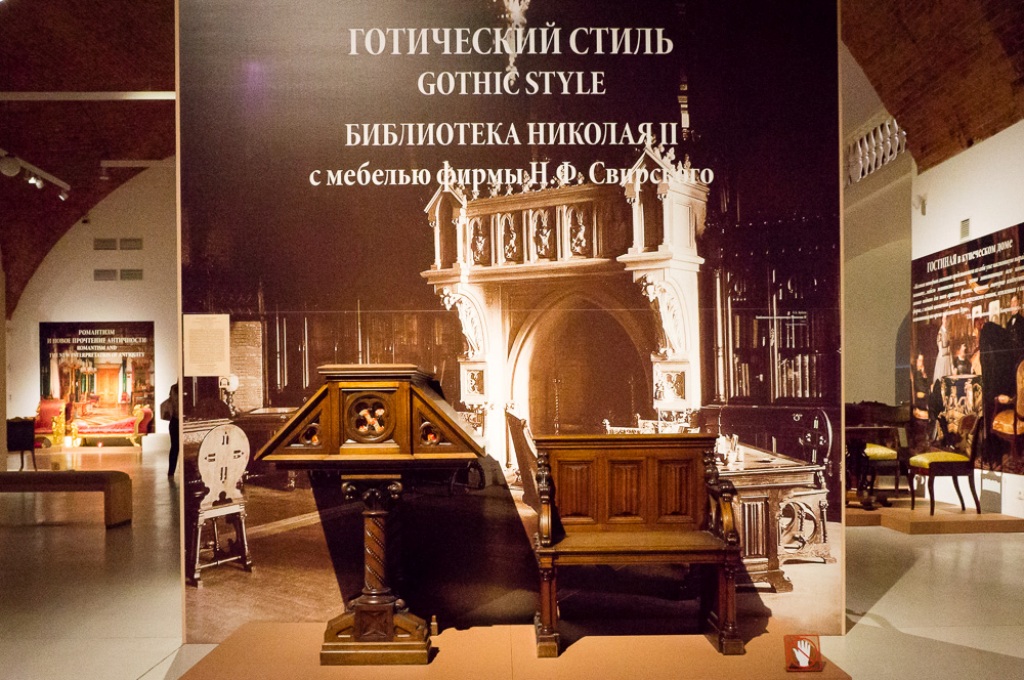
PHOTO: Furniture for the Gothic Library of Nicholas II, designed by N. V. Nabokov, made by N. F. Svirsky
The furniture which decorates the room was designed by the architect Nikolay Vasilyevich Nabokov (1838 – after 1907), and made by Nikolai Fedorovich Svirsky, at his workshop located at 45/47 Borovaya Street in St. Petersburg. The Russian State Historical Archive [RGIA] has preserved Svirsky’s furniture design drawings to the present day. Some of his creations for the Gothic Library were displayed in a temporary exhibition held in the State Hermitage Museum in 2018.
In 1905, Nicholas II and his family moved to Tsarskoye Selo, where they took up permanent residence in the Alexander Palace. Following his abdication in February 1917, the Imperial Residences were all nationalized under the new Provisional Government. It’s leader Alexander Kerensky (1881-1970) wasted little time in acquisitioning the Gothic Library for his own personal use.
PHOTO: Kerensky seated in Nicholas II’s Gothic Library in the Winter Palace, 1917
In March 1917, a decree was issued declaring the contents of the Winter Palace as state property. Only a portion of the library’s original book collection have been *preserved. Today’s caretakers in the State Hermitage mUSEUM confirm that the Emperor read all the books that were kept, often leaving his notes in them.
*In the 1930s and early 1940s, 10,915 titles, 15,720 volumes from Nicholas II’s library in the Winter Palace, were sold to various libraries in the United States, including Harvard, NYPL, and Stanford. In addition, about 2,800 volumes were acquired by the Library of Congress in Washington, D.C.
I am pleased to share a link to a beautiful three-dimensional panorama of the Gothic library of Nicholas II in the Winter Palace, courtesy of the State Hermitage Museum – Click HERE to view.
In February, 1903, a grand party was held in the Winter Palace in St. Petersburg, followed two days later by a grandiose fancy dress ball, whereby guests dressed in bejeweled 17th-century style costumes. The ball, timed to coincide with the 290th anniversary of the Romanov dynasty, took place at the end of the Nativity Fast.
Nicholas II and Alexandra Feodorovna saw the ball as a first step towards the restoration of the rituals and costumes of the Moscow court, continuing the traditions bequeathed by the glorious ancestors of the Romanov dynasty of the distant pre-Petrine times.
Gathering in the Romanov Gallery on 24th (O.S. 11th) February, guests followed in pairs to the Nicholas Hall of the Winter Palace to give their hosts a “Russian bow”. The party’s central event was a concert in the Hermitage Theater with scenes from Modest Musorgsky’s opera Boris Godunov (key parts were performed by Feodor Chaliapin and Nina Figner), Minkus’ ballet La Bayadère and Tchaikovsky’s ballet Swan Lake directed by Marius Petipa (performed by the prima ballerina Anna Pavlova). The performance was followed by a Russian dance in the Pavilion Hall. Dinner was given in the Spanish, Italian and Flemish Rooms of the Hermitage. Thereupon Their Majesties and the guests proceeded to the Pavilion Hall where the party culminated in dancing.
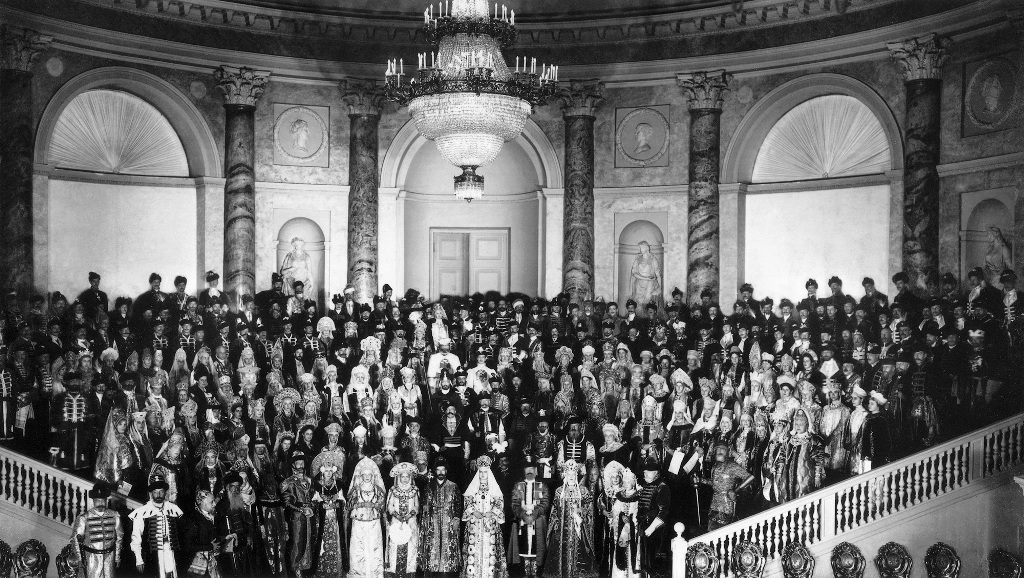
PHOTO: Guests pose for a photograph in the Hermitage Theater
The second part of the ball took place two nights later, on 26th (O.S. 13th) February: all the guests dressed in 17th-century style costumes, made from designs by the artist Sergey Solomko, in collaboration with historical experts. Among the 390 guests, were 65 “dancing officers” – all dressed as 17th century archers or falconers – and personally appointed by the Empress . Members of the Imperial Family gathered in the Malachite Room, others in the adjacent areas. When ten o’clock struck, the guests went to the Concert Hall to dance. The court orchestra, wearing costumes of trumpet-players of Tsar Alexei Mikhailovich performed behind a gilt grating, while 34 round tables were arranged in the Nicholas Hall for dinner. The Concert Hall and Small Dining Room accommodated bars, the Malachite Room, tables with tea and wine.
When dinner was over, the August hosts and their guests returned to the Concert Hall to dance till one in the morning. After three specially prepared dances were performed (Russian dance, round dance and plyasovaya), directed by chief ballet director Aistov and Kshesinsky, waltzes, quadrilles and mazurkas were enjoyed. Young officers of Guards Regiments, Horse-guardsmen, Life-guardsmen and Lancers, acted as male partners in the dances. Participants had received some training: at the dress rehearsal held in the Pavilion Hall on 10 February, 1903, ladies wore sarafans and kokoshniks, while men sported dresses of streletses, falconers, etc. Empress Alexandra Feodorovna and Grand Duchess Elizabeth Feodorovna acted as “judges”.
Despite all the doubts, disputes and gossip, leading up to the luxurious and memorable event, the ball went wonderfully well. Impressed by the ball, Nicholas II wrote in his diary:
“The hall, filled with ancient Russian people, looked very beautiful.”
The palace commandant, Major General Vladimir Nikolaevich Voeikov noted:
“The impression was fabulous – from the mass of old national costumes, richly decorated with rare furs, magnificent diamonds, pearls and semi-precious stones, mostly in old frames. On this day, family jewels appeared in such an abundance that exceeded all expectations.”
After the balls of 11th and 13th February, 1903, the Empress commissioned the best photographers of St. Petersburg: L. Levitsky, D.M. Asikritov, D.S. Zdobnov, Yves. Voino-Oransky, F.G. Boasson, E.L. Mrozovskaya and many others, to take individual and collective photographs of the participants in their costumes. In 1904, a limited edition album containing the photographs was released, consisting of ten large-format files (folders). 21 heliogravures and 174 phototypes. The album was sold primarily among the participants of the ball, and the proceeds from the sale went to charity.
The 1903 Bal, remains the most celebrated festivity arranged in St. Petersburg during the reign of Emperor Nicholas II (1894-1917). More than a century later, it remains an event of an enduring historical significance.
Official Portraits of Nicholas II taken in the Concert Hall of the Winter Palace
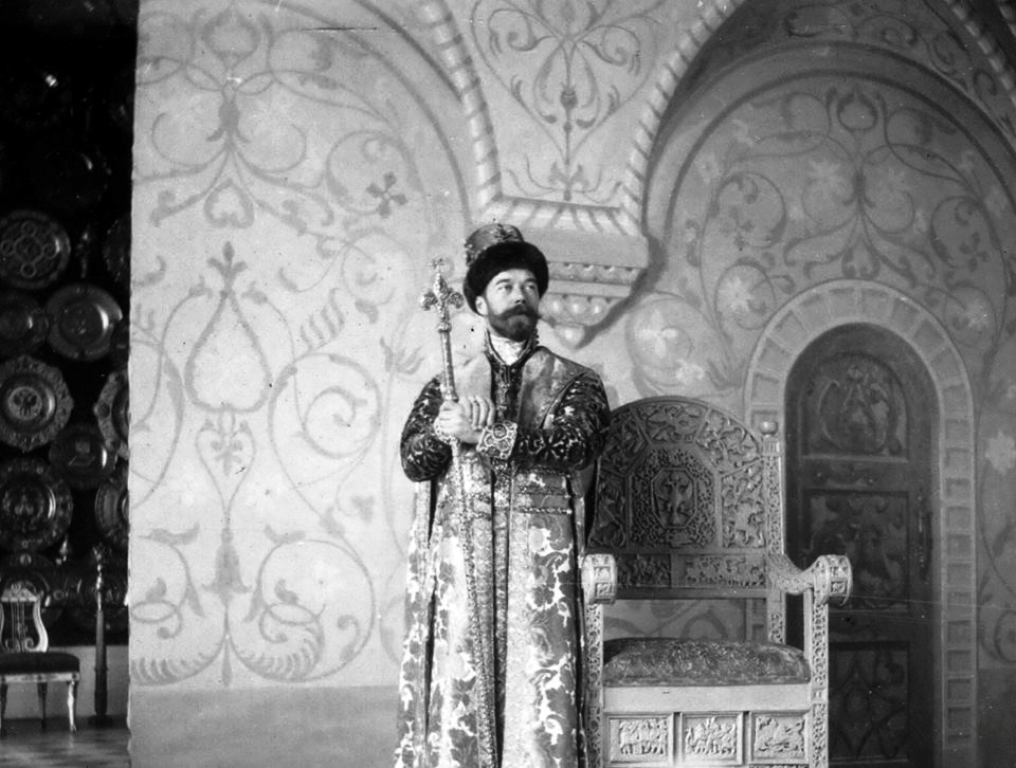
PHOTO: For the background, photographers utilized a stand imitating the walls of a 17th century chamber of the Terem Palace in the Moscow Kremlin was installed in the Concert Hall of the Winter Palace – as seen in the photo above. The throne chair, is a prop, from the storeroom of the Hermitage Theater.
PHOTO: Emperor Nicholas II wearing the costume of Tsar Alexei Mikhailovich (1629-1676); the Empress Alexandra Feodorovna in the costume of his first wife Tsarina Maria Ilyinichna Miloslavskaya (1624-1669). Photo by L.S. Levitsky, 1903
***
Nicholas II’s 17th Century Costume
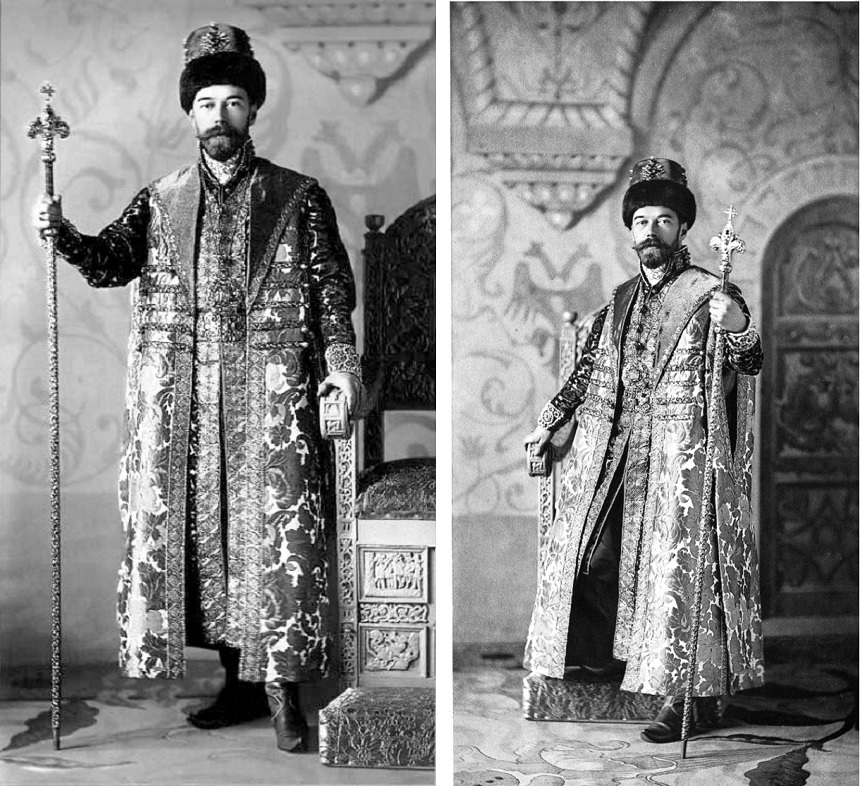
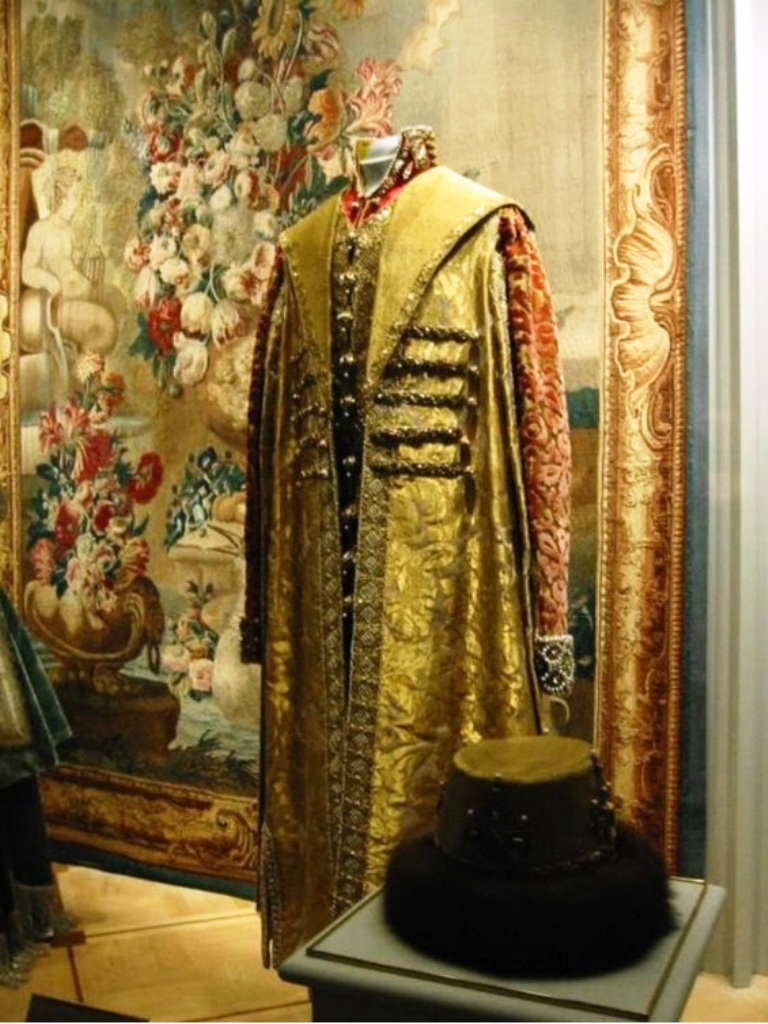
Emperor Nicholas II was dressed in an exact copy of the 17th century clothes, worn by his beloved ancestor, Tsar Alexei Mikhailovich (1629-1676).
The costume sketch for Nicholas II was developed by the Director of the Hermitage, Ivan Alexandrovich Vsevolozhsky (1835-1909) and the artist of the St. Petersburg Imperial Theaters, Yevgeny Petrovich Ponomarev (1852-1906). Two types of velvet and gold brocade were ordered from the Supplier of the Imperial Court – the Sapozhnikovs firm. The fancy dress for Emperor Nicholas II, called “The Small Tsar’s Attire”, was sewn by the theatrical costume designer of the Imperial Theaters Ivan Osipovich Kaffi (1860-19 ??). He was assisted by two dressmakers, whose names have not survived. The tsar’s hat was created in the hat workshop of the brothers “Bruno”, suppliers of the Imperial Court since 1872..
The 17th century-style costume worn by Emperor Nicholas II at the ball held in the 1903 Ball in the Winter Palace, has been preserved to this day in the State Armoury Museum of the Moscow Kremlin. It is on display in Room 6 of the museum, which houses a rich collection of secular and ceremonial costume. The tsar’s 1903 costume can be seen in Showcase 45 (see photo above)
His costume and shashka (hat) were made from the finest materials and design: “velvet, brocade, silk, satin, leather, sable, gilded thread braid, gold, precious stones, pearls, weaving, braiding, casting, chasing, engravings, carving and enamel.”
Opal worn by Emperor Nicholas II (left). Manufactured: Russia, 1903, cufflinks and buttons – Constantinople 2nd half of the 17th century. Materials: Damask, brocade, gold. Work: Sewing, weaving.
Kaftan worn by Emperor Nicholas II (right). Manufactured: Russia, 1903, cufflinks and buttons – Constantinople 2nd half of the 17th century. Materials: Golden velvet, silk, satin. Work: Sewing, casting, chasing.
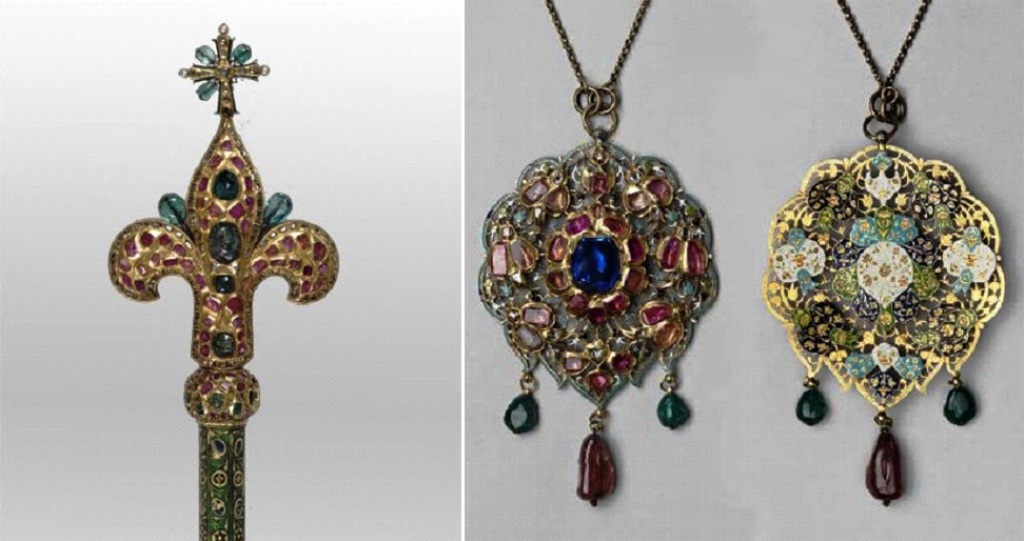
Rod (staff) of Tsar Alexei Mikhailovich. Istanbul, mid-17th century Gold, precious stones, pearls, iron; casting, chasing, carving, enamel. Collection of the the State Armoury Museum.
Zapona-pendant of Tsar Alexei Mikhailovich. Istanbul, second half of the 17th century. Gold, precious stones; chasing, carving, enamel. Collection of the the State Armoury Museum.
***
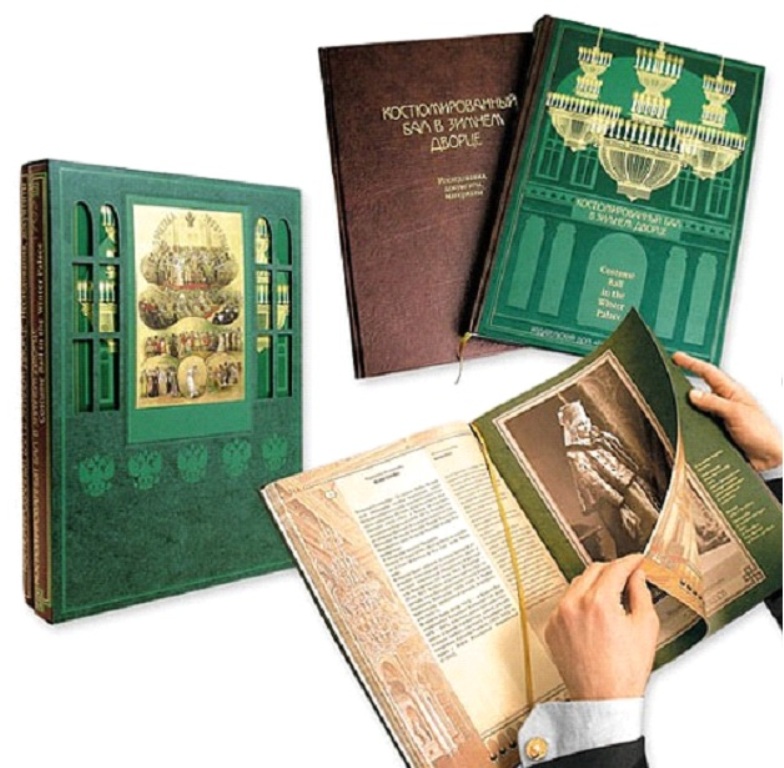
The Costume Ball in the Winter Palace. Luxury 2-Volume Edition
In 2003 the Russian publishing company Русский Антиквариат issued a limited luxury edition printing of The Costume Ball in the Winter Palace in a handsome 2-volume set with slipcase. The publication was a joint project of the State Hermitage Museum, the Moscow Kremlin State Museum, with the participation of researchers, genealogists and descendants of relatives of the nobility who attended the historic event.
The publishing firm offered two variations of the 2-volume set. The first featured one volume in Russian, the second volume in English, however, the firm also issued 100 copies featuring both volumes in English. In 2009, I managed to acquire a number of copies of the 2-volume English edition, and sold them through my bookshop.
Volume I featuredall the documentary and research material, including preserved costumes, unique photos and archival documents, most of which are published for the first time. 128 pages, 50 black and white illustrations, 20 tables with colour images, and introductory article by the Director of the State Hermitage Museum Mikhail Piotrovsky. The cover is made from high quality dark brown leather substitute with gold lettering.
Volume II – showcases the Ball participants. 464 sepia-colour pages, 198 photos of the Ball participants. The cover is made from high quality dark green leather substitute, with gold lettering. More than half of prints made from the original photos. Each image is accompanied by a biographical article.
Sadly, the publisher of these fine books has since gone out of business. Copies of the rare all English edition set, which are highly sought after by collectors in Britain and North America, are occasionally offered through rare book auctions.
Note: the video above features a compilation of vintage photographs, set against the ‘Troparion on the Feast of the Epiphany’ sung by the Sretensky Monastery Choir
On 19 (O.S. 6) January 1904, Emperor Nicholas II took part in the annual celebrations marking the Feast of the Epiphany in St. Petersburg.
The Emperor along with members of the Imperial Court, and senior members of the Russian Orthodox Church proceeded down the Jordan Staircase from the first floor of the Winter Palace to the bank of the Neva River for the Blessing of the Waters at Epiphany in commemoration of Christ’s Baptism in the river Jordan.
Nicholas II descends the stairs leading down to the Neva for the Blessing of the Waters
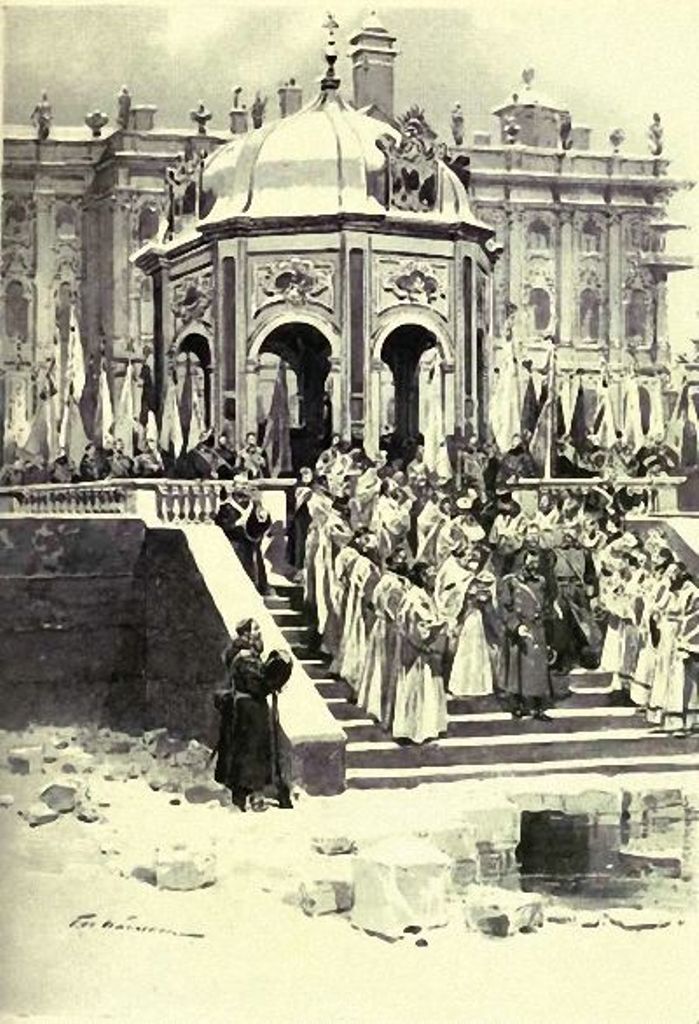
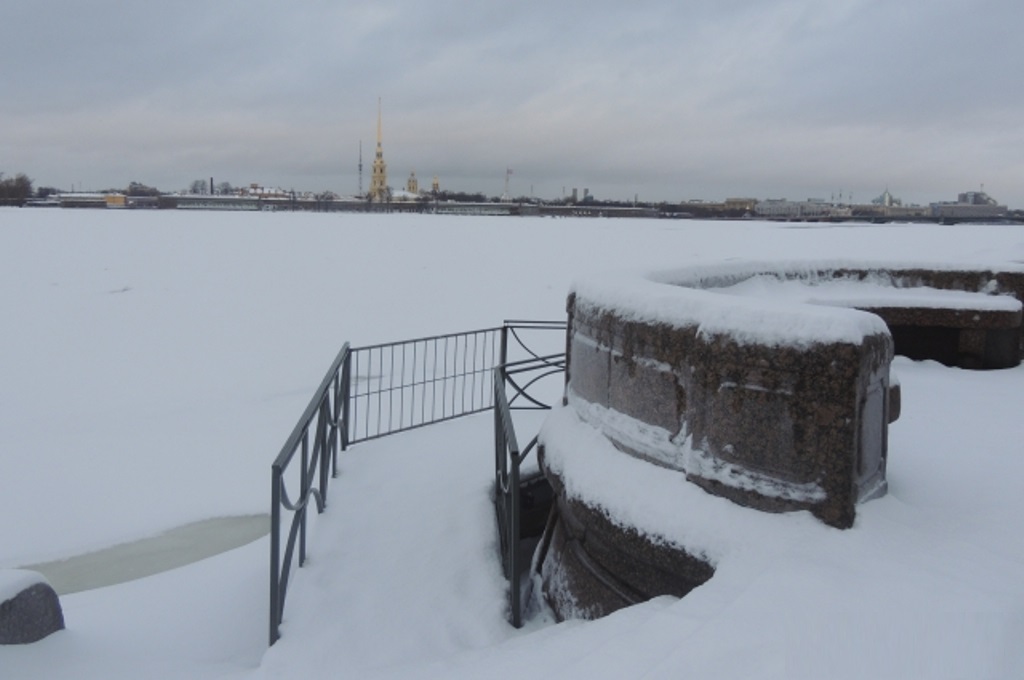
Situated near the northern entrance to the Winter Palace, a temporary wooden pavilion was constructed on the embankment in front of steps leading down to the Neva. The Metropolitan of St. Petersburg dipped a cross in a hole made in the ice. A small cup was then dipped into the water and presented to the Emperor, who took a sip and then handed the cup back to the Metropolitan. Prayers were said for the health of the Tsar and his family.
The above photo shows the spot on the embankment of the Neva River, where the temporary wooden pavilion was constructed for the Blessing of the Waters in the early 20th century.











 Nicholas II
You must be logged in to post a comment.