Prince Ivan Ratiev: the man who saved the Imperial Regalia in 1917

PHOTO: Prince Ivan Dmitrievich Ratiev (1868-1958)
Prince Ivan Dmitrievich Ratiev (1868-1958) was a Georgian prince and a prominent officer of the Imperial Russian Army. He later served as a high-ranking official at the Winter Palace in St. Petersburg.
Ratiev was born in Oryol on 17th July 1868, into a branch of the Georgian princely house of Ratishvili, which had emigrated to the Russian Empire in 1724. He graduated from the Oryol Cadet Corps and then from the Nicholas Cavalry College. In 1890 he joined the 44th Nizhegorod Dragoon Regiment, deployed in Georgia.
In 1896, he married Ekaterina Irakliyevna, née Princess Gruzinskaya (1872–1917), a great-granddaughter of King Heraclius II of Georgia (1720-1798) and a lady-in-waiting of Empress Alexandra Feodorovna (1872-1918). The couple had two children: Dmitri (1899-1926), and Olga (1902-1987).

PHOTO: Prince Ivan Dmitrievich Ratiev with his wife
Ekaterina and their two children Dmitri and Olga
Ratiev retired from army service due to a trauma sustained in a horse race at Tbilisi in 1907. He then studied at Academy of Fine Arts in Paris and, after his return to Russia, worked for the Ministry of the Imperial Court in St. Petersburg. He was assigned to an army cavalry unit of the Winter Palace with the rank of rittmeister [riding master]. By the Imperial Order of 6th December 1913, he was made a lieutenant-colonel of the Imperial Guard cavalry and an acting Police Master of the Winter Palace. Promoted to the rank of colonel in 1916, Prince Ratiev was appointed as a deputy commandant of the Winter Palace in April 1917, two months after the February Revolution overthrew the tsar Nicholas I
It was during the storming of the Winter Palace in October 1917, for which Ratiev is best known. Thanks to his heroic efforts, he managed to save the Imperial Regalia[1] from being looted or destroyed by revolutionary thugs.
On 7th November (O.S. 25th October) 1917, Ratiev did not flee his post like so many others during these turbulent time, instead he ordered his guards to transfer the Imperial Regalia to safer parts of the Palace. The prince sent his 16-year-old son Dmitri and two of his most trusted grenadiers to guard the secret depository, which, among other precious objects, which included the Russian Imperial Crown adorned with 4936 diamonds, the Orb and the Sceptre incorporating the Orlov diamond.
Upon confronting the revolutionaries, Ratiev negotiated with the Bolshevik leader Vladimir Alexandrovich Antonov-Ovseenko (1883-1938), who oversaw the armed assault of the Palace, which led to successful negotiations to preserve the Imperial Regalia.
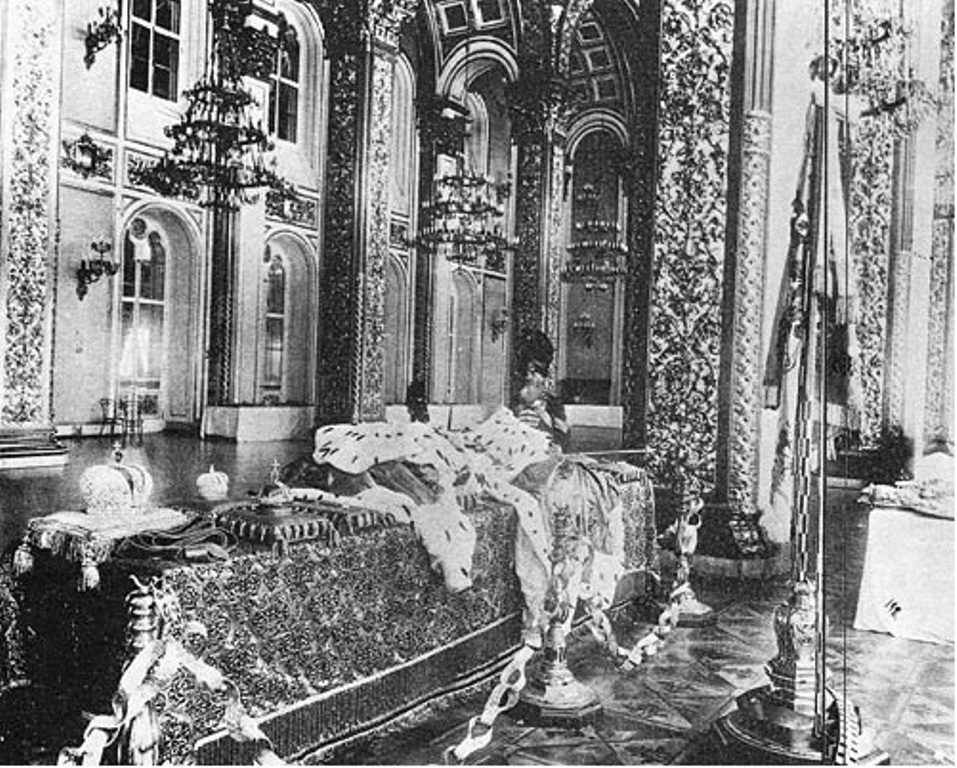
PHOTO: The Imperial Regalia: crowns, orb, and sceptre laid out in preparation for the historic crowning of Russia’s last tsar Nicholas II in Moscow on 27th May (O.S. 14th May) 1896
The Soviet leadership publicly expressed their gratitude to Prince Ratiev in the 5th November 1917 edition of Izvestia[2] for his “self-sacrificing efforts to protect and preserve the people’s treasures” and appointed him the chief commandant of the Winter Palace and of all state museums and palaces in the Petrograd district.
In March 1919, Ratiev escorted the “golden echelon”, a train carrying Russia’s gold reserve, following the transfer of the Russian government from Petrograd to Moscow. During the journey, however, Ratiev was pressured into surrendering the train and even being fired upon at Tver. Ratiev retired from the state service shortly thereafter and worked as a translator for various organizations of Moscow for several years.
His subsequent life was marred by the loss of his wife and son, the latter who drowned while swimming in the Moscow River. In March 1924, Ivan Ratiev, his daughter Olga and sister Sophia were arrested on charges of belonging to a “counter-revolutionary monarchist organization.”
Initially, Ratiev was sentenced to five years in the Gulag, however, due to his service in 1917, the sentence was commuted to exile to Ekaterinburg, where the family spent 3 years.
In 1931, Ratiev moved to the Georgian capital of Tbilisi, where he lived as a “state pensioner”. He died on 28th April 1958, at the age of 89.
NOTES:
[1] Before the 1917 Revolution, the Imperial Regalia, which included the Imperial Crown, orb and sceptre, were stored in the Diamond Chamber of the Winter Palace in St. Petersburg. In May 1896. the Imperial Regalia were transported by train and under heavy guard to Moscow, for the Holy Coronation of Emperor Nicholas II. During the First World War, the Imperial Regalia was moved to Moscow and stored in the Armory Chamber of the Kremlin. In 1922, the Soviet Diamond Fund was established. Today, the Imperial Regalia is stored in the Diamond Fund vault (opened in 1967).
[2] Izvestia (“The News”) is a daily broadsheet newspaper founded in February 1917, Izvestia, which covered foreign relations, was the organ of the Supreme Soviet of the Soviet Union, disseminating official state propaganda. It is now described as a “national newspaper” of Russia.
© Paul Gilbert. 11 July 2024
 Nicholas II
You must be logged in to post a comment.