
PHOTO: Revolutionaries burning the Tsar’s portrait in 1917. Artist: Ivan Alekseevich Vladimirov (1869-1947)
NOTE: this article was last updated on 24th July 2024 – PG
Contemporary historians have led us to believe that news of Nicholas II’s death was met with indifference among the Russian people. Rather than conduct their own research on the matter, they choose instead to rehash the popular Bolshevik version of events – this is in itself is not the sign of a good historian.
Recall that following the abdication of Nicholas II in February 1917 and the October 1917 Revolution, which resulted in a Bolshevok coup, it was clear that a return of the monarchy in Russia was hardly possible. But no one in Russia expected the brutal murder of the Tsar and his family. Earlier, the Bolsheviks had planned to hold an open trial of Nicholas II – in order to draw a symbolic line under the era of Tsarism in Russia. In particular, Trotsky advocated such a trial. Lenin, in turn, feared that the Romanovs were still loved by the people, and therefore the trial might not bring the fruits that the Bolsheviks would have wanted. Lenin considered that based on the events of the Civil War it would be more expedient to secretly kill the entire Imperial Family and remain silent about it as long as possible.
While the elation exhibited by the revolutionaries is indeed true, it did not reflect the heartfelt sentiments of millions of Orthodox Christians, monarchists and others in the former Russian Empire.
Patriarch Tikhon (1865-1925), openly defended the Imperial family, by condemning the Bolsheviks for committing regicide.
When the tragic news of the murder of the Tsar and his family came, the Patriarch immediately served a memorial service at a meeting of the Local Council of the Russian Orthodox Church; then served the funeral Liturgy, saying that no matter how how the Sovereign was judged by his enemies, his murder after he abdicated was an unjustified crime, and those who committed him should be branded as executioners.
During his sermon at the Kazan Cathedral in Moscow, Patriarch Tikhon said:
“… a terrible thing has happened: the former Tsar Nikolai Alexandrovich was shot, by decision of the Ural Regional Soviet of Workers’ and Soldiers’ Deputies, and our highest government, the Executive Committee, not only approved it but deemed it as legitimate. But our Christian conscience, guided by the Word of God, cannot agree with this. We must, in obedience to the teaching of the Word of God, condemn this act, otherwise the Tsar’s blood will fall not just on those who committed it, but on all of us.
“We will not evaluate and judge the deeds of the former Sovereign: an impartial trial of him belongs to history, and now he faces the impartial judgment of God, but we know that he, abdicating the throne, did so with the good of Russia in mind and out of love for the Motherland. He could, after his abdication, have found security and a comparatively quiet life abroad, but he did not do so, choosing to stand with Russia. He did nothing to improve his situation, instead he meekly submitted to fate,
“… and suddenly he is sentenced to death somewhere in the depths of Russia, by a small handful of people, not for any guilt, but only for the fact that someone allegedly wanted to kidnap him [the Bolsheviks claimed that the Tsar’s family and supporters were attempting to rescue him]…
“Our conscience cannot be reconciled to this, and we must declare it loudly, as Christians, as sons of the church. Let them call us counter-revolutionaries for this, let them imprison us, let them shoot us. We are ready to endure this in the hope that the words of the Savior will be attributed to us: “Blessed are those who hear the Word of God and keep it.”
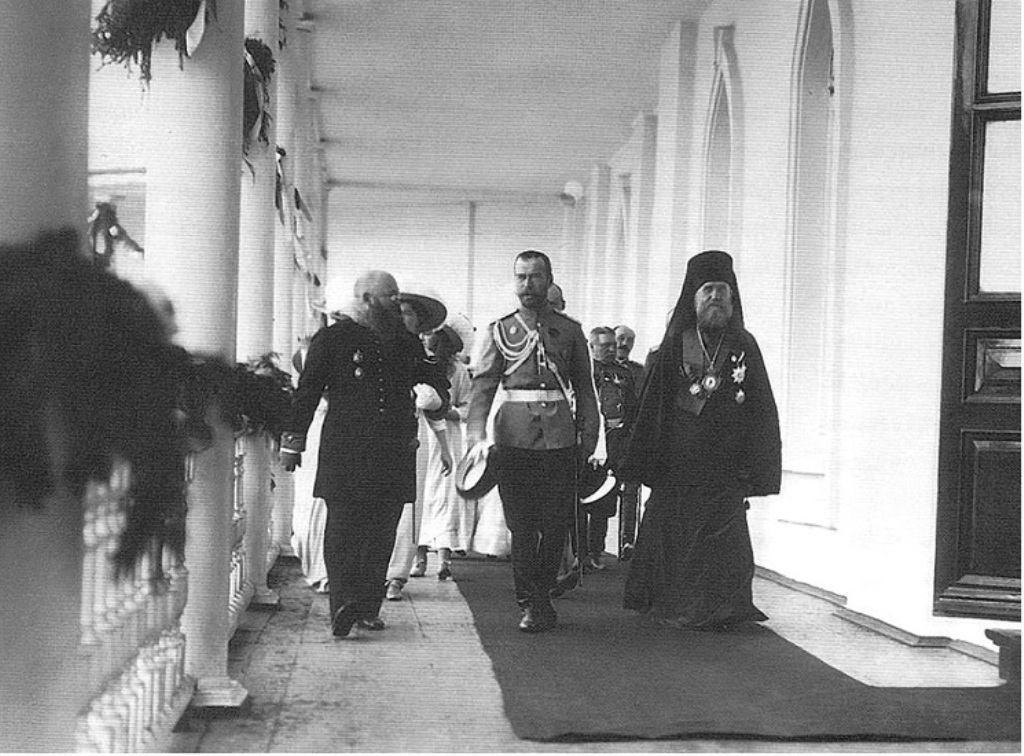
PHOTO: Emperor Nicholas II with Archbishop (future Patriarch) Tikhon
at the Transfiguration Monastery. Yaroslavl, 21 May 1913
And others condemned the regicide . . .
Eugenie Fraser, born and raised in Russia writes about her years in Petrograd and news of the tsar’s death: “In August, filtered through from Siberia, came the news of the slaughter of the Royal family by the sadistic thugs of the Bolshevik party. Horror and revulsion touched every decent thinking citizen in the town. To execute the Tsar and his wife in this barbaric fashion was bad enough, but to butcher the four young girls and the helpless boy was the work of mindless criminals. In churches people went down on their knees and openly wept as they prayed for the souls of the Tsar and his family.”
“Even in all this turmoil and confusion, and even among those with little sympathy for the abdicated tsar, the brief five-line announcement in July 1918 of the execution of Nicholas II and his family in Ekaterinburg caused a terrible shock,” writes Serge Schmemann. He further notes “Prince Sergei Golitsyn recalled in his diary how people of all levels of society wept and prayed, and how he himself, as a nine year old boy, cried night after night in his pillow.”
Major-General Sir Alfred Knox further noted in his memoirs: “An old soldier . . . breathed into my ear that the Emperor was a good man, and fond of his people, but was surrounded by traitors.”
It is important to recall that it was in the summer of 1918, when Lenin unleashed the first Red Terror. People lived in fear of punishment from the thugs and criminals of the new order, for showing any sympathy for the murdered tsar. Many hid their framed portraits of the tsar, and kept their grief and monarchist sentiments to themselves.
NOTE: This article has been excerpted from my forthcoming book Nicholas II: A Century of Myths and Lies [publication date yet to be announced]
© Paul Gilbert. 24 July 2024
 Nicholas II
You must be logged in to post a comment.