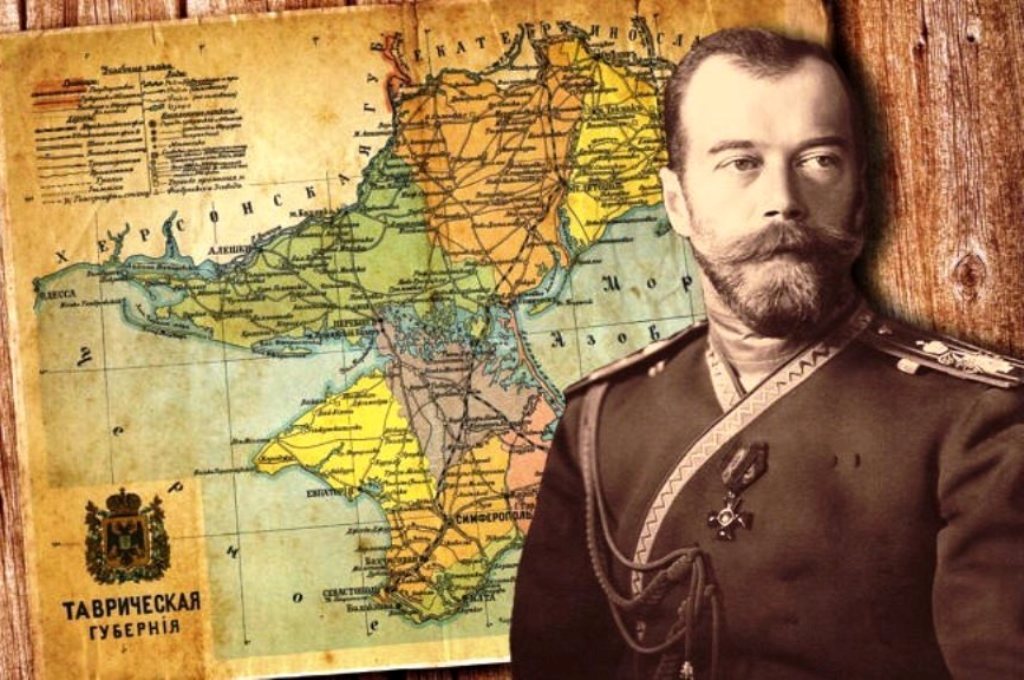
Emperor Nicholas II was all very fond of his residence in Livadia, a magnificent white limestone palace perched on a ledge overlooking the Black Sea on the southern coast of Crimea.
The old Large wooden palace[1] was demolished to make way for the new Imperial Residence. Construction on the new palace began on 21st January 1910, and after only 17 months, was inaugurated on 11th September 1911. The Tsar spent about 4 million gold rubles – from his own funds – to finance it’s construction. The palace had 116 rooms, with interiors furnished in different styles, and surrounded by beautifully landscaped gardens.
The Imperial Family stayed in the new Livadia Palace in the autumn of 1911 and 1913 and in the spring of 1912 and 1914, their visits lasting months at a time.
But, is it true that Nicholas II wanted to move the capital of the Russian Empire to Yalta?

PHOTO: Northern facade of the Livadia Palace
Watercolour by Nikolay Petrovich Krasnov (1864-1939)
A diplomat, a Russian general, Alexander Mossolov[2], wrote in his diary, noting a conversation he had had with the Emperor, who told him about his idea of transferring the capital from rainy St. Petersburg to sunny Crimea.
According to Mossolov, while returning from Uchan-Su[3] along a path high above the highway with a beautiful view of Yalta, the Emperor noted that he was tied to the southern coast of Crimea and did not want to leave. And when Mossolov inquired whether the Emperor would have liked to transfer the capital to Yalta, Nicholas II replied: “This idea has flashed through my mind more than once.”
True, after a few minutes the Emperor admitted that it was impossible to do this.
“And if it were the capital, I probably would have stopped loving this place.” Some dreams, the diplomat quoted the emperor.
***
Any one who has ever visited Livadia, and stood at the windows on the balconies admiring the magnificent views of both the mountains behind and the Black Sea in front, can appreciate why this place was so loved by the Imperial Family.
Following the Tsar’s abdication in February 1917, the Imperial Family were held under house arrest in the Alexander Palace at Tsarskoye Selo, until the end of July. It was the decision of the Head of the new Provisional Goverment Alexander Kerensky who decided to send the Imperial Family into exile. Nicholas hoped that they would be allowed to settle in Livadia, where they would be far removed from the capital, however, Kerensky had other plans – he sent them to Tobolsk in Siberia.
Sadly, the Imperial Family’s “peace” would have been short lived. During the First World War, Crimea was occupied by German forces. On 30th April 1918, German troops entered Livadia, and immediately began to plunder the palace, many of its artefacts lost forever. The Imperial Family would have been forced to flee or be captured by the enemy.
NOTES:
[1] The Large or Grand Imperial Palace was constructed between 1862-66 by the famous Russian architect Ippolit Antonovich Monighetti (1819-1878) for Emperor Alexaander II, his wife Empress Maria Alexandrovna and their children. Emperor Nicholas II and his family resided in the nearby Small or Maly Palace (where Nicholas’s father Emperor Alexander III died on 2nd November (O.S. 20th October) 1894). from 1894 until 1911. The
[2] Lieutenant-General Alexander Alexandrovich Mossolov (1854-1939) served as Head of the Office of the Ministry of the Imperial Court. He was one of the few people of who remained faithful to Nicholas II. Mossolov is the author of ‘At the Court of the Last Tsar.’ The English language edition was published in 1935, the content of which is somewhat different from the Russian version.
[3] Uchan-Su is the highest (98 metres /322 ft) waterfall in Crimea, situated 7 km from Yalta, on the southern slopes of the Crimean Mountains.
© Paul Gilbert. 3 August 2024
 Nicholas II
You must be logged in to post a comment.