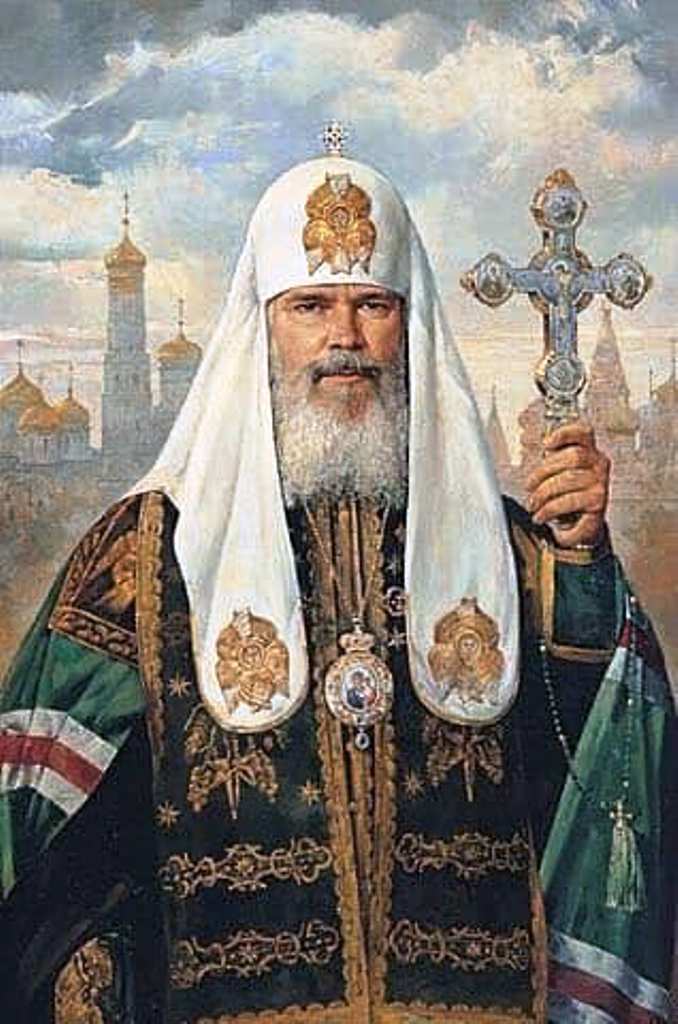
PHOTO: His Holiness Patriarch Alexei II of Moscow and All Russia
On this day – 5th December 2008 – His Holiness Patriarch Alexei II of Moscow and All Russia (1929-2008) died in Peredelkino, at the age of 79.
Alexei Mikhailovich Rüdiger was born in Tallinn, Estonia on 23rd February 1929. He was elected Patriarch of Moscow eighteen months prior to the fall of the Soviet Union in 1991. He became the first Russian Patriarch of the post-Soviet period to be chosen without government pressure; candidates were nominated from the floor, and the election was conducted by secret ballot.
In July 1998 Alexei II decided not to officiate at the funeral of Emperor Nicholas II and his family in the Saints Peter and Paul Cathedral in St. Petersburg, citing doubts about the authenticity of their remains. He also banned bishops from taking part in the funeral ceremony.
In the face of skepticism, Patriarch Alexei II was obliged to profess agnosticism over the identity of the bodies, as a way to avoid massive internal rifts within the church. He also claimed that the Church had been sidelined in the investigation.
The funeral was attended by Russian president Boris Yeltsin, Prince Michael of Kent and more than 50 descendants of the Romanov dynasty. Maria Vladimirovna Romanova, her son and her mother, were the only Romanov descendants who refused to participate, also citing doubts about the authenticity of the Rkaterinburg remains.
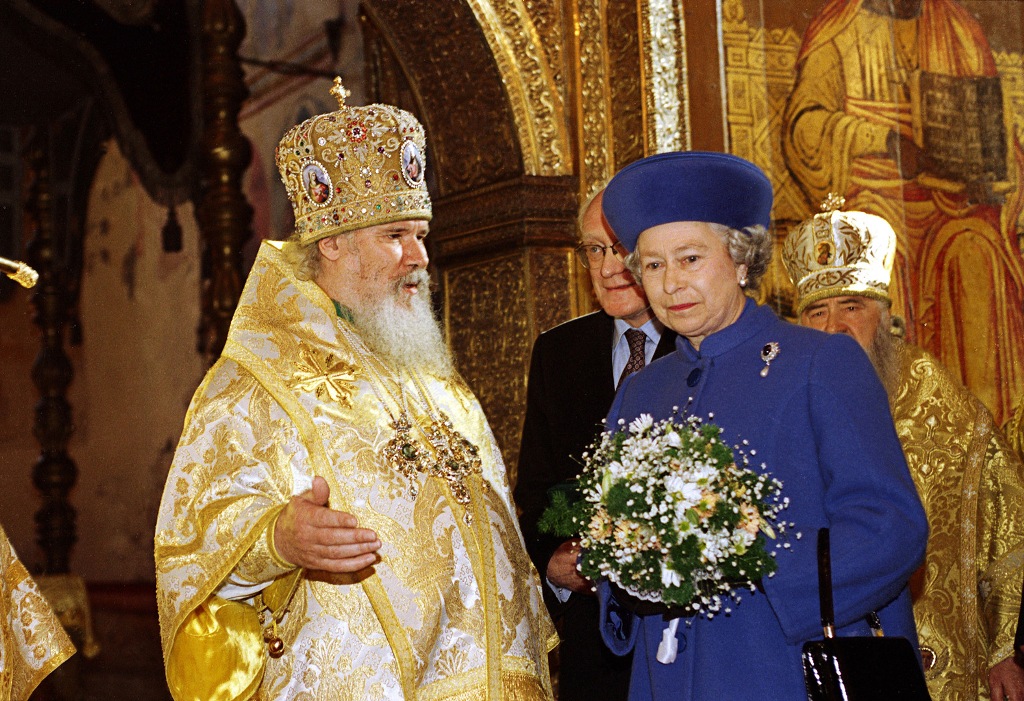
PHOTO: Patriarch Alexei and Queen Elizabeth II. Moscow, 18th October 1994
Instead, Patriarch Alexei II, Maria Vladimirovna Romanova, her son George Hohenzollern, and her mother Leonida Georgievna (1914-2010) attended a liturgy for the murdered Imperial Family at the Trinity Lavra of St. Sergius, the most important Russian monastery and the spiritual centre of the Russian Orthodox Church, situated in the town of Sergiyev Posad [named Zagorsk during the Soviet years], about 70 km north-east of Moscow.
Under His Holiness’s leadership, the New Martyrs and Confessors of Russia who suffered under Communism were glorified, beginning with the Grand Duchess Elizabeth, Metropolitan Vladimir, and Metropolitan Benjamin (Kazansky) of Petrograd in 1992.
In 2000, after much debate, the Council of Bishops of the Russian Orthodox Church glorified Emperor Nicholas II and his family, as Passion-Bearerss[1][2]. Their canonization took place on 20th August 2000, at the Christ the Saviour Cathedral in Moscow.
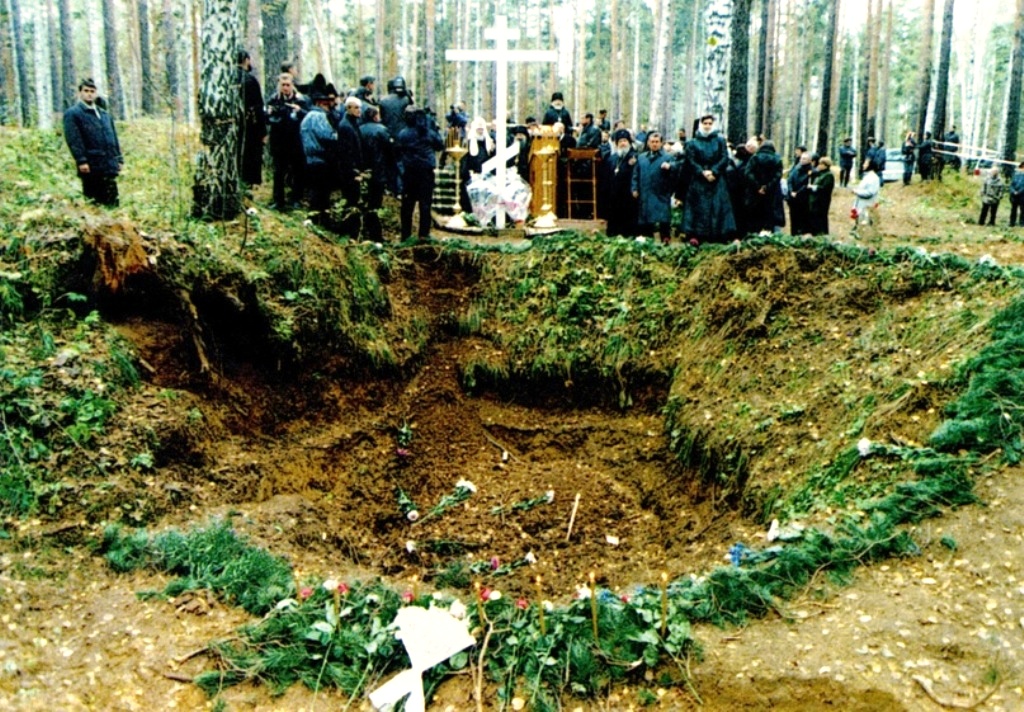
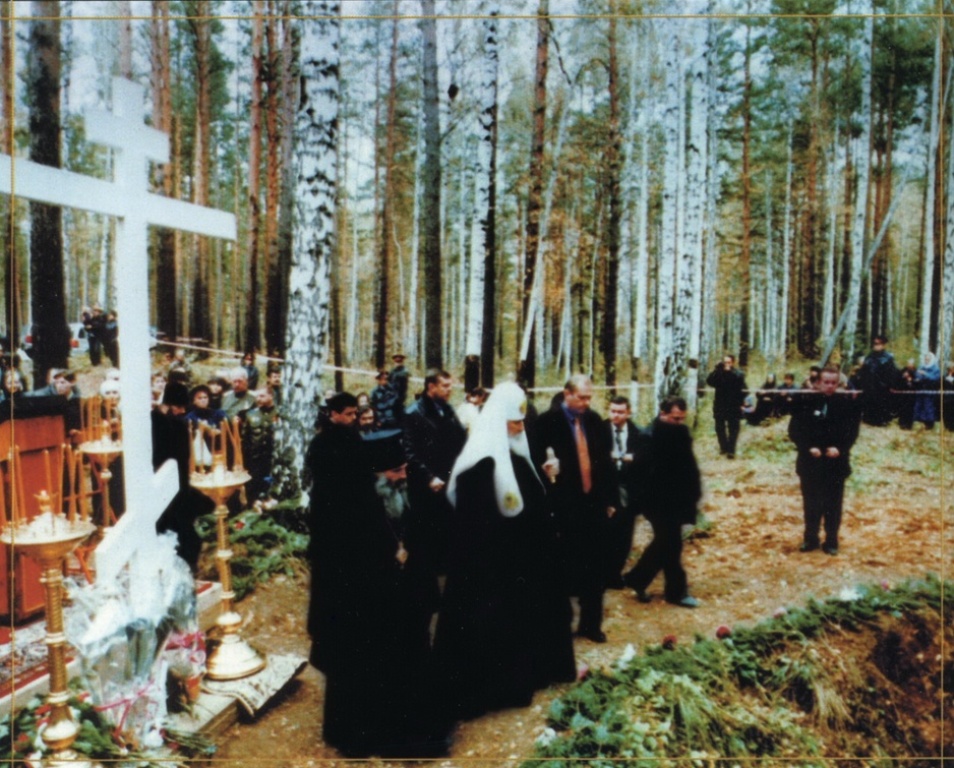
PHOTO: two very sombre photos of Patriarch Alexei standing at Mine No. 7 (collapsed) at Ganina Yama[3]. It was around this place, that the Monastery of the Holy Royal Passion-Bearers was built.
On 23rd September of the same year, during his visit to the Urals, Patriarch Alexei II laid a memorial capsule in the eastern wall of the foundation of the future church. The construction of the Church on the Blood in Ekaterinburg. The church, which was completed in 2003, was built on the site of the Ipatiev House, where the Imperial Family along with four faithful retainers were murdered on 17th July 1918. The Ipatiev House was demolished in September 1977.
On the same day, His Holiness visited the Ganina Yama[3] tract [situated 15 km (10 miles) north of Ekaterinburg] and, having blessed the establishment of the monastic monastery, put his signature on the master plan of the monastery. The first stone of the monastery was laid on 1st October 2000. On 27th December, the Holy Synod officially “blessed the opening of a monastery in the name of the Holy Royal Martyrs in the Ganina Yama[3] tract”. On 28th December, the all-male Monastery of the Holy Royal Martyrs was established here.
His Holiness Patriarch Alexei II of Moscow and All Russia died at his home in Peredelkino [southwest of Moscow] on 5th December 2008, from heart failure, aged 79. He died 80 days short of his 80th birthday.
The funeral service for His Holiness was performed at the Cathedral of Christ the Saviour in Moscow, he was buried in the Cathedral of the Epiphany, the vicarial church of the Moscow Patriarchs in Yelokhovo, located in the Basmanny district of Moscow.
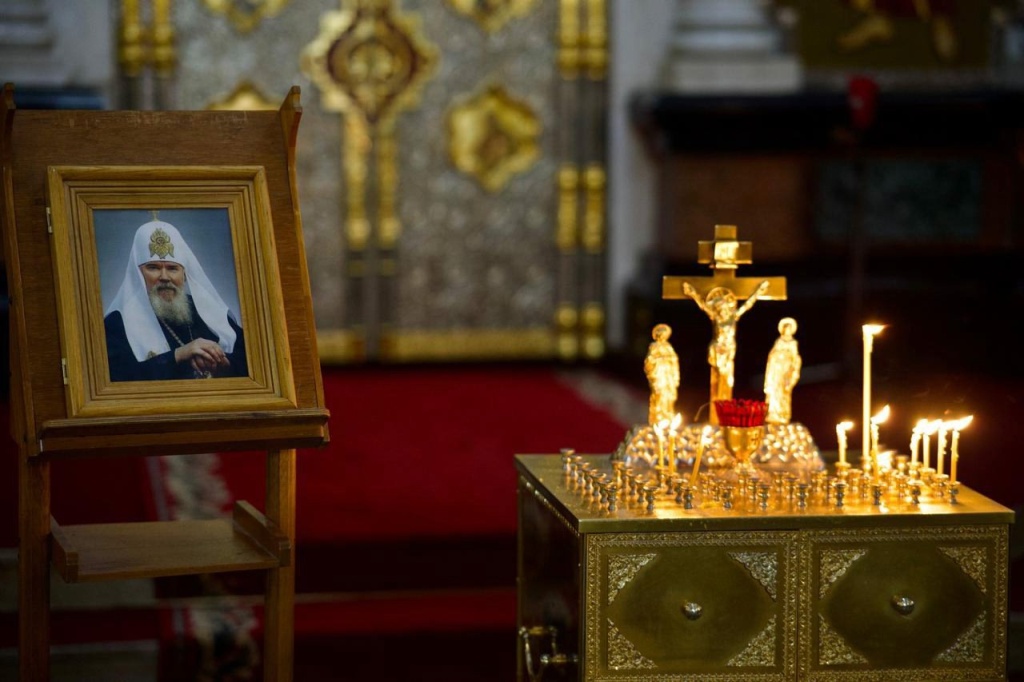
Memory Eternal! Вечная Память!
NOTES:
[1] Despite their official designation as “passion-bearers” in 2000, by the Council of Bishops of the Russian Orthodox Church, Emperor Nicholas II and his family are often referred to as “martyrs” in Church publications, icons, and in popular veneration by the people.
[2] Emperor Nicholas II and his family were canonized as martyrs by the Russian Orthodox Church Outside of Russia (ROCOR) in 1981.
[3] Ganina Yama is the generally accepted name of the abandoned Isetsky mine, located in the Four Brothers tract, overgrown with birch and pine forests, situated situated in the Sverdlovsk region.
© Paul Gilbert. 5 December 2024
 Nicholas II
You must be logged in to post a comment.