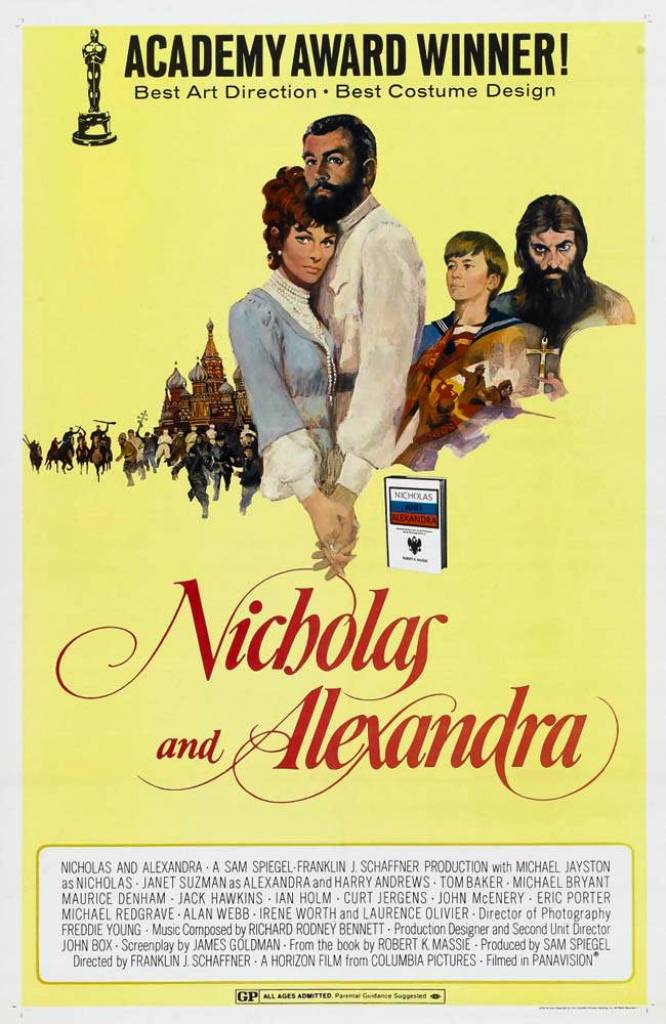
The year 2021 marked the 50th anniversary of the release of the film adaptation of Robert K. Massie’s (1929-2019) classic book Nicholas and Alexandra. Published in 1967, it remained on the New York Times Bestseller List for 46 weeks, and has never gone out of print! Selling more than 4.5 million copies, it is regarded as one of the most popular historical studies ever published. Praised in The New York Times as a “long-needed and balanced account” of the last tsar and his family. In Massie’s study, Nicholas comes across not as the “stupid, weak or bloodthirsty” monarch, as he is often been portrayed by his Western counterparts.
The film version was released on 13th December 1971, and nominated for numerous awards. At the 44th Academy Awards (1972), Nicholas and Alexandra won two awards of six nominations; at the 25th British Academy Film Awards (1972), Nicholas and Alexandra received three nominations; at the 29th Golden Globe Awards (1972), Nicholas and Alexandra received three nominations; and at the 15th Annual Grammy Awards (1973), Richard Rodney Bennett was nominated for Best Original Score Written for a Motion Picture or a Television Special.
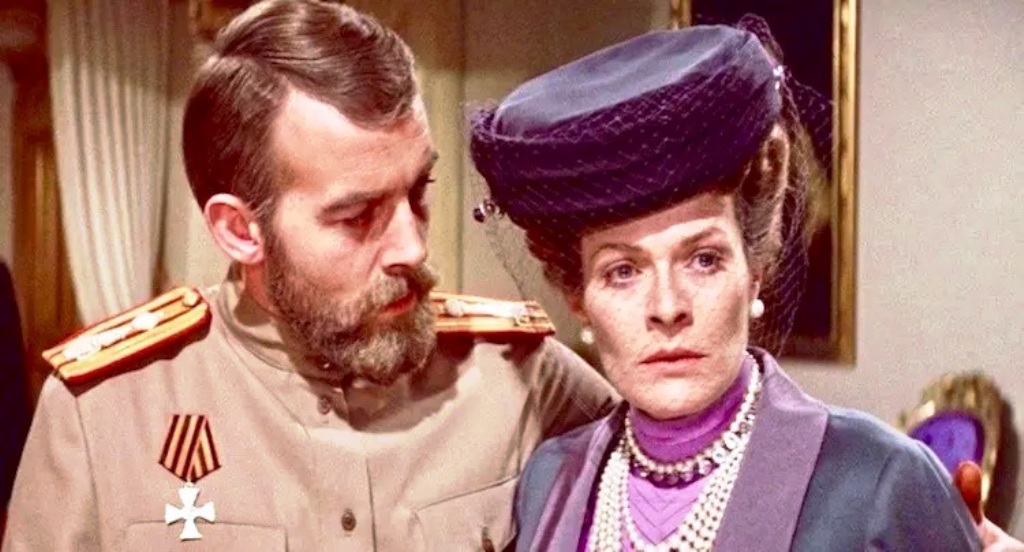
PHOTO: Michael Jayston as Nicholas II and Janet Suzman as Alexandra Feodorovna
The film featured a star-studded cast of notable British actors and actresses: Michael Jayston (1935-2024) as Nicholas II; Janet Suzman [b. 1939] as Alexandra Feodorovna; Irene Worth [1916-2022] as the Dowager Empress Maria Feodorovna; Tom Baker [b. 1934] as Grigori Rasputin; Jack Hawkins [1910-1973] as Count Vladimir Frederiks, the Minister of the Imperial Court; Timothy West [1934-2024] as Dr. Botkin, the court physician; Jean-Claude Drouot [b. 1938] as Pierre Gilliard, the children’s Swiss tutor; Laurence Olivier [1907-1989] as Count Witte, the Prime Minister; Michael Redgrave [1908-1985] as Sazonov, the Foreign Minister; Eric Porter [1928-1995] as Pyotr Stolypin, the Prime Minister after Witte; John McEnery [1943-2019] as Kerensky, leader of the Russian Provisional Government; Michael Bryant [1928-2002] as Lenin; Martin Potter [b. 1944] as Prince Felix Yusupov; Richard Warwick [1945-1997] as Grand Duke Dmitri Pavlovich; among many others.
Personally, I greatly disliked this film for a number of reasons. It is due to the popularity and cult-like status of this film which compelled me to address some of the many factual errors of this film, and that it will serve as a resource for those who have viewed it for the first time.
Aside from some terrible acting, such as Janet Suzman’s appalling portrayal of Empress Alexandra Feodorovnam the film is rife with historical inaccuracies. For instance, not a single scene was filmed in Russia. This of course is due to the fact that in 1971 Russia was still the Soviet Union, and the discussion or promotion of the last Tsar was still taboo. Instead, the film was shot entirely in Spain and Yugoslavia.
While I personally acknowledge that both Massie’s book and film inspired many people to learn more about Russia’s last Tsar, sadly, there are those who will actually base their own assessment of Nicholas II on this film, and that in itself sets a very damaging scenario.
While I acknowledge that while this is merely a film and not a documentary, I cannot overlook the fact that the producers have blurred the lines between historical accuracy and crude sensationalism.
Below, are just four of the more notable historical inaccuracies, which I spotted in the film – I documented many others in my notes while watching the film:
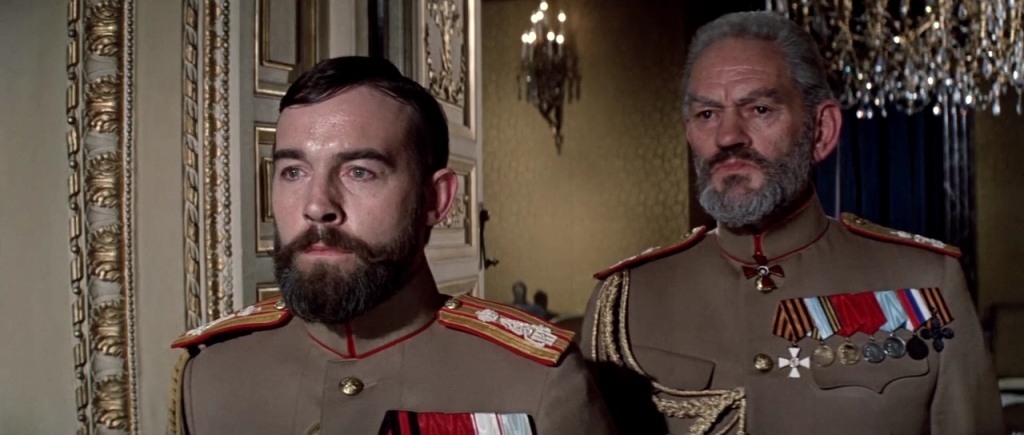
PHOTO: Michael Jayston as Nicholas II and Harry Andrews as Grand Duke Nikolai Nikolaevich
[1] In an early scene, Nicholas II addresses Grand Duke Nikolai “Nikolasha” Nikolaevich – played by Harry Andrews [1911-1989] – as “uncle”, however, this is incorrect. Grand Duke Nikolai was a first cousin once removed of Emperor Nicholas II..
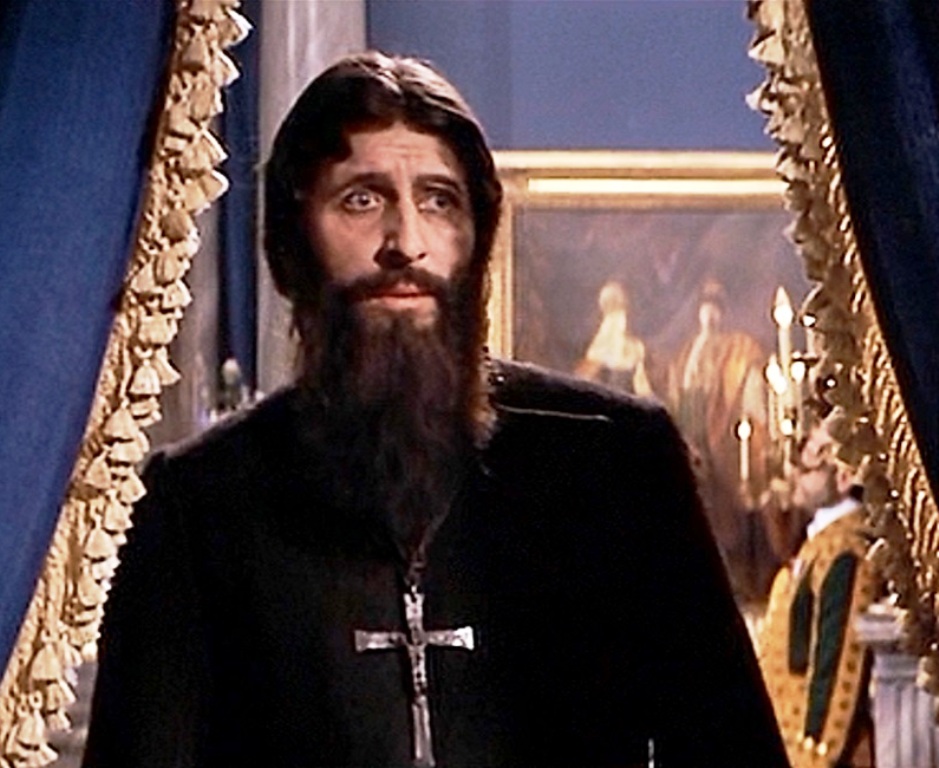
PHOTO: Tom Baker as Grigori Rasputin
[2] When Rasputin returns from Siberia, he enters a room where the Empress is waiting. He approaches her, she looks into his eyes adoringly, lifts the cross hanging around his neck and proceeds to kiss it.
Later in the film, upon being transferred from Tobolsk to Ekaterinburg, the entire family are seen leaving the “House of Freedom” together. This scene is certainly not based on fact. It is well known that Nicholas, Alexandra and Maria left Tobolsk on 26th (O.S. 13th) April 1918, while Olga, Tatiana, Anastasia and Alexei left Tobolsk the following month.
Upon arrival at the Ipatiev House in Ekaterinburg, the Imperial Family are greeted at the door by Yakov Yurovsky, played by English actor Alan Webb [1906-1982]. This scene is historically inaccurate, as Yurovsky was not appointed to the Ipatiev House until 4th July 1918 – 13 days before the Imperial Family were murdered. I would like to add, that in July 1918, Yurovsky was only 40, whereas in the film, he is depicted as an elderly man. At the time of the making of the film, Webb was already 65.
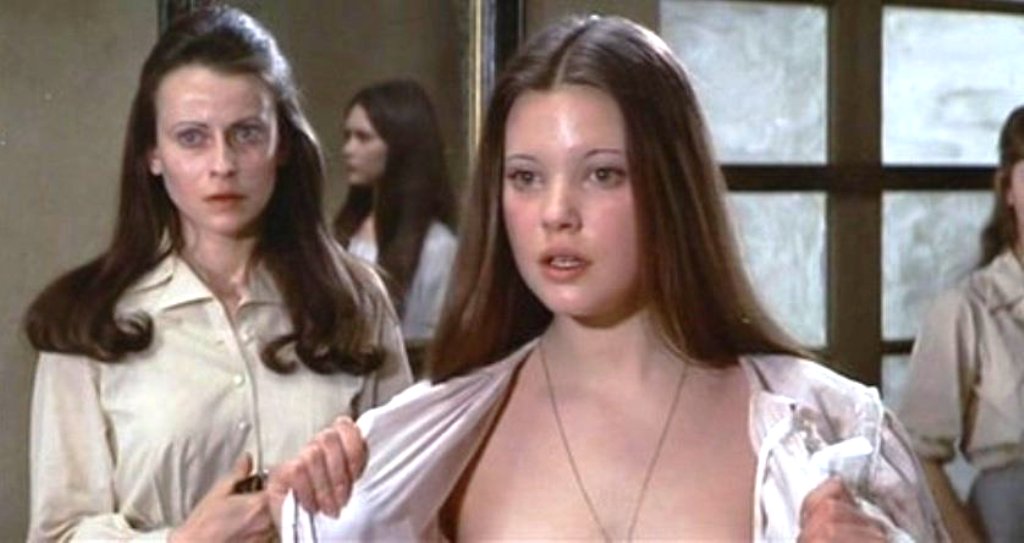
PHOTO: scene whereby the grand duchess allegedly exposes herself to a guard
[3] During their house arrest in Ekaterinburg, a guard enters the room of the grand duchesses where they are getting dressed for bed. One of the daughters (Tatiana) asks what he wants, and then opens her dressing gown to expose her naked body. The grand duchess cries that she is only 21 and desires to be wanted.
What nonsense! The daughters of Nicholas II and Alexandra Feodorovna were all raised as decent Orthodox Christians. None of these pious and respectful young women would never have exposed themselves to such vulgar thugs! This would not be the first time that such a claim would be made . . .
In their book The Fate of the Romanovs, American co-authors Greg King and Penny Wilson alleged that Grand Duchess Maria Nikolaevna had a “private moment” with Ivan Skorokhodov, one of the guards at the Ipatiev House. They continued in their claim that Maria slipped away with Skorokhodov for a private moment and they were discovered together in a compromising position. They further allege that both the Empress and her older sister Olga appeared angry with Maria in the days following the incident and that Olga avoided her company.
Sadly, British author Helen Rappaport also entertained this nonsense between Maria and Skorokhodov on page 30 of her book ‘Ekaterinburg. The Last Days of the Romanovs‘. King and Wilson’s claim has been widely dismissed as a myth based on “absolutely no first-hand evidence.”
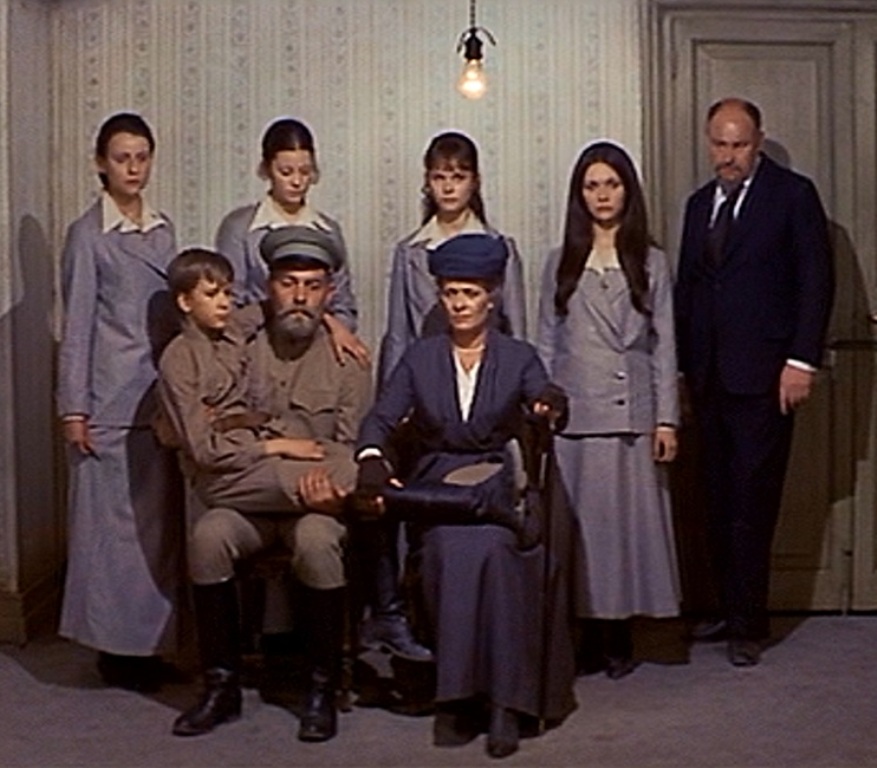
PHOTO: the final scene in the murder room is missing three people
[4] On the night of 16/17 July 1918, the family enter the murder room where two chairs are depicted against the wall. This is incorrect, the room was empty, and it was the Empress who requested the chairs: one for herself, the other for Alexei. The most blatant error in this scene, however, is that only nine persons are in the room: the Imperial Family and Dr. Botkin. There were in fact eleven persons in the room on that fateful night! Missing are Alexei Trupp, footman; Ivan Kharitonov, cook; and Anna Demidova, Alexandra’s maid. In fact, the latter three are not to be seen in the entire film!
As new generations of film buffs discover Nicholas and Alexandra, I can only hope that they will watch it with both an open mind and heart. That in this day and age of masses of information at their fingertips, that the film will inspire them to embark on their own personal quest for the truth.
I hope that they will read Massie’s book, but also other books, articles and documentaries. It must be noted that when Massie was researching for his bestselling book in the 1960s, his resources were very limited, his “facts” based on the information available to him at the time. Massie did not have access to the invaluable Romanov Archives in Moscow. Recall that it was Stalin who had these archives sealed, they were even forbidden to Soviet historians, with the exception of course, for propaganda purposes. The archives were only unsealed in the 1990s, at which time Massie completed his sequel The Romanovs: The Final Chapter, published in 1996.
The remaking of classic films seems to be all the rage these days, so perhaps a new film adaptation, one which will be worthy of Massie’s classic work. If so, the writers must refrain from adding fictitious nonsense to the script, relying on Massie’s research. And for authenticity, it must be filmed on location in Russia: in St. Petersburg, Tsarskoye Selo, Livadia, Tobolsk and Ekaterinburg.
© Paul Gilbert. 7 February 2025
 Nicholas II
You must be logged in to post a comment.