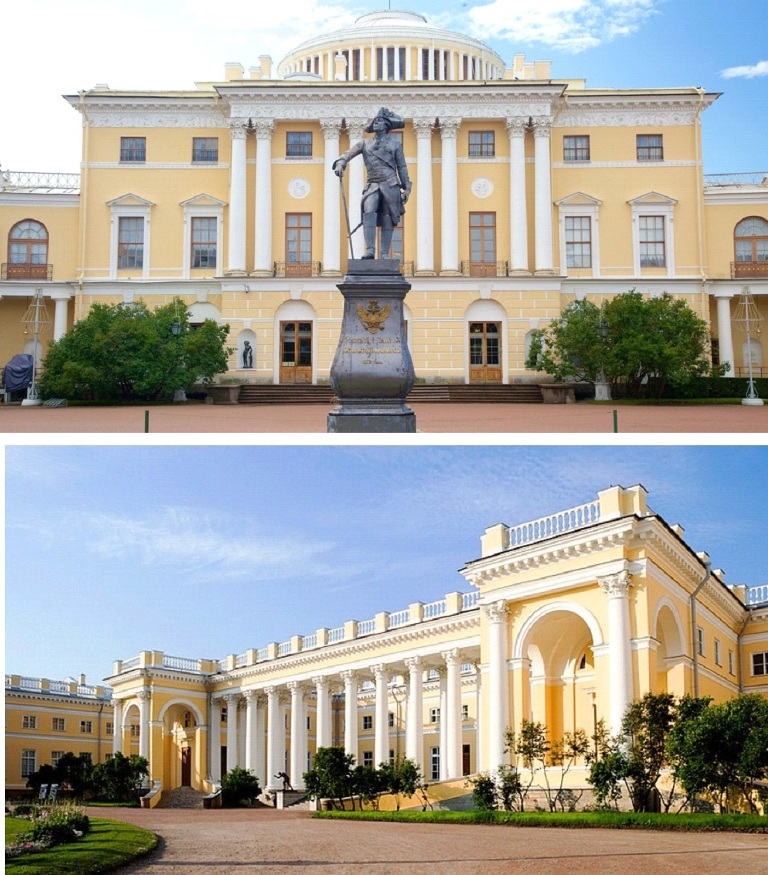
PHOTO: Pavlovsk Palace (top) and the Alexander Palace (bottom)
NOTE: this article was originally published on 18th February 2025, it was updated with additional information and photographs on 18th February 2026 – PG
In 1951, by a government decree, the Alexander Palace was transferred to the Ministry of Defense of the USSR. The Naval Department used the building as a top-secret, submarine tracking research institute of the Baltic Fleet.
Any hope of the Alexander Palace being reopened as a museum – as it was before the Great Patriotic War (1941-45) – were now lost. The palace’s collection, which consisted of thousands of items, and which had been part of the evacuated items held in the Central Depository of Museum Collections of Suburban Palaces-Museums, were at this point transferred to the Pavlovsk Palace State Museum.
From 1951, the Alexander Palace would remain strictly off-limits to visitors for the next 45 years. When it appeared that the Soviet Navy intended to vacate the complex, the Alexander Palace was included in the 1996 World Monuments Watch by the World Monuments Fund (WMF).
In the summer of 1997, a permanent exhibition dedicated to Emperor Nicholas II and his family was opened in the Eastern Wing of the palace. It was at this time that my annual Romanov Tour became the first group from the West to visit the interiors of the Alexander Palace.
Despite the exhibition, the rest of the palace remained under the administration of the Naval Department, who continued to occupy the Western Wing. It is due to their occupancy in this section of the palace, that very few of the original interiors and their elements survived.
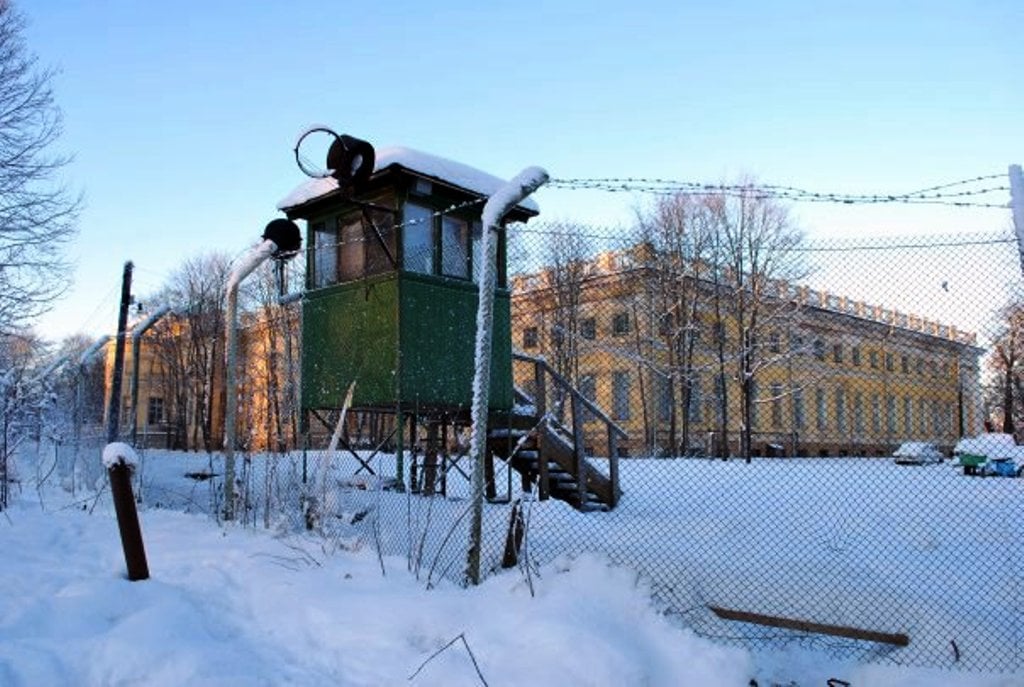
PHOTO: he Alexander Palace at Tsarskoye Selo, as it looked in the early 1990s, when the palace was still surrounded by a security fence and watchtower.
It was not until October 2009, according to the order of the Federal Property Management Agency, that the Alexander Palace was placed under the administration of the Tsarskoye Selo State Museum Reserve.
After an extensive restoration project which began in the autumn of 2015, the private apartments of Emperor Nicholas II and Empress Alexandra Feodorovna opened to public on 13th August 2021.
Visitors to the Alexander Palace can now tour 13 recreated interiors, : the New Study of Nicholas II, Moorish Bathroom of Nicholas II, Working Study of Nicholas II, Reception Room of Nicholas II, the Valet’s Room, PLUS the Maple Drawing Room, Pallisander (Rosewood) Living Room, Mauve (Lilac) Boudoir, Alexandra’s Corner Reception Room, the Imperial Bedroom, the Small and Large Libraries and the Marble/Mountain Hall.
In addition, 3 State Halls: the Portrait Hall, the Semi-Circular Hall and the Marble Drawing (aka the former Billiard) Room. were restored and opened to the public in July 2025.
Today, more than 6 thousand items from the funds of the Tsarskoye Selo State Museum-Reserve are displayed in the recreated interiors of the Alexander Palace.
In a recent interview with Art Newspaper Russia, the Director of the Tsarskoye Selo State Museum-Reserve Olga Taratynova talked about the restoration of the Alexander Palace and the reconstruction of the Private Apartments of Emperor Nicholas II and Empress Alexandra Feodorovna.
“The Alexander Palace suffered much less than the Catherine Palace,” said Taratynova. “Unlike the Catherine Palace, it was not destroyed by fire [as a result of shelling by the Nazis]. Instead, it endured a different fate. The Alexander Palace served as the residence of the family of the last Emperor, and it is a miracle that anything survived at all,” she added.
“For Alexander Pushkin’s anniversary in 1949, an exhibition dedicated to him was opened in the palace, and for this purpose, a number of interiors were lost. Soviet dogma of the time believed that Art Nouveau was a decadent style, citing no need to preserve it. And then the building was transferred to the Ministry of War. In 2009, when the Alexander Palace was transferred to us [the Tsarskoye Selo State Museum-Reserve], we quickly carried out “cosmetic repairs” in three of the State Halls and opened them to the public. But all the things were in Pavlovsk. They were transferred there in 1951, and have remained there ever since, Taratynova continued”
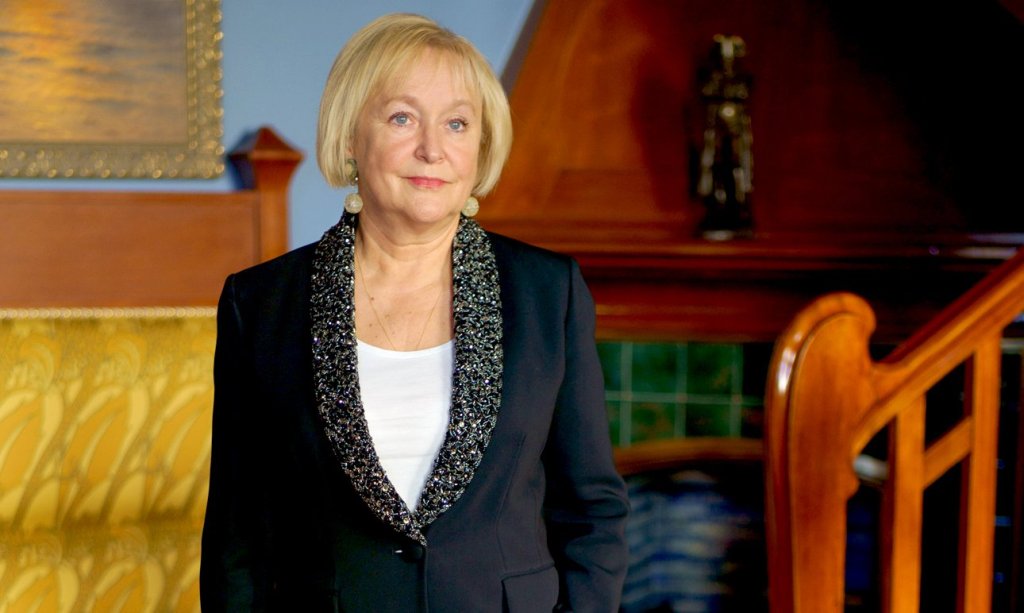
PHOTO: Director of the Tsarskoye Selo State Museum-Reserve Olga Taratynova
“In preparation for the reopening of the Private Apartments of Nicholas II and Alexandra Feodorovan in 2021, they [Pavlovsk State Museum] gave us about 200 items from their collection for “temporary use”. We knew from inventories and photographs, that these items originated in the Alexander Palace], and knew exactly where they were historically located. So I can’t complain, Pavlovsk assisted us. But they did not return everything, of course, because many of the items have been on display in Pavlovsk Palace for many years now.”
“Now in the Alexander Palace, we have tried to create the atmosphere of a beloved home. This was really the case – an intimate space, where Nicholas II invited only a small circle of close friends and trusted associates. And in the apartments of Alexandra Feodorovna and the children, only extended family members and devoted servants were allowed. We tried to focus on the atmosphere, we even added sound: in some rooms, for example, you can hear, the sounds of billiard balls, in others – a distant piano playing. There are also smells – first of all, the scent of lilacs, because Alexandra Feodorovna loved them very much, they now bloom in her rooms. We revived this tradition two years ago, our gardeners have been growing lilacs even in winter,” Olga Taratynova concluded.
***
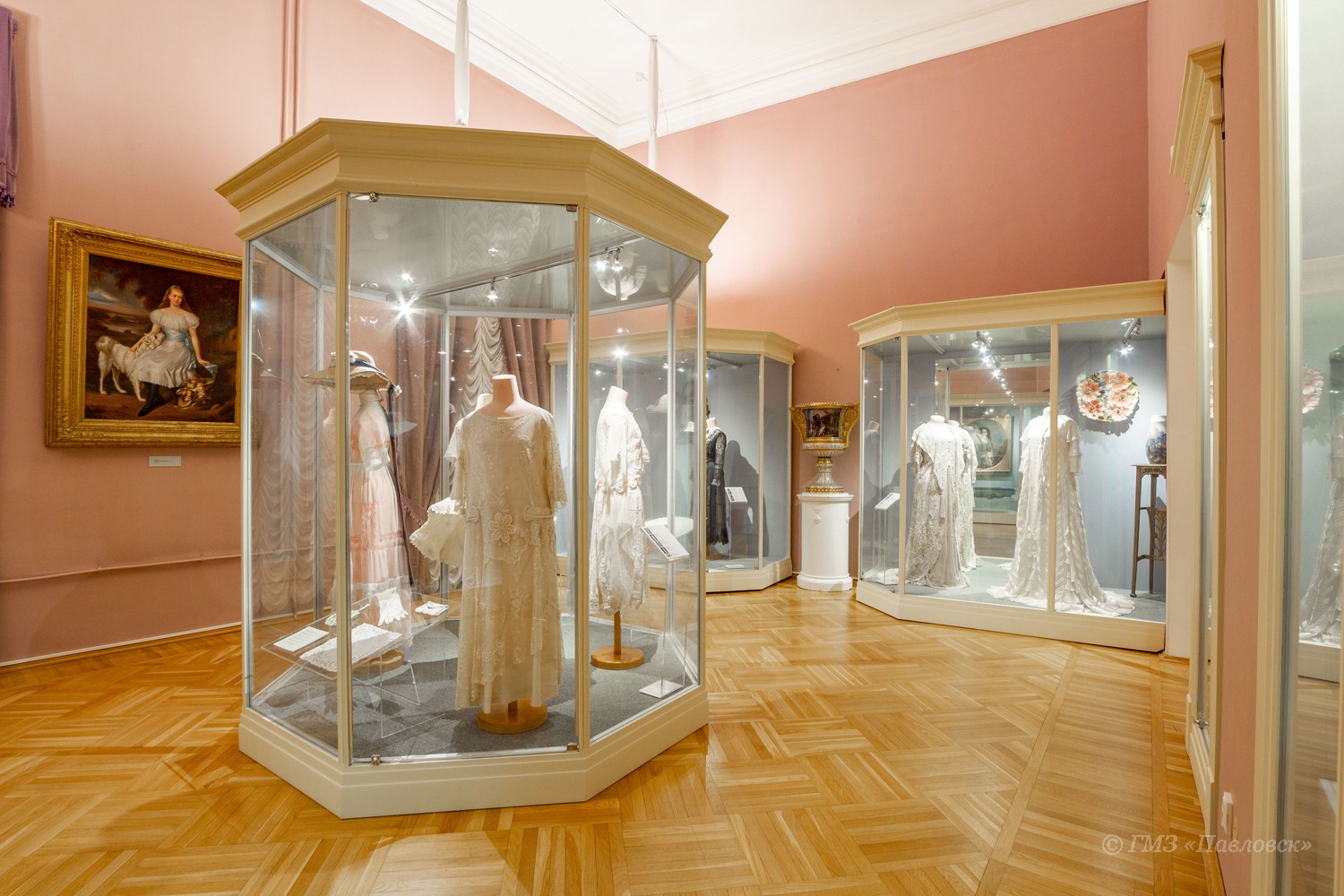
PHOTO: view of one of the halls of the Museum of Costumes in Pavlovsk Palace
In the 1990s, the “Museum of Costumes” was opened in the south wing of Pavlovsk Palace. Several small halls are filled with glass display cases showcasing authentic clothing and accessories which belonged to members of the imperial family during the late 19th to early 20th centuries.
Of particular note are the dresses and evening gowns worn by the Dowager Empress Maria Feodorovna [wife of Emperor Alexander III and mother of Emperor Nicholas II] and Empress Alexandra Feodorovna [wife of Emperor Nicholas II]. But, what is odd about these exhibits, is that neither Empress ever lived at Pavlovsk, these dresses and gowns originated from the Alexander Palace at Tsarskoye Selo.
Other glass display cases showcase many of the personal items which belonged to the two Empresses. These include fans from Dowager Empress Maria Feodorovna’s vast collection, plus elegant handbags, umbrellas, gloves, hats and other accessories.
One of the most interesting exhibits are two decorative kokoshniks [see photo below], which belonged to the Grand Duchesses Tatiana and Anastasia Nikolaevna, which again, originated from the Alexander Palace.
In addition, the third floor of Pavlovsk Palace is dedicated to the history of Russian furniture, featuring many items from the Alexander Palace, which were transferred there in 1951.
The author of this article has personally visited the Museum of Costumes and the furniture exhibit on two seperate occasions. It is interesting to note that no where in either exhibit, does it mention that the items on display originated or belong to the Alexander Palace at Tsarskoye Selo.
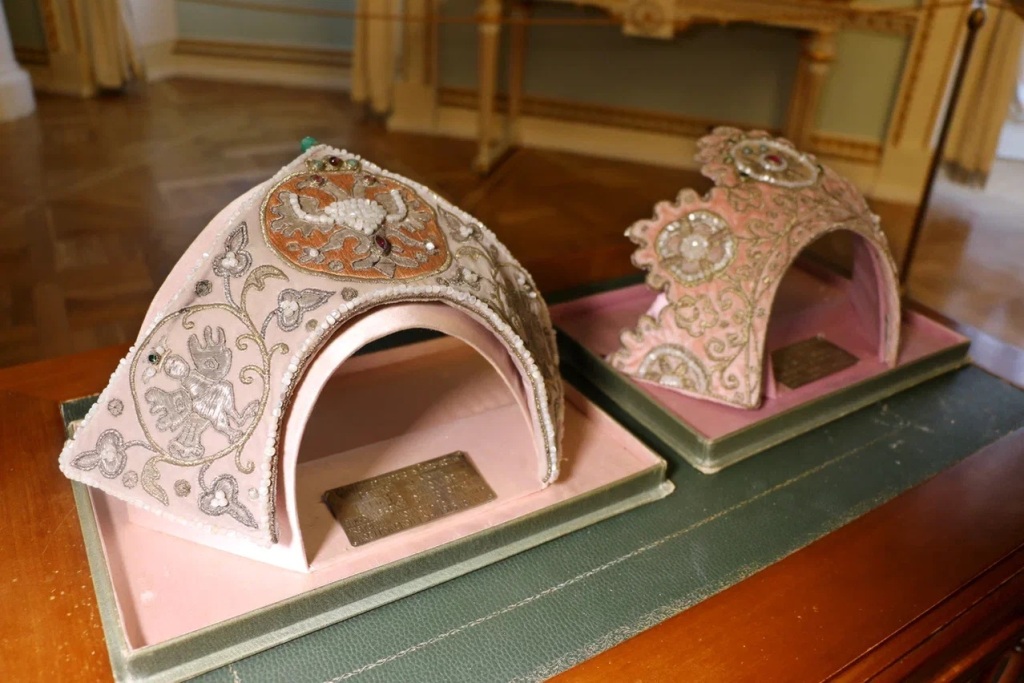
PHOTO: kokoshniks, which belonged to the Grand Duchesses Tatiana and Anastasia Nikolaevna on display in the Museum of Costumes at Pavlovsk Palace
***
Prior to the outbreak of the Great Patriotic War in 1941, the Alexander Palace housed more than 52.5 thousand items, of which more than 44.8 thousand items were lost [destroyed or stolen] between 1941 to 1945. From the 7.7 thousand items which survived, a significant part of the items are now in the collection of other museums in Russia. Among these were 5,615 items, which were moved from the Alexander Palace to the Pavlovsk State Museum Reserve in 1951. Of these, nearly 200 pieces were originally from the Alexander Palaces’ three ceremonial halls: the Portrait, Semi-Circular and Marble Halls. These include 39 pieces of porcelain, 41 paintings, 73 decorative bronze pieces, and 28 pieces of furniture.
Since the fall of the Soviet Union in 1991, and in particular since the restoration of the Alexander Palace, the return of these objects has been a bone of contention between the two palace-museums. During a visit to Pavlovsk several years ago, I raised the subject with one of the Directors [who shall remain anonymous] at Pavlovsk. “If we return these exhibits to the Alexander Palace, then we [Pavlovsk] will have nothing,” he declared.
Personally, this author believes that Pavlovsk have a moral responsibility to return all of the items transferred there in 1951. The history of these items is connected to the Alexander Palace, not Pavlovsk Palace. It seems that the current Minister of Culture of the Russian Federation Olga Lyubimova, should step in to right this historic wrong. Let us hope that she does the right thing, and order the return of the 5,615 items to the Alexander Palace, where they can be put on display in the rooms from which they originated.
© Paul Gilbert. 18 February 2025. Revised and updated 18 February 2026
***
Paul Gilbert’s Romanov Bookshop on AMAZON
Please CLICK on the PHOTO or LINK above to review my current selection of titles in hardcover, paperback and ebook editions. Listings provide a full description for each title, pricing and a Look inside feature.
 Nicholas II
You must be logged in to post a comment.