18th century Chandeliers returned to the Alexander Palace State Halls

PHOTO © Tsarskoye Selo State Museum-Reserve
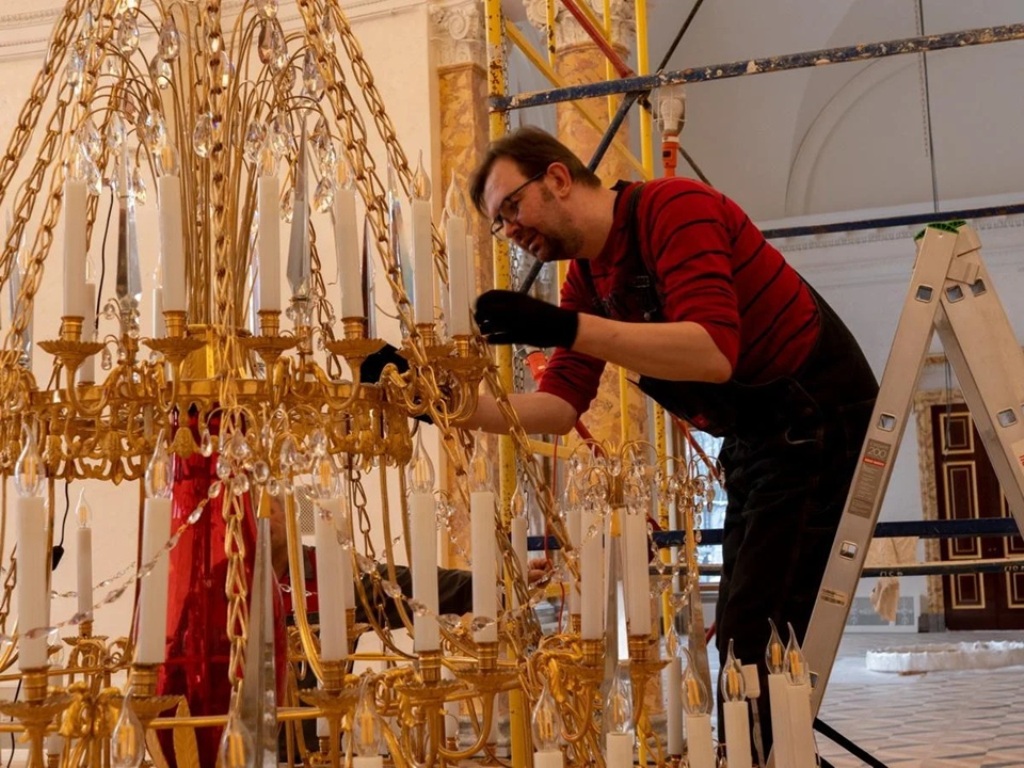
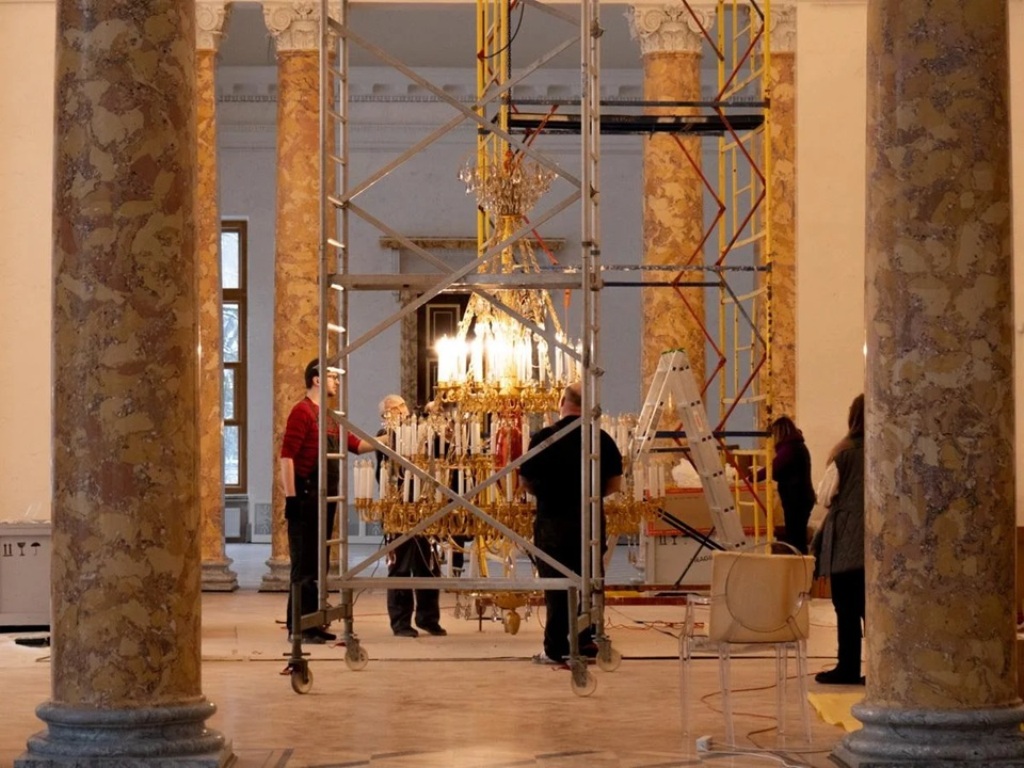
The restoration of the interiors of the Alexander Palace at Tsarskoye Selo continues . . . On 5th March 2025, three 18th century chandeliers were restored and returned to the palace’s beautiful ceremonial halls.
Recall that in 2012, “cosmetic repairs” were carried out in the Portrait Hall, the Semi-Circular Hall and the Marble (Billiard) Room. In June 2010, the State Halls, which are situated in the central part of the palace – between the east and west wings – were solemnly opened to visitors, as part of events marking the 300th anniversary of Tsarskoye Selo. However, despite the best efforts of curators, limited restoration funds, and dispersed collections, meant that the presentations were somewhat sparse and of varying quality. The State Halls were closed again in the Autumn of 2015 for additional restoration work, and reopened in 2021.
The three restored chandeliers were created according to a drawing by the famous Italian architect Giacomo Quarenghi (1744-1817), who constructed the Alexander Palace between 1792–96. The chandeliers were made of made of bronze, glass and crystal, and designed to hold 100 candles each. They are the largest and heaviest chandeliers in the museum’s collection and designed for such a large number of candles. Each chandelier stands 3.5 meters [11.5 ft.] high, and weighs more than 240 kilograms [530 lbs.]. The restoration work was carried out by specialists from the Yuzhakova Studio workshop in St. Petersburg.
PHOTOS © Tsarskoye Selo State Museum-Reserve
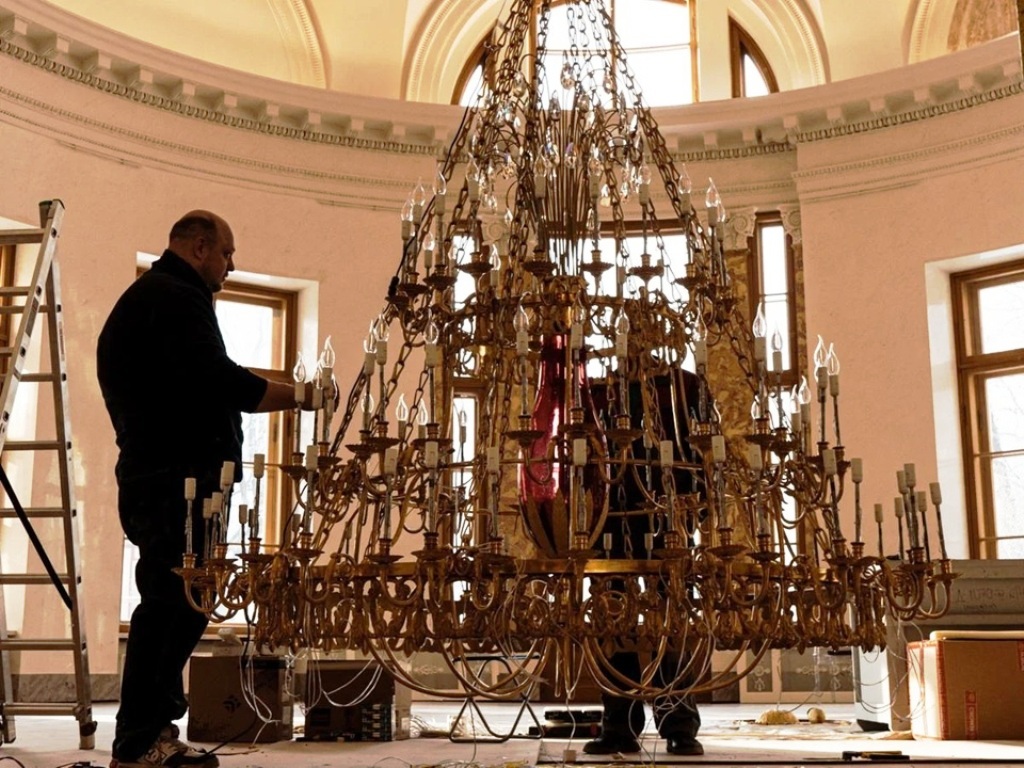
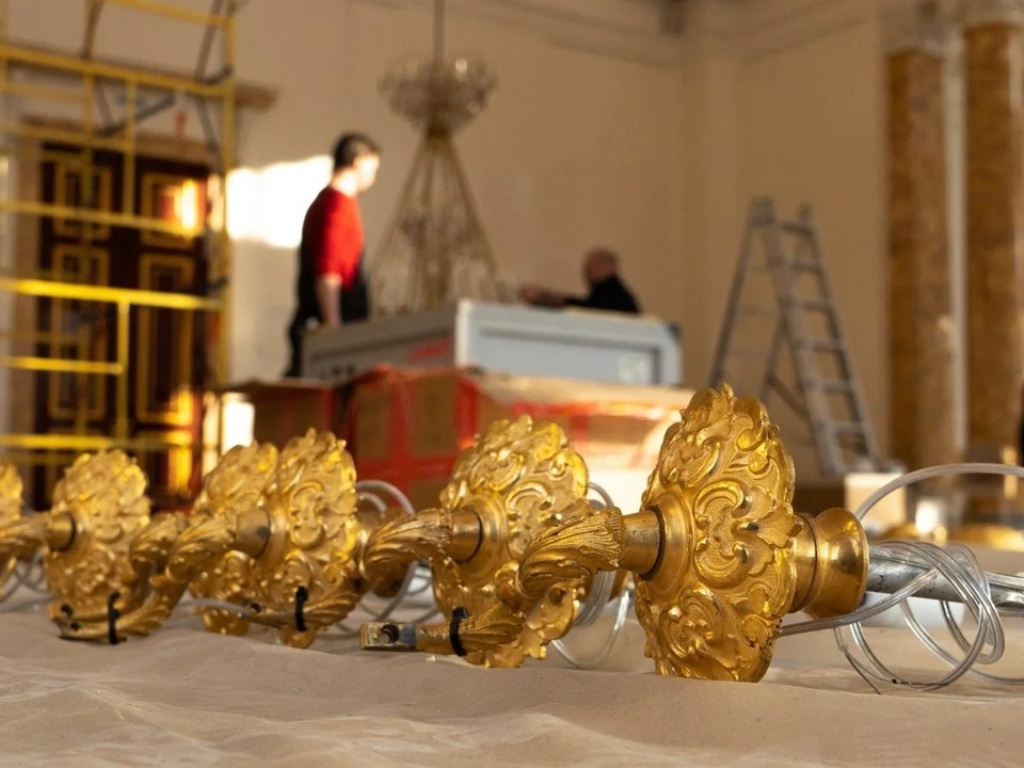
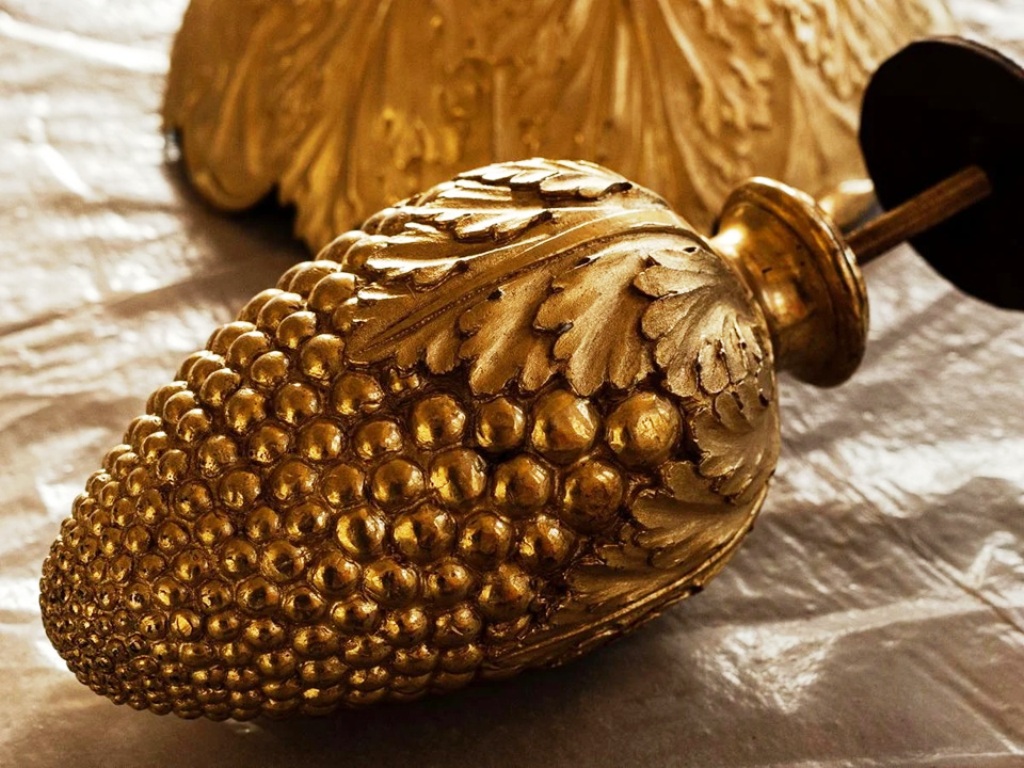
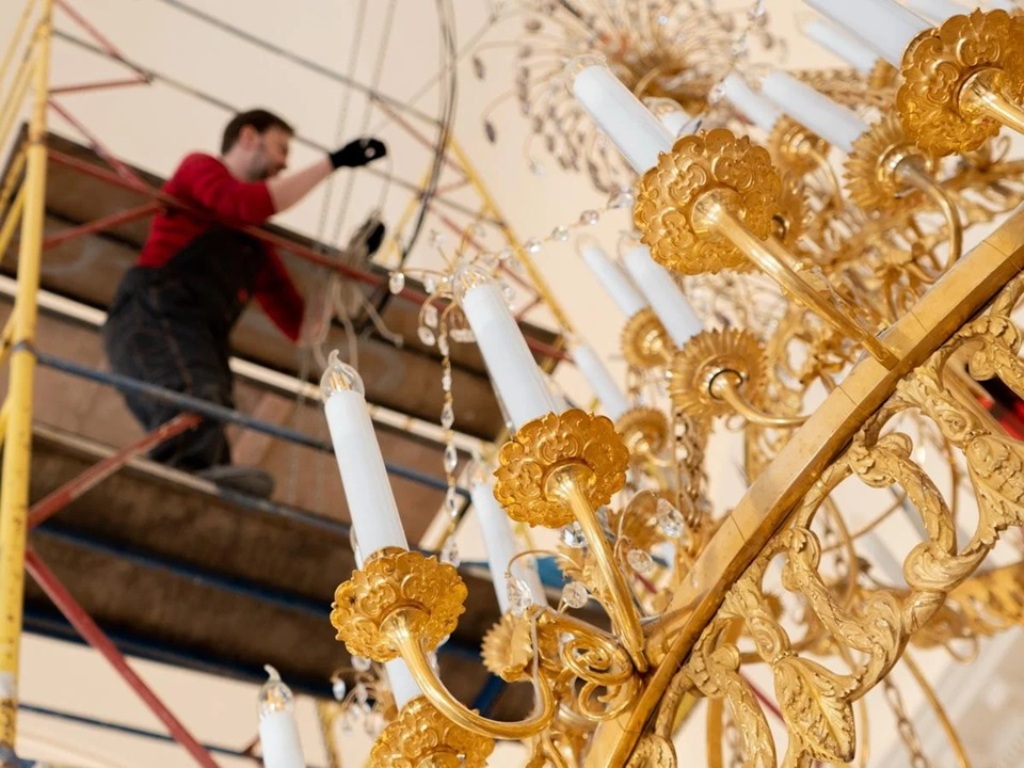
“In the process of work, the chandeliers were dismantled into parts and cleaned and polished. The restorers repaired bronze tears, cracks, caverns and filled in the areas of lost gilding. The missing parts were recreated according to existing analogues. If you look at these chandeliers, you will see that their crystal headdress is extremely rich and diverse – they are generously decorated with numerous garlands, pendants, obelisks of different sizes and faceted rosettes. The craftsmen also restored the chips and made up for the losses on the central bulb of ruby glass. Working with such a fragile material, especially in such a volume, requires the utmost delicacy and skill,” said Ekaterina Stadler, curator of the Museum Metal Collection.
The restorers also replaced the old electrical wiring, the final touch was the manufacture of milk glass tubes imitating candles.
Initially, the chandeliers were created for the St. George Hall of the Winter Palace, but they were not installed at the time. The initial order called for eight chandeliers, however, only three were made by the Johann Zech bronze foundry in St. Petersburg. At the time, the chandeliers were made to hold 50 candles each. After the death of Empress Catherine II, her son Emperor Paul I ordered the chandeliers to be installed in the halls of his new residence – the Mikhailovsky [aka Engineers] Castle in St. Petersburg. Following the death Emperor Paul, the chandeliers were returned to the Winter Palace.
PHOTOS © Tsarskoye Selo State Museum-Reserve
PHOTOS © Tsarskoye Selo State Museum-Reserve
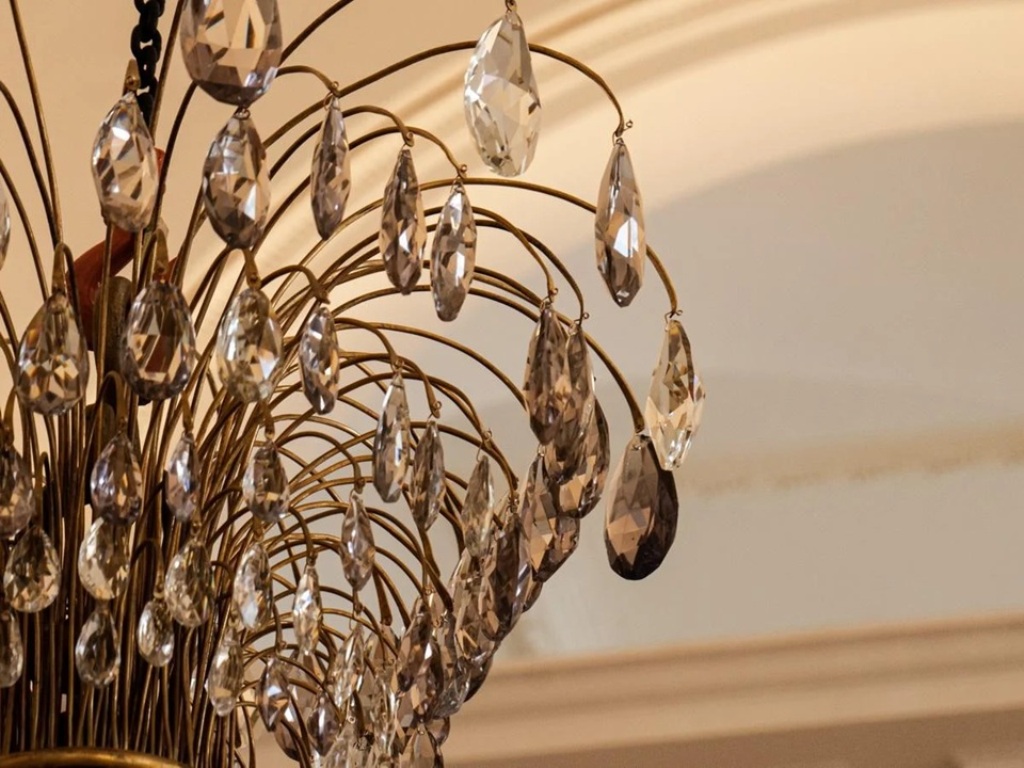
The chandeliers were transferred to Tsarskoye Selo in 1830. Russia’s first Minister of the Imperial Court, Pyotr Mikhailovich Volkonsky (1776-1852), wrote: “His Majesty the Emperor [Nicholas I] deigned to repair the four large chandeliers that were in the Concert Hall of the Winter Palace, and then send three of them to Tsarskoye Selo to Lieutenant General Zakharzhevsky <… > where they should be hung in a large drawing room or a large hall.”
The compositional basis of the chandeliers is a massive openwork rim with a glass tray at the bottom and a central stem with ruby glass balusters. The entire structure is attached on chains converging to a socket with a bump topped with a “fountain” with pendants. The combination of gilded bronze and the glare of crystal, especially when candles were lit, created an unusually decorative visual effect.
PHOTOS © Tsarskoye Selo State Museum-Reserve
PHOTOS © Tsarskoye Selo State Museum-Reserve
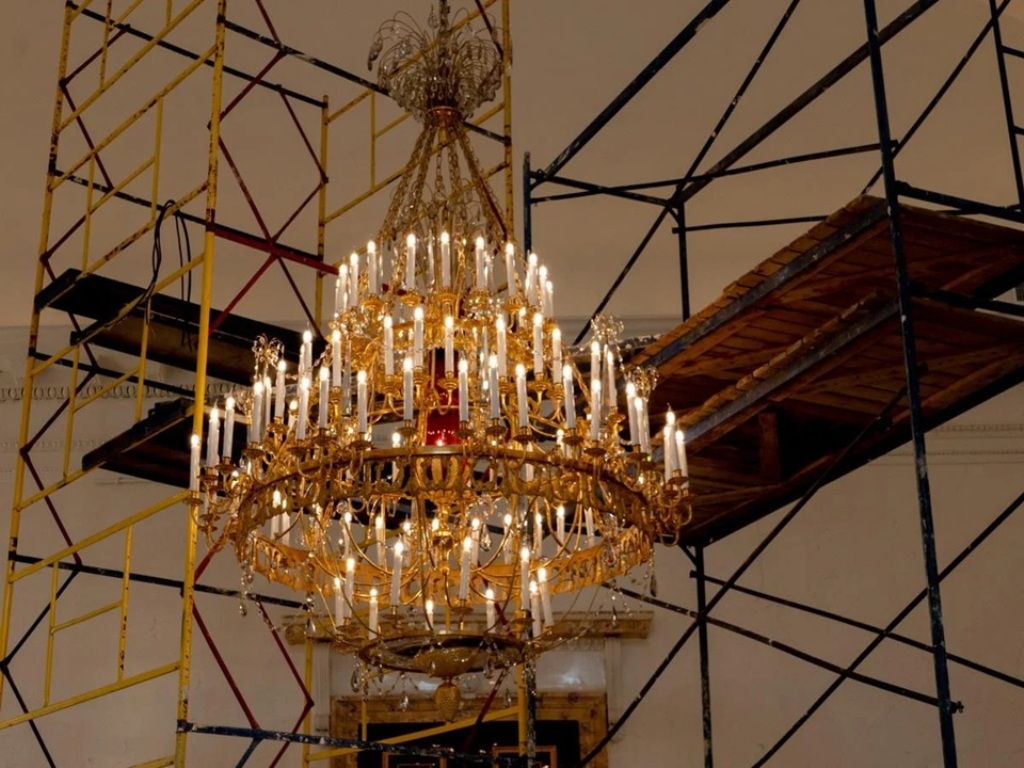
The chandeliers were placed in three halls of the ceremonial enfilade of the New (Alexander) Palace – the Semicircular and Portrait Halls and the Marble Drawing Room. In 1848, by order of Empress Alexandra Feodorovna, born Princess Charlotte of Prussia (1798-1860), 50 candle horns on two newly made thin hoops were added, bringing a total of 100 candles to each chandelier for better lighting. In the early 1900s – during the reign of Emperor Nicholas II – the chandeliers were electrified. During the Great Patriotic War [1941-45], the chandeliers were evacuated: one chandelier to Novosibirsk, two to Sarapul.
Recall that the first 13 interiors of the Alexander Palace – the personal apartments of Emperor Nicholas II and his wife Alexandra Feodorovna – opened to visitors in August 2021. In February 2023, work was completed in the Marble Hall with a slide. The restoration of the palace and its adaptation to modern use continues. In 2025, the Western wing of the palace is scheduled to open to the public.
© Paul Gilbert. 6 March 2025
 Nicholas II
You must be logged in to post a comment.