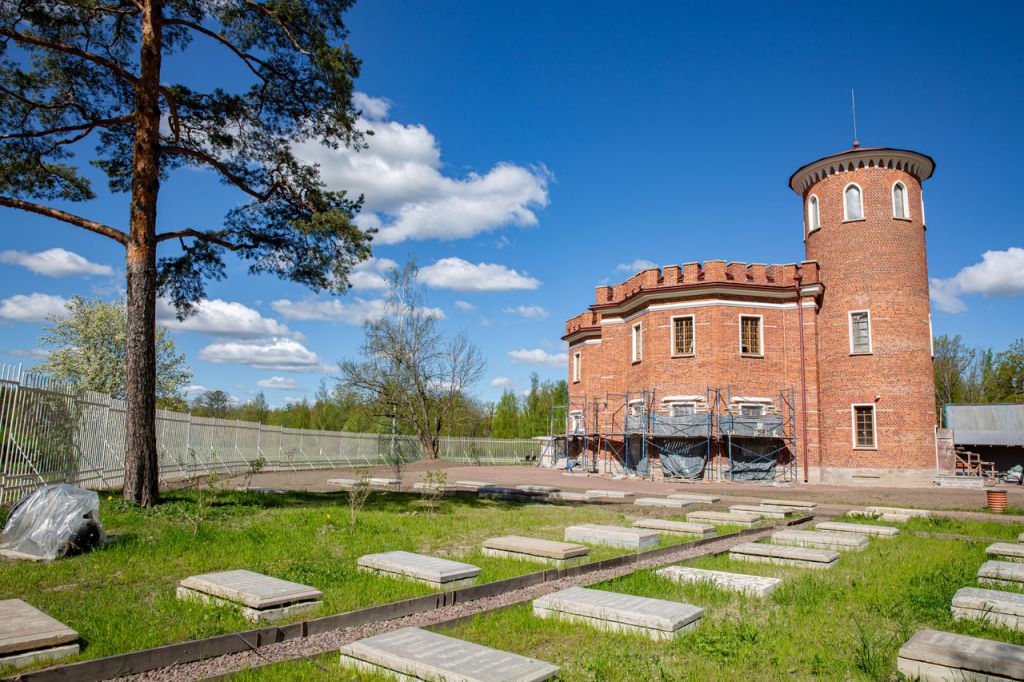
Photo: Press Service of the Tsarskoye Selo State Museum-Reserve
The Tsarskoye Selo State Museum-Reserve have announced plans to complete the restoration of the Pensioner’s Stable Pavilion and Imperial Horse Cemetery, situated in the Alexander Park. The opening is scheduled for the end of 2025.
“This is a unique place where you can study the history of horses that served the Russian emperors and empresses. We managed to research the names of the horses, and we will recreate nameplates for each of the graves. For the first time, the current generation will see this place as it looked during Tsarist times,” said the director of the museum Olga Taratynova.
The idea for an equine graveyard was conceived by Emperor Nicholas I (1796-1855) when he commissioned the Scottish-born architect and landscape designer Adam Menelaws (1753-1831), to build a retirement home for his favourite horses in 1826.
Between 1827-1830, Menelas constructed a red-brick gothic fantasy in an English style quite out of keeping with the baroque and Russian-style buildings found throughout the Alexander and Catherine Parks. The Pavilion included a single tower with rooms for the stable boys, and low, arched windows in the stables, through which the elderly horses could peer. There was room for eight horses to live out their pension years in peace. The old horses were allowed to walk about in the meadow during summer.
It was upon the death of his wife Empress Alexandra Feodorovna’s (1798-1860) beloved horse “Beauty”, which belonged to her for 24 years, that Emperor Nicholas I issued an imperial edict stating that the horse should be buried there. The cemetery became the final resting place for the horses of Emperors Alexander I, Nicholas I, his wife Alexandra Feodorovna, Alexander III and Nicholas II.
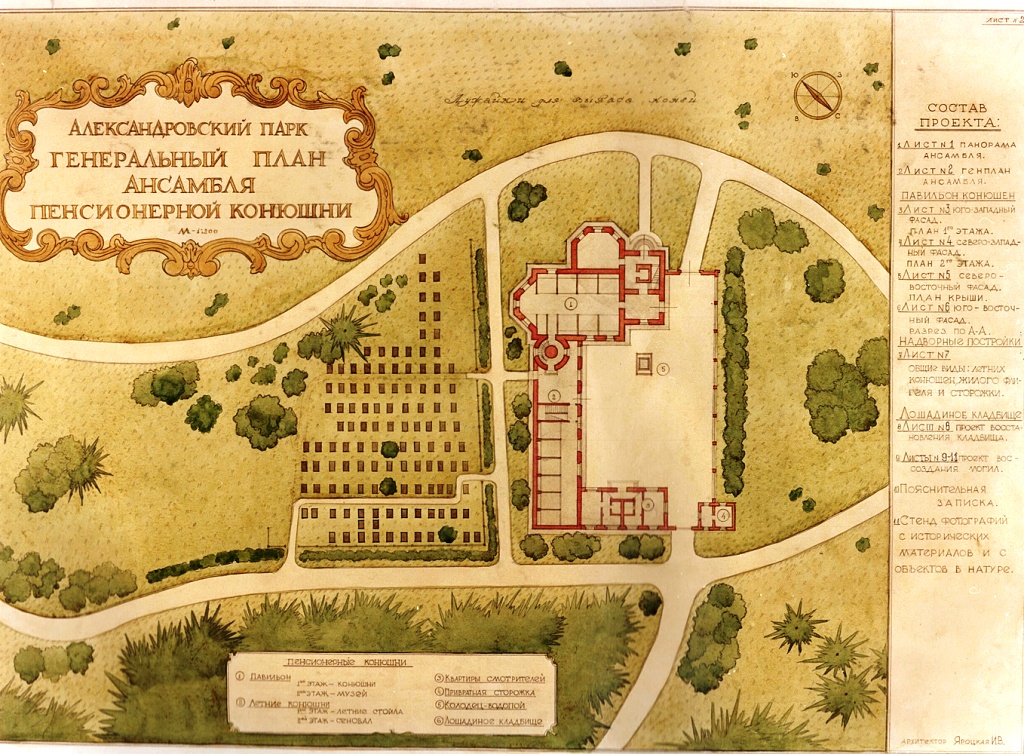
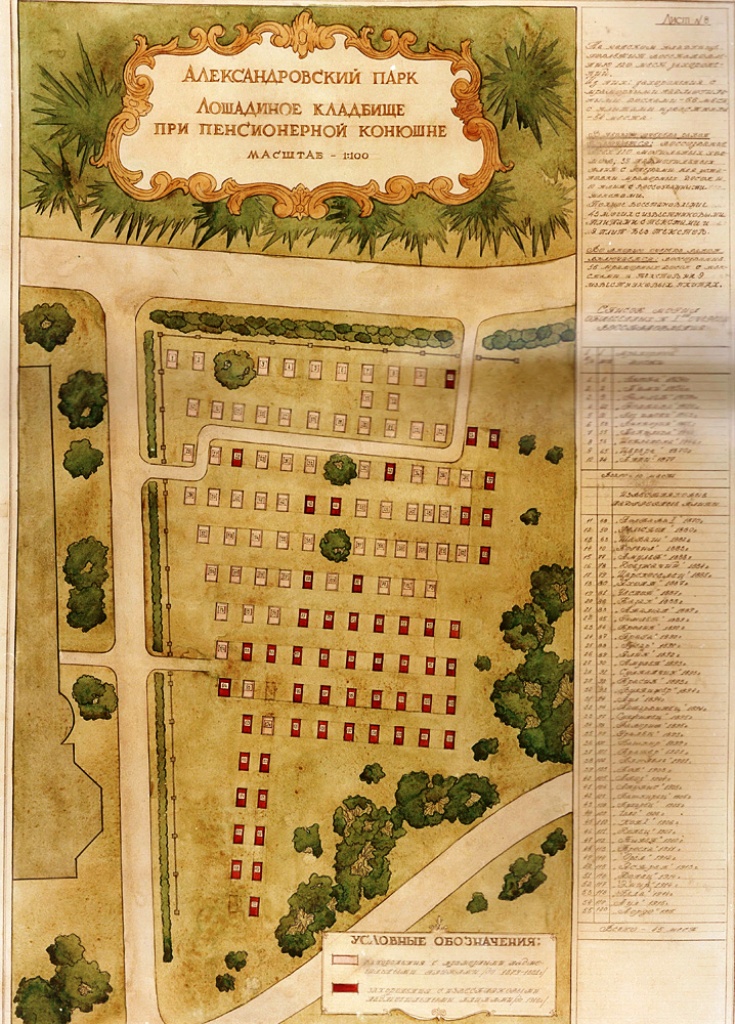
PHOTOS: 19th century drawings of the layout of the Pensioner’s Stable Pavilion and Imperial Horse Cemetery. The bottom drawing shows the graves (filled in red, with a number), the list on the lower right, gives the name of the horse buried in each grave.
Marble slabs mark the final resting places of the favorite horses of the Russian emperors and empresses. Here lies “L’Ami”, the horse on which Emperor Alexander I rode triumphantly into Paris at the end of the Napoleonic wars; “Flora”, the horse that carried the Emperor Nicholas I during the Siege of Varna in 1828; and “Cob” the horse, which the Emperor Alexander III used to ride, when he reviewed his troops.
In 1901, Emperor Nicholas II’s favourite horse “Bluebell”, from 1875, died at the age of 30. After her death, Nicholas II issued an edict for “Bluebell” to be buried in the Imperial Horse Cemetery.
In total, there are more than 110 graves in the cemetery. Each slightly larger than a human grave, the plots were originally decorated with gold leaf lettering. But the gilt paste has long since washed away as the headstones disintegrated over the years, due the harsh elements and from neglect.
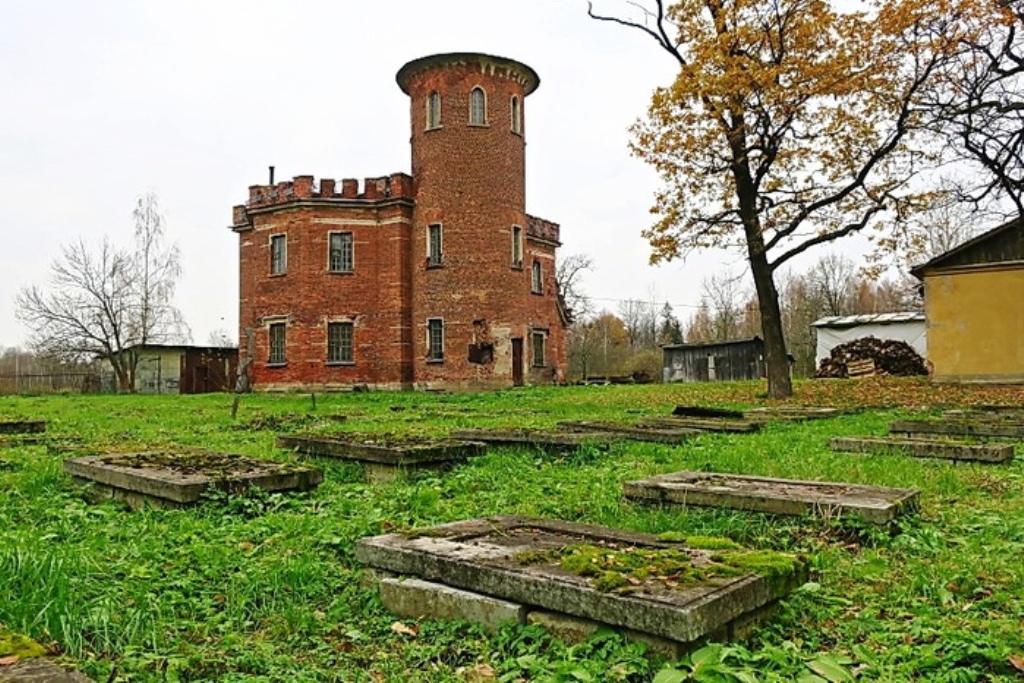
PHOTOS: For decades, the gravestones were barely visible beyond heaps
of crumpled junk metal, through a haze of long grass and spring flowers.
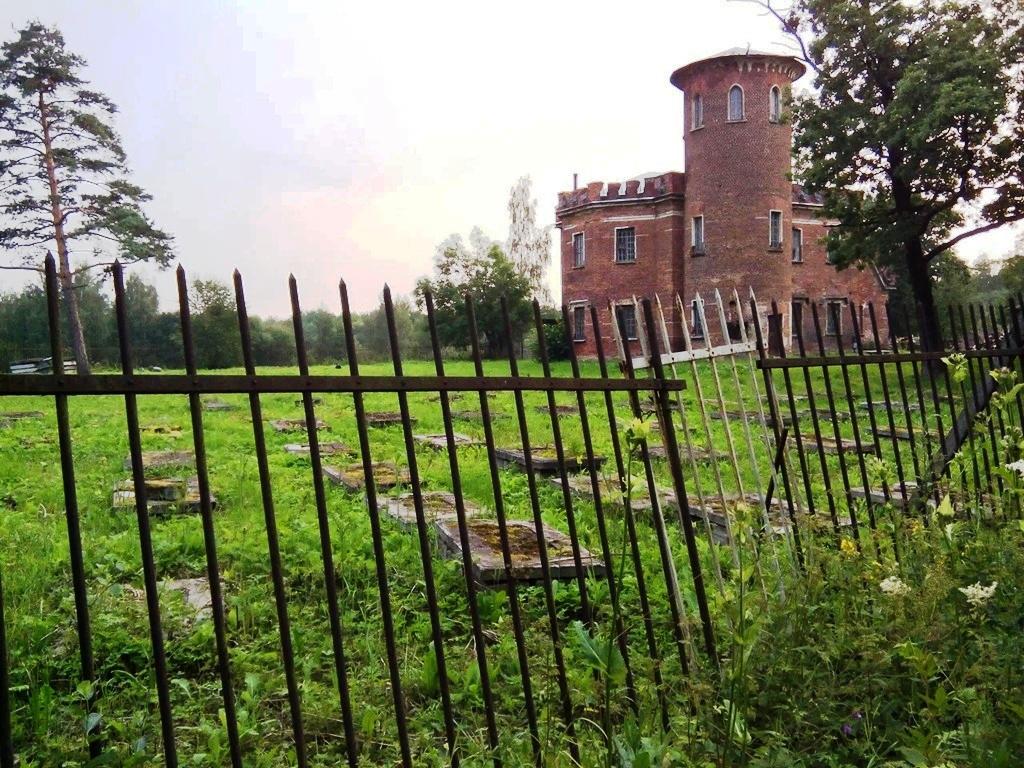
Following the 1917 Revolution, the Bolsheviks used the Imperial Horse Cemetery for propaganda purposes, citing the exaggerated nonsense – which the Bolsheviks were famous for – that the Romanovs treated their horses better than they did the peasants.
During the Great Patriotic War (1941-45), the stable building was slightly damaged, and over time it fell into disrepair. For decades, the gravestones were barely visible beyond the broken iron fences, heaps of crumpled junk metal, and through a haze of long uncut grass and weeds. There were calls for the pavilion and cemetery’s restoration, but with so many of the city’s more mainstream museums in desperate need of funding, the Pensioner’s Stable Pavilion and horse cemetery was not considered a priority.
In 2001, work began on the excavation of some of the graves. Money had been raised abroad by French writer Jean-Louis Gouraud [b. 1943], who was so intrigued by the cemetery when he first saw it that he dedicated himself to campaigning for its restoration. Nearly $400,000 USD was raised. “It is an incredibly important historical site because it tells us so much about the Imperial Family, who loved their horses,” he said.
Work was temporarily halted, due to lack of funds, however, work resumed in 2019, when a comprehensive restoration project funded by the museum began. The facades of Pensioner’s Stable Pavilion were restored, general construction work was carried out, utilities and joinery elements were recreated.
In 2025, the restoration of the layout of the Imperial Horse Cemetery and tombstones began, as well as the recreation of marble nameplates with inscriptions for each grave will be completed.
After the restoration is completed, a new museum dedicated to the Imperial Horse Stable and Cemetery will open in the Pensioner’s Stable Pavilion. Among the exhibits will be a decorative harness and its festive trimmings for a donkey and cart presented to Tsesarevich Alexei Nikolaevich, by the Italian King Victor Emmanuel III (1869-1947) and his wife Queen Elena (1873-1952), during the visit of Nicholas II to Italy in October 1909.
© Paul Gilbert. 24 May 2025
 Nicholas II
You must be logged in to post a comment.