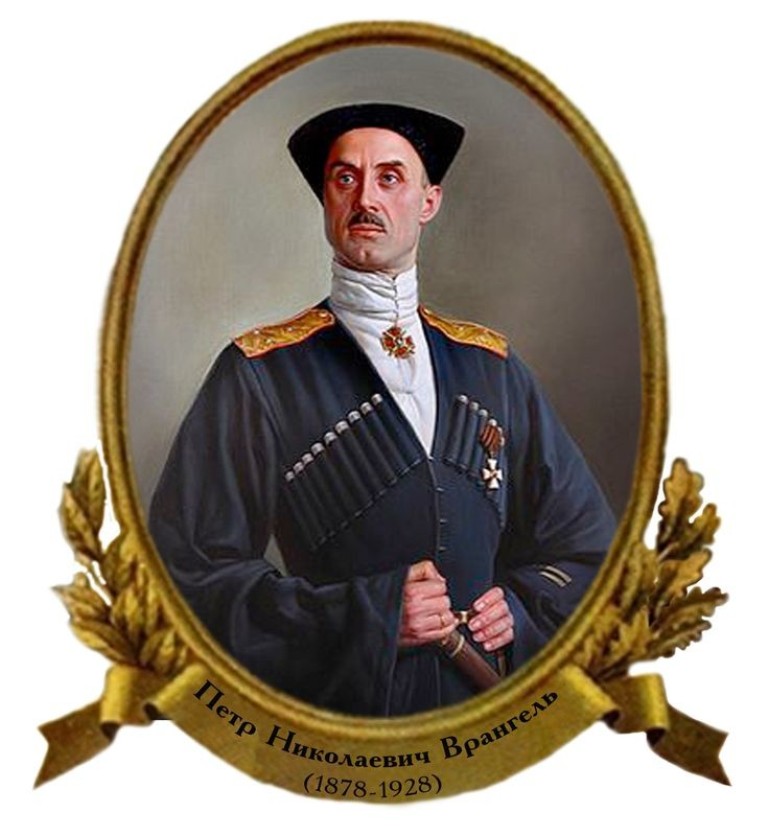
PHOTO: General Pyotr Nikolayevich Wrangel
General Pyotr Nikolayevich Wrangel (1878-1928) was a prominent military leader, who served under Emperor Nicholas II. Wrangel was an officer of the Tsarist army and rose to the rank of major general. He took part in the First World War, where he proved himself as a brave and talented military leader, for which he was awarded the Order of St. George, 4th Class.
Unlike many other Tsarist generals, Wrangel did not play a role in the March 1917 conspiracy against Nicholas II. After the abdication of the Emperor and the outbreak of the Russian Civil War, Wrangel commanded the Volunteer Army and then the White Russian Army in the south of the country, which fought against the Bolsheviks.
Pyotr Nikolayevich was a devout monarchist, and openly advocated the restoration of the monarchy. Wrangel believed that after the overthrow of the monarchy, Russia plunged into chaos, and only the restoration of the monarchy could restore order and greatness to the country.
Wrangel, like many other members of the White movement, sought to overthrow the Bolsheviks and restore the old order in Russia, including the monarchy. For Wrangel, the monarchy was not only a form of government, but also a symbol of historical Russia, its culture and traditions.
Wrangel did not support the idea of absolute monarchy, he advocated a constitutional monarchy, where the power of the monarch would be limited by law.
Wrangel, having been defeated by the Red Army, was forced to leave Russia. His actions in the Civil War, which did not lead to the victory of the White movement, left a significant mark on 20th century history. In 1920, he took part in the Russian Exodus, in which more than 145,000 White Russian soldiers and civilians went into exile.
Wrangel first lived in Constantinople and then Serbia, where he came to be known as one of the most prominent White émigrés. In 1927 he relocated to Brussels and died a year later, at the age of 49. On 6th October 1929 his remains reinterred in the Church of the Holy Trinity, the Russian church in Belgrade, Serbia, according to his wishes..
***
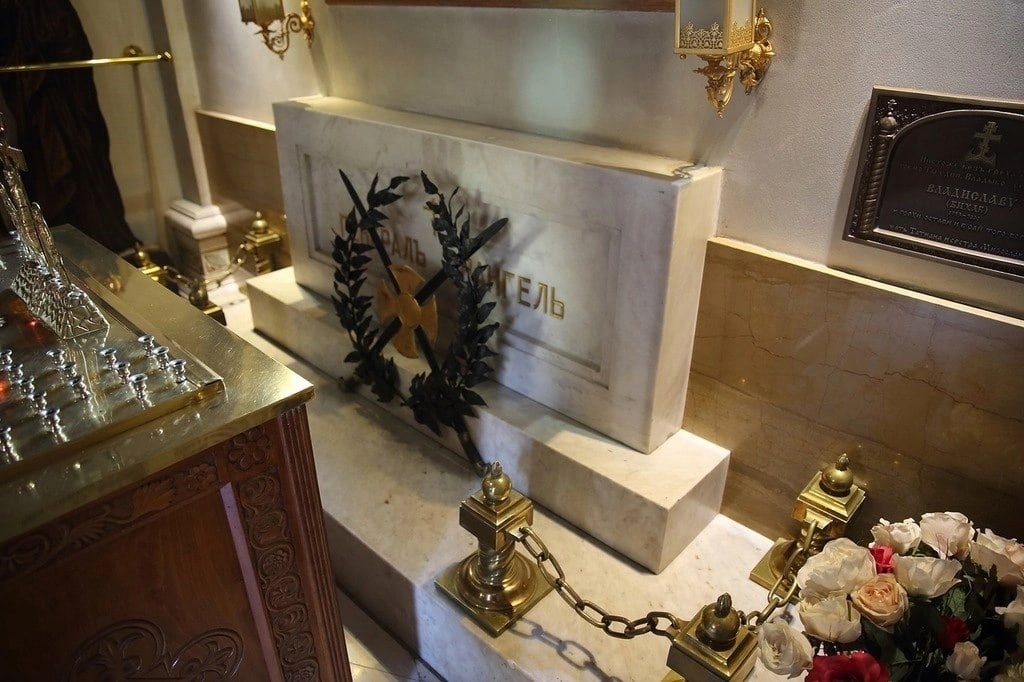
PHOTO: the grave of General Wrangel in the Church of the Holy Trinity, Belgrade
In 2007, Sergei Zuev, head of the Foundation for the Perpetuation of the Memory of the Victims of Political Repression in Moscow, sent a letter to General Wrangel’s grandson Pavel Bazilevsky, with a proposal to transfer the general’s remains to Russia. In response, Bazilevsky wrote a powerful and admirable letter, in which he decries the Russian Revolution and Bolshevism, noting that his grandfather’s remains will not be returned to Russia until such time as the remains of Lenin and Stalin’s are removed from the Kremlin walls.
Dear Sergey Sergeevich!
“Thank you for your letter of 29th January 2007 with a proposal to rebury the remains of General Baron Pyotr Nikolaevich Wrangel in the Donskoy Monastery in Moscow. Our family is deeply touched by your appeal and the realization that the desire of thousands of other Russian people support your proposal. Your proposal made us think about the meaning and expediency of such a step, weighing all the pros and cons in order to give a serious, reasoned answer and explanation.
“It is known that the main feature of General Wrangel’s character was his adherence to principles. He fought against Bolshevism and the vicious system it engendered, not out of a sense of class hatred, but out of a deep conviction that Bolshevism was an absolute evil, both for Russia and for humanity as a whole.
“Over the past two decades, there have been tremendous changes in the consciousness of Russians regarding the essence of Bolshevism and Soviet power. However, the main issue remains, and that is the condemnation of this evil at the state level. As a result, the ferment in people’s minds continues, the consequence of which is such a state of affairs that in public opinion polls in recent years, almost half of the population of Russia believe that Stalin remains a popular personality.
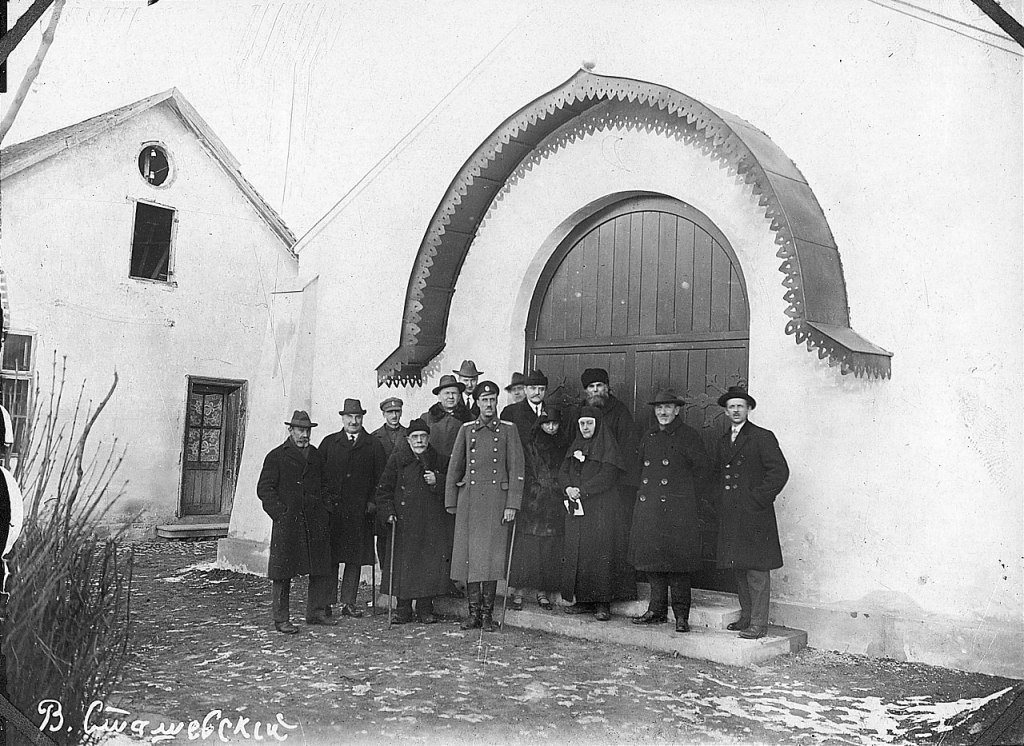
PHOTO: Wrangel outside the Church of the Holy Trinity, Belgrade. 1924
“General Wrangel died in Brussels in 1928, but more than a year later, by his own will, expressed during his lifetime, he was buried in the crypt of the Russian church in Belgrade. There he rests to this day, and not far away, in the cemetery, lie thousands of colleagues, ranks of his army, infinitely devoted to him, to whom he also gave his last strength. This mutual trust between the commander-in-chief and his subordinates has no limits – it is not limited either by his death or by the passage of time. Both in life and in death, he is in the ranks, together with his officers, soldiers and Cossacks. To transfer his remains now – alone – for reburial in Moscow, to take him from the ranks of his subordinates devoted to him (and their descendants devoted to his memory), is possible only for a very good reason. Had he lived, it is unlikely that he himself would have agreed to leave his army for the honour of being buried in Moscow, knowing that Lenin and Stalin still occupy an honourable place there next to the Kremlin.
“General Wrangel’s last words on Russian soil in 1920 were about his fulfillment of duty to the end. As the memory of General Wrangel lives in us, his descendants, so does the memory of his comrades-in-arms, to whom the duty and testament of the Commander-in-Chief of the Russian Army will not be fulfilled as long as the mausoleum on Red Square and the remains of the Red Executioners remain within the walls of the Kremlin.
I recall the funeral sermon of Archpriest Vasily Vinogradov, who said at his grave back in 1928, in Belgium: ‘Kissing his sacred remains, let us promise to kindle in ourselves the never-dying love for the destitute homeland and the sacred fire of irreconcilability to the satanic, atheistic regime, without making any compromises or agreements, no matter who they come from. One must live in peace, says St. Theodosius, with one’s enemies, but not with God’s.’
“Appreciating your sincere initiative, we regret with a heavy heart that the time for the reburial of General Wrangel in his homeland has not yet come. General Wrangel was and remains for many a symbol of an irreconcilable, principled struggle. For all their historical significance, neither [Anton] Denikin nor [Vladimir] Kappel is treated in such a way among his subordinates and even among his enemies as a general Wrangel, never was. To this day, the emigration honours his memory and the ideals for which he fought. His struggle is not over, and his premature reburial will only detract from the significance of the feat and sacrifices, both of Wrangel himself and of all the White warriors who gave their lives for the good of Russia.”
Pyotr A. Bazilevsky
© Paul Gilbert. 26 June 2025
 Nicholas II
You must be logged in to post a comment.