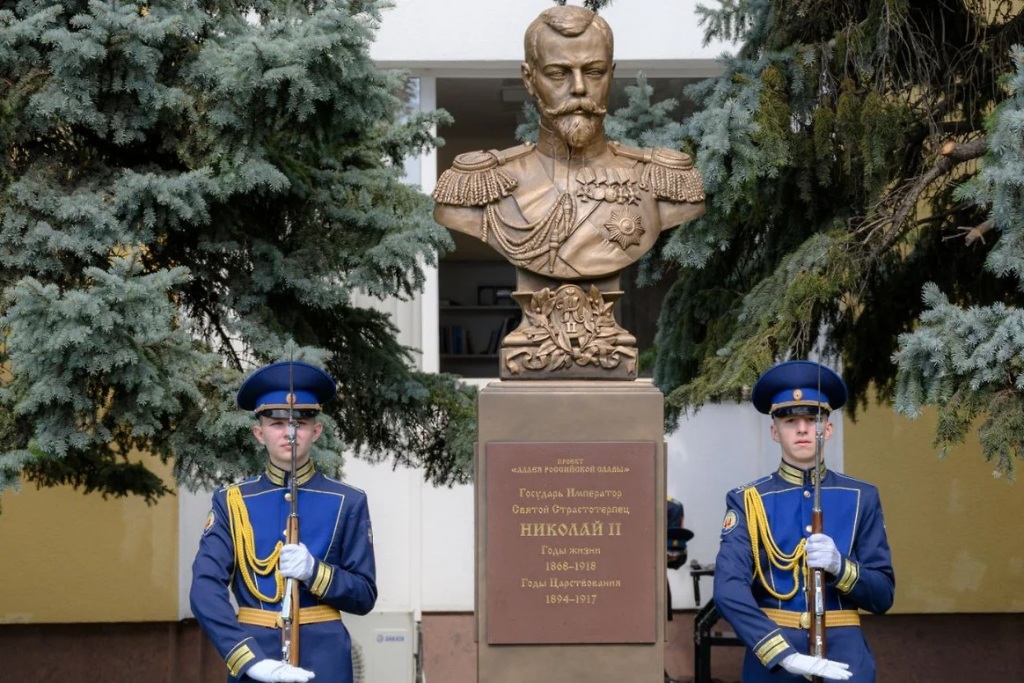
PHOTO: cadets from the Krasnodar Presidential Cadet School form a guard of honour during the opening ceremonies of a new monument to Emperor Nicholas II in the “Cossack city”
On 21st September 2025, a new bust-monument of Emperor Nicholas II was installed and consecrated on the grounds of the Presidential Cadet School In the Russian city of *Krasnodar. The bust is a copy created by the famous Russian sculptor is Alexander Alekseevich Apollonov (1947-2017).
*Krasnodar is known as the “Cossack city”. Founded in 1793 as a fortress city by the Black Sea Cossacks, it has a rich history tied to the Cossack culture. The city was originally named Yekaterindar, meaning “Catherine’s Gift,” and later renamed Krasnodar, which translates to “Red Gift,” reflecting the city’s imperial past and the Cossack identity. Today, Krasnodar retains its connection to the Cossacks through various historic sites and cultural events.
The opening ceremony was attended by the Lieutenant General of the Foreign Intelligence Service
Leonid Reshetnikov, Vice-Governor of the Krasnodar Territory and Ataman of the Kuban Cossack Host Society Alexander Vlasov and Minister of Culture of the Krasnodar Territory Victoria Lapina.
Also in attendance were Chairman of the Elisabeth-Sergius Educational Society Foundation (ESPO) Anna Vitalievna, and representatives of the Heritage of the Empire movement, and the leadership of the Presidential Cadet School, city officials, among others.
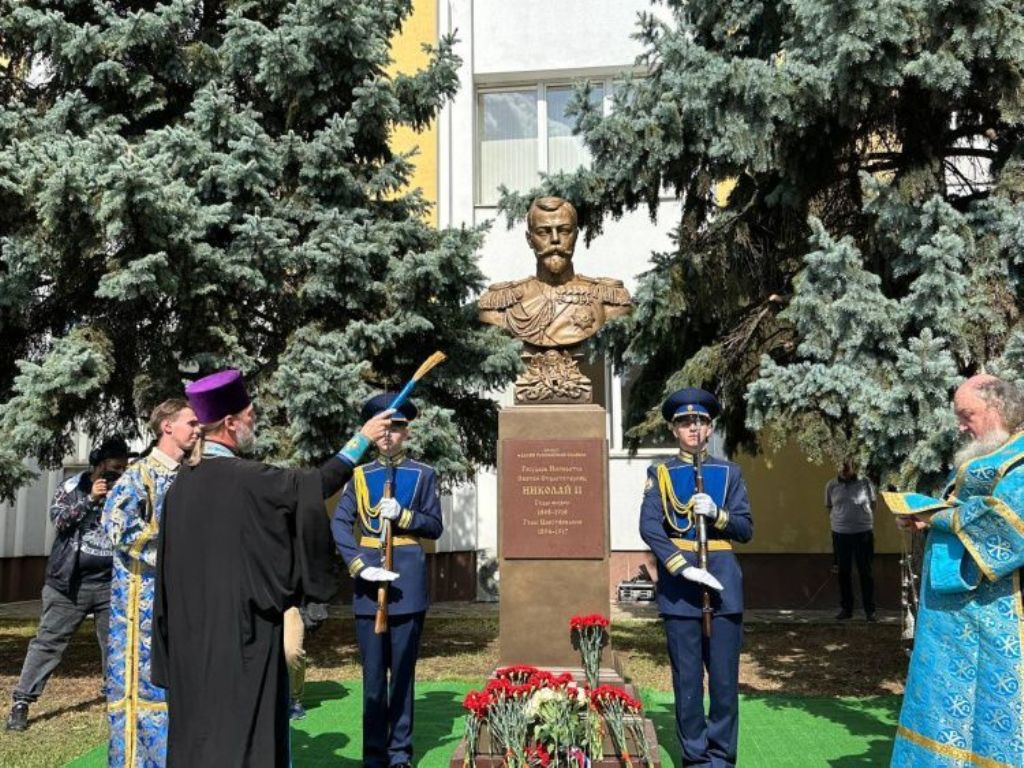
PHOTO: a local Orthodox priest performs the act of consecration on the new monument to Emperor Nicholas II in Krasnodar
The bust was installed as part of the historical and cultural project Imperial Route, which the Krasnodar Territory joined in August 2025. The solemn event included the laying flowers at the monument and the school’s cadets taking part in a solemn march past the monument, along the parade ground.
The Imperial Route project now unites 32 regions of Russia and is aimed at popularizing the history of the House of Romanov. As part of the route, other memorial plaques and sites have also been unveiled in the Krasnodar Territory, including the recent commemoration of the visit of Emperor Nicholas I to Gelendzhik in 1837.
Alexander Vlasov noted the importance of the memory of Nicholas II, emphasizing his contribution to the development of the country and his connection with the Cossack troops. Representatives of the the Kuban Cossack Host Society and invited guests stressed the importance of preserving historical continuity and educating young people on national history.
“The opening of the bust of the last emperor is our tribute to the history of Russia, to the Imperial Family,” said Alexander Vlasov. – I will also remind you that, from 1904, the August Heir of Nicholas II, Tsesarevich Alexei, was the Ataman of all Cossack troops and the honorary chief of several Cossack regiments and schools.
The history of the Kuban and the Cossacks are closely associated with the Russian Imperial family . . .
“In 1888, Emperor Alexander III, along with the heir to the throne Nicholas Alexandrovich [future Emperor Nicholas II] and other members of the Imperial Family visited Yekaterindar. Today, a restored Triumphal Arch, located on the main street in Krasnodar, is a reminder of the historic visit.
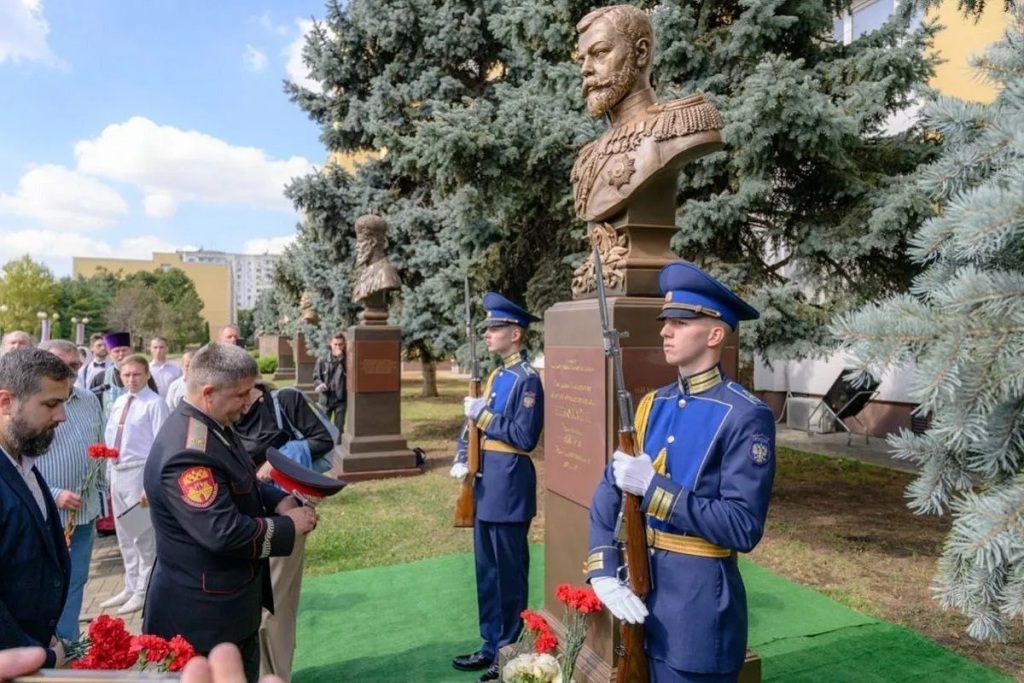
PHOTO: cadets from the Krasnodar Presidential Cadet School form a guard of honour during the opening ceremonies of a new monument to Emperor Nicholas II in the “Cossack city”
Since the fall of the Soviet Union in 1991, more than 100 monuments, sculptures, busts and memorial plaques to Nicholas II have been installed in cities and towns across the Russian Federation.
In July, busts of Nicholas II and Tsesarevich Alexei were temporarily placed in the city of Uryupinsk, Volgograd Region, during a commemorative event. Plaster sculptures were installed on the Alley of Heroes, where a monument to Joseph Stalin was located during the Soviet period. After the ceremony, the busts were dismantled.
Russia’s most famous monument to Nicholas II is the monument by Vyacheslav Mikhailovich Klykov (1938-2006) in the village of Taininskoye in the Mytishchi district of the Moscow region. The monument depicts the Emperor wearing his ermine trimmed Coronation robe with regalia and is located on the site of the former travelling palace, next to the ancient near the Church of the Annunciation (1675-1677. The monument has been blown up twice by extremists, each time restored.
© Paul Gilbert. 22 September 2025
 Nicholas II
You must be logged in to post a comment.