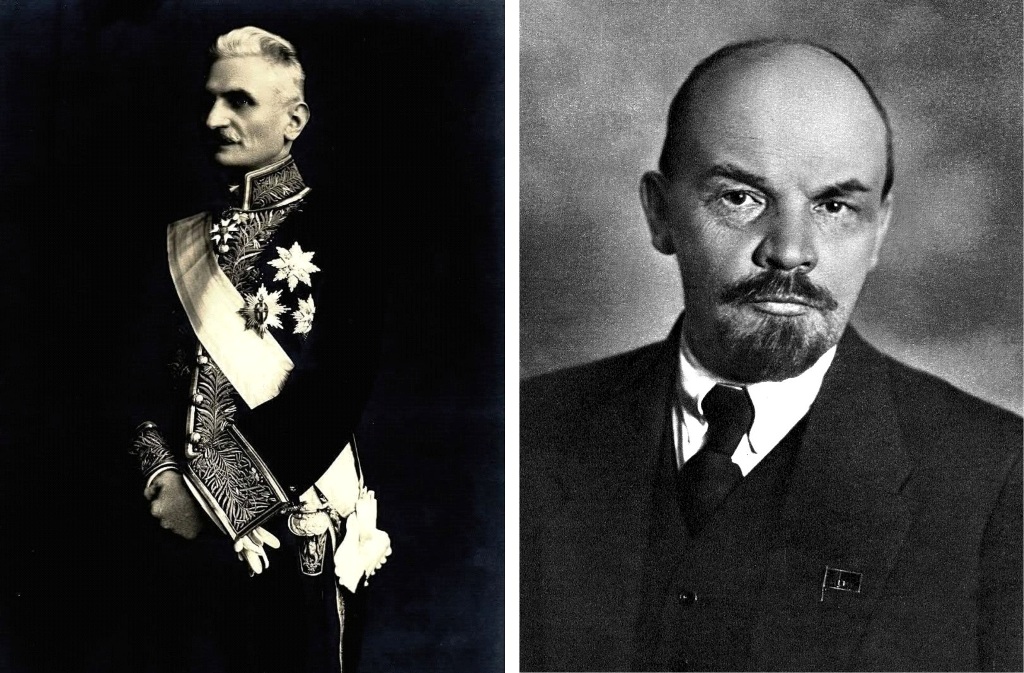
PHOTO: Serbian ambassador Miroslav Spalajković
and Bolshevik leader Vladimir Lenin
“He approached Lenin (1870-1924) and spat in his face,” said Prince Mikhail Grigorievich Trubetskoy (1873-1930) – regarding the incident of the Serbian ambassador Miroslav Ivanović Spalajković (1869-1951) with Lenin at a reception held in July 1918.
“Here I want to cite one fact, very interesting,,” said Trubetskoyt, “it was following the October 1917 Revolution, all the foreign diplomats remained in Petrograd [St. Petersburg]. Spalajković, who served as Serbia’s ambassador to Russia (1913-1919), also remained in Petrograd.
It was towards the end of July 1918, rumours began to circulate in Russia about the execution of the Imperial Family in Ekaterinburg.
Lenin periodically hosted receptions to which the foreign diplomats were invited. At the end of July, he arranged a small banquet. It was during this reception, that Lenin, said “despite the fact that Soviet power was now being pressed on all sides [by the Whites] from the north – by Yudenich, from the east by Kolchak, from the south by Denikin, that life was improving.”
He added that “at last, the capital was beginning to be swept and cleaned, new street lanterns were being installed, electric lighting was being improved, and a new shop had been opened for you, diplomats, where, I hope, you could buy absolutely anything.”
Lenin then stated: “Well, let’s go to the next room, where dinner has been prepared for you.” “Oh, yes,” Lenin suddenly recalled, “I had to tell you, but, in general, you all know this yourselves, that in view of the fact that Ekaterinburg was under attack by Kolchak’s army, we had to liquidate the the Tsar and his family. But you know very well about this, because rumours are circulating all over Petrograd and Moscow.”
Spalajković could not contain himself. He approached Lenin and spat in his face.… And silently with his secretaries, he left the hall, and the next day he left the Soviet Union, and returned to Belgrade.
“Discussion on this incident was immediately silenced,” said Trubetskoy. “The authorities concluded that Spalajković was mentally ill, an unrestrained and undoubtedly ill-mannered person. Despite this characterization, Spalajković was later a representative of the already large South Slavic state in Paris[1], where my father met him and asked if the incident with Lenin was true. Spalajković replied that he could not resist because he considered Lenin the greatest criminal of the century.”
To better understand the reasons behind Spalajković reaction towards Lenin. it is important to understand that for Serbians, Emperor Nicholas II is revered both as a saint and as a statesman, for his efforts in coming to Serbia’s aid during the First World War.
NOTES:
[1] In January 1919, a delegation from the Kingdom of Serbs, Croats, and Slovenes, better known as the Kingdom of SHS, arrived in Paris to seek recognition of its state at the international peace conference.
FURTHER READING:
Nicholas II through Serbian eyes + PHOTOS
“For us, Serbs, Nicholas II will be the greatest and most revered of all saints
Serbs honour Royal Martyrs with liturgy and procssion in Belgrade + VIDEO
 Nicholas II
You must be logged in to post a comment.