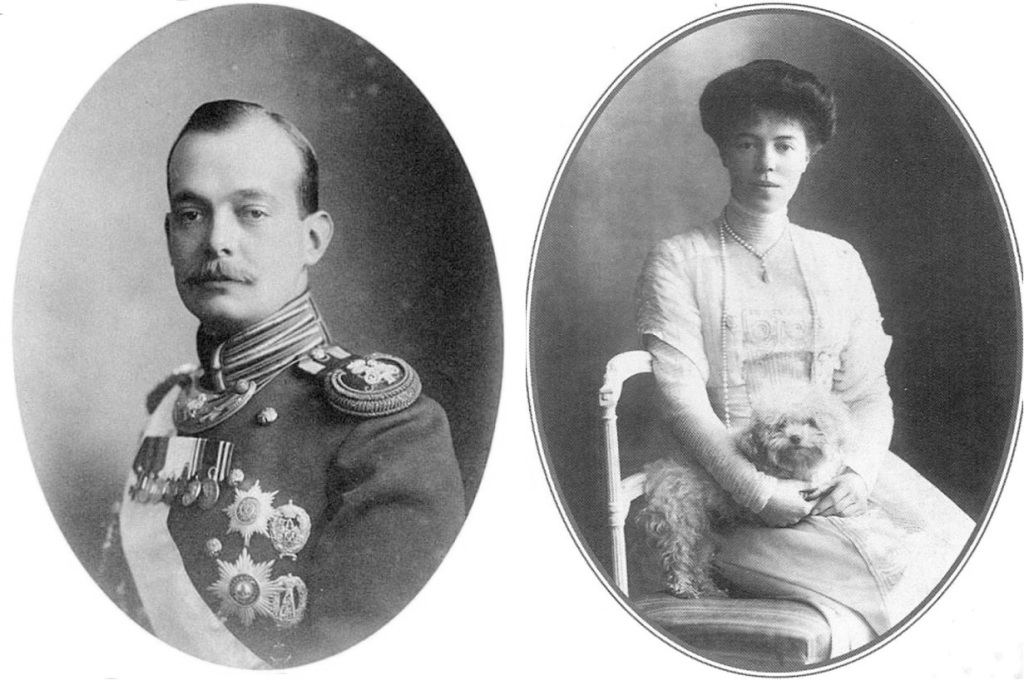
PHOTO: Grand Duke Andrei Vladimirovich and Grand Duchess Olga Alexandrovna
Upon the abdication of Emperor Nicholas II from the throne on 15th March (O.S. 2nd March) 1917, both the monarchy and the Russian Empire ceased to exist. Upon the death of Russia’s last tsar Nicholas II on 17th July 1918, the Russian Imperial Family ceased to exist. With that, the Laws of the Russian Empire and the Family Laws of the Romanov dynasty had no legal power. When the Bolsheviks came to power in October 1918, the surviving grand dukes, grand duchesses, princes and princesses of the Imperial Blood were reduced to ordinary citizens, many were executed, the lucky ones fled into exile.
For the former grand dukes and grand duchesses now living in exile in Berlin, Paris and even New York, their titles no longer guaranteed them any special rights or privileges.
The LAST Romanov grand duke and grand duchess were Grand Duke Andrei Vladimirovich (1879-1956) and Grand Duchess Olga Alexandrovna (1882-1960). Upon their respective deaths, there were to be no more grand dukes and grand duchesses of Russia.
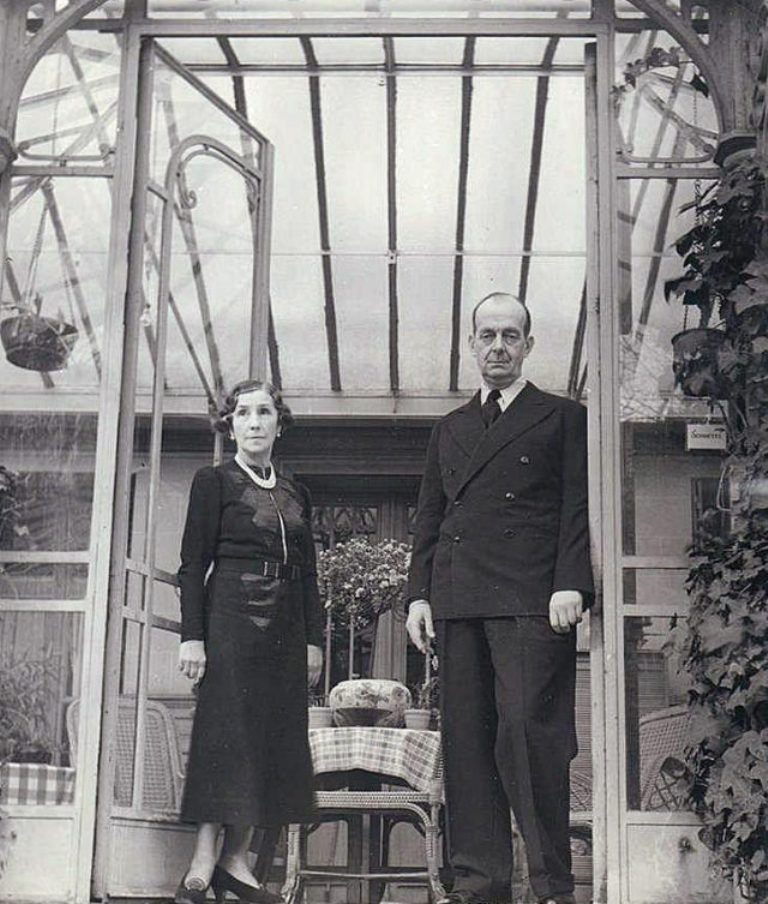
PHOTO: Grand Duke Andrei Vladimirovich with his wife Mathilde Kschessinska on the veranda of their Villa Molitor, located in the 16th arrondissement of Paris.
The last grand duke
The last grand duke of Russia was Grand Duke Andrei Vladimirovich (1879-1956)
Grand Duke Andrei Vladimirovich was born at Tsarskoye Selo on 14th (O.S. 2nd) May 1879. He was one of five children, and fourth son born to Grand Duke Vladimir Alexandrovich and Grand Duchess Maria Pavlovna (born Duchess Marie of Mecklenburg-Schwerin). He is the younger brother of the Traitor Grand Duke Kirill Vladimirovich.
Raised by British nannies, English was Andrei’s first language. He also learned Russian, French and German. Grand Duke Andrei grew up in opulence. The family’s main residence was the Vladimir Palace in St Petersburg, but as his father preferred country life, they spent the greater part of the year at the Vladimir Villa, a mansion in Tsarskoye Selo, returning to the capital during the winter months.
Following Romanov tradition, Andrei was destined to follow a military career, although he did not have much interest in his military career. Instead, he pursued a life of leisure enjoying the privileges provided by his imperial status and wealth.
In 1900, he began an affair with the famous Prima Ballerina Assoluta of the Mariinsky Theatre in St. Petersburg, Mathilde Kschessinska (1872-1971).
Mathilde certainly had a thing for handsome Romanov grand dukes, having been romantically involved with no less than three of them: Tsesarevich Nicholas Alexandrovich [future Emperor Nicholas II], Grand Duke Sergei Mikhailovich, and Grand Duke Andrei Vladimirovich.
After the October 1917 Revolution Andrei was briefly arrested along with his brother, Grand Duke Boris, but they escaped. Andrei departed revolutionary Russia in March 1920, being the last grand duke to leave for exile.
In 1921, he married his long-time mistress Mathilde Kschessinska , in a simple ceremony in the Russian Orthodox Church of St. Michael Archangel in Cannes.
In 1902, she had given birth to a son, Vladimir (known as “Vova”; 1902– 1974); he was later titled H.S.H. Prince Romanovsky-Krasinsky, but said that he never knew for sure who his father was. Nevertheless, Andrei recognized Mathilde’s son as his own.
The couple lived in the South of France until 1929 when they moved permanently to Paris, where Kschessinska opened a ballet school.
After World War II, Grand Duke Andrei’s last years were marked by increasingly frail health and straitened financial circumstances. On the morning of 30th October 1956, Andrei worked in his study. Having finished a letter on his typewriter, he felt dizzy, went to his bed to lie down and died, at age 77. He was buried wearing the uniform of the Horse Guard Artillery Brigade, which he had commanded during World War I. He was buried at the Sainte-Genevieve-des-Bois Russian Cemetery, situated 25 km south from Paris.
Mathilde Kschessinska died on 6th December 1971 at the age 99 in Paris, France, eight months short of her 100th birthday. She was also buried alongside her husband Andrei and her son Vladimir in the Sainte-Genevieve-des-Bois Russian Cemetery.
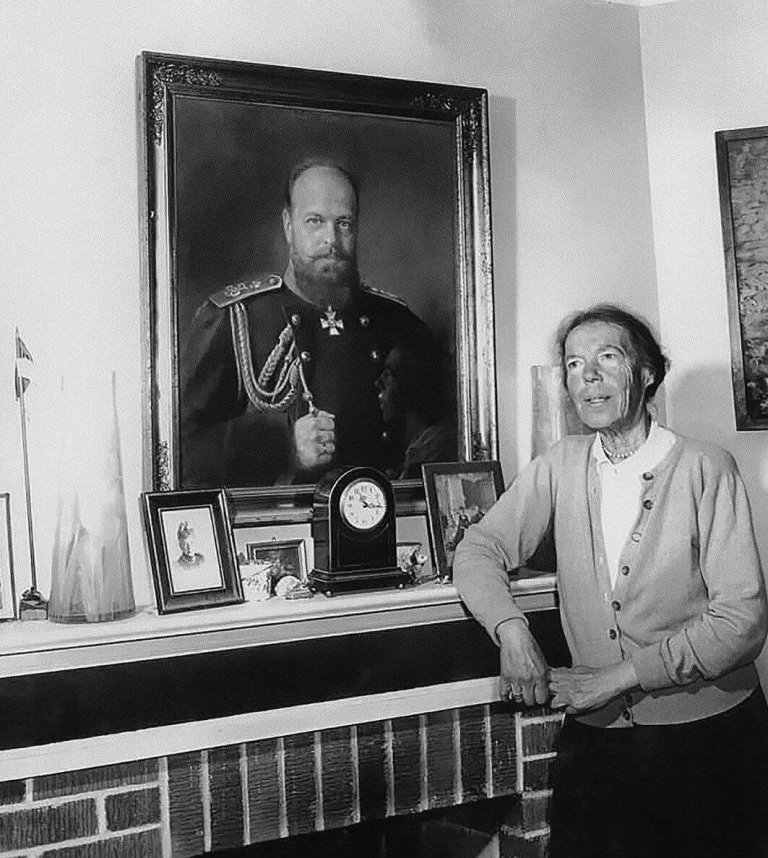
PHOTO: Grand Duchess Olga standing in front of a portrait of her father, which hung in the living room of her home in Cooksville, Ontario in the 1950s
The last grand duchess
The last grand duchess of Russia was Grand Duchess Olga Alexandrovna (1882-1960).
Grand Duchess Olga Alexandrovna was born in the Cottage Palace at Peterhof on 13th June (O.S. 1st June), 1882. She was was the youngest of six children born to Emperor Alexander III and Empress Maria Feodorovna, she was the youngest sister of Russia’s last emperor Nicholas II.
Olga married twice: on 9th August 1901, she married Duke Peter Alexandrovich of Oldenburg (1868-1924). Their marriage was not a happy one. Not only did their marriage remain unconsummated, Peter was believed by family and friends to be homosexual. In addition, Peter was an inveterate and well-known gambler, the money he coaxed out of his wife was often lost at the gambling tables of the capital.
On 16th October 1916, after living separately for two years, Emperor Nicholas II officially annulled the marriage (with ecclesiastical agreement) between Olga and Peter. When the Tsar granted the annulment, he also allowed his sister to marry Colonel Nikolai Kulikovsky.
On 17th (O.S. 4th) November 1916, she married Colonel Nikolai Alexandrovich Kulikovsky (1881-1958). in the Kievo-Vasilievskaya Church on in Kiev. The couple were married for 42 years, they had two sons: Tikhon (1918-1993) and Guri (1919-1984), both of whom were born in Russia. When Grand Duchess Olga married Nikolai Kulikovsky (a commoner) in 1916, she was forced to renounce all rights to the Russian throne as well as those of her descendants.
Olga was a prolific artist. During her lifetime, she produced over 2,000 paintings, which provided a source of income for her and her family. During the First World War, she trained to be a Red Cross Nurse.
Olga endured much loss during her life, outliving her entire family, including her beloved father Emperor Alexander III (1894); her brother George (1899); her brother Michael (1918); her brother Emperor Nicholas II and his entire family (1918); her mother Dowager Empress Maria Feodorovna (1928); her sister Xenia (April 1960); and was forced to flee Russia with her husband and two sons in 1919. She lived in Denmark until 1948, when she emigrated to Canada.
In June 1959, Queen Elizabeth II and Prince Philip, Duke of Edinburgh sailed into Toronto harbour. During their 2-day visit to the Canadian city, they invited Grand Duchess Olga Alexandrovna to a luncheon onboard the ‘HMY Britannia‘.
During her life in exile, Grand Duchess Olga Alexandrovna was asked about the restoration of the Russian monarchy . . .
According to Ian Vorres, in his biography ‘The Last Grand Duchess’, published in 1964, Grand Duchess Olga stated: ”I cannot think that there will ever be a Tsar in Moscow again. The changes have been too great . . . . a new age exists that has developed without us. I am convinced that to dream about a Romanov restoration is a pure waste of time today.”
Grand Duchess Olga along with many other members of the Romanov family in exile, never forgave Grand Duke Kirill Vladimirovich for his premature recognition of the Provisional Government, nor did they support his claim in 1922, when he proclaimed himself the “Guardian of the Russian Throne”, and in 1924 as the “Emperor of All Russia”, as neither carried “any dynastic validity”.
Nikolai Alexandrovich Kulikovsky died in Cooksville, Ontario on 11th August 1958, at the age of 76. His funeral was held on 13th August 1958, at the Church of Christ the Saviour in Toronto. He was buried on the same day, at the North York Cemetery in Toronto.
Grand Duchess Olga Alexandrovna died in Toronto, Canada on 24th November 1960, at the age of 78. Her funeral was held on 30th November 1960, at Christ the Saviour Cathedral in Toronto. Olga’s body was then interred next to her husband in York Cemetery, Toronto. Officers of the Akhtyrsky Hussars and the Blue Cuirassiers stood guard in the small Russian church, which overflowed with mourners.
Grand Duchess Olga Alexandrovna remains one of the most beloved members of the Russian Imperial family to this day. Her memoirs ‘The Last Grand Duchess’ were written by Ian Vorres in 1964.
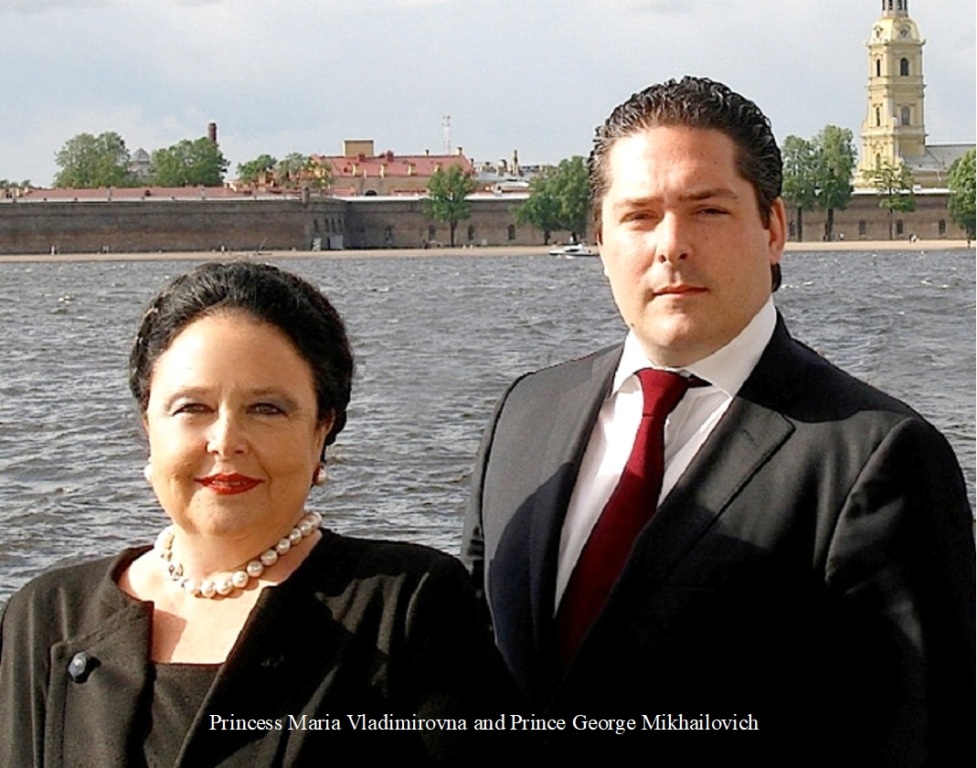
Fake grand dukes and grand duchesses
There are currently several persons who have their eye on becoming Russia’s next monarch, each of whom have awarded themselves titles which no longer exist. While doing so, they overlooked the fact that none of them have any rights to the Russian throne (should it ever be restored).
Among these pretenders are Princess Maria Vladimirovna, who styles herself as “Her Imperial Highness Grand Duchess” Maria Vladimirovna. Among her more radical fan base, she is also known as “Empress deJure . . .”. Her son, Prince George Mikhailovich, styles himself as “His Imperial Highness Tsesarevich Grand Duke”. George has even less rights to the non-existent throne than his mother. His father was Prince Franz Wilhelm of Prussia [born 1943], of the defunct House of Hohenzollern, therefore, George is more a Hohenzollern than a Romanov.
Maria is not a grand duchess, she is a princess, George is not a grand duke, he is a prince. Mother and son Romanov are not at all popular with the Russian people. Neither of their father’s was an Emperor or Empress, and therefore had no rights to bestow the title of “grand duke” or “grand duchess” on either of them. More importantly, the title of “grand duke” was reserved for the sons and male-line grandsons of a reigning Emperor, likewise for the title of “grand duchess”. Their claims are nothing more than the delusional fantasy world of which they both live.
© Paul Gilbert. 19 January 2026
***
Paul Gilbert’s Romanov Bookshop on AMAZON
Please CLICK on the BANNER or LINK above to review my current selection of titles in hardcover, paperback and ebook editions. Listings provide a full description for each title, pricing and a Look inside feature.
 Nicholas II
You must be logged in to post a comment.