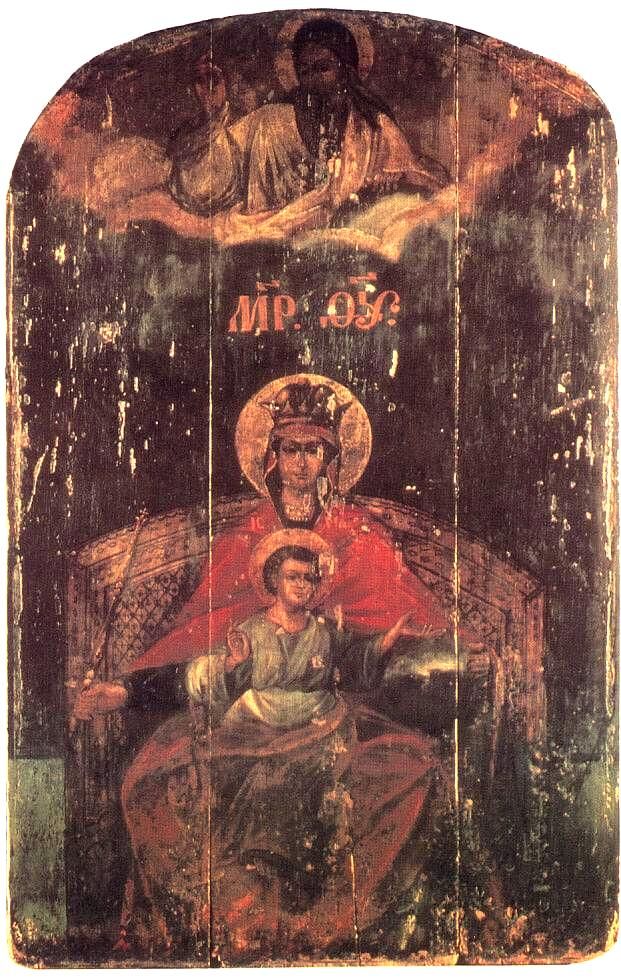
PHOTO: the original Reigning Icon of the Mother of God in
the Church of Our Lady of Kazan, Kolomenskoye (near Moscow)
NOTE: this article was originally posted on 15th March 2019. It was updated
with additional information and photos on 15th March 2026 – PG
***
On 15th (O. S. 2nd) March 1917, Emperor Nicholas II abdicated from the throne. That same day, the Reigning Icon of the Mother of God was revealed to a peasant woman in Kolomenskoye. Many believe the reappearance of the icon was an indication that the Virgin Mary was displeased with Russia for dethroning Nicholas II during the February 1917 Revolution.
The Reigning Icon of the Mother of God is believed to date from the 18th century. It is considered one of the most revered icons both inside Russia and in Russian emigre circles.
The icon was originally venerated in the Ascension Convent, in the Chertolye neighborhood near the Moscow Kremlin. In 1812, as Napoleon Bonaparte’s Grande Armée approached Moscow during the French invasion of Russia, the icon was taken to the village church in Kolomenskoye for safekeeping and subsequently forgotten until 1917.
At the end of the February Revolution of 1917, on 15 March (O.S. 2 March) 1917, Tsar Nicholas II of Russia abdicated the throne. That same day, Evdokia Adrianova, a peasant woman in the village of Pererva in Moscow Province, dreamed that the Blessed Virgin appeared and spoke to her. She was instructed to travel to the village of Kolomenskoye, where she would find an old icon which, “will change colour from black to red.”
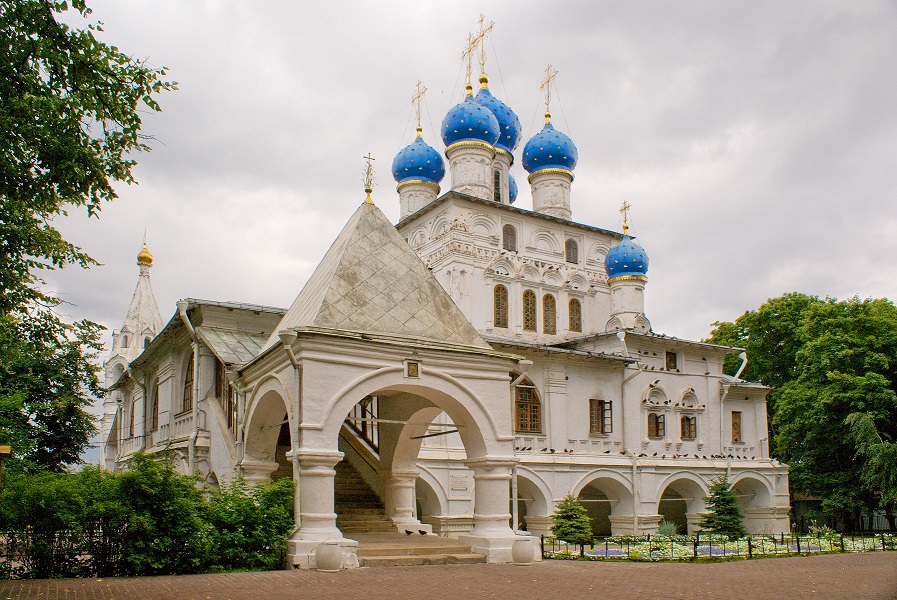
PHOTO: the Church of Our Lady of Kazan in Kolomenskoye (nearMoscow)
Upon her arrival, the parish priest Father Nikolai Likhachev (1865-1893) took Evdokia at her word and together they searched until they found, in an old storage room located in the basement, an icon covered with candle soot. When they took the icon outdoors, the sunlight revealed that the Mother of God was wearing the scarlet robes of a monarch. She also wore the Imperial crown and held a sceptre and orb — the symbols of Imperial power.
Since all this took place on the same day as the Tsar’s abdication from the throne, the appearance of the icon was immediately thought to be connected with that event. What is more, the priest was given to understand that the Crown that had fallen from the head of the Tsar had been taken up by the Theotokos, the Mother of God: henceforth, She would be the reigning Tsarina of the Russian State. Thus the icon was named the ‘Reigning’ icon and became widely revered among the Russian people.
The discovery of the miraculous appearance of the Reigning Icon spread instantly, and crowds of pilgrims began to flock to the Church of Our Lady of Kazan, Kolomenskoye (near Moscow) to venerate it.
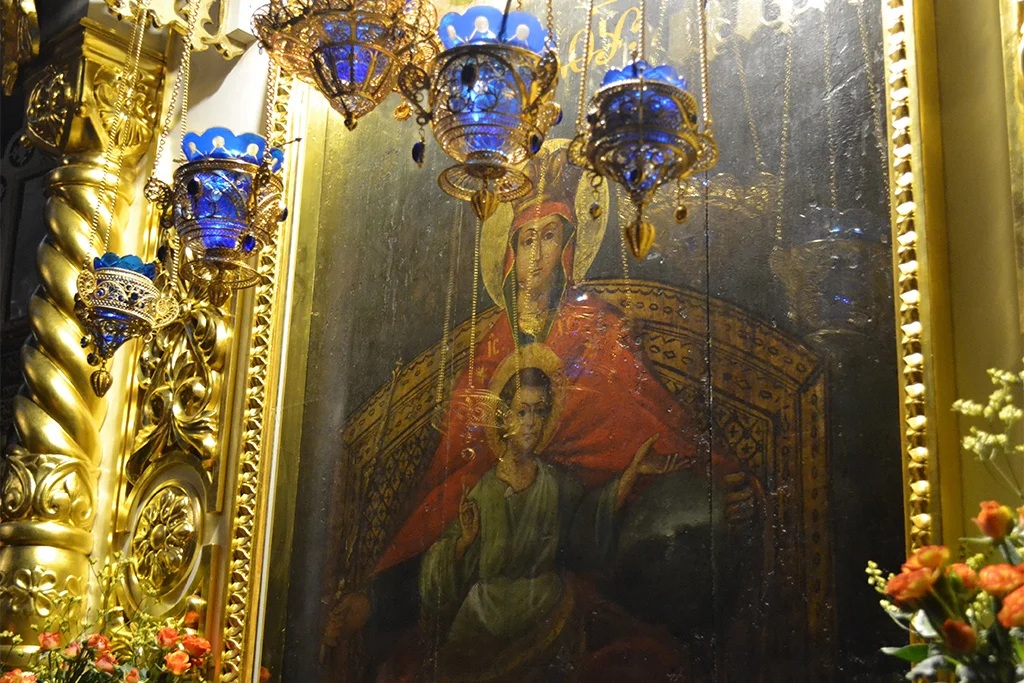
PHOTO: The original Reigning Icon of the Mother of God in
the Church of Our Lady of Kazan, Kolomenskoye (near Moscow)
Russian monarchists believe the reappearance of the icon was an indication that the Virgin Mary was displeased with Russia for dethroning Tsar Nicholas II during the February 1917 Revolution. They believe that She will hold the Imperial Crown for safekeeping until the House of Romanov is restored.
After the revolution, efforts were made to protect and preserve the icon. It was transported from one place to another. She visited the Marfo-Mariinsky [Martha and Mary] Convent – founded by the Grand Duchess Elizabeth Feodorovna (1864-1918) – in Moscow, where she was greeted with great honours. Later, in Soviet times, the icon was kept in the vaults of the State Historical Museum in Moscow.
On 27th July 1990, the Reigning Icon of the Mother of God was returned to the Church of Our Lady of Kazan in Kolomenskoye. Today, anyone can come to Moscow, to the Kolomenskoye Museum-Reserve, and pray before the miraculous image.
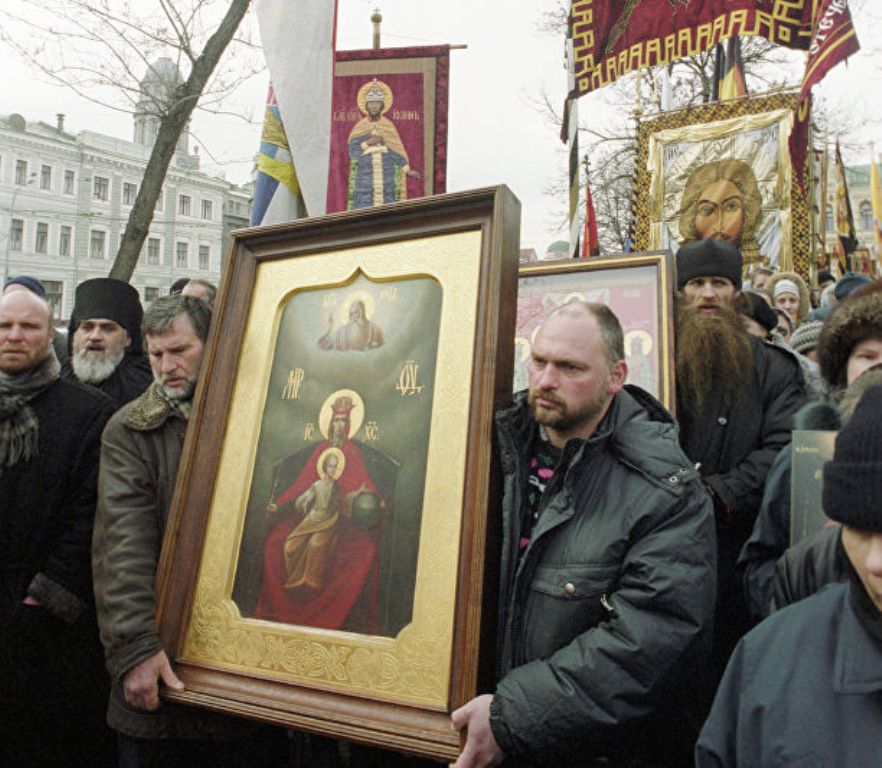
PHOTO: A copy of the Reigning Icon of the Mother of God
is carried in a cross procession held in Moscow
After the reunification of the Moscow Patrichate of the Russian Orthodox Church and the Russian Orthodox Church Outside Russia (ROCOR) in August 2007, the icon was taken to Russian parishes in Europe, the United States and Australia.
In modern times, Orthodox believers celebrate the day of the Reigning Icon of the Mother of God on 15th March. The significance of the Reigning Icon for the Russian people is enormous: it reminds them that even when earthly power collapses, heavenly protection remains with them. The icon has become a symbol of the inflexibility of the Russian spirit and protected Russia for more than a century.
The Reigning Icon does not require a special complex prayer. You can turn to the Mother of God in your own words, the main thing is to do it from the bottom of your heart. Traditionally, an akathist to the Reigning Icon or a troparion to the feast is read before the icon. Many Orthodox Christians come to church on 15th March or 2nd March (according to the Old Style Julian Calendar). On this day that worshippers light a candle and ask for intercession. During the Great Lent (from 23rd February to 11th April 2026), prayer before the Reigning Icon acquires a special meaning. Lent is a time of purification and repentance, and turning to the Mother of God helps to strengthen the spirit and walk this path with dignity.
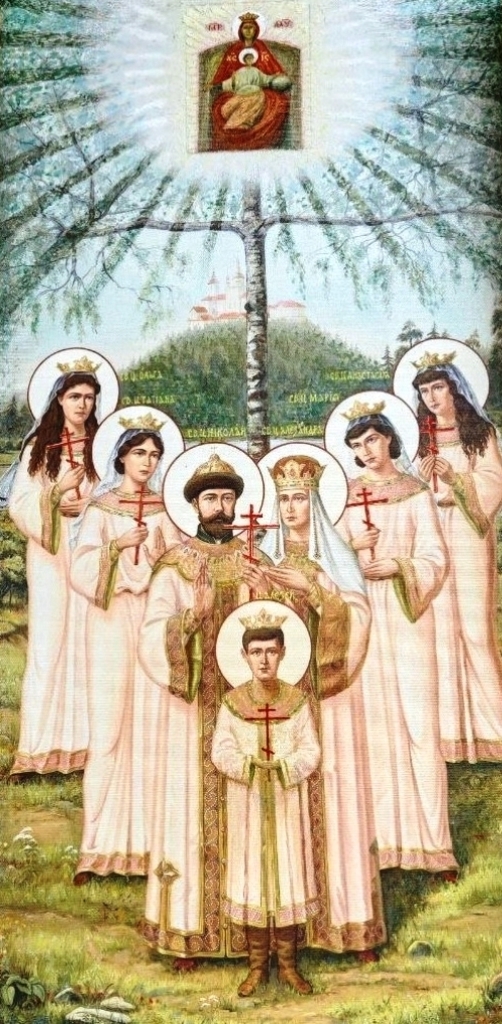
PHOTO: a contemporary Russian icon depicting the Holy Royal
Passion-Bearers standing under the image of the Mother of God
During the service held on the eve on the day of the discovery of the Reigning Icon of the Mother of God, Metropolitan Evgeny of Yekaterinburg and Verkhoturye diocese noted that the mystery of what happened that night at the Dno station is completely hidden from us, as well as what happened in the heart of the Tsar on the day of his abdication.
“We must warm our hearts with the Mother of God. To tell Her that Her appearance in Kolomenskoye was not in vain. It was not in vain that all those labours and prayers that She lifted up for Russia, so that Russia would be called Holy Russia and the home of the Most Holy Theotokos,” – His Eminence noted.
FURTHER READING
The Abdication of Emperor Nicholas II, March 1917 + PHOTOS and VIDEO
© Paul Gilbert. 15 March 2019 – Updated on 15th March 2026
 Nicholas II
You must be logged in to post a comment.