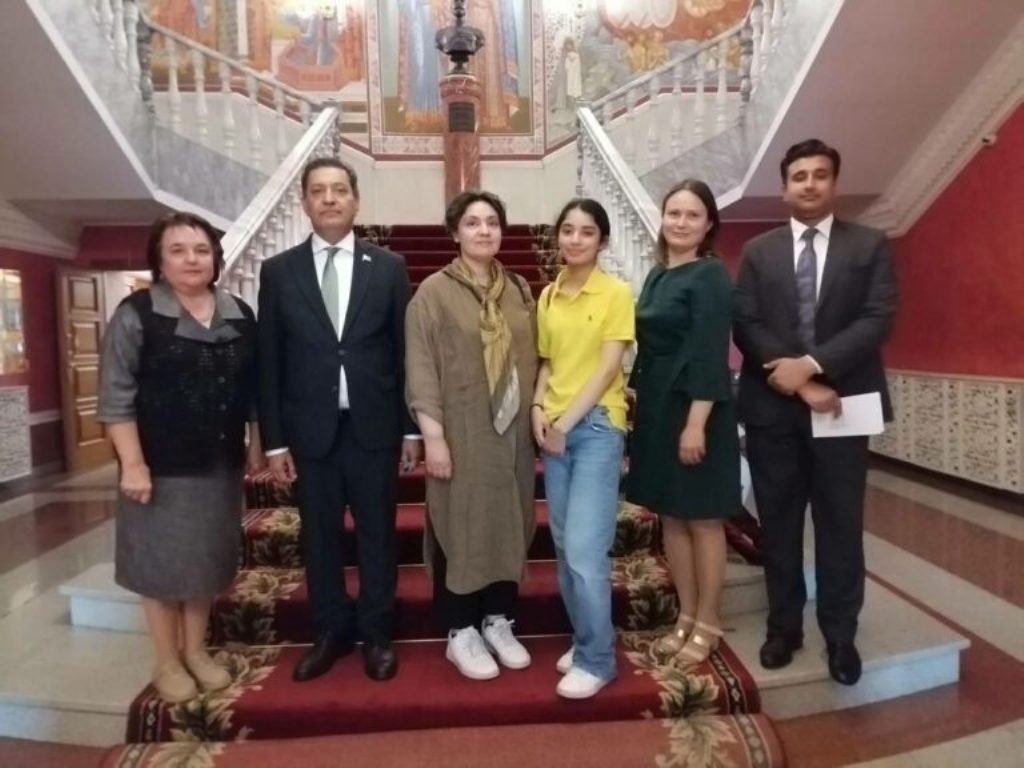
PHOTO: Pakistani Ambassador Muhammad Khalid Jamali and members of his delegation, in the Patriarchal Compound of the Church on the Blood. Note the bust of Nicholas II on a pedestal at the top of the stairs
On 31st July 2025, a delegation headed by the Ambassador of the Islamic Republic of Pakistan to the Russian Federation Muhammad Khalid Jamali visited the Church on the Blood and the Museum of the Holy Royal Family in Ekaterinburg.
Representatives of the delegation were given a tour of the museum, which is situated in the Patriarchal Compound of the Church on the Blood. While being shown exhibits, they were told about the life and work of Emperor Nicholas II, Empress Alexandra Feodorovna, Tsesarevich Alexei Nikolaevich and the Grand Duchesses Olga, Tatiana, Maria and Anastasia.
“Particular attention was paid to the last period of their lives, during which the Imperial Family were being held under house arrest in Tsarskoye Selo, Tobolsk and Ekaterinburg, where they subsequently met their death and martyrdom in the Ipatiev House, on 17th July 1918.” said the head of the Museum of the Holy Royal Family, Victoria Mikhailovna Kalmykova.
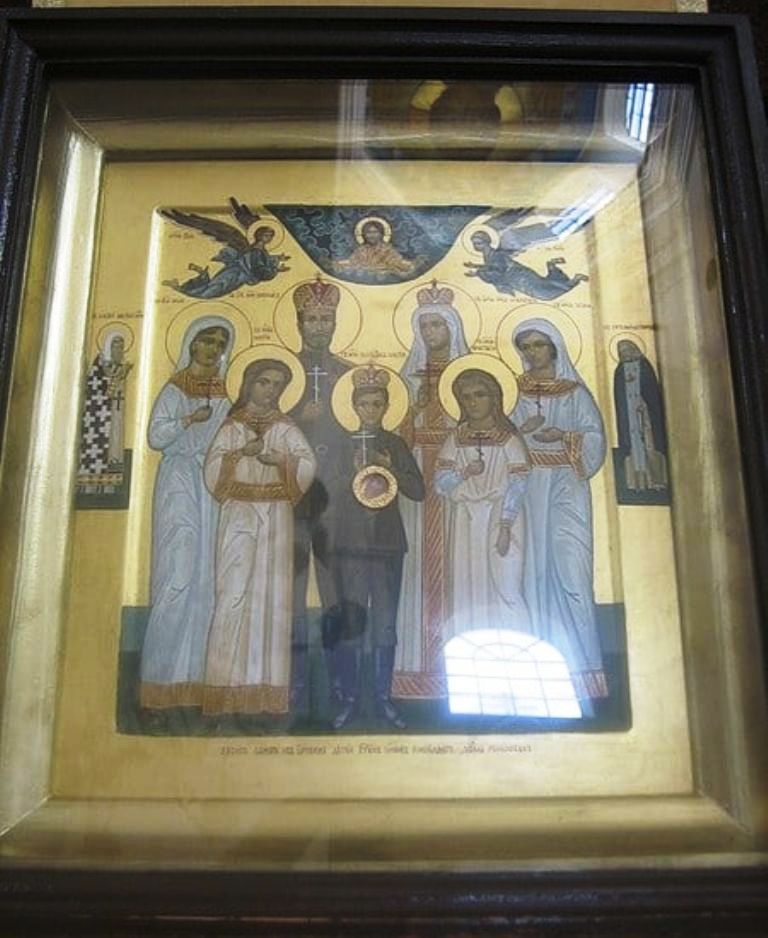
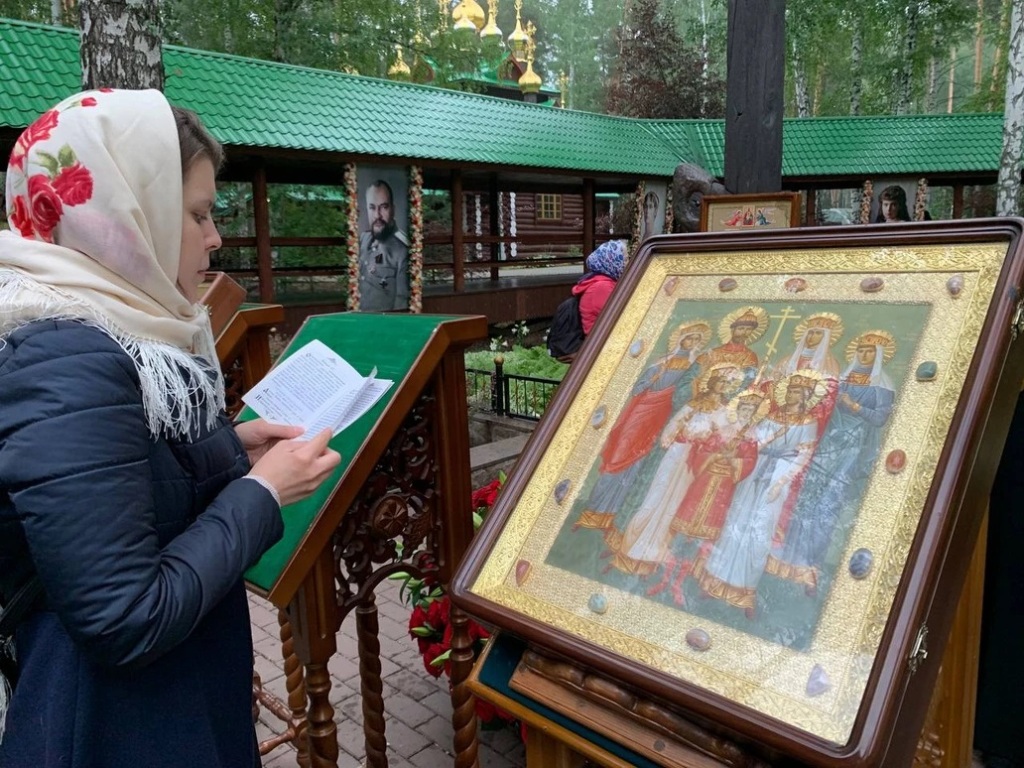
PHOTO: the icon of the Holy Royal Passion-Bearers. A capsule on the Heir’s chest contains a baby tooth of Tsesarevich Alexei Nikolaevich, preserved by his Swiss tutor Pierre Gilliard
According to the head of the museum, the members of the delegation reacted with great respect to the shrines of the Church-on-the-Blood – the icon of the Mother of God “Three-handed”, which belonged to the Imperial Family and was with them in the Ipatiev House, the icon of the Holy Royal Passion-Bearers containing a tooth of Tsesarevich Alexei, to the reliquary containing the relics of St. Seraphim of Sarov, glorified during the reign of His Majesty Emperor Nicholas II, were previously kept.
The members of the delegation were very interested in the personal items belonging to members of the Imperial Family: a fragment of a children’s blanket made by the Grand Duchesses for the birth of Tsesarevich Alexei Nikolaevich in 1904; a children’s summer openwork glove that belonged to the Grand Duchess Tatiana Nikolaevna; a dinner napkin of Emperor Nicholas II, among other items belonging to His Majesty of that time.
At the end of the visit, the members of the delegation expressed gratitude for getting acquainted with the shrines of the Church on the Blood, and for the memorable and interesting tour of the museum.
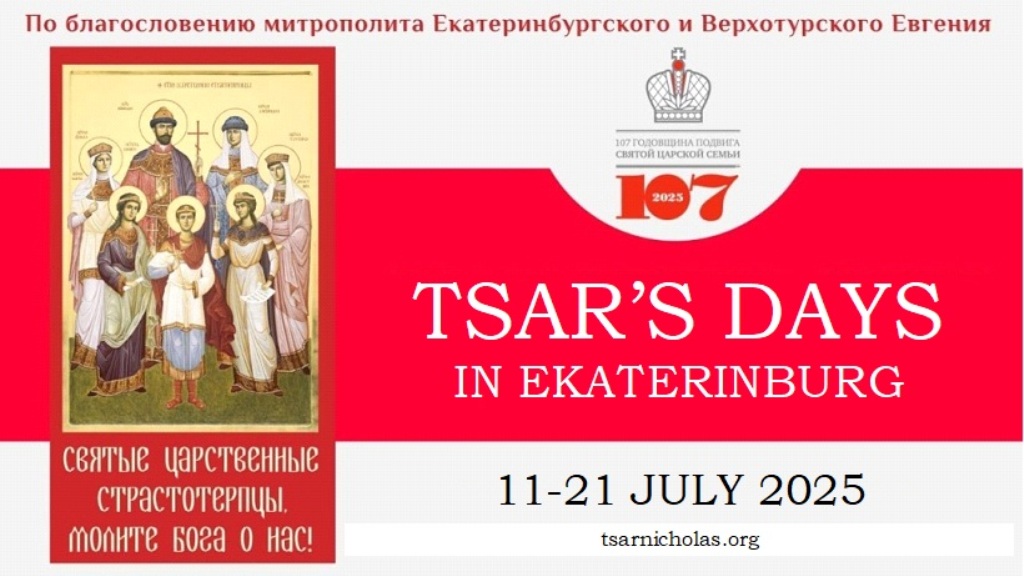
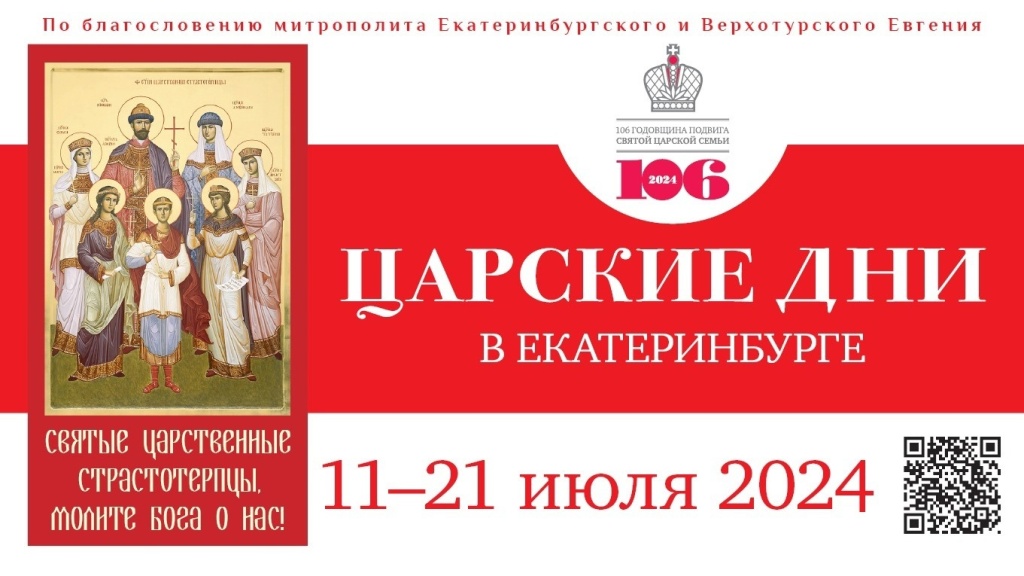
The Ekaterinburg Metropolis are currently preparing for Tsar’s Days – 2025, which will be held in the Ural capital and in Alapaevsk from 11th to 21st July. This year marks the 107th anniversary of the death and martyrdom of Emperor Nicholas II, his family and their four faithful retainers on 17th July 1918. It also marks the 107th anniversary of the death and martyrdom of Grand Duchess Eliabeth Feodorovna and other Romanov family members in Alapaevsk on 18th July 1918.
Metropolitan Evgeny of Yekaterinburg and Verkhoturye noted the importance of the upcoming memorial events, which traditionally bring together tens of thousands of faithful from across Russia and abroad.
The central event of Tsar’s Days is the Divine Liturgy held on the night of 16/17 July, followed by a 21-km [13 miles] Cross Procession, from the Church on the Blood in central Ekaterinburg to the Monastery of the Holy Royal Passion-Bearers at Ganina Yama. for which “the whole of Russia gathers” in the Ural capital.
This years’ Tsar’s Days is part of the 24th International Festival of Orthodox Culture, which will be held over a 10-day period from 11-21 July. Aside from divine services and religious processions, the festival will feature many events in honour of the Holy Royal Martyrs, including bell ringing, concerts and musical evenings, as well as exhibitions and conferences hosted by well-known historians, theologians and authors.
Preparations for the Tsar’s Days are being carried out by the Ekaterinburg Metropolia with the support of the regional and city authorities.
Once again, Porosenkov Log will not included in this year’s Cross Procession. Porosenkov Log is where the remains of the Imperial Family were exhumed in two separate graves in 1991 and 2007 respectively. Due to the fact that the Moscow Patriachate does not yet recognize the Ekaterinburg Remains as those of the Imperial Family. Their official recognition rests with the Bishops’ Council of the Russian Orthodox Church.
The veneration of Nicholas II
The veneration of Nicholas II and his family actually began just days after their murder in July 1918. During the Soviet years, such activity would most certainly have been suppressed, forcing the faithful to honour the Holy Royal Passion-Beaers in secret.
After the fall of the Soviet Union in 1991, everything changed, when in 2000, some 300 faithful gathered at the sight of the Ipatiev House in Sverdlovsk [Ekaterinburg]. In 2002, the first Cross Procession in memory of the Holy Royal Martyrs was held in the Ural capitlal, attracting 3,000 faithful. The procession has been held every year since, the most important being in 2018, the year marking the 100th anniversary of the death and martyrdom of the Imperial Family.
On the night of 16/17 July 2024, on the eve of the Feast Day of the Holy Royal Martyrs[1], the Hierarchal Divine Liturgy was celebrated at the Church on the Blood in Ekaterinburg. This year marks the 106th anniversary of the murder of Emperor Nicholas II, his wife, their five children, and four faithful retainers.
Divine services were held in the Imperial Room[2], were led by the bishops who had arrived in the Ural capitol for Tsar’s Days: Bishop Roman of Rubtsovsk and Aleysk, and Bishop Leonty of Syzran and Shigon.
Concelebrating with the bishops were Archpriest Nikolai Tarantin, head of the protocol service of the Ekaterinburg Diocese, Archpriest Maxim Minyailo, chairman of the diocesan department for Church relations with society and the media, senior priest of the Church on the Blood, and Priest Daniel Ryabinin, head of the diocesan missionary department; Priest Pavel Starkov, head of the Youth Department, spiritual father of St. Simeon’s Orthodox Gymnasium (School); Rector of the Ekaterinburg Theological Seminary, Hieromonk Korniliy Zaitsev, Chief of Staff of the Synodal Diocese of the Ekaterinburg Diocese, Hieromonk Simeon (Seregin), and other clergymen of the Ekaterinburg Diocese.
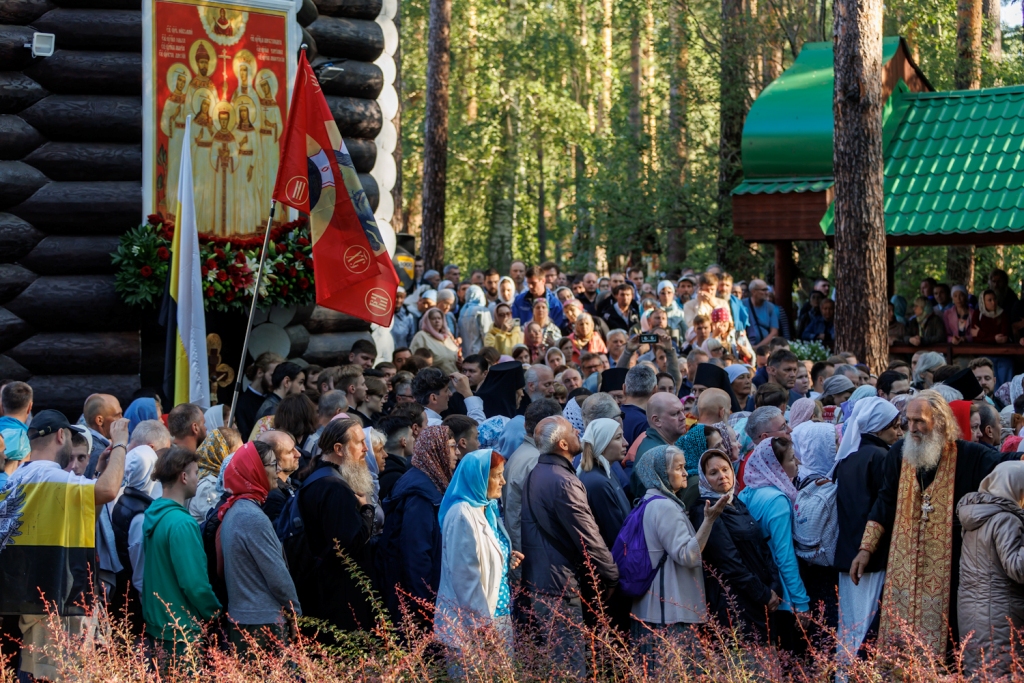
Traditionally, the Divine Liturgy on the night of 16th July is celebrated with a large crowd of faithful – hundreds of believers prayed in the church.
The hymns of the service were sung by the choir of the Ekaterinburg Theological Seminary under the direction of Anastasia Mukhlynina, a graduate of the seminary’s choir director’s department.
Archpriest Sergiy Alexeev, a cleric of the Holy Trinity Cathedral in Ekaterinburg, addressed the faithful present with a sermon on the pre-communion verse.
Communion on this day was performed from five chalices – many pilgrims arrived in Ekaterinburg to pray at the main services of the Tsar’s Days and honour the memory of the Holy Royal Family.
At the end of the service, Metropolitan Evgeny of Ekaterinburg and Verkhoturye greeted the bishops, clergy and pilgrims who had arrived from across Russia and other countries for the Tsar’s Days.
Metropolitan Evgeny asked everyone to preserve the memory of the Holy Royal Passion-Bearers and to imitate wisdom and strength in the love they showed. At 3:00 p.m., Little Vespers with an akathist to the Holy Royal Passion-Bearers was served in the Church-on-the-Blood, then at 4:30 p.m., the All-Night Vigil began on the square in front of the church, which was led by the Eminent Archpastors. The main service of the Tsar’s Days – the Divine Liturgy – began at midnight, followed by the Royal Cross Procession.
Procession of the Cross to Ganina Yama
In the early morning hours of 17th July 2024, the traditional Royal Cross Procession was held from the Church on the Blood in Ekaterinburg to the Monastery of the Holy Royal Passion-Bearers at Ganina Yama – a 21 km. [13 miles] journey on foot[3]. The Cross Procession was preceded by a Divine Liturgy on the square in front of the church, which was headed by 13 bishops of the Russian Orthodox Church.
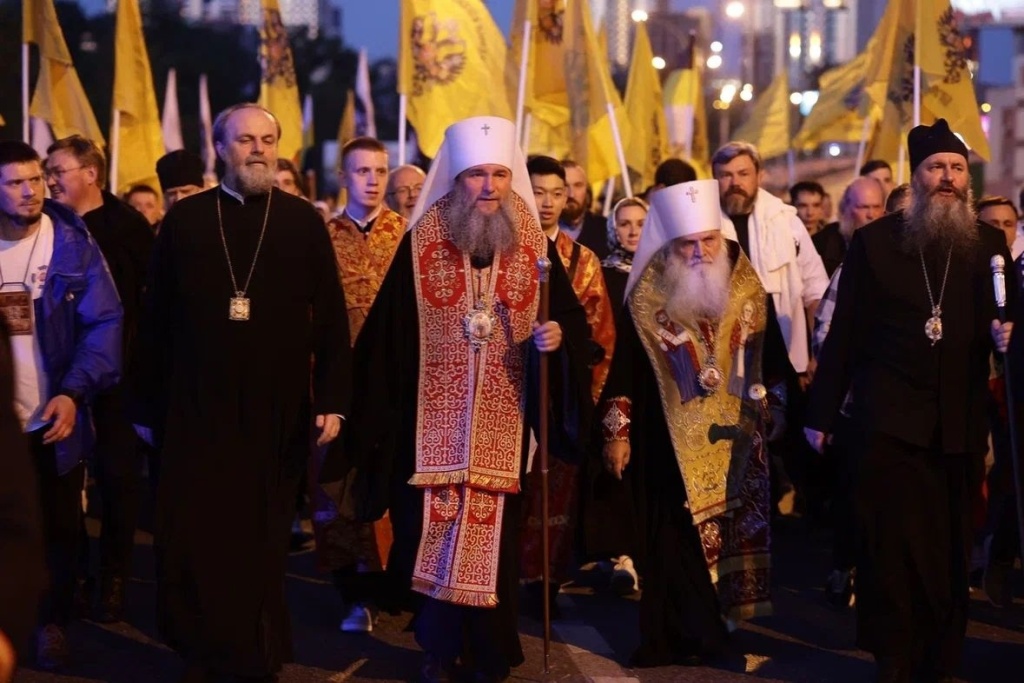
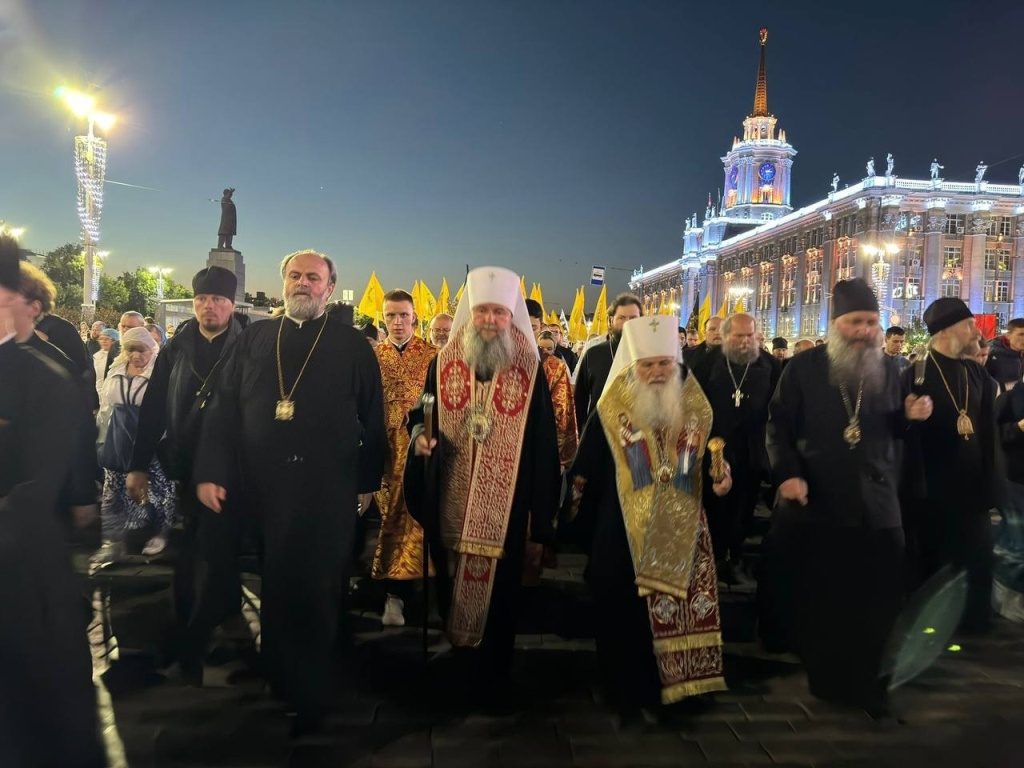
An estimated 45,000 faithful took part in this year’s Cross Procession, together with the head of the Ekaterinburg Metropolia, was led by Metropolitan Vikenty of Tashkent and Uzbekistan, head of the Central Asian Metropolitan District, and other archpastors.
Under the repentant Jesus Prayer: “Lord, Jesus Christ, Son of God, have mercy on us!” – the multi-thousand column of believers, clergy and laity from across Russia – covered the distance in about four to five hours. Those who took part in the procession came from every corner of the Russian Federation – from Stavropol to Novosibirsk, from Astrakhan to Arkhangelsk, as well as abroad.
The procession was accompanied by 10 mobile aid groups of the Orthodox Mercy Service and volunteers of the Tsar’s Days.
In the Cross Procession, two Reliquaries were carried, the first Reliquary containing a part of the Belt of the Most Holy Theotokos, which was donated to the Ekaterinburg Diocese, the second Reliquary containing the relics of 14 saints of the Ekaterinburg Metropolia: the Venerable Martyr Grand Duchess Elizabeth Feodorovna, the Venerable Martyr nun Varvara (Barbara) Yakovleva, the Venerable Basilisk of Siberia, the Righteous Simeon of Verkhoturye, the Blessed Cosmas of Verkhoturye, the Venerable Elijah Chebotarev, the Hieromartyr Alexander Malinovsky, the Hieromartyr Arkady Gariaev, Hieromartyr Konstantin Bogoyavlensky, Hieromartyr Lev Ershov, Venerable Arefa Katargin, Hieromartyr Alexis Budrin, Venerable Confessor John (Chevroletin) and Hieromartyr Alexander Adrianov.
The Royal Cross Procession concluded with a moleben to the Holy Royal Passion-Bearers at the Monastery of the Holy Royal Martyrs at Ganina Yama.
The Most Reverend Archpastors, Bishop Evgeny and Bishop Vikenty, thanked the thousands of faithuful who took part in the Royal Cross Procession for their spiritual feat.
Divine Liturgies were celebrated in the seven churches of the monastery, the churches are dedicated to each of the seven members of the Imperial Family. As the day progresssed, more and more pilgrims arrived at the monastery for prayer and reflection.
Holy Royal Passion-Bearers, pray to God for us! Святые Царственные страстотерпцы, молите Бога о нас!
NOTES:
[1] On 1st November 1981, the Imperial Family were canonized as new martyrs by the Russian Orthodox Church Outside Russia (ROCOR).
On 20th August 2000, the the Imperial Family were canonized as passion-bearers by the Moscow Patriarchate.
Passion-bearers are people who face death with resignation, in a Christ-like manner, as distinguished from martyrs, the latter historically killed for their faith. Proponents cited the piety of the Tsar and his family and reports that the Tsarina and her eldest daughter Olga prayed and attempted to make the sign of the cross immediately before they died.
Despite their official designation as “passion-bearers” by the Moscow Patriarchate, they are nevertheless spoken of as “saints” in Orthodox publications, icons, and in popular veneration by the people.
[2] The Imperial Room is situated in the lower church sanctified in honor of the Holy Royal Martyrs. It was established on the site of the room located in the basement of the Ipatiev House, where Emperor Nicholas II, his family, and four retainers were all brutally murdered on the night of 16/17 July 1918.
[3] Once again, Porosenkov Log was not included in this year’s Cross Procession. Porosenkov Log is where the remains of the Imperial Family were exhumed in two separate graves in 1991 and 2007 respectively. Due to the fact that the Moscow Patriachate does not yet recognize the Ekaterinburg Remains as those of the Imperial Family. Their official recognition rests with the Bishops’ Council of the Russian Orthodox Church.
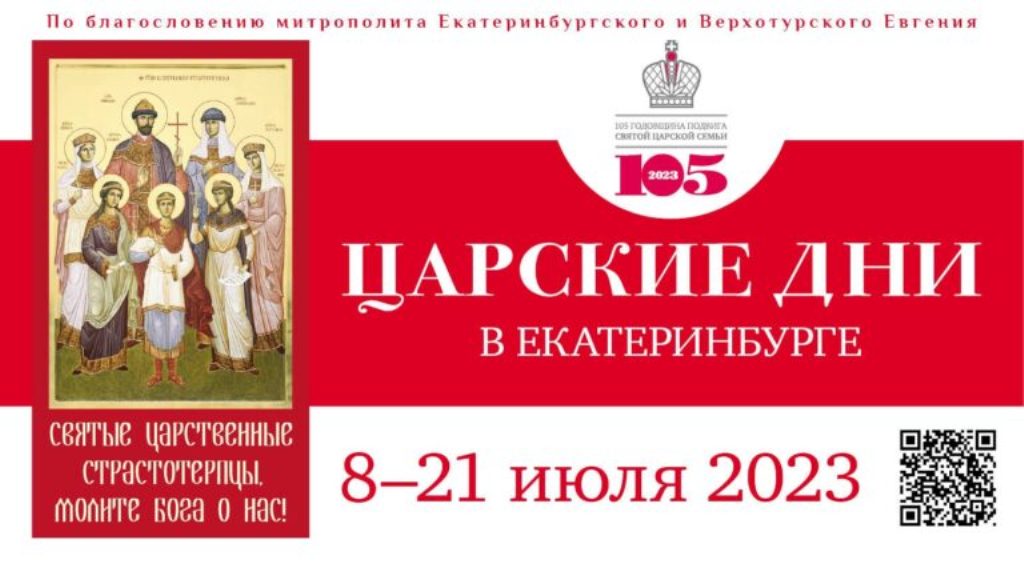
On the night of 16/17 July 2023 – the eve marking the 105th anniversary of the death and martyrdom of Emperor Nicholas II and his family – some 40,000 faithful attended a Divine Liturgy and Cross Procession in Ekaterinburg.
Defying Western sanctions, a number of foreigners also attended this years events, including the Italian opera singer and singing teacher Elvis Fanton, who said he felt compelled to come to Ekaterinburg after having a dream about Tsesarevich Alexei Nikolaevich. Fanton is a regular visitor to the Ural capital, where he has performed in concerts dedicated to the only son and heir of Russia’s last Tsar.
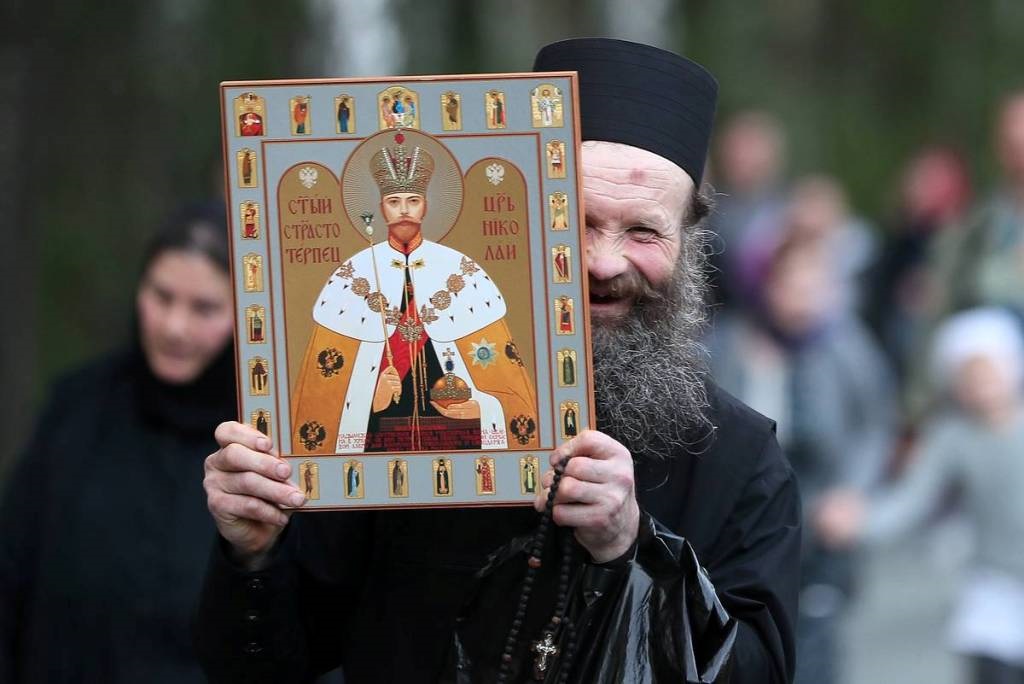
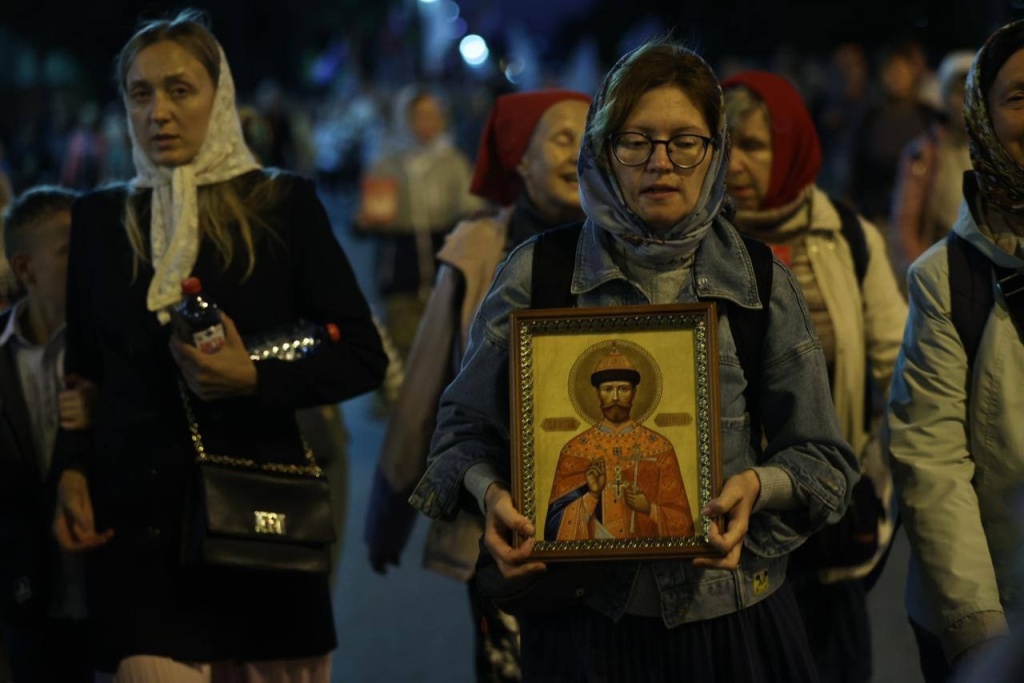
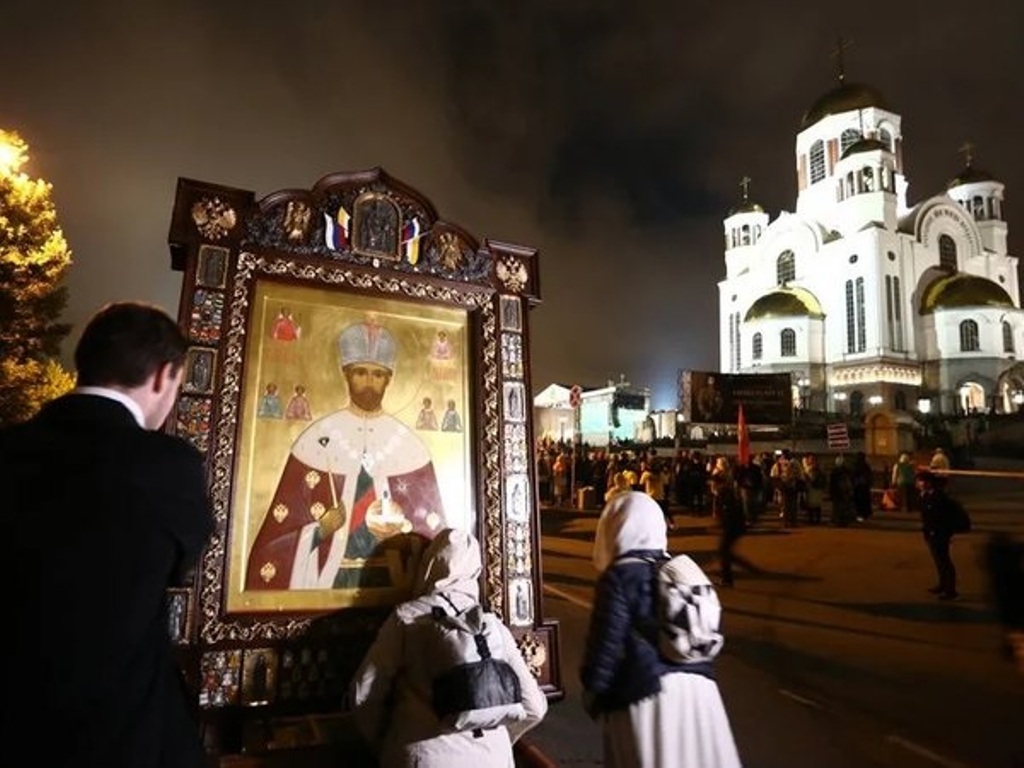
PHOTO: Orthodox Christians venerate an icon of the Holy Tsar Martyr Nicholas II on the square in front of the Church on the Blood in Ekaterinburg
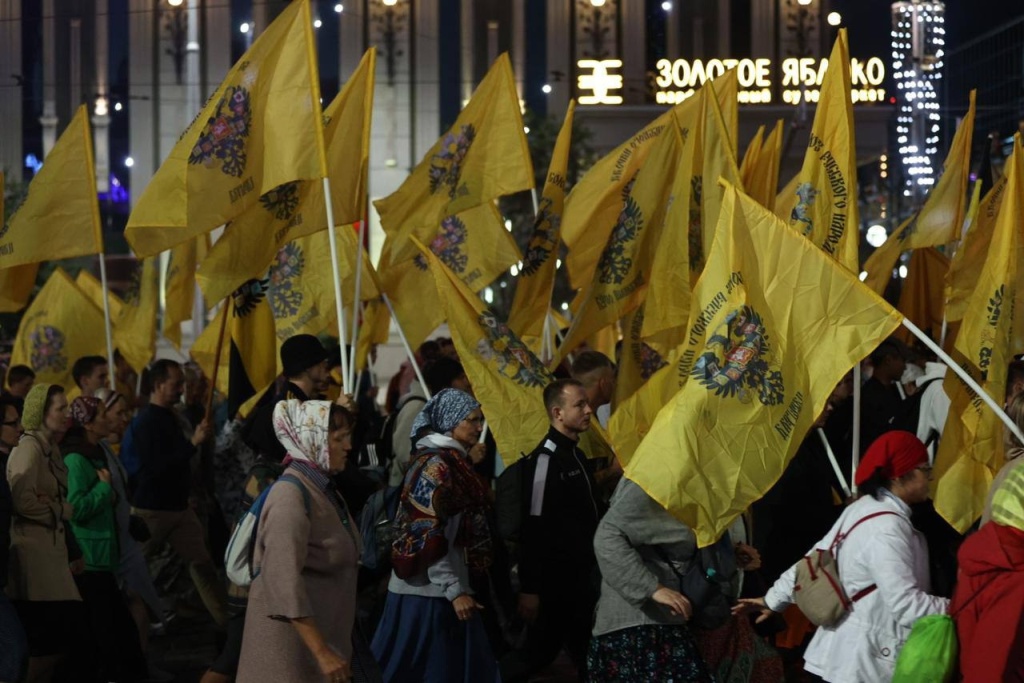
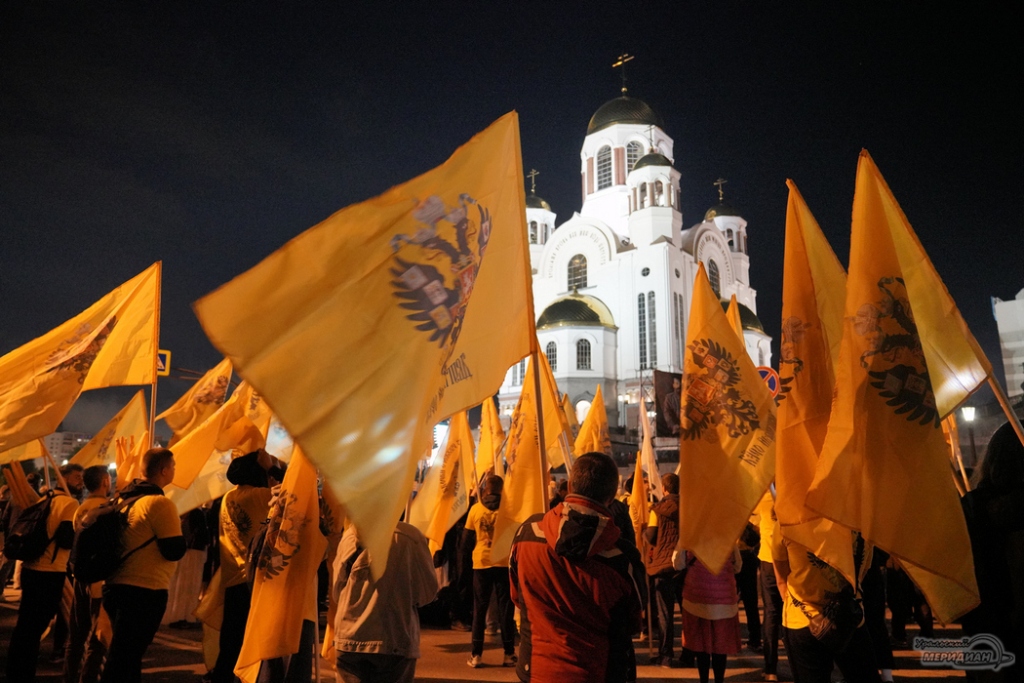
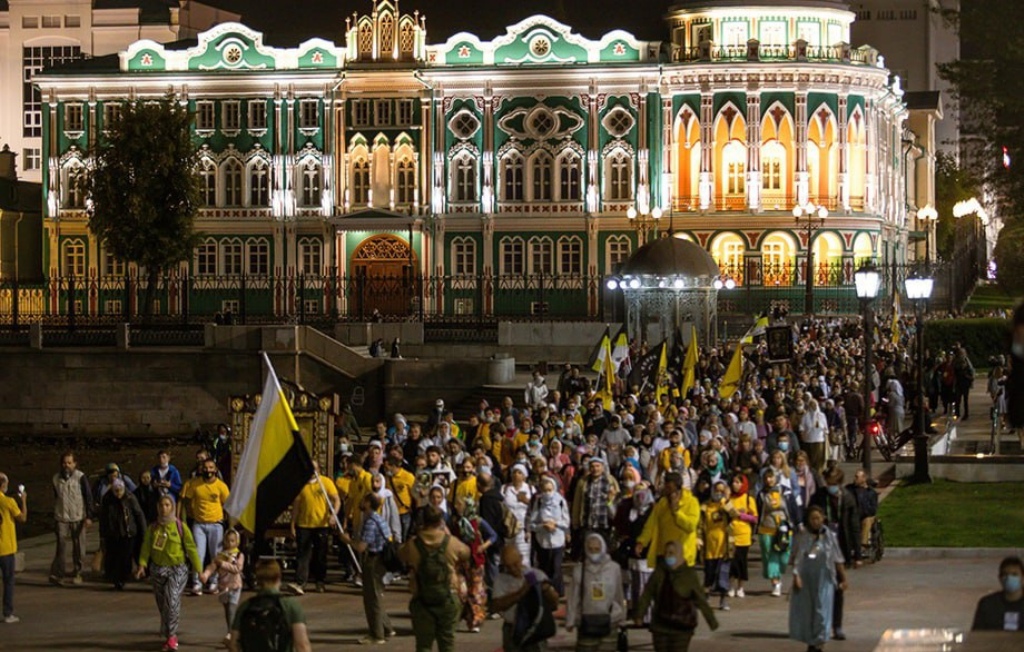
PHOTO: Orthodox Christians gather on the square outside the Church on the Blood holding yellow flags depicting the double-headed eagle of the Russian Empire
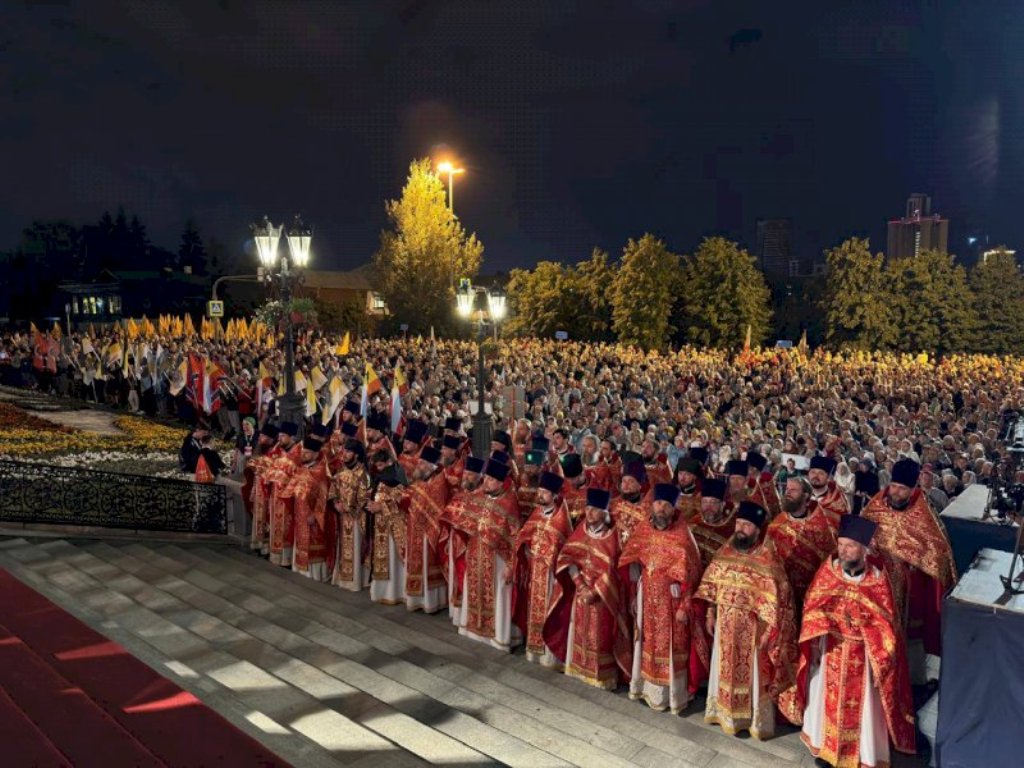
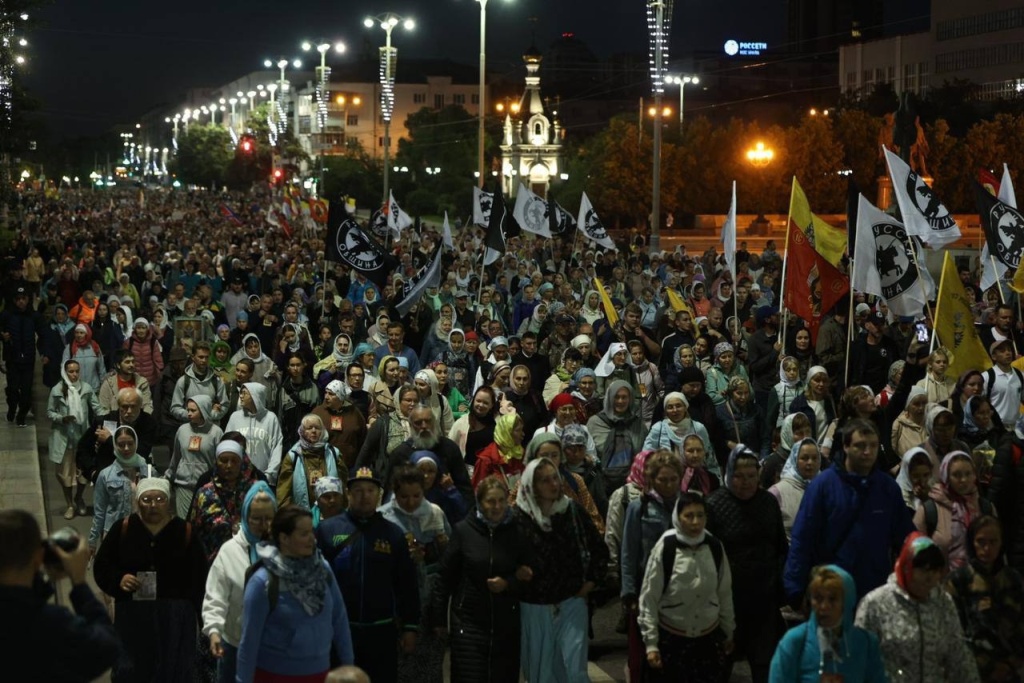
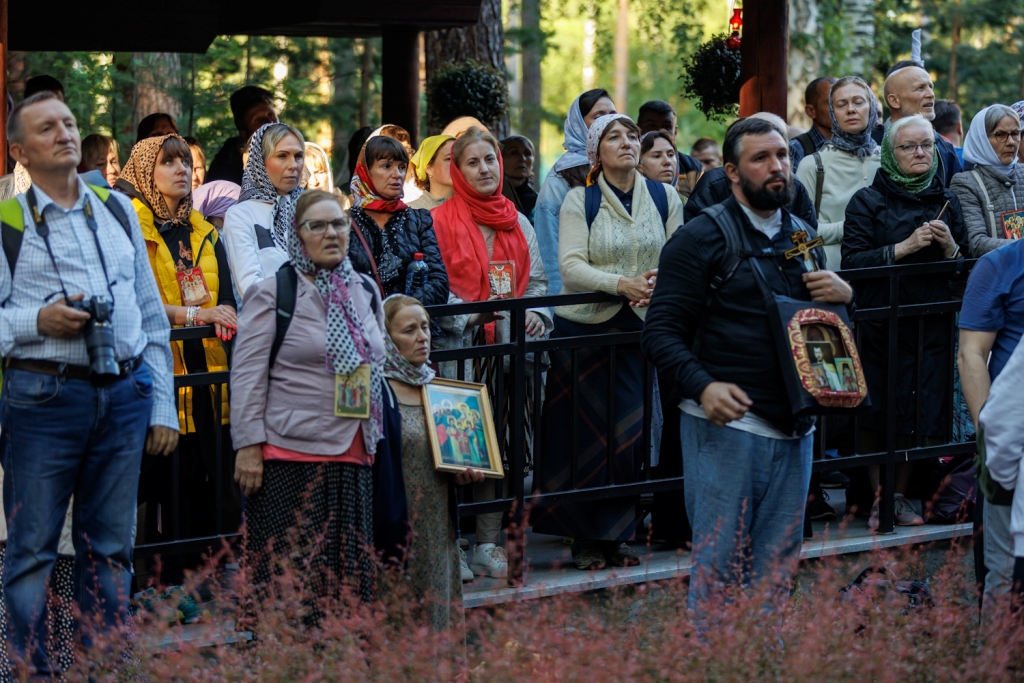
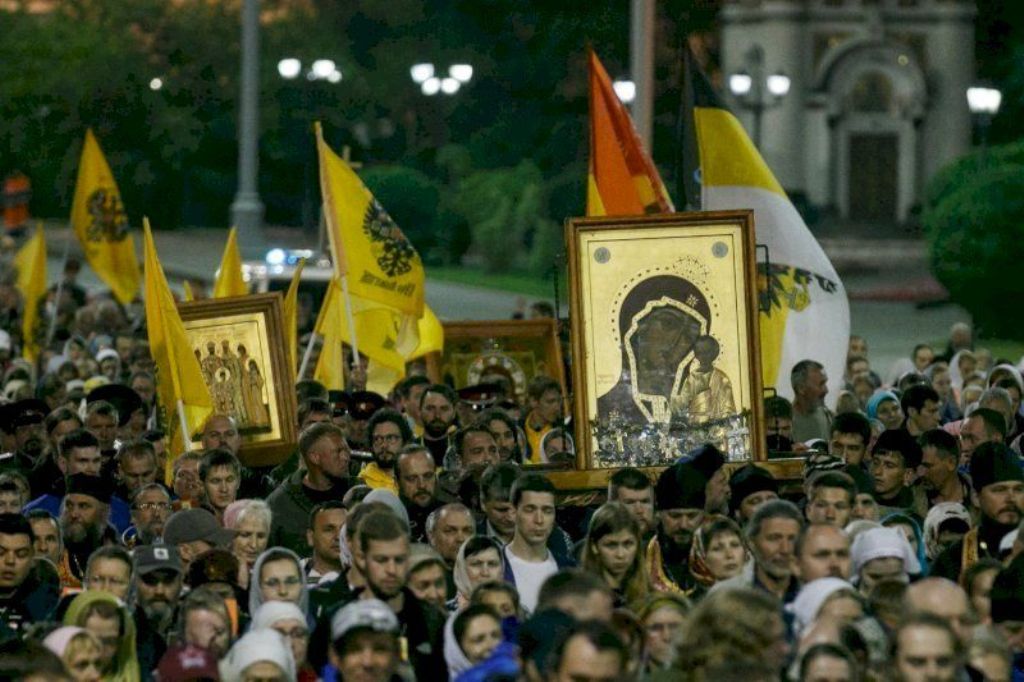
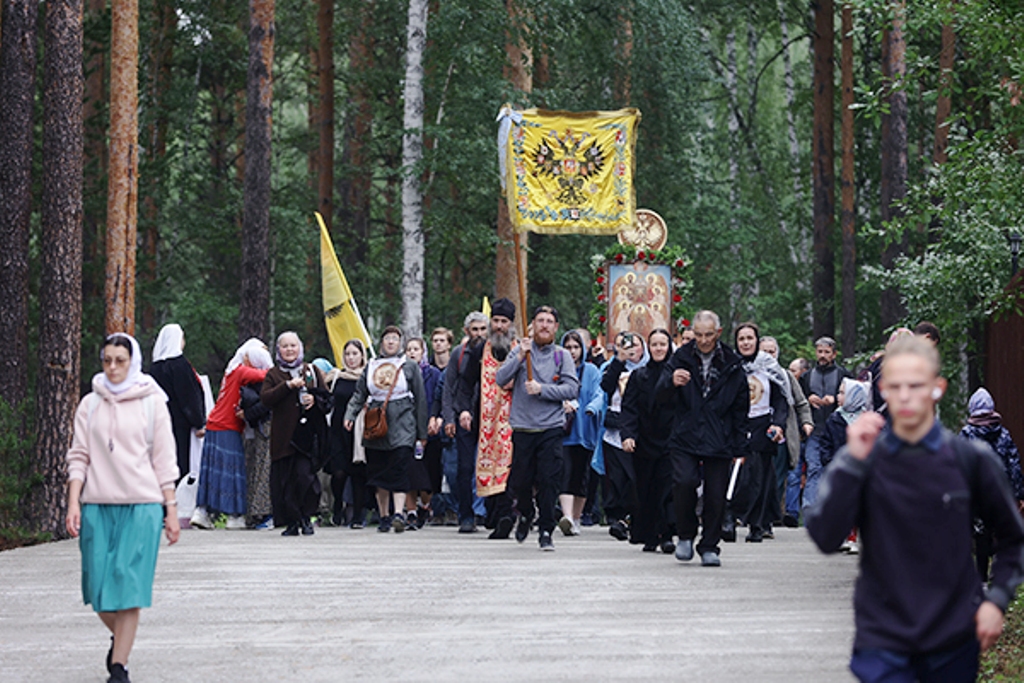
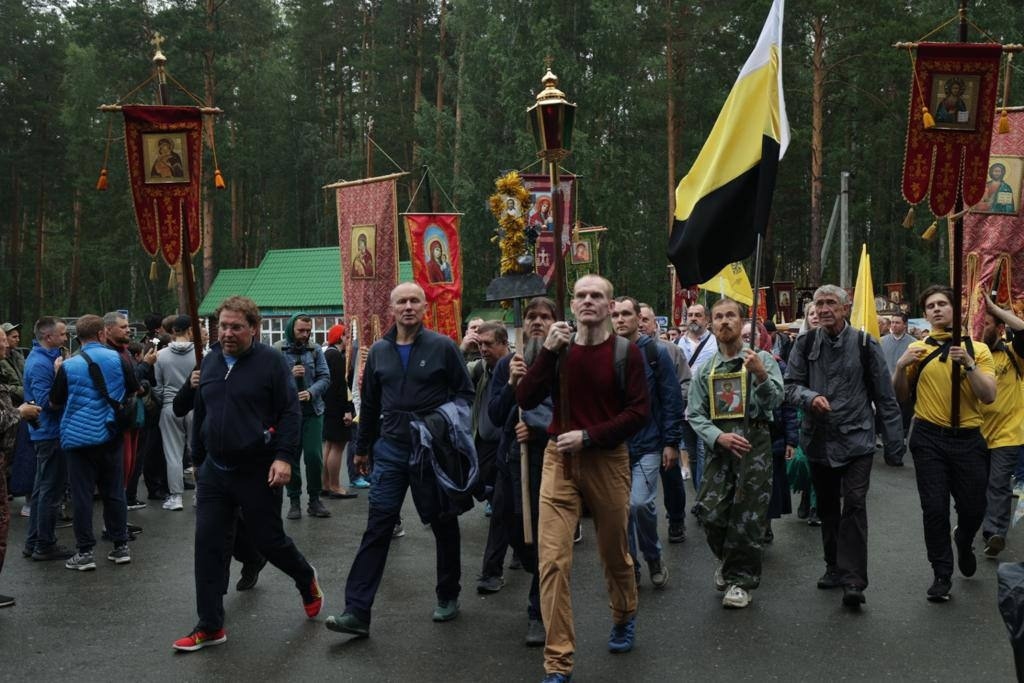
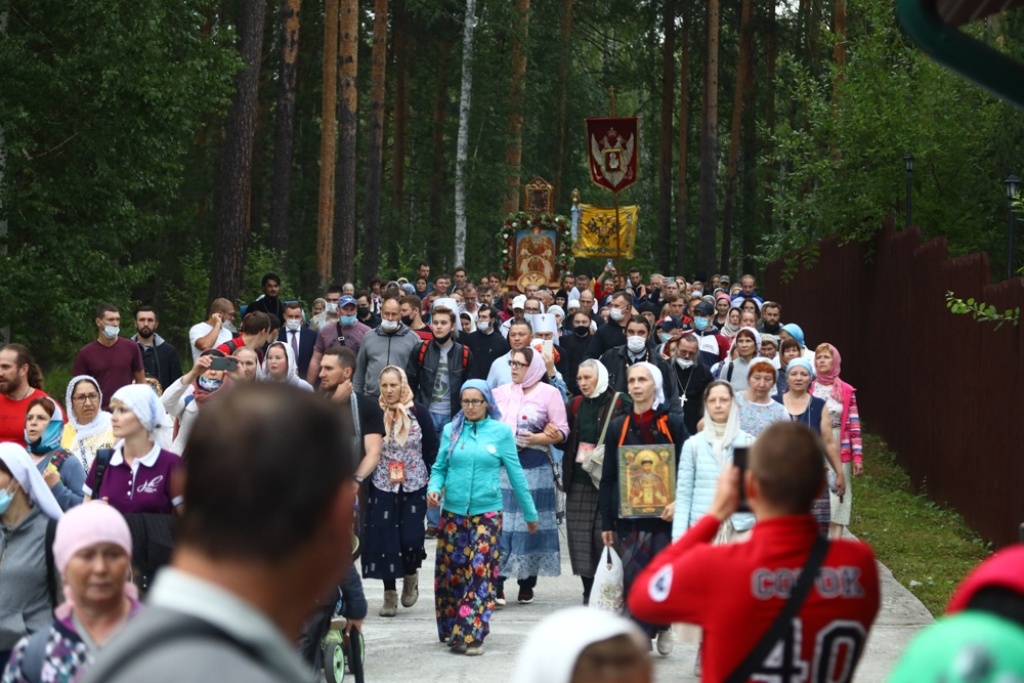
PHOTO: Orthodox Christians carrying icons, banners and flags
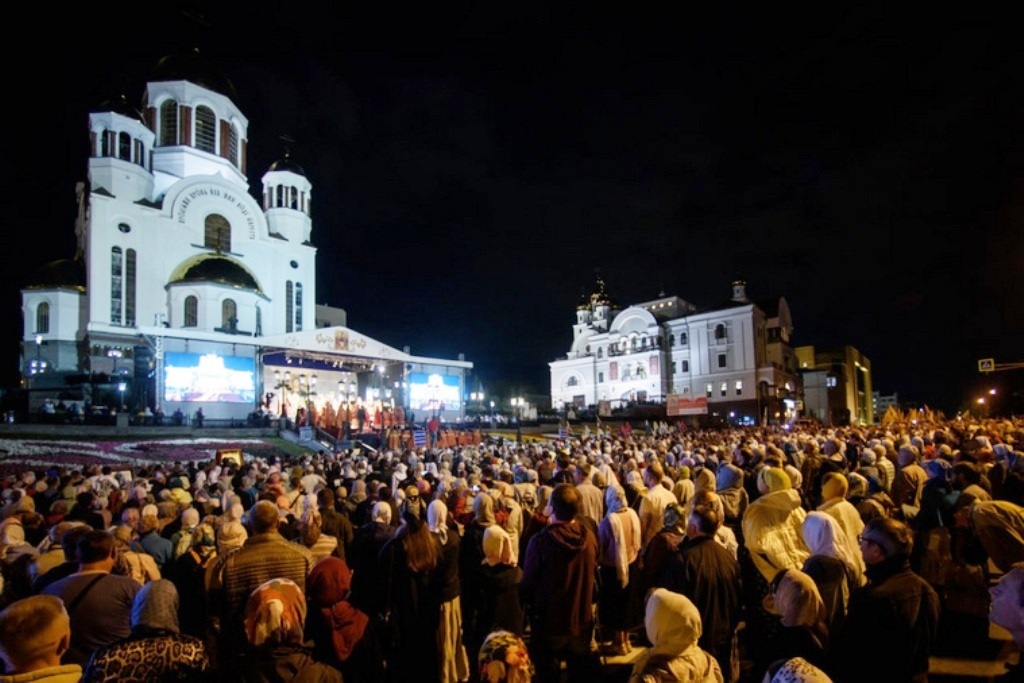
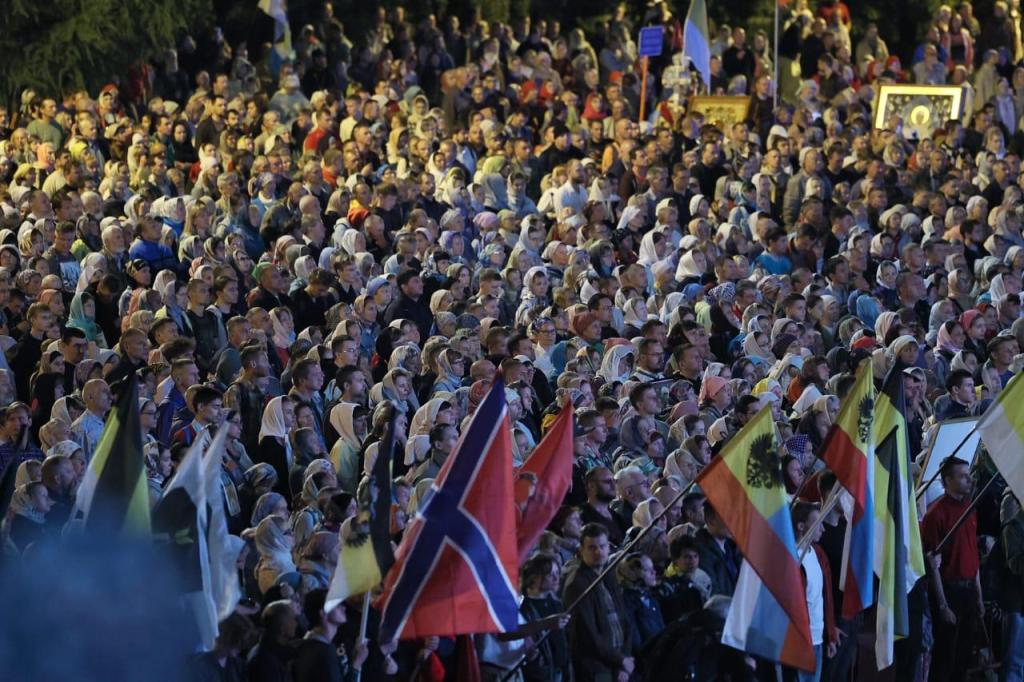
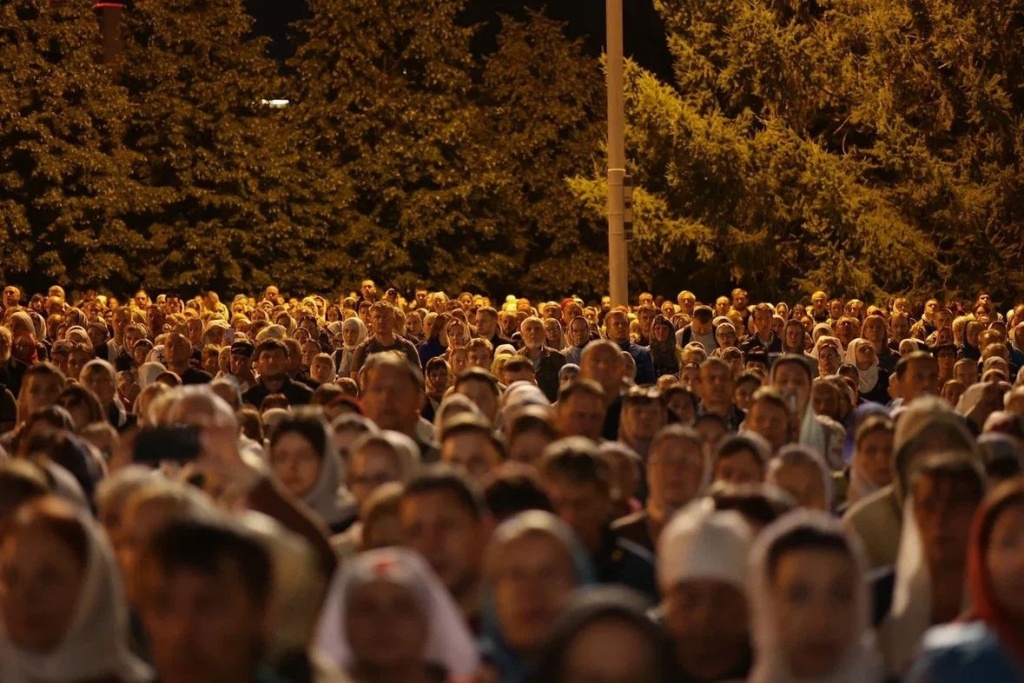
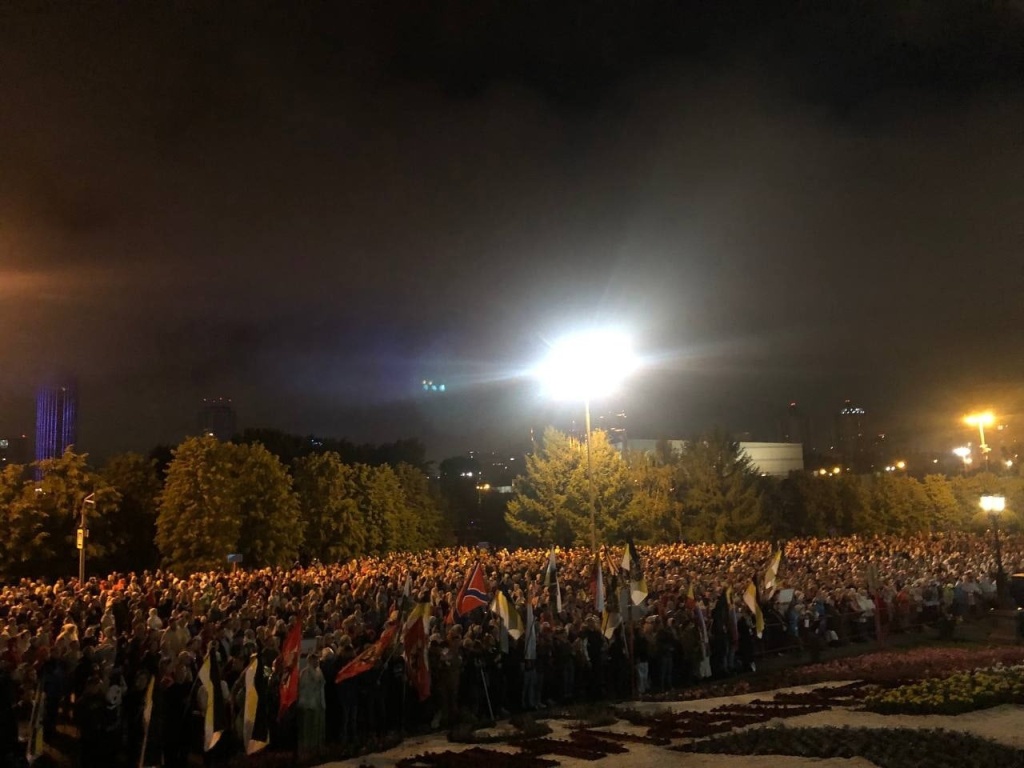
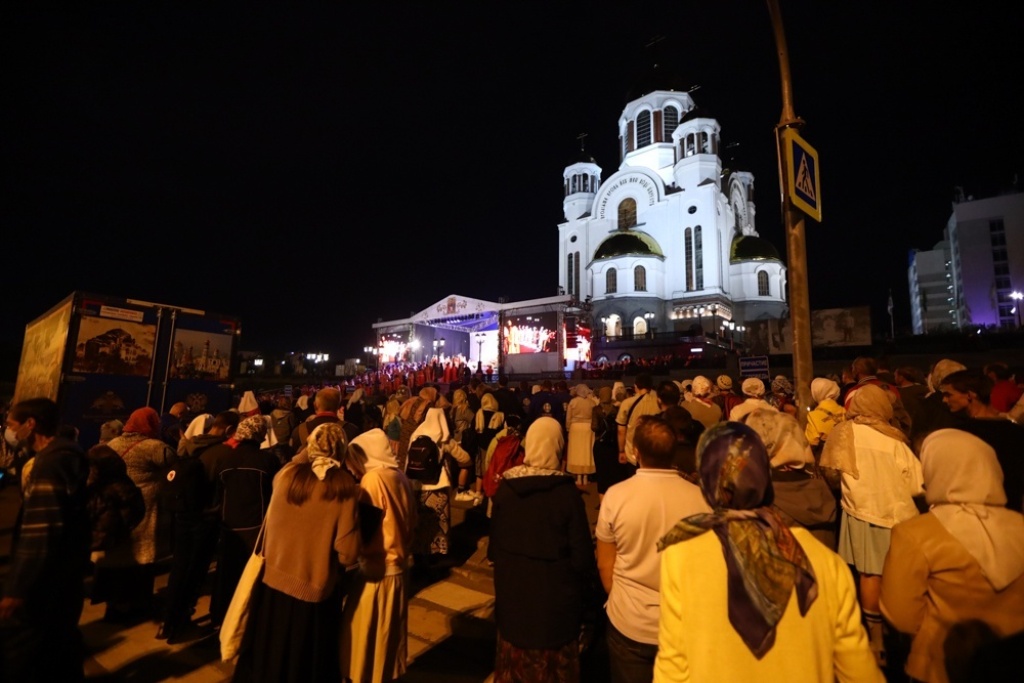
PHOTO: 40,000 faithful gathered for the Divine Liturgy on the square in front of the Church on the Blood for the Divine Liturgy in Ekaterinburg
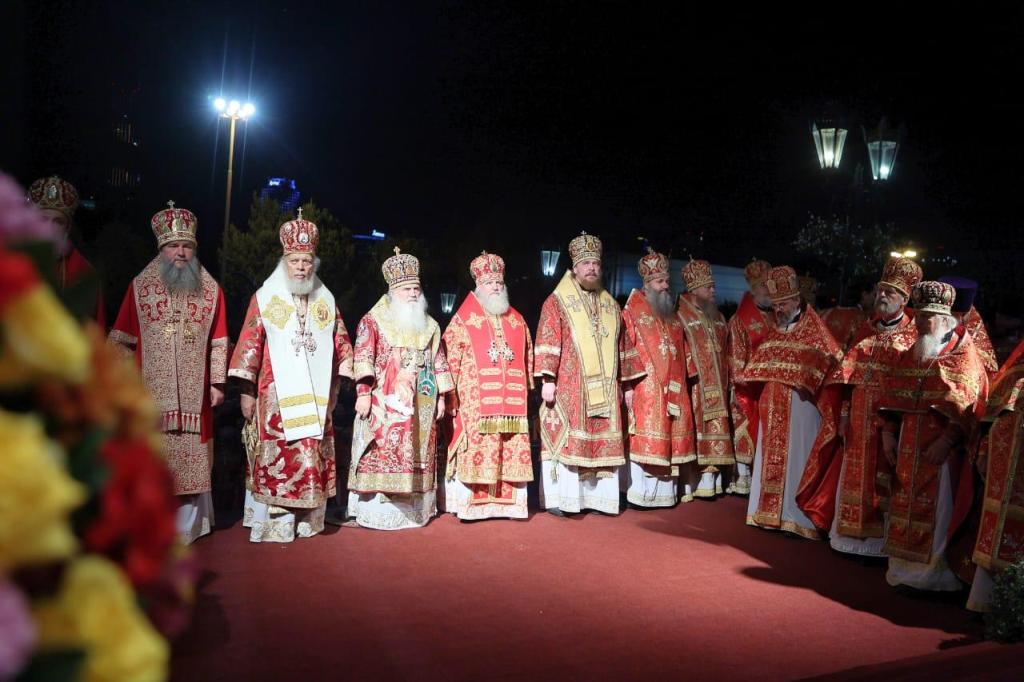
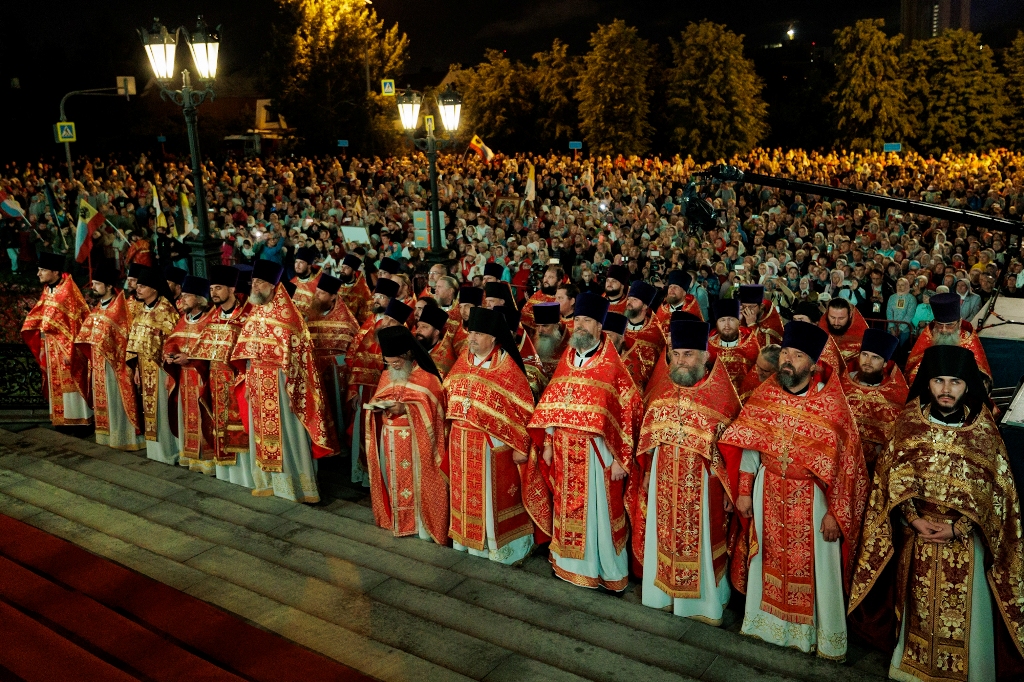
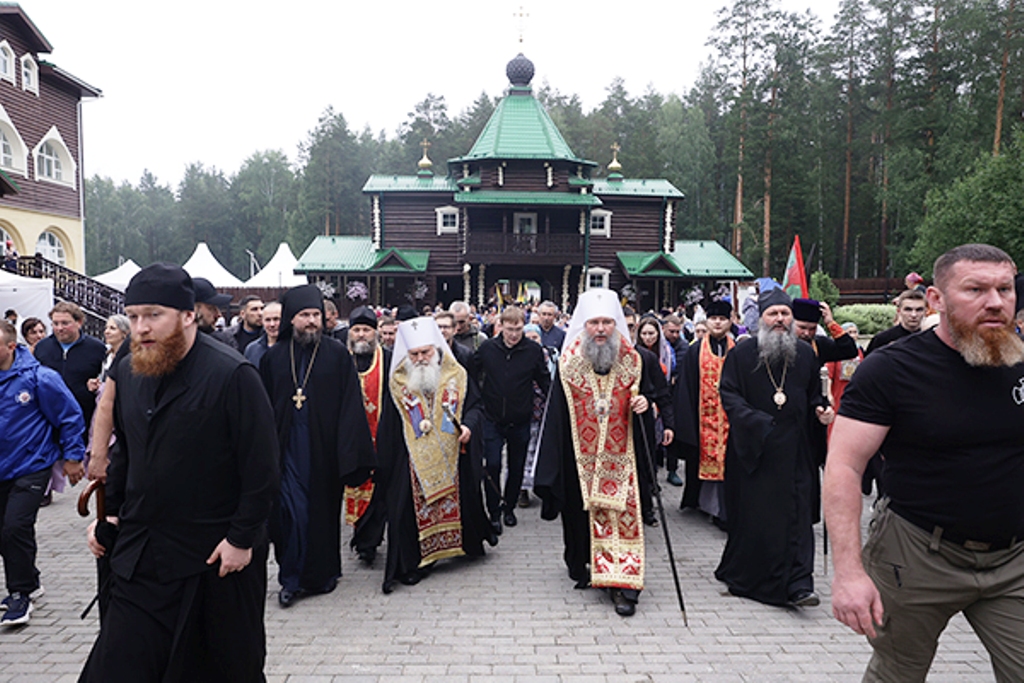
PHOTO: this year’s outdoor Divine Liturgy was performed by 12 Orthodox bishops
Prior to the outdoor service, a Divine Liturgy in honour of Emperor Nicholas II and his family was performed in the Imperial Room,[1] situated in the Lower Church of the Church on Spilled Blood. Twelve bishops took part, including Metropolitan Vincent of Tashkent and Uzbekistan, Head of the Central Asian Metropolitan District, Representative of the Patriarch of Antioch and All the East to the Patriarch of Moscow and All Russia, Metropolitan Niphon of Philippopolis, Metropolitan Kirill of Kazan and Tatarstan, Metropolitan Eugene of Yekaterinburg and Verkhoturye, Metropolitan Alexy of Chelyabinsk and Miass, Bishop Anthony of Moravichi, Bishop Theodosius of Isilkul and Russo-Polyansky, Bishop Theodosius of Nizhny Tagil and Nevyansk, Bishop Methodius of Kamensk and Kamyshlov, Bishop Vladimir of Shadrinsky and Dalmatovsky, Bishop Vincent of Zlatoust and Satka, Bishop Leonid of Argentina and South America.
The outdoor Divine Liturgy began at 11:30 pm on the square in front of the Church on the Blood, also led by 12 bishops. In addition, representatives of the local Orthodox Churches — Antioch, Serbian, Czech, American — also prayed, some of the prayers were performed in several languages. Abbots and abbesses, monastics, who came to honour the memory of the Holy Royal Martyrs from various monasteries, prayed during the service.
It is sad to note that not a single descendant of the Romanov Dynasty attended this year’s Divine Liturgy, including Princess Maria Vladimirovna nor her son Prince George Mikhailovich-Hohenzollern, the latter of which lives in Moscow with his wife and son.
VIDEO: click on the above image to watch the Cross Procession from the Church on the Blood in Ekaterinburg to the Monastery of the Holy Royal Martyrs at Ganina Yama on 17th July 2023. Duration:
Cross Procession to Ganina Yama
At 3:00 am, tens of thousands of people—including clergy and laity from all over the Russian Federation and beyond began the 21km [13 miles] Cross Procession – headed by Metropolitan Yevgeny of Yekaterinburg and Verkhoturye and other archpastors – from the Church on the Blood to the Monastery of the Holy Royal Martyrs at Ganina Yama[2].
The column of faithful pilgrims covered the route on foot – part of which was in the rain in about 5 hours. Together in unison, they chanted the prayer, “Lord Jesus Christ, Son of God, have mercy on us!”. They were accompanied by ten mobile groups from the Orthodox Charity Service and Tsar’s Days volunteers.
Upon arrival at the monastery at Ganina Yama, a moleben was served at the “heart” of the monastery—the mineshaft where the Imperial family’s remains were thrown after they had been brutally murdered by the Bolsheviks.
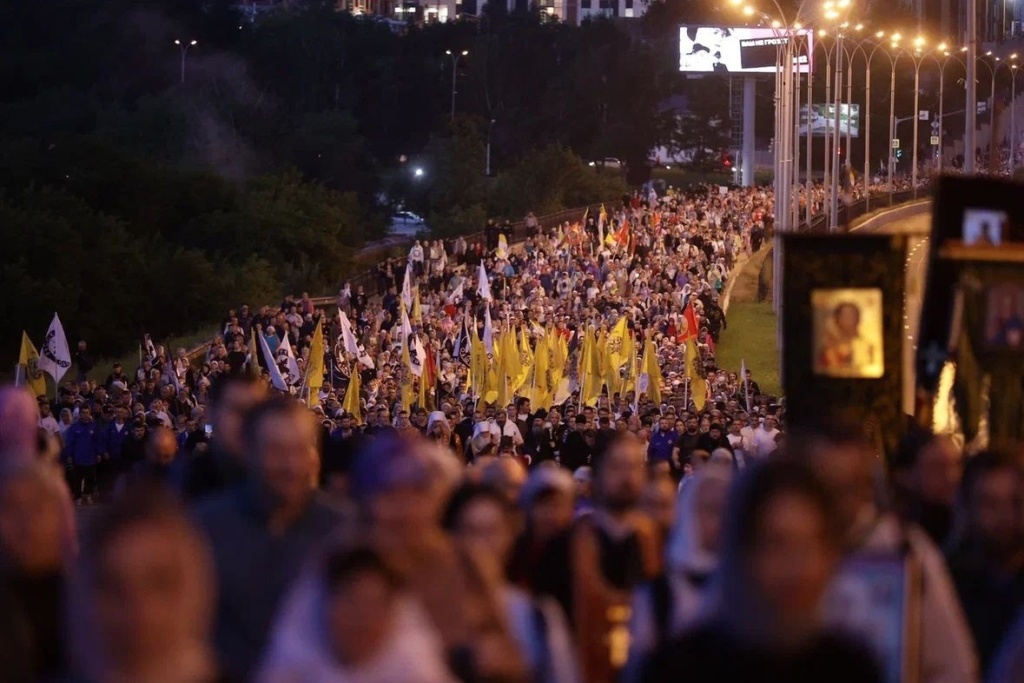
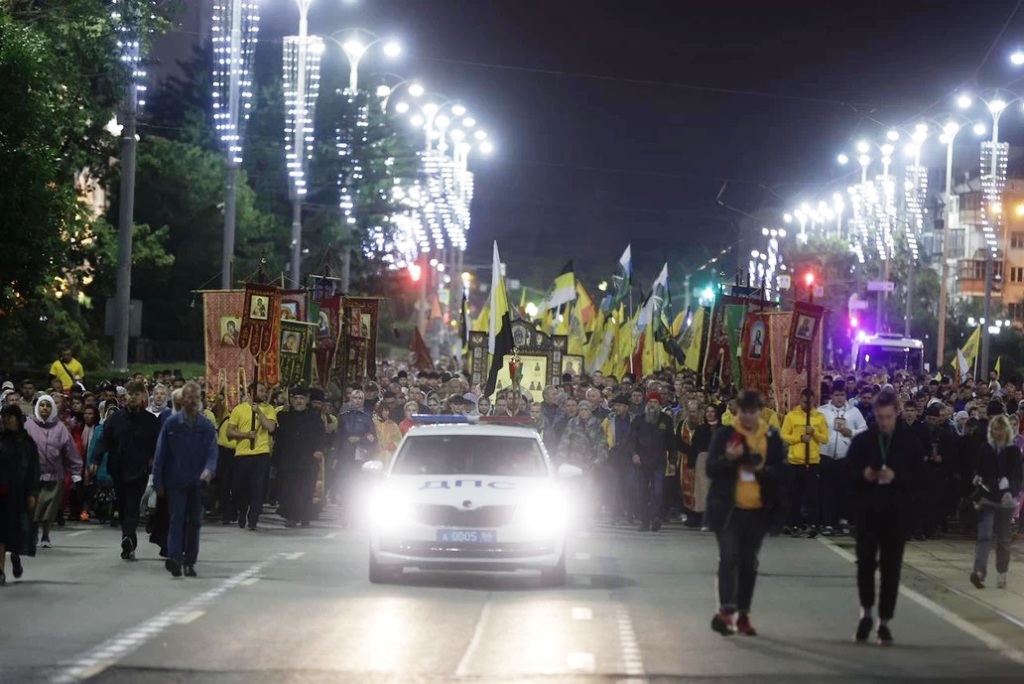
PHOTO: tens of thousands of people took part in the 21km Cross Procession from the Church on the Blood in Ekaterinburg to the Monastery of the Holy Royal Martyrs at Ganina Yama
PHOTO: the Cross Procession winded its way through the streets of the Ural capital in the early morning hours of 17th July
PHOTO: it took about 5 hours for the column of faithful to arrive at the Monastery of the Holy Royal Martyrs at Ganina Yama
PHOTO: Together in unison, they chanted the prayer, “Lord Jesus Christ, Son of God, have mercy on us!”
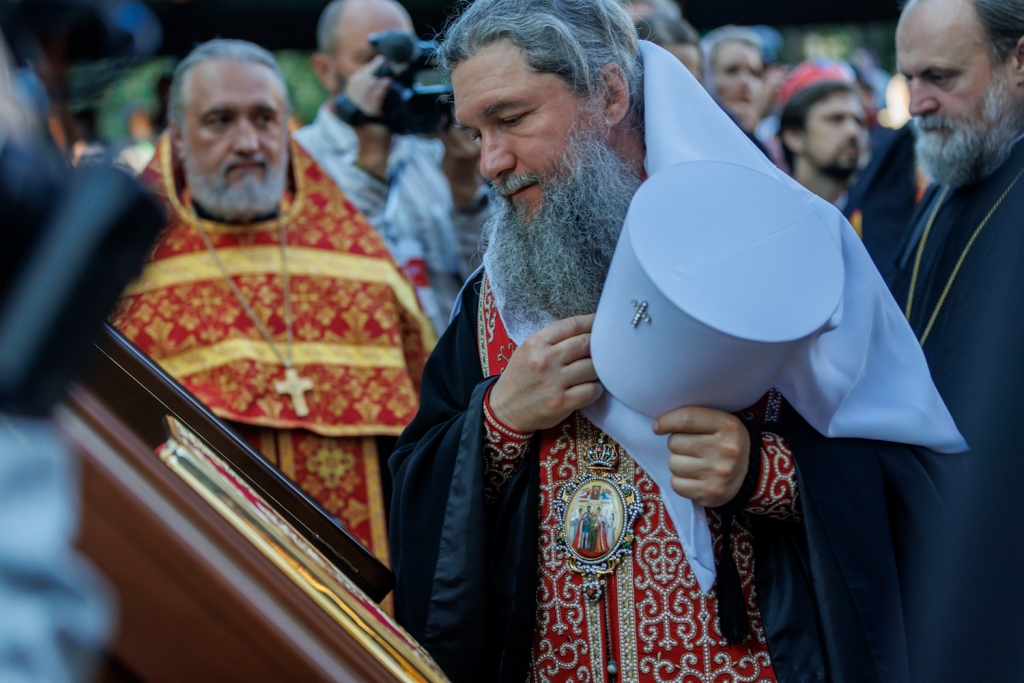
PHOTO: Metropolitan Yevgeny of Yekaterinburg and Verkhoturye (center) and other archpastors arrived at the Monastery of the Holy Royal Martyrs at Ganina Yama
His Eminence Evgeny[3] thanked all those who participated, and said a few words about the Imperial Family and their memory.:
“I wish that you would tell your close ones about this, so that in future years even more of you would come, and thus testify to our love for the Imperial family and our desire to receive their blessing upon our world, upon our unity, upon the sanctity of family life, and for peace and prosperity in our Russian land.”
“A lot of churches are dedicated to the Imperial Family. Over the past 30 years, hundreds of churches have been erected in Russia in the name of the Holy Royal Passion-Bearers[4]. And in every place where their temple stands, there are a lot of people. If we saw today all those who revere the Imperial family, then, it is possible, that their numbers would be more than the population of the whole of Ekaterinburg,” the metropolitan added.
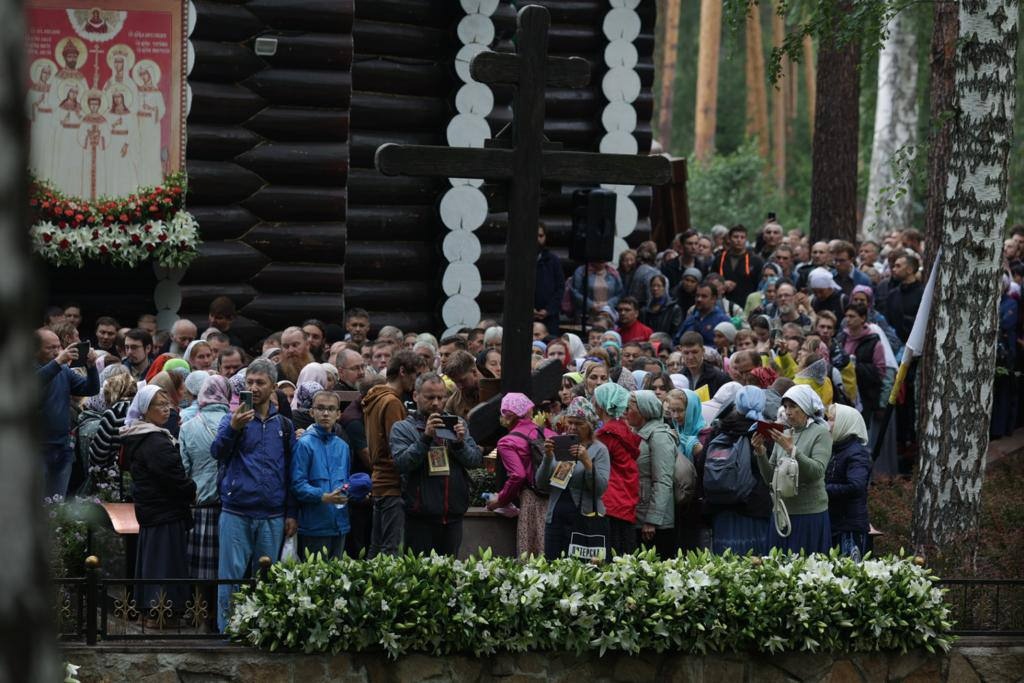
PHOTO: pilgrims gather around the “heart” of the monastery—the mineshaft where the Imperial family’s remains were thrown after they had been brutally murdered by the Bolsheviks
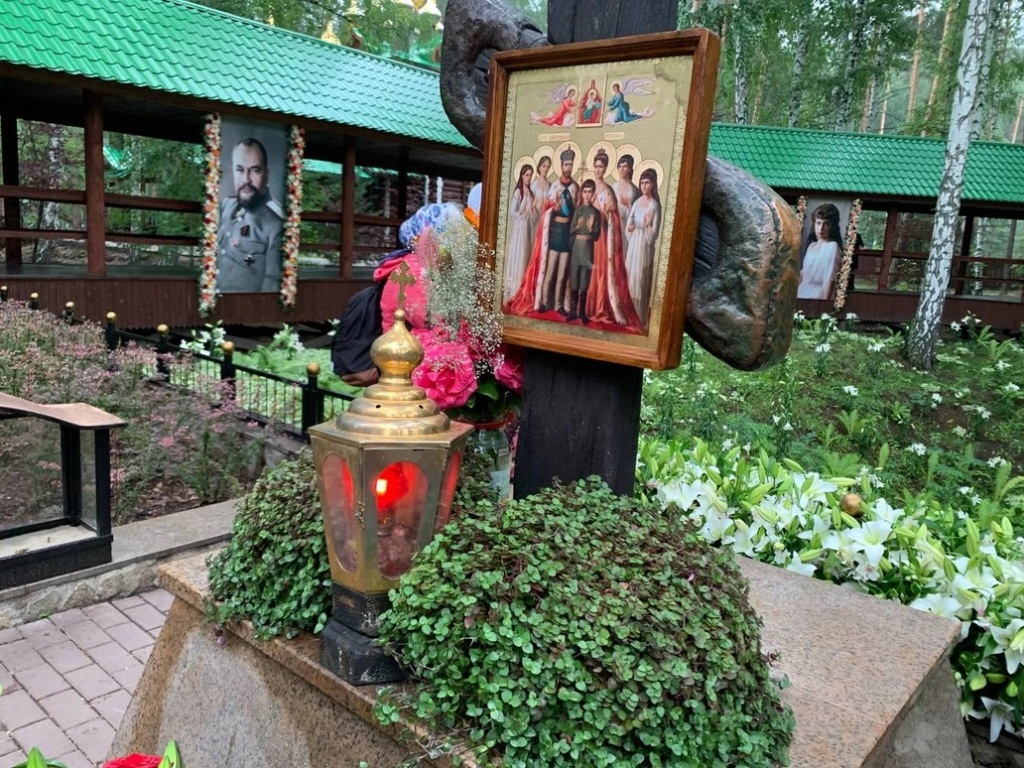
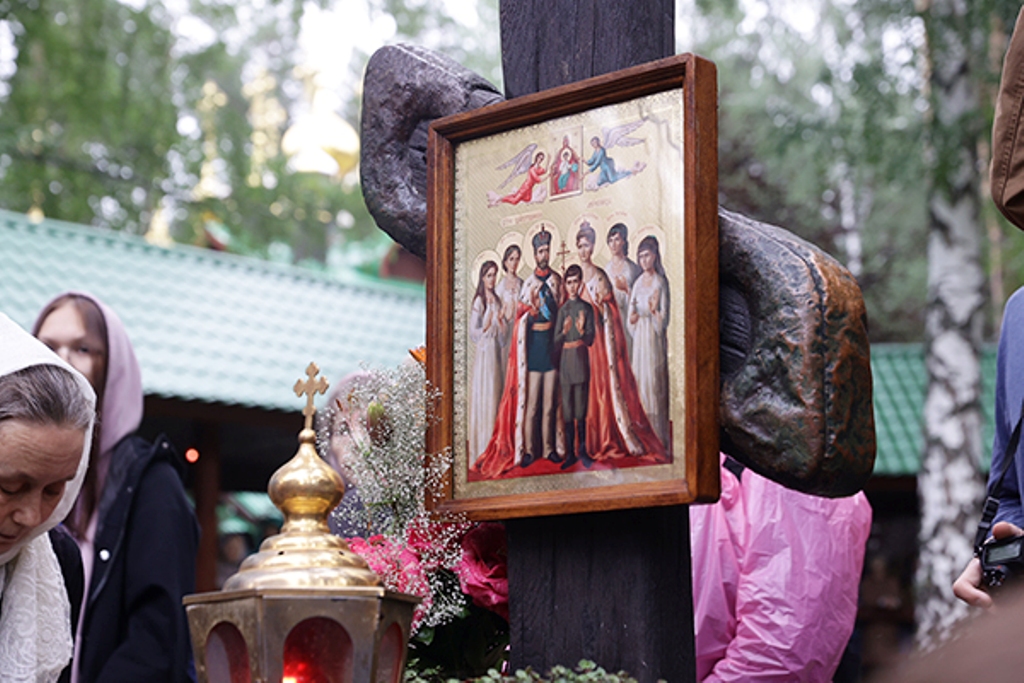
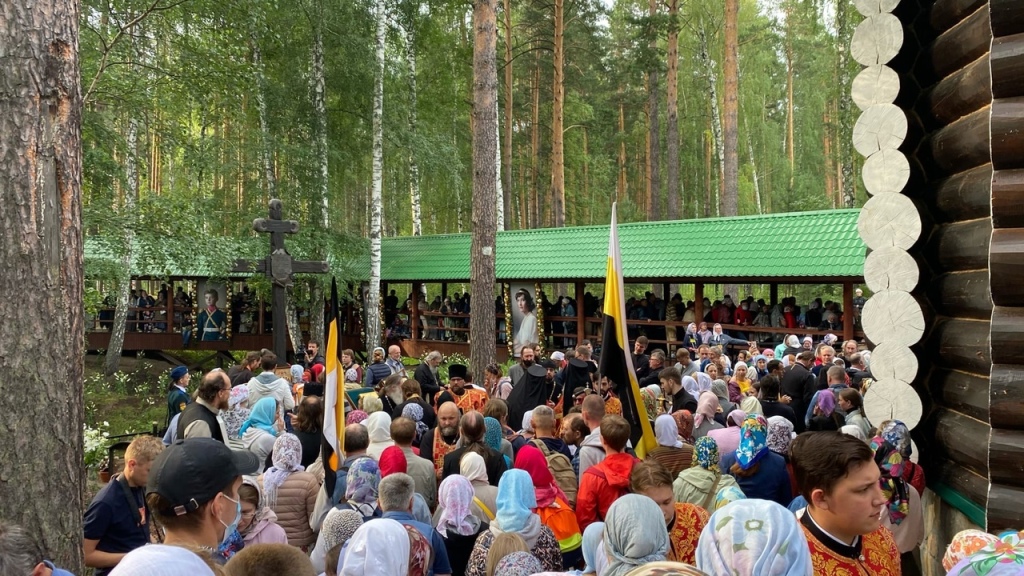
PHOTO: a large wooden Orthodox cross marks the location of the now collapsed mineshaft where the Imperial Family’s remains were first disposed of by the regicides
PHOTO: a simple icon depicting the Holy Royal Martyrs mounted on the large wooden cross
“Ekaterinburg is connected with the Imperial Family, because it was from here that they ascended to the Heavenly abodes, and therefore the people honour them. I think our city stands thanks to the prayers of a whole family of righteous saints, the holy Royal Family,” His Eminence Metropolitan Evgeny of Ekaterinburg said.
“Tsar’s Days are a special phenomenon in the history of our Church, our country, because Tsar’s Days are our repentance before the Holy Royal Family, before the Holy Tsar-Martyr,” added Dr. Peter Multatuli, who has been researching and writing about the life and reign of Russia’s last Tsar since the early 1990s.
“What is repentance? Repentance is a change, we must radically change our view, our attitude towards the Sovereign-Emperor and his family, who were murdered by the Bolsheviks. For me, the procession is my moral duty,” Multatuli said, adding that his great-grandfather Ivan Mikhailovich Kharitonov (1872-1918), the senior chef of the Imperial Family, was killed together with the Holy Royal Martyrs, “which, of course, makes these days also a family affair for me.”
Holy Royal Martyrs, pray to God for us! 🙏 Святы Царственные мученики, молите Бога о нас! 🙏 ☦️
NOTES:
[1] The altar of the Imperial Room is situated in the Lower Church sanctified in honour of the Holy Royal Martyrs. It was established on the site of the room located in the basement of the Ipatiev House, where Emperor Nicholas II, his family, and four retainers were all brutally murdered in the early morning hours of 17th July 1918.
There is some dispute about whether this sanctuary stands in the spot of the murder room. It is believed that it was not possible to build on the exact spot due to construction issues, and that the actual spot of the murder room lies outside the church along its wall.
As one of my Russian Orthodox friends correctly pointed out: “Whether it is in the exact spot or not to me is irrelevant as when you are in that room, you are spiritually in the exact place it happened”.
[2] Once again, Porosenkov Log was not included in this year’s Cross Procession.
Porosenkov Log is where the remains of the Imperial family were unearthed in two separate graves in 1991 and 2007 respectively. Due to the fact that the Moscow Patriachate does not yet recognize the Ekaterinburg Remains as those of the Imperial Family. Their official recognition rests with the Bishops’ Council of the Russian Orthodox Church.
[3] Metropolitan Yevgeny of Yekaterinburg and Verkhoturye (born Alexei Sergeyevich Kulberg; born 25th September 1972, Moscow). From 9th October 2017 to 15th October 2018, he served as abbot of the Monastery of the Holy Royal Martyrs at Ganina Yama. On 8th December 2020, by the decision of the Holy Synod, he was elected Bishop of Yekaterinburg and Verkhoturye. On December 25, 2020, Patriarch Kirill of Moscow and All Russia elevated Bishop Eugene of Yekaterinburg and Verkhoturye to the rank of Metropolitan.
[4] On 1st November 1981, Emperor Nicholas II and his family were canonized as new martyrs by the Russian Orthodox Church Outside Russia (ROCOR). On 20th August 2000, after much debate, they were canonized as passion bearers by the Moscow Patriarchate
The Moscow Patriarchate canonized the family as passion bearers: people who face death with resignation, in a Christ-like manner, as distinguished from martyrs, the latter historically killed for their faith. Proponents cited the piety of the family and reports that the Tsarina and her eldest daughter Olga prayed and attempted to make the sign of the cross immediately before they died.
The term “passion-bearer” is used in relation to those Russian saints who, “imitating Christ, endured with patience physical, moral suffering and death at the hands of political opponents. In the history of the Russian Church, such passion-bearers were the holy noble princes Boris and Gleb (1015), Igor of Chernigov (+ 1147), Andrei Bogolyubsky (+ 1174), Mikhail of Tverskoy (+ 1318), Tsarevich Dimitri (+ 1591). All of them, by their feat of passion-bearers, showed a high example of Christian morality and patience.
Despite their official designation as “passion-bearers” by the August 2000 Council, Nicholas II and his family are referred to as “martyrs” in Church publications, icons, and in popular veneration by the people.
I have published more than 30 titles to date through AMAZON – featuring one of the largest selections of books on Nicholas II, the Romanov dynasty and the history of Imperial Russia.
The net proceeds from the sale of each book help fund my research in clearing the name of Russia’s much slandered Tsar.
Please CLICK on the BANNER or LINK above to review my current selection of titles in hardcover, paperback and ebook editions. Listings provide a full description for each title, pricing and a Look inside feature.
From 12th to 20th July, the 22nd annual Tsar’s Days will be held in the Urals [Ekaterinburg and Alapaevsk], which includes a series of solemn events [16th to 18th July] dedicated to Emperor Nicholas II and his family, who met their death and martyrdom in Ekaterinburg 104 years ago, on 17th July 1918.
The main events are the night Divine Liturgy, which is performed on the square in front of the Church on the Blood, built on the site of the Ipatiev House, where members of the Imperial Family and their faithful subjects ended their earthly days, and the 21-km [13 miles] Cross Procession to the Monastery of the Holy Royal Martyrs at Ganina Yama, on the site of which the regicides first disposed of the Imperial family’s remains, before returning the following day to exum thre remains and bury them in two separate graves at *Porosenkov Log.
On 18th July, similar events will be held in Alapaevsk, where 8 additonal members of the Romanov dynasty and their faithful servants [see below] met their death and martydom.
The Ekaterinburg Martyrs– 11 victims
Emperor Nicholas II, Empress Alexandra Feodorovna, Grand Duchesses Olga, Tatiana, Maria, Anastasia, Tsesarevich Alexei Nikolaevich, and their four faithful retainers Dr. Eugene Botkin (court physician), Alexei Trupp (footman), Ivan Kharitonov (cook), and Anna Demidova (Alexandra’s maid).
The Alapaevsk Martyrs– 8 victims
Grand Duchess Elizabeth Feodorovna, Grand Duke Sergei Mikhailovich, Princes of the Imperial Blood Ioann, Konstantin and Igor Konstantinovich, Prince Vladimir Paley (son of Grand Duke Paul Alexandrovich), and two faithful servants: sister of the Marfo-Mariinsky Convent Varvara Alekseevna (Yakovleva), and Fyodor Semyonovich (Mikhailovich) Remez, secretary of the Grand Duke Sergei Mikhailovich.
In addition, the XXI International Festival of Orthodox Culture will be held in Ekaterinburg from 12th-20th July. The festival features many events in honour of the Holy Royal Martyrs, including divine services, religious processions, exhibitions, concerts, conferences and other events.
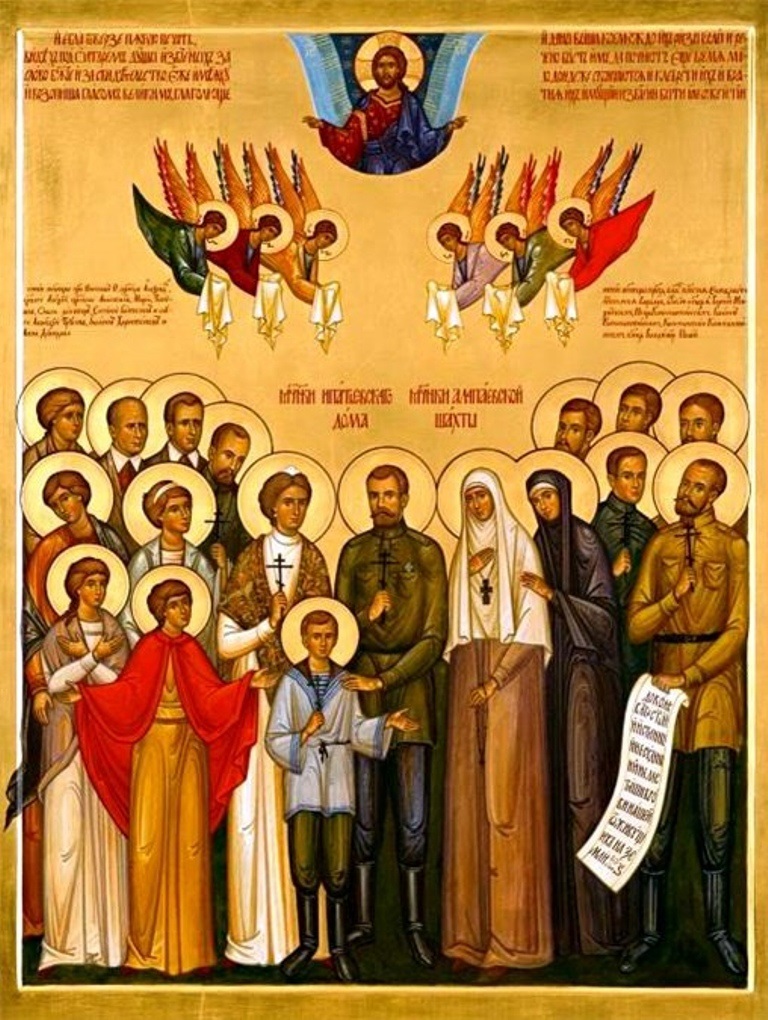
PHOTO: icon depicting the Ekaterinburg and Alapaevsk Martyrs
SERVICE CALENDAR
July 16, Saturday
09:00 – Divine Liturgy at the altar of the Holy Royal Martyrs, situated in the Lower Church of the Church on the Blood in Ekaterinburg.
13:00 — Cross procession along the route in which the Holy Royal Martyrs travelled upon arriving in Ekaterinburg [from Tobolsk] on 30th April 1918, from the Shartash Train Station [Kuibysheva street, 149-a] to the Church on the Blood. Route: [Tsarskaya street, 10] along the route: railway station Shartash – Kuibyshev street – Vostochnaya street – Chelyuskintsev street – Sverdlov street – K. Liebknecht street).
15:00 – Small Vespers with Akathist to the Holy Royal Martyrs. Confession. In the Lower Church of the Church on the Blood.
16:30-20:00 – All-night vigil, on the square in front of the Church on the Blood.
17:00-20:00 – All-night vigil, at the Monastery of the Holy Royal Martyrs at Ganina Yama.
23:30-02:00 – Divine Liturgy, on the square in front of the Church on the Blood.
July 17, Sunday
~ 02:30 – Traditional 21-km [13 miles] Cross Procession from the Church on the Blood to the Monastery of the Holy Royal Martyrs at Ganina Yama Route: Tsarskaya street, 10 – st. Tolmacheva – Lenin Ave. – V. Isetsky Boulevard – st. Kirov – st. Bebel – st. Technical – st. Reshetskaya – Railway forest park – pos. Shuvakish – Ganina Yama.
Upon the arrival of the procession, a Liturgy to the Holy Royal Martyrs will be performed at the Field kitchen.
06:00 – Divine Liturgy (early). Church on the Blood. In the Lower Church, altar at the site of the martyrdom of the Holy Royal Martyrs aka the Imperial Room [built on the site of the murder room, located in the basement of the Ipatiev House].
09:00 – Divine Liturgy (late). Church on the Blood, Upper Church
09:00 – Divine Liturgy. Monastery of the Holy Royal Martyrs at Ganina Yama.
17.00 – All-night vigil. Church of St. Sergius of Radonezh, at Ganina Yama.
17.00 – All-night vigil. Monastery in the Name of the Holy New Martyrs and Confessors of the Russian Church, Alapaevsk.
02:30 – Small Vespers with Akathist to the Holy Royal Martyrs Grand Duchess Elizabeth Feodorovna and nun Varvara. Holy Trinity Archbishop’s Compound, Alapaevsk.
03:30 – Procession from the Holy Trinity Bishops’ Metochion to the Napolnaya School [where Grand Duchess Elizabeth along with other members of the Imperial family and their servants were held under arrest] and further to the Monastery in the Name of the Holy New Martyrs and Confessors of the Russian Church, Alapaevsk.
05:30 – Divine Liturgy (early). Monastery in the Name of the Holy New Martyrs and Confessors of the Russian Church, Alapaevsk.
09:00 – Divine Liturgy (late). Monastery in the Name of the Holy New Martyrs and Confessors of the Russian Church, Alapaevsk.
Tsar’s Days in the 21st century
The first procession in memory of the Holy Royal Martyrs, headed by Metropolitan of Ekaterinburg and Verkhoturye Kirill, took place in 2002, in which more than 2 thousand pilgrims and about 100 clerics participated. In 2012, for the first time since the construction of the Church on the Blood in Ekaterinburg, an all-night vigil and Divine Liturgy were performed in the open air.
In 2017 an estimated 60,000 people took part; in 2019, 60 thousand participated; in 2020, 10 thousand people [due to COVID], and in 2021, 3 thousand people [once again, due to COVID]. In addition, up to 2 thousand people gathered an alternative religious procession of the schismatic and tsarist monk Sergius (Romanov) in the Sredneuralsk Convent in Honour of the Icon of the Blessed Virgin Mary.
In 2018, more than 100,000 Orthodox Christians, monarchists, among others from across Russia and around the world took part in the Patriarchal Liturgy and procession of the cross from the Church on the Blood to the Ganina Yama.
*NOTE: due to the fact the Moscow Patriachate does not yet recognize the Ekaterinburg Remains as authentic, the Cross Procession does not stop at Porosenkov Log, where the remains of the Imperial family were unearthed in two separate graves in the late 1970s and 2007.
The Holy Synod of the Russian Orthodox Church (ROC) have confirmed that the Bishops’ Council, will meet in Moscow at the end of 2022, during which they will review the findings of the Investigative Commission and deliver their verdict on the authenticity of the Ekaterinburg Remains.
If you enjoy my articles, news stories and translations, then please help support my research by making a donation in US dollars to my project The Truth About Nicholas II – please note that donations can be made by PayPal or credit card. Thank you for your consideration – PG
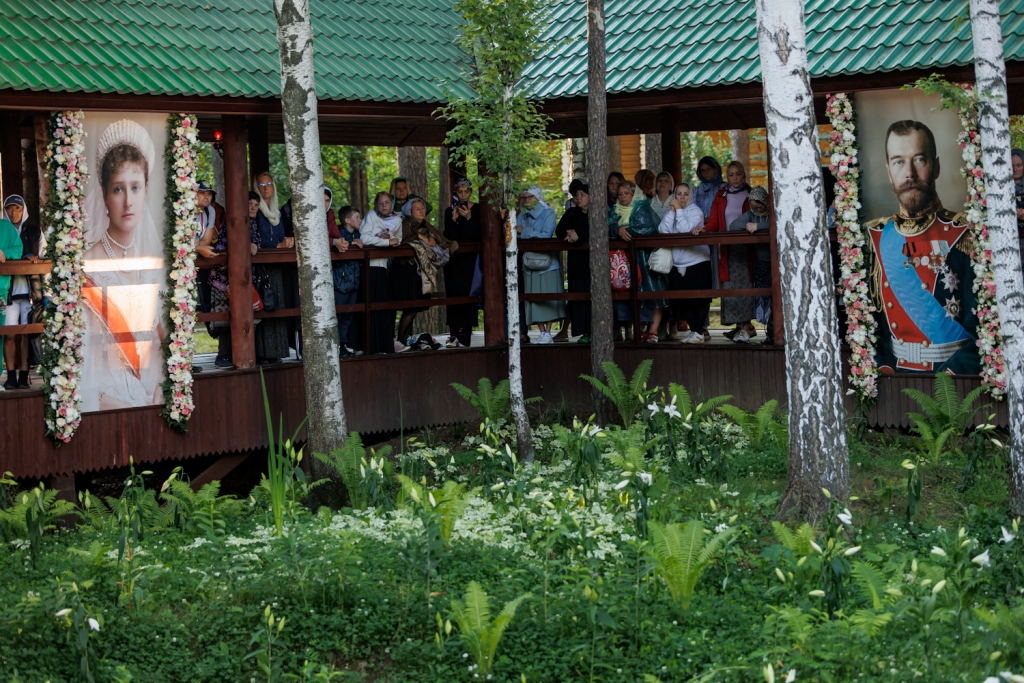
PHOTO: members of the Double-Headed Eagle Society carry an icon of the Holy Tsar-Martyr Nicholas II on the square in front of the Church on the Blood in Ekaterinburg
On the night of 16/17 July, a Divine Liturgy in memory of the Holy Royal Martyrs, took place on the square in front of the Church on the Blood in Ekaterinburg. The Divine Liturgy and Cross Procession are the highlights of the annual Tsar’s Days held in the Ural capital.
Traditionally, several tens of thousands of people participate in the Tsar’s Cross Procession – 10 thousand in 2020 [due to COVID], 60 thousand in 2019 and 100 thousand in 2018 [100th anniversary]. Despite the pandemic, an estimated 3 thousand Orthodox Christians and monarchists took part in this year’s Divine Liturgy.
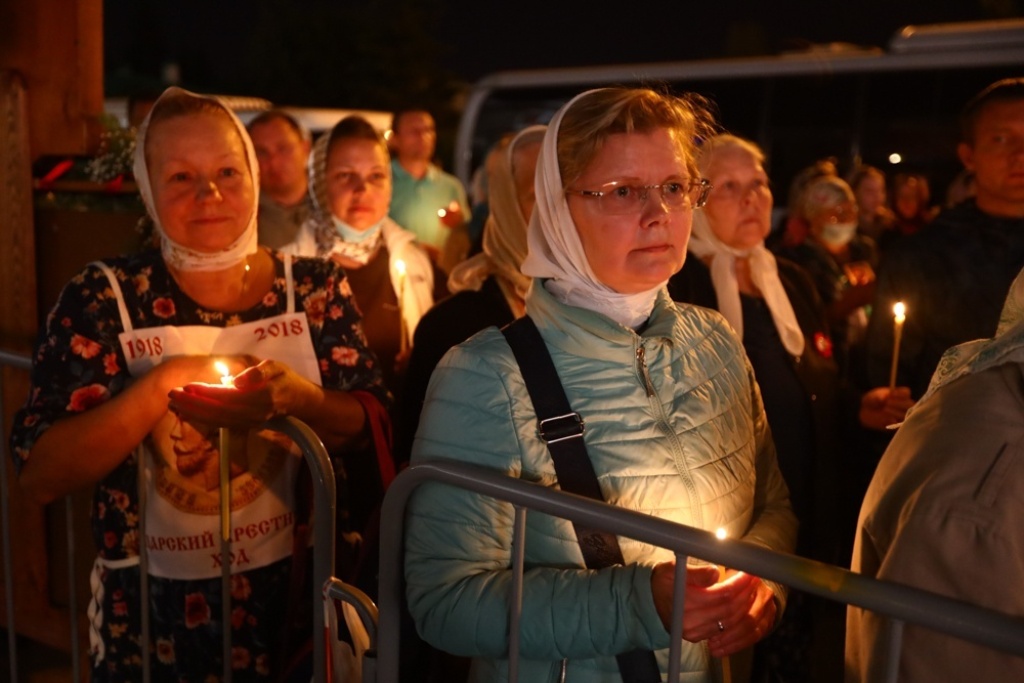
PHOTO: on the night of 16th July 2021, an estimated 3 thousand pilgrims attended the Divine Liturgy at the Church on the Blood in Ekaterinburg
In addition, the memory of the Holy Royal Martyrs was honoured with Divine Liturgies held in Orthodox churches across Russia and around the world. In addition, many people lit candles in front of icons, while offering prayers in the privacy of their homes around the globe. The author of this article was one of them.
The Divine Liturgy was led by eight bishops of the Russian Orthodox Church: Metropolitan Eugene of Yekaterinburg and Verkhotursky, Metropolitan of Tashkent and Uzbekistan Vikentiy, Metropolitan of Chelyabinsk and Miassky Alexy, Bishop of Orsk and Gaysky Irenaeus, Bishop of Isilkul and Russian-Polyansky, Bishop Theodosius of Nizhny Novgorod and Nizhny-Polyan Kamyshlovsky Methodius, Bishop of Zlatoust and Satka Vincent.
PHOTO: Orthodox Christians gather on the square in front of the Church on the Blood to honour the memory of the Holy Royal Martyrs
Metropolitan Eugene addressed the faithful, who had assembled on the square in front of the church:
“The sacred, solemn, tragic, joyful night has come, which we call the Tsar’s night within the Tsar’s Days. A night that combines in itself the tragedy of Good Friday, the Gethsemane struggle that the Holy Royal Martyrs experienced at this place. And on the same night, the great joy of the Resurrection of Christ and the glory into which the Holy Royal Martyrs entered from this place is revealed. All this is experienced very closely by every person, and we have the opportunity to draw here both the hope of the resurrection and our strength to endure these Gethsemane temptations.
“At this time 103 years ago, the August Family, having prayed to God, saying: “In Thy hands, O Lord, I commend my spirit,” just like we do when to go to sleep. And after a few minutes, footsteps sounded along the corridors, they began to be raised, woken up and taken to the basement. We know today what glory it ended with. And I would like to wish everyone to be inspired by their faith, humility and patience,” – said Metropolitan Eugene.
The night service was broadcast live by the Soyuz Orthodox TV channel to 87 countries around the world. You can watch the Divine Liturgy in its entirety, by clicking on the VIDEO below, duration 2 hours and 41 minutes:
Vladyka conveyed to the participants in the Divine Liturgy the blessing of His Holiness Patriarch Kirill to be attentive to each other and to observe all the necessary health and safety measures during the pandemic. He called on everyone to pray for the sick and also for their doctors. Metropolitan Eugene also emphasized, that when the Cross Procession to Ganina Yama begins, “I will put on a mask and, which I hope, will set a good example so that we all show humility – this is our discipline, this is our strength.”
Following the Divine Liturgy, a Cross Procession took place from the Church on the Blood to the Monastery of the Holy Royal Martyrs at Ganina Yama. Pilgrims follow the route in which the bodies of the Imperial Family were transported to Ganina Yama – a distance of 26 km (16 miles), taking about four to five hours to walk on foot.
PHOTO: in the early morning hours of 17th July 2021, an estimated 2 thousand pilgrims participated in a Cross Procession from the Church on the Blood to the Monastery of the Holy Royal Martyrs at Ganina Yama
Due to the fact that the Governor of the Sverdlovsk Region cancelled this years Cross Procession (due to the COVID situation), the head of the Ekaterinburg Diocese, Metropolitan Eugene of Ekaterinburg and Verkhotursky defied the order, and led 2 thousand believers on today’s Cross Procession to Ganina Yama. This year, however, the roads were not closed to traffic, forcing the pilgrims to walk on narrow sidewalks and the shoulder of the highway to safely make the journey.
PHOTO: pilgrims arrive on foot at the Monastery of the Holy Royal Martyrs at Ganina Yama, after walking a distance of 26 km (16 miles) from the Church on the Blood, a journey taking about four to five hours
At approximately 6:30 am, another Divine Liturgy was performed at Mine No. 7, where the bodies of members of the Imperial Family and their loyal servants were thrown into the mineshaft by their killers. More than 80 clergymen prayed together with the arch-pastors of the Russian Orthodox Church.
PHOTO: Divine Liturgy was led by Metropolitan Eugene of Yekaterinburg and Verkhoturye at the Cross, erected over Mine No. 4, where the bodies of the Holy Royal Martyrs were thrown by their killers into an abandoned mine
The Divine Liturgy was led by Metropolitan Eugene of Yekaterinburg and Verkhoturye, Metropolitan of Tashkent and Uzbekistan Vikenty, Bishop of Isilkul and Russian-Polyansky Theodosius, Bishop of Nizhny Tagil and Nevyansk Theodosius.
Holy Royal Martyrs, pray to God for us! 🙏 Святы Царственные мученики, молите Бога о нас! 🙏
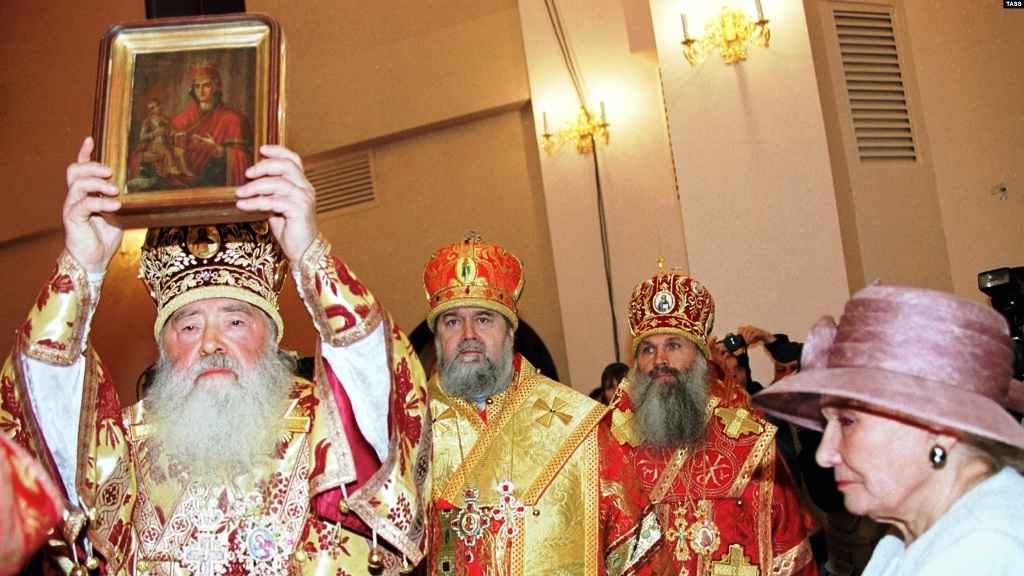
PHOTO: Olga Nikolaevna Kulikovskaya-Romanova (right), solemnly handed over the Icon of the Most Holy Theotokos “Three-handed” to the Church on Blood in Ekaterinburg on 10th July 2003
Today – 11th July – the feast of the Icon of the Most Holy Theotokos “Three-handed” – a miraculous icon revered in the Orthodox Church – is being celebrated in the Church on the Blood in Ekaterinburg.
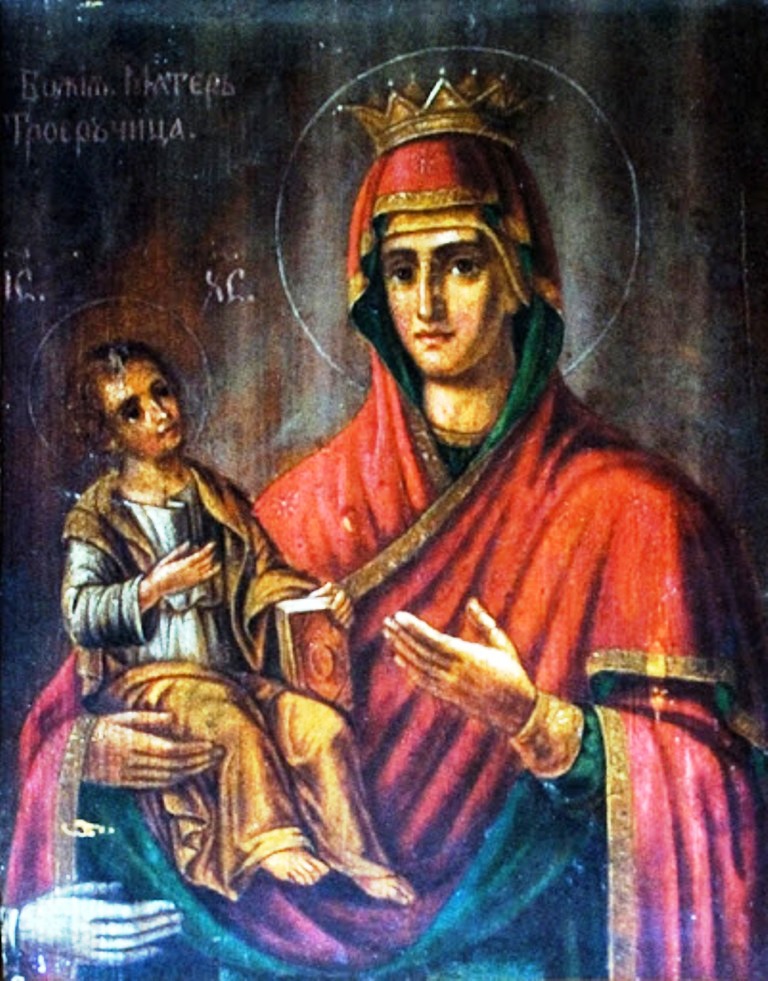
During their house arrest in the Ipatiev House from April to July 1918, the Imperial Family had an Icon of the Most Holy Theotokos “Three-handed”, before which they prayed daily, until their death and martyrdom on 17th July 1918.
The Imperial Family’s icon was discovered following the regicide in the Ipatiev House by a Guards officer who personally knew Grand Duchess Olga Alexandrovna (1882-1960) and her husband Nikolai Kuikovsky (1881-1958). Later, the icon traveled with Admiral Alexander Kolchak’s (1874-1920) army and Russian emigrants, through China to the United States and Canada. In the early 1920s, through the efforts of officers devoted to Emperor Nicholas II, it was taken to Denmark and presented to the Dowager Empress Maria Feodorovna (1847-1928). Passing from generation to generation, the icon remained in the Romanov family until 2003: upon the Dowager Empress’s death in 1928, the icon passed to her youngest daughter Grand Duchess Olga Alexandrovna , then passing to her eldest son Tikhon in 1960.
In the year marking the 85th anniversary of the death and martyrdom of the Imperial Family, Olga Nikolaevna Kulikovskaya-Romanova (1926-2020) took part in the consecration of the Church on the Blood in Ekaterinburg, erected on the site of the Ipatiev House, demolished in 1977. In addition and according to the last will and testament of her husband and nephew of Nicholas II Tikhon Nikolaevich Kulikovsky, Olga Nikolaevna brought from Canada the Icon of the Most Holy Theotokos “Three-handed”.
PHOTO: the Icon of the Most Holy Theotokos “Three-handed” of which the Imperial Family prayed to daily, during their house arrest in Ekaterinburg from April to July 1918
By the Providence of God, on the night of 10th July 2003, Olga Nikolaevna Kulikovskaya-Romanova, solemnly handed over the Icon of the Most Holy Theotokos “Three-handed” to the Church on Blood in Ekaterinburg, built on the site of the demolished Ipatiev House, where the Holy Royal Martyrs met their deaths and martyrdom. Thus, the dying wish of Tikhon Nikolaevich Kulikovsky – the last owner of the family icon – had been fulfilled.
In her solemn speech to the pilgrims Olga Nikolaevna said: “I am happy that the Lord deigned me to fulfill the will of my husband Tikhon Nikolaevich Kulikovsky-Romanov … This icon in the Ipatiev House was a spiritual witness to the sufferings of the Holy Royal Martyrs. Everything has come full circle. After many years of wanderings, the Icon of the Most Holy Theotokos “Three-handed” has returned to its proper place in Ekaterinburg. “
According to tradition, the feast of the Icon of the Most Holy Theotokos “Three-handed”, marks the beginning of Tsar’s Days within the Ekaterinburg archdiocese. In July 2019, during the Divine Liturgy in the Church on the Blood, Metropolitan Kirill, now – the head of the Tatarstan archdiocese, said “from this day, begins Passion Week, dedicated to the memory of the Holy Royal Martyrs. Starting from today, and every day of Passion Week, the earthly life and the last moments of the Holy Royal Martyrs will be honoured.”
A Divine Liturgy will be held on the night of 16/17 July in the Church on the Blood. Earlier this week, the Governor of the Sverdlovsk Region cancelled the annual Cross Procession from the Church to the Holy Royal Monastery at Ganina Yama. Despite this, Metropolitan Evgeny of Ekaterinburg and Verkhotursky insists that he will still take part in the sacred procession.
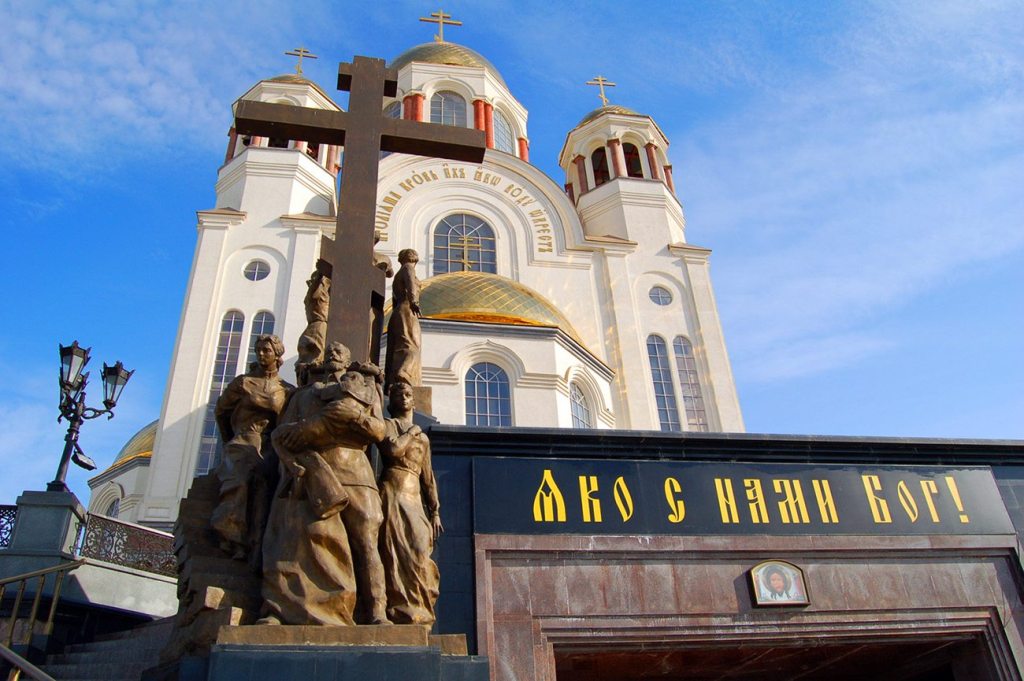
PHOTO: monument to the Holy Royal Martyrs, set against the Church on the Blood in Ekaterinburg
On 4th July 2021, the Church on the Blood in Honour of All Saints Resplendent in the Russian Land, celebrates its patronal holiday.
The Church-Monument on the Blood was erected on the site of the martyrdom of Emperor Nicholas II, his August family and their four faithful retainers.
At the end of 1878, a mining official, State Councillor Ivan Ivanovich Redikortsev, built a two-story stone mansion on a hill near the Church of the Ascension of the Lord. In 1908, the house was bought by a military civil engineer Nikolai Nikolayevich Ipatiev (1869-1938).
On the night of 16/17 July 1918, Emperor Nicholas II, his family and four faithful retainers were brutally murdered in the basement of the Ipatiev House. Following the regicide the house was returned to Ipatiev, who then sold the mansion to representatives of the White Army.
On 4th August 1975, a secret resolution of the Central Committee of the CPSU No.P185 / 34 “On the demolition of the Ipatiev mansion in the city of Sverdlovsk” was adopted.
The Ipatiev House was demolished on 22-23 September 1977 by Russia’s future president Boris Yeltsin (1931-2007), who was at the time First Secretary of the Sverdlovsk Regional Committee of the CPSU.
On 20th September 1990, the Sverdlovsk Soviet decided to transfer the land on the western slope of the Voznesenskaya Gorka to the Ekaterinburg diocese.
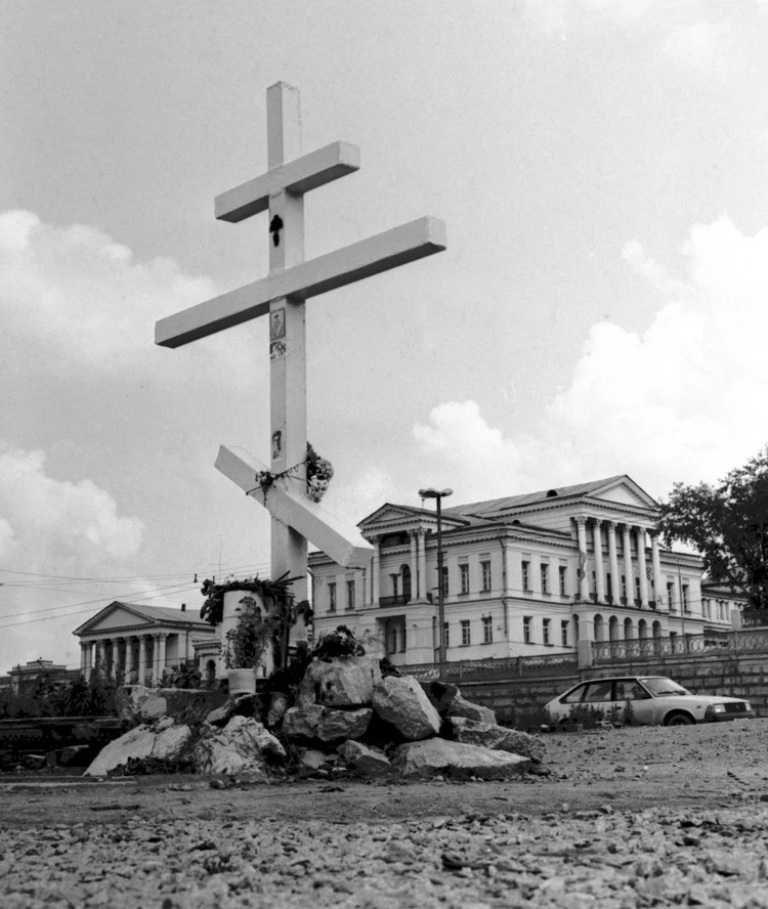
On 10th October 1990, the City Executive Committee made a decision to install “a memorial symbol at the site of the murder of the Tsar’s family.” In the same month, Archbishop Melchizedek of Sverdlovsk and Verkhoturye consecrated an Orthodox Cross on the site.
On 28th December 1993, a blessing was received for the construction of the church. A state commission was gathered and architectural as well as funding plans were developed.
On 19th May 1994, with the blessing of Nikon, Bishop of Yekaterinburg and Verkhoturye, a chapel canopy was erected over the cross, crowned with a dome and cross.
On 4th April 2000, Archbishop Vikentiy of Yekaterinburg and Verkhotursky performed a requiem for the Tsar’s family and a Divine Liturgy at the construction site of the church. In August 2000, at the jubilee Bishops’ Council of the Russian Orthodox Church in Moscow, the Tsar’s family was glorified as a passion-bearers.
On 23rd September of the same year, His Holiness Patriarch Alexei II of Moscow and All Russia (1929-2008) laid a memorial capsule in the eastern wall of the foundation of the future church. The construction of the Church on the Blood was completed in 2003.
The completed complex comprises two churches, a belfry, a patriarchal annex, and a museum dedicated to the former imperial family; the altar of the main five-domed church, made in the Russian-Byzantine style, is directly over the site of the Romanovs’ murder. The complex covers a total of 29,700 square feet (2,760 m2).
On 16th July 2003, the upper church was consecrated in honour of All the saints who shone in the Russian land. On 18th April 2010, His Holiness Patriarch Kirill of Moscow and All Russia consecrated the Lower Church in honour of the Holy Royal Passion-Bearers.
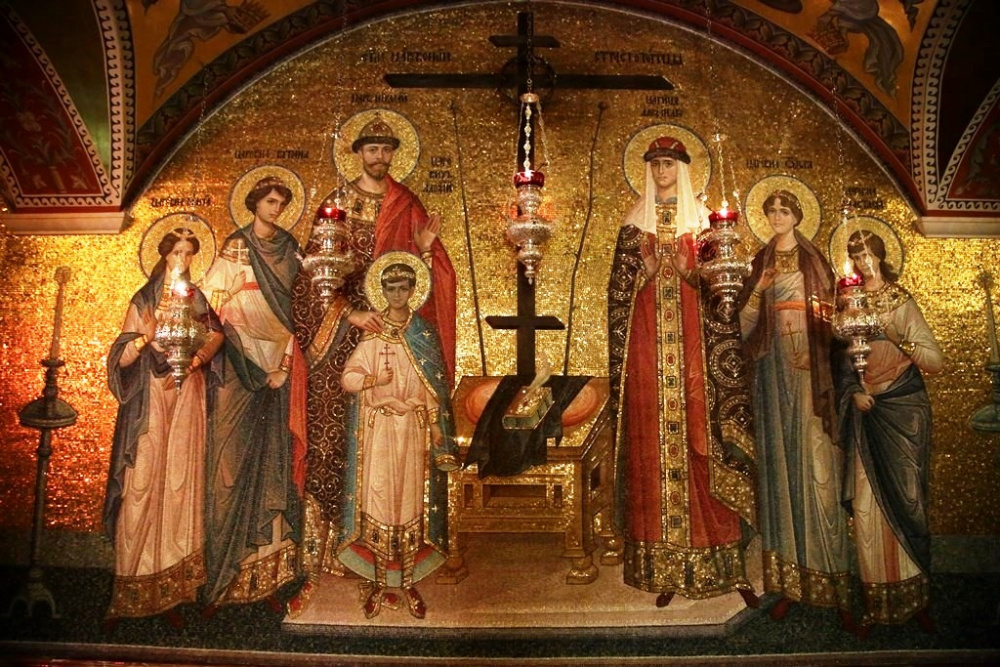
PHOTO: beautiful mosaic panel depicting the Holy Royal Martyrs on the wall of the Imperial Room, located in the Lower Church of the Church on the Blood
PHOTO: A simple wooden cross was installed on the site of the Ipatiev House in the 1990s
Prior to the construction of the Church on the Blood in Ekaterinburg, local archaeologists took a particular interest in the site where the 18th century mansion once stood.
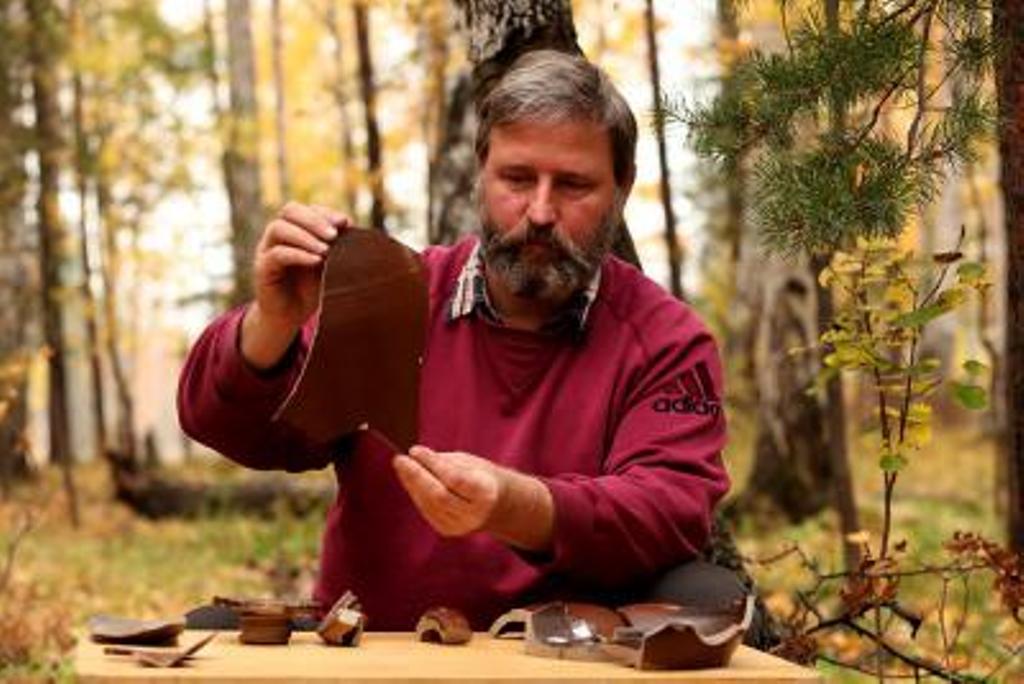
An excavation of the site was organized by archaeologist Sergey Nikolaevich Pogorelov in 2000. At that time, he headed the Department for the Study of Historical Monuments in the Regional Research and Production Center.
The area where the Ipatiev House was located stood on land once owned by the Ural-Siberian Factory. In 1766-1808 the wooden Old Ascension Church stood on the site of the house, which included a small cemetery. Later, residential quarters were constructed, including the Ipatiev House in the 1880s.
According to Pogorelov, in 2000, when the question arose about the construction of the Church on the Blood, city and regional authorities were notified that a decree issued in 1990 stipulated that no construction could take place on historic sites without historical and archaeological research being carried out first.
Excavations began in early June through September of 2000, and then continued in the summer of 2001. During that time, nearly 600 people took part in them. They made some interesting discoveries. For instance, during the excavations it turned out that the Soviet authorities had removed the remains of the basement walls of the Ipatiev House many years prior.
When archaeologists found the place where the basement execution room was located, they discovered that in its place, a concrete bunker had been built. They then referred to the city plans which were given them by the administration. As it turned out a government communication line had been laid along Klara Zetkin Street (former Voznesensky Prospekt and Voznesensky Lane, respectively), . When the cables were laid near where the Ipatiev House stood, they turned sharply 90 degrees, passing through where the execution room was located, and into the bunker, and then back to Klara Zetkin towards Voznesenskaya Gorka. Archaeologists learned that in the early 1970s, the local Soviet had set up the bunker with the intent of destroying the place where the Imperial family had been murdered.
However, an even greater discovery for archaeologists was what they found under the bunker when they began to dig deeper. Under the concrete structure was a grave, partially carved into the rock. Inside, in a coffin with forged nails, lay the remains of a woman and a baby.
Archaeologists had discovered the 18th century Orthodox cemetery, proving that the Ipatiev House was partly built on the site of the Church of the Ascension, and partly on the churchyard. The police were called in and the remains of the woman and her child were taken away.
Pogorelov noted that many graves must have been lost in the 1980s when part of the slope of the Voznesenskaya Gorka, was cut back during the reconstruction of Karl Liebknecht Street.
During their excavations, archaeologists uncovered an area of more than 500 square meters at a depth of about 2 meters.
PHOTO: Archaeologist Sergey Nikolaevich Pogorelov shows fragments of ceramic vessels found at Porosenkov Log in 2010
They found an underground stone structure with an area of 5 by 5 meters with granite walls in the foundation and stone granite slabs of the floor. Inside were the remains of the shelves of the party archives. It was here that the trunks belonging to the Imperial family were stored after their transfer from Tobolsk in April 1918.
On the western side of the estate grounds stood several poplars. There was some speculation that the trees had been planted during the Soviet years. Experts from the Institute of Plant and Animal Ecology conducted a dendrochronological analysis and found that they are more than 100 years old. Thus, it was determined that the trees were there when the Imperial family were living there under house arrest.
Among the trees a hole was discovered. They thought it was a cellar, but it turned out to be a well. It had been pierced into the monolithic rock of the Voznesenskaya hill using mining tools.
Archaeologists found a mention of this well in the notes of Yakov Yurovsky, who led the execution of the Imperial family. He wrote that he was repairing it at the moment when Nicholas II approached him. The well itself was filled with many artefacts, among them items belonging to the Imperial family.
The following year, when construction on the Church on the Blood was already underway, and two underground floors were planned on the site, the well suddenly filled with water. The builders wanted to fill it with concrete, however, a decision was made to preserve it. Today, the former well named “Tsarskoe” of the Ipatiev House is now located in the lower underground floors of the Church on the Blood.
As a result of the excavation of the estate, archaeologists managed to collect about 64 thousand artefacts. There were no precious items among them – only those that are of interest from a historical point of view. Fragments of dishes, buttons, metal objects … Everything that fell to the ground or tossed into the well since the 18th century.
Pogorelov found pieces of china with the emblems of the Imperial Porcelain Factory bearing the initials of Nicholas II, from the coronation porcelain service of 1896. He later discovered that part of the service had been stolen by the Bolsheviks after the murder of the Imperial family. Their whereabouts remain unknown to this day.
It took 300 crates to pack the 64,000 artefacts, and stored in different places until 2013. According to Pogorelov “nobody provided help, nor were the legislation requirements fulfilled”. The crates were subsequently transferred to the Museum of the History of Ekaterinburg. Today, the famous Russian archaeologies does not know what happened to the collection.
The Museum of the History of Ekaterinburg would not comment on what happened to the collection further nor whether the artefacts from the excavations at the site of the Ipatiev House are still in their funds.
Dear Reader: It is always a pleasure for me to present new articles based on my own research from Russian archival sources, offering first English translations of new works from Russian media sources on myNicholas II blogandFacebookpages. Many of these articles and topics seldom (if ever) attract the attention of the Western media. Please note that I personally translate the articles, and complement them further with additional materials, photographs, videos and links.
If you found this article interesting, then please help support my research by making a donation in US or Canadian dollars to my projectThe Truth About Nicholas II– please note that donations can be made by GoFundMe, PayPal, credit card, personal check or money order. Thank you for your consideration – PG
The Icon of the Mother of God “Of the Three Hands” is located in the Upper Church of the Church on the Blood in Ekaterinburg
Today, 11th July, the feast of the Icon of the Mother of God “Of the Three Hands”, was celebrated in the Church on the Blood in Ekaterinburg. The icon belonged to the Tsar’s family, who venerated it during their imprisonment in the Ipatiev House in 1918. It remained in their possession until the very last minutes of their earthly life.
This image was found after the regicide in the Ipatiev House. It was later carried out of Russia by a member of the Kolchak army. The icon proceeded through China to the United States of America and Canada, and in the early 1920s, through the efforts of the officers devoted to the sovereign, it was transferred to the Dowager Empress Maria Feodorovna. The icon remained in the circle of the Romanov family, passing from generation to generation until 2003.
The Icon of the Mother of God “Of the Three Hands” which belonged to the Imperial Family
In July 2003, the wife of the emperor’s nephew Olga Nikolaevna Kulikovskaya (1926-2020) solemnly presented the Icon of the Mother of God “Of the Three Hands” to the Church on the Blood, built on the site of the murder of the Holy Royal Martyrs, and thus fulfilled the death wish of her husband Tikhon Nikolaevich Kulikovsky (1917-1993), who owned the family heirloom for many decades.
By the Providence of God it was arranged that the icon arrived on 10th July 2003 for the evening liturgy on the eve of the feast of the Icon of the Mother of God “Of the Three Hands”.
With the feast of the Icon of the Mother of God “Of the Three Hands” the Tsar’s Days officially begins. A Divine Liturgy will be performed this evening in the Church on the Blood by Metropolitan Kirill of Yekaterinburg and Verkhotursky. Beginning today, we will remember the final days and the last moments of the earthly life of the Holy Royal Martyrs.





 Nicholas II
You must be logged in to post a comment.