Russian Geographical Society issues new edition of Nicholas II’s journey to the Far East
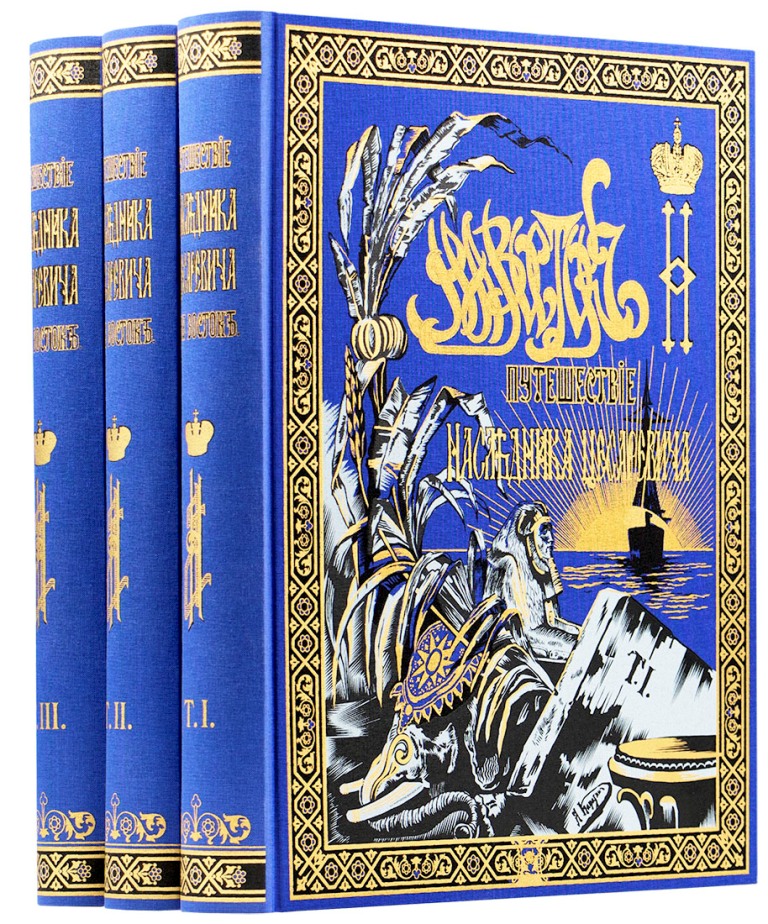
Earlier this week, a new Russian-language edition of a book dedicated to the 1890-91 Far East journey of the future Emperor Nicholas II, was published by the Russian Geographical Society. The three-volume set of books was presented to business circles, diplomats’ and journalists at the Russian House in Bangkok, Thailand.
The original three-volume “Journey to the East of His Imperial Highness the Sovereign Heir Tsesarevich Nicholas” was created by the orientalist and member of the Russian Geographical Society Prince Esper Esperovich Ukhtomsky (1861-1921), who accompanied Nicholas on his nine month journey.
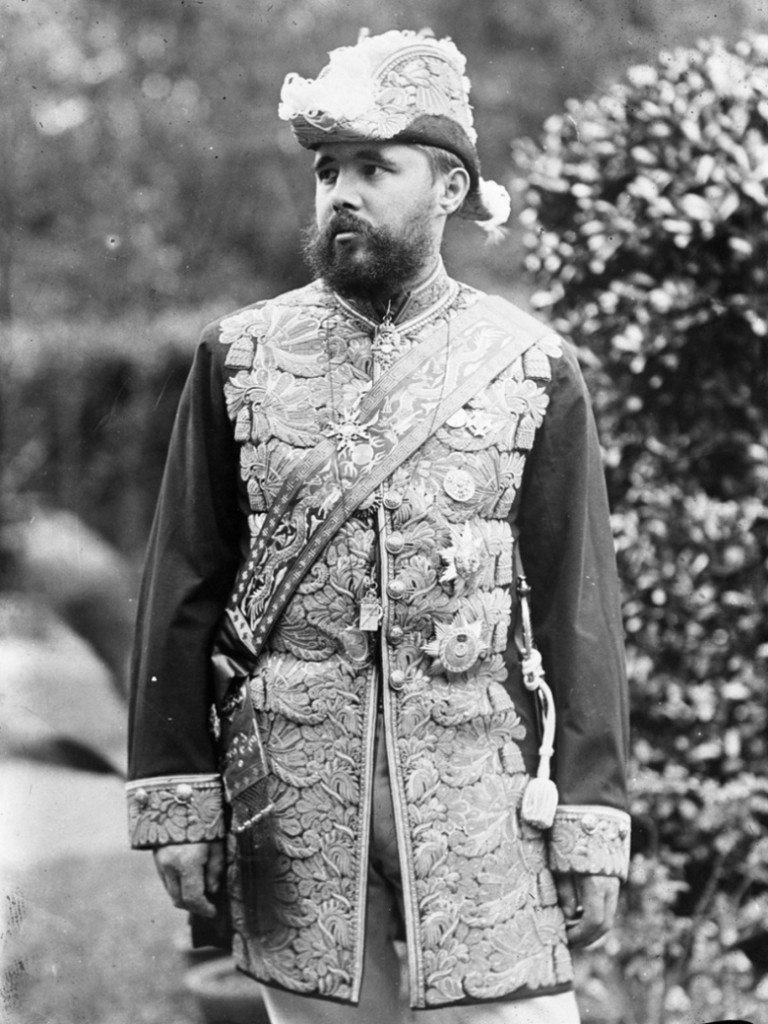
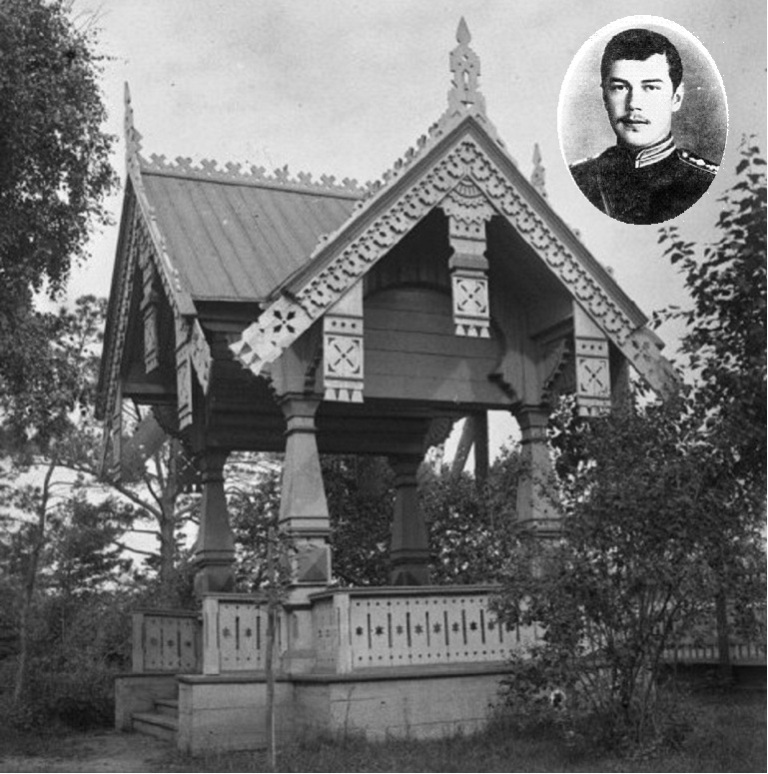
PHOTO: Prince Esper Esperovich Ukhtomsky (1861-1921)
Recall that on 5th November (O.S. 23rd October) 1890, Tsesarevich and Grand Duke Nicholas Alexandrovich [future Emperor Nicholas II] embarked on a journey, which took him around the greater part of the Eurasian continent. The total length of the journey exceeded 51,000 kilometres, including 15,000 km of railway and 22,000 km of sea routes.
The map below depicts the Eastern journey of the future and last Tsar of Russia, which took him to Egypt, India, Ceylon (Sri Lanka), Singapore, Batavia (Jakarta, Dutch East Indies) Siam (Thailand), Saigon (French Indochina), Hong Kong, China, and Japan. It was during his visit to the Empire of Japan, that Nicholas was the target of a failed assassination attempt in Otsu.
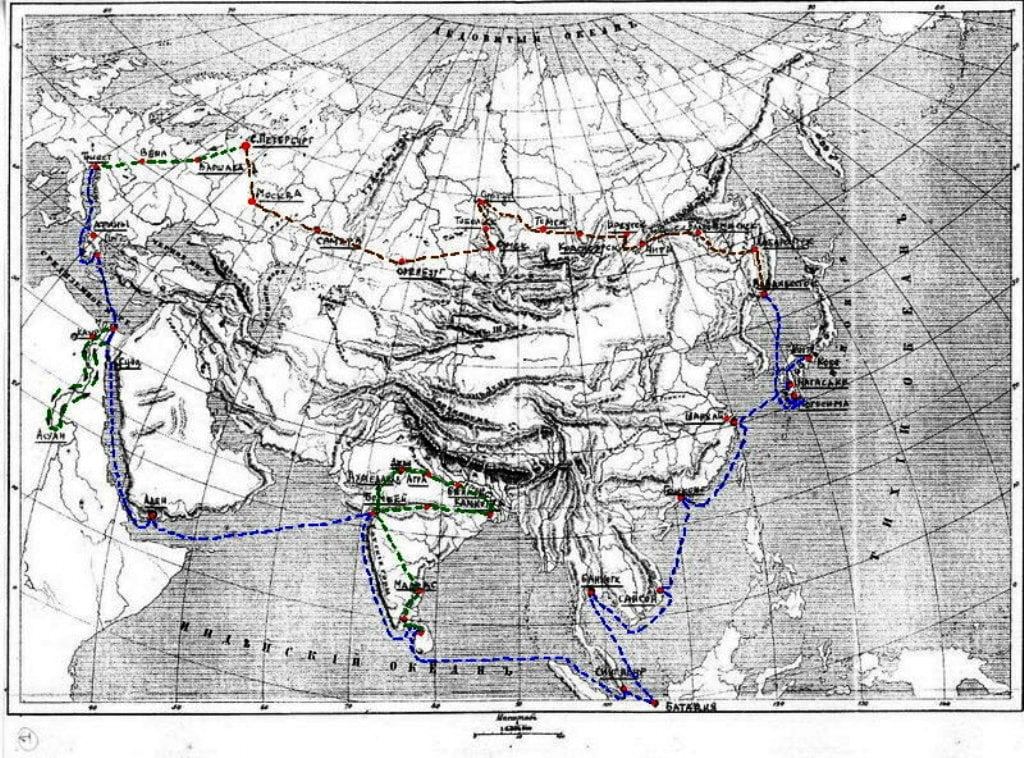
On his return to Russia, Nicholas took part in opening ceremony of the Trans-Siberian Railway in Vladivostock. He then made his way across the Russian Empire, through Transbaikalia and Siberiam before arriving back in St. Petersburg on 17th August [O.S. 4th August] 1891.
During the nine month journey, Ukhtomsky kept a travel diary, recording daily the places and landmarks visited, meetings with kings, princes and government officials as well as historical and cultural research, including geographical and ethnographic observations. His vivid essays about the countries and peoples of the East at the end of the 19th century make a fascinating read.
The original Russian-languaged edition of the book was published in three volumes between 1893 and 1897 and brought the author all-Russian fame.
An English-language edition was also published in 1896. Volume One of Travels in the East Nicholas II Emperor of Russia when cesarewitch 1890-1891 is available to read online.
The republication of Nicholas II’s journey to the Far East is timed to coincide with the 135th anniversary of the visit of Tsesarevich Nikolai Alexandrovich to Siam in 1891,” – said Anastasia Timofeeva, Advisor to the Department of Expert, Analytical and International Activities of the Russian Geographical Society.
“The Tsesarevich’s’s journey became symbolic of the beginning of friendly relations between Russia and Thailand. It was during his visit to Siam, that the heir to the Russian throne was awarded the Most Illustrious Order of the Royal House of Chakri. In turn, the King of Siam Chulalongkorn (1853-1910) was presented with the Order of St. Andrew the Apostle First-Called. This helped to establish a trusting dialogue between the two countries. Today, the republication of this historic book, continues the joint historical and cultural heritage which helps to strengthen relations between the business and cultural circles of Russia and Thailand.,” she added.
There are plans to produce a Thai-lanaguage edition of the book, of which copies will be presented to both the National Library of Thailand and the Siam Society Under Royal Patronage.
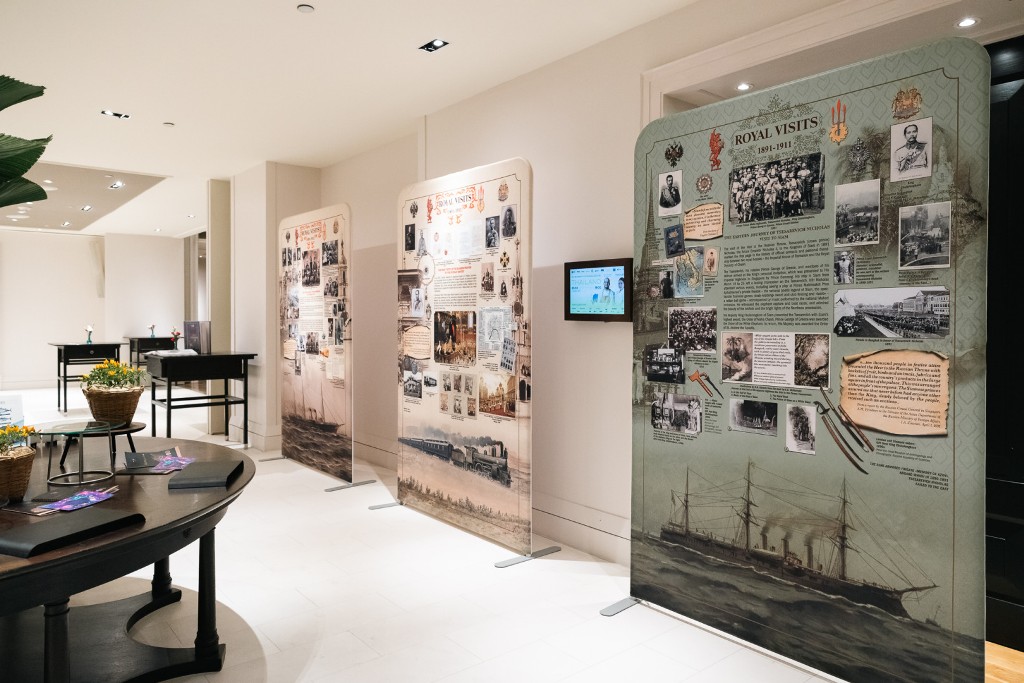
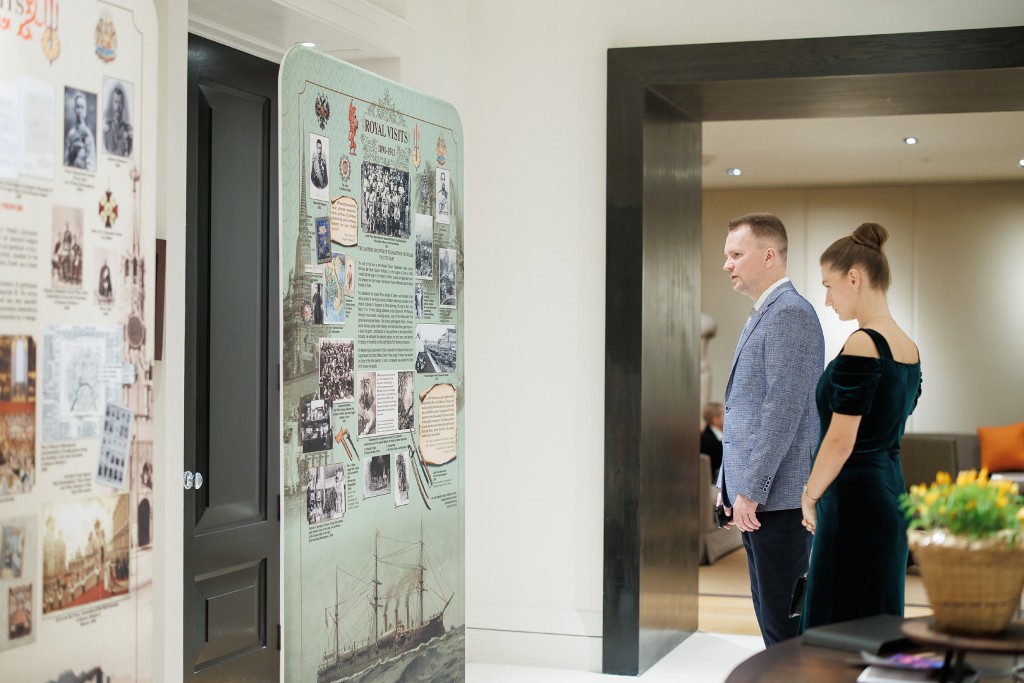
PHOTOS: an exhibition dedicated to the history of the dynastic friendship between the Russian Imperial House and the Royal House of Chakri (the ruling dynasty in Thailand, was preparted for the presentation of the book
The republished book about the travels of Nicholas II to the East presents 700 illustrations that were handmade by the Russian military officer, painter and writer Nikolai Nikolaevich Karazin (1842-1908).
In addition, the book is illustrated with photographs of Vladimir Dmitrievich Mendeleev (1865-1898), the son of an outstanding Russian chemist.
In the book, you can find sketches and testimonies about Siam (Thailand), which allows a modern reader to see the country through the eyes of the expedition participants.
The updated edition of this publication is supplemented with name and geographical indications and a map of the journey. This makes the publication accessible to both researchers and a wide range of readers.
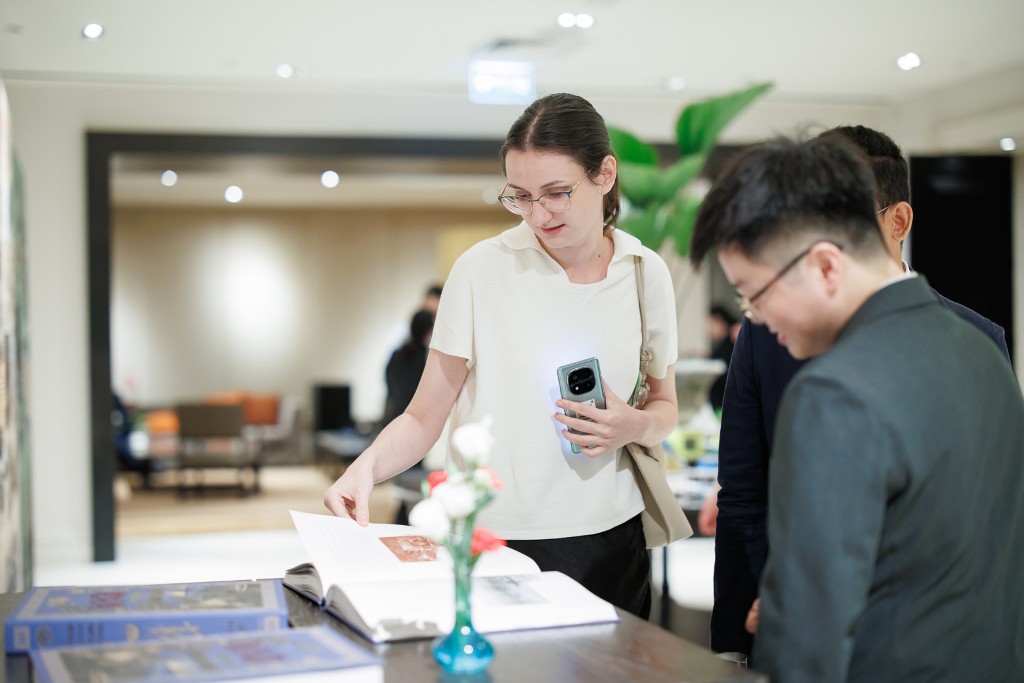
PHOTO: guests lead through the pages of the book Nicholas II’s journey to Far East
During the presentation, the organizers prepared an exhibition dedicated to the history of the dynastic friendship between the Russian Imperial House and the Royal House of Chakri (the ruling dynasty in Thailand, which has been in power since 1782).
The presentation was followed by a gala dinner, where the cuisines of Russia and Thailand met. The chefs of the two countries prepared an unusual menu. Guests were treated to borscht with coconut milk and shrimp, buckwheat porridge with tree mushrooms and other authentic dishes.
The organizers of the project were Rossotrudnichestvo and the Restaurant Group of Russia, founded by Alexei and Dmitry Vasilchuk. The event was held with the partner support of the Russian Embassy in Thailand. The cuisine of Thailand was represented by chef Phi Thip Pausila (Belle), and the Russian gastronomic school was represented by Alexander Railyan.
© Paul Gilbert. 28 March 2026
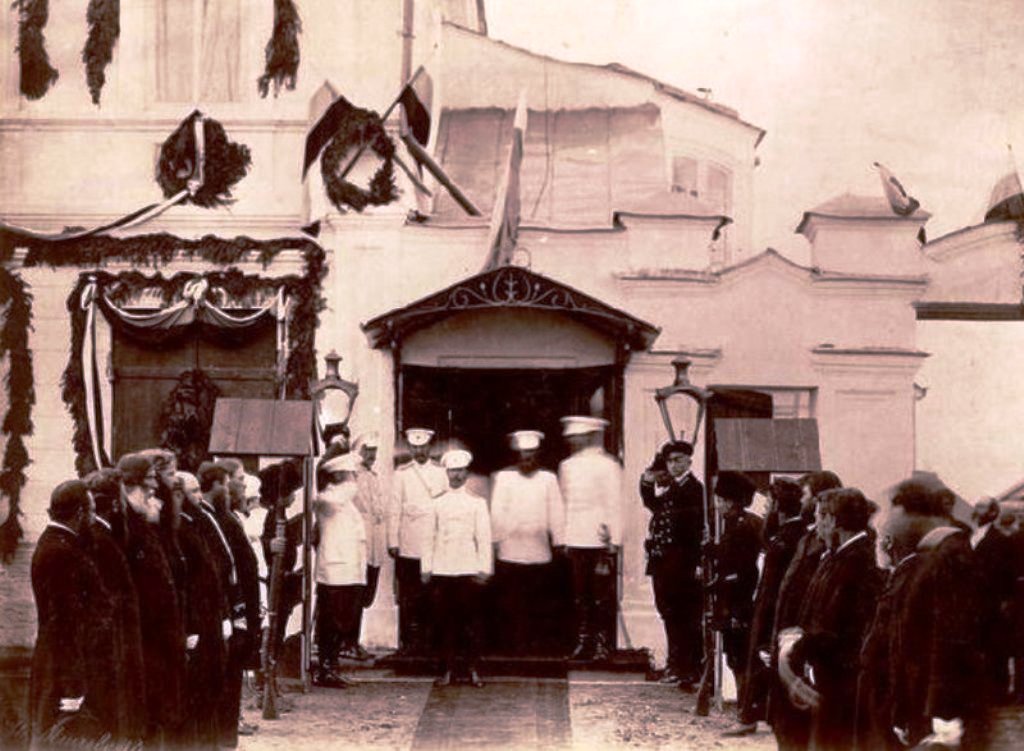
 Nicholas II
You must be logged in to post a comment.