The fate of an icon gifted by the last Russian empress to Anastasia Hendrikova in October 1917

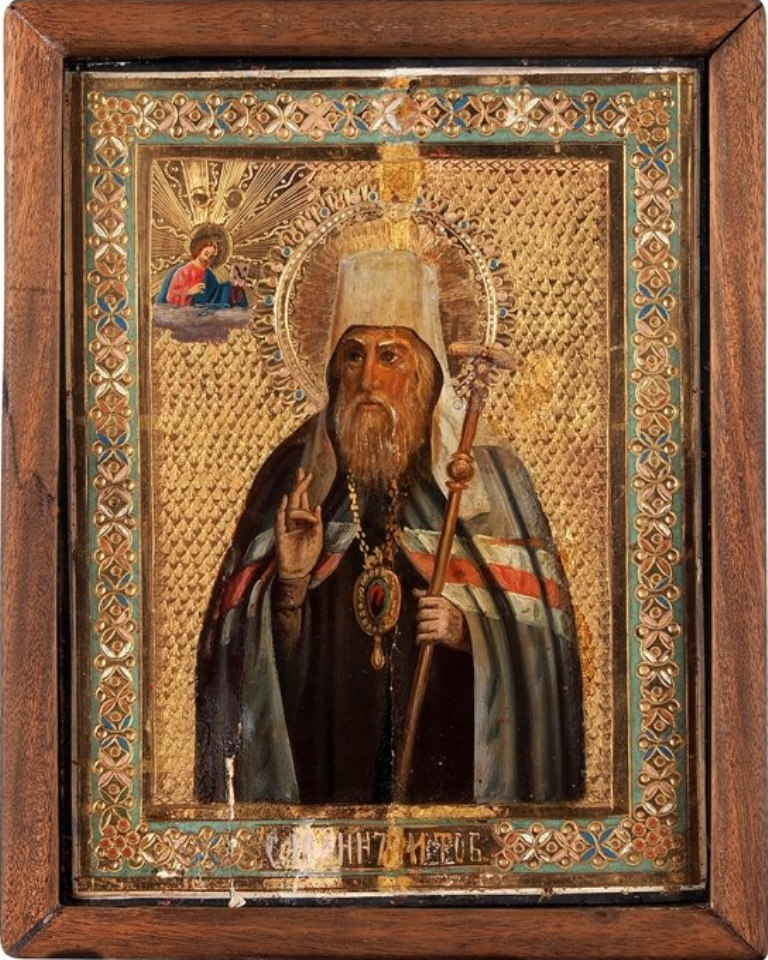
PHOTO: an icon depicting St. John of Tobolsk, gifted by Empress Alexandra Feodorovna to Anastasia Hendrikova in 1918, sold at a Paris auction to a private collector in 2021

The former lady in waiting to Empress Alexandra Feodorovna, Countess Anastasia Hendrikova (1888-1918) has been very much in the news of late. On 30th May 2024, the Perm Diocese announced that a forensic study confirmed the identity of Hendrikova’s remains, along with those of Ekaterina Schdeider, On 9th June 2024, a Funeral (Memorial) Litany was served in a Perm church. In recent days, yet another story about Hendrikova appeared in the Russian mdeia which deserves mention.

In August 1917, Anastasia Hendrikova voluntarily followed Emperor Nicholas II and his family into exile to Siberia, where they were held under house arrest for 8 months. During those difficult days, Hendrikova proved to be a great source of comfort to Empress Alexandra Feodorovna, to whom she was devoted. She helped the Empress endure the hardships of exile and imprisonment.

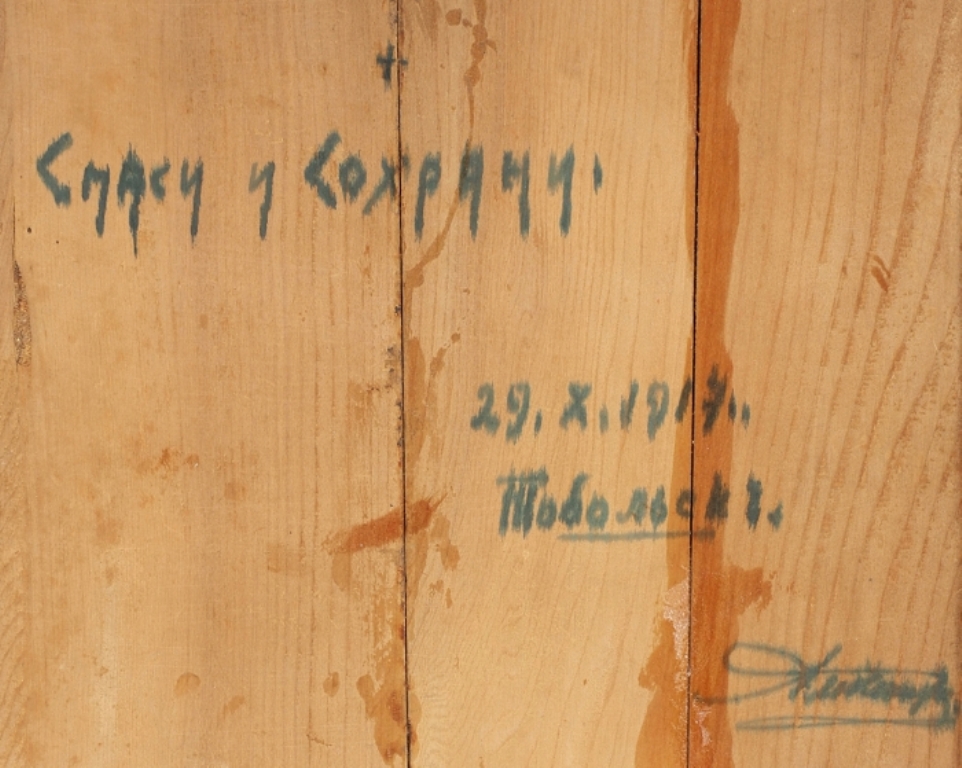
On 29th October 1917, the Empress presented her devoted maid of honour with an icon depicting the image of St. John (Maximovich) of Tobolsk[1]. On the back of the icon the Empress had written the inscription «Спаси и сохрани / 29.X.1917 / Тобольск / Александра» [“Save and Protect. 29.10.1917 / Tobolsk / Alexandra”]. The size of the icon measured 22.3×17.3 cm. In a wooden case — 25.3 × 20.3 cm. 

On the reverse of the icon case, there is a bronze engraved plate with the inscription “This icon was given by H.I.M. Alexandra Feodorovna, to maid of honour Countess Anastasia Vasilievna Hendrikova during the stay of the Imperial Family in Tobolsk.”

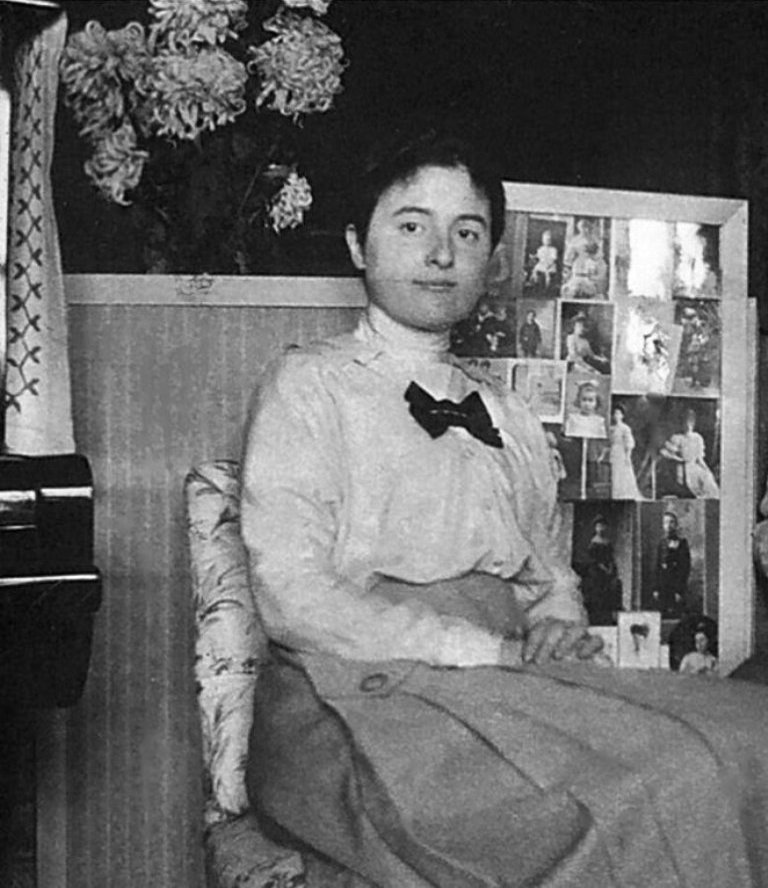
PHOTO: Countess Anastasia Hendrikova (1888-1918) 

On the part of the Empress, it was indeed a gift of great value and affection, a testimony of deep friendship in sharing the suffering of imprisonment. Countess Hendrikova was then 29 years old.

After her imprisonment in Perm and the murder of the Imperial Family, Countess Anastasia Hendrikova was taken from prison to the Cheka on 21st August 1918, where she was interrogated. One of the investigators asked her whether “she voluntarily followed the Romanovs to Tobolsk. She replied that she went voluntarily.

“Well,” he replied “since you are so devoted to them, tell us: if we were to let you go now, would you return to them again and continue to serve them?”

“Yes, until the last day of my life,” she replied. A few weeks later, Anastasia Hendrikova was shot by the Bolsheviks on the night of 3/4 September 1918 in Perm.

PHOTOS: (above) on the back of the icon Empress Alexandra wrote an inscription “Save and preserve / 29.X.1917”; (below) a bronze engraved plate with an inscription dedicated to Anastasia Hendrikova from the Empress.

After Hendrikova’s murder, the icon found it’s way into the hands of her brother Count Pyotr (Peter) Hendrikov[2]. For many years, he kept the icon as a family shrine and took it with him when he went to live in France. In his old age, he donated the icon to the orphanage church of the Russian Military Invalids situated near Paris.

But in 2001, the unexpected happened – the church and the orphanage were destroyed by fire. The ancient icon could have been lost forever, had it not for the priest Mikhail Gudkov, who found the precious relic among the burned out ruins of the church.

Father Mikhail cherished the historical value of the icon, and before his death he passed it on to his son.

In the autumn of 2021, the ancient icon, which has become a symbol of boundless love and loyalty, went under the hammer at a Moscow’s famous Litfond Auction House[3], as part of their “Relics of the House of Romanov” sale. The auction was held on 30th September 2021. The icon of St. John of Tobolsk was listed at 1.6 million rubles [$18,400 USD] and sold for 2.6 million rubles [$30,000 USD] to a private collector in Russia.

NOTES:

[1] In August 1915, Emperor Nicholas II sanctioned the canonization of St. John (Maximovich) of Tobolsk (1651-1715). The solemn glorification of John of Tobolsk took place the following year, on 10th June 1916. He was the last saint to be canonized during the reign of Russia’s last Tsar.

[2] Pyotr (Peter) Vasilyevich Hendrikov (1883-1942) died in Paris on 13th February 1942.

[3] The Litfond auction house is the undisputed leader among auction houses in Russia, occupying about 60% of the market. About 100 auctions are organized in Moscow and St. Petersburg each year.

© Paul Gilbert. 18 June 2024

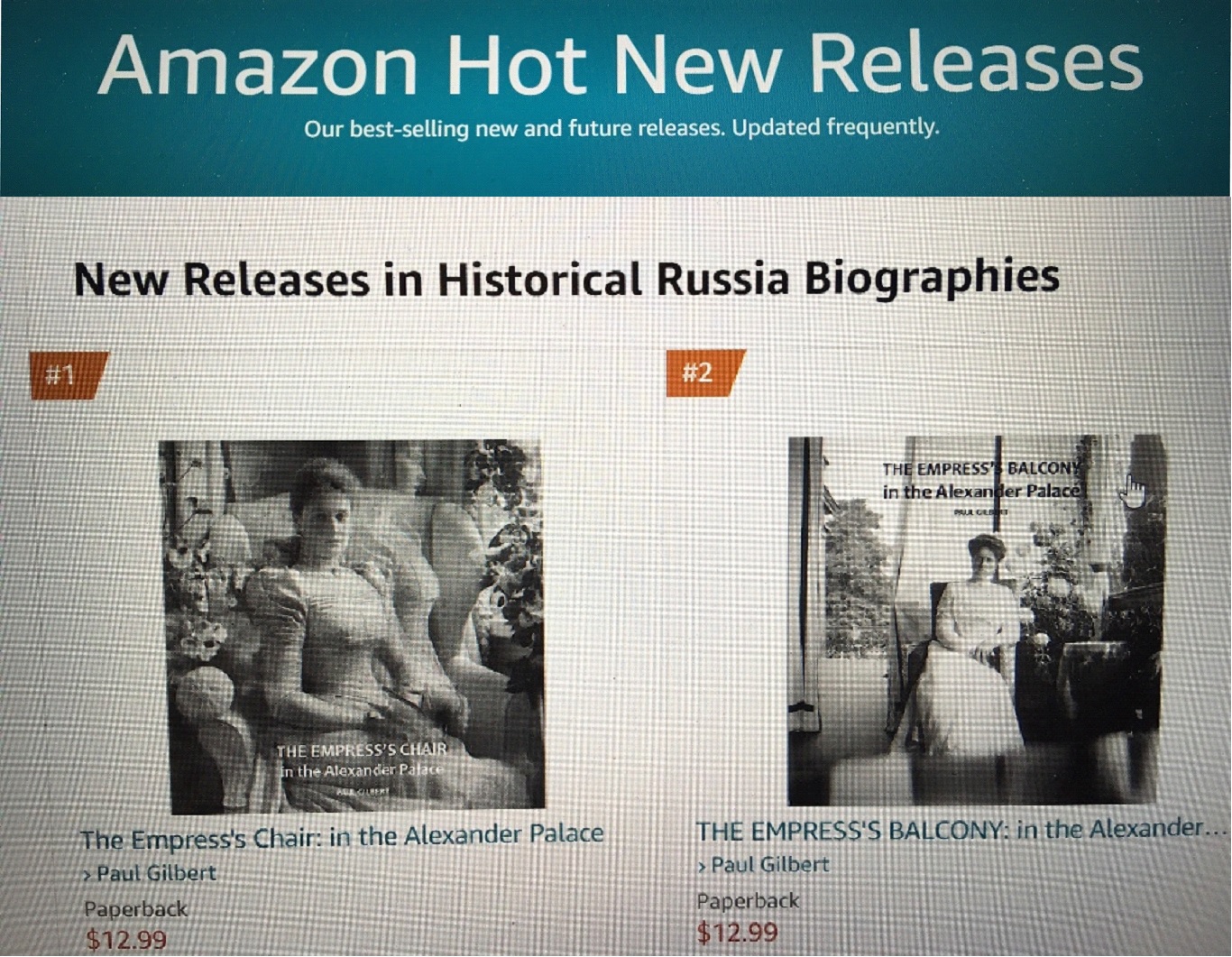
‘The Empress’s Balcony’ and ‘The Empress’s Chair’ become bestsellers on AMAZON

On 16th June 2023, ‘The Empress’s Balcony in the Alexander Palace‘ and ‘The Empress’s Chair in the Alexander Palace‘ claimed the No. 1 and No. 2 positions on Amazon’s ‘New Releases in Historical Russia Biographies’ Bestseller list. My two latest books held these spots for 10 consecutive days in a row – setting a new record for any of my previously published books.

Based on the number of posts on my Facebook page, both titles have been well received and enjoyed by readers from all over the world. One Australian reader wrote: “Who would have thought a chair and balcony could be the subject of a book, but you did it!”

Each richly illustrated pictorial features a new 8-1/2″ x 8-1/2″ paperback format with glossy cover. The price is $12.99 USD, both titles are available from AMAZON in the United States, Canada, Great Britain, Australia, France, Germany, Italy, Spain, Netherlands, Sweden, Poland and Japan.

The Empress’s Balcony – 110 pages – is a unique pictorial dedicated to the famous balcony where the Imperial Family spent so much time together and a favourite spot for family photographs.

The text on pages 3 to 14 explores the history and restoration of the Maple Drawing Room, which led out onto the balcony. It explains the construction of the iron grille balcony in 1896, and why it was dismantled between 1947-49 by the Alexander Palace’s new Soviet caretakers. The selection of nearly 100 vintage photographs presented in this album, are all we have left of this once happy and peaceful sanctuary for the Imperial Family while they were in residence at Tsarskoye Selo. Click HERE to order.

The Empress’s Chair – 120 pages – explores yet another iconic spot found in Empress Alexandra Feodorovna’s favourite room: the Mauve Boudoir.

The text on pages 3 to 14 explores the history and restoration of the Mauve Boudoir. More than 100 black and white photographs record nearly 30 members of the Imperial Family, their relatives and guests, all posing in the iconic corner chair. Neither the Mauve Boudoir of the Empress’s chair survived, however, both have recently been recreated. Click HERE to order.

© Paul Gilbert. 28 June 2023

Memorial plaque to Empress Alexandra Feodorovna installed in Istra

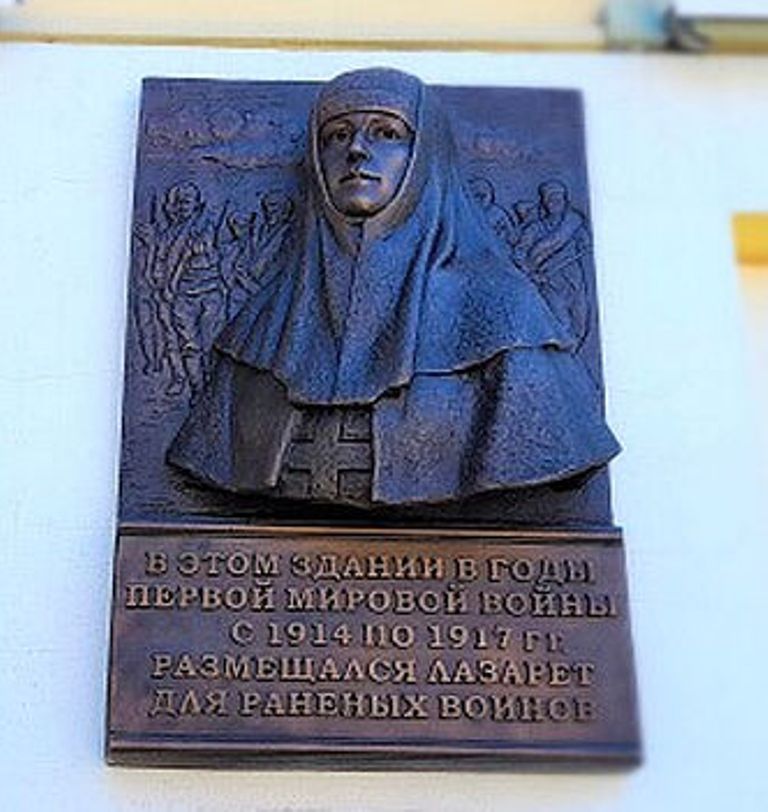
PHOTO: view of the bronze memorial bas-relief of Empress Alexandra Feodorovna

On 25th May 2023, a bas-relief plaque depicting Empress Alexandra Feodorovna was installed on the façade of the Drama Theatre, in Istra, situated 40 km northwest of Moscow.

During the First World War, the building served as an infirmary for wounded Russian soldiers, from September 1914 to the end of 1917.

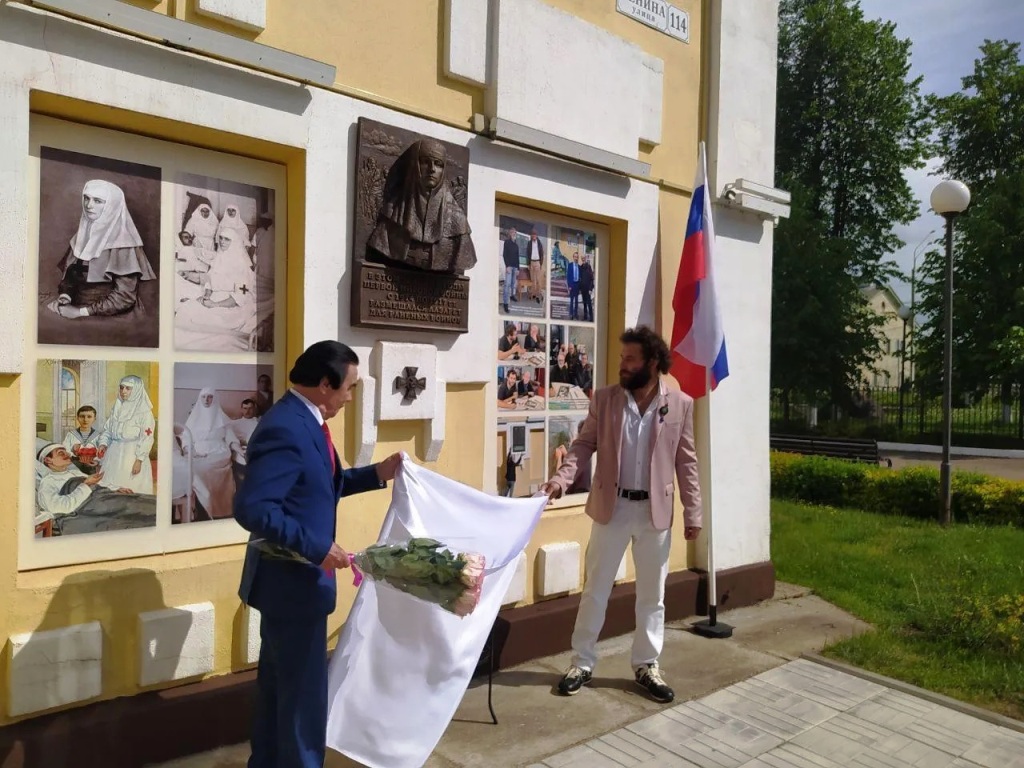
The bronze bas-relief was made by Moscow sculptor Philip Trushin, and financed by the academician and philanthropist Vladimir Yatsuk.

PHOTO: Moscow sculptor Philip Trushin (right) unveils his bas-relief of Empress Alexandra Feodorovna

The rite of consecration of the memorial plaque was performed by the clergyman of the Resurrection New Jerusalem Stavropegic Monastery, Father Paisius.

The memorial plaque, depicts Empress Alexandra Feodorovna, dressed in the uniform of a sister of mercy, set against the background of soldiers of the Russian Imperial Army.

During the First World War, Alexandra Feodorovna organized a whole network of infirmaries, which included 85 institutions for wounded soldiers in Tsarskoye Selo, Pavlovsk, Peterhof, Sablin and other places. Many of the infirmaries were built at the Empress’s own expense.

PHOTO: view of the former infirmary for wounded Russian soldiers in Istra

© Paul Gilbert. 12 June 2023

Two NEW books on the Alexander Palace

I cannot think of a better way to kick off the summer than the release of two NEW titles on the Alexander Palace at Tsarskoye Selo: The Empress’s Balcony and the Empress’s Chair.

I have compiled two unique pictorials dedicated to two of the most iconic spots in the former residence of Russia’s last Imperial Family, both of them favourite spots for the rest and relaxation of Empress Alexandra Feodorovna.

The Empress’s famous balcony and the corner chair in her Mauve Boudoir served as the settings for hundreds of iconic photographs of herself, the Tsar, their children, as well as extended family members and those close to the Imperial Family.

Each of these pictorials feature more than 100 full-page black-and-white photos. The accompanying text explores the history of both the balcony and chair, as well as the history and recreation of the Maple Drawing Room and Mauve Boudoir. While the balcony was demolished during the Soviet years, the Empress’s chair has recently been recreated for the recreated interior of her Mauve Boudoir, which opened to the public in 2021.

Each of these charming pictorials will be a welcome addition to any one who shares an interest in the Alexander Palace and its Imperial residents during the late 19th to early 20th centuries.

***

*This title is available from AMAZON in the USA, UK, Canada, Australia,
France, Germany, Spain, Italy, Netherlands, Poland, Sweden and Japan

CLICK HERE TO ORDER THE PAPERBACK EDITION @ $12.99 USD

English. 110 pages, 98 black & white photos

Between 1896-1898 – the Court architect Silvio Danini carried out the reconstruction of the eastern wing of the Alexander Palace, which included the personal apartments of Nicholas II and Alexandra Feodorovna.

In addition, he installed the famous L-shaped iron balcony for the Empress, which was accessed via the Maple Drawing Room.

The Empress’s balcony became a favourite setting for taking family photographs, taken by the Empress and her children, all of whom were avid amateur photographers. More than a century later, these iconic images provide us with a rare glimpse into the private world of the Imperial Family.

The photographs presented in this pictorial, have all been selected from the private albums of the Empress and her children, and that of Alexandra’s friend and lady-in-waiting Anna Vyrubova.

The balcony was dismantled between 1947-49, with no plans to restore it. In the meantime, we have to content ourselves with the selection of vintage photographs which have survived to this day, and are presented in this pictorial.

*This title is available from AMAZON in the USA, UK, Canada, Australia,
France, Germany, Spain, Italy, Netherlands, Poland, Sweden and Japan

CLICK HERE TO ORDER THE PAPERBACK EDITION @ $12.99 USD

English. 120 pages, 107 black & white photos

Between 1896-1898 – the Court architect Silvio Danini carried out the reconstruction of the eastern wing of the Alexander Palace, which included the personal apartments of Nicholas II and Alexandra Feodorovna.

Among the Empress’s quarters was the Mauve Boudoir, which would become her favourite room. According to legend, the Empress gave Alexnder Meltzer a lilac branch, her favourite flower, so that he could choose the colour scheme for the decoration of the room.

Among the most notable pieces of furniture in this room was a corner chair, which became a popular spot for family photographs, taken by the Empress and her children, all of whom were avid amateur photographers. More than a century later, these iconic images provide us with a rare glimpse into the private world of the Imperial Family.

Like many other rooms in the Alexander Palace, the Mauve Boudoir suffered a sad fate – the decoration and the interior were lost during the Great Patriotic War. The room has since been reconstructed and restored to its original historic look, as has the Empress’s famous chair.

© Paul Gilbert. 31 May 2023

French Savonnerie carpet in the Corner Reception Room of the Alexander Palace

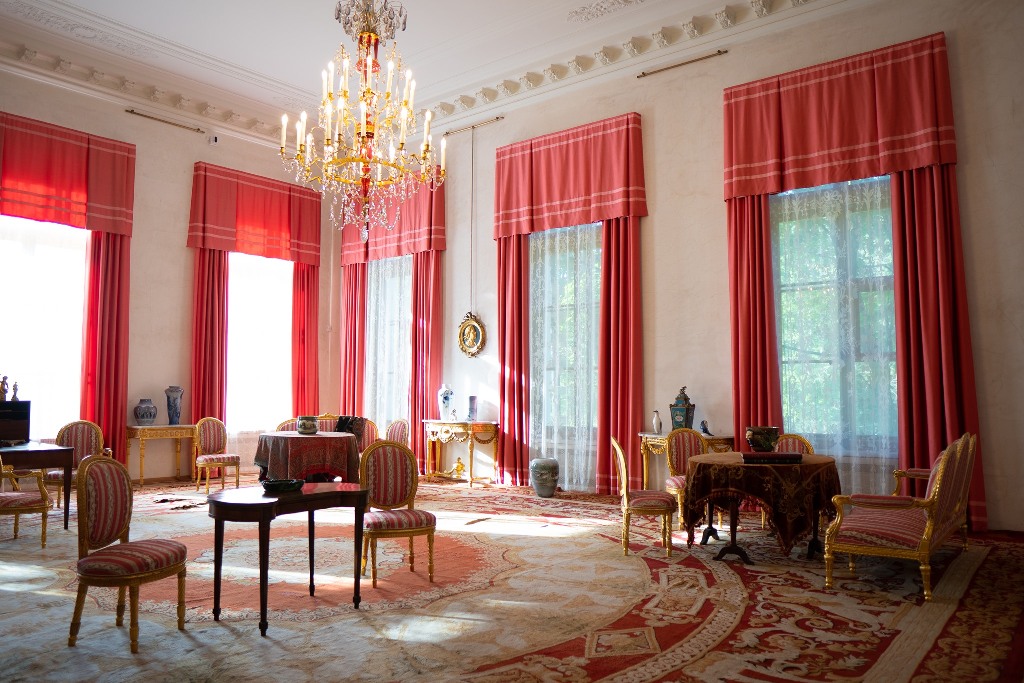
View of Empress Alexandra’s Corner Reception Room, in the Alexander Palace
PHOTO © Tsarskoye Selo State Museum

The Tsarskoye Selo State Museum have released some beautiful new photos of the Empress Alexandra’s Corner Reception Room, situated in the eastern wing of the Alexander Palace.

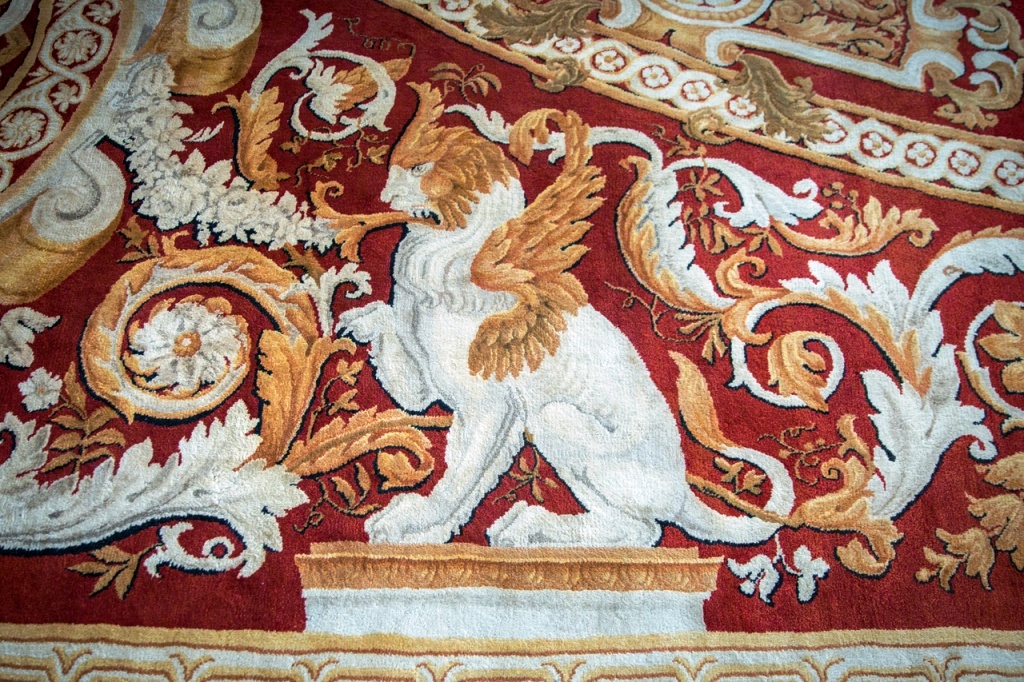
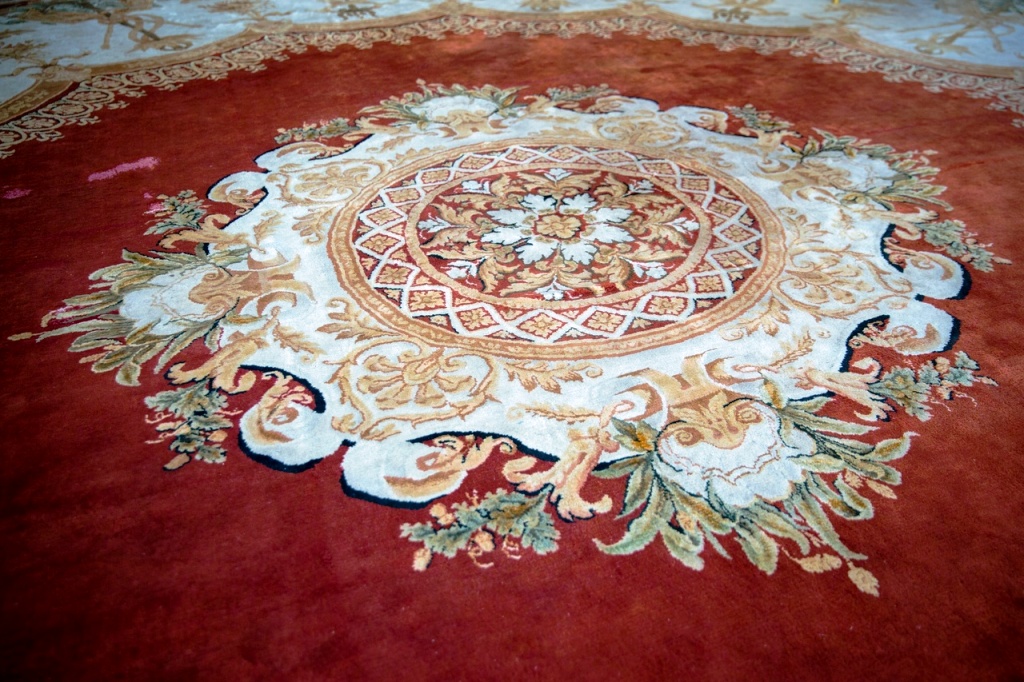
The room is decorated with a luxurious 100 square meter woolen carpet. The central includes griffins, dolphins, masks, and cartouches. The carpet was made at the French Savonnerie manufactory at the beginning of the 19th century and purchased specifically for the Billiard Room (later the Corner Reception Room) of the Alexander Palace. At that time, the carpet was spread out only during the Highest Presence of Emperor Nicholas II and Empress Alexandra Feodorovna. The room was sometimes used for family breakfasts and lunches, at which a “waterproof canvas” was placed over the carpet, in order to protect it from spillage.

The pre-history of the Savonnerie manufactory lay in the concerns of King Henri IV to revive the French luxury arts. When Savonnerie appeared in France in the 17th century, it was considered the most prestigious European manufactory of knotted-pile carpets of its time. It was established in a former soap factory (French savon) on the Quai de Chaillot district of Paris in 1615. Under an eighteen year patent, a monopoly was granted by Louis XIII in 1627 to Pierre DuPont and his former apprentice Simon Lourdet, makers of Turkish-style carpets. Until 1768, the products of the manufactory remained exclusively the property of the Crown. Not only did Savonnerie carpets adorn the rooms of the Louvre and Versailles, they were also among the grandest of French diplomatic gifts.

Detail of the Savonnerie carpet in Empress Alexandra’s Corner Reception Room
PHOTO © Tsarskoye Selo State Museum

Detail of the Savonnerie carpet in Empress Alexandra’s Corner Reception Room
PHOTO © Tsarskoye Selo State Museum

The formation of the individual style of the manufactory was influenced by classical oriental patterns and ornaments, to which elements of European art of different eras were added: luxurious baroque, exquisite rococo, and sophisticated classicism. Drawings of carpet products produced by Savonnerie manufactory are full of various floral ornaments, compositions of vignettes, bouquets and wreaths, decorated with images of heraldic medallions, and zoomorphic motifs.

Carpets were made mainly of wool with the addition of natural silk, which emphasized the beauty of a complex, detailed pattern. It took several months to create a sketch, from which some two hundred to four hundred colours and shades were used in the production of a single carpet.

By the end of the 18th century, the Savonnerie manufactory was producing not only carpets, but also screen panels and tapestries. The decline of the manufactory began during the years of the French Revolution. In 1825, the company experienced financial difficulties and became part of the Manufactory of Tapestries (later the Manufactory of National Furnishings), which resulted in the loss of its once privileged status at the French Court and the aristocracy.

View of Empress Alexandra’s Corner Reception Room, in the Alexander Palace
PHOTO © Tsarskoye Selo State Museum

It is nothing short of a miracle, that the luxurious woollen carpet in the Corner Reception Room of the Alexander Palace, survived the ravages of 20th century Russia, which included two revolutions, a civil war, two world wars, and more than seventy years of Soviet dogma. We are indeed fortunate, that it is once again on display, for all to see, in the reconstructed and restored interiors of the private apartments of Nicholas II and Alexandra Feodorovna, in the eastern wing of the palace.

© Paul Gilbert. 30 September 2022

Why did Nicholas II’s favourite motorcar sport a swastika?

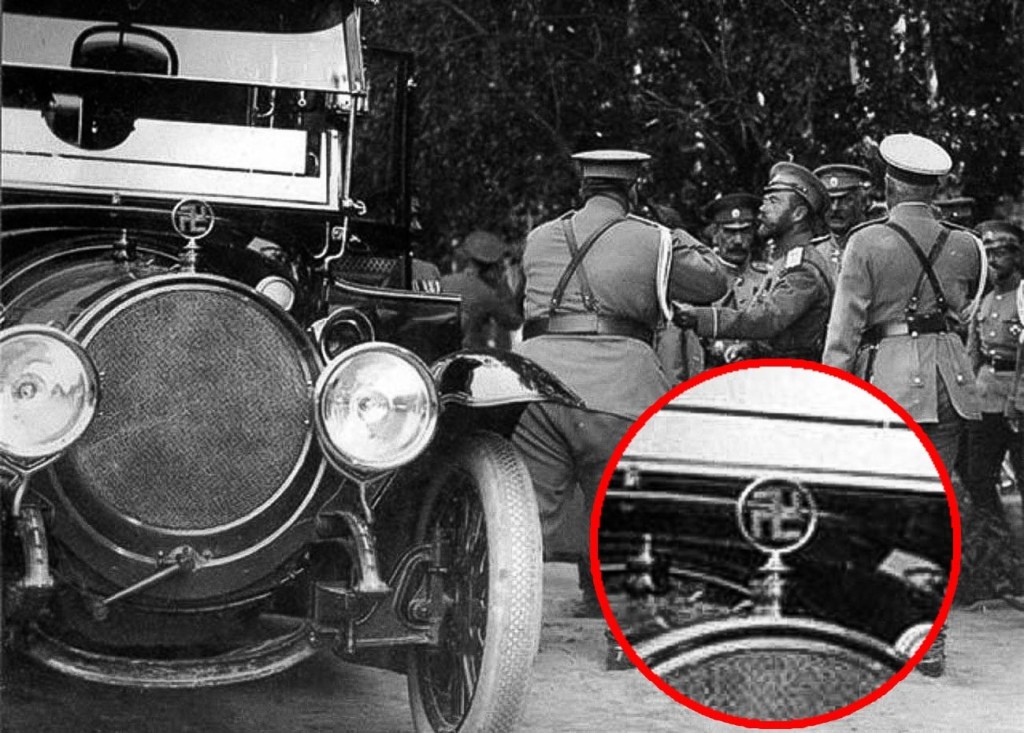
PHOTO: Emperor Nicholas II’s favourite Delaunay-Belleville motorcar, sporting a left-facing swastika (counter clockwise) on the hood. Tsarskoye Selo 1913

The swastika symbol is an ancient religious symbol in various Eurasian cultures, now also widely recognized for its appropriation by the Nazi Party and by neo-Nazis. It continues to be used as a symbol of divinity and spirituality in Indian religions, including Hinduism, Buddhism and Jainism. It generally takes the form of a cross, the arms of which are of equal length and perpendicular to the adjacent arms, each bent midway at a right angle.

In the 1930s the German Nazi Party adopted a right-facing (clockwise) form and used it as an emblem of the Aryan race. As a result of World War II and the Holocaust, in the West it continues to be strongly associated with Nazism, anti-Semitism, white supremacism, or simply evil.

In 19th century Russia, however, the swastika had a completely different meaning. The left-facing swastika (counter clockwise) swastika, best described as a “sacred solar cross”, was adopted as a symbol of the Russian Empire. In the years before the Russian Revolution, it was used on the facades of houses, depicted on icons, clothes and dinner plates, as well as Emperor Nicholas II’s favourite motorcar.

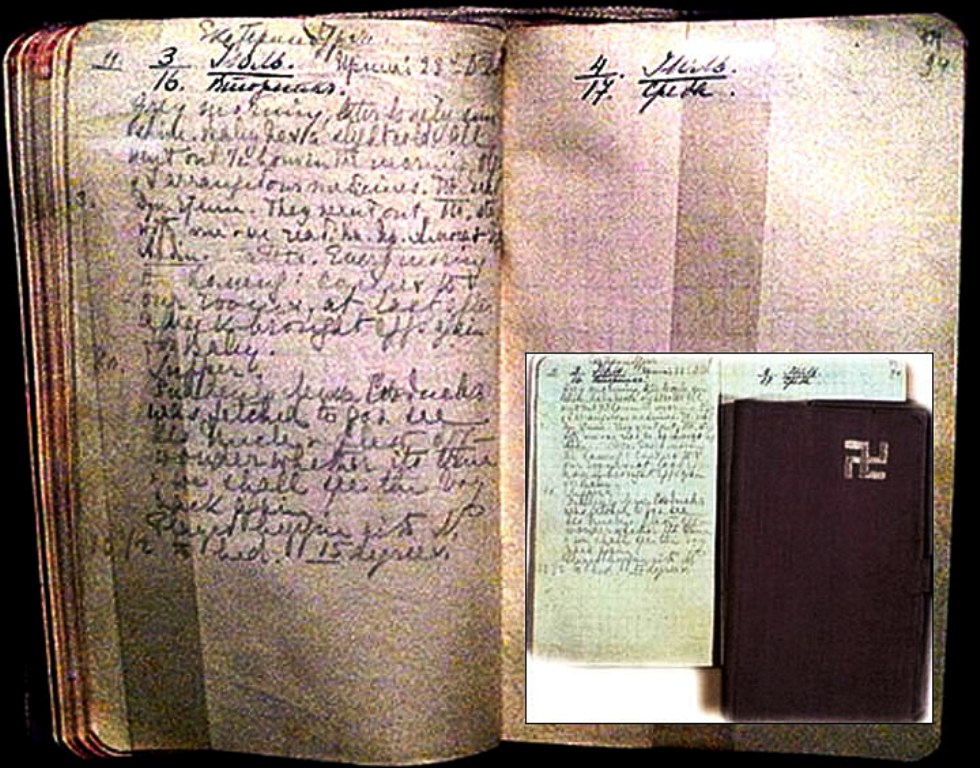
PHOTO: the last diary [1917] of Empress Alexandra Feodorovna, was embroidered with a left-facing swastika (counter clockwise)

In addition, the left-facing swastika (counter clockwise) was a favourite symbol of Empress Alexandra Feodorovna. She wore a talisman in the form of a swastika, wearing it everywhere for happiness, including on her letters from Tobolsk and Ekaterinburg. In a letter dated 16 December 1917 to Anna Vyrubova, she wrote: “Always to be recognized by my sign 卐.”

According to Vladimir Kozlov & Vladimir Krustalev, in her 1917 diary, Alexandra noted the anniversary of a person’s death with a swastika. In Sanskrit, svastika means “well-being”. When her daughter, Grand Duchess Tatiana Nikolaevna gave her mother the little notebook in which the diary was kept, she embroidered a swastika on the cloth cover [depicted in the photo above] she made for it.[1]

In settling in her room in the Ipatiev House at Ekaterinburg, Alexandra inscribed a swastika on a window frame, followed by the date 17 [N.S. 30] April 1917, and another swastika on the wall over her bed.

In addition, investigator Nikolai Sokolov , who investigated the murder of the Imperial family, suggested that persons from the Emperor’s entourage were part of a secret organization. According to him, in their correspondence, among other things, they used the swastika.

NOTES:

[1] Ed. Vladimir Kozlov & Vladimir Krustalev. The Last Diary of Tsarista Alexandra. Yale University Press, 1997

© Paul Gilbert. 2 June 2022

Haemophilia gene confirms authenticity of Tsesarevich Alexei’s remains

PHOTO: Empress Alexandra Feodorovna, at the bedside of her son Alexei in 1912

In a new documentary aired on Russian television in January 2022, a member of the Russian Academy of Sciences, stated that the haemophilia gene was found in the remains of Emperor Nicholas II’s only son, discovered at Porosenkov Log in 2007.

“The haemophilia gene made it possible to confirm the authenticity of the remains of the son of Nicholas II, Tsesarevich Alexei Nikolaevich,” said the director of the Scientific Center for Genetics and Life Sciences of Sirius University, and Member of the Russian Academy of Sciences, Doctor of Biological Sciences Evgeny Rogaev in the documentary The Romanov Case. The Investigation Established.

DNA examinations were carried out along three lines – female, male and asexual. “We have now determined who was the carrier of the mutation, and who was not. The tests showed that Alexandra Feodorovna carried both a healthy variant and the diseased variant, as expected, because she has two X chromosomes. Sadly, Alexei carried the diseased variant of the X-chromosome.

Tests were also concluded the status of the Empress’s four daughters. “The older sisters Olga and Tatiana were not carriers of haemophilia, however, in one of the younger sisters we found that she was a carrier of the diseased variant. Based on anthropological studies, we have concluded that it was Anastasia who also carried the diseased variant”, said the expert.

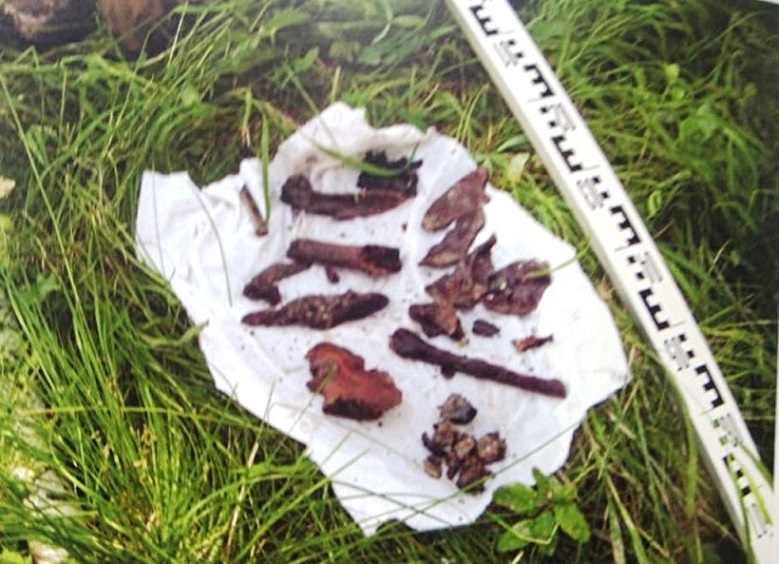
In the burial site, in addition to bone fragments, a piece of burnt striped fabric was discovered, which we believe belonged to Tsesarevich Alexei, who was wearing a vest on the day of the murders in the Ipatiev House.

PHOTO: Only 44 pieces of Alexei and Maria’s bones [1] have been found at Porosenkov Log, near Ekaterinburg

On 30 April 2008, Russian forensic scientists announced that DNA testing had proven that the remains belong to the Tsesarevich Alexei and his sister Grand Duchess Maria. DNA information, made public in July 2008, that was obtained from the Ekaterinburg site and repeated independent testing by laboratories such as the University of Massachusetts Medical School revealed that the final two missing Romanov remains were indeed authentic. In March 2009, results of the DNA testing were published, confirming that the two bodies discovered in 2007 were those of Alexei and Maria.

For many years, it has generally been accepted that Alexei began bleeding from his navel at the age of six weeks . . . this has since been proven incorrect. This was based on an entry in Nicholas II’s diary, six weeks after the birth of Alexis . . . Alix and I were very concerned about the bleeding of little Alexei from his umbilical cord . . .”.

Two noted Romanov historians Margarita Nelipa and Helen Rappaport both tell us otherwise, that Alexei’s bleeding was noted the day following his birth. Their claim is based on two separate, yet reliable sources:

[1] “One day after Alexei’s birth, Grand Duke Peter Nikolaevich (1854-1931) came to congratulate the sovereign and stayed for lunch. Upon his departure, the sovereign mentioned the presence of “blood on the diapers”. Returning to his Znamenka estate (in Alexandria), he repeated this detail to his wife who telephoned Nikolai II (before visiting Alix later that evening). During their conversation, he said that the doctors had confirmed that the atypical bleeding was indeed due to haemophilia.”

Source: ‘Alexei. Russia’s Last Imperial Heir: A Chronicle of Tragedy’ by Margarita Nelipa. Published by Gilbert’s Books in 2015

[2] Grand Duke Peter Nikolaevich and his wife Grand Duchess Militza Nikolaevna (1866-1951) had driven over to the Lower Dacha the day Alexei was born . . . as their son Prince Roman Petrovich (1896-1978) later recalled in his memoirs [published in Danish].

‘When they returned in the evening to Znamenka, my father remembered that . . . the Tsar had told him . . . That the doctors were concerned about the frequent splatters of blood in his swaddling clothes. . . .”

Grand Duke Peter telephoned the palace, “When the Tsar answered that they had hoped that the bleeding would soon stop, my mother took the receiver and asked if the doctors could explain the cause of the bleeding. When the Tsar could not give her a clear answer, she asked him with the calmest of voices she could manage: ‘I beg you, ask them if there is any sign of haemophilia’ . . . The Tsar fell silent on the phone for a long time and then started to question my mother and ended by quietly repeating the word that had staggered him: haemophilia.”

Source: ‘Four Sisters. The Lost Lives of the Romanov Grand Duchesses’ by Helen Rappaport. Published in 2014

In addition, is a letter dated 1st August 1904 – 2 days after Alexei’s birth, in which the Emperor mentions the “unusual bleeding” to Grand Duchess Militza Nikolaevna:

Dear Militza,

I am writing Alix’s words to you: Thank God, the day passed calmly. After having a dressing at 12 o’clock and up to 9:30 in the evening, there was not a drop of blood. The doctors hope this will continue. Korovin stays overnight. Fedorov leaves for the city and will return tomorrow. We both like him immensely! The little “treasure” is surprisingly calm when a bandage is applied, or he sleeps or lies and laughs. The parents now have a little relief in their hearts. Fedorov says that the loss of blood over two days is roughly ⅛ – 1/9 of the total amount of blood.

Nicholas

Source: Alexei: Russia’s Last TsesarevichLetters, diaries and writings by George Hawkins. Independently published in 2022

NOTES:

[1] For years, the boxes containing 44 bone fragments remained on dusty shelves in the Russian State Archives. In December 2015, their remains were transferred to the Novospassky Monastery in Moscow, where they remain to this day.

© Paul Gilbert. 25 February 2022
How a French princess almost became the last Empress of Russia

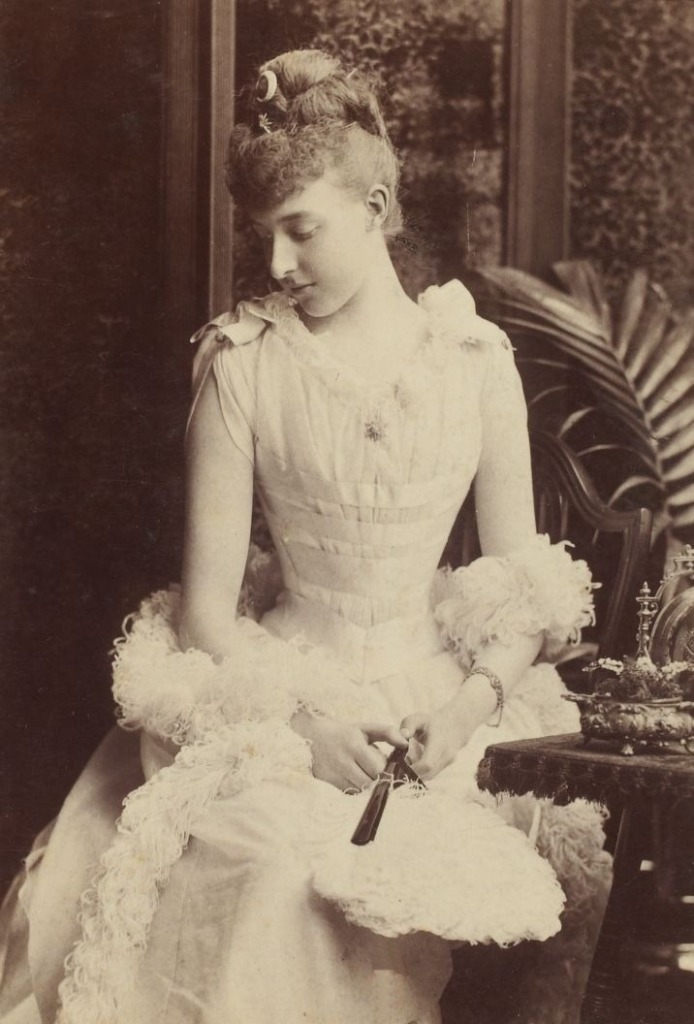
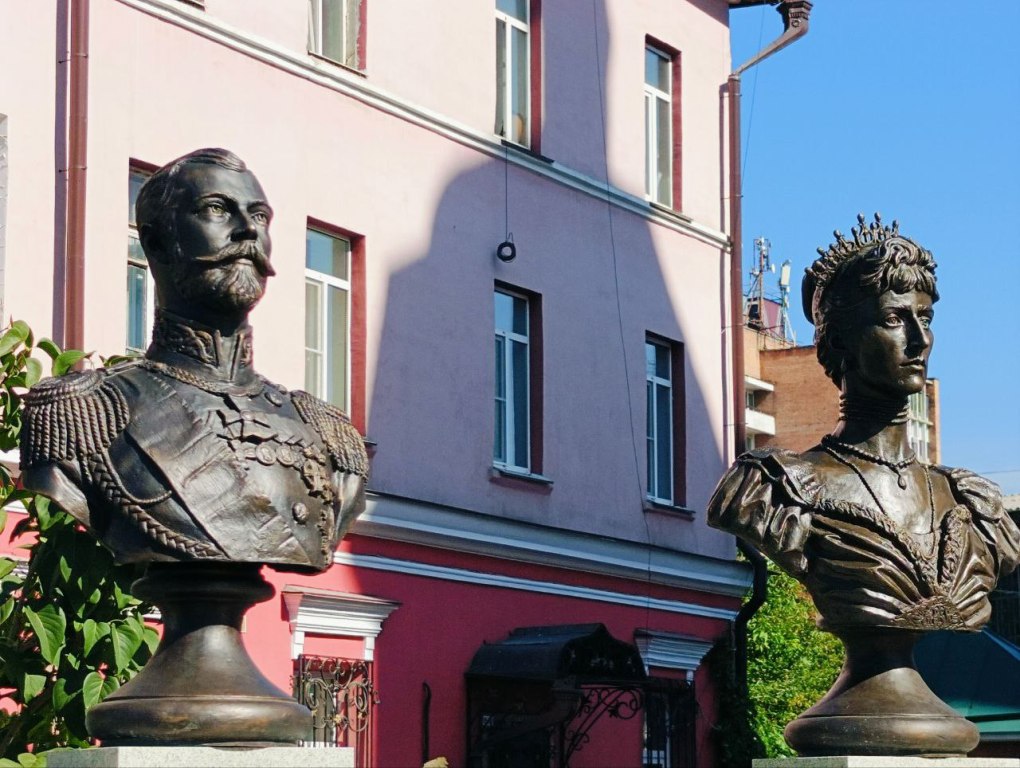
PHOTO: Princess Hélène of Orleans (1871-1951)

It was Peter the Great who started the tradition of marriages with German princesses, which was continued by his successors. This is explained both by the religious issue – Protestants easily accepted Orthodoxy, unlike Catholic princesses – and by political unions, because the German principalities were the closest neighbours of the Russian Empire. The only exception was Emperor Alexander III, who married a Danish princess.

When Tsesarevich Nicholas Alexandrovich – the future Emperor Nicholas II – fell passionately in love with Princess Alice of Hesse-Darmstadt, he received an unexpected rebuff from his parents, who had their own arguments against such a union. At the end of the 19th century, Russia once again changed its foreign policy ally – France replaced Germany and Austria.

This political union was the main project of Alexander III, who began cordial relations with France, eventually entering into an alliance with the French in 1892. Best of all, an alliance would strengthen a marriage. And although France at that time was already a republic, she could offer Princess Hélène of Orleans (1871-1951), a representative of the Orleans branch of the Bourbon dynasty, as a bride. Hélène was the third of eight children born to Prince Philippe, Count of Paris, and Infanta Maria Isabel of Spain.

Moreover, the fact that the princess did not belong to a ruling house was considered as a plus, because in this case she would not be able to influence her husband in the interests of her family. And Empress Maria Feodorovna, being a Dane, simply did not want to see a German princess as her daughter-in-law. She held strong militant anti-German sentiment because of the annexation of Danish territories by Prussia in 1864.

Therefore, Hélène had long been considered the main contender for the crown of the Russian Empress. Hélène of Orleans was known for her beauty, knew several languages, and she loved sports. Journalists referred to her as a model of women’s health and beauty. Of course, one can only speculate whether Nicholas’s marriage with Hélène would have changed the course of Russia’s history?

For one, Hélène would not have passed on to her children, namely, her son, the haemophilia gene, which played a fatal role in the history of the Russian Imperial Family. It was Alexei’s morbidity that led the odious Rasputin to the pinnacle of power. Empress Alexandra Feodorovna, trusting the elder with the most valuable thing – her son. According to some historians, the Empress began to consult with him in those matters where he could not be competent in any way, often influencing her husband. Nicholas adored his wife too much to ignore many of her requests.

Historians believe, that if he had treated his wife more calmly, he could make decisions on his own and remain calm in acute situations. In addition, Hélène was French, and would not have caused such antipathy as the German Alexandra Feodorovna, when in 1914 Russia entered the war against Austria and Germany.

Nicholas, never pursued his parents choice for the French princess as a bride, as he was already in love with Princess Alix of Hesse. It is quite possible, that the strong willed Alexander III could have forced his son to marry Hélène, but his health failed him. Fearing that he would not have time to marry his son personally, and feeling completely ill, he yielded to Nicholas request to marry the woman he loved. The subsequent events are known, but Alexandra Feodorovna was never able to please either the court, or the people, or the relatives of her beloved husband.

Hélène of Orleans eventually married Prince Emmanuel Philibert of Savoy, cousin of King Victor Emmanuel of Italy. In marriage, she gave birth to two sons, was engaged in charity, left many travel notes on her travels in Europe and Africa. She outlived Nicholas II , her husband and both her sons. She died on 21st January 1951 (aged 79), in Castellammare di Stabia, Italy.

© Paul Gilbert. 12 February 2022
Lilacs return to the Alexander Palace

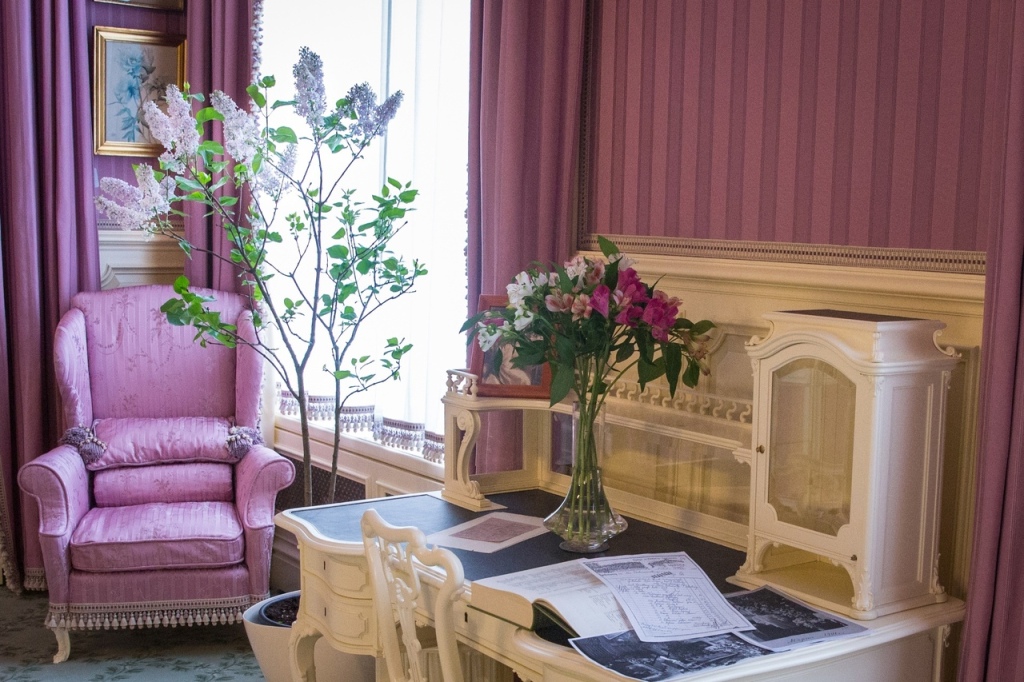
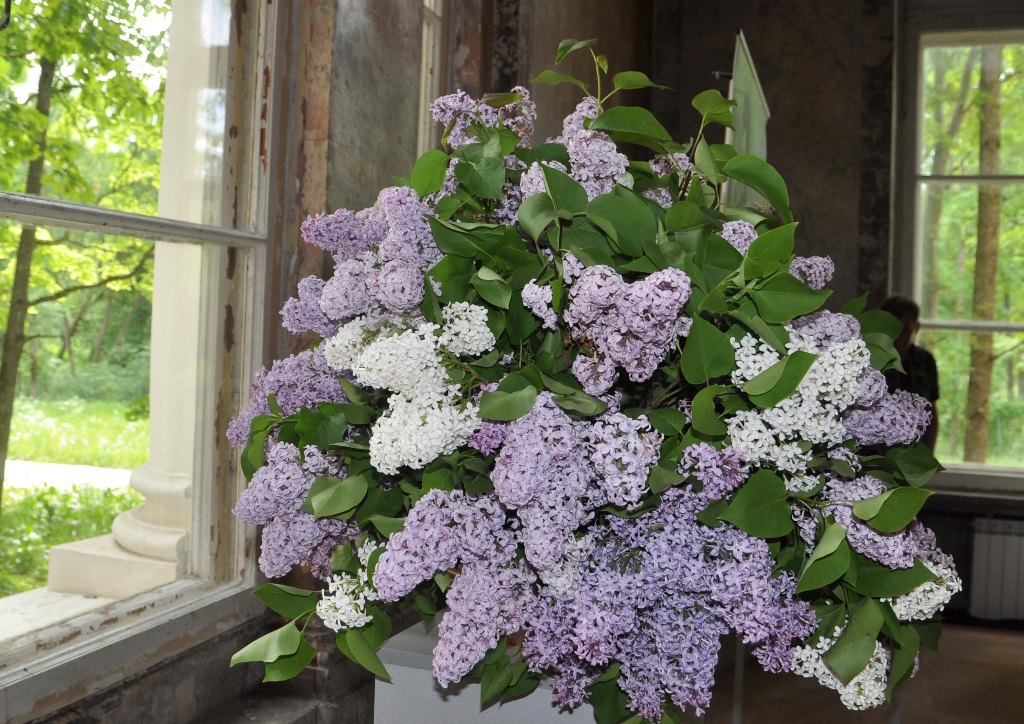
PHOTO: after more than a century, fresh lilacs once again decorate the recently restored interior of the Empress’s Mauve Boudoir in the Alexander Palace. © Tsarskoye Selo State Museum

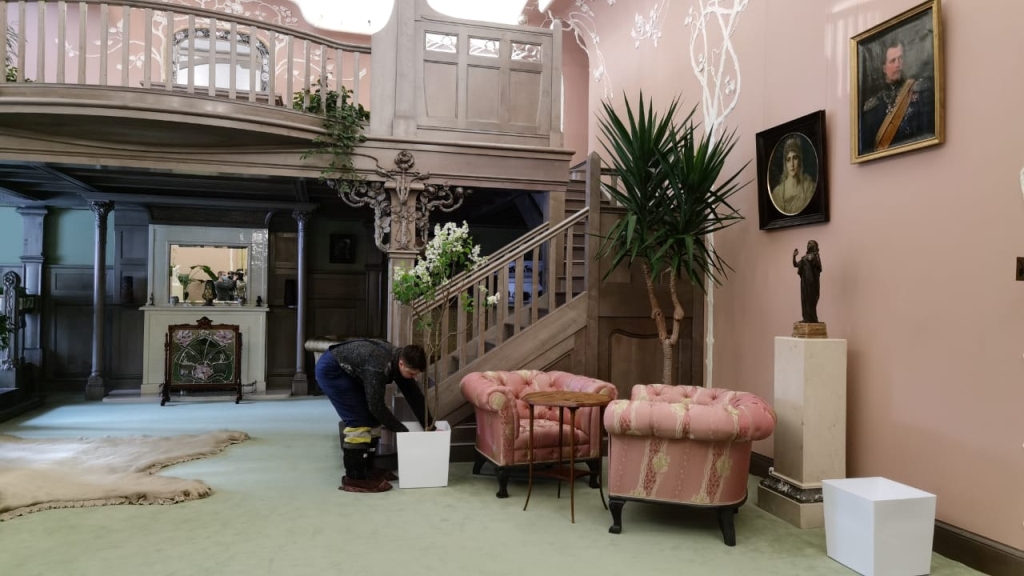
For the first time in more than a hundred years, the fragrant scent of lilacs once again fill the interiors of the Alexander Palace during the cold winter months. The Tsarskoye Selo State Museum have revived the tradition, by placing lilacs in the Mauve (Lilac) Boudoir and the Maple Drawing Room of the Alexander Palace.

It was during the Imperial Family’s residence in the palace [between 1905-1917] that Empress Alexandra Feodorovna, filled her rooms fresh flowers year round. During the winter months, fragrant lilacs were grown in the greenhouses at Tsarskoye Selo. Even during the first few months of their house arrest in 1917, flowers remained in the interiors. Since “prisoners” were not entitled to any luxuries, the flowers were soon removed from the rooms by their captors.

PHOTO: fresh lilacs have also been placed in the recently restored interior of the Maple Drawing Room in the Alexander Palace. © Tsarskoye Selo State Museum

In order to provide fresh lilacs for the palace, the greenhouses at Tsarskoye Selo, as in the beginning of the last century, use a forcing technique, by which plants come out of dormancy, allowing them to bloom throughout the year. In the early 20th century, bushes were planted in greenhouse boxes, and lilacs began to be prepared for awakening in December, with the help of additional light. The interiors of the Alexander Palace were decorated with historical varieties, among them the famous white “Madame Lemoine” lilac, which was on the order lists of Tsarskoye Selo gardeners. It was from this variety that the cult of lilac began.

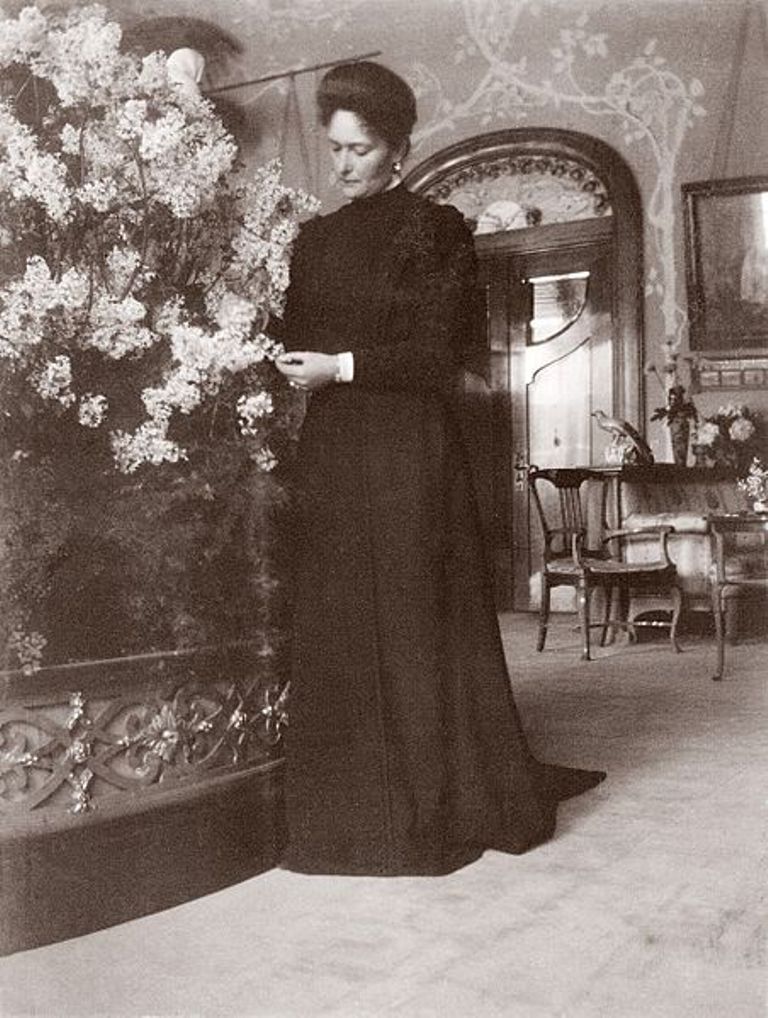
Empress Alexandra Feodorovna loved flowers – the rooms in her private quarter of the palace were decorated with fresh flowers all year round. Floral themes were also present in the wall upholstery, furniture, stucco reliefs on the walls and ceilings. The Empress was especially fond of lilacs. It is no coincidence that in her Mauve (Lilac) Boudoir, that the furniture and walls were decorated with lilac-colored silk, which reflected the Empress’s preferred lilac tones in clothes, and lilac-scented perfumes.

PHOTO: Empress Alexandra Feodorovna admiring a tub of lilacs in the Mauve Boudoir of the Alexander Palace, Tsarskoye Selo. 1909

Lilacs were placed everywhere in the palace: cut branches in a vase on a table by the window and bushes in a jardinière [a decorative flower box or planter] by the sofa in the Mauve (Lilac) Boudoir; magnificent lilac compositions decorated the Pallisander (Rosewood) and Maple Drawing Rooms.

In present day, between late spring – early summer, the Catherine and Alexander Parks are filled with lilacs, especially along Lilac Alley in the Catherine Park.

Lilacs first appeared at Tsarskoye Selo in the 18th century. Under Empress Elizabeth Petrovna, trees and shrubs were regularly planted in the parks of Tsarskoye Selo, including lilacs. Under Catherine II, parks and greenhouses were replenished with new species of plants, flowers and shrubs, including lilacs. Under Alexander I in 1817, at the direction of the architect Adam Menelas, the gardener Fyodor Lyamin planted lilacs in front of the palace and the colonnade, where they continued to bloom for over a hundred years. In the middle of the 19th century, the Lilac Alley was created, stretching from the Pink Guardhouse to the Krestovy Canal. In the 19th century, gardeners planted many new varieties of lilacs with various colors: white, mauve, purple and pink.

In the 19th century, many new varieties of lilac appeared with a variety of colors: white, mauve, purple and pink. A rich collection was formed at the end of the century in a small family company Lemoynov from the French city of Nancy. It was founded by Victor Lemoine, a master of ornamental plant breeding. He was not a supplier of the Russian Imperial Court, however, his varieties were purchased for Tsarskoye Selo, among them – “Madame Antoine Buchner” (terry lilac with dark pink buds, large, fragrant flowers from mauve-pink to pale whitish -pink), “Madame Lemoine” (lilac with white, large, double fragrant flowers).

PHOTO: each year, lilacs decorate the interiors of the Alexander Palace on 6th June, in honour of Empress Alexandra Feodorovna’s birthday. The photo above, shows the Marble (Mountain) Hall

In the years prior to the closing of the Alexander Palace for restoration between 2015-2021 – bouquets of fresh lilacs were placed in the former apartments of the Empress on her birthday: 6th June [O.S. 25th May]. Now that the restoration of the eastern wing of the Alexander Palace has been completed, let us hope that this annual tradition is also revived.

© Paul Gilbert. 12 January 2022

Icon made on the occasion of Nicholas II and Alexandra Feodorovna’s wedding sold at auction

On 11th November, the icon “St. Nicholas the Wonderworker and the Martyr Tsarina Alexandra”, sold at an auction held at Literary Fund Auction House in Moscow for 4.3 million rubles [$60 thousand USD].

The icon was made by the Moscow jewellery company I.P. Khlebnikov, Sons and Co. The firm was founded in 1871 and in 1879 was awarded the title of Supplier to the Court of His Imperial Majesty Emperor Alexander II.

The icon was made on the occasion of the wedding of Emperor Nicholas II and Empress Alexandra Feodorovna, held on 27th November [O.S. 14th November] 1894 at the Grand Church – the home church of the Imperial Family – in the Winter Palace, St. Petersburg.

The wood icon made by A.A. Artsibashev, is 30.6 x 25.6 x 2.1 cm. Setting: silver, enamel, filigree, filigree enamel, chasing, gilding, mount; 30.7 x 25 x 3 cm. Good condition. The icon has a museum, artistic, historical and cultural significance.

© Paul Gilbert. 12 November 2021