“They did not betray their oath” – the fate of the generals who remained loyal to Nicholas II

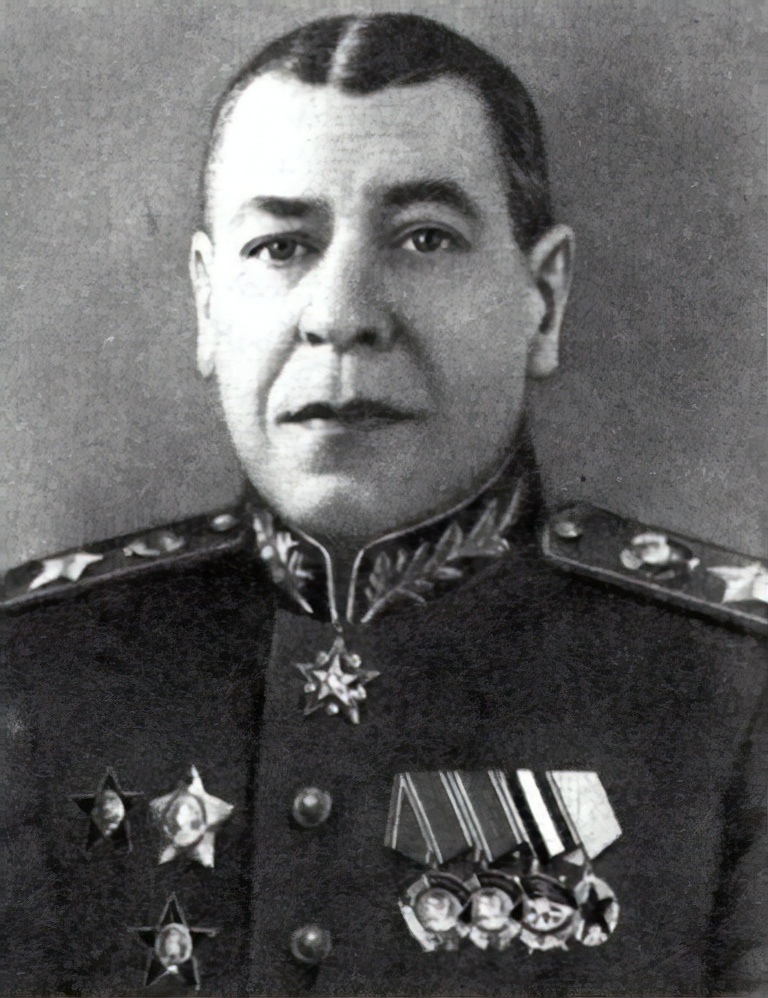
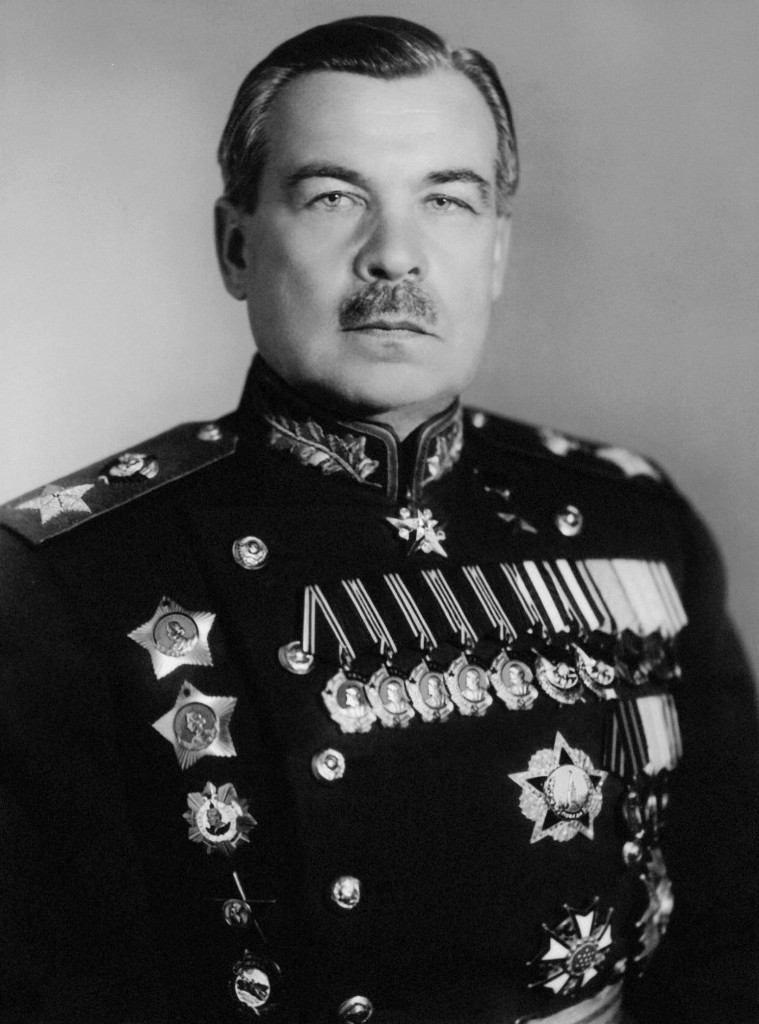
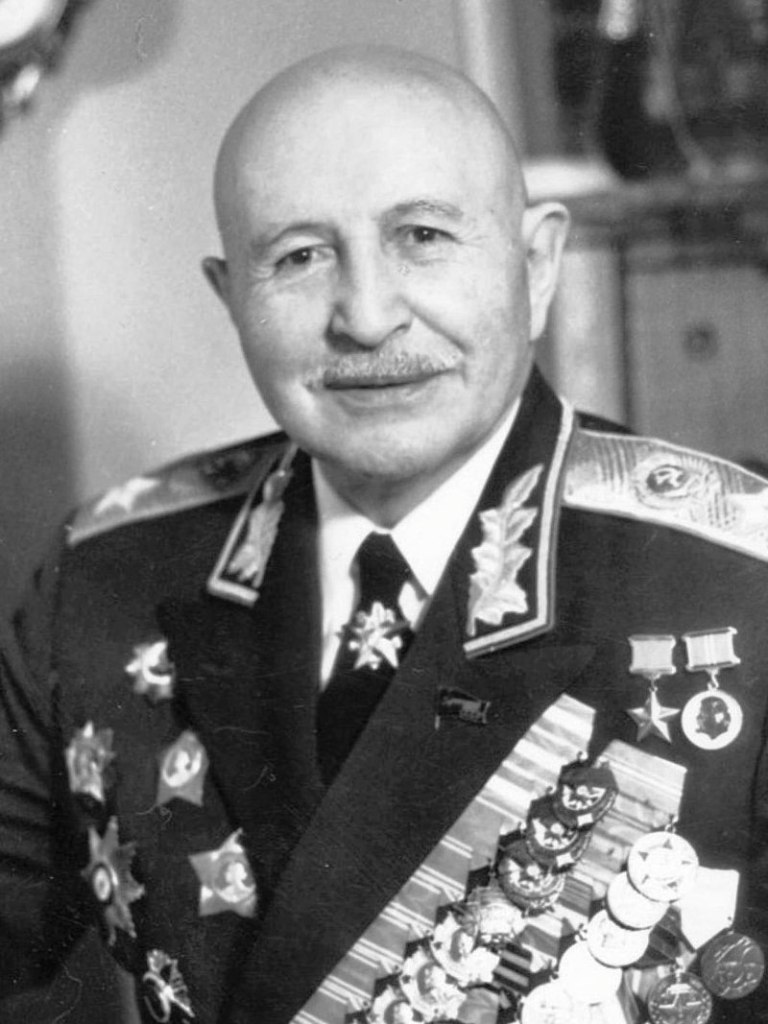
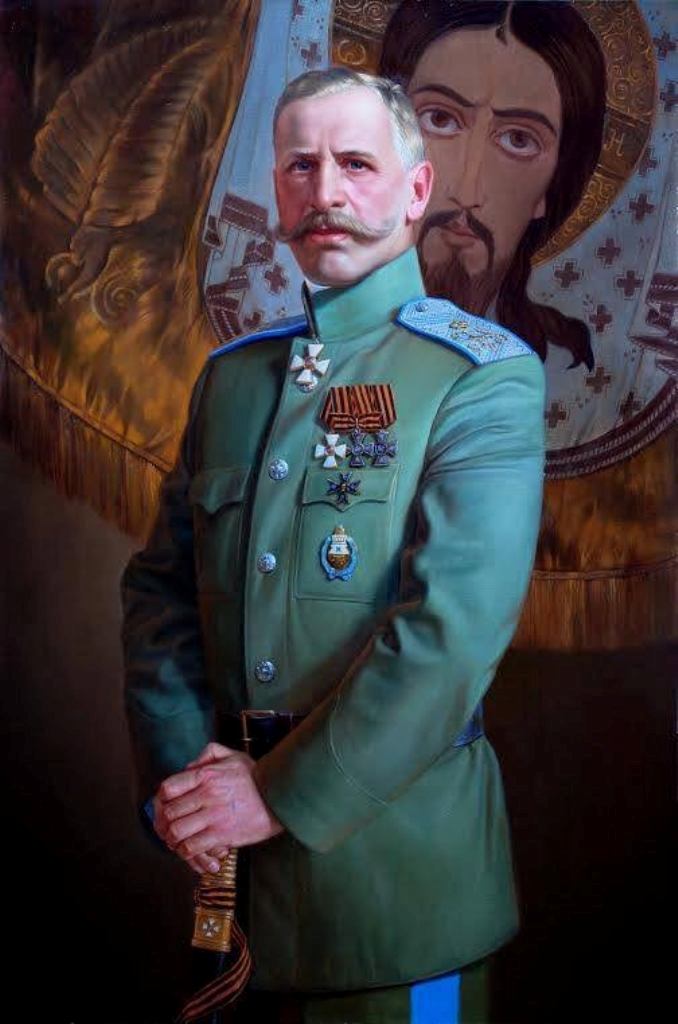
PHOTO: Generals Nikolai Ivanov, Fyodor Keller and Huseyn Khan Nakhchivanski
The abdication of Nicholas II, continues to be shrouded in controversy, myths and lies. Modern day academically lazy historians continue to spread the century old myth that the Tsar was betrayed by all of his generals in the days leading up to his abdication. This is not true!
During the February 1917 Revolution, while most all of Russia’s top military leaders agreed with the position of the chief of staff of the General Headquarters (Stavka) of the Russian Imperial Army, General Mikhail Alexeev, that Emperor Nicholas II must abdicate the throne. Among them, was the Tsar’s first cousin Grand Duke “Nikolasha” Nikolaevich (1856-1929).
A fact, which is often overlooked by today’s historians and authors, is that there were in fact three generals who remained loyal to their oath to the Emperor: Nikolai Iudovich Ivanov (1851-1919), Fyodor Arturovich Keller (1857-1918), and Huseyn Khan Nakhchivanski (1863-1919). All three generals had distinguished military careers and highly decorated with orders and medals for their service, duty and bravery.
It was during the February 1917 Revolution, that these generals offered the Tsar the services of their troops to suppress the revolution. And when the Tsar abdicated, and it was time to swear allegiance to the new Provisional Government, these same three generals defiantly refused.
Sadly, the lives of these generals ended tragically. None of them survived the Civil War, and yet they remained loyal to Emperor Nicholas II until the end of their days.
Memory Eternal! Вечная Память!
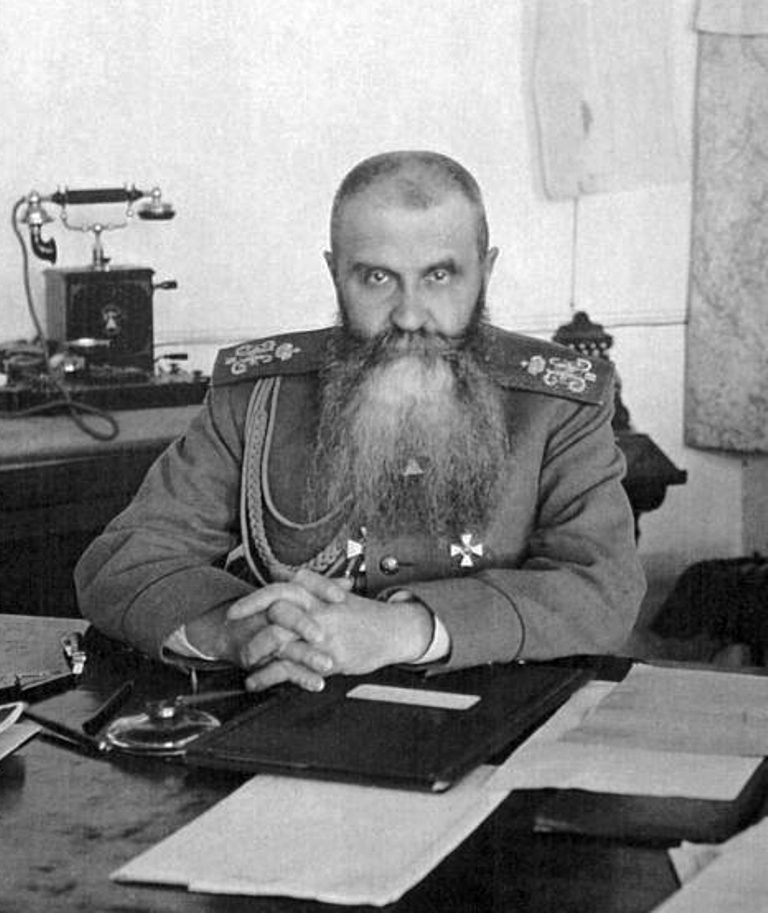
Nikolay Ivanov
The origin of Nikolai Iudovich Ivanov (1851-1919) origin remains a subject of debate, some sources say that he came from a noble family from the Kaluga Governorate, but other sources claim that he was the son of a cantonist[1]. Despite all of these sources, the origin of where Ivanov’s family came from, remains a mystery.
After graduating from the military gymnasium, Nikolai Ivanov continued his military education and became an artillery officer. He served in the 3rd Guards and Grenadier Artillery Brigade, he then participated in the Russo-Turkish War of 1877-1878. During the Russo-Japanese War of 1904-1905, he commanded a corps and repeatedly showed personal bravery, for which he was awarded the Order of St. George 3rd and 4th Class and a Gold Sword for Bravery. In 1908, Ivanov received the highest rank of general of the branch of the armed forces (artillery) at that time.
During the First World War, Ivanov commanded the troops of the South-Western Front. Later at the end of 1915, he conducted a failed operation by the 11th Army against the enemy’s forces. And in March 1916, he was replaced by General Aleksei Brusilov as the commander-in-chief of the Southwestern Front. Ivanov he was then appointed a member of the State Council, and adjutant to Emperor Nicholas II.
On 27th February 1917, the Emperor received disturbing reports about the civil and social unrest in Petrograd, and that the garrison of the capital refused to obey their superiors. Ivanov was appointed commander of the Petrograd Military District with extraordinary powers and subordination of all ministers to him. The Georgievsky Battalion (aka Knights of St. George), were reinforced by two machine-gun companies, which were placed at his disposal. In addition, Ivanov was to be sent two cavalry and infantry regiments from the Northern and Western Fronts.
The Emperor instructed Ivanov and ordered him to go to Tsarskoye Selo to ensure the safety of the Empress and her children. Military units loyal to the Tsar sent from the Fronts were also supposed to arrive there. Ivanov was to take command of them all at Tsarskoye Selo and from there to march on Petrograd to quell the unrest.
Now it is known that the chief of staff of the General Headquarters (Stavka) of the Russian Imperial Army at Mogilev, General Mikhail Alexeev (1857-1918), and the commanders of the Fronts sabotaged the Emperor’s order on the allocation of troops.
After Ivanov learned about the Tsar’s abdication, he went back to the Headquarters at Mogilev, but was arrested and taken to Petrograd. By order of the Minister of Justice of the new Provisional Government Alexander Kerensky (1881-1970), Ivanov was released. In 1918, General Pyotr Krasnov (1869-1947) of the White Army, appointed Ivanov commander of the Special Southern Army, consisting of the Voronezh, Astrakhan and Saratov corps.
On 29thJanuary 1919, after a short but serious illness (from typhus), the former commander-in-chief of the Southern Army, General of Artillery Nikolai Iudovich Ivanov died in Odessa.
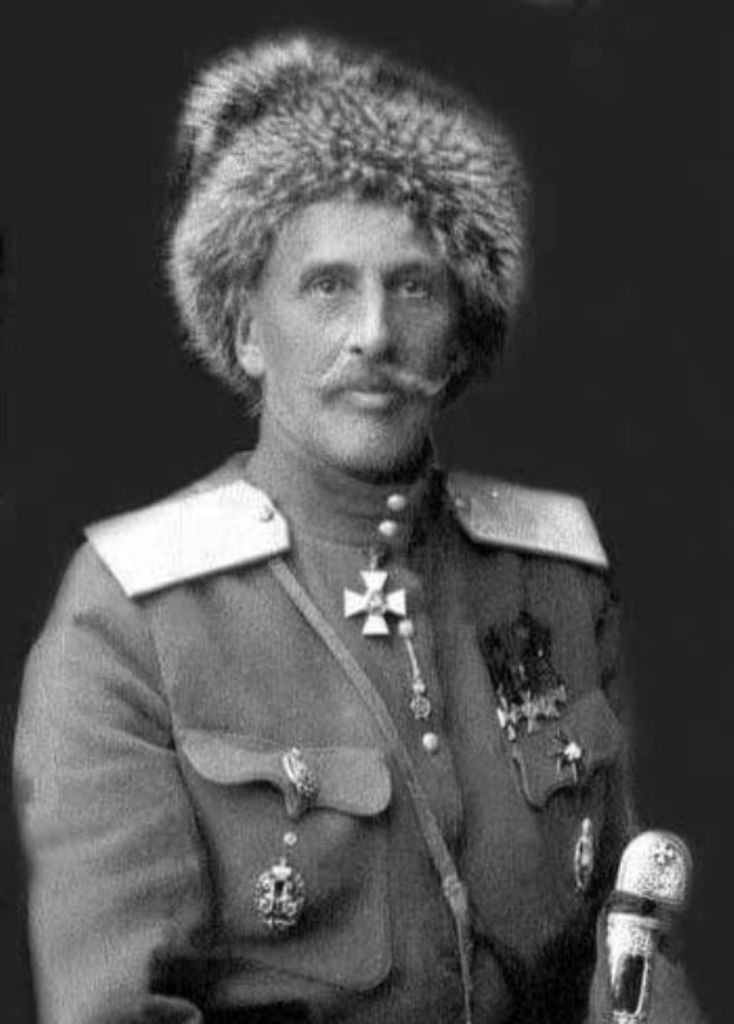
Fyodor Keller
Fyodor Arturovich Keller (1857-1918) came from a military family of Russified Germans, many members of which were generals. In 1877, he volunteered for the Russo-Turkish War and awarded the St. George’s Cross 1st and 2nd Class for bravery.
In 1906, Keller survived two attempts on his life by revolutionaries. In 1907, he was awarded the rank of Aide-de-Camp and in July of the same year, he was promoted to major general with enrollment in His Imperial Majesties Retinue.
In August 1914, while commanding the 10th Cavalry Division, he won a number of victories over the enemy, for which in 1916 Emperor Nicholas II awarded him a golden sword. In addition, for services in battle he was awarded the Order of St. George 3rd and 4th Classes.
The news of the abdication of the Emperor found Keller in the post of commander of the 3rd Cavalry Corps. On 6th March 1917, he sent a telegram to Nicholas II, in which he begged him not to leave the throne and offered his troops to suppress sedition. The telegram never reached the Emperor, having been intercepted by supporters of the Provisional Government.
Keller refused to take the oath of allegiance to the new Provisional Government, and was dismissed from his position on 15th March. He left for Kharkiv, where his family lived at that time.
Keller was not happy with the White movement, as it refused to put forward monarchist agenda. He moved to Kiev, where on 19th November 1918 he was appointed by the puppet pro-German “Hetman of Ukraine” Pavlo Skoropadskyi, to lead the armed forces formed from the Russian officers in Kiev, who were there to protect the city from Symon Petliura’s[2] followers.
Skoropadskyi needed the support of Russian monarchists, but Keller understood the appointment as the beginning of his own dictatorship. Keller instituted a five-member Council of the State Defense, composed entirely of the monarchist politicians, and stated that he served one Russian state. Skoropadskyi dismissed Keller on 26th November for “overstepping his authorities”.
Sadly, the events which unfolded in Kiev turned out to be fatal for Keller. When Petliura’s followers entered the city, Keller was in hiding in the St. Michael’s Golden-Domed Monastery. He had categorically rejected the Germans’ proposal to hide in their units, changing the Russian uniform for the German one.
Finally, on 21st (O.S. 8th) December 1918, Petliura’s followers captured and shot Keller along with two of his adjutants (December 21, 1918). His golden sword was presented to Petliura.
Keller’s body was buried under a false name in the Holy Intercession Monastery in Kiev. His grave has not been preserved, his body never found.
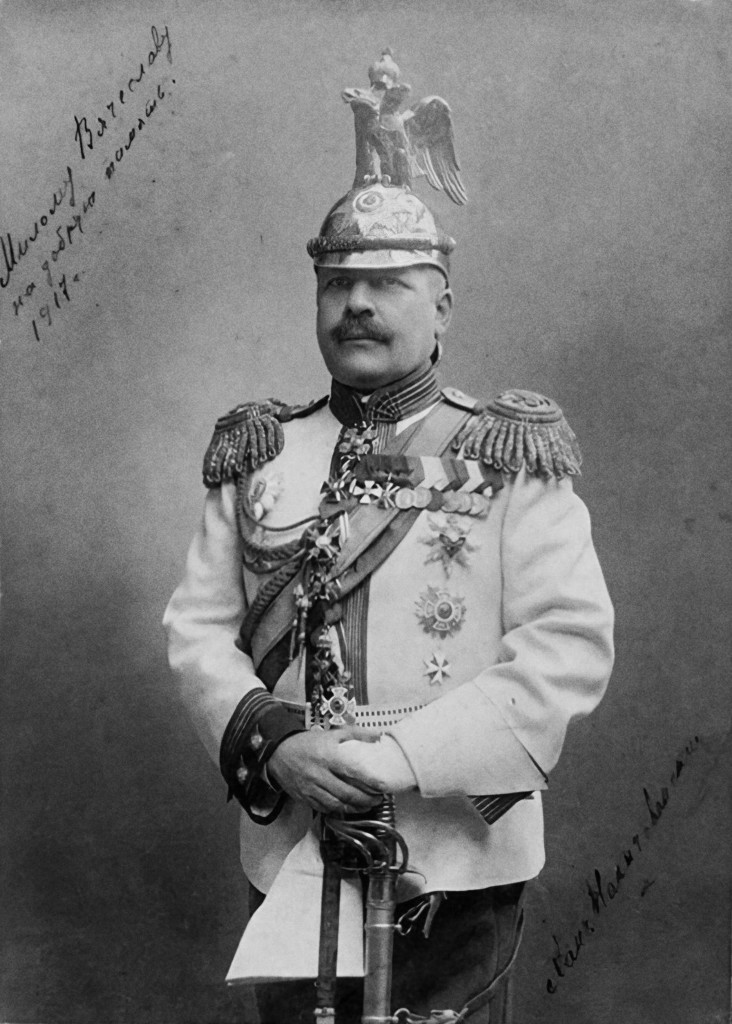
Huseyn Khan Nakhchivanski
Huseyn Khan of Nakhichevan (1863-1919) came from a family of hereditary khans of Nakhichevan, who took Russian citizenship in 1828. From this family came a number of Muslim generals, which was rare in the Russian Imperial Army. After graduating from the Corps of Pages with honours, Huseyn Khan regularly participated in the solemn receptions of foreign monarchs in St. Petersburg.
During the Russo-Japanese War, Huseyn Khan served as commander of the 2nd Dagestan Volunteer Cavalry Regiment. During the war the regiment distinguished itself, and Huseyn Khan himself received seven decorations. On 27th January 1907, he was decorated with the Order of St George 4th Class and the Golden Saint George Sword for launching a successful cavalry onslaught to save an encircled Russian infantry unit.
At the very beginning of the First World War, Huseyn Khan was appointed commander of the Combined Cavalry Corps and participated in the offensive against East Prussia. From 19th October 1914 he was commander of the 2nd cavalry corps and on 22nd October 1914, he was decorated with the Order of St George 3rd Class, which was presented to him personally by Emperor Nicholas II. In June 1915, he was appointed General-Adjutant of His Imperial Majesty and became the only Muslim to hold that position.
The news of the February 1917 Revolution found Huseyn Khan as the commander of the reserve Guards Cavalry Corps. On 3rd March 1917, he sent a telegram to General Alexeev at Mogilev, in which he expressed his readiness to die for the Tsar. His telegram, like Keller’s was not handed over by Alexeev to the Emperor.
Huseyn Khan refused to swear allegiance to the Provisional Government. As a result, Huseyn Khan was officially dismissed from the army on 16th April. His chief of staff, Major General Baron Alexander Wienen, shot himself.
Huseyn Khan returned to Petrograd, where he lived with his family. He was one of the few Azeri figures who did not support the newly formed Azerbaijan Democratic Republic, remaining a staunch Russian monarchist.
Following the October 1917 Revolution and the assassination of the head of Petrograd Cheka, Moisei Uritsky (1873-1918) in August 1918, Nakhchivanski together with some other prominent citizens of Petrograd was taken hostage by the Bolsheviks. He was held in the Shpalernaya Prison along with the Grand Dukes Paul Alexandrovich, Nicholas Mikhailovich, George Mikhailovich and Dmitry Konstantinovich. Also in the same prison was Prince Gabriel Constantinovich, who used to serve under the command of Huseyn Khan and who later managed to escape, and who mentioned in his memoir that he met Huseyn Khan during their walks in the prison yard.
The Grand Dukes were executed in the Peter and Paul Fortress on 29th January 1919. It is presumed by a number of Russian historians that Huseyn Khan was executed together with the Grand Dukes. However, the exact circumstances of his death and his burial place still remain unknown.
NOTES:
[1] A cantonist refers to Jewish boys conscripted into military service in the Russian Empire, particularly during the reign of Emperor Nicholas I (1825-1855). They were educated in special cantonist schools, where they were subjected to harsh conditions and pressure to adopt Christianity. The system began in 1827, and by 1857, it was abolished due to public and international criticism, highlighting the inhumane treatment of these young conscripts.
[2] Symon Vasyliovych Petliura (1879-1926) was a Ukrainian politician and journalist. He served as the Supreme Commander of the Ukrainian People’s Army (UNA) and led the Ukrainian People’s Republic during the Ukrainian War of Independence, a part of the wider Russian Civil War.
© Paul Gilbert. 22 August 2025
***

I am committed to clearing the name of Russia’s much slandered Tsar. In exchange for this 18-page booklet, please consider making a small $5 or $10 donation in aid of my research. These donations are of great assistance in helping me offset the cost of obtaining and translating documents from Russian archival sources, which are often paid for out of my own pocket. It is these documents which help present new facts and information on the life and reign of Nicholas II. In addition, my research continues to debunking many of the myths and lies which exist more than a century after his death and martyrdom.
Please note, that there is NO obligation, thank you for your consideration!




 Nicholas II
You must be logged in to post a comment.