Furniture from the Imperial Yacht ‘Polar Star’ gifted to State Hermitage Museum
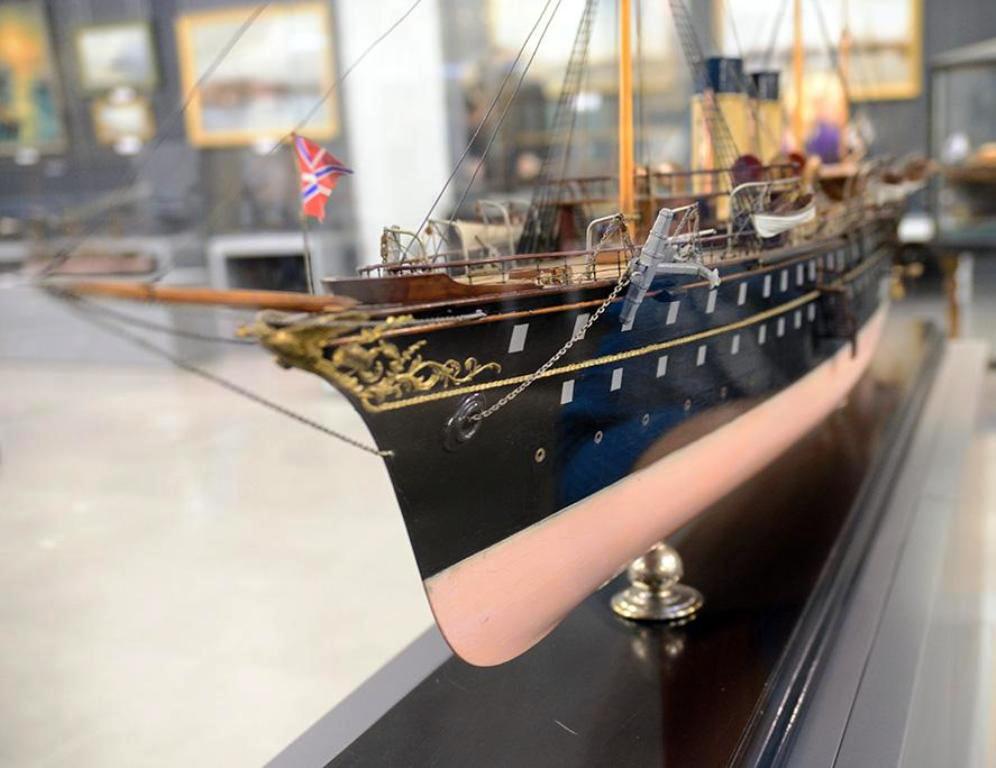
PHOTO: Model of the Imperial Yachts Polar Star «Полярная звезда»
From the Collection of the Central Naval Museum, St. Petersburg

On 29th June 2024, an exhibition of furniture from Emperor Alexander III’s yacht Polar Star «Полярная звезда» opened in the Gothic Library of Emperor Nicholas II situated in the Winter Palace (State Hermitage Museum) in St. Petersburg. The pieces have been donated to the Hermitage by Mikhail Yuryevich Karisalov, a Russian industrialist, art patron and hereditary collector.

The set is made up of ten items: two tables, an armchair, two low cupboards, a dressing mirror, a cartonniere (filing cabinet), two doors and a mirror from a cupboard. They were all made at Nikolai Feodorovich Svirsky’s (1851-after 1915) factory to designs by the architect Nikolai Vasilyevich Nabokov (1838-after 1907) -who also designed the furniture for the Gothic Library.

Svirsky’s factory specialized in producing pieces decorated with marquetry using “our own method”. The distinctive feature of the craftsmen’s signature was extremely intricate, literally jeweller-like, detail work in the inlaid designs, making it possible to convey the subtlest nuances of colour.

In 1889 Svirsky put his creations on show at the 1889 Paris Exposition, where he was awarded the Grand Prix and a gold medal. In 1894 the Svirsky Factory was granted the honorary title of Supplier to the Imperial Court, and two years later his products were awarded a gold medal at the All-Russian exhibition in Nizhny Novgorod.

The manufacture of the furnishings for all the cabins aboard the Imperial Yacht Polar Star that was built for the Imperial amily’s long-distant voyages would be one of Svirsky’s most significant commissions. The correspondent of the Pravitelstvenny Vestnik (Government Messenger] newspaper wrote: “Regarding the interior finishing of the yacht, it must be said that this is something wholly exceptional and perfect in its elegance; there is not gaudy, eye-catching splendour here, but there is artistic splendour… On the right, from the Imperial Dining-Room, a door leads into Her Majesty the Empress’s [Maria Feodorovna] boudoir; there the walls and furniture are upholstered with English waxed cretonne; the cupboard, toilet table, writing desk and doors are covered with superb inlay work…”
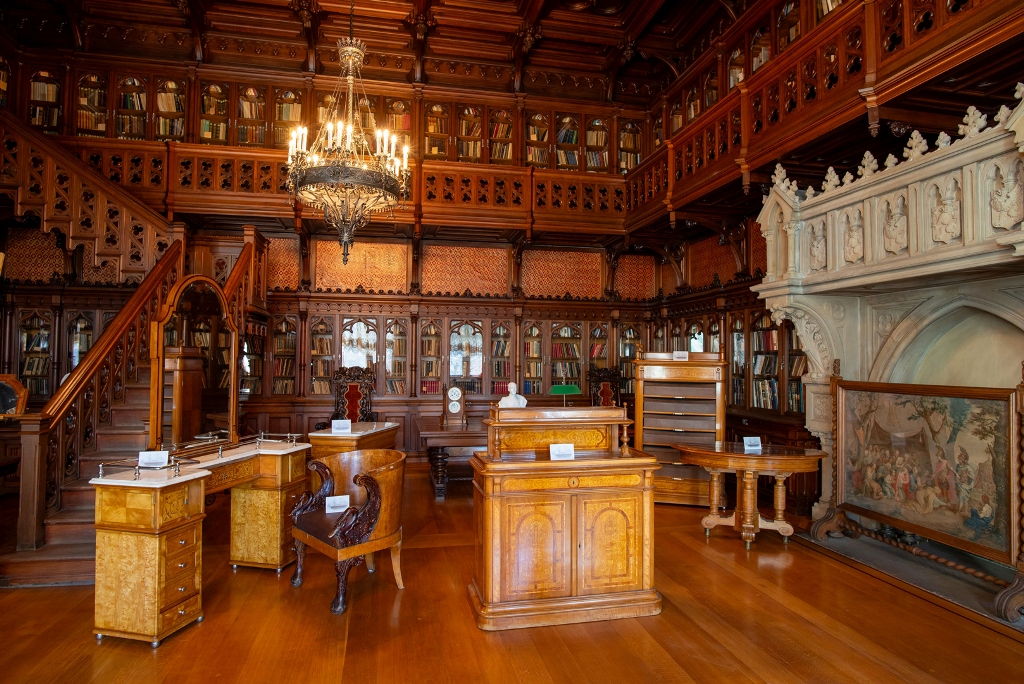
PHOTO: 10 pieces of furniture from the Imperial Yacht Polar Star, on display in the Gothic Library of Emperor Nicholas II in the State Hermitage Museum, St. Petersburg

The exhibition includes two items that the journalist mentioned – the Empress’s “toilet table” and a low cupboard inlaid with Maria Feodorovna’s monogram МФ (MF).

Emperor Alexander III and Empress Maria Feodorovna are known to have sailed all around Europe on the Polar Star. On arrival in different countries, they would happily show off the exquisite interiors of their floating home. Following the death of A;exander III in 1894, the Polar Star became the personal yacht of the Dowager Empress, which she used for her visits to Denmark and Great Britain.

After the October Revolution, the yacht became the headquarters of the Bolsheviks’ Central Committee of the Baltic Fleet (Tsentrobalt), then in the 1930s it was refitted to serve as a floating base for submarines. Later, a cable was run from the yacht, which was moored on the Neva River in front of the Hermitage, to provide electricity to the museum halls. Click HERE to learn about the fate of the Imperial Yacht Polar Star.

For the Hermitage, the items of furniture from the Polar Star are of especial value – from artistic, historical and memorial points of view. After the temporary exhibition in the Gothic Library, the set will find a place within the display devoted to the Art Nouveau era in the General Staff Building, where a separate room showcasing Svirsky’s works will be go on permanent display.

The exhibition curator is Natalia Yuryevna Guseva, Candidate of Art Studies, Deputy Head of the State Hermitage’s Department of the History of Russian Culture, keeper of the Russian furniture collection.

© State Hermitage Museum / Paul Gilbert. 15 July 2024
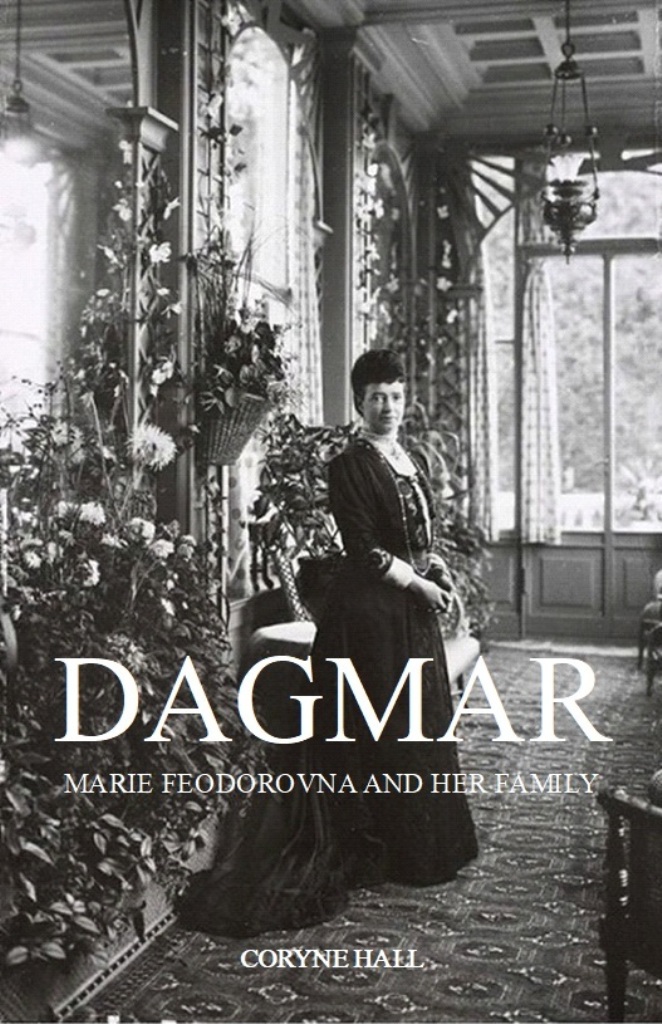
DAGMAR: Empress Marie Feodorovna and Her Family

*This title is available from AMAZON in the USA, UK, Canada, Australia,
France, Germany, Spain, Italy, Netherlands, Poland, Sweden and Japan

CLICK HERE TO ORDER THE HARD COVER EDITION @ $25.00 USD

CLICK HERE TO ORDER THE PAPERBACK EDITION @ $20.00 USD

English. 204 pages, with notes and illustrations

This year marks the 25th anniversary of Little Mother of Russia: A Biography of Empress Marie Feodorovna by Coryne Hall. Since it’s publication in 1999, she has written a number of new articles about Empress Marie Feodorovna and her family based on new research.

These works are presented in DAGMAR, and include chapters on Tsar Alexander III’s Imperial Fishing Lodge in Finland; the friendship of French tutor Ferdinand Thormeyer and Alexander III’s family; Marie’s relationship with her sister the British queen Alexandra; Marie’s fate following the Russian Revolution; her years of exile in Denmark; her death in 1928, and her reburial in Russia in 2006.

In addition is a chapter about her son Emperor Nicholas II’s close relationship with the Kingdom of Denmark and his Danish relatives.

Finally, Coryne Hall provides a fascinating study of Daniah efforts to help members of the Russian Imperial Family in Bolshevik Russia.

Also by Coryne Hall – Nicholas II and the British Monarchs (published in 2023).

© Paul Gilbert. 14 March 2024

Nicholas II’s little known third brother: Alexander (1869-1870)

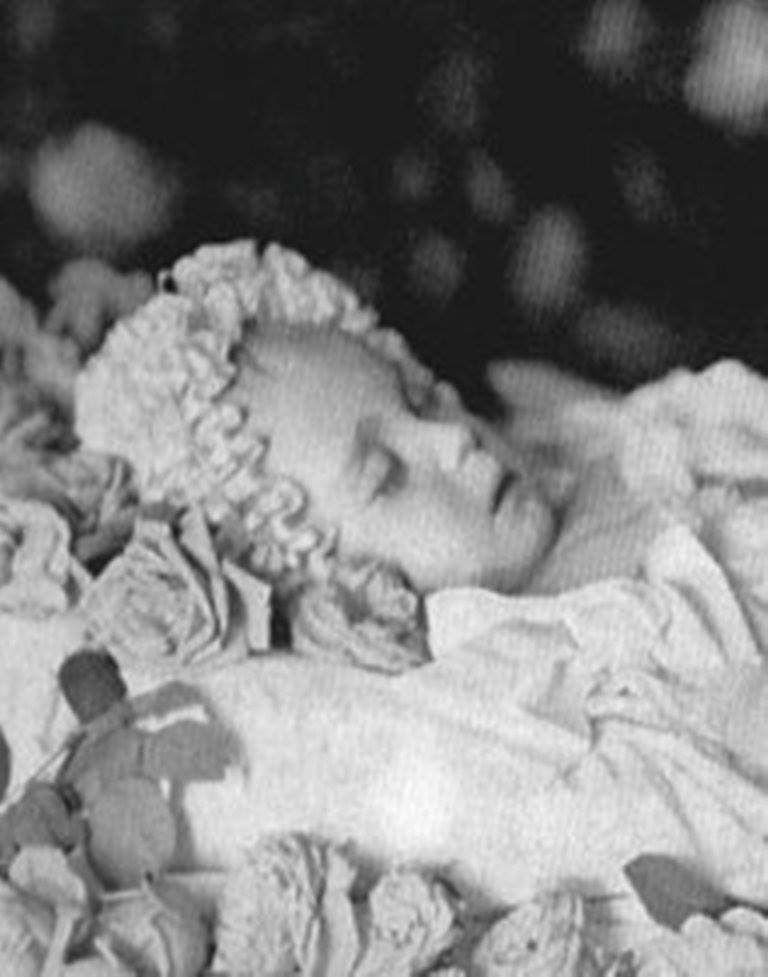
PHOTO: The only photograph of the “Angel Alexander”, was taken by his parents posthumously

Up until the early 20th century infant mortality in Imperial Russia was among the highest in the world[1]. Many a family lost at least one child either during childbirth or disease. Infant mortality was something that did not discriminate, regardless of one’s position in life, including members of the Russian Imperial Family.

Grand Duke Alexander Alexandrovich was born on 7th June (O.S. 26th May) 1869. He was the second child, of the then Tsesarevich Alexander Alexandrovich (future Emperor Alexander III) and Tsesarevna Maria Feodorovna (future Empress Maria Feodorovna, née Princess Dagmar of Denmark).

Alexander was the younger brother of the future Emperor Nicholas II, and third in line to the Russian throne at the time of his birth.

Sadly, the “Angel Alexander” did not live a full year, he died of bacterial meningitis, one month before his first birthday, on 2nd May (O.S. 20th April) 1870, age 10 months and 26 days.

The doctors who observed the infant – obstetrician Jacob Schmidt, pediatrician Karl Rauchfus and surgeon Gustav Hirsch recorded the course of the disease in detail. They noted that on the night of 15/16 April, after the secondary flu which infected the child’s right lung, signs of acute damage to the meninges appeared. On 17th April, there was a “slight improvement in the patient’s condition”, on 18th April – “a feverish state of moderation”, on 19th April – “for the most part he was conscious”, but the next day there was a deterioration and sudden death.

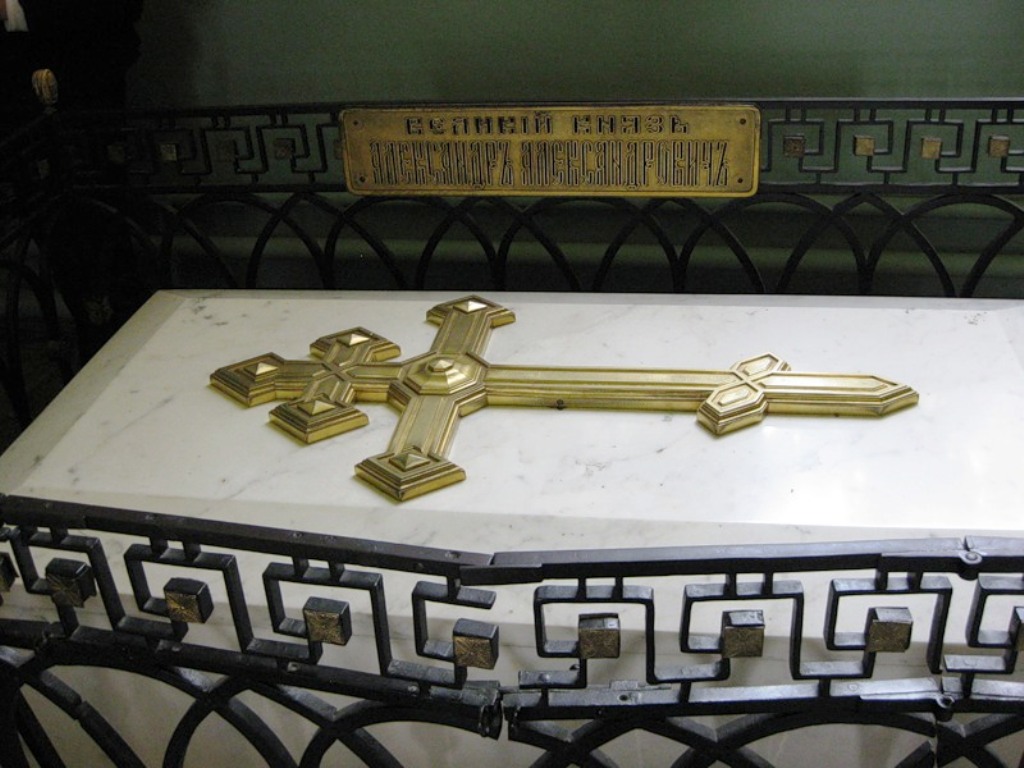
PHOTO: the tiny white marble sarcophagus bearing the remains of Grand Duke Alexander Alexandrovich in the SS Peter and Paul Cathedral, St. Petersburg

Tsesarevich Alexander wrote in his diary: “God, what a day You sent us and what is this test that we shall never forget to the end of our lives? Be it Your Will Lord and we shall conciliate before You and Your Will.”

“The doctors maintain he did not suffer, but we suffered terribly to see and hear him,” Maria Feodorovna wrote to her mother, Queen Louise of Denmark.

Grand Duke Alexander was sketched on his deathbed by the famous Russian portrait artist Ivan Nikolaevich Kramskoi (1837-1887). The only photograph of the “Angel Alexander”, was taken by his parents posthumously.

Sergei D. Sheremetev, the adjutant to Tsesarevich Alexander, accompanied the infant’s body on horseback to the Peter and Paul Fortress in St. Petersburg, where he was buried in the SS Peter and Paul Cathedral. The infant Grand Duke Alexander Alexandrovich was laid to rest in the northern nave of the Peter and Paul Cathedral in a tiny white marble sarcophagus. On the upper edge of the sarcophagus there is a gilded cross made of bronze, on the side there is a bronze plaque with an epitaph inscribed on it

Alexander’s death was the first of many personal losses which the Empress Maria Feodorovna would endure before her own death in 1928. She outlived her beloved husband “Sasha”, her parents, her sister Alexandra, all four of her sons, and five grandchildren.

Memory Eternal! Вечная Память!

NOTES:

[1] At the beginning of the twentieth century, Russia had the highest infant mortality in Europe – 250 out of 1000 newborns died before they reached one year of age.

Infant mortality under Nicholas II steadily declined. The downward trend in mortality (both children and adults) began before the revolution. According to statistics, the death rate during the reign of Nicholas II per 1000 people had been steadily decreasing.

In 1913, the All-Russian Guardianship for the Protection of Motherhood and Infancy was established by a personalized Imperial Decree, with the goal of reducing infant mortality in Russia, setting up shelters for mothers and children, Russia’s first dairy kitchens, children’s hospitals, maternity hospitals, etc.

© Paul Gilbert. 6 May 2023