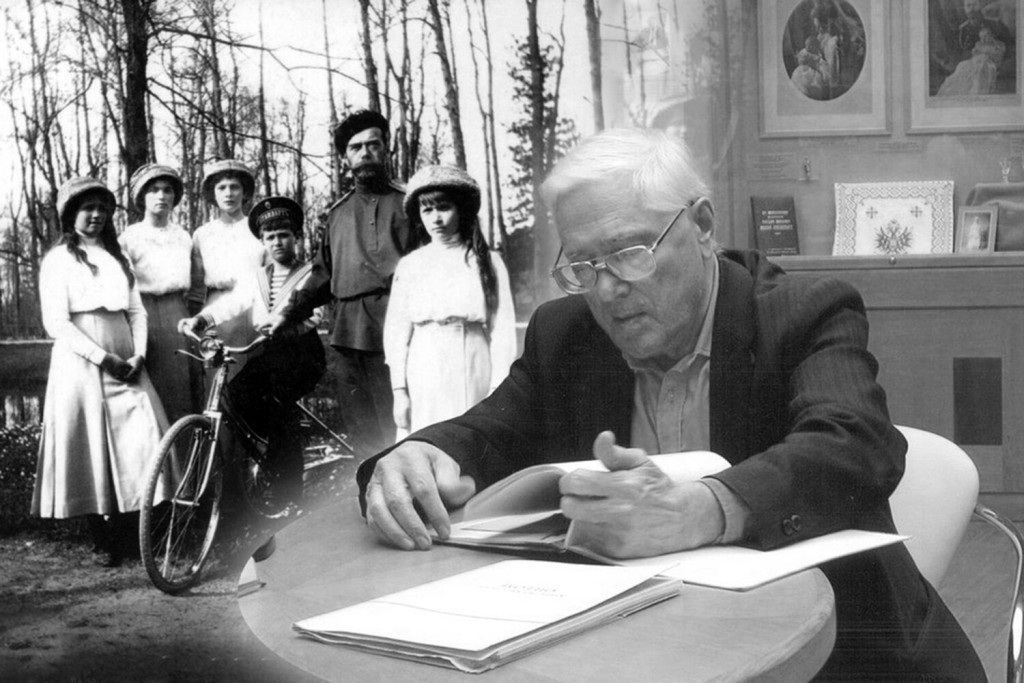
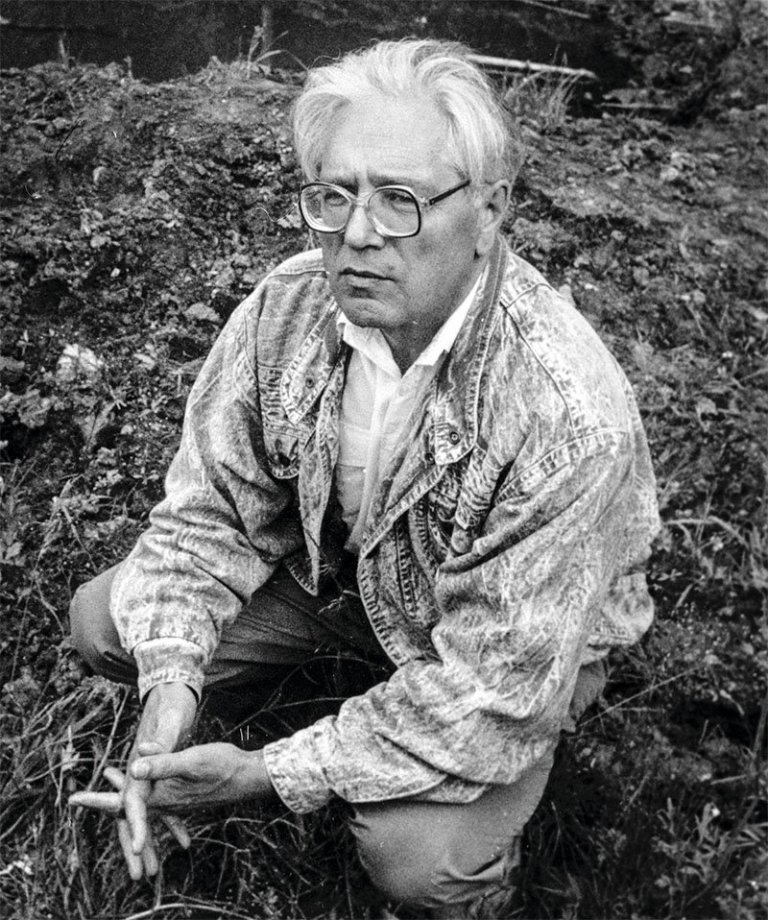
Alexander Avdonin, the Ural geologist who discovered the remains of Nicholas II and his family in 1979, died in Ekaterinburg on 20th February 2026, at the age of 93.
In May 1979, working in secret, Alexander Avdonin, together with the writer and screenwriter Geliy Trofimovich Ryabov (1932-2015), discovered the place where the remains of the Imperial Family and their four faithful retainers were hidden by the regicides in July 1918. For 12 years, the Doctor of Geological and Mineralogical Sciences kept this secret. It was only in 1991, following the fall of the Soviet Union, the remains were exhumed and identified. Avdonon and Ryabov’s discovery is considered one of the most significant events in post-Soviet Russia’s history.
Alexander Nikolaevich Avdonin was born in Sverdlovsk [Ekaterinburg] on 10th June 1932, in the family of a civil engineer Nikolai Gavrilovich and a housewife Ksenia Ivanovna Avdonin. After graduating from school, in 1948, he entered the Sverdlovsk Mining and Metallurgical College. He graduated in 1952 with a degree in geology technician. From 1952 to 1957, he studied at the Faculty of Geology and Geophysics of the Sverdlovsk Mining Institute, receiving the specialty of geophysical engineer.
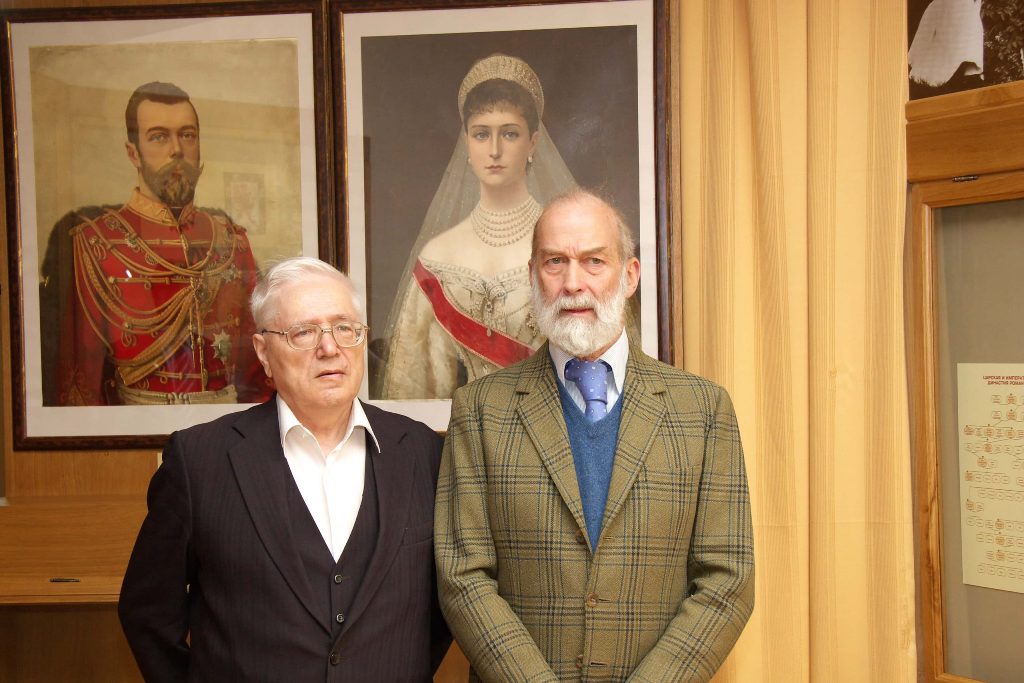
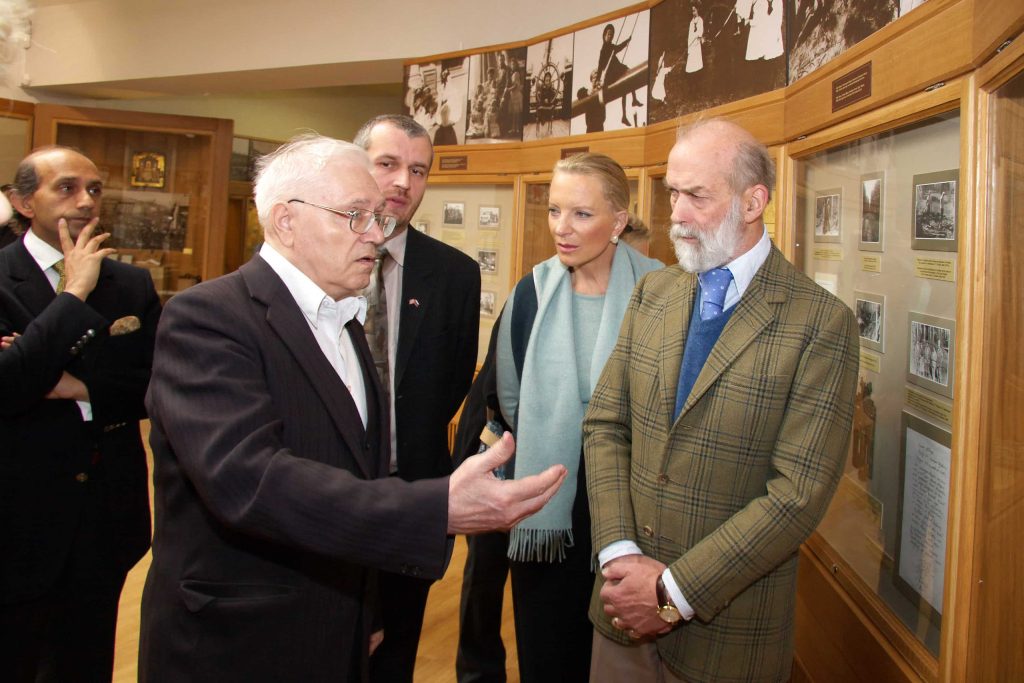
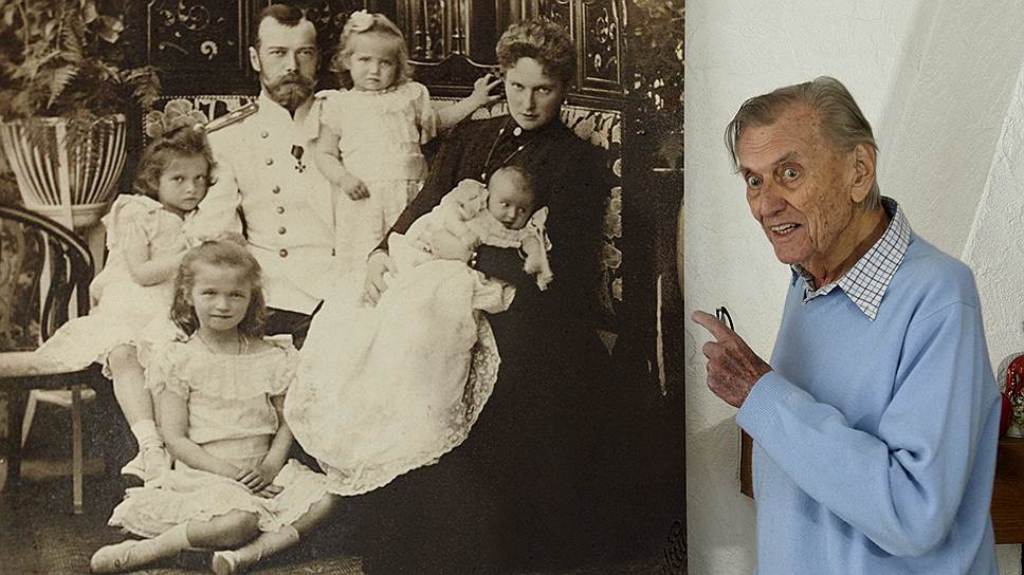
PHOTOS: Alexander Avdonin with Prince Michael of Kent at the Sverdlovsk Regional Museum of Local Lore in Ekaterinburg. June 2012
From 1957 to 1991, Avdonin worked in the Ural Geological Administration as the head of experimental and methodological research in the Ural Geophysical Expedition. In 1981, he was awarded the degree of Doctor of Geological and Mineralogical Sciences.
Following the exhumation of the Ekaterinburg Remains in 1991, Avdonin founded the Yekaterinburg Public Discovery Foundation and became its chairman. In 1993, he was included in the government commission for the identification of the remains of the Imperial Family and remained a member until the burial of Nichola’s II and his family’s remains in St. Petersburg on 17th July 1998.
From 1993, Avdonin worked as a senior researcher at the Sverdlovsk Regional Museum of Local Lore. He was the organizer and member of the creative team for the exhibitions “Russia. The Romanovs. The Urals” (1993) and “The Romanovs: Return to History” (1997). In addition, he he was in charge of the museum’s “Hall in Mmemory of the Romanovs”.
Alexander Avdonin was the author of monographs and scientific articles, and the initiator of the scientific “Romanov Readings” conferences. He gave public lectures at universities in Russia, as well as the United States, Italy, Spain, Germany, and other countries.
Alexander Avdonin’s funeral will take place on Sunday, 23rd February, in the village of Kurganovo, Sverdlovsk region, where he recently lived.
Alexander Nikolaevich Avdonin (1932-2026) Memory Eternal! Вечная Память!
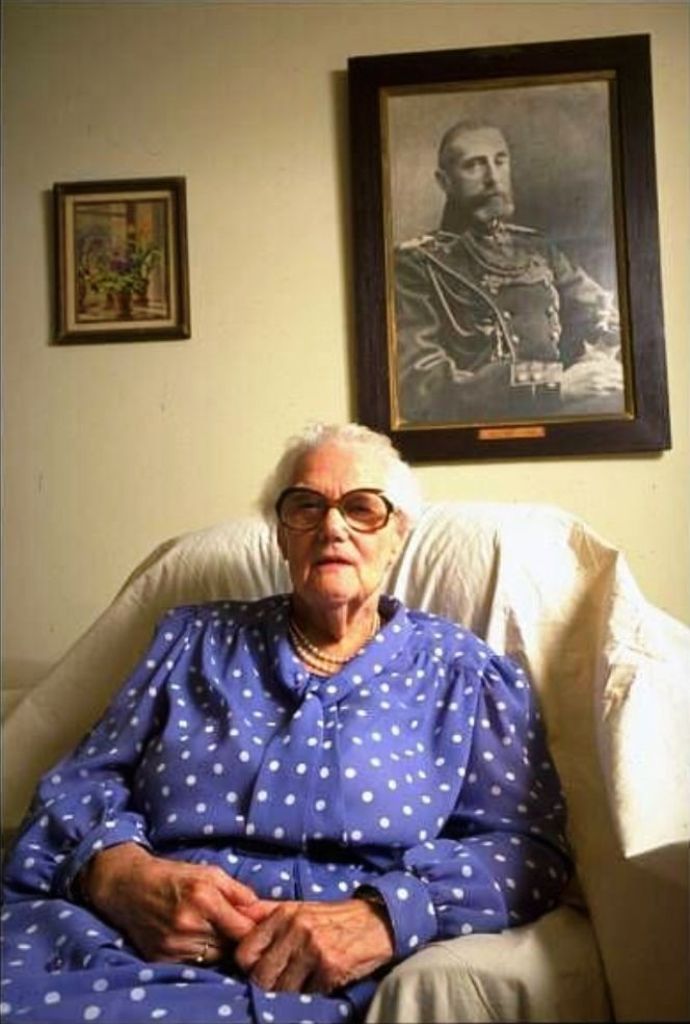
PHOTO: Princess Vera Konstantinovna seated in front of a framed portrait of her beloved father Grand Duke Konstantin Konstantinoivich (1858–1915). This photo was aken at the Tolstoy Foundation’s elderly care home in Valley Cottage, New York. 1988.
Today – 11th January 2026 – marks the 25th anniversary of the repose of Princess of the Imperial Blood Vera Konstantinovna, at the age of 94
It was on this day – 11th January 2001 – that Princess Vera Konstantinovna died at the Tolstoy Foundation’s elderly care home in Valley Cottage, New York in the United States.
Princess Vera was born at Pavlovsk on 24th April (O.S. 11th April) 1906, the youngest of nine children born to Grand Duke Konstantin Konstantinovich (1858-1915) and his wife, Grand Duchess Elizabeth Mavrikievna (1865-1927).
In exile, Princess Vera served as honorary chairman of the Association of the Members of the House of Romanov. In addition, she was an honorary member of the Russian Imperial Union-Order, and an honorary member of the Supreme Monarchical Council.
photo: In happier times . . . Princess Vera surrounded by her dolls and toys in her playroom in Pavlovsk Palace. 1910
Vera Konstantinovna was the only surviving Romanov who remembered pre-revolutionary life and her legendary relatives. For Vera, the children of the last Tsar remained her childhood playmates, not distant figures for adoration. She was a living embodiment of the best traditions of the House of Romanov, earning great respect in the circles of the Russian emigration.
Princess Vera recalls the February 1917 Revolution in Petrograd – she was 11 years old at the time:
“In the spring of 1917, I came home from a walk and saw a red bow on the livery of my personal lackey: “Shame on you, this is against the Tsar!” I was indignant. Then the footman replied: “The Tsar is no more!” So I learned that he had abdicated”…
“On another day, I walked with my teacher across the Field of Mars. We went to the church in the Engineers Castle. A sailor was walking towards us, he had a look of horror on his face. And on his chest he wore the St. George’s Cross. He was, of course, brave. But this image of a revolutionary wearing the St. George’s cross, made such an impression on me that I remembered it all my life …”
Princess Vera died at the Tolstoy Foundation’s elderly care home in Valley Cottage, New York, on 11th January 2001, at the age of 94.
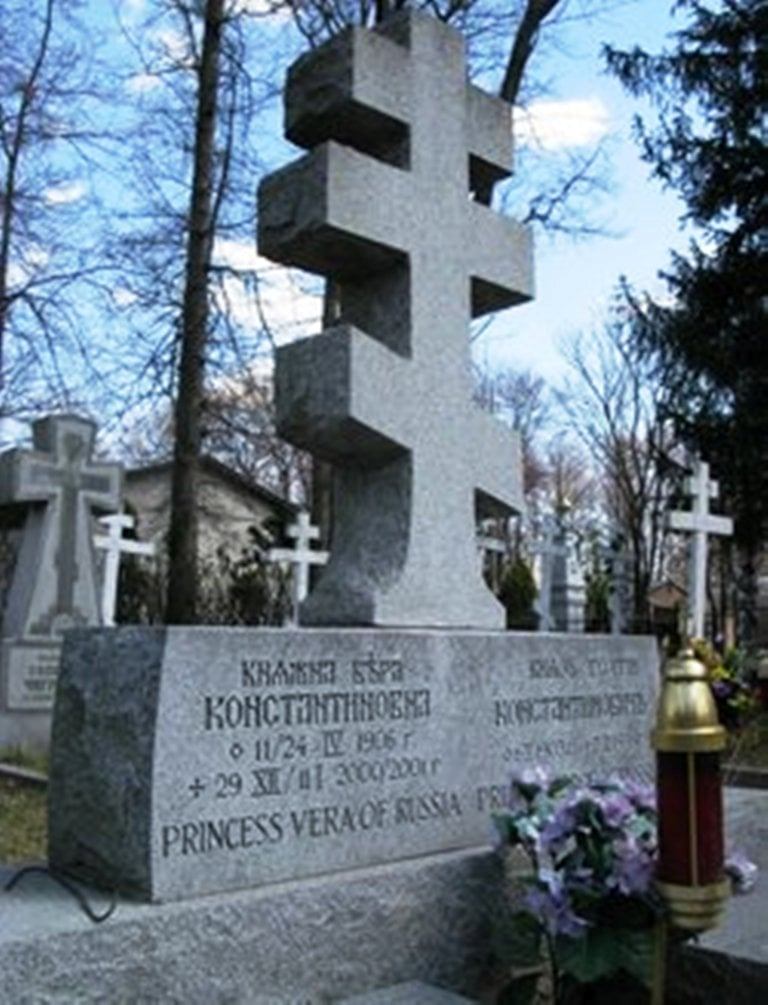
PHOTO: rincess Vera was buried next to her brother Prince Georgy Konstantinovich (1903-1938) at the cemetery of the Russian Orthodox Monastery of Novo-Diveevo in Nanuet, New York.
Her funeral was held on 15th January 2001. She was buried next to her brother Prince Georgy Konstantinovich (1903-1938) at the cemetery of the Russian Orthodox Monastery of Novo-Diveevo in Nanuet, New York.
The Russian History Museum has prepared this brief yet interesting tribute to a woman who was a pillar to the Russian emigration in the United States, and a founding patron of the Russian History Museum in Jordanville, NY.
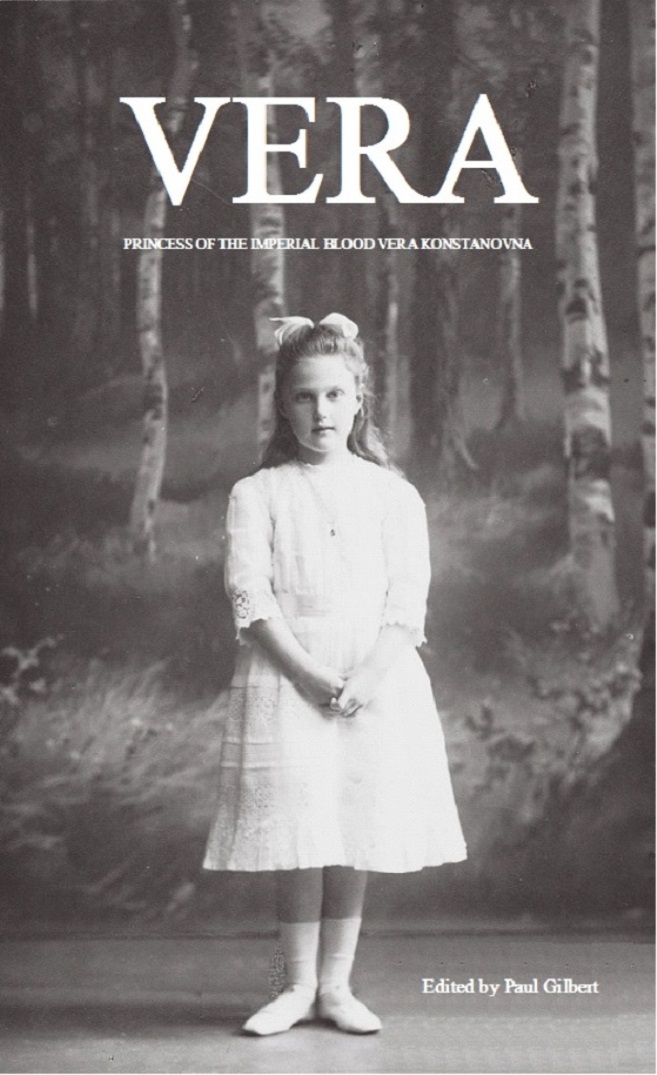
Princess Vera (1906- 2001), was the youngest child of Grand Duke Konstantin Konstantinovich. By the time she fled Bolshevik Russia in October 1918, she had already lost half of her family. Vera was the only Romanov who remembered pre-revolutionary life and her legendary relatives, including Nicholas II and Alexandra Feodorovna [her god-mother], and was a playmate to their younger children. Princess Vera died on 11 January 2001, at the age of 95.
Paperback edition. 148 pages + 75 black & white photographs
On this day – 31st December 2016 – Prince Dmitri Romanovich Romanov died in Copenhagen, Denmark at the age of 90. Following the death of his brother Prince Nicholas Romanovich in 2014, Dmitri became his rightful successor as Head of the House of Romanov.
Through his paternal lineage, Prince Dmitri was a great-great-grandson of Emperor Nicholas I of Russia (1796–1855) and his consort, Princess Charlotte of Prussia (1798-1860), who founded the Nikolaevichi branch of the Russian Imperial Family. He is a second cousin of the last Russian Emperor Nicholas II.
Dmitri was born on 17th May 1926 in in the villa of his grandfather, Grand Duke Peter Nikolaevich (1864-1931), in Cap d’Antibes on the French Riviera. He was the youngest son of Prince of the Imperial Blood Roman Petrovich (1896-1978) and his wife Princess Praskovia Dmitrievna (née Countess Sheremeteva, 1901-1980). In connection with the birth of their son, a congratulatory telegram addressed to Dmitri’s parents was sent from Denmark to France by the Dowager Empress Maria Feodorovna (1847-1928).
Prince Dmitri spent the first ten years of his life in France. He was brought up entirely in the Russian spirit under the guidance of his paternal grandmother, Grand Duchess Militsa Nikolaevna (1866-1951). Dimitri Romanovich’s teachers were graduates of the Smolny Institute in St. Petersburg [established by Catherine the Great in 1765]. Every Sunday, the family visited the home church, where young Dimitri served in the altar.
PHOTO: Prince of the Imperial Blood Roman Petrovich and his wife Princess Praskovia Dmitrievna (née Countess Sheremeteva. Egypt. Circa early 1950s
Early life – France, Italy, Egypt
After the victory of the Socialists in the French parliamentary elections in 1936, Dmitri moved with his parents to Italy, where the queen was Helena of Savoy [born Princess Jelena of Montenegro, 1873-1952] the sister of his paternal grandmother Grand Duchess Militsa Nikolaevna. For a short time, the family lived in the Quirinal Palace in Rome, the official residence of the king of Italy.
Dmitri studied at a private Italian school, where he was taught Latin and classical Greek. When Italy withdrew from the war in 1943 and Germany occupied Rome, Dimitri and his family hid from the Germans for nine months, changing apartments and addresses, as the Nazis announced a hunt for all relatives of the Italian king Victor Emmanuel III.
In May 1946, Dmitri and his family sailed from Naples to Cairo on the Italian ship Obruzzi. Initially, the family planned to stay in Egypt for only two months and then return to Europe, but their forced exile lasted until 1952. Soon after arriving in Egypt at the age of 19, Dimitri Romanovich, with the consent of his parents, began working as a simple mechanic at the Ford repair plant in Alexandria, where he earned a mechanic’s certificate. Dimitri Romanovich worked at the plant for three years, and then worked as a car sales manager.
In 1960 Prince Dmitri moved to Denmark, where he worked for a number of banks including the Danske Bank, where he was an executive until his retirement in 1993.[2] He was fluent in Russian, French, English, Danish and Italian. Dmitri became a Danish citizen in 1979
PHOTO: the wedding of Prince Dmitri Romanovich and Johanna von Kaufmann, 1959
Marriages
Prince Dmitri Romanovich was married twice.
In 1958, Dimitri and his friends went on a trip to Scandinavia by car. In Helsinki, he met a young girl named Johanna von Kauffmann (1936–1989). In 1959, the young couple married, settling in the suburbs of Copenhagen. Johanna died of cancer on 13th 1989, at the age of 52. The couple had no children.
In 1989, Prince Dimitri Romanovich married Dorrit Reventlow (born 1942) on 28th July 1993, at the Trinity Cathedral of the Ipatiev Monastery in Kostroma. His second marriage was the “FIRST” time a Romanov had been married in Russia since the fall of the dynasty in 1917. Before the wedding, Princess Dorrit converted to Orthodoxy taking the name Feodora Alexeevna. The couple had no children.
PHOTO: Prince Dimitri Romanovich and his second wife Princess Feodora Alexeevna
Dynastic status
From birth, Dmitri Romanovich was titled by His Highness Prince of the Imperial Blood, which, however, was never recognized by the descendants of Grand Duke Kirill Vladimirovich (1876-1938).
Since the creation of the Romanov Family Association in 1979, which today unites most of the male and female descendants of Emperor Nicholas I (1796-1855). Dmitri Romanovich did not recognize Prince Vladimir Kirillovich (1917-1992) as the head of the House of Romanov. After the death of the latter in April 1992, Dmitri recognized his brother Prince Nicholas Romanovich as the rightful head of the House of Romanov. Together with other representatives of the House of Romanov, he repeatedly declared the illegitimacy of the claims to the Russian throne of Vladimir Kirillovich and his daughter Maria Vladimirovna. From 1989 to 2014, Prince Dmitri served as an adviser to the head of the Romanov Family Association.
After the death of his brother in September 2014, Dmitri Romanovich headed the Romanov Family Association. All descendants of the Russian Imperial House (except Maria Vladimirovna and her son George Mikhailovich) recognized him as the head of the House of Romanov. The successor of Dimitri Romanovich was Prince Andrei Andreevich (1923-2021), who was the oldest living representative of the House of Romanov at the time.
Dimitri Romanovich was the last male representative of the Nikolaevichi branch of the House of Romanov, which originated from Grand Duke Nicholas Nikolaevich, Sr. (1831-1891) and his wife, Grand Duchess Alexandra Petrovna (born Duchess Alexandra of Oldenburg, 1838-1900). Dimitri Romanovich had no children, and his elder brother Nikolai Romanovich had only daughters. As a result, upon the death of Prince Dimitri Romanovich on 31st December 2016, the male line of the Nicholaevich branch of the Romanov family died out.
PHOTO: seven Romanov princes gather in Paris in June 1992
Social activities
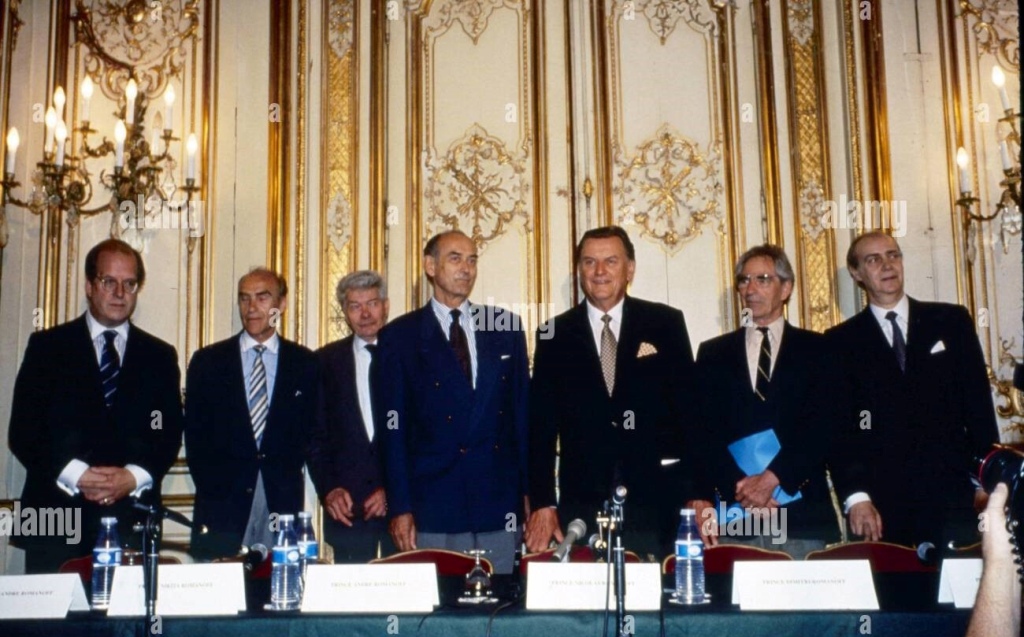
On 29th June 1992, seven Romanov princes met in Paris: Nikolai Romanovich (1922-2014), Dimitri Romanovich (1926-2016), Andrei Andreevich (1923-2021), Mikhail Feodorovich (1924-2008), Nikita Nikitich (1923-2007), Alexander Nikitich (1929-2002) and Rostislav Rostislavovich (1938-1999).
The male descendants of the House of Romanov declared that none of them had any claims to the Russian throne, and that their activities in Russia would only be educational and charitable. Prince Dmitri was an opponent of the restoration of the monarchy. He believed that in Russia “there should be a democratically elected president.
It was during this meeting, that the princes decided to create a charitable foundation to help Russia. The foundation was established in 1994 and registered in London. The Romanov Fund for Russia was headed by Dimitri Romanovich.
As part of its humanitarian activities, the foundation provides charitable assistance and support to those in need in the field of medicine, education and social welfare, and promotes activities in the field of culture, art and enlightenment. The foundation takes care of hospitals for hearing-impaired children, boarding schools and nursing homes.
In July 1992, Prince Dmitri visited Russia for the first time, visiting St. Petersburg and Moscow. In the first years of its activity, the foundation faced difficulties of various nature associated with the collapse of the Russian state economy and the critical state of the social security system. In the period from 1993 to 1995, Dimitri Romanovich headed five humanitarian visits to Russia on behalf of the Romanov Fund for Russia.
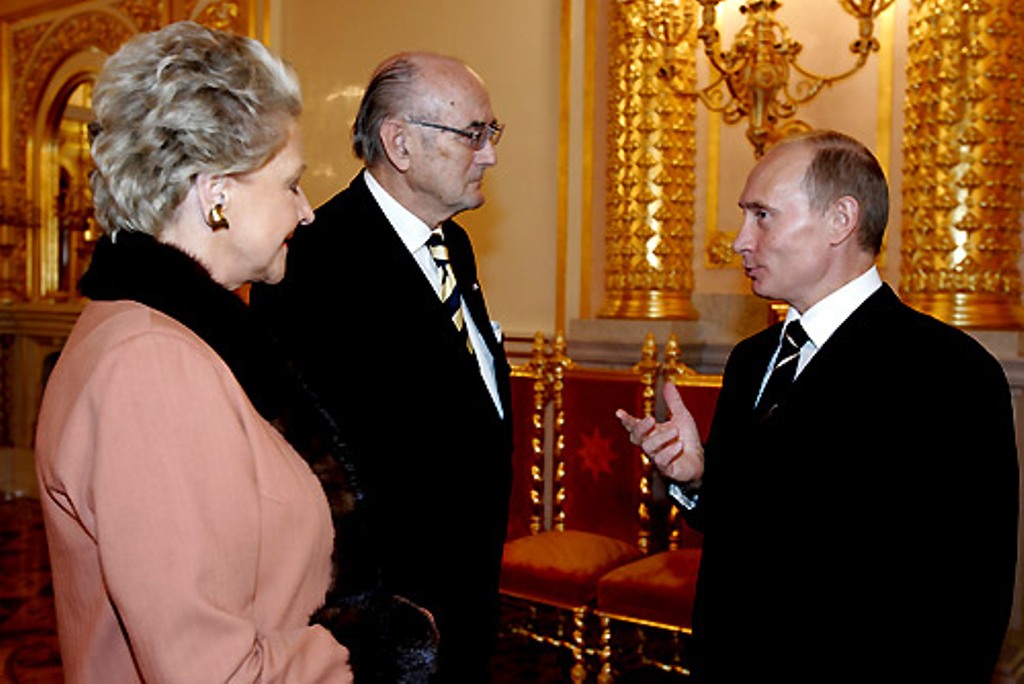
PHOTO: Russian president Vladimir Putin with Prince Dmitri Romanovich and his wife Princess Feodora Alexeevna, during an official reception held in the Grand Kremlin Palace in Moscow. 2006
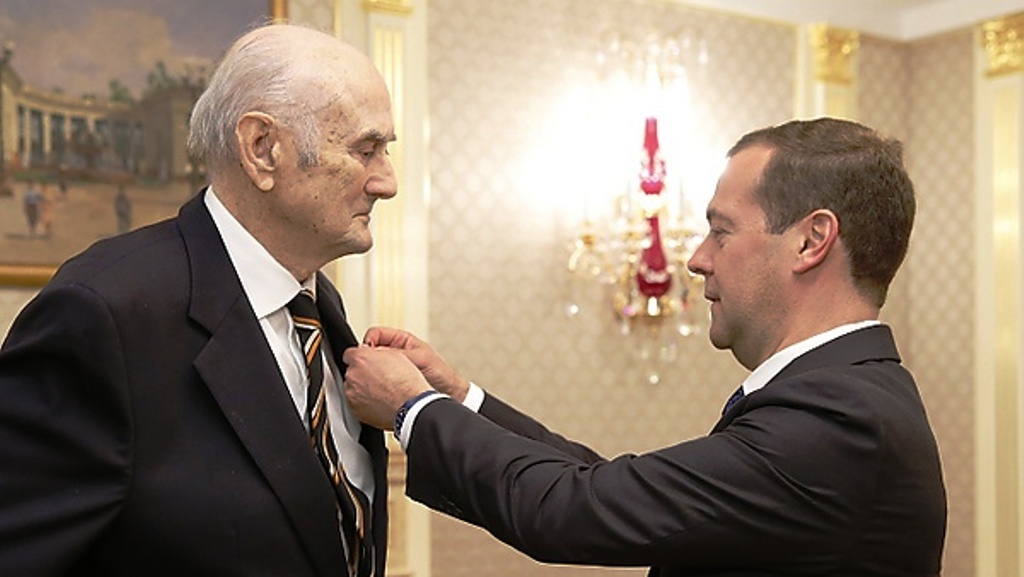
PHOTO: Prime Minister Dmitri Medvedev awarding Prince Dmitri Romanovich with the Order of Alexander Nevsky, 6th October 2016
Awards and honours
In 2006, Prince Dmitri Romanovich met with Russian President Vladimir Putin in Moscow. The meeting took place during a state reception devoted to National Unity Day in St. George’s Hall of the Grand Kremlin Palace.
This meeting occurred in the context of the reburial of the Dowager Empress Maria Feodorovna (Emperor Nicholas II’s mother). Maria Feodorovna had died in exile in Denmark, and her dying wish was to be buried next to her husband, Emperor Alexander III, in Russia.
In June 2011, the then President of the Russian Federation Dmitri Medvedev awarded Prince Dmitri the “Order of Friendship” for “great achievements in strengthening friendship and cultural cooperation between Russia and the Kingdom of Denmark and for his achievements as chairman of the Romanov Fund for Russia.” The award ceremony took place in Moscow.
In May 2016, Dimitri Romanovich was awarded a certificate of honour from the Government of the Russian Federation “for his great contribution to the dissemination of knowledge about the historical and cultural heritage of Russia abroad, and assistance in strengthening international humanitarian ties.”
In August 2016, by decree of the President of the Russian Federation Vladimir Putin, Prince Dmitri was awarded the Order of Alexander Nevsky. The Chairman of the Government of the Russian Federation Dmitri Medvedev, headed the award ceremony in the building of the Government of the Russian Federation, on 6th October 2016. Prince Dmitri receive the award “for his great contribution to spreading abroad the knowledge of Russia’s historical and cultural heritage and efforts to promote international humanitarian ties.”
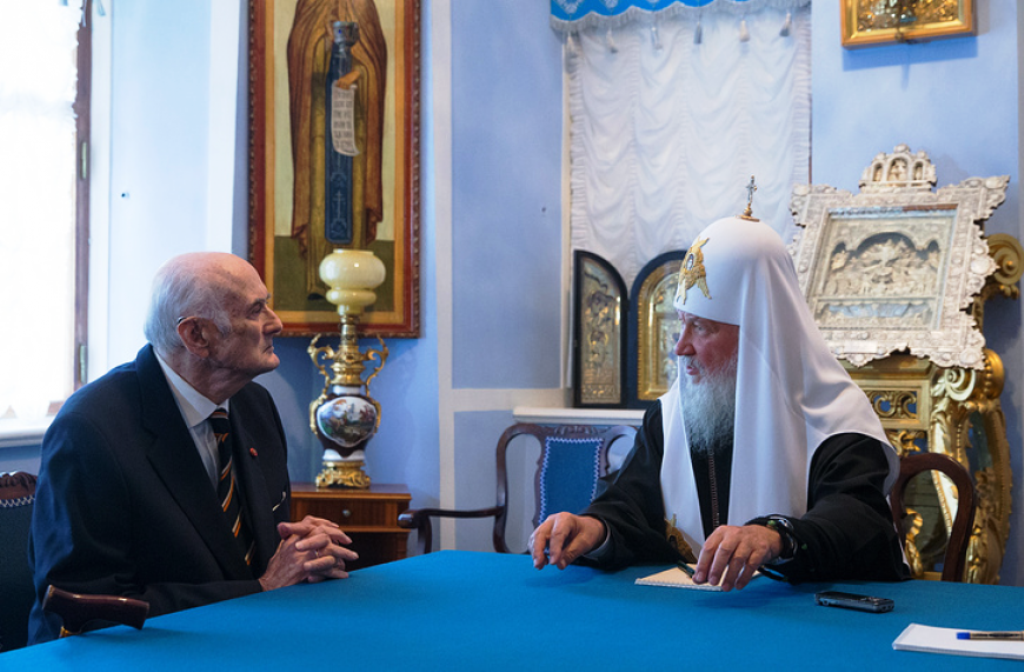
PHOTO: Prince Dmitir Romanovich with His Holiness Patriarch Kirill of Moscow and All Russia, at the Trinity Lavra of St. Sergius. October 2016
In October 2016, Prince Dmitri also met with His Holiness Patriarch Kirill of Moscow and All Russia at the Trinity Lavra of St. Sergius. During the meeting, His Holiness said: “Thank you for your love for our common Motherland, for preserving the wonderful traditions of the House of Romanov, for your participation in the delivery of the remains of both [Empress] Maria Feodorovna and [Grand Duke] Nicholas Nikolaevich. Your work unites history. This is the uniqueness of your personality and the uniqueness of the House of Romanov in general. Living people united in their family tradition of honouring our national history, torn apart by the tragic events of the early 20th century.”
Patron of the Arts
Dimitri Romanovich was also known as a patron of the arts. In December 2000, he donated the sabre of his great-grandfather, Grand Duke Nikolai Nikolaevich, Sr (1831-1891), as well as the Shipka battle banner, to the State Hermitage Museum in St. Petersburg.
In July 2004, he donated the family icon of the Saviour, which once belonged to his paternal grandmother Grand Duchess Militsa Nikolaevna (1866-1951) to the Novodevichy Convent in St. Petersburg.
In July 2005, he donated an icon of the Saviour to the restored Church of the Bright Resurrection of Christ on the Smolenka River in St. Petersburg. This 19th-century icon was kept in the Romanov family and passed down from generation to generation.
In July 2009, together with his wife, he donated the family icon of Saints Mitrophan and Tikhon of Voronezh to the restored Feoodorovsky Cathedral in St. Petersburg. According to Dimitri Romanovich, he was blessed with this icon. in Rome in 1944 by his spiritual mentor, Hieromonk Zosima,
Dmitri Romanovich has appeared in the media and documentaries, giving interviews about the history of the Romanov. For example: in 2003 in the Danish documentary “En Kongelig familie“, in 2007 on France 3 in the film “Un nom en héritage, les Romanov“, in 2008 on NTV in the film “Ghosts of the House of Romanov“, as well as in 2014 in the ZDF documentary “Royal Dynasties: The Romanovs” and in 2015 in the documentary “The Crown of the Russian Empire” produced by Russia-24.
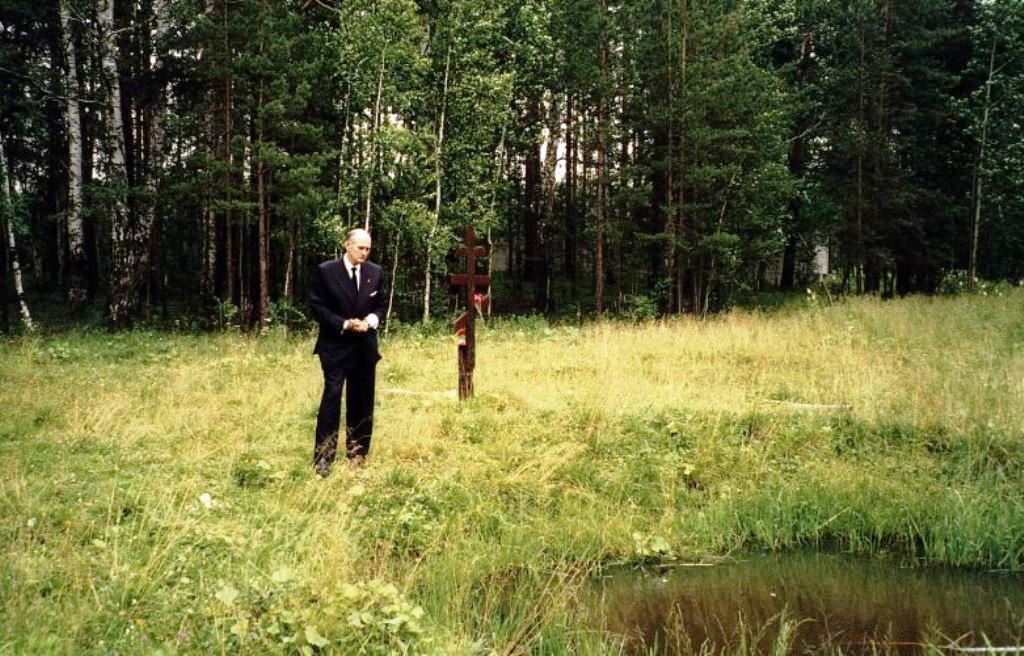
PHOTO: Dmitri Romanovich at the place where the remains of the Imperial Family were found on the Old Koptyaki Road, near Ekaterinburg
Reburial of the Imperial Family
After the discovery of the remains of Emperor Nicholas II, Empress Alexandra Feodorovna, three daughters and four faithful retainers near Ekaterinburg in July 1991, Prince Dmitri Romanovich actively assisted the government commission and the investigation in identifying the remains.
Dmitri Romanovich was one of the first members of the House of Romanov to visit the place where the remains were found on the Old Koptyakovskaya Road, near Ekaterinburg. He was the only one of the Romanovs who took part in the mourning events that took place in Ekaterinburg before the remains were sent to St. Petersburg.
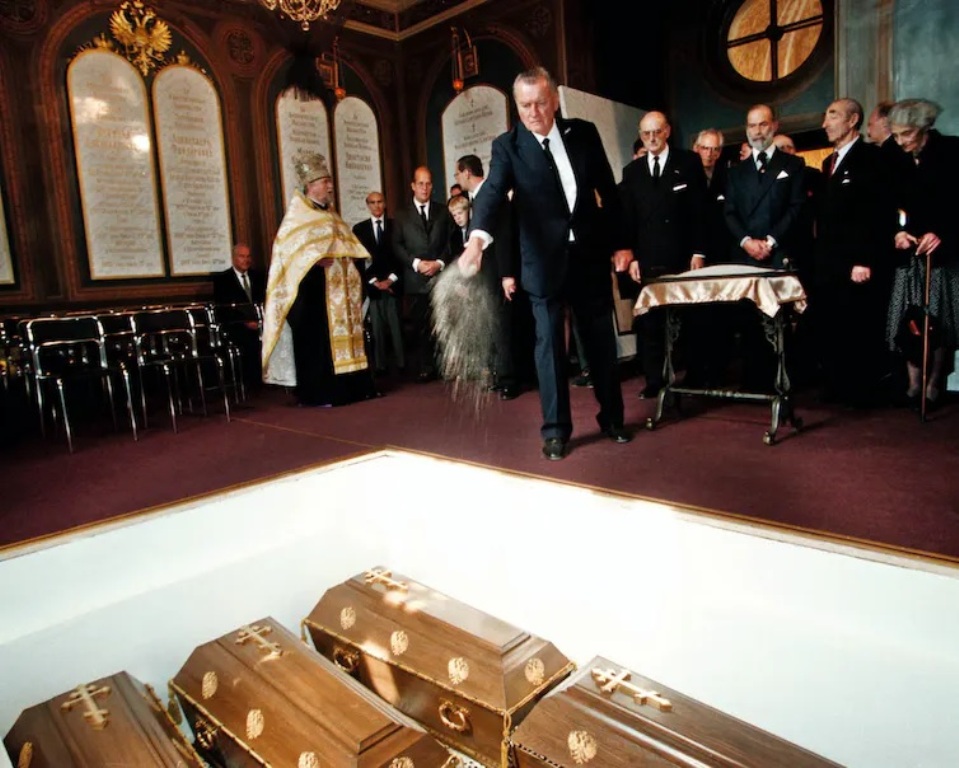
On 17th July 1998, together with other representatives of the House of Romanov, he participated in the funeral ceremony for the reburial of the remains of Emperor Nicholas II, members of his family and servants, which took place in the SS Peter and Paul Cathedral in St. Petersburg.
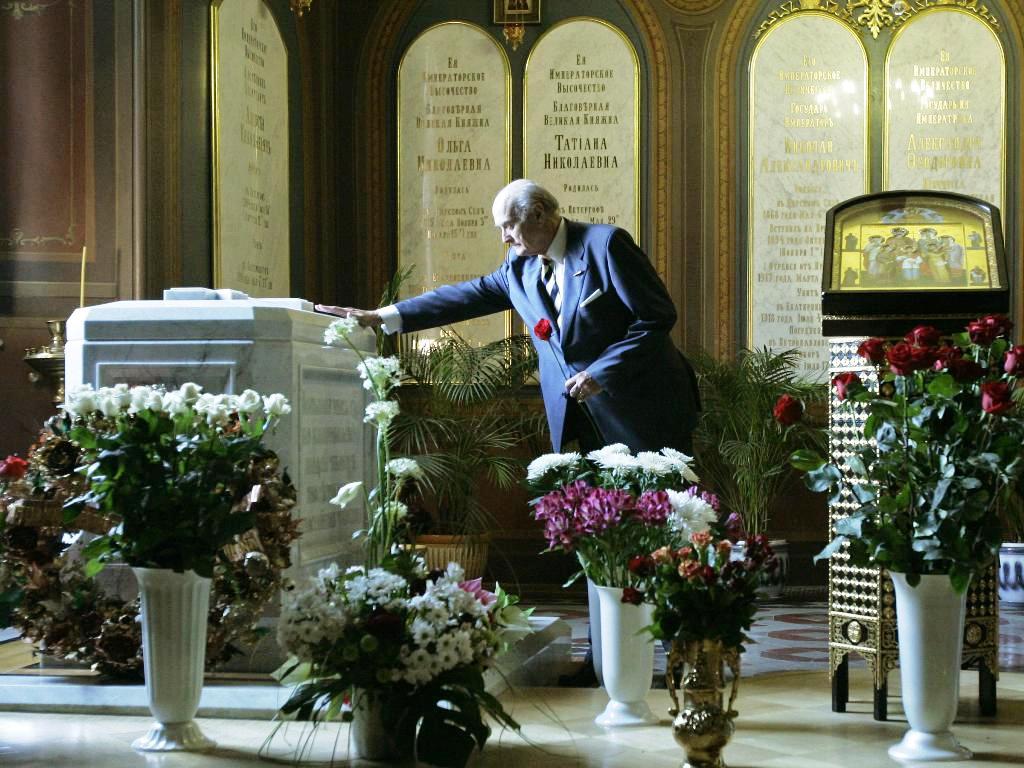
PHOTO: Dmitry Romanovich pays his respects at the tomb holding the remains of Emperor Nicholas II, Empress Alexandra and their three daughters in St. Petersburg’s St. Peter and Paul Cathedra. 2008
Russian president Boris Yeltsin (1931-2007) attends the funeral on 17th July 1998. Addressing the funeral ceremony, Yeltsin described the murder of the Russian Imperial Family as “one of the most shameful pages in Russian history”, and urged Russians to close a “bloody century” with repentance.
He said: “Today is a historic day for Russia. For many years, we kept quiet about this monstrous crime, but the truth has to be spoken.”
Yeltsin said he had no choice but to attend this funeral in consideration of the fact that the funeral presented a historical opportunity for the Russian people to exculpate themselves from the sins of their fathers, and the sins of the murder of their Romanov family.
More than 50 Romanov descendants attended the historic burial. The only family members who did NOT attend were Princess Maria Vladimirovna, her mother Princess Leonida Georgievna, and Maria’s son Prince George Mikhailovich.
The author of this article was invited to attend the events marking the burial of Nicholas II and members of his family. On the morning of 17th July 1998, I met many descendants of the House of Romanov in the lobby of the Astoria Hotel. I was invited to ride in one of the special buses provided for the more than 50 Romanov descendants, from the Astoria Hotel to the Peter and Paul Fortress. This was the one and only time that I met Princes Nicholas (1922-2014) and Dimitri Romanovich (1926-2016) in person.
After the discovery in July 2007 of the remains of Tsarevich Alexei Nikolaevich and Grand Duchess Maria Nikolaevna, Dmitri Romanovich actively assisted the investigation in identifying the remains. He advocated the speedy burial of the Tsesarevich and his sister in the SS Peter and Paul Cathedral.
In December 2015, Alexei and Maria’s remains were transferred from the State Archives of the Russian Federation to the Lower Church of the Transfiguration Cathedral of the Novospassky Monastery in Moscow, where they remain to this day.
PHOTO: Prince Dimitri Romanovich at the coffin of Empress Maria Feodorovna in the Rosskile Cathedral, Denmark. August 2006.
Reburial of Empress Maria Feodorovna
In 2001 Prince Dmitri together with his brother Prince Nikolai Romanovich and Prince Mikhail Andreevich (1920-2008), who lived in Australia, initiated the reburial to Russia of the Dowager Empress Maria Feodorovna [born Princess Dagmar of Denmark, 1847-1928].
Prince Dmitri acted as an intermediary during negotiations between the government of the Russian Federation and the Danish royal court. Together with his wife, Princess Feodora Alexeevna, he accompanied the coffin with the remains of the Empress from Copenhagen to St. Petersburg.
From 25th to 29th September 2006, Prince Dmitri and his wife, together with other members of the Romanov Family Association, took part in the events for the reburial of the Dowager Empress, next to those of her husband Emperor Alexander III in the SS Peter and Paul Cathedral in St. Petersburg.
PHOTO: Prince Dmitri Romanvich at the coffins of his uncle Grand Duke Nicholas Nikolaevich and aunt Grand Duchess Anastasia Nikolaevna, in the Donskoy Monastery, Moscow
Reburial of Grand Duke Nicholas Nikolaevich
In December 2013, Prince Dmitir and his brother Prince Nicholas Romanovich, appealed to the Russian government with a request to rebury the remains of their paternal uncle Grand Duke Nikolai Nikolaevich (1856-1929) and aunt Grand Duchess Anastasia Nikolaevna (born Princess Anastasia of Montenegro, 1867-1935) in Moscow.
In April 2015, Prince Dmitri Romanovich participated in the reburial ceremony of Grand Duke Nikolai Nikolaevich and his wife, Grand Duchess Anastasia Nikolaevna, in in the chapel in honour of the Transfiguration of the Lord at the the World War I memorial military cemetery in Moscow.
PHOTO: Prince Dmitri Romanovich and his wife admire a portrait of Empress Alexandra Feodorovna in the Livadia Palace, during their visit to Crimea in 2015
Visit to Crimea
Together with his brother, Prince Dmitri supported the annexation of Crimea by the Russian Federation in 2014. He was the first of the Romanov family to visit Crimea after the Russian annexation. On 25th August 2015, Dimitri Romanovich and his wife Princess Feodora Alekseevna arrived in Sevastopol, where during a press conference they announced their readiness to move from Denmark to Crimea for permanent residence.
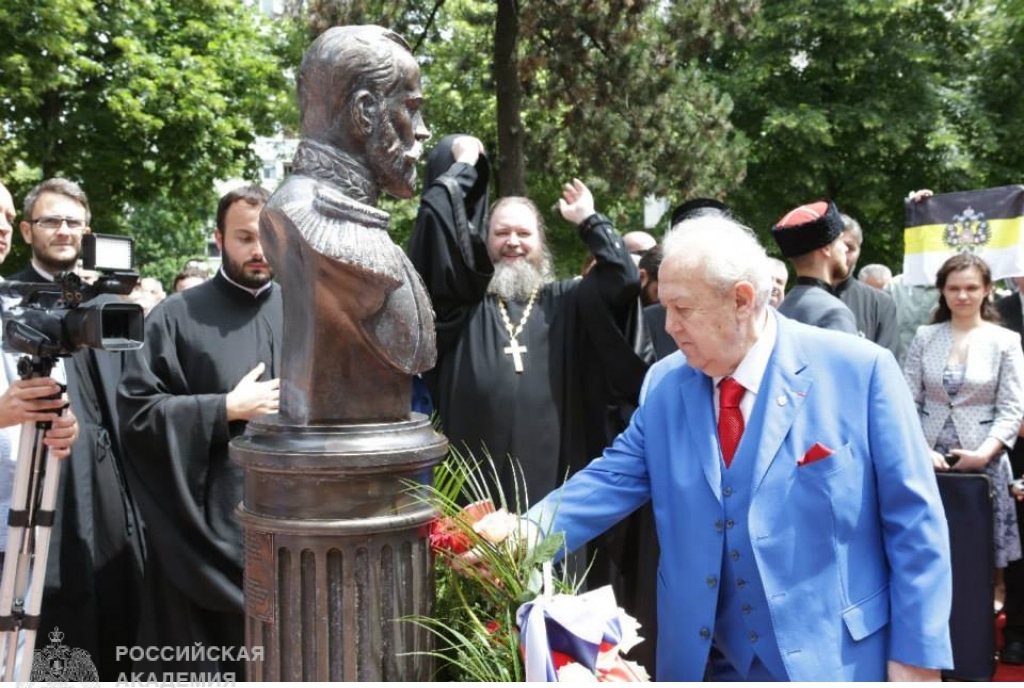
The following day, Dmitri and Princess Feodora Alekseevna visited the Livadia Palace, where they laid flowers at the monument to Emperor Nicholas II, erected in the spring of 2015. Dimitri Romanovich also visited the Djulber (aka Dulber) Palace, the family estate of the Nikolaevichs in the Crimea, which was built by Dmitri’s grandfather Grand Duke Peter Nikolaevich.
On 27th August, Dimitri Romanovich visited the museum-panorama of the defense of Sevastopol. On the same day, he visited the flagship of the Black Sea Fleet, the Guards missile cruiser Moskva. He was told about the history of the ship, its combat characteristics and the life of sailors and officers. At parting, the crew of the cruiser presented Dimitri Romanovich with two commemorative coins with a face value of 10 rubles, minted in honor of the annexation of Crimea by Russia. On the final day of the visit, 28th August, Dimitri Romanovich visited the Massandra Palace of Emperor Alexander III.
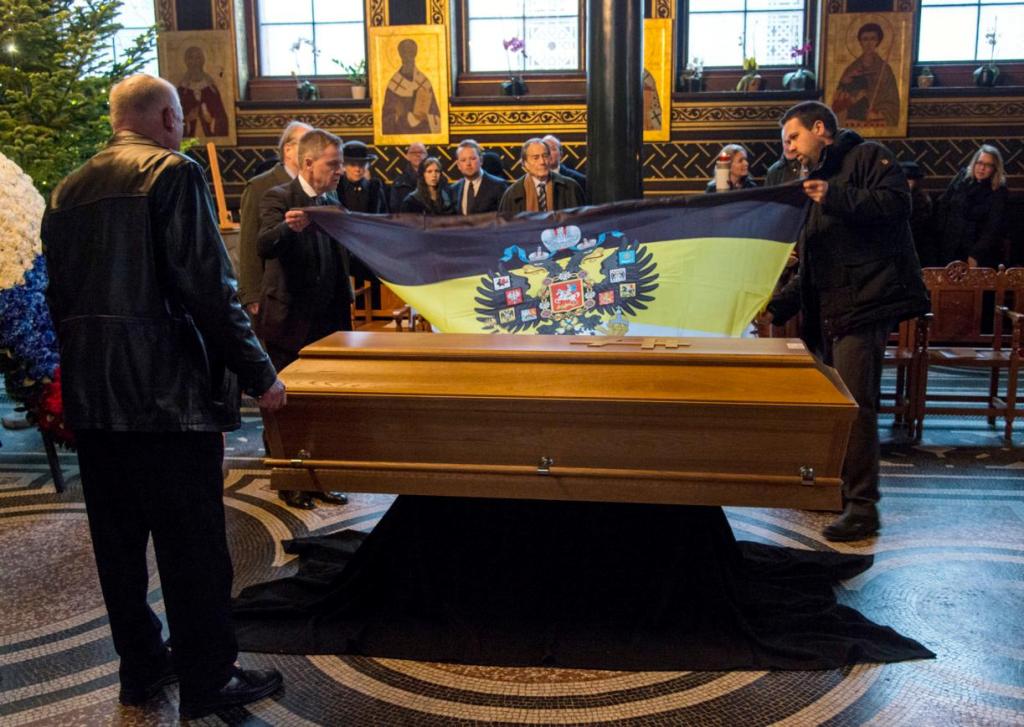
PHOTO: Prince Dmitri’s funeral was held on 10th January 2017, at the Alexander Nevsky Russian Orthodox Cathedral in Copenjagen, Denmark.
Death and funeral
At the end of December 2016, Prince Dmitri ‘s health deteriorated and he was subsequently hospitalized. He died on 31st December 2016 in a hospital in Copenhagen, Denmark.
The funeral service was held on 10th January 2017, in the Church of Alexander Nevsky in Copenhagen, performed by Archpriest Sergei Plekho
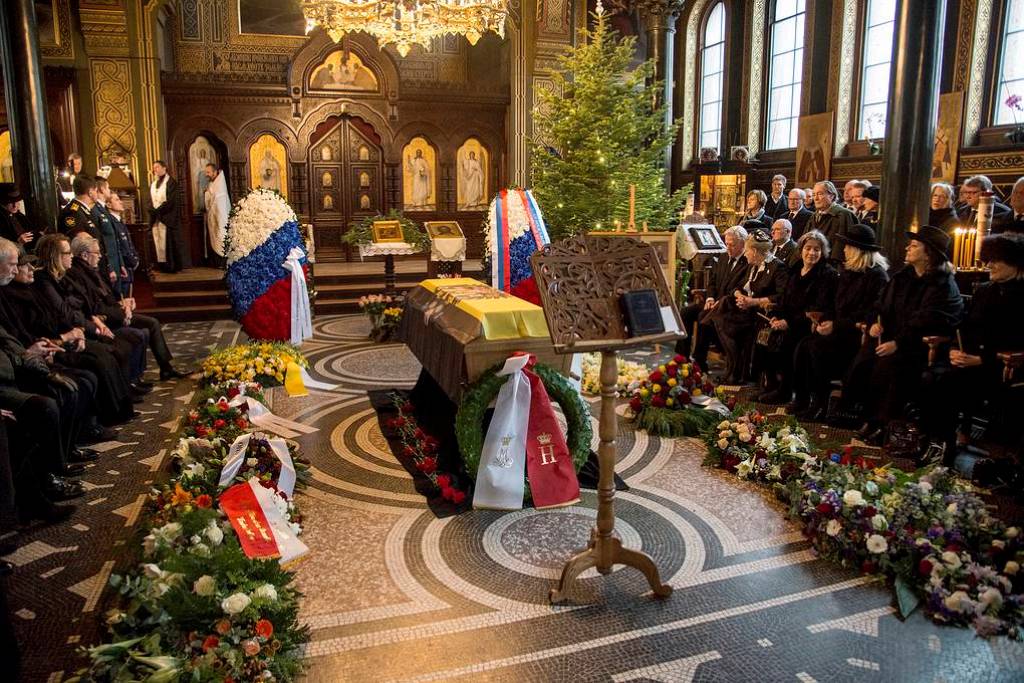
The prince’s coffin, covered with the Romanov tri-colour flag – black, yellow, white with a double-headed eagle, was surrounded with flowers and wreaths, among which two stood out – from Queen Margrethe II of Denmark and President of the Russian Federation Vladimir Putin.
Russia’s Ambassador to Denmark Mikhail Vanin, who was present at the funeral service, read out a message from Russian President Vladimir Putin, expressing his condolences on the death of Prince Dimitri Romanov.
“Dimitri Romanovich was a “true patriot of Russia,” said Putin. “Throughout his life, the chairman of the Romanov Family Association kept the indissoluble spiritual connection with the motherland and made a great contribution to the dissemination of knowledge about the history and culture of our country abroad and about the heritage and traditions of the Russian Imperial House,” the Russian president added.
Numerous representatives of the foreign Russian diaspora attended his funeral, as well as Marshal of the Royal Court of Denmark Michael Eyrinreich, Chief Herald of the Russian Federation Georgy Vilinbakhov, and numerous Danish and Russian officials.
On 11th January 2017, a pannikhida [memorial service for the dead] was performed for the newly-departed Dimitri Romanovich, which was conducted by Archpriest Sergius Plekhov In the small chapel, at the Wedbeck Cemetery, situated about 20 km north of Copenhagen.
Then the coffin was transferred to the final resting place next to his first wife, Princess Joanna, née von Kauffmann, who died in 1989. After lowering the coffin into the grave, those present took turns throwing a handful of earth and Dimitri Romanovich’s favorite flowers, red roses.
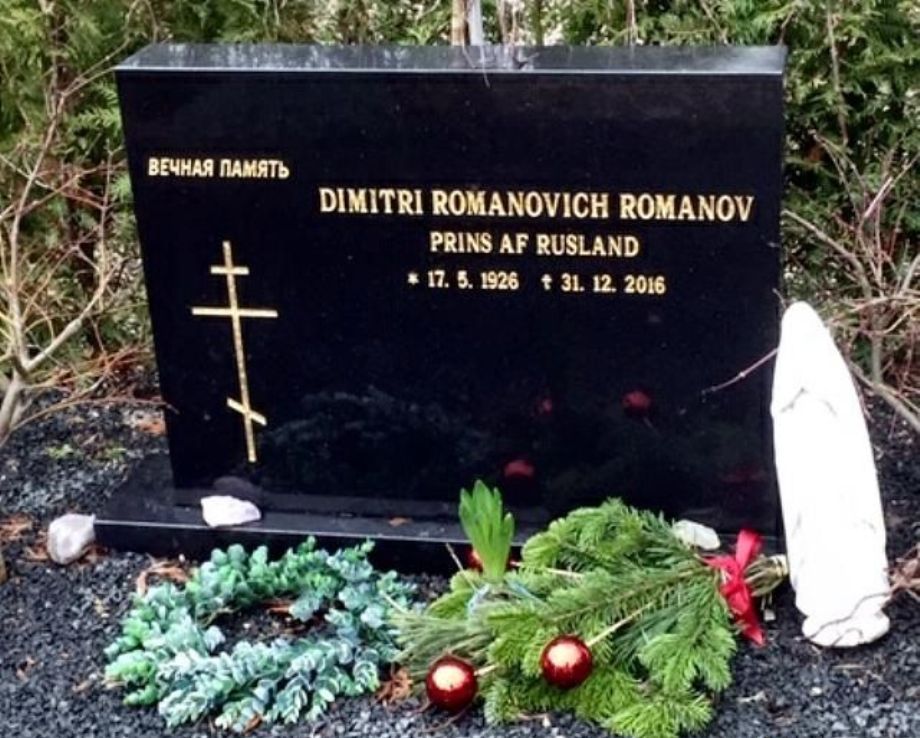
PHOTO: grave of Prince Dmitri Romanovich Romanov (1926-2016) in Vedbaek Cemetery
Upon the death of his brother Nicholas in 2014, Dimitri assumed the Headship of the Imperial House of Russia. When Prince Dimitri Romanovich died on 31st December 2016, the male line of the Nicholaevich branch of the Romanov family died out.
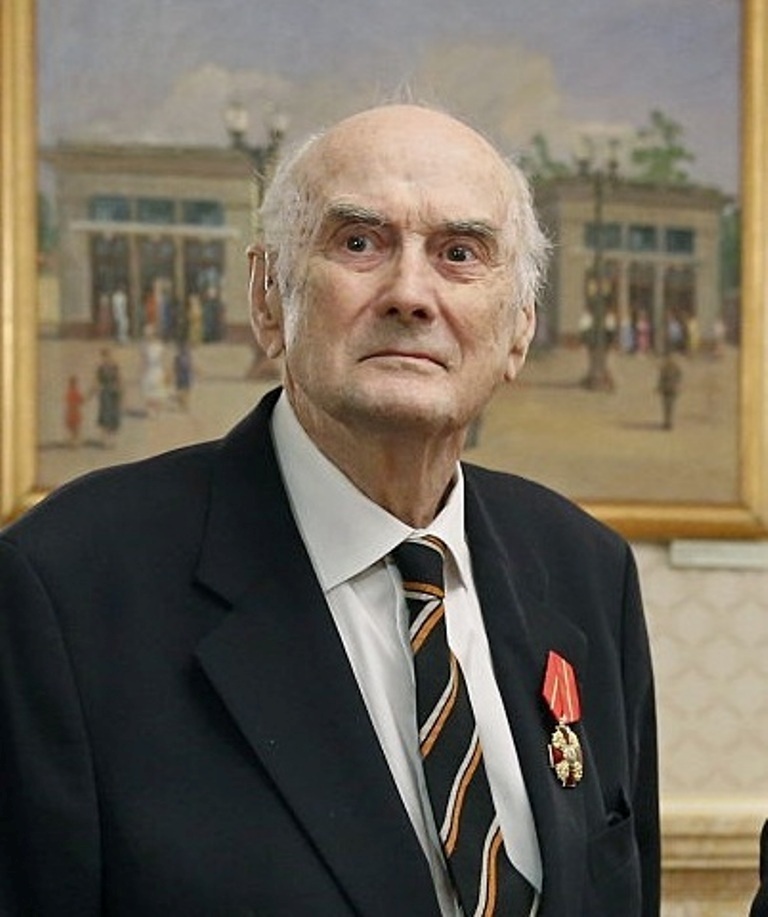
Prince Dmitri Romanovich Romanov with the Order of Alexander Nevsky (1926-2016) Memory Eternal! Вечная Память! ☦️
On this day – 15th September 2014 – Prince Nicholas Romanovich Romanov died in Bolgheri, Tuscany, Italy at the age of 91. Following the death of his cousin Prince Vladimir Kirillovich in 1992, Nicholas became his rightful successor as Head of the House of Romanov.
Prince Nicholas was born on 26th September 1922 in Cap d’Antibes near Antibes on the French Riviera. He was the eldest son of Prince of the Imperial Blood Roman Petrovich (1896-1978) and his wife Princess Praskovia Dmitrievna (née Countess Sheremeteva, 1901-1980).
Nicholas Romanovich belonged to the third branch of the first line of the House of Oldenburg-Russia (House of Holstein-Gottorp-Romanov, itself descended from the first branch of the House of Holstein-Gottorp). These three branches are all descended from the first branch of the House of Oldenburg. He is a direct descendant of Emperor Nicholas I (1796-1855).
PHOTO: Three generations: Prince Nicholas Romanovich Romanov with his grandfather (left) Grand Duke Peter Nikolaevich, and his father Prince Roman Petrovich (right)
Childhood, boyhood and youth
As children, Prince Nicholas Romanovich and his brother Dmitri Romanovich were immersed in a Russian atmosphere. he received a private education from Father Zossima, this monk taught him the old Russian school curriculum. Despite their exile, Prince Roman Petrovich and his wife raised their two sons in the Russian spirit, in their daily lives. The brothers observed the Old Style Julian calendar, and the religious holidays of the Russian Orthodox Church.
Nicholas did part of his studies in France, but he aspired to a career in the Italian navy as an officer. To realize his dream, his parents used their close ties to the Italian royal house (his paternal grandmother, Princess Militza of Montenegro, was the sister of Helen of Montenegro, the wife of Victor Emmanuel III of Italy). His grandmother made the necessary arrangements with the members of the House of Savoy. Nicholas Romanovich left his family to continue his studies in Italy, where he was taught by the retired Italian officer, Captain Tommaso Surdi. After completing his studies, the prince would be admitted to the Italian Naval School in Livorno. Suffering from short-sightedness, the prince had to abandon his career in the navy. During the Second World War the Italian fleet suffered terribly, incurring great losses, according to the prince, this myopia may have saved his life.
In 1936, his family moved to Italy, Nicholas Romanovich did classical studies, he graduated in 1942. From his early childhood the prince spoke Russian and French, later he learned English and Italian, his tutor, Marcel Berlinger taught him Latin and ancient Greek.
PHOTO: Prince of the Imperial Blood Roman Petrovich with his wife Princess Praskovia Dmitrievna and children Prince Dimitri (seated on his mother’s lap) and Prince Nicholas (right). Antibes, France. Late 1920s.
World War II and the post-war years
During the Fascist occupation of Rome, members of Nicholas Romanovich’s family lived under the constant threat of deportation, especially the prince’s paternal grandmother, Militza of Montenegro, who found refuge in a convent, and then in Vatican City. The prince’s family resided at the Villa Marlia near Lucca in Tuscany. In September 1943, surrounded by carabinieri, Nicholas and his family were taken to Rome, where they lived for the duration of the war. On 8th September 1943, Italy signed the armistice, and the prince’s family was present at the Villa Savoia (residence of the King and Queen of Italy) and witnessed the departure of Victor Emmanuel III and Queen Elena from Italy. In turn, the members of the prince’s family left Villa Savoia and lived clandestinely for more than nine months.
After the liberation of Rome by the Allies, Nicholas Romanovich was employed in one of the Allied agencies, the Psychological Warfare Branch. When World War II ended, the prince found a job with the United States Information Service (USIS). In 1946, Nicholas and his family moved to Egypt, where the prince held a few odd jobs, but wishing to return to Italy to continue his university studies, Nicholas considered his stay in Egypt as a period of rest. Between 1947 and 1948, the Turkish tobacco trade gave the prince a certain financial ease, he was also employed by an insurance company.
In 1950, Nicholas decided to return to Europe. On the way to Geneva, the prince stopped in Rome, where he met his future wife. Prior to his marriage, he was employed by the British Austin Motor Company, working with the firm’s representative in Italy, Colonel Andrew Constable-Maxwell.
PHOTO: Prince Nicholas Romanovich and his wife Countess Sveva della Gherardesca
Marriage and children
Nicholas Romanovich married Sveva della Gherardesca (b. 1930) on 21st January 1952 in St. Michael the Archangel Church (Russian Orthodox) in Cannes, France, while a civil marriage took place on 31st December 1951 in Florence, Italy. The prince’s wife belonged to the famous Tuscan family della Gherardesca, her father, Count Walfredo della Gherardesca was one of the descendants of Count Ugolino (Ugolin), a character in Dante’s Divine Comedy. Her mother was and the Marchioness Nicoletta de Picolellis.
Prince Nicholas and his wife had three daughters:
Natalia Nikolaevna (b. 1952), who married Giuseppe Consolo (b. 1948) in 1973, and had two children;
Elisabeth Nikolaevna (b. 1956), who married Mauro Bonacini (b. 1950) in 1982, and had two children;
Tatiana Nikolaevna (b. 1961), who married Gian Battista Alessandri (b. 1958) in 1983, divorced in 1988, remarried Giancarlo Tirotti (b. 1947), and had one child.
In 1982, Prince Nicholas and his wife moved to Rougemont, a small mountain village in the canton of Vaud, Switzerland. The couple lived there for seven months every year, usually in the winter. During the rest of the year they stayed in Italy with their daughters.
In January 1955, Nicholas’s brother-in-law died accidentally, and Nicholas Romanovich became the manager of his wife’s Tuscan estate. Between 1955 and 1980, the prince became a breeder of the Chianina cattle breed, some of these cattle were exported to Canada, he was also a winegrower.
PHOTO: Prince Nicholas Romanovich Romanov visiting Saints Peter and Paul Cathedral in St. Petersburg
Heartbeat from a non-Russian throne
During a BBC(Russia) interview in May 2006, Prince Nicholas Romanovich (1922-2014) confirmed that in 1942, Fascist Italy wanted to make him king of Montenegro, but he refused.
“In 1942 I was only 20 years old” – said Prince Nicholas – “I did not like Mussolini or the Nazis, even if I were a Montenegrin, I would still refuse.”
“More than 60 years have passed since then. I remember being at home in Rome. My father called me and said: “The Italian Minister of the royal court, the Duke of Aquarelle will arrive soon. He wants to talk with you.”
“I asked what he wanted. Father replied: “You will see.” When the minister arrived at the house, I was of course curious to know what he wanted. I was friends with his sons.”
“The minister approached me and said: “The Montenegrin throne is at your disposal. Give your answer – do you accept or not?”
“This surprised me very much, especially since my father had not warned me. I answered no. I said that I am not a Montenegrin. I am Russian, and Montenegro does not interest me. Since he was the minister of the Fascist government, I did not want to admit that I wanted to be to a appointed fascist regime.”
NOTE: Prince Nicholas Romanovich’s grandmother Grand Duchess Militsa Nikolaievna (1866-1951) was the Montenegrin Princess Milica Petrović-Njegoš, daughter of King Nicola I of Montenegro (1841–1921). [She married Grand Duke Peter Nikolaevich (1864-1931) of Russia on On 26 July 1889]
“The minister then told my father that I was already over 16 years old, that I was a dynastic adult, and that he had no right to refuse this wonderful gift offered to his son. My father also refused.”
And so Montenegro was left without a king …
“When the First Great War ended” – added Prince Nicolas – “Montenegro was under the occupation of the Austro-Hungarian armies. My great-grandfather, King Nicola, was forced to leave his country.”
“And when, at the end of the war, attempts to reorganize Europe began, Montenegro was left without its strongest patron, which was Russia . . . Tsarist Russia.”
“The Montenegrin king was left without patronage, and the Montenegrin kingdom disappeared from the world map.”
PHOTO: the Head of the House of Romanov Prince Nicholas Romanovich throws a handful of earth into the grave of Emperor Nicholas II and his family. St. Petersburg, 17th July 1998
Head of the House of Romanov
After the sale of his Tuscan farm, Nicholas began to gather information about the Romanov family in order to write a biography. At the same time, the prince painted watercolours depicting the fictitious operation of a battleship of the Russian Imperial Navy in the Mediterranean, and he affixed to them legends written in his own hand. This work, on the advice of his friend Masolino d’Amico, was presented to a publisher, it was published in 1988 by the publisher the Italian publisher Mondadori, This work was entitled Storia di una corazzàta Tonda [Tr. History of the Tonda battleship].
The interest shown by Prince Nicholas in the country of his ancestors and the changes that had taken place in Russia led the media, particularly television, who pursued him constantly for interviews. As a result, Nicholas gave more than one hundred interviews during his lifetime. In addition, he has appeared in documentaries about Russia’s last Tsar, and has given many lectures on Russia and the Romanov family.
It was Prince Roman Petrovich, who came up with the idea of a family association of the Romanovs in the mid-1970s. It was not until 1979, however, that the Romanov Family Association was officially created. Prince Dmitri Alexandrovich served as it’s first president and Nicholas as vice-president. When Prince Vasili Alexandrovich became president in 1980, Nicholas remained vice-president. In 1989, after the death of Vasili Alexandrovich, Prince Nicholas was elected the new president. It should be noted that Princess Maria Vladimirovna has never joined the Romanov Family Association, nor did her late father Prince Vladimir Kirillovich.
The Romanov Family Association was an organization whose goal was to strengthen the connection between the descendants of the House of Romanov, who were living now scattered across the globe. The association exists to the present day.
The official position of the Romanov Family Association is that the rights of the family to the Russian Throne were suspended when Emperor Nicholas II abdicated for himself and for his son Tsesarevich Alexei in favour of his brother Grand Duke Michael Alexandrovich who then deferred ascending the Throne until a Constituent Assembly ratified his rule. Michael did not abdicate but empowered the Provisional Government to rule.
Following the death of Prince Vladimir Kirillovich on 21 April 1992, Prince Nicholas Romanovich became his rightful successor and rightful Head of the House of Romanov. He was elected pretender to the throne of Russia on 31st December 1992, by members of the Russian Imperial Family in exile, against his cousin the Princess (known as the “Grand Duchess”) Maria Vladimirovna.
In June 1992, the prince visited Russia for the first time, and further visits followed. From 1998, Nicholas Romanovich visited Russia once a year. In July 1998, as head of the House of Romanov, Prince Nicholas Romanovich, attended the ceremonies held on the occasion of the funeral of the last Tsar Nicholas II of Russia in St. Petersburg.
Prince Nicholas led more than 50 Romanov descendants at the funeral of Emperor Nicholas II and his family in St. Petersburg, on 17th July 1998. The writer of this obituary was also in St. Petersburg for this historic event, and it was the one and only time that I met in person both Princes Nicholas and Dmitri Romanovich in person. The meeting took place in the lobby of the Astoria Hotel, and although it was nothing more than a handshake, an introduction and an exchange of a few words. I recall Prince Nicholas smiling and shaking my hand when I told him I had come from Canada for the funeral. I was struck by the warmth and sincerity of this brief encounter. I was even invited to travel on the special coaches which had been arranged to transport the more than 50 Romanov descendants[1] from the Astoria to the SS Peter and Paul Cathedral for the funeral.
As head of the Romanov family, Prince Nicholas was also present at the reburial of the remains of the Dowager Empress Maria Feodorovna in Russia in September 2006. Prince Nicholas and his brother Prince Dmitri had been responsible for lobbying the Danish royal family and the Russian President Vladimir Putin to allow the transfer of the Dowager Empress’s remains to Russia so they could be buried alongside her husband Emperor Alexander III.
PHOTO: an elderly Prince Nicholas Romanovich remains one of the most highly respected descendants of the Romanov Dynasty
Prince Nicholas Romanovich died in Bolgheri. Tuscany on 15th September 2014, aged 91. His funeral was held on 17th September 2014, at the Church of Saints Jacob and Christopher in Bolgheri. The funeral ceremony was performed by two priests, one from the Roman Catholic Church, the other from the Holy Great Martyr Catherine of the Moscow Patriarchate. At the foot of the coffin lay a wreath of flowers of the Russian tricolor, as well as numerous wreaths and fresh flowers. The condolences of Russian President Vladimir Putin were conveyed to the family of the deceased by Russian Ambassador to the Vatican Alexander Avdeev. A telegram of sympathy signed by the speaker of the State Duma of the Russian Federation Sergei Naryshkin was also read. Prince Nicholas was then interred in the crypt of the Counts della Gherardesca, the burial site of his wife’s family, at the Basilica of St. Francis in Pisa in Tuscany.
Prince Nicholas was survived by his wife, their three children, five grandchildren and three great-grandchildren.
Memory Eternal! Вечная Память!
In 2022, Russian historian Ivan Matveev published a biography Хранитель истории династии. Жизнь и время князя Николая Романова / Keeper of the History of the Dynasty. The Life and Time of Prince Nicholas Romanov.
[1] The only Romanov descendants who did not take part in the funeral ceremonies were Princess Maria Vladimirovna, her son George and her mother Princess Leonida Georgievna (1914-2010). The reason being, that none of them (even to this day) recognize the Ekaterinburg Remains, as those of Emperor Nicholas II, his wife, and their five children. Lord have Mercy!
On 27th May 2025, Maria Dmitrievna Ivanova [born Countess Tatishcheva], died in Paris, at the age of 96.
Born in Nice on 26th February 1930, Maria is a direct descendant of the founder of Ekaterinburg, the sixth generation great-granddaughter of Vasily Nikitich Tatishchev (1686-1750), and niece of Adjutant General Vasily Nikitich Tatishchev (1859-1918), a devoted and loyal subject of Emperor Nicholas II.
Maria recalled in her memories: “My father, Count Dmitry Sergeevich Tatishchev (1898-1972), graduated from the Corps of Pages, whereupon he was promoted as an ensign in the Preobrazhensky Life Guards Regiment, in which almost all the Tatishchevs served. He was 18 years old, and after a month of training in St. Petersburg, he was sent to the Front, where he was awarded the Order of St. Anna’s 4th Class for Bravery. But after 4 months the commander of the Preobrazhensky, General Kutepov, disbanded the regiment. . . . Following the Tsar’s abdication and the October Revolution, he joined the North-Western Army of General Yudenich, which fought against the Bolsheviks.”
In 1920, Maria’s father fled Bolshevik Russia. From 1921 he lived in Marseille, then in Nice, before finally setting in Paris. In exile, he dedicated his life to perpetuating the memory of the last Russian emperor. Dmitry Tatishchev served as vice-chairman of the Union of Adherents for the Memory of Emperor Nicholas II [ Союз ревнителей памяти Императора Николая II] an independent, voluntary educational and charitable association of White Russian emigrants and their descendants, who venerated the memory of Emperor Nicholas II and his Family. Dmitry also worked on a Russian-language documentary about Nicholas II.
In 1929, Tatishchev married Countess Emilia Alekseevna Kapnist (1908-1996), the couple had one child, Maria Dmitrievna Tatishcheva.
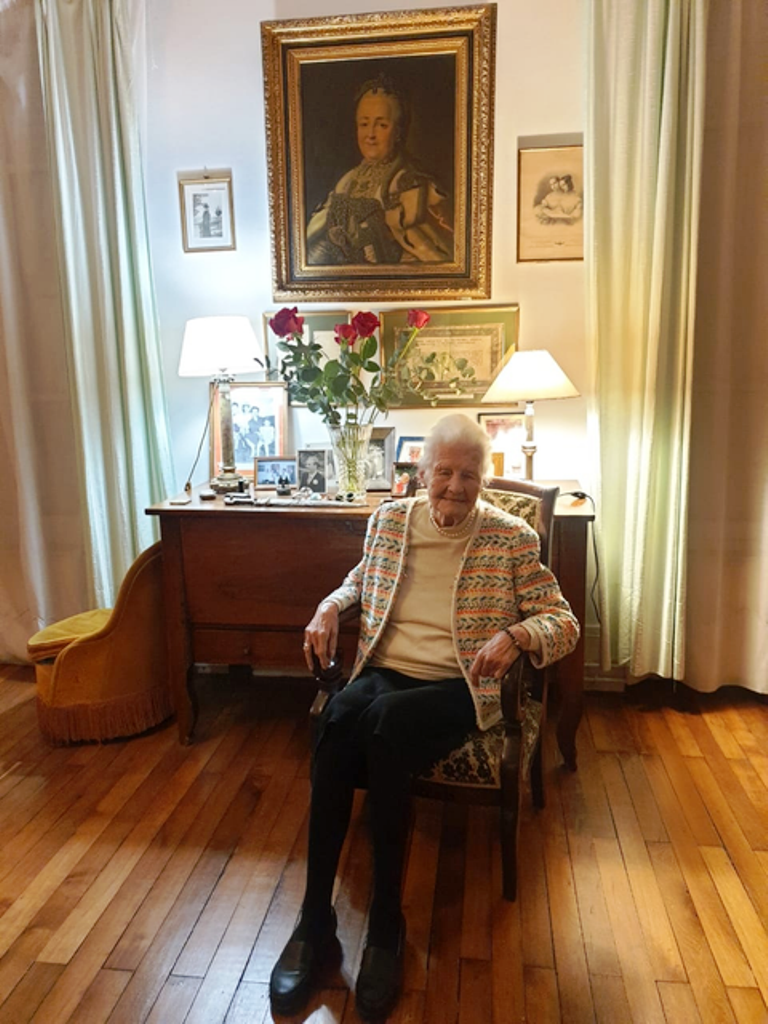
PHOTO: Maria Dmitrievna Ivanova [Born Countess Tatishcheva], at her home in Paris
Maria Dmitrievna Tatishcheva lived in Paris, where she devoted her entire life helping Russians who fled Bolshevik Russia after the Revolution, and emigrated to France. In 1948, she began working at the Help Center for Russian Emigrants. The center helped émigrés to find employment, housing, obtain documents and organized children’s shelters.
In 1949, Maria married Yuri Alexandrovich Ivanov (1923-1987). The couple had one son Sergei Yuryevich.
From 1964, Maria headed the Russian parish school at the Cathedral of St. Alexander Nevsky Church in Paris, for children, grandchildren and great-grandchildren of Russian emigrants living in France.
From 1987 to 2000, she was in charge of the Tolstoy Foundation, which helped Russian refugees who emigrated from the USSR.
Maria first went to Russia in 2003, visiting Ekaterinburg, when the city celebrated its 280th anniversary, as a descendant of the founder of the city. It was during this visit to the Ural capital that the head of the Yekaterinburg Metropolia informed Maria that the diocesan Commission for the Canonization of Saints was currently preparing documents for the canonization of her uncle Vasily Nikitich Tatishchev (1859-1918).
Maria Dmitrievna Ivanova-Tatishcheva died in Paris on 27th May 2025. A memorial service was held on Friday, 30th May in the Cathedral of Saint Alexander Nevsky in Paris. She was buried in the Sainte-Genevieve-des-Bois Russian Cemetery, situated 25 km south from Paris.
Memory Eternal! Вечная Память!
***
PHOTO: Vasily Nikitich Tatishchev (left) and Ilya Leonidovich Tatishchev (right)
At the invitation of Nicholas II, the devoted Adjutant General Vasily Nikitich Tatishchev followed the Tsar’s family into exile to Tobolsk, where, he played an important role, caring for the august family and offering spiritual support. When Nicholas II and the Empress Alexandra Feodorovna and her daughter Maria left Tobolsk for Ekaterinburg, Tatishchev remained with the Tsar’s children. On 23rd May 1918, upon arrival in Ekaterinburg with Tsesarevich Alexi and the Grand Duchesses Olga, Tatyana, Anastasia, the Adjutant General was separated from the Tsar’s family and imprisoned in Ekaterinburg.
On 10th June 1918 Ilya Leonidovich Tatishchev was shot by the Bolsheviks. According to church historians, he was buried in the cemetery of the Novo-Tikhvin Convent. [Note: Tatishchev’s grace was lost during the Soviet years – PG]
The head of the Ekaterinburg Metropolis informed Maria Dmitrievna that the diocesan commission for the canonization of saints is currently preparing documents for the canonization of her uncle. [Note: Ilya Leonidovich Tatishchev was canonized by the Russian Orthodox Church Outside Russia (ROCOR) in 1981 – PG]
“It is known that not only did he know the gospel by heart, but lived the life a devout Orthodox Christian.
On the night of 24/25th April 2025, American author Greg King died, aged 61. The cause of death was cardiovascular disease.
King is the author of more than a dozen biographies of prominent historical figures, but he is perhaps best known for his writings about Russia’s last tsar Nicholas II (2006), Empress Alexandra Feodorovna (1994), the Grand Dukes Konstantinovich (2006), Prince Felix Yusupov (1996) and Anastasia/Anna Anderson (2010).
His works on European and British royalty include biographies on King Ludwig II of Bavaria (1996), Crown Prince Rudolph of Austria, Archduke Franz Ferdinand of Austria, Wallis Simpson Duchess of Windsor (1999) and the Court of Queen Victoria (2007).
His non-royalty works included studies of the Luisitania (2015) and the Andrea Doria (2020).
A number of King’s works were co-authored by his long-time friend Penny Wilson.
In addition, Greg King was a frequent onscreen expert and commentator for historical documentaries, his work has appeared in numerous publications including The Washington Post, Majesty Magazine, and Royalty Magazine.
On a personal note, I only met Greg on one occasion, and that was in the mid-1990s. He was among the first group of American and Canadian travellers who took part in my first organized tour of Russia: The World of Nicholas and Alexandra. We communicated by telephone and email for some years after that, and then we parted ways. I continued to follow his work.
My favourite book written by King is The Court of the Last Tsar: Pomp, Power and Pageantry in the Reign of Nicholas II (2006). I recall him telling me of his plans to write this particular book, during our visit to St. Petersburg and Moscow all those many years ago. In addition, is his book A Life for the Tsar: Triumph and Tragedy at the Coronation of Emperor Nicholas II of Russia (2016).
While I did not agree with some of Greg’s research, I have to give credit where credit is due. He had a large and dedicated following and his passing will leave a large void in research on the life and reign of Russia’s last Tsar and his family. His death at such an early age is indeed tragic, may he rest in peace.
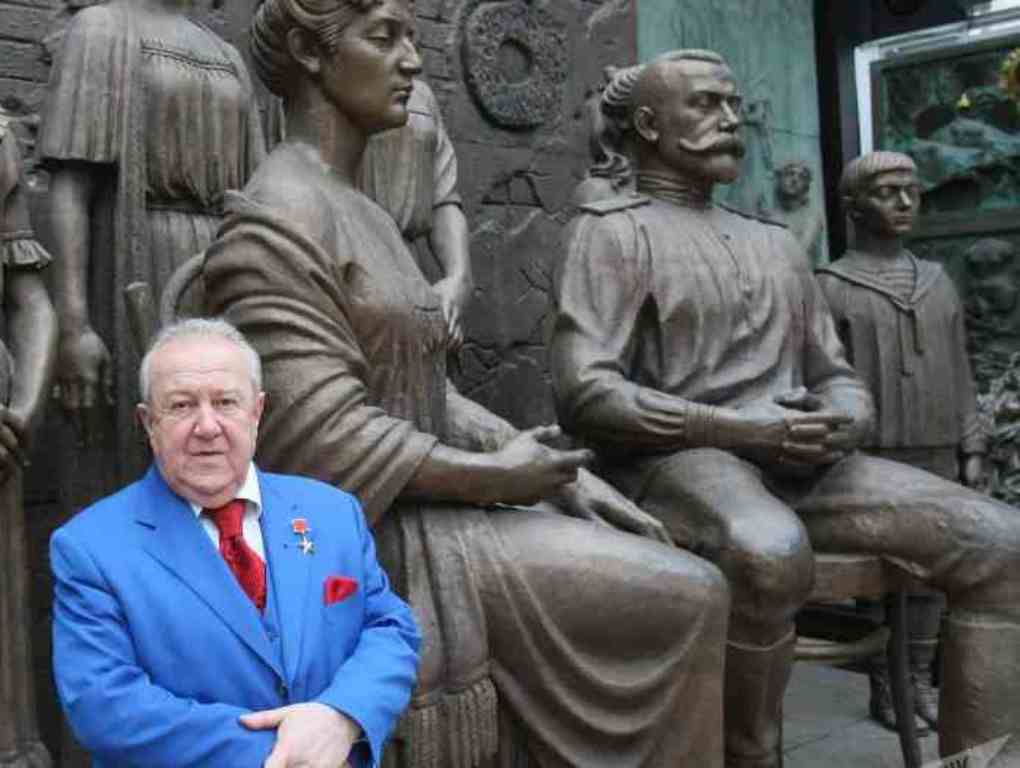
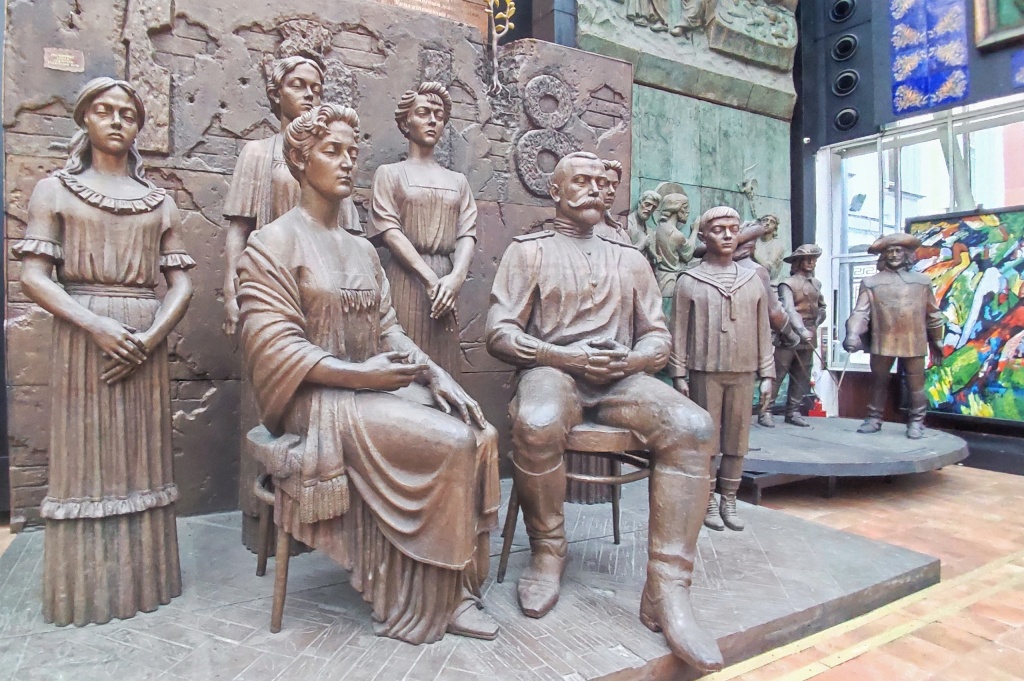
PHOTO: Zurab Tsereteli standing in front of his sculptoral composition ‘Night at the Ipatiev House’, depicting Nicholas II and his family, at the Zurab Tsereteli Art Gallery in Moscow– see photo at the end of this post for a full view
On Tuesday, 22nd April 2025, the famous Russian-Georgian sculptor and President of the Russian Academy of Arts Zurab Konstantinovich Tsereteli died in Moscow, after a lengthy illness, at the age of 91. The cause of death was cardiac arrest.
Tsereteli was born in Tbilisi (Georgia) on 4th January 1934. He studied at Tbilisi State Academy of Arts, graduating in 1958. The same year, he married Inessa Alexandrovna Andronikashvili (1937-1998), a princess from a noble Georgian family that claimed patrilineal descent from Byzantine Emperor Andronikos I Komnenos (1118-1185).
The sculptor has been the president of the Russian Academy of Arts since 1997. Tsereteli is known for his works not only within Russia, but in many countries around the world. Among them are monuments to Nikolai Gogol (Rome, 2002), St. Nicholas the Wonderworker (Bari, Italy, 2003), Pope John Paul II (Ploermel, France, 2006), “The Three Musketeers” (Condom, France, 2010), monument to Marina Tsvetaeva (Saint-Gilles Croix de Vi, France, 2012), the Apostle Paul (Veria, Greece, 2013), a monument to Nicholas II (Republika Srpska, 2014), “The Birth of the New World” (Arecibo, Puerto Rico, 2016) and others. In 2018, Tsereteli donated a monument to the poet Alexander Griboyedov to the Russian Drama Theater named after A.S. Griboyedov in Tbilisi.
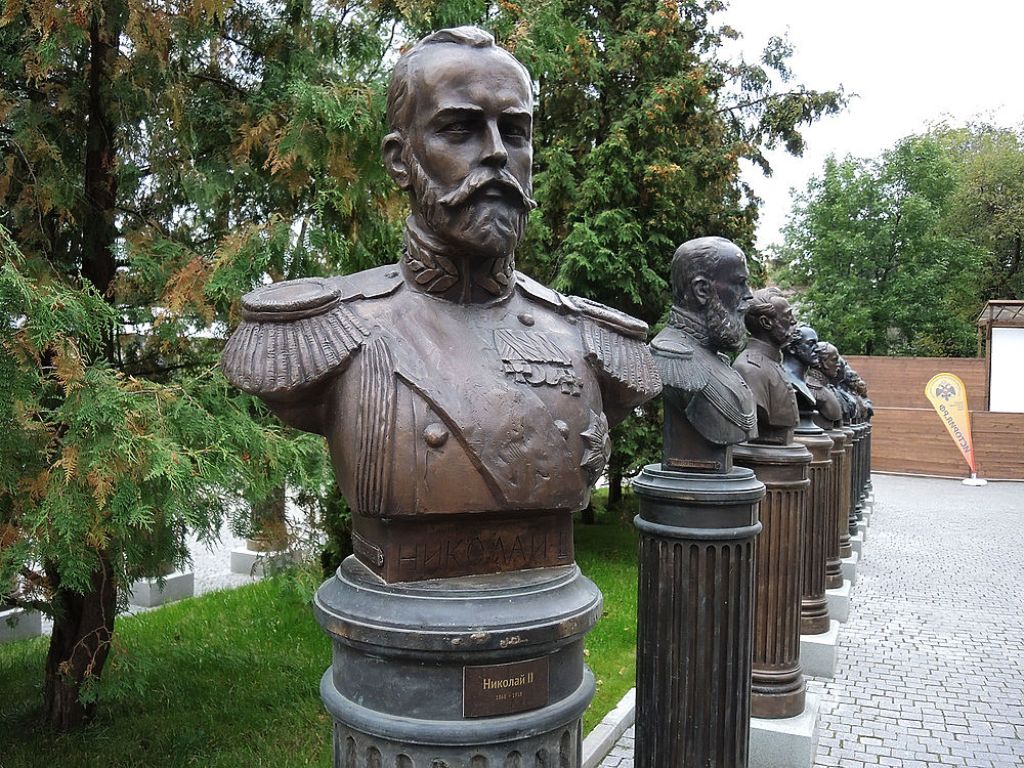
PHOTO: the ‘Alley of Rulers’ in Moscow, features bust-monuments of Russia’s political leaders and emperors, including Nicholas II
In Russia, some of Zurab Tsereteli’s most famous works are “Night at the Ipatiev House” (Moscow, 2007), Princess Olga (Pskov, 2003), “Wives of the Decembrists, The Gates of Destiny” (Moscow, 2008), among many others. On 31st May 2024, a magnificent equestrian monument to Emperor Alexander III was unveiled and consecrated in the city of Kemerovo, the capital of Kuzbass, situated in Western Siberia.
In 1997, by order of the Moscow government, a 98-meter monument to Peter the Great was opened at the western confluence of the Moskva River and the Vodootvodny Canal in central Moscow. The then mayor Yuri Luzhkov (1936-2019) criticized the monument for it’s “gigantism and bad taste”. There were protests demanding the dismantling of the sculpture. In 2008, the monument was included in the list of the ugliest man-made structures in the world.
On 1st October 2024, the ‘Alley of the Rulers of Russia’ opened at Boldino, the former estate of the outstanding statesman and historian Vasily Nikitich Tatishchev (1686-1750), near Moscow. This sculptural composition by Zurab Tsereteli consists of 43 busts of historical figures who have led Russia over its more than 1,000 year history – from Prince Rurik to the Romanovs to the first President of the Russian Federation Boris Yeltsin.
PHOTO: Zurab Tsereteli at the unveiling of his bust-monument to Nicholas II, in Banja Luka, the capital of the Republika Srpska (Bosnia and Herzegovina), on 21st June 2014
Tsereteli was the Founder of the Moscow Museum of Modern Art (1995), the Zurab Tsereteli Art Gallery (2000) and the Museum of Modern Art in Tbilisi (Georgia, 2012). He is the author of more than 5 thousand works of painting, graphics, sculpture, frescoes and mosaics, however, he gained the greatest fame as a sculptor-monumentalist. In 1995–2000, he participated in the reconstruction of the Cathedral of Christ the Saviour in Moscow.
According to the sculptor’s grandson Vasily Tsereteli, a farewell to Tsereteli, will be held on 23rd April, in the Cathedral of Christ the Saviour in Moscow. Tsereteli will be buried on Sunday, 27th April, in the Mtatsminda Pantheon of Writers and Public Figures in Tbilisi, Georgia where his wife rests.
PHOTO: Zurab Tsereteli’s‘Night at the Ipatiev House’ (2007), depicting Emperor Nicholas II and his family, at the Zurab Tsereteli Art Gallery in Moscow
In a statement issued by Maria Zakharova, a representative of the Russian Foreign Ministry: Zurab Konstantinovich Tsereteli will be remembered as a world-renowned artist and sculptor, a public figure who knew “neither borders nor obstacles in strengthening peace and supporting creativity.
“He will live on, not only in our hearts, but also through his works: in stained glass windows and enamels decorating foreign missions, and in monuments and sculptures installed in different parts of the world,” she added.
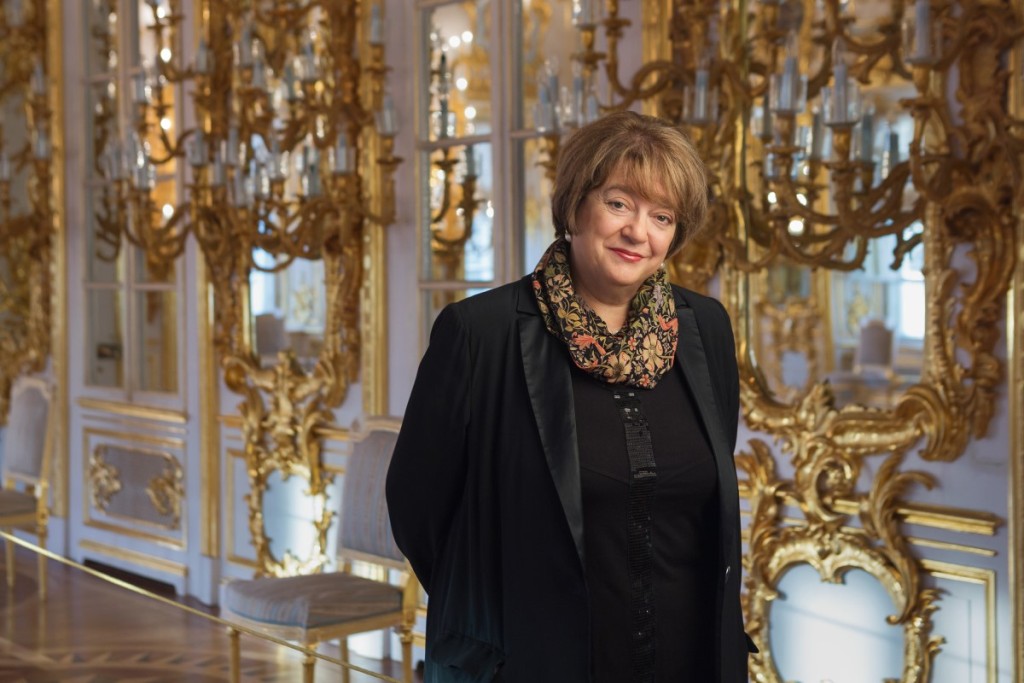
How very sad that my first article of the new year should be an obituary. I regret to announce the death of Elena Yakovlevna Kalnitskaya, who served as the highly respected Director General of the Peterhof State Museum for the past 13 years. She died on 2nd January 2025 after a long illness. She was 72 years old.
Elena Kalnitskaya was born in Leningrad (St. Petersburg) on 6th September 1952. A noted Eussian art historian, Elena Kalnitskaya served as the Director General of the Peterhof State Museum-Reserve since 2009. During her tenure as director, she organized large-scale restoration work in the palaces and parks of Peterhof and Oranienbaum. Among these projects were the restoration of the Farm Palace in the Alexandria Park and the recreation of the Lower Dacha, the latter of which remains on hold. She contributed to the implementation of a large-scale program for the development of the museum: holding major Russian and international exhibitions, organizing scientific conferences, and publishing the catalogues of the museum’s vast collection. She also authored over 200 scientific and popular publications dedicated to the history of the culture of the Russian Empire.
On 6th September 2022, Elena Yakovlevna celebrated her 70th birthday. In her honour, a noon volley was fired from the cannon of the Peter and Paul Fortress in St. Petersburg.
At the end of March 2023, Kalnitskaya was forced to step down as Director General of the Peterhof State Museum due to health problems.
Memory Eternal! Вечная Память!
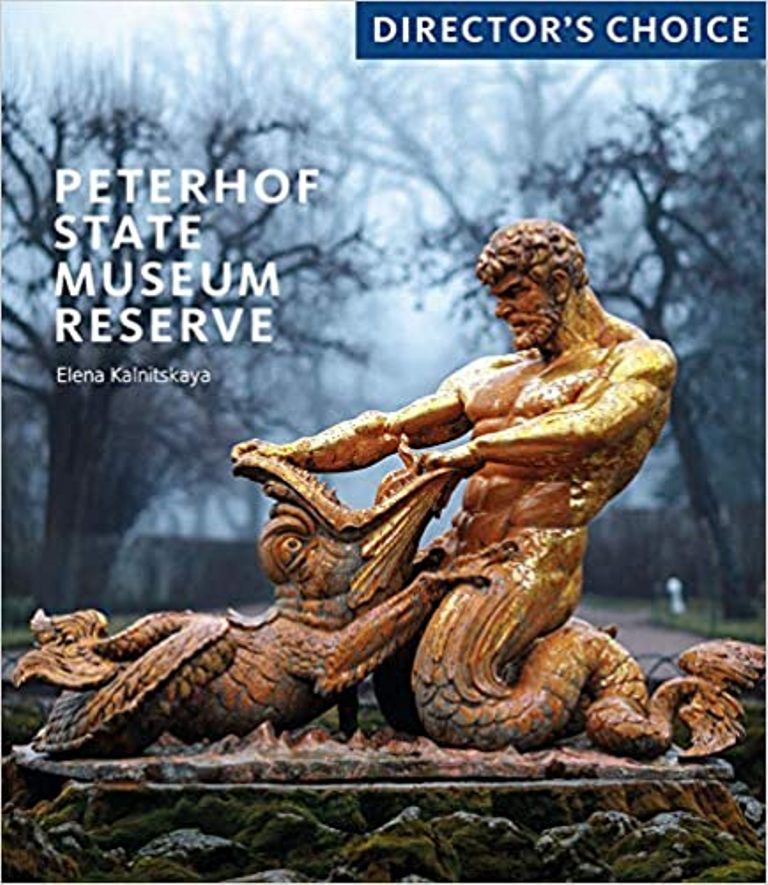
In October 2023, a new English-language book ‘Peterhof State Museum Reserve: Director’s Choice‘ by Elena Kalnitskaya, was published and made available on AMAZON. In this short 96-page book, Kalnitskaya presents a selection of her favorite palaces, monuments, and objects and their stories.
A description of her book reads as follows:
“The Peterhof State Museum-Reserve is one of the most visited and attractive museums in Russia, the “fountain capital” of a huge country. Uniting today more than 30 expositions located on the territory of Peterhof, Alexandria, Strelna and Oranienbaum, the museum acquaints its guests with the great past of Russia.
“The history of each Peterhof monument is deeply individual, but, being formed into single architectural ensembles, are an organic synthesis of history, art, architecture, human destinies. The planning structure of Peterhof skillfully combines regular and landscape parks, palaces of different architectural styles, small forms and fountains. The famous water supply system, which has no analogues in the world, keeps the memory of its creator – emperor Peter the Great.
“The Peterhof collections, collected by the crowned owners of the residence to decorate it, consist of a variety of museum items. “There is a soul in every museum object,” says Director Elena Kalnitskaya, and this is clear in each work of art presented in this book. Each object tells its own story, but also invites the reader to better understand the history of Russia.”
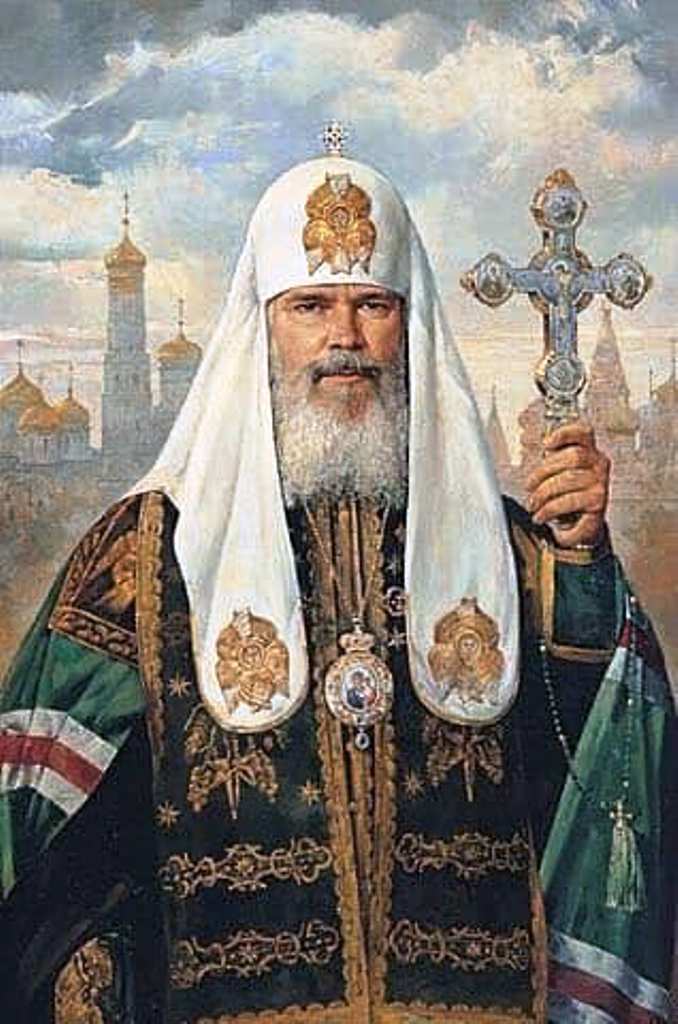
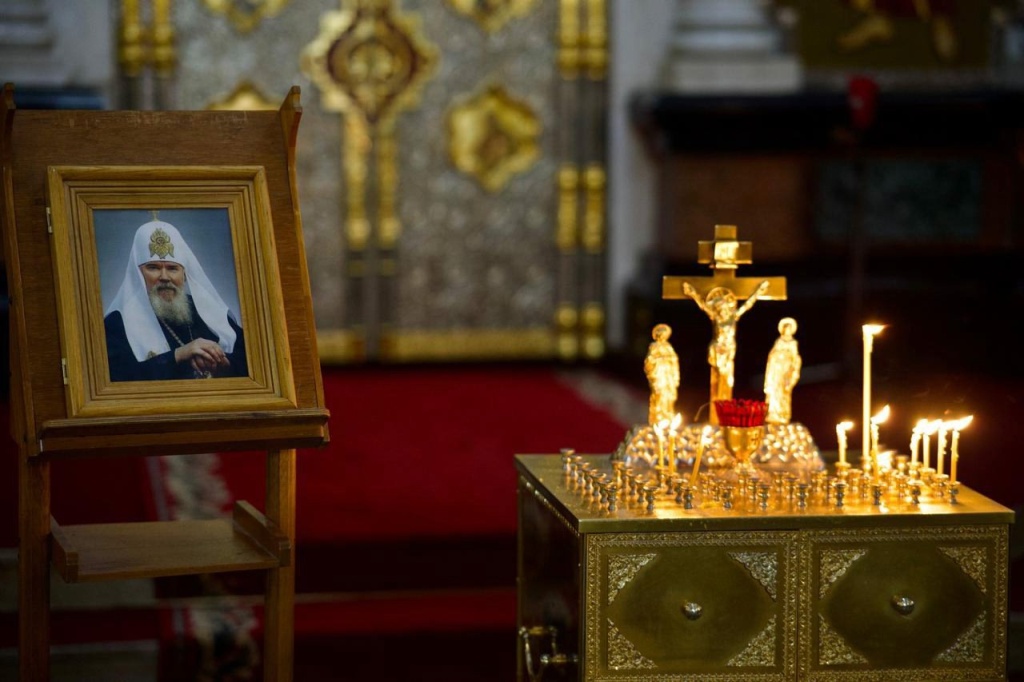
PHOTO: His Holiness Patriarch Alexei II of Moscow and All Russia
On this day – 5th December 2008 – His Holiness Patriarch Alexei II of Moscow and All Russia (1929-2008) died in Peredelkino, at the age of 79.
Alexei Mikhailovich Rüdiger was born in Tallinn, Estonia on 23rd February 1929. He was elected Patriarch of Moscow eighteen months prior to the fall of the Soviet Union in 1991. He became the first Russian Patriarch of the post-Soviet period to be chosen without government pressure; candidates were nominated from the floor, and the election was conducted by secret ballot.
In July 1998 Alexei II decided not to officiate at the funeral of Emperor Nicholas II and his family in the Saints Peter and Paul Cathedral in St. Petersburg, citing doubts about the authenticity of their remains. He also banned bishops from taking part in the funeral ceremony.
In the face of skepticism, Patriarch Alexei II was obliged to profess agnosticism over the identity of the bodies, as a way to avoid massive internal rifts within the church. He also claimed that the Church had been sidelined in the investigation.
The funeral was attended by Russian president Boris Yeltsin, Prince Michael of Kent and more than 50 descendants of the Romanov dynasty. Maria Vladimirovna Romanova, her son and her mother, were the only Romanov descendants who refused to participate, also citing doubts about the authenticity of the Rkaterinburg remains.
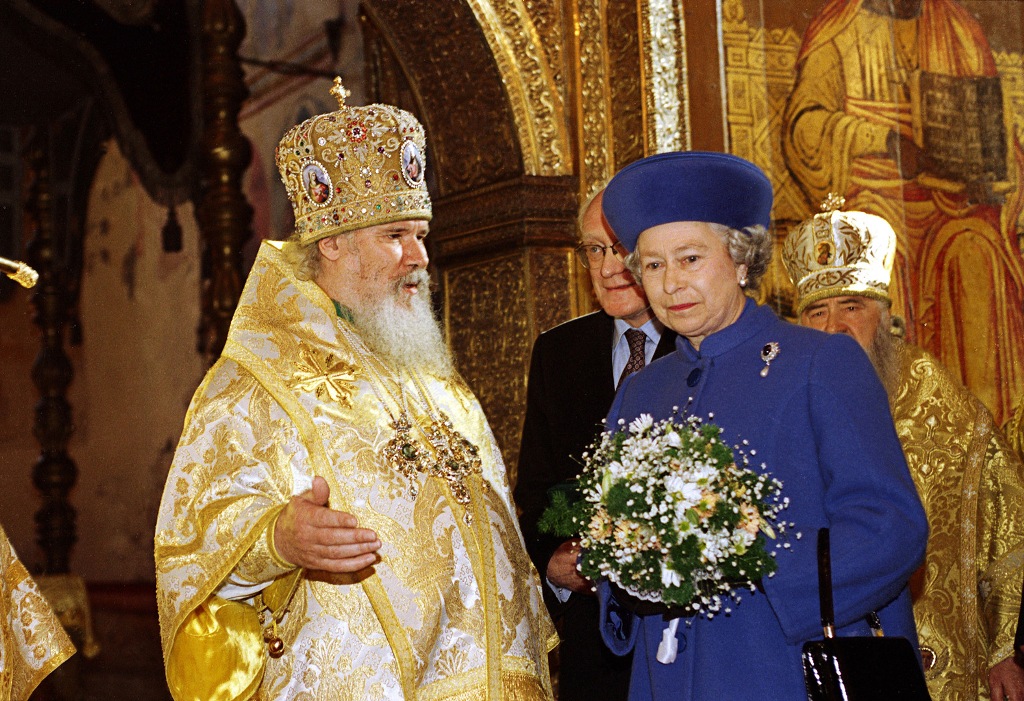
PHOTO: Patriarch Alexei and Queen Elizabeth II. Moscow, 18th October 1994
Instead, Patriarch Alexei II, Maria Vladimirovna Romanova, her son George Hohenzollern, and her mother Leonida Georgievna (1914-2010) attended a liturgy for the murdered Imperial Family at the Trinity Lavra of St. Sergius, the most important Russian monastery and the spiritual centre of the Russian Orthodox Church, situated in the town of Sergiyev Posad [named Zagorsk during the Soviet years], about 70 km north-east of Moscow.
Under His Holiness’s leadership, the New Martyrs and Confessors of Russia who suffered under Communism were glorified, beginning with the Grand Duchess Elizabeth, Metropolitan Vladimir, and Metropolitan Benjamin (Kazansky) of Petrograd in 1992.
In 2000, after much debate, the Council of Bishops of the Russian Orthodox Church glorified Emperor Nicholas II and his family, as Passion-Bearerss[1][2]. Their canonization took place on 20th August 2000, at the Christ the Saviour Cathedral in Moscow.
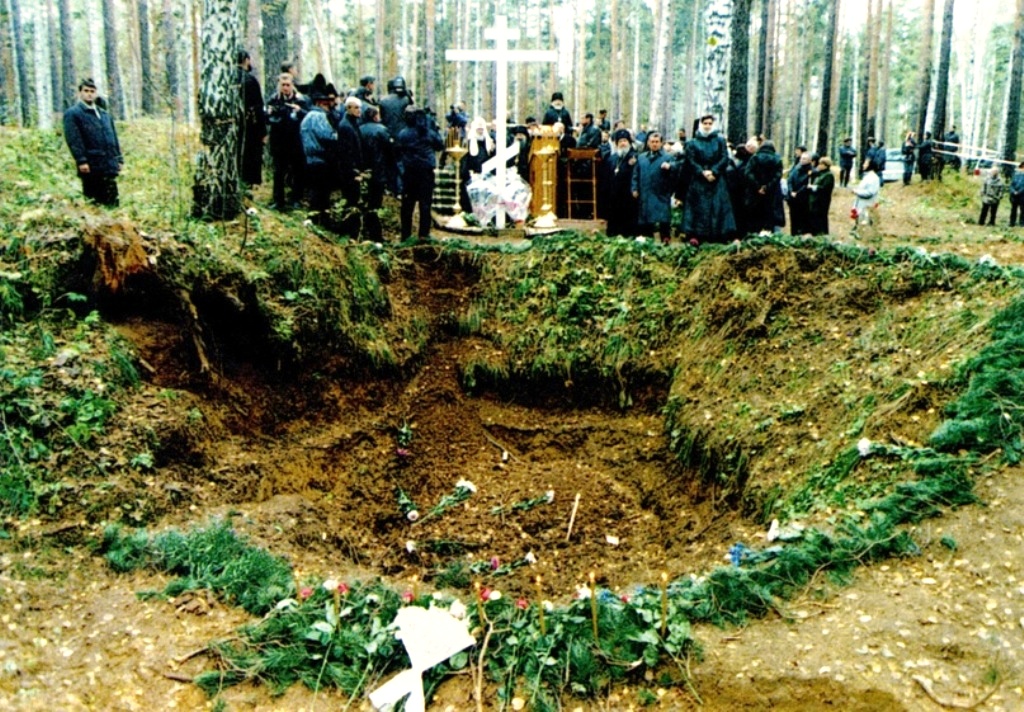
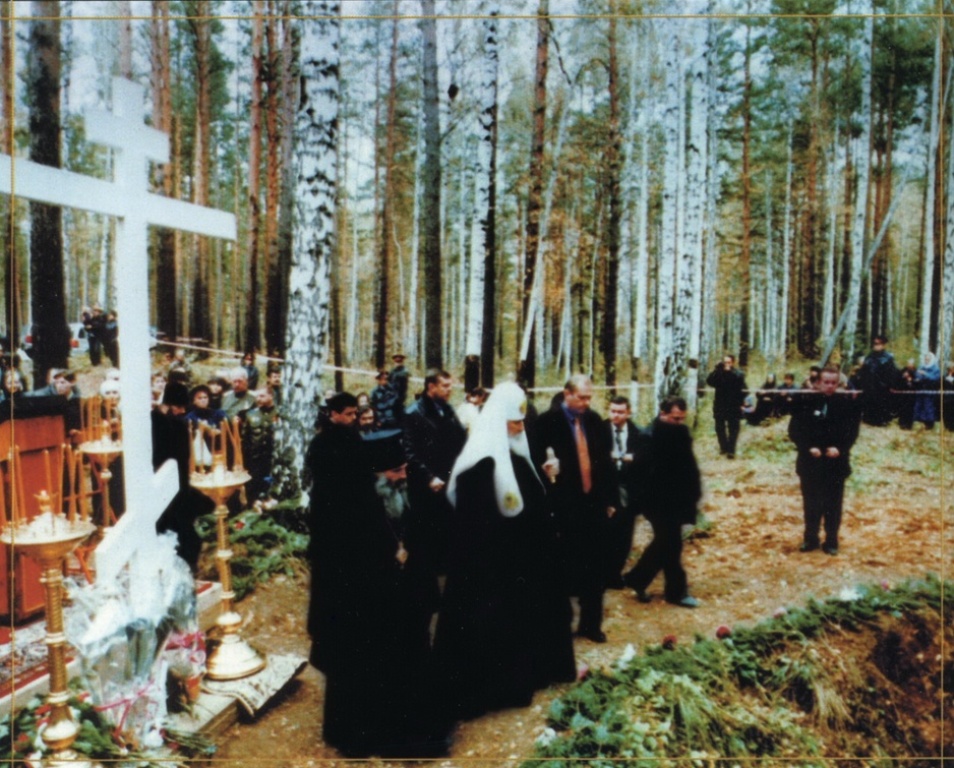
PHOTO: two very sombre photos of Patriarch Alexei standing at Mine No. 7 (collapsed) at Ganina Yama[3]. It was around this place, that the Monastery of the Holy Royal Passion-Bearers was built.
On 23rd September of the same year, during his visit to the Urals, Patriarch Alexei II laid a memorial capsule in the eastern wall of the foundation of the future church. The construction of the Church on the Blood in Ekaterinburg. The church, which was completed in 2003, was built on the site of the Ipatiev House, where the Imperial Family along with four faithful retainers were murdered on 17th July 1918. The Ipatiev House was demolished in September 1977.
On the same day, His Holiness visited the Ganina Yama[3] tract [situated 15 km (10 miles) north of Ekaterinburg] and, having blessed the establishment of the monastic monastery, put his signature on the master plan of the monastery. The first stone of the monastery was laid on 1st October 2000. On 27th December, the Holy Synod officially “blessed the opening of a monastery in the name of the Holy Royal Martyrs in the Ganina Yama[3] tract”. On 28th December, the all-male Monastery of the Holy Royal Martyrs was established here.
His Holiness Patriarch Alexei II of Moscow and All Russia died at his home in Peredelkino [southwest of Moscow] on 5th December 2008, from heart failure, aged 79. He died 80 days short of his 80th birthday.
The funeral service for His Holiness was performed at the Cathedral of Christ the Saviour in Moscow, he was buried in the Cathedral of the Epiphany, the vicarial church of the Moscow Patriarchs in Yelokhovo, located in the Basmanny district of Moscow.
Memory Eternal! Вечная Память!
NOTES:
[1] Despite their official designation as “passion-bearers” in 2000, by the Council of Bishops of the Russian Orthodox Church, Emperor Nicholas II and his family are often referred to as “martyrs” in Church publications, icons, and in popular veneration by the people.
[2] Emperor Nicholas II and his family were canonized as martyrs by the Russian Orthodox Church Outside of Russia (ROCOR) in 1981.
[3] Ganina Yama is the generally accepted name of the abandoned Isetsky mine, located in the Four Brothers tract, overgrown with birch and pine forests, situated situated in the Sverdlovsk region.
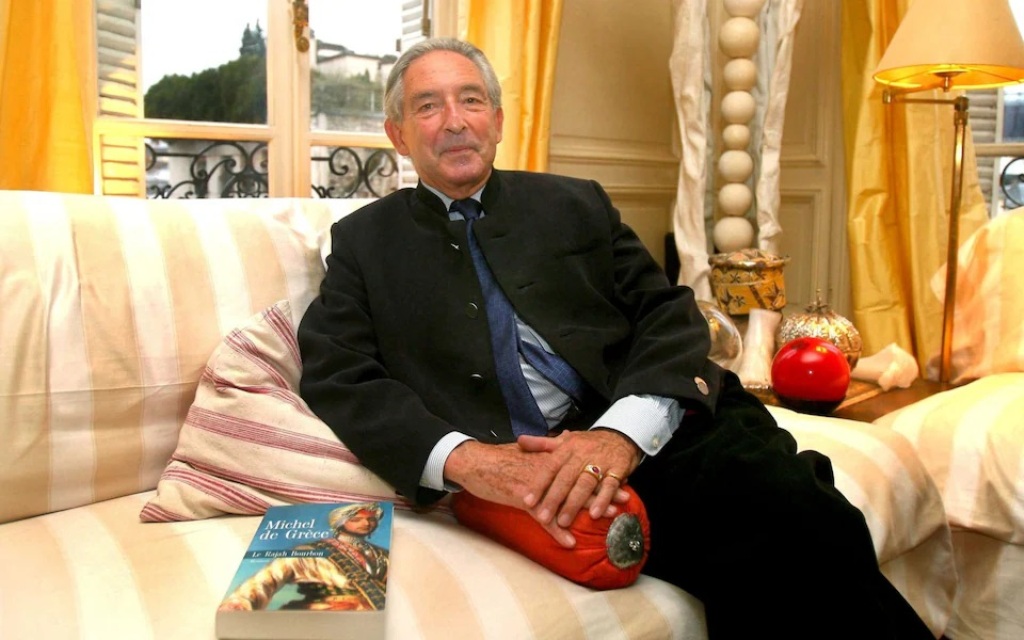
PHOTO: Prince Michael of Greece and Denmark (1939-2024)
On 28th July 2024, Prince Michael of Greece and Denmark died in Athens, Greece, at the age of 85. He was the last surviving grandchild of King George I of Greece (1845-1913) with a lineage to the House of Bourbon through his mother’s side of the family and the last surviving great-grandchild of King Christian IX of Denmark (1818-1906). In addition, he was a first cousin of numerous royals, including King Charles III of Great Britain.
Prince Michael was born on 7th January 1939, in Rome to Prince Christopher of Greece and Denmark (1888-1940) and his second wife, Princess Françoise d’Orléans (1902-1953). His godparents were his two first cousins Queen Helen, Queen Mother of Romania (1896-1982) and King George II of Greece (1890-1947).
Sadly, he had a very traumatic childhood, his father died a year after his birth and his mother died in 1953. Before she passed away, Francoise d’Oreleans settled her son in Spanish Morocco, alongside her brother, the Orleanist claimant to the French throne, Henri of Orléans, (1908-1999) and his wife Princess Isabelle Murat and their family of 11 children. Prince Michael would live with his uncle Henri after the death of his mother, returning to Paris once the royal banishment laws had been overturned, and moving into the Manoir du Cœur Volant estate near Versailles.
Spending his young adulthood in Paris, he studied political science and then re-patriated to Greece for military duty, serving a term in the Hellenic Coast Guard, discharged with the rank of Sub-lieutenant.
Prince Michael inherited from his mother a half-interest in the domain of the Nouvion-en-Thiérache, once the seat of the Dukes of Guise, from whom the Bourbon-Orléans inherited the vast property, which included a grand château and a petit château, in Aisne. The Comte de Paris owned the other half of the Nouvion. He and Michael sold the grand château in 1980, while the petit château was sold in 1986.
Prince Michael grew up to become a a renowned writer and historian under the pseudonym Michel De Grece. He penned several biographies about members of ruling dynasties, those about contemporaries often including accounts and anecdotes attributed to his royal relatives.
He also authored novels about historical royalty, distinguished for meticulous detail. He was also the author of several richly illustrated pictorials, including The royal house of Greece (1988), Imperial Palaces of Russia (1992), Nicholas and Alexandra: The Family Albums (1992), and Jewels of the Tsars (2006).
His book on Emperor Nicholas II and Empress Alexandra Feodorovna, was one of the first large format pictorials to be published on the last Tsar and his family. Featuring nearly 300 black and white photos from the State Archives of the Ryssuab Federaion (GARF), it remains a favourite among Romanophiles, and is highly sought after by collectors.
Michael married Marina Karella (born 17 July 1940) on 7th February 1965 in Athens. The marriage was held at the Royal Palace in Athens. This was a non-dynastic marriage, which obtained the legally required authorisation of King Constantine II (1940-2023) only after Michael renounced all rights of succession to the Greek throne for himself and his descendants. The couple had two daughters: Alexandra (b. 1968) and Olga (b. 1971).
Prince Michael died at a hospital in Athens, on 28th July 2024, at the age of 85. His funeral is to be held on 1st August 2024 at the Church of Saint Theodores in the First Cemetery of Athens, followed by burial in the Tatoi Royal Cemetery.




 Nicholas II
You must be logged in to post a comment.