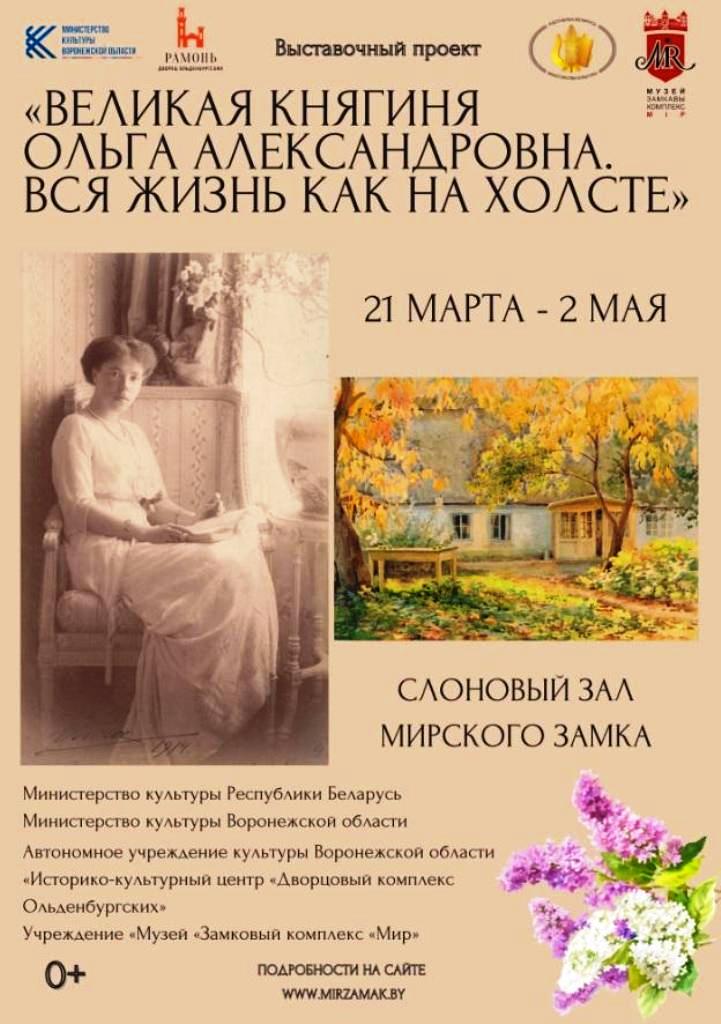
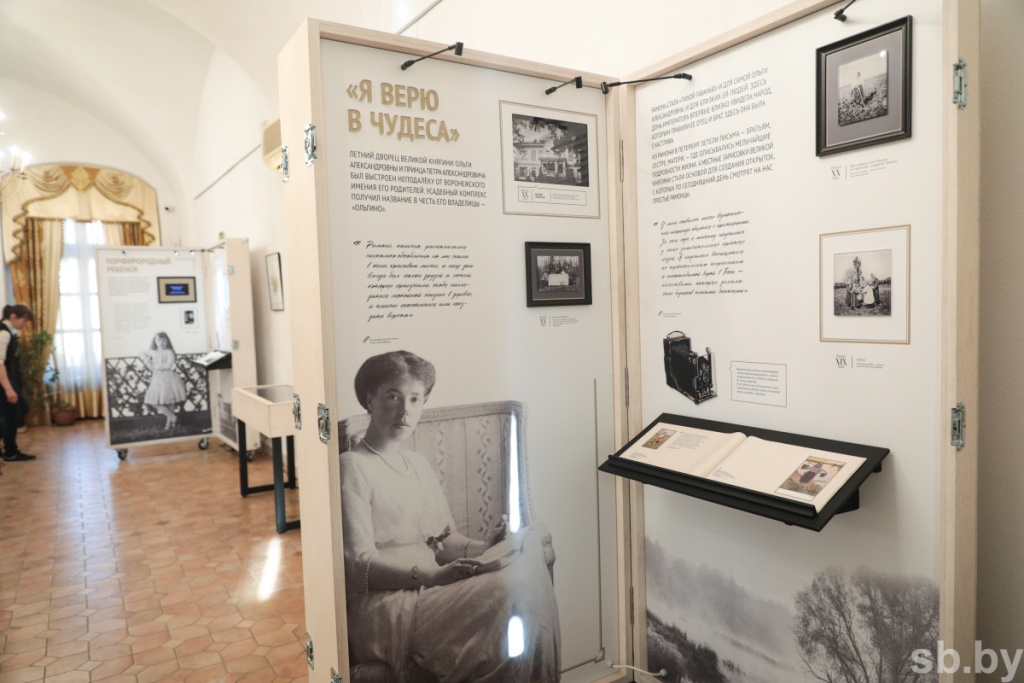
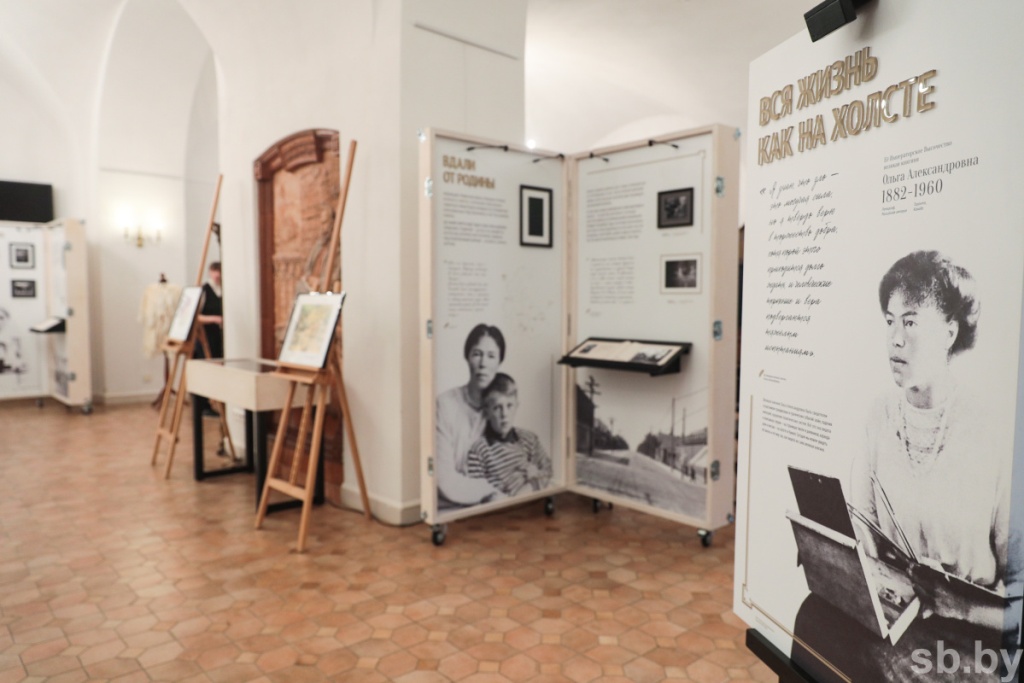
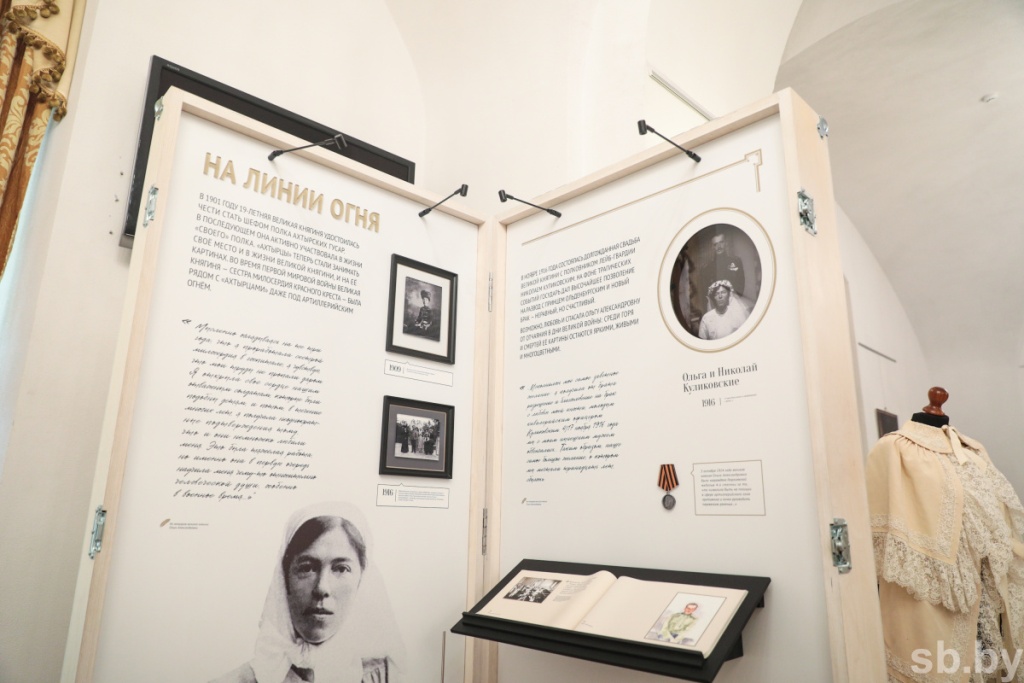
On 21st March 2024, the Grand Duchess Olga Alexandrovna. Life on a Canvas exhibition, opened in Mir Castle, situated in the village of Ramon[1], near Voronezh, Belarus.
According to the Oldenburg Palace Museum, the venue for the exhibition was chosen due to the close family ties between members of the Imperial Family and the Svyatopolk-Mirsky family, the last owners of Mir Castle. For example, the great-niece of Prince Nikolai Svyatopolk-Mirsky, was Princess Sofia Ivanovna Orbeliani (1874-1915), who served as a lady-in-waiting and close friend of Empress Alexandra Feodorovna.
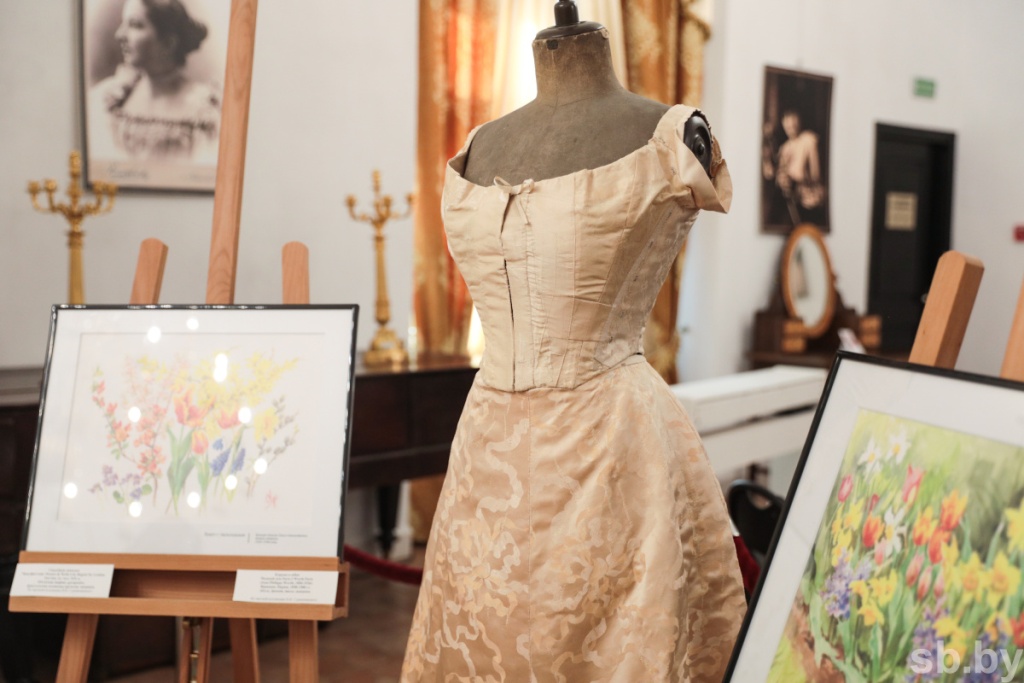
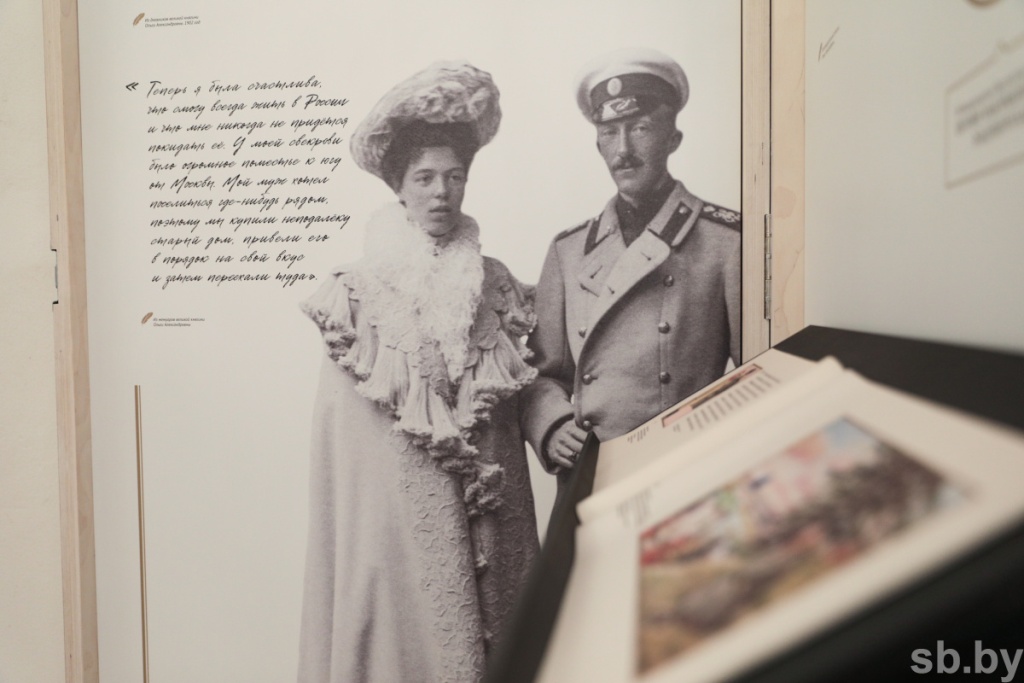
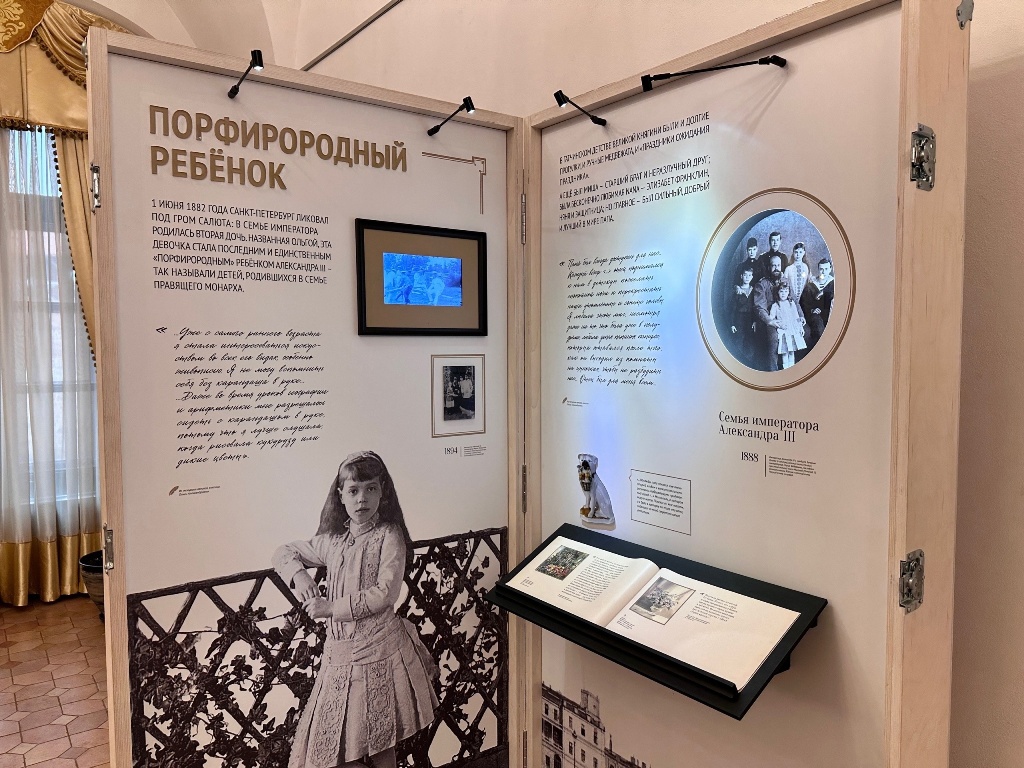
The exhibit presents the Russian years of Grand Duchess Olga Alexandrovna through letters to her brother Emperor Nicholas II, and her nieces: Grand Duchesses Olga, Tatiana, Maria and Anastasia Nikolaevna.
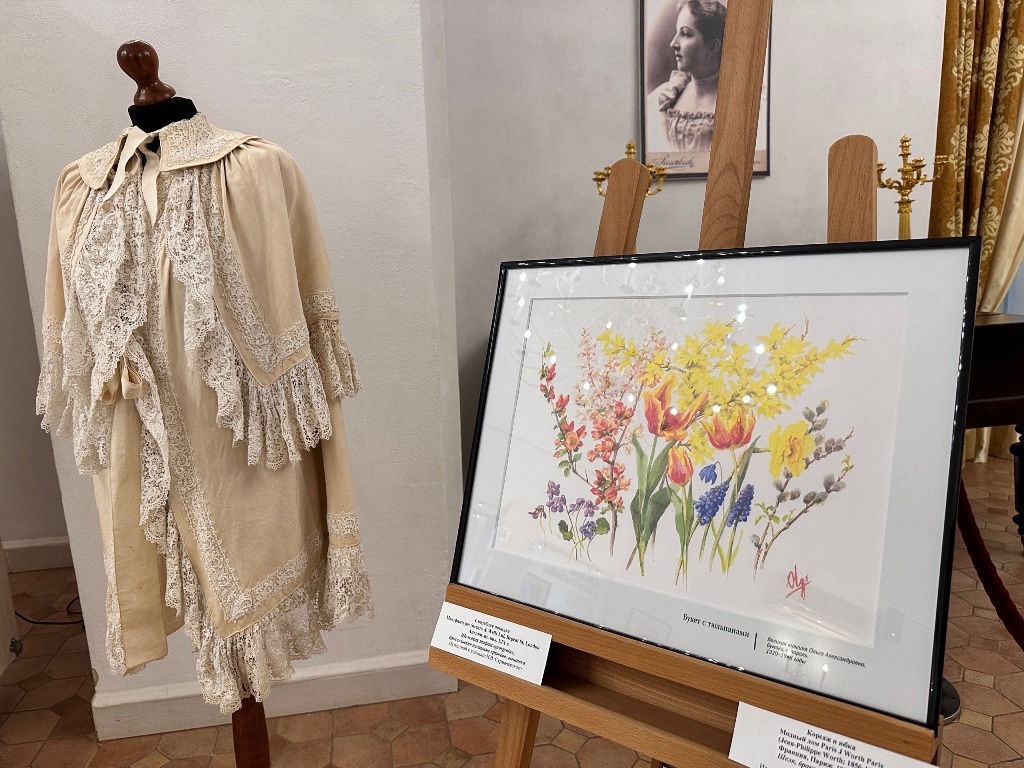
The exhibition is supplemented with items from the funds of the the personal archive of Her Imperial Highness, stored in the Oldenburg Palace: photographs from Olga’s albums, drawings and paintings created in subsequent years, entries from her private diaries, and watercolours.
These exhibits which reflect the heritage of the Grand Duchess before the 1917 Revolution, afford visitors with an opportunity to acquaint themselves with the events of her long and often difficult life.
The life of Olga Alexandrovna, the last Russian Grand Duchess, was filled with trials that rarely fall to the lot of man. But with her kindness, modesty, and courage, she managed to overcome the horrors prepared for her by the 20th century. She was a benefactor of numerous schools, hospitals, almshouses, societies, and during the First World War she became a simple Red Cross nurse.
Interested in painting from her early childhood, Olga Alexandrovna never stopped painting throughout her life. Her works are real and lively, reflecting the happy moments of happy times with family, and the beauty of landscapes, nature, and the elegance of floral compositions.
Never discouraged, Olga was able to see beauty in everything, she was grateful for every new day, simple, humble and bright – this is how she is reflected in her works. In emigration, Olga Alexandrovna’s house became a center for all those who shared the bitter fate of exile. The Grand Duchess continued her charitable activities: her watercolours were exhibited in several European capitals, and the proceeds from the sale went to help Russian emigrants who found themselves in difficult financial situations.
The more one learns about Grand Duchess Olga Alexandrovna, her kindness, her charitably work, her piety, etc., one can truly understand why she remains one of the most beloved and respected members of the Russian Imperial Family and the Romanov Dynasty.
The Grand Duchess Olga Alexandrovna. Life on a Canvas exhibition runs at the Mir Castle until 2nd May 2024.
NOTES:
[1] On 27th July 1901, Grand Duchess Olga married Duke Peter Alexandrovich of Oldenburg (1868-1924). In 1906, the couple settled into ‘Olgino’, their home situated on the Oldenburg estate, in the village of Ramon, near, Voronezh.
In 1915, the couple separated; Olga had no children from her first marriage. On 27th August 1916, Emperor Nicholas II approved the definition of the Holy Synod, which recognized her marriage to Prince of Oldenburg dissolved
PHOTO: Grand Duchess Olga Alexandrovna poses in front of some her watercolours at Gatchina, late 19th century.
On 14th April 2024, more than 40 watercolours painted by Grand Duchess Olga Alexandrovna (1882-1960), will go under the hammer at an auction in Moscow.
Olga’s watercolours continue to generate interest among professional and amateur collectors, both in Russia and abroad. The demand for her works have helped drive up list prices when any of her paintings are presented at auction. This current group of watercolours is expected to break all previous records.
The auction catalogue [in Russian only] contains a total of 43 watercolors, including landscapes still life, flowers, etc. The total estimated value of this group is 30 million rubles [$325,000 USD]. Estimates of individual lots range from 500,000 [$5,400 USD] to 1.5 million [$16,200 USD] rubles.
A total of 104 items of the Grand Duchess’s legacy will be sold, including autographs of members of the Russian Imperial Family, commemorative medals, pieces of furniture, and sculptures.
This group of watercolours and other items belonged to Olga Nikolaevna Kulikovsky-Romanov (1926-2020), the third wife of Grand Duchess Olga’s eldest son, Tikhon Nicholaevich Kulikovsky (1917-1993). Upon the grand duchess’s death in 1960, the bulk of her estate was acquisitioned by Tikhon. When Tikhon died in 1993, the collection passed to his wife Olga Kulikovsky. During the 1990s, Olga Kulikovsky travelled to Russia, taking the watercolours and other items with her. She toured the country, hosting numerous exhibits of her mother-in-laws paintings to Russians for the first time.
The youngest child and daughter of Emperor Alexander III and the youngest sister of Emperor Nicholas II, Olga was a prolific painter, producing over 2,000 paintings in her lifetime. She studied painting from various Russian masters, including Vasily Makovsky. During her early years in Russia, Olga painted for pleasure, often gifting her watercolours to relatives and friends, signing the works with her first initials.
During her years in exile – in both Denmark and Canada – Olga signed her works with “Olga”. The sale of her paintings provided a source of income for her and her family during their years in exile. This photo comes from the album of her cousin Princess Victoria of Wales.
Let us hope that this current collection of 43 watercolours are purchased as a group, and added to the collection of the State Historical Museum in St. Petersburg – PG
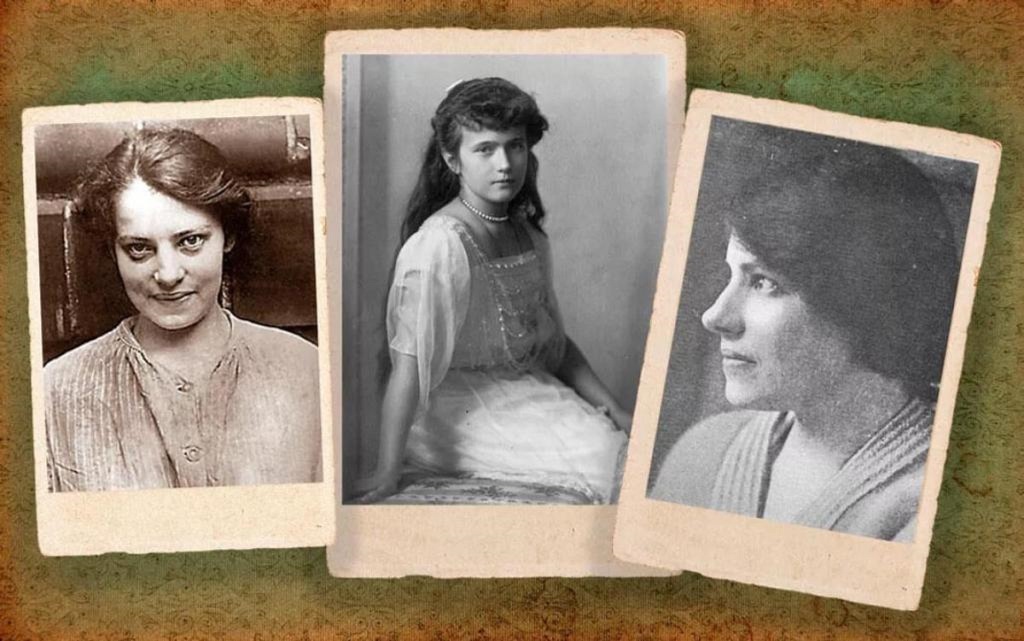
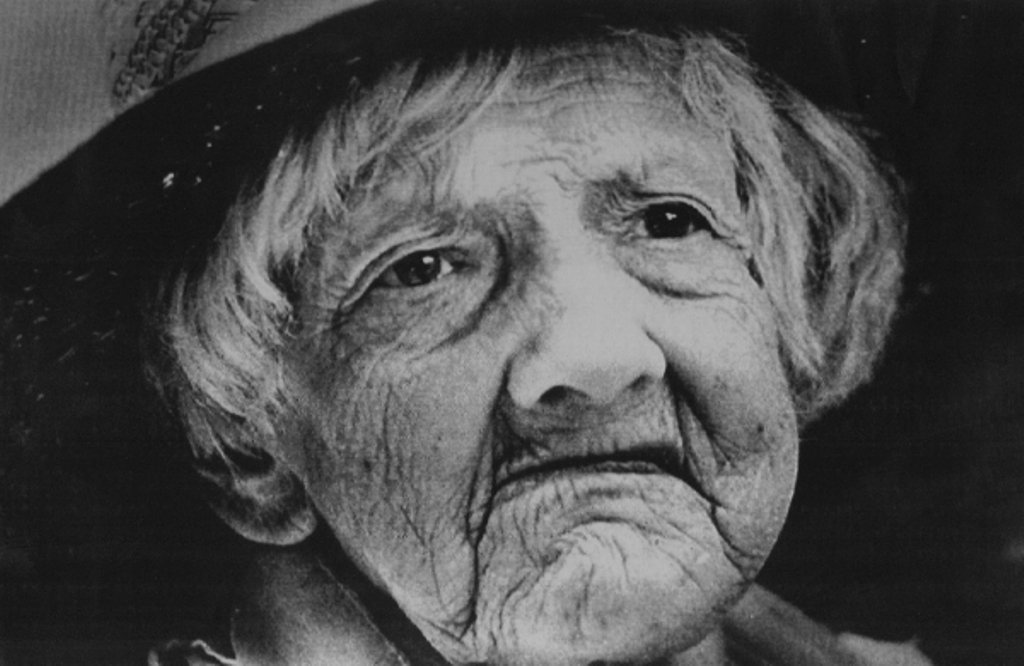
PHOTO: Grand Duchess Anastasia Nikolaevna (center) and Anna Anderson (left and right)
Today – 12th February 2024 – marks the 40th anniversary of the death of Anna Anderson, a Polish factory worker who, for decades, duped the world into believing that she was the youngest daughter of Eussia’s last Tsar. The proceedings of her claim would become the longest-running lawsuit in German history.
This article includes testimony from two of the people closest to Grand Duchess Anastasia Nikolaevna: her aunt Grand Duchess Olga Alexandrovna and her tutor Charles Sydney Gibbes, both of whom dismissed Anna Anderson’s claim – PG
***
Russian historian and author Robert K. Massie coined it best when he wrote: “The mysterious disappearance of the Russian Imperial Family in July 1918 created fertile soil for the sprouting of delusion, fabrication, sham, romance, burlesque, travesty and humbug,” when he referred to the “long, occasionally colourful, frequently pathetic line of claimants and imposters” that has glided and stumbled across the last century.
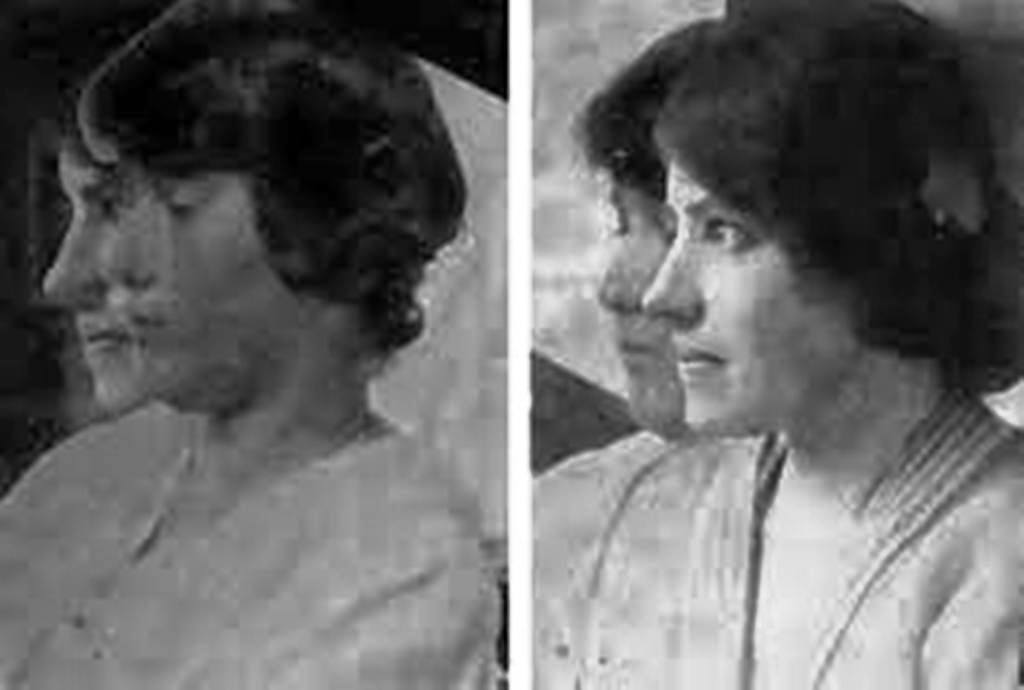
It was a US lab who confirmed the true identify of one of history’s greatest impostors: Anna Anderson, who claimed to be Grand Duchess Anastasia Nikolaevna. Thanks to DNA technology, however, science was able to prove that she was not the youngest daughter of Emperor Nicholas II, but that of a Polish peasant girl Franziska Schanzkowska.
A sample of Anderson’s tissue, part of her intestine removed during her operation in 1979, had been stored at Martha Jefferson Hospital, Charlottesville, Virginia. Anderson’s mitochondrial DNA was extracted from the sample and compared with that of the Romanovs and their relatives. It did not match that of the Duke of Edinburgh or that of the bones [Ekaterinburg Remains], confirming that Anderson was not related to the Romanovs.
The sample, however, matched DNA provided by Karl Maucher, a grandson of Franziska Schanzkowska’s sister, Gertrude (Schanzkowska) Ellerik, indicating that Karl Maucher and Anna Anderson were maternally related and that Anderson was Schanzkowska. Five years after the original testing was done, Dr. Terry Melton of the Department of Anthropology, Pennsylvania State University, stated that the DNA sequence tying Anderson to the Schanzkowski family was “still unique”, though the database of DNA patterns at the Armed Forces DNA Identification Laboratory had grown much larger, leading to “increased confidence that Anderson was indeed Franziska Schanzkowska”.
Similarly, several strands of Anderson’s hair, found inside an envelope in a book that had belonged to Anderson’s husband, Jack Manahan, were also tested. Mitochondrial DNA from the hair matched Anderson’s hospital sample and that of Schanzkowska’s relative Karl Maucher, but not the Romanov remains or living relatives of the Romanovs.
Many of us were relieved that this case had finally been put to rest. It was hoped that science would appease Anna Anderson’s supporters and thus bringing closure to this popular conspiracy theory. It was not to be . . .
PHOTO: this comparison on the side profiles of Grand Duchess Anastasia Nikolaevna and Anna Anderson, created by Pierre Gilliard, provide evidence that they were two different women
The claimants
Over the past 30+ years, I have been contacted by Anna Anderson’s supporters who insist that she was the real Anastasia. They argue the same “facts” from books on the subject written by Peter Kurth, Greg King and Penny Wilson, Michel Wartelle among others. In addition there have been numerous imposters claiming to be the children or grandchildren of either Nicholas II or one of his five children. In the 1990s I received a parcel from a man in Vancouver, who claimed that he was the son of Tsesarevich Alexei Nikolaevich. The box was filled with photocopied documents, letters and photographs, the cover letter read: “Mr. Gilbert, I dare you to prove me wrong!”
And if that wasn’t enough: during a lecture which I hosted in Chicago in 1997, an American man showed up insisting that he was the “reincarnation” of Emperor Nicholas II. He even grew a beard and trimmed it to the likeness of that of the Tsar. Still to this day, I receive emails from people who demand a DNA test to prove their “Romanov ancestry”.
Anna Anderson became the subject of films, documentaries and countless books – even in post-Soviet Russia. In 2014, Candidate of Historical Sciences Georgy Nikolaevich Shumkin released his book Кто Вы, госпожа Чайковская? К вопросу о судьбе царской дочери Анастасии Романовой:архивные документы 1920-х годов [Who are you, Mrs. Tchaikovskaya? On the fate of the tsar’s daughter Anastasia Romanova], in which the Ural scientists tries to unravel the mystery of the false daughter of Nicholas II. The book proved so popular, it was reprinted in 2022.
Testimonials by those who personally knew the real Anastasia . . .
Grand Duchess Olga Alexandrovna – aunt of Grand Duchess Anastasia Nikolaevna
Grand Duchess Olga Alexandrovna cherished her connection to her brother Tsar Nicholas II’s four daughters. She especially took a liking to the youngest of Nicholas’s daughters, her god-daughter Grand Duchess Anastasia Nikolaevna. “My favourite god-daughter she was indeed! . . . Anastasia or Shvipsik (“little one”), as I used to call her. . . . She was such a generous child,” recalled Olga.
In 1925, Grand Duchess Olga travelled to Berlin to meet Anna Anderson in person. She was met by Pierre Gilliard and his wife who accompanied her to the Mommesen Nursing Home where Anna was being treated for tuberculosis. Olga also said she was dismayed that Anderson spoke only German and showed no sign of knowing either English or Russian, while Anastasia spoke both those languages fluently and was ignorant of German, a language which was never spoken in the Imperial Family.
“My beloved Anastasia was fifteen when I saw her for the last time in the summer of 1916. She would have been twenty-four in 1925. I thought Mrs. Anderson looked much older than that. Of course, one had to make allowances for a very long illness and the general poor condition of her health. All the same, my niece’s features could not possibly have altered out of all recognition. The nose, the mouth, the eyes were all different.”
The Grand Duchess remarked that the interviews were made all the more difficult by Mrs. Anderson’s attitude. She would not answer some of the questions put to her, and looked angry when when those questions were repeated. Some Romanov photos were shown to her, and there was not a flicker of recognition in her eyes. It was obvious that she greatly disliked M. Gilliard and little Anastasia had been devoted to him. The Grand Duchess had brought a small icon of St. Nicholas, the patron saint of the Imperial Family. Mrs. Anderson looked at so indifferently that it was obvious the icon said nothing to her.
“That child was as dear to me as if she were my daughter. The spiritual bond between my dear Anastasia and myself was so strong that neither time nor that ghastly experience could have interfered with it.
But although the Grand Duchess put no credence in Mrs. Anderson’s story, she was deeply sorry for the woman.
“Somehow or other she did not strike me as an out-and-out impostor. Her brusqueness warred against it. A cunning impostor would have done all she could to ingratiate herself with myself. But Mrs. Anderson’s manner would have put anyone off. My own conviction is that it all started with some unscrupulous people who hoped they might lay their hands on at least a share of the fabulous and utterly non-existent Romanov fortune. . . . I had a feeling she was ‘briefed,’ as it were, but far from perfectly. The mistakes she made could not all be attributed to lapses of memory. For instance, she had a scar on one of her fingers and she kept telling everybody that it had been crushed because of a footman shutting the door of a landau too quickly. And at once I remembered the real incident. It was Maria, her elder sister, who got her hand hurt rather badly, and it did not happen in a carriage but on board the Imperial Train. Obviously someone, having heard something of the incident, had passed a garbled version of it to Mrs. Anderson.”
The Grand Duchess spent nearly four days by Anna Anderson’s bed. Hour by hour, Olga went on searching for the least clue to establish the woman’s identity. “I had left Denmark with something of a hope in my heart. As soon as I sat down by that bed in the Mommsen Nursing Home, I knew I was looking at a stranger. I left Berlin with all hope extinguished,” she told her biographer Ian Vorres.
Source: The Last Grand Duchess. Her Imperial Highness Grand Duchess Olga Alexandrovna. by Ian Vorres. Charles Scribner & Sons (1964)
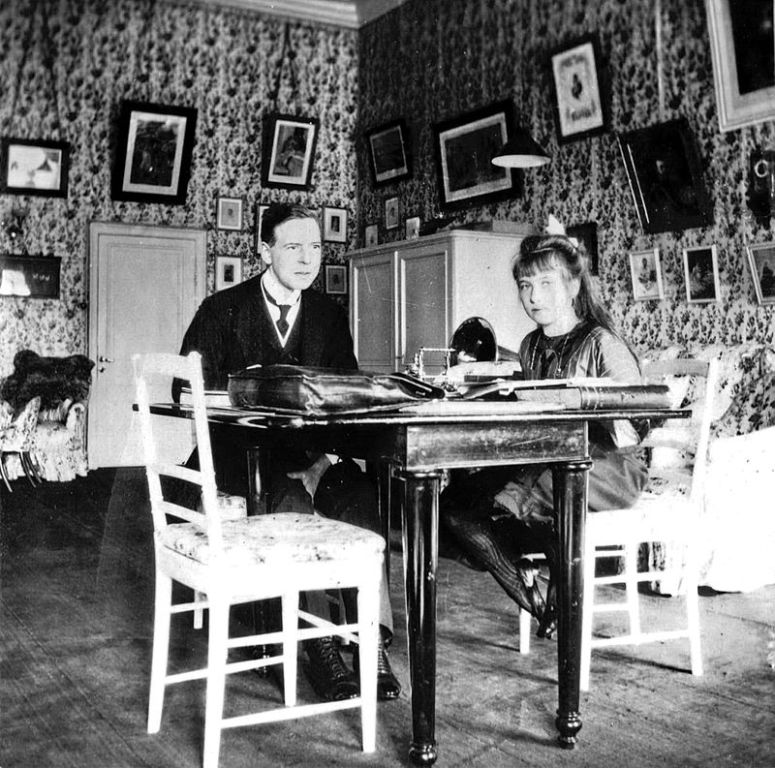
Charles Sydney Gibbes – tutor to the Imperial Children, including Grand Duchess Anastasia Nikolaevna
It was in April 1928, when Charles Sydney Gibbes heard from a friendly journalist about a woman taken very seriously in America as Grand Duchess Anastasia Nikolaevna, the youngest daughter of the late Tsar, and even by some members of the Imperial Family. In December 1928, Gibbes wrote from Oxford to Grand Duke Alexander Mikhailovich in Paris, about his impressions of the claimant:
“In my opinion, there is, unfortunately, no room for doubt that the Grand Duchess Anastasia perished at Ekaterinburg at the same time as the Emperor, the Empress, the Tsarevich, and her three sisters, the Grand Duchesses Olga, Tatiana, and Marie, with Mlle Demidova, and the rest. This fact, of itself, disposes of the claim now made by Mme Tchaikovsky [Anna Anderson]. Additional facts of refutation are now wanting, but the essential point is found in the sad fact of the Grand Duchess’s death . . .
“As soon as the way was open, after the retreat of the Bolshevik Government, I hastened to Ekaterinburg. Nothing beyond vague rumour, however, could be learned. It was not until the following summer, 1919, when a full investigation was made by Mr Sokolov, that the extent and horror of the tragedy was learnt. I visited the clearing in the forest outside Ekaterinburg and saw what had been recovered. Months of toil were involved in pumping out and washing the contents of the deep mine shaft into which the remains from the bonfire had been thrown . . . All who actually took part in the investigation and inspected the remains were obliged to abandon hope that anyone had survived.
“Only a few, of course, were able to form an opinion under these conditions which presented all the facts of the case. There were, however, plenty of interested persons who had nothing but rumour and garbled accounts to build upon. Among these the most extraordinary tales were circulated. Various Pretenders actually appeared while I was still in Siberia. Not being obsessed by any great faith in themselves, these people’s courage quickly failed and they were easily confuted and exposed.
“The first legends concerning the Imperial children were in circulation as early as 1917 while we were still all living together in Tobolsk. At the end of that year the Daily Graphic printed a fantastic paragraph stating that the Grand Duchess Tatiana, one of the Tsar’s daughters, had gone to America, etc., etc.; she was then actually sitting with me in a drawing-room in Tobolsk reading the news of herself. If such things happened in creditable newspapers in 1917, while they were still alive, what could not happen with credulous people after they were dead?
“I have not had the advantage of seeing Mme Tchaikovsky in person but her photographs failed to invoke in me the slightest belief in her story, however much I wish that it were true. The evidence supplied by Mons. Bischoff is one of irrefutable force to anyone who has intimately known the Grand Duchess Anastasia Nikolaevna. There is one point, however, in which I can speak with paramount knowledge and authority. Mme Tchaikovsky has affirmed that I limp. Had I been dead, it might have been difficult to prove, but being yet alive and happily in full possession of both my legs, I am able to demonstrate that I limp only in the imagination of Mme Tchaikovsky.”
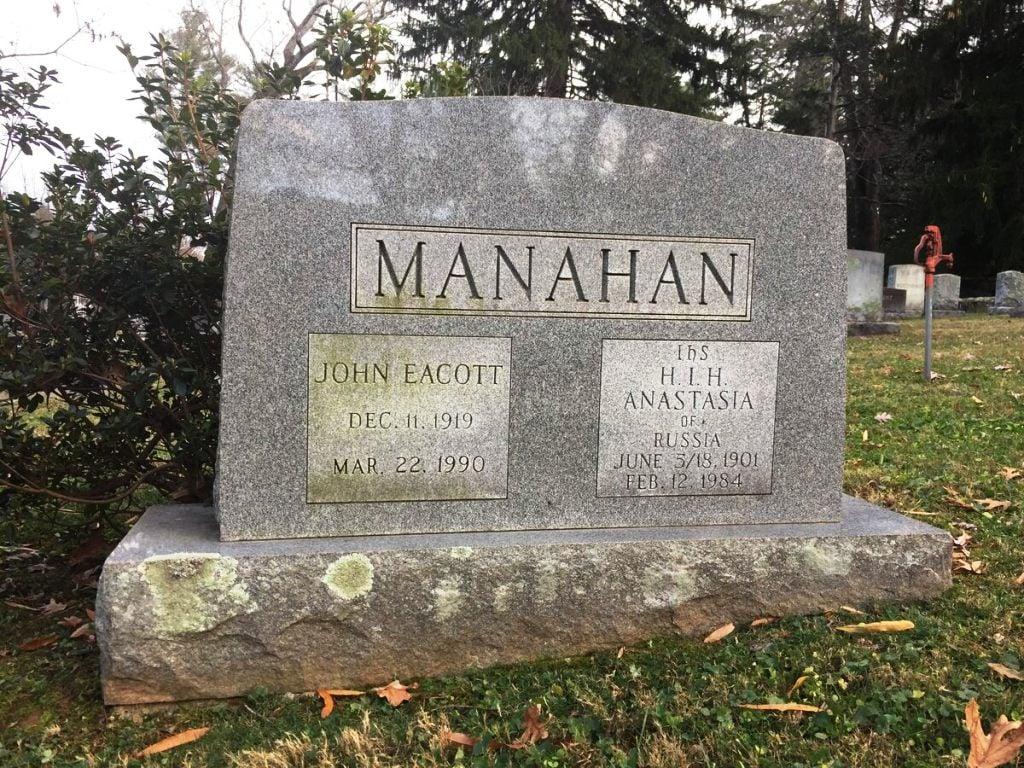
PHOTO: Anna Anderson was cremated on 12th February 1984, and her ashes were buried in the churchyard at Castle Seeon in Bavaria, Germany on 18th June 1984. Her husband John Eacott Manahan died on 22nd March 1990, and was buried with his wife. Note that Anna Anderson’s tombstone reads “H.I.H. Anastasia of Russia”.
For the record . . .
Emperor Nicholas II, his wife Empress Alexandra Feodorovna, their four daughters Grand Duchesses Olga, Tatiana, Maria, Anastasia Nikolaevna, and their only son and heir to the Russian throne Tsesarevich and Grand Duke Alexei Nikolaevich were ALL brutally murdered by the Bolsheviks in the basement of the Ipatiev House in Ekaterinburg on 17th July 1918.
There were NO survivors! There were NEVER any sons and daughters born to any member of the Imperial Family, let alone any grandchildren. Surely, it is time to let these Holy Martyrs rest in peace.
I am committed to clearing the name of Russia’s much slandered Tsar. In exchange for this 18-page booklet, please consider making a small $5 or $10 donation in aid of my research. These donations are of great assistance in helping me offset the cost of obtaining and translating documents from Russian archival sources, which are often paid for out of my own pocket. It is these documents which help present new facts and information on the life and reign of Nicholas II. In addition, my research continues to debunking many of the myths and lies which exist more than a century after his death and martyrdom.
Please note, that there is NO obligation, thank you for your consideration!
PHOTO: Grand Duchess Olga Alexandrovna standing in front of her works at a charity exhibition, held in her palace on Artilleriyskaya str. 46-48 [renamed Tchaikovsky st., in 1923] in St. Petersburg. Photographer: I. N. Alexandrov. (1914).]
On 16th November 2023, a collection of 180 watercolours by Grand Duchess Olga Alexandrovna (1882-1960) have been donated to the Russian State Museum in St. Petersburg. The donation was made possible thanks to the St. Catherine’s Charitable Foundation and the Ministry of Culture of the Russian Federation.
The collection of 180 works were in the possession of Olga Nikolaevna Kulikovsky-Romanov (1926-2020), the third wife of Grand Duchess Olga’s eldest son, Tikhon Nicholaevich Kulikovsky (1917-1993). Upon the grand duchess’s death in 1960, a large number of her watercolours were acquisitioned by Tikhon. When Tikhon died in 1993, his wife Olga Kulikovsky decorated her Toronto apartment with the watercolours. [*I visited Mrs Kulikovsky;s apartment on several occasions in the 1990s, and bore witness to the vast collection of the grand duchess’s works decorating the walls – PG] During the 1990s, Olga Kulikovsky travelled to Russia, taking the watercolours with her. She toured the country, hosting numerous exhibits of her mother-in-laws paintings to Russians for the first time.
“It’s a miracle that such a collection has returned to Russia,” said the Minister of Culture Olga Lyubimova. “The return of these paintings to their homeland is a unique event. This is an opportunity for the specialists of the Russian Museum to study them. I am sure that these works will decorate the exposition and attract the attention of a variety of audiences: from the scientific community to schoolchildren studying history.” The Minister of Culture thanked the St. Catherine’s Foundation for the wonderful gift.
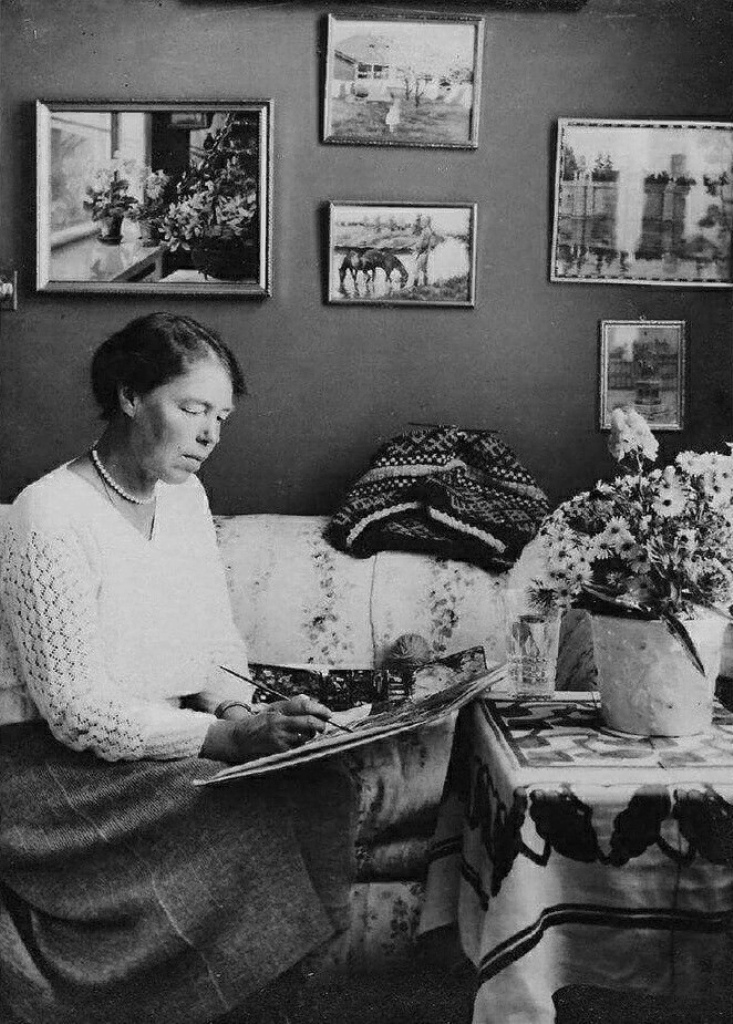
PHOTO: Grand Duchess Olga produced over 2,000 paintings during her lifetime
“This collection is a contribution to the important process of preserving the historical and cultural heritage of our country,” said Alexander Andreev, General Director of the St. Catherine’s Charitable Foundation. “We are very pleased that the collection is in Russia, and soon everyone will be able to see these paintings on display in the Russian Museum.”
“We have received a very valuable gift today,” said Alla Manilova, Director of the State State Russian Museum. “Philanthropists play an outstanding role in the life of the museum, and the donation of a collection is always a landmark event. Especially in this case, when the collection of Grand Duchess Olga Alexandrovna, the daughter of Emperor Alexander III and the younger sister of Emperor Nicholas II, is donated to our museum.”
Alexander Andreev also personally thanked Olga Lyubimova and her colleagues for the great work they did together with the foundation to return Grand Duchess Olga Alexandrovna’s works of art to Russia.
During her life, it is known that the youngest sister of Russia’s last Tsar, painted more than 2,000 watercolours during her lifetime – in Russia, Denmark and Canada. Grand Duchess Olga’s works are today in the private collections of HM Queen Elizabeth II, HRH the Duke of Edinburgh, HM King Harald of Norway, the Ballerup Museum, Denmark, and private collections in the United States, Canada, and Europe. The Russian State Museum’s collection, however, is now the largest in the world.
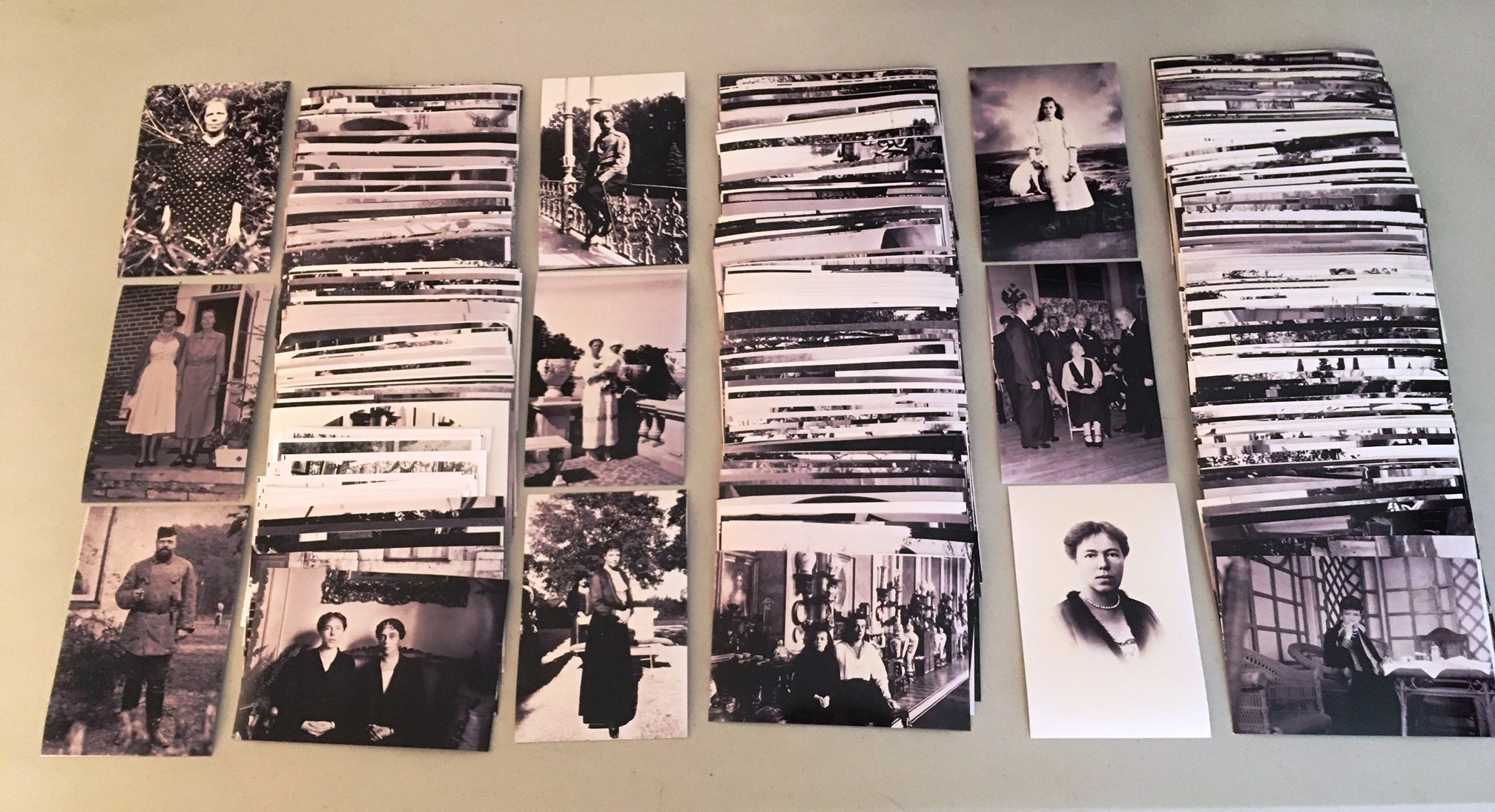
PHOTO: a collection of 332 black and white photographs from one of the private photo albums belonging to Grand Duchess Olga Alexandrovna are for sale from my collection. CLICK on the image to enlarge – PG
As many of you know, I will be moving back to England in the summer of 2025. As a result, I am forced to sell not only my furniture and other possessions, I have also made the very difficult decision to part with some of my Romanov treasures.
Back in 1998-99 I went to visit a man living in Rosedale, an historic and very affluent residential area in Toronto, Ontario. I had been invited by historian and author Patricia Phenix, who was researching for her book Olga Romanov: Russia’s Last Grand Duchess [Published in 1999 by Viking-Penguin]. The gentleman had a collection of photographs copied from one of the personal photograph albums belonging to Grand Duchess Olga Alexandrovna [1882-1960]. He was kind enough to show us the photographs, and even agreed to allow us to make copies.
Aside from the original album, ONLY three sets of these photographs exist. We had two sets made – a great expense at time – one for Pat, the other for myself. We returned the original set to the gentleman in Rosedale, who several years later “loaned” them to Olga Kulikovsky-Romanov, who used them for the exhibitions of Grand Duchess Olga’s paintings, which she was organizing in Russia. She never returned the photographs to the gentleman in Rosedale.
The photos depict Grand Duchess Olga and her family in Russia, Denmark and Canada, where she died on 24th November 1960. The photos from her Russian years include her mother Empress Maria Feodorovna, her brothers Tsar Nicholas II and Grand Duke Mikhail Alexandrovich, as well as her sister Grand Duchess Xenia Alexandrovna.
This lot consists of a total of 332 black and white photographs. The quality and clarity of each photo varies from one image to the next. The photographs are copies of those from Olga’s photo album. The fate of the photo album is unknown, but is believed to have been sold at auction.
PLEASE NOTE THAT THIS IS AN AUCTION SALE: I am offering this collection of 332 photos to the highest bidder. I have set the bidding price at $150 USD. I invite those of you who are interested to send me a private e-mail [royalrussia@yahoo.com], stating your highest bid. The winner will be notified by e-mail on Tuesday, 5th September 2023. Payment can be made by credit card or PayPal. All sales are final.
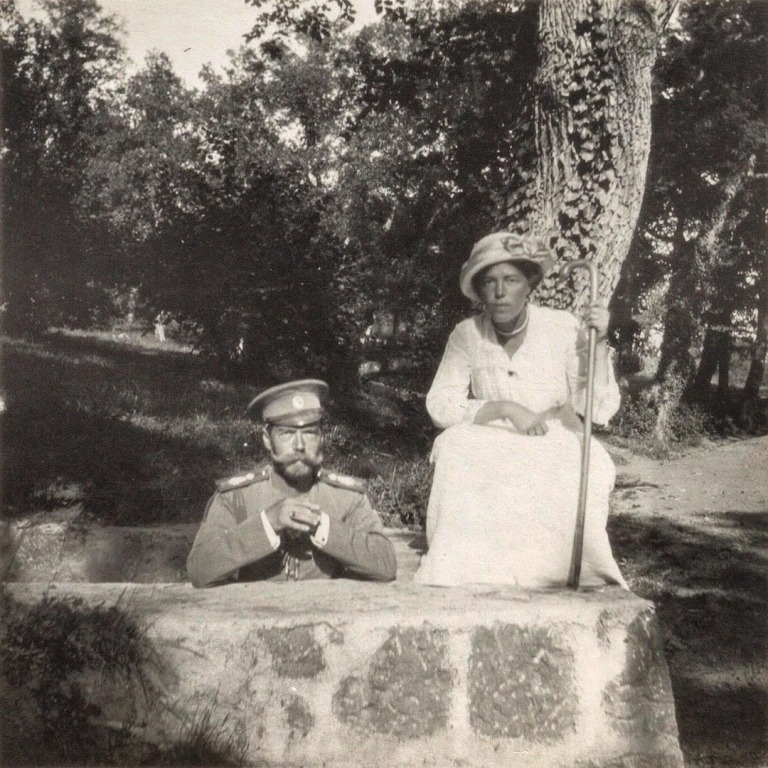
PHOTO: Emperor Nicholas II with his younger sister Grand Duchess Olga Alexandrovna in the lower Massandra Park, Crimea in the Autumn of 1913
On this day – 13 June (O.S. 1 June) 1882, Grand Duchess Olga Alexandrovna was born in the Cottage Palace, situated in the Alexandria Park at Peterhof. Olga was the youngest of six children born to Emperor Alexander III and the Empress Marie Feodorovna. Growing up, she spent much of her childhood in the family’s 900 room palace at Gatchina, 40 miles (63 km) outside of St. Petersburg. Her father had been in power a little over a year when she was born, having succeeded his father Alexander II, who had been assassinated while travelling along the Catherine Canal on 13 March (1 March OS), 1881. His assassins were brought to trial and hung for their vicious crime.
Olga and her siblings, Nicholas (the future Emperor Nicholas II), born 1868; George, born 1871; Xenia, born 1875; and Michael “Misha,” born 1878, did not attend school, but were taught Russian and other languages [they were fluent in English, French and Danish], literature, mathematics, history, and art by various tutors within the confines of the palace. One other brother, Alexander, born in 1869, died in infancy. They had an English governess, Elizabeth “Nana” Franklin, whom Olga adored.
THE RUSSIAN YEARS
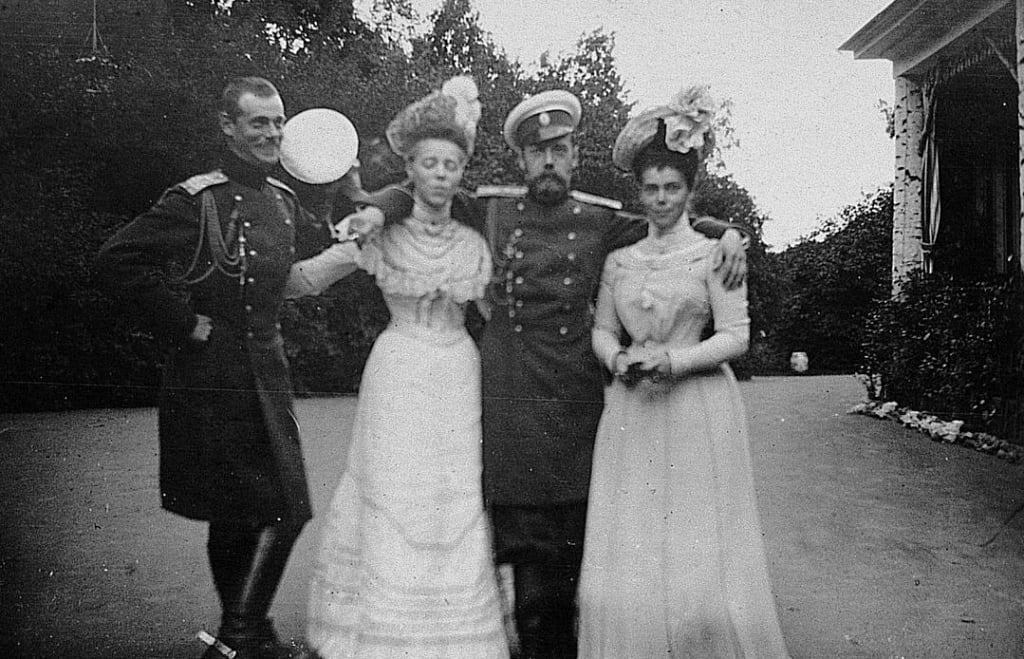
PHOTO: Olga with her siblings: from left to right: Grand Duke Mikhail Alexandrovich, Grand Duchess Olga Alexandrovna, Emperor Nicholas II and Grand Duchess Xenia Alexandrovna. Year unknown
Olga considered her childhood years growing up at Gatchina as the happiest time of her life. She took a great interest in playing the violin and painting. Unlike many royal children, Olga and her siblings lived a modest, spartan life in which the strictest of discipline was required by their tutors, governesses, and parents. They slept on firm beds with hard, flat pillows and very narrow mattresses. A modest rug covered the floor. Straight-backed wicker chairs, the most ordinary of tables and bookshelves, needlework and toys, made up the only furnishings. A single precious object sat in one corner of their rooms: a silver-framed icon of the Blessed Mother of God, studded with pearls and other precious stones. Of all her siblings, she was closest to Michael or “Misha” as she preferred to call him. They spent hours running and playing from room to room and through the vast halls of the palace lined with priceless vases.
It is generally believed that Olga had a strained and distant relationship with her mother for most of her life. On the other hand, she was very close to her father. They enjoyed their time together, taking walks and playing games in the vast Gatchina park, and sharing secrets. Olga was only 12 years old, when her father died suddenly in 1894. His death left the young grand duchess grief stricken, but she kept his memory alive by not forgetting what he had taught her: the simple way in which he preferred to life, care and respect for others, and appreciation for the natural beauty around her. Olga has been described as being indifferent to both dazzling jewellery and the strict etiquette that were symbolic of the Russian Court.
In August of 1901, she married Duke Peter Alexandrovich of Oldenburg. Two years later, she attended a review of her brother Michael’s regiment at nearby Pavlovsk. It was there that she first set eyes on “God Apollo” as his fellow junior officers called him. Colonel Nikolai Kulikovsky, age 22, was a close friend of Michael’s and she persuaded her brother to seat her next to Nikolai during lunch, which he did. Before the meal was over Olga was in love. Soon after, Olga wanted to divorce Peter and marry Nikolai, but neither her husband, Peter, or her brother, Nicholas II would permit it. However, the marriage remained unconsummated, both Olga and Peter were unhappy, their marriage was finally officially annulled by the Emperor in 1916.
On 14 November 1916, she married Nikolai Kulikovsky in the Church of St. Nicholas in Kiev. As a result of marrying a commoner, Grand Duchess Olga’s descendants from her marriage to Nikolai were excluded from succession to the Russian throne.
The following year, the political atmosphere went from bad to worse in Russia and her brother abdicated on 2 March 1917. On 12 August 1917, Olga and Nikolai’s first child, a son, Tikhon, was born.
Less than a year later, on 17 July 1918, her brother, Nicholas and his family were brutally murdered by the Bolsheviks in the Ipatiev House at Ekaterinburg and the Romanov dynasty came to an end. The new regime headed by Vladimir Lenin placed a bounty on the heads of any surviving members of the Romanov family. Olga and Nikolai had to flee Russia shortly after their second son, Guri, was born on 23 April 1919.
IN EXILE
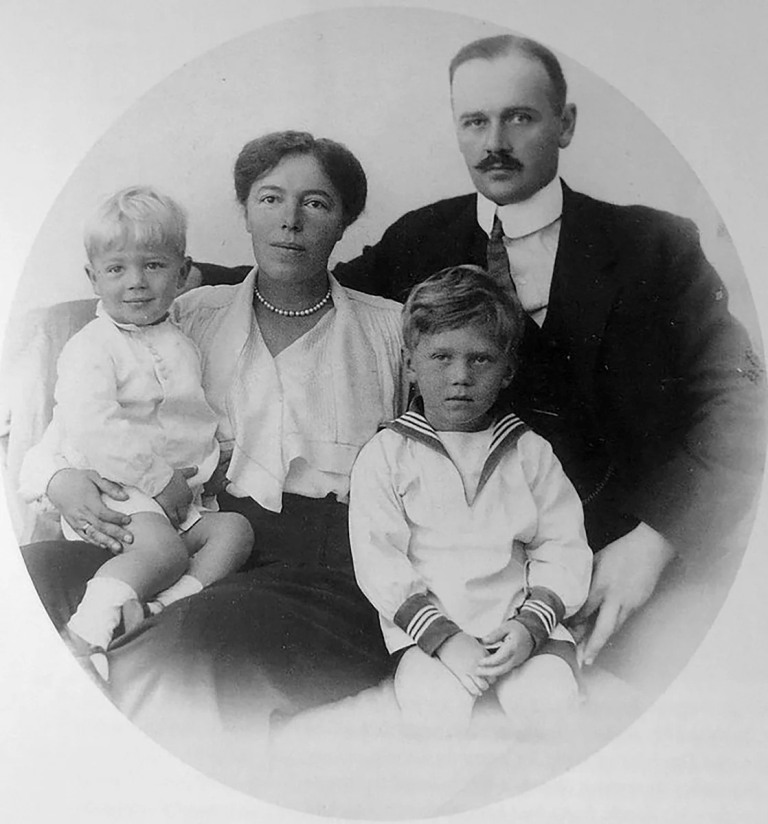
PHOTO: Grand Duchess Olga, her husband, Nikolai Kulikovsky, and their two sons, Guri (left) and Tikhon (right)
In 1920 they travelled by train to Novorossiysk and took shelter in the Danish Consulate. A month later, they went by ship to Dardanelles, a barge to the Island of Prinkipo, then on to Constantinople and Belgrade, where they met Regent Alexander Karageorgevich [later King Alexander I of Yugoslavia]. Her mother and sister, Xenia, went on a British ship to Malta and then on to England, where cousin King George V provided them with assistance. He was very supportive to Olga and her family during their exile in Denmark. In 1919, Dowager Empress Maria Feodorovna took up residence at her summer villa, Hvidore, in Denmark. Olga was reunited with her mother on Good Friday, in the Amalienburg Palace in Copenhagen. Olga, Nikolai, and their two sons then went to live at Hvidore. Her mother, the last living Empress of all the Russias, passed away on 13 October 1928. After the death of her mother, the royal estate of Hvidore was sold and the Grand Duchess and her family were able to purchase with her portion of the inheritance Knudsminde Farm, situated several miles outside of Copenhagen, Denmark.
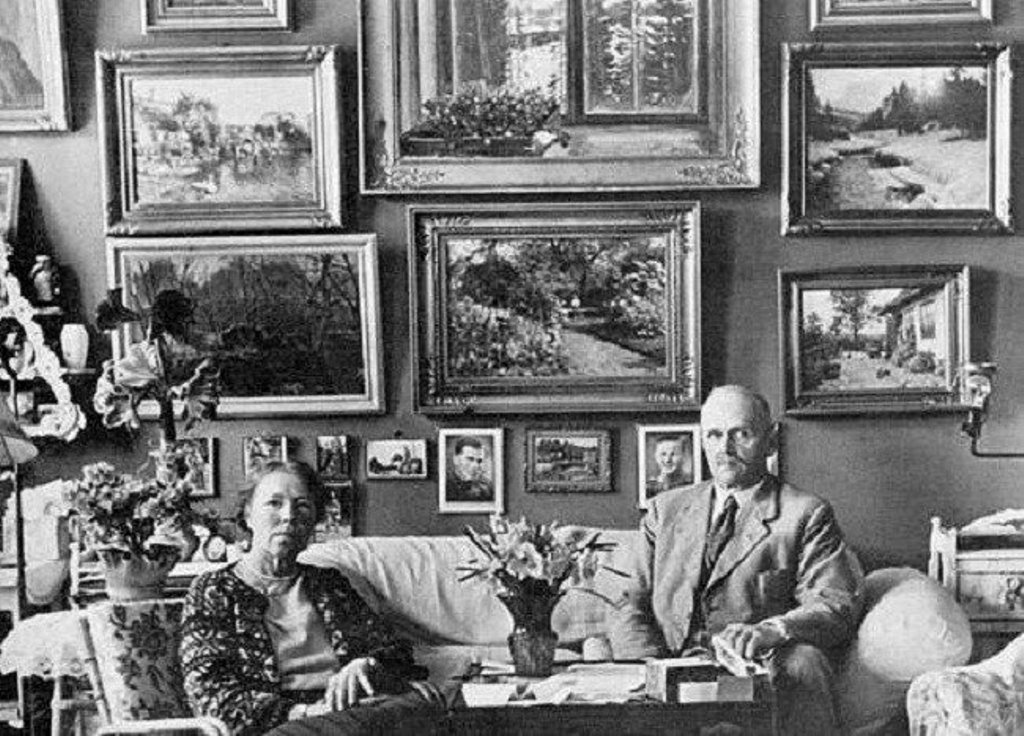
PHOTO: Olga and Nikolai at their home in Knudsminde, Denmark in the 1930s. The wall behind them is covered with some of the grand duchess’s watercolours
Europe once again became a battlefield during World War II (1939-1945). Son Guri was married in May, 1940, and Tikhon in April 1942. When Denmark was liberated on 5 May 1945, Olga and her family could not return to their homeland as they would most certainly be arrested and executed. Following World War II, Stalin’s propaganda machine declared that Grand Duchess Olga had conspired with Germany against Russia during the war. In 1948, King Frederik IX could no longer guarantee their safety and Olga faced exile for the second time in her 66 years.
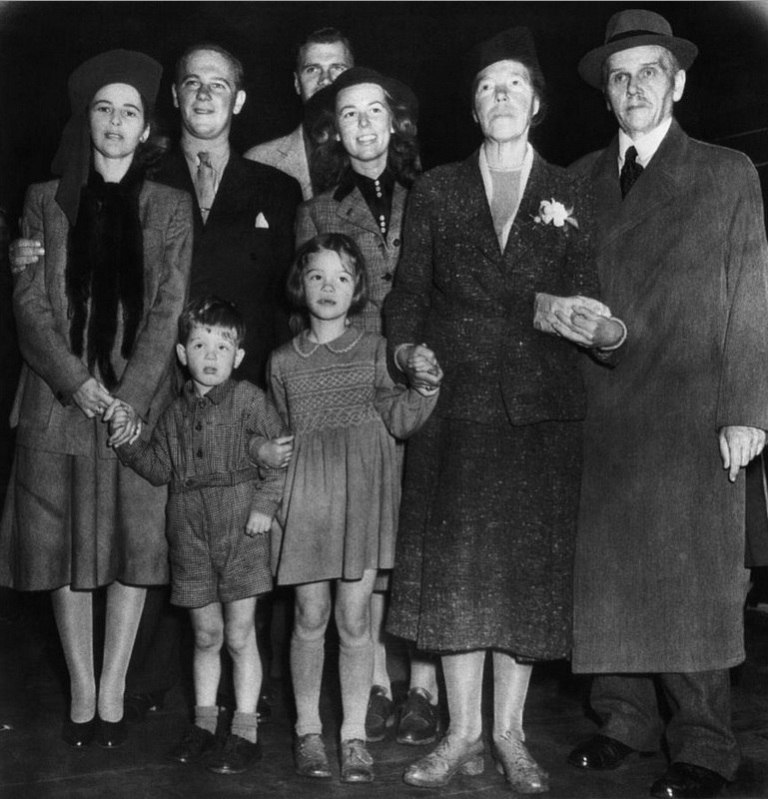
Her second cousin King George VI enquired about their finding asylum in Canada. Arrangements were made through A.H. Creighton, president of the Canadian Pacific Railway and District Superintendant of the Department of Immigration and Agriculture Development, for relocation to Canada. The Agent General for Ontario, Canada, J.S. Armstrong, stationed in England, handled the arrangements for the departure of the Russian Grand Duchess and her family to depart for the safety of rural Canada. In May 1948, the Kulikovskys travelled to London by Danish troopship. They were housed in a “grace and favour” apartment at Hampton Court Palace while arrangements were made for their journey to Canada as agricultural immigrants. On 2 June 1948, Olga, Nikolai, Tikhon and his Danish-born wife Agnete, Guri and his Danish-born wife Ruth, Guri and Ruth’s two children, Xenia and Leonid, and Olga’s devoted companion and former maid Emilia Tenso (“Mimka”) departed Liverpool for Canada on board the Empress of Canada. of eight to sail on the Empress of Canada, for their new adopted homeland.
THE CANADIAN YEARS
PHOTO: the Kulikovskys’ in England, just prior to sailing to Canada in 1948
They arrived in Montreal on 10 June, and took a train to Union Station in Toronto. Their first night in Toronto was spent in a massive suite in the Royal York Hotel, but after two days Olga felt uncomfortable in such opulent accommodations and accepted an offer to stay with a local Russian family in their home. The Evening Telegram headline read: “Sister of Last of the Czars Arrives in Ontario to Farm.” Creighton found them a 100 acre (40 ha) farm in Campbellville with a 10 room, two and a half storey red brick house for $14,000. They settled in with their sons, daughters-in-law, Agnete and Ruth, grandchildren, Leonid and Xenia, and 81 year old companion Mimka. With them were trunks filled with furniture, clothes, paintings, Faberge pieces and picture frames, her mother’s traveling case and many other family mementos, not to mention Olga’s jewels that Mimka had managed to smuggle out of their house in Kiev and kept secure all those years.
After they were settled, Olga and her family became active members of the Toronto parish of the Russian Orthodox Church. They attended services at the Christ the Saviour Cathedral, which was then located at 4 Glen Morris Street [the cathedral moved to its present location at 823 Manning Avenue in the summer of 1966]. Together, Olga and Nikolai took a great interest in the well-being of both the church and its parish.
Olga’s portrait hangs in the Cathedral, today, and her works as an artist embellish the beautiful interior iconostasis. She had created icons for the second level of iconostasis as well as the image of the Mother of God for the ancient (16th century) Greek “passage”, which was donated to the church by the management of Royal Ontario Museum. It was installed in the church on the right side from the altar (near the holy water tank). The main quality of Olga Alexandrovna was her attitude towards the people around her. Her unselfish kindness for everyone she met, her openness and welcoming heart were to leave a deep imprint in the memory of the parishioners of Christ the Saviour Cathedral. After her death in 1960, the parish school was named in her honour.
PHOTO: Grand Duchess Olga produced over 2,000 paintings during her lifetime
Olga, who had painted since residing in Denmark in the 1930s, began to paint still life and landscapes in watercolours. In October 1951, she had a showing at the Eaton’s Art Gallery, in Toronto, where her son, Tikhon was employed. She produced over 2,000 paintings in her lifetime. The sale of her paintings provided a source of income for her and her family. Works by Grand Duchess Olga are today in the private collections of HM Queen Elizabeth II, HRH the Duke of Edinburgh, HM King Harald of Norway, the Ballerup Museum, Denmark, and private collections in the United States, Canada, and Europe. Her paintings are highly sought after by collectors, each one fetching a hefty sum at auction.
By the end of 1951, Nikolai’s health was failing and he could no longer manage the work the farm entailed. So they sold the farm to Wolfgang von Richthofen, a relative of the WWI German flying ace, the Red Baron. They moved to 2130 Camilla Road in Cooksville, a suburb of Toronto [now amalgamated into the city of Mississauga] in 1952. Neighbours and visitors to the region took interest in the rumours of the last surviving Romanov grand duchess living in Canada, and visited her often.
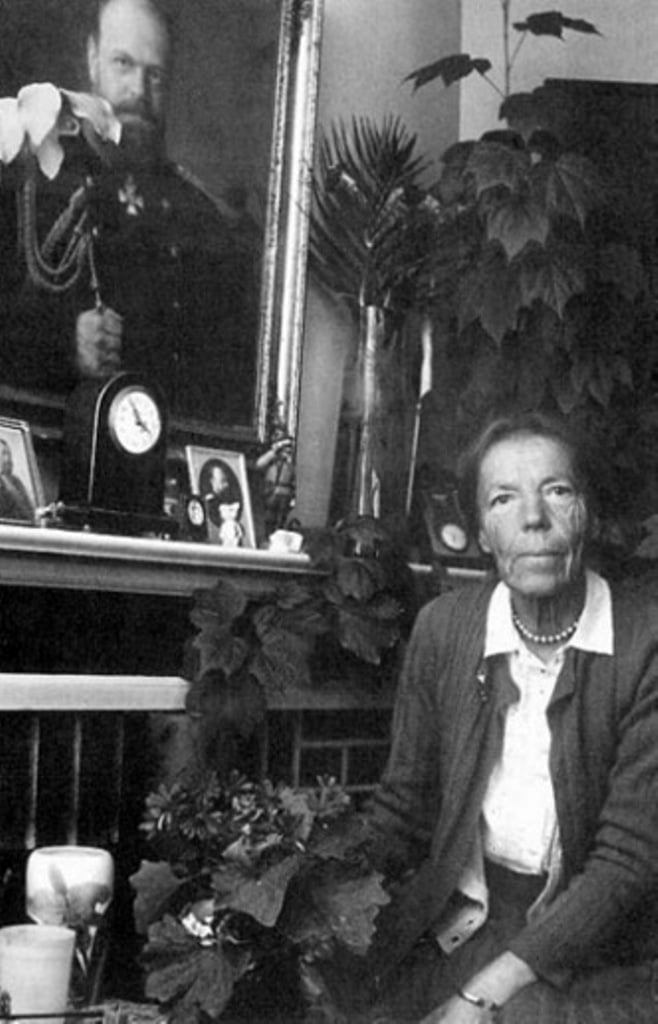
PHOTO: Grand Duchess Olga Alexandrovna poses in front of a portrait of her father Emperor Alexander III, which hung in her modest home on Camilla Road in Cooksville, Ontario, Canada
Their home was situated a half a mile (0.8 km) north of the thoroughfare named for King George’s wife, Elizabeth, the Queen Elizabeth Way (QEW). The Grand Duchess became good friends with Colonel Thomas Kennedy and it has been said that he took good care of her during her later years. In 1954, when Olga’s cousin Princess Marina of Kent [the daughter of Grand Duchess Elena Vladimirovna of Russia] came to visit, Camilla, a gravel road at the time, was paved from the QEW to Olga’s driveway for the royal visitor’s black limousine, which caused quite a stir in the neighbourhood. No doubt a lovely gesture from the Colonel.
Princess Marina of Kent was not the only royal who visited Grand Duchess Olga at her Cooksville home. Other royal guests included Princess Tatiana Konstantinovna of Russia, His Highness Prince Vassily Alexandrovich, Louis Mountbatten, 1st Earl Mountbatten of Burma, and his wife, Edwina Mountbatten, and Countess Mountbatten of Burma.
Grand Duchess Olga kept in touch with the Russian émigrés to the end of her life. Members of her old Akhtyrsky Hussar Regiment [she had been appointed honourary Commander-in-Chief of the 12th Akhtyrsky Hussar Regiment in 1901]. were now scattered all over the world, but she had not forgotten them. She had a remarkable memory and remembered many of the officers and men not only by their name and surname. In 1951, former officers and members of the famed Akhtyrsky Regiment gathered at her home to celebrate the 300th anniversary of the founding of the Royal Regiment. Thereafter, she became the patroness of the Association of Russian Cadets of Toronto.
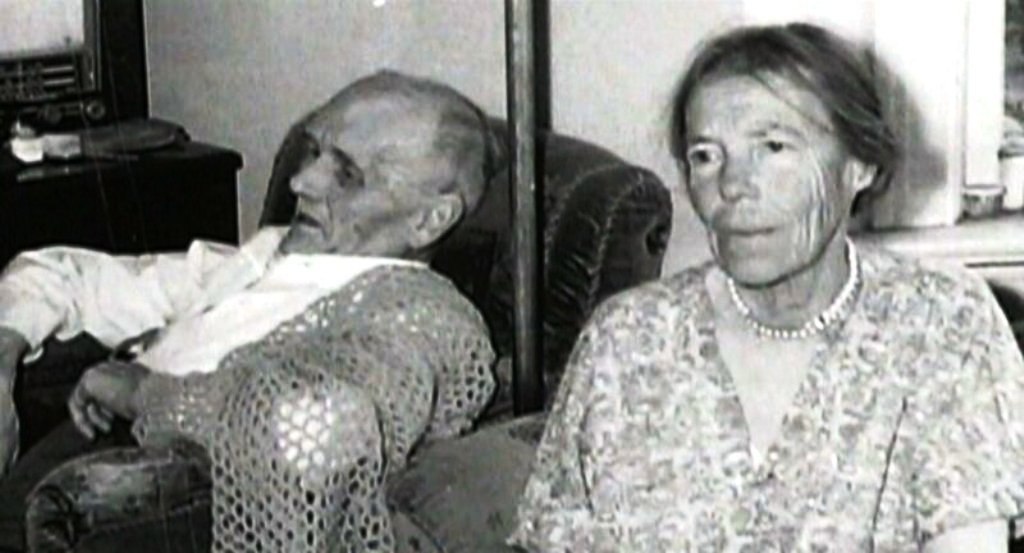
PHOTO: the last known photograph of Olga and Nikolai before his death in 1958. Olga outlived her husband by a little more than two years
By 1958, Nikolai was virtually paralysed, and on the morning of August 11, 1958, Olga woke to find that he had died in his sleep.
Prince Alexis Troubetzkoy spent the summer of 1959 in Hamilton, Ontario, where he had been commissioned as an officer with the Royal Canadian Navy (Reserve). He telephoned the Grand Duchess who graciously invited him to tea one Saturday afternoon. For days, he was nervous about meeting the youngest daughter of Emperor Alexander III. When he arrived at her home, he walked up the driveway to her modest bungalow, grasping a bouquet of roses with perspiring hands. Nervously, he knocked on the door and was greeted by “a little old lady dressed in a scruffy, unpretentious dress”, whom he assumed was the maid.
“Is the Grand Duchess at home?” he asked in Russian. “And what do you want with the Grand Duchess?” came the woman’s reply. “Well, I have an appointment with her” he said, now somewhat irritated. “Well”, said the woman gravely, looking at him with feigned suspicion, “I don’t know. . .”. She paused, flashed a warm smile, and threw her arms around him, exclaiming with delight, “I am she!”
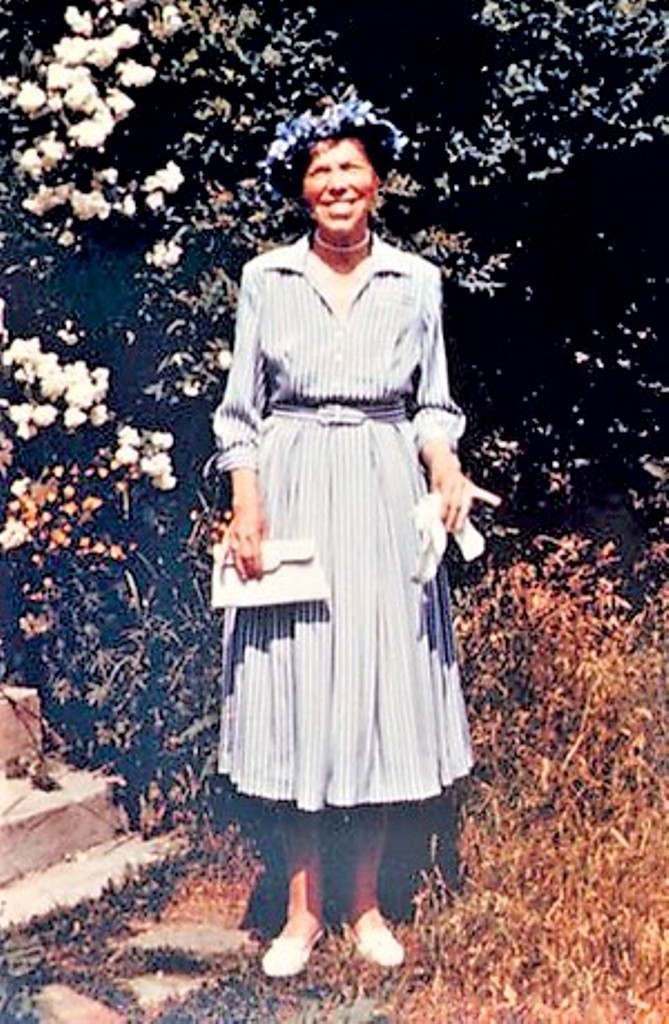
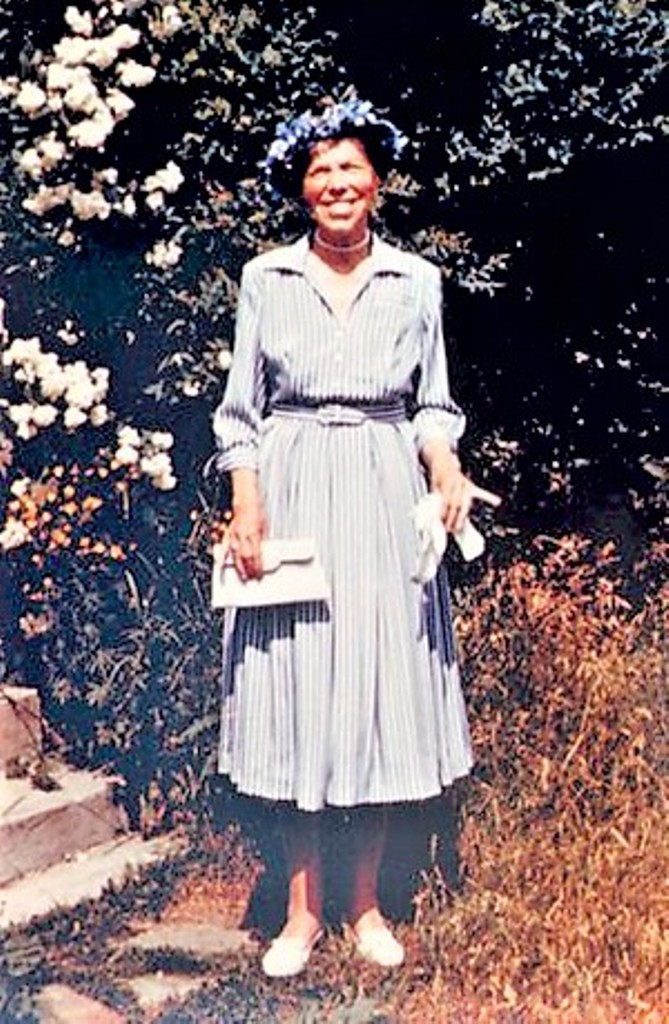
PHOTO: Grand Duchess Olga Alexandrovna, wearing the plain blue and white cotton dress and little blue straw hat, which she picked out specially for Queen Elizabeth II’s luncheon on the Royal Yacht Britannia, in June 1959
Prince Troubetzkoy visited the Grand Duchess several times that summer. It was during this time that the St. Lawrence Seaway was officially opened. The Royal Yacht Britannia brought Queen Elizabeth II and Prince Phillip to Canada. Olga, along with Tikhon were invited to a private luncheon on board the Britannia, which was docked in the Toronto Harbour. Olga was King George V’s first cousin, and thus a cousin to both Elizabeth, and her sister, Margaret. She knew both sisters well when they were small children.
The following day, Prince Troubetzkoy called on the Grand Duchess to find out how things went and what her impressions of the royal luncheon were.
“Ah”, she said, “it was a cozy evening, and it was great fun to have seen Elizabeth once again, after these many, many years”. Eyes glistening and bubbling with excitement, the Grand Duchess went on to tell the details of the evening and to give impressions of the now grown-up Elizabeth. She spoke of the two sisters as small girls and she carried vivid memories of them, one of whom she found “considerably less serious and playful” and the other “pensive and perhaps a bit less warm”. The Grand Duchess commented on a table which stood in one of the salons; it was taken from the Russian Imperial Yacht Standart and presented to King George V for the Royal Yacht. She remembered it.
What impressed Prince Troubetzkoy most of all was that Grand Duchess Olga had not been forgotten by the Queen. At the time of the Revolution, Olga together with her mother, the Dowager Empress, and sister, Xenia, found themselves safe in Denmark. The Empress died there in 1928 and Xenia settled in England at Hampton Court, living under the protection of King George V in a “grace and favour” residence. Olga’s life, however, evolved considerably less comfortably. She was married to a commoner and the couple made their way to Canada to begin life afresh as farmers. At the time of Prince Troubetzkoy’s visits, Olga was already a widow. In the years that lapsed between her visits with the child Elizabeth, no substantive contact had been maintained between the Court and the exiled Grand Duchess. But, despite the many years which had lapsed, it was family once more.
Grace Fraser Hancock also remembers Grand Duchess Olga. In 2004, she recalls, “I met Grand Duchess Olga shortly after she moved across the street from us in Cooksville. She was a very proud lady. I remember that she hated hats, and the year she was going to visit Queen Elizabeth and Prince Philip, she had to buy a hat. So I took her to Dixie Plaza and we bought a pale blue hat. When she got home, she told me that as she was leaving the royal yacht, she tossed her hat into the lake. She always wore pearls. She said that you had to wear them all the time because the pearls absorbed the oil from your skin and gave them a lustre. She took in stray dogs and always took them for walks and she wore rubber boots without socks and her feet used to get blue, so I bought her a pair of workmen’s socks to wear.”
DEATH & LEGACY
PHOTO: one of the last photographs of Grand Duchess Olga, with her biographer Ian Vorres (1924-2015) – The Last Grand Duchess: Her Imperial Highness Grand Duchess Olga Alexandrovna (1964)
Grand Duchess Olga became ill in 1960 and was diagnosed with cancer. After a brief stay in the Toronto General Hospital, she was taken in by her friends, Colonel Konstantin and Galina Martemianoff, who lived at 716 Gerrard Street in Toronto’s east end. Grace Fraser Hancock recalls, “I had heard that she was ill, so my friend Erma Large and I drove into Toronto to see her. She was living over a hairdressing salon. The lady she was staying with took us upstairs and she was lying on a small cot and she was very frail. We sat and talked to her for awhile and left.” Grand Duchess Olga died on 24 November 1960, in the tiny room of the Martemianoffs’ second floor flat with a picture of her husband by her side. This scenario gave rise to the rumour that Olga died penniless, but such was not the case.
VIDEO: click on the image above to watch a newsreel of Grand Duchess Olga Alexandrovna’s funeral in Toronto – duration: 45 seconds
On 30 November Grand Duchess Olga lay in state in Christ the Saviour Cathedral in Toronto. The Union Jack and Russian imperial standard hung from each corner of the platform where the coffin sat. Her funeral was attended by more than 500 mourners. Wreaths were sent by King Frederik IX and Queen Ingrid of Denmark, King Olav V of Norway and Queen Elizabeth II of Great Britain; imperial guardsmen from the 12th Hussars Ahtyrsky Regiment were the pallbearers. She was buried next to her husband Nikolai, in the Russian Section of York Cemetery. The Grand Duchess’ friend, Bishop John of San Francisco, sprinkled Russian earth on her grave. The Grand Duchess was the soul and the heart of the Toronto parish, and her death in 1960 created a void within the Russian community, leaving none of the parishioners untouched and felt by many as a personal tragedy.
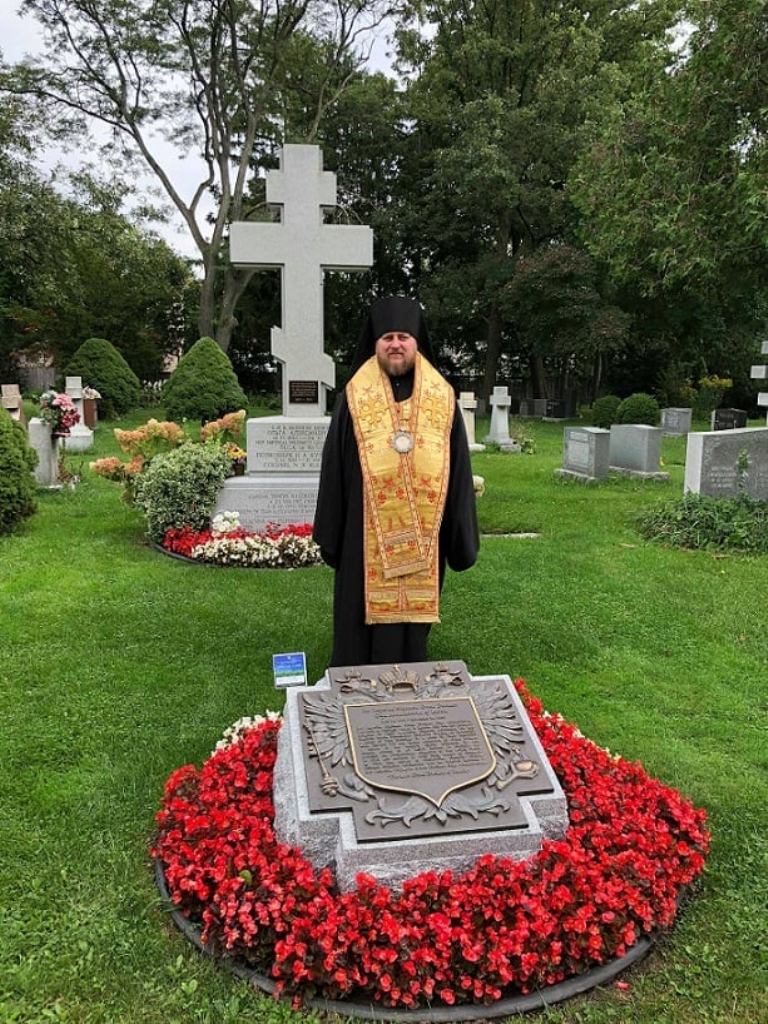
PHOTO: The final resting place of Grand Duchess Olga Alexandrovna in York Cemetery, Toronto, Canada
After her death, her sons closed down her house on Camilla Road and sold it and all her possessions that she treasured from her days in Russia. Her estate was estimated to be worth around $200,000. The combined worth of the items that Olga managed to smuggle out of Russia in today’s dollars would have been estimated at more than $1.2 million. Guri died in 1984 and Tikhon in 1993.
A bronze plaque was unveiled on August 25, 1996, at her grave site in York Cemetery, in Toronto, in dedication of her memory, while more than 200 family members, friends and newsmen looked on. It is interesting to note, that Mimka, Olga’s devoted companion and former maid is buried in a simple grave nearby.
PHOTO: Olga Alexandrovna – the last Gand Duchess of Russia
During her life in exile, Grand Duchess Olga never lived with any delusions of grandeur or dreams of a Romanov return to power. She lived a remarkable life, enduring more than her share of personal heartaches. She experienced an attempted assassination of her brother Nicholas in 1891, the death of her dear father in 1894, the death of her brother George in 1899, a war between Russia and Japan between 1904-1905, adultery in 1906, a nervous breakdown in 1913, the death of her governess also in 1913, separation and divorce in 1916, serving as a nurse in an Army hospital in Kiev during World War I (1914-1918), an attempted assassination on her own life, a Revolution that brought an end not only to her brothers reign as Emperor, but also an end to the monarchy in her beloved homeland, exile from both Russia and Denmark, the murders of both her brother Michael and Nicholas and his entire family in 1918, the death of her mother in 1928, the death of her beloved husband, Nikolai in 1958 and the death of her sister Xenia in April 1960. Her final tragedy was the cancer that took her life eight months later in November 1960. Despite a lifetime of relentless tragedy that followed her during her 78 years, she endured each with noble fortitude. She was once and always, a Grand Duchess of Russia.
***
COMING SOON!
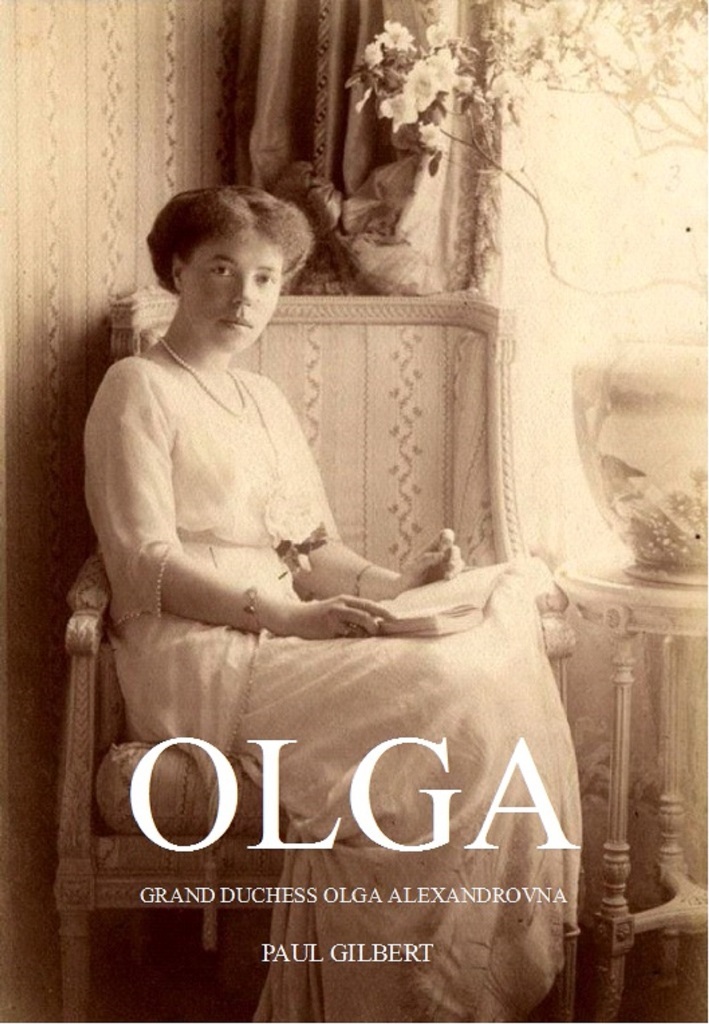
OLGA: GRAND DUCHESS OLGA ALEXANDROVNA
Paperback. 148 pages. Richly illustrated with more than 100 black and white photos
This book is a tribute to one of the most beloved and respected members of the Russian Imperial Family: Grand Duchess Olga Alexandrovna (1882-1960).
The first part explores her Russian, Danish and Canadian years respectively; the second part explores her love of painting – Olga painted more than 2,000 in her life; the third is about her work and dedication as a nurse during WWI; the fourth is an interview with her daughter-in-law Olga Kulikovsky-Romanoff (1926-2020), who shares her husband Tikhon’s anecdotes and details about his mother: the Grand Duchess of Russia.
NOTE: This title will be made available on AMAZON in 2023, publication date yet to be announced.
PHOTO: Grand Duchess Olga Alexandrovna, wearing the plain blue and white cotton dress and little blue straw hat, which she picked out specially for Queen Elizabeth II’s luncheon on the Royal Yacht Britannia, in June 1959
During her years in exile in Canada from1948 to 1960, the youngest sister of Russia’s last tsar Grand Duchess Olga Alexandrovna (1882-1960), maintained contact with European royalty and aristocracy. She dined with earls, countesses, duchesses, and princesses when they visited Canada, and received gifts from Finland, Denmark, and Japan on her name day and at Easter and Christmas.
In the 1950s, Olga lived in in Cooksville, Ontario[1]. Although She lived modestly, her tiny five room house on Camilla Road was the setting for visits from Olga’s British royal relatives. Among those were Princess Marina, Duchess of Kent[2] who visited Olga’s home between her royal engagements during her Canadian tour in August 1954, and Louis and Edwina Mountbatten[3], who on an official tour of Canada in August 1959, flew from Ottawa to see their cousin[4].
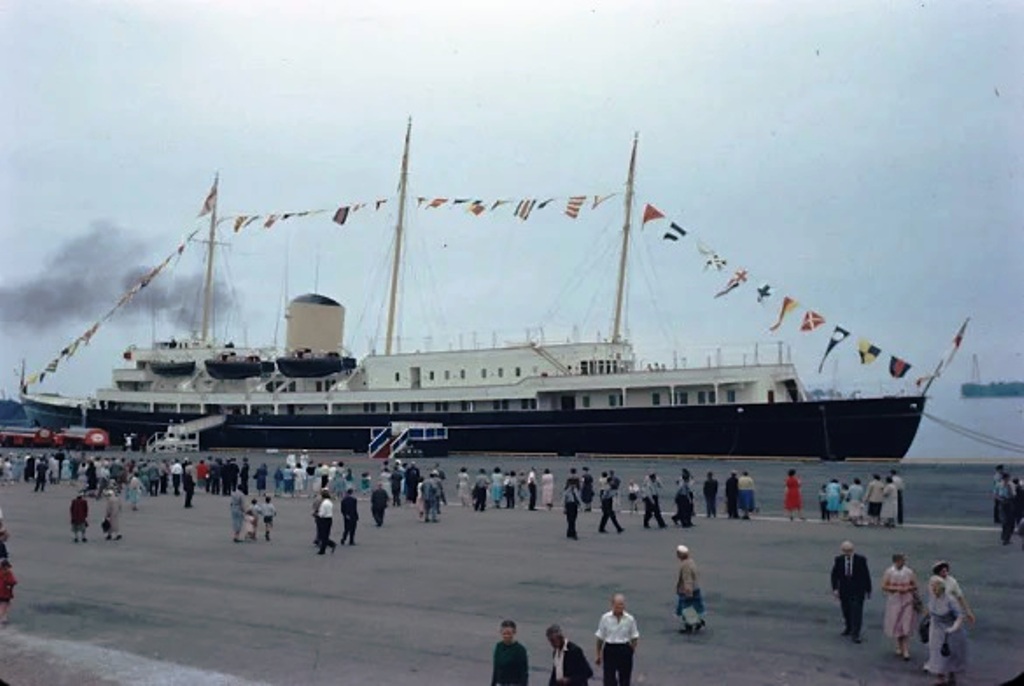
On the morning of 29th June 1959, Queen Elizabeth II and Prince Philip, Duke of Edinburgh sailed into Toronto harbour onboard HMY Britannia as part of their Canadian tour.
During their 2-day visit to Toronto, Her Majesty would be hosting a luncheon on HMY Britannia, and requested the presence of the the now widowed[5] Grand Duchess Olga Alexandrovna – her first cousin twice removed and a first cousin once removed, respectively[6] – and her elder son, Tikhon Kulikovsky [1917-1993].
PHOTO: HMY Britannia docked in Toronto Harbout, 29th June 1959
Olga’s neighbours in Cooksville were much excited about the impending royal visit. Olga complained to her biographer Ian Vorres, “They were at me morning, noon, and night, urging that I should buy a new frock . . .they do not see that I am far too old to start buying new clothes.”[7]
After endless argument and persuasion, Olga agreed to go to a dress shop in Toronto. Once there, however, she insisted on being given full liberty of choice. She picked out a plain blue and white cotton dress for $30 dollars. A friend who accompanied her suggested a little blue straw hat and one of two accessories. As it so happened, the dress was on sale, and Olga, feeling very happy about saving money on the purchase, agreed.
On the day of the luncheon, all of Olga’s neighbours gathered on Camilla Road to see her off that memorable morning. “All this fuss, just to go see Lizzie and Philip!” she said.
Katherine Keiler-Mackay, wife of the Lieutenant Governor of Ontario, Lieutenant Colonel John Keiler-MacKay, had different concerns than Olga’s wardrobe. She told Patricia Phenix that prior to the luncheon, “[Olga] looked nervous . . .We were all afraid the Queen might overlook her and she might be hurt.”[8]
Keiler-Mackay need not have worried. Although there were 50 persons invited, Grand Duchess Olga was personally and warmly welcomed by the Queen, who personally escorted her to the head table.
She enjoyed lunching with the Queen, but we will never know what the royal cousins talked about that day. Was the subject of the failure and betrayal by Elizabeth’s grandfather King George V’s withdrawing asylum to the Imperial Family in 1917 ever brought up? Or the brutal murder of her brother and his family by the Bolsheviks in July 1918? Given the setting and festive mood of the event, it is hardly likely, however, we will never know.
Upon the death of Olga’s sister Grand Duchess Xenia in May 1960, a telegram of condolence was sent to Olga by Queen Elizabeth and Prince Philip. Paintings by Olga are today part of the collections of Queen Elizabeth II and Prince Philip, Duke of Edinburgh.
It is interesting to note, that in later years, Olga recalled her meeting Prince Philip, the future Duke of Edinburgh (1921-2021) during a visit of Queen Olga of Greece, who left her own exile in Italy to see her god-daughter Olga and the Dowager Empress at Hvidore, Denmark. The Greek Queen brought Prince Philip, her six-year-old grandson along. “I remember young Philip as a wide-eyed youngster, with blue eyes sparkling with humour and mischief. Even then, when a mere child, he possessed a mind of his own, though he seemed rather subdued in the presence of my mother. I served him tea and cookies, which vanished in a split second. I could never have imagined then that this lovely child would one day be the consort of the Queen of England.”[9]
NOTES:
[1] Cooksville, Ontario, a suburb of Toronto (now amalgamated into the city of Mississauga). Olga’s house on Camilla Road, has survived to the present day
[2] Princess Marina of Greece and Denmark (1906-1968), later Princess Marina, Duchess of Kent, was a Greek princess by birth and a British princess by marriage. She was a daughter of Prince Nicholas of Greece and Denmark and Grand Duchess Elena Vladimirovna of Russia [both first cousins of Emperor Nicholas II], and a granddaughter of King George I and Queen Olga of Greece. Princess Marina married Prince George, Duke of Kent, fourth son of King George V and Queen Mary, in 1934. They had three children: Prince Edward, Princess Alexandra, and the current Prince Michael of Kent (born 1942).
[3] Louis Francis Albert Victor Nicholas Mountbatten, 1st Earl Mountbatten of Burma (1900-1979). was a maternal uncle of Prince Philip, Duke of Edinburgh, and a second cousin of King George VI.
[4] This would be Grand Duchess Olga’s last royal visit, she died in Toronto the following year on 24th November 1960. She was interred next to her husband, in York Cemetery, Toronto, on 30th November 1960
[5] Nikolai Kulikovsky died on 11th August 1958. When Olga married Nikolai (a commoner) in 1916, she was forced to renounce all rights to the Russian throne as well as those of her descendants.
[6] Grand Duchess Olga Alexandrovna was a cousin of the Queen’s grandfather, King George V.
[7] Vorres, Ian. The Last Grand Duchess, [Charles Scribners and Sons, New York] 1964., pg. 208-209
[8] Phenix, Patricia. Olga Romanov: Russia’s Last Grand Duchess [Penguin Books, Toronto] 1999, p. 239
[9] Vorres, Ian. The Last Grand Duchess, [Charles Scribners and Sons, New York] 1964., pg. 171
I have not offered any new book titles through my AMAZON Bookshop – specializing in books on the life, reign and era of Nicholas II – since April. My cancer diagnosis in April, surgery in May, and chemo treatment since, pretty much brought my work to a grinding halt.
Despite the side effects from the chemo – which on some days leaves me very tired and drained of energy – I am pleased to say, that I am now slowly returning to my writing.
Pending no further health setbacks, I plan on publishing 2 NEW titles in September [with additional titles planned for the remaining months of this year]: one on Grand Duchess Olga Alexandrovna, the other on Anna Vyrubova. Both titles will be available exclusively through AMAZON.
An annoucement will be made here on my blog, my Facebook page, and to those who subscribe to my bi-weekly news updates (by e-mail), when these titles are available.
THANK YOU to all of you who support my work in keeping the memory of the Imperial Family and the history of Imperial Russia alive!
OLGA: GRAND DUCHESS OLGA ALEXANDROVNA Paperback. 148 pages
This book is a tribute to one of the most beloved and respected members of the Russian Imperial Family: Grand Duchess Olga Alexandrovna (1882-1960).
The first part explores her Russian, Danish and Canadian years respectively; the second part explores her love of painting – Olga painted more than 2,000 in her life; the third is about her work and dedication as a nurse during WWI; the fourth is an interview with her daughter-in-law Olga Kulikovsky-Romanoff (1926-2020), who shares her husband Tikhon’s anecdotes and details about his mother: the Grand Duchess of Russia.
Richly illustrated with more than 100 black and white photos
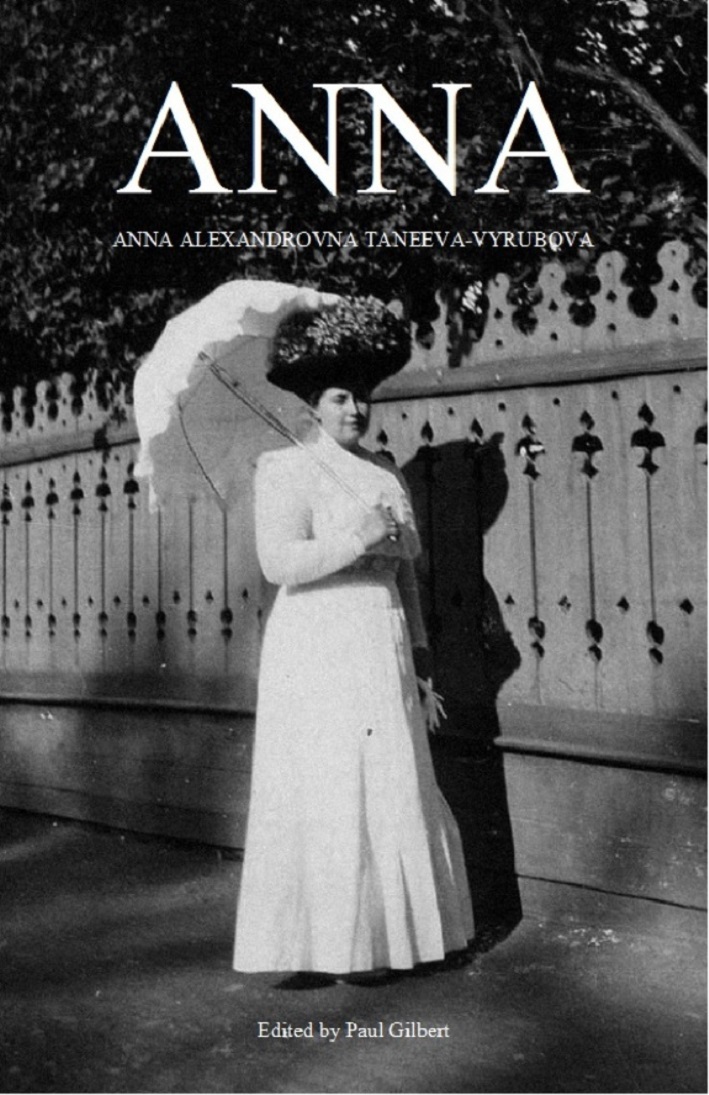
ANNA: ANNA ALEXANDROVNA TANEEVA-VYRUBOVA Paperback. 172 pages
Anna Alexandrovna Vyrubova (née Taneyeva), was born on 16th July 1884. She is most famous as the lady-in-waiting, the best friend and confidante of Empress Alexandra Feodorovna. She also become one of Grigorii Rasputin’s (1869-1916) most influential advocates.
This new book features 7 chapters, including a synopsis of Vyrubova’s memoirs – published in the 1920s; her home in Tsarskoye Selo; an interview with Anna in 1917; her life in exile in Finland; efforts to have her canonized, among others.
Vyrubova died in exile on 20th July 1964, at the age of 80. She was buried in the Orthodox section of Hietaniemi cemetery in Helsinki.
Illustrated with more than 60 black and white photographs
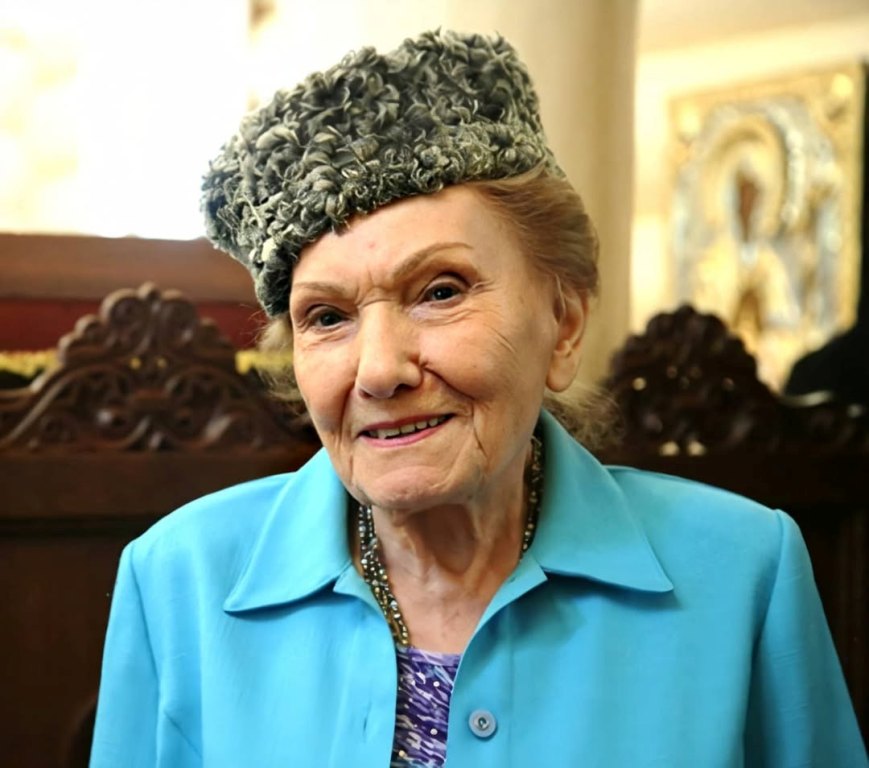
Olga Kulikovsky (née Pupynina) was born into a family of Russian immigrants on 20th September 1926, in Valjevo, Yugoslavia (Serbia). Her father, Nikolai Nikolaevich Pupynin was a hereditary nobleman of the Tambov province, a military Cossack officer of the Imperial and White armies, and participant in the famous Ice Campaign (Spring 1918).
Her mother, Nina Konradovna Kopernitskaya was an artist and sculptor, educated in Warsaw and Munich. From 1920, the family was in exile: first in Yugoslavia, after World War II in Venezuela.
Olga Kulikovsky graduated from the Mariinsky Don Institute of Noble Maidens (Smolny branch), who were evacuated from Novocherkassk during the Civil War to Bela Tserkva [Bela Crkva (Serbian)]. During the Second World War, she was interned in Germany (Stuttgart), where she worked in a factory and survived the barbaric bombing of civilians by British and American aircraft. Subsequently, she moved to South America, received a medical, commercial, architectural education, and learned seven languages. After moving to Canada, she worked as a translator in government agencies.
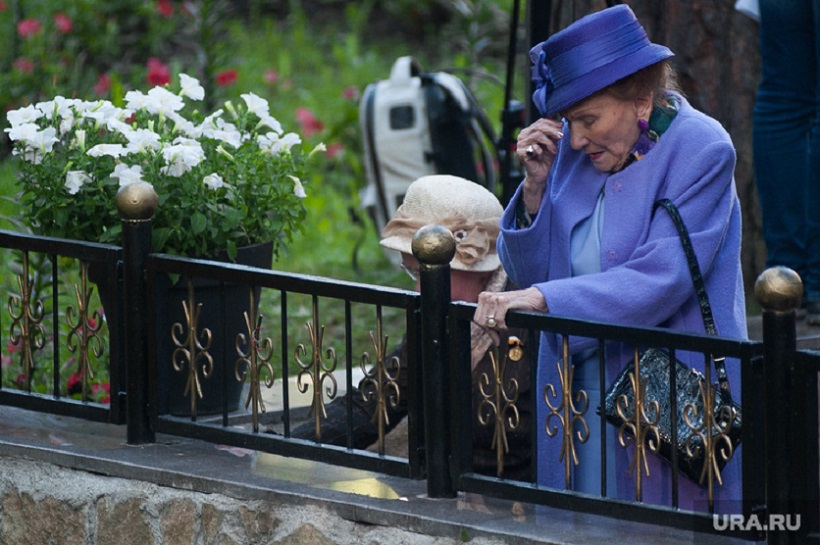
PHOTO: Olga Nikolaevna Kulikovsky-Romanov praying at Monastery of the Holy Royal Martyrs at Ganina Yama in July 2018
Over the years Olga Kulikovsky participated in public activities in Russia, where she transferred to the Russian Orthodox Church some shrines preserved in the Kulikovsky family in Canada. Among these was the Icon of the Mother of God, “Of the Three Hands” belonged to Nicholas II and his family. She may, however, be best known for her tireless efforts to popularize the artistic work of Grand Duchess Olga Alexandrovna.
Mrs. Kulikovsky was the founder and chairman of the HIH Grand Duchess Olga Alexandrovna Memorial Fund since its foundation in 1991. With her passing, a new chapter begins for the charitable organization.
Undoubtedly, the Fund in the name of Grand Duchess Olga Alexandrovna will continue to serve Russia, whose activities will become a worthy testimony to the memory of the Grand Duchess and her daughter-in-law.
In recent years, Mrs. Kulikovsky had been working on a new book, “A Quarter Century of Russia’s Service.” This monumental work is dedicated to her 25 years of active and often difficult work of the Fund in Russia and abroad. Unfortunately, she never managed to see this publication come to fruition. [Her book is published in Russian/English, and is only available in Russia.]
It is important to add, that despite her age, she worked tirelessly to help clear the name of Russia’s much slandered Tsar and his family.
PHOTO: the grave containing the remains of Grand Duchess Olga Kulikovsky, Nikolai and Tikhon Kulikovsky and Olga Kulikovsky, situated in the Orthodox section of York Cemetery, Toronto
She was found dead at her home in Balashikha, Moscow Region, where she lived.
Her body was returned to Canada, where her funeral was held in Toronto on 16th May 2020. According to her last will and testament, Olga Nikolaevna Kulikovsky was buried in York Cemetery in Toronto, next to her husband Tikhon Nikolayevich Kulikovsky (1917-1993)..
On the white marble cross, established by Mrs. Kulikovsky in 1993, after her husband’s death, her name was inscribed with the last date open. Olga Nikolaevna died on 1st May 2020.
The Kulikovskys are buried along with Grand Duchess Olga Alexandrovna (1882-1960) and her second husband Nikolai Alexandrovich Kulikovsky (1881-1958).
Olga Nikolaevna Kulikovsky-Romanov (1926-2020) Memory Eternal! Вечная Память!






 Nicholas II
You must be logged in to post a comment.