Repin’s painting of Nicholas II and the State Council installed in the Mariinsky Palace
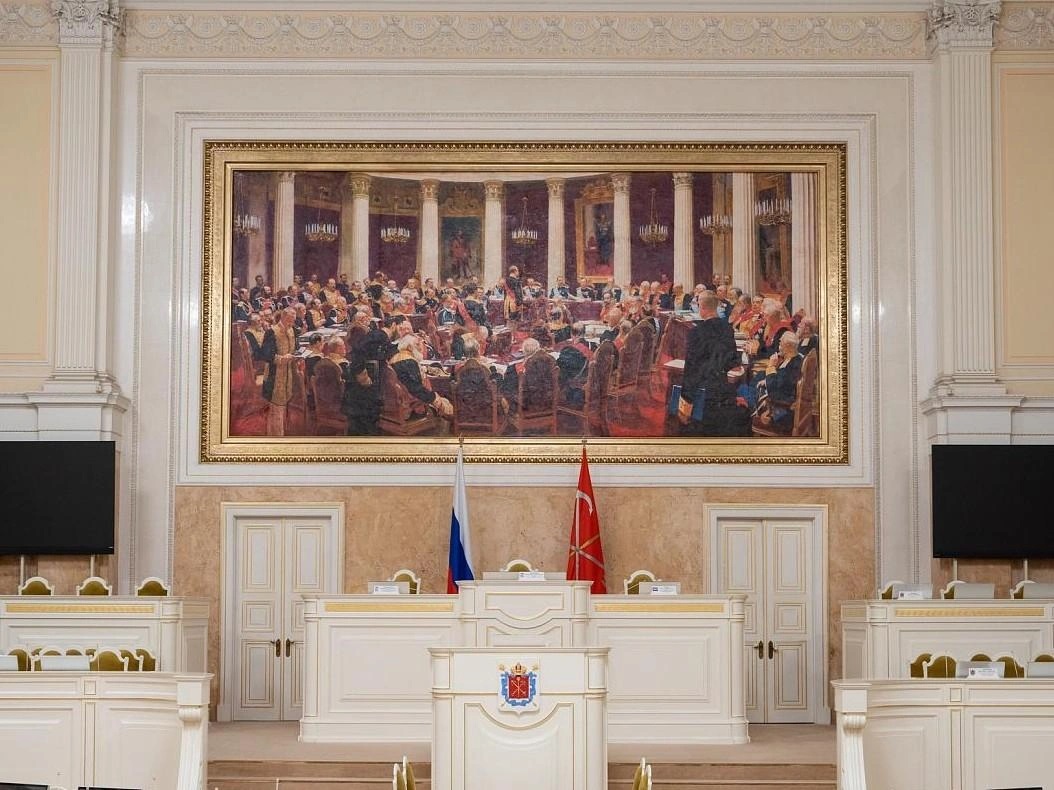
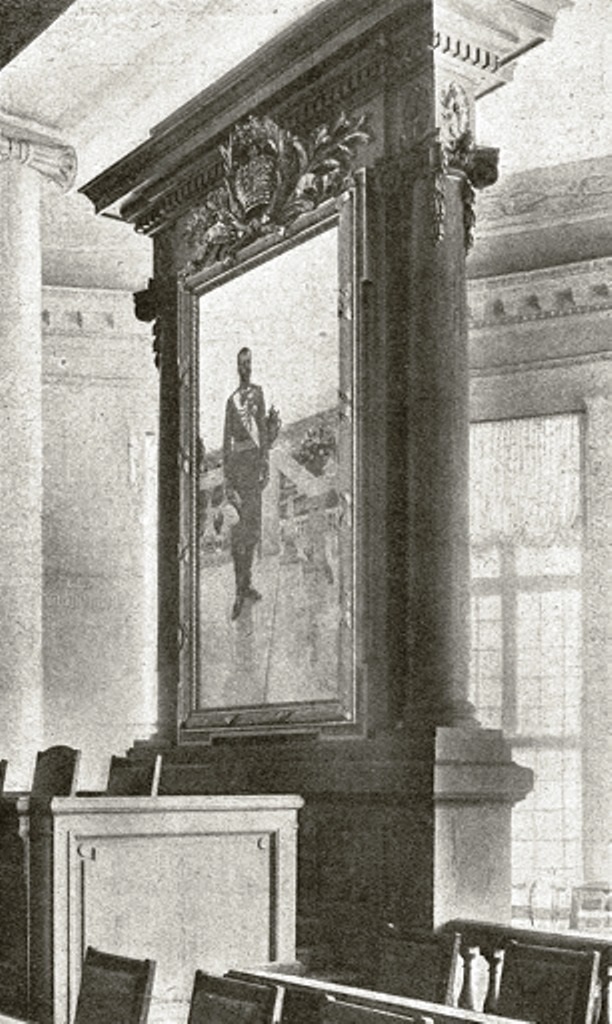
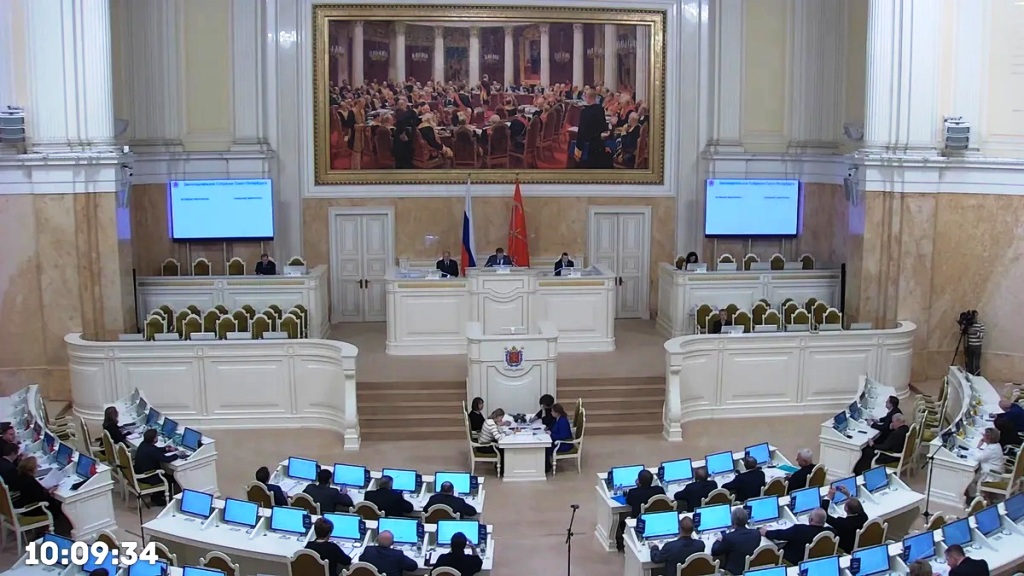
PHOTOS: in December 2024, a copy of “The Ceremonial Meeting Of The State Council 7 May 1901” by Ilya Repin, was installed in the Great Hall of the Mariinsky Palace in St. Petersburg

One of the most iconic paintings which reflects the splendour of the Russian Empire has to be “The Ceremonial Meeting Of The State Council 7 May 1901”, by Ilya Yefimovich Repin (1844-1930). A copy of the great Russian artist’s masterpiece was recently installed in the Great Hall of the Mariinsky Palace in St. Petersburg. The palace has been the site of the Legislative Assembly of Saint Petersburg since 1994.

An exact copy of Repin’s painting was a gift from the St. Petersburg artist Oleg Lukyanov for the 30th anniversary of the city parliament. “We thank Oleg Lukyanov, and the director of the State Russian Museum Alla Manilova for this wonderful gift,” said Speaker Alexander Belsky at the opening of the legislature on 4th December 2024.

The chairman of the Legislative Assembly also noted that specialists worked on the painting for more than two months, while the final touches took an additional six days. An exact copy of the canvas is made in the technique of “urban fresco”, which makes it possible to achieve full compliance with the original painting.

Ilya Repin’s masterpiece was first presented to the public in St. Petersburg on 4th January 1904. The painting depicts Emperor Nicholas II and members of the State Council after the emperor read out a charter in honour of the centenary of the establishment of the Indispensable Council (the predecessor of the State Council).
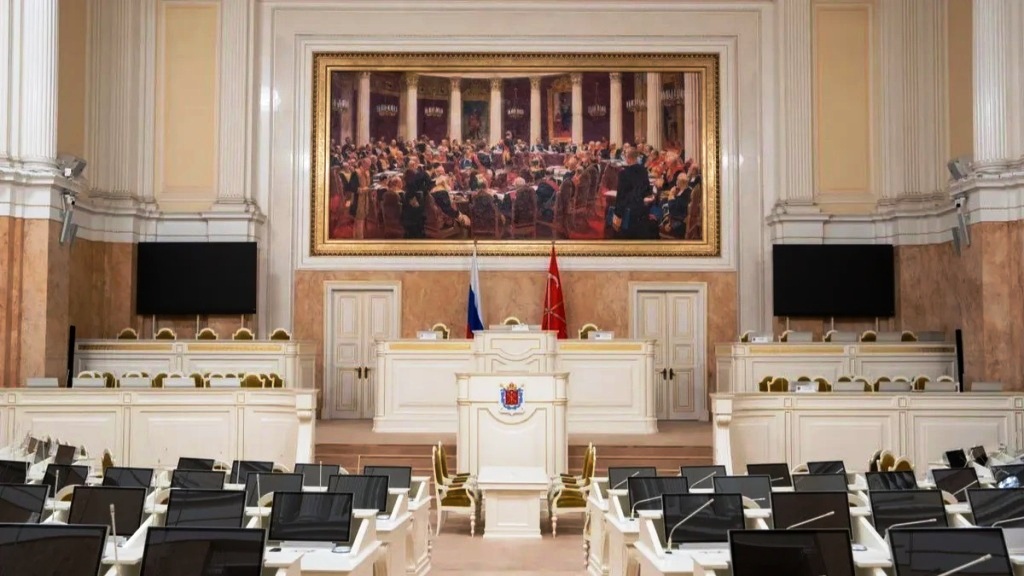
PHOTOS: two views of copy of “The Ceremonial Meeting Of The State Council 7 May 1901” by Ilya Repin, was installed in the Great Hall of the Mariinsky Palace, in St. Petersburg
***

A brief history of Repin’s masterpiece
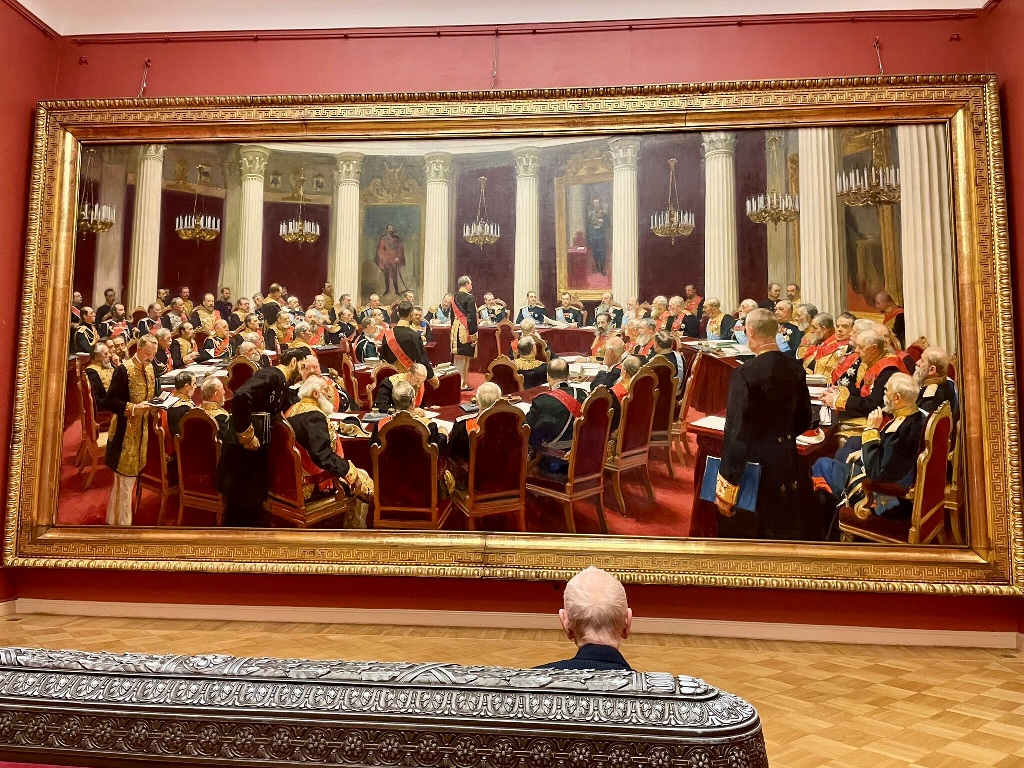
PHOTO: the original “The Ceremonial Meeting Of The State Council 7 May 1901” by Ilya Repin, today hangs in the State Russian Museum in St. Petersburg. The canvas is so large, that it takes up an entire wall, in a hall dedicated to Repin’s masterpiece.

The original “The Ceremonial Meeting Of The State Council 7 May 1901” by Ilya Repin, has been in the collection of the State Russian Museum since 1938. The canvas is so large, that it takes up an entire wall, in a hall dedicated to Repin’s masterpiece.

It is among the most significant and largest paintings from the collection of the State Russian Museum: the large-format canvas measuring 4 by 8 meters [ 13 ft. by 26 ft.].

Painted under a state order, the painting truly conveys the splendor of the Russian Empire. More than a century ago, the political and bureaucratic elite in uniforms attend a solemn meeting in the Round Hall of the Mariinsky Palace. Secretaries are carrying anniversary medals, the future Minister of Internal Affairs Vyacheslav Plehve is standing in front of Tsar Nicholas II, who has finished reading a charter on the occasion of his 100th anniversary. The canvas was created specifically for the Mariinsky Palace, where meetings of the State Council were held.

The Ceremonial Meeting Of The State Council 7 May 1901” is a collective portrait featuring no less than 81 figures. It was painted one hundred and twenty one years ago (1903), in which Repin was paid a large fee. The customer of the canvas, Emperor Nicholas II, was pleased with the result.
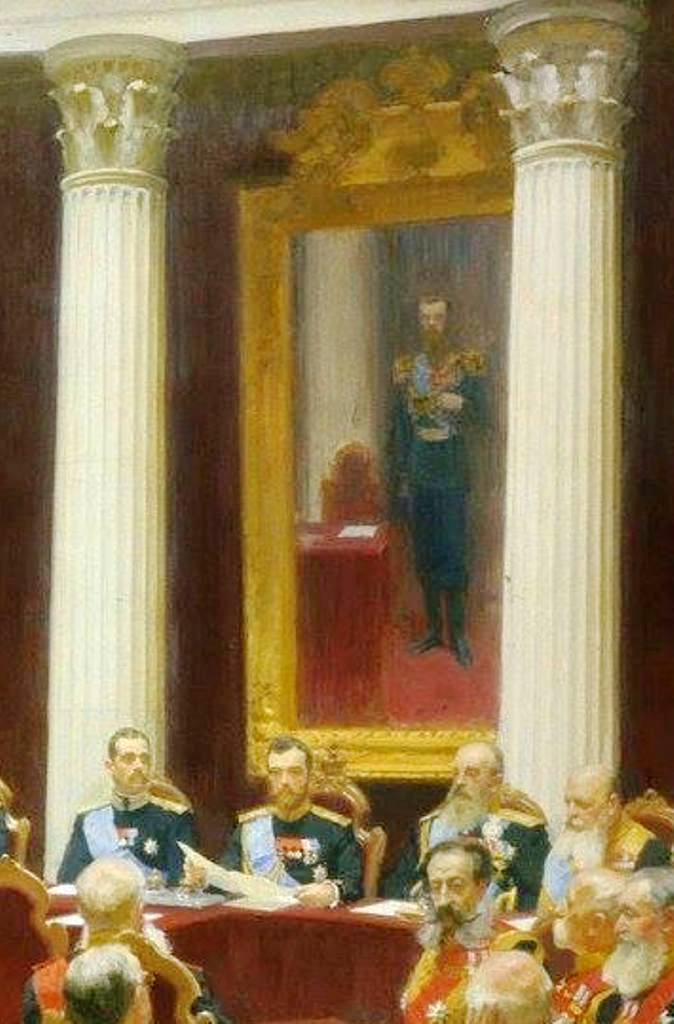
PHOTO: detail from Repin’s painting, which shows Emperor Nicholas II seated between two pillars, under a ceremonial portrait of himself – also by Ilya Repin – painted in 1895. His brother Grand Duke Mikhail Alexandrovich is seated to his right, and Grand Duke Mikhail Nikolayevich (1832-1909), who served as Chairman of the State Council, from 1881 to 1905, is seated to his left.

Founded in 1801 by Emperor Alexander I (1777-1825), the State Council celebrated its centenary with a ceremonial sitting in the Round Hall of the Mariinsky Palace in St. Petersburg on 7th May 1901. All the members of the State Council and the State Chancellery attended in full-dress uniform. Emperor Nicholas II and senior members of the Imperial Family are flanked by their ministers. Repin painted the scene from behind the chairs on the right (next to the columns.

He rapidly sketched the original modello on a canvas on which the perspective of the hall had already been marked out, working from a previously selected point. The artist later turned this study into a large picture with the help of two students from the Imperial Academy of Arts: Boris Kustodiev (1878-1927) and Ivan Kulikov (1875-1941). Every member of the State Council is depicted in natural and diverse poses, with strong physical resemblances.
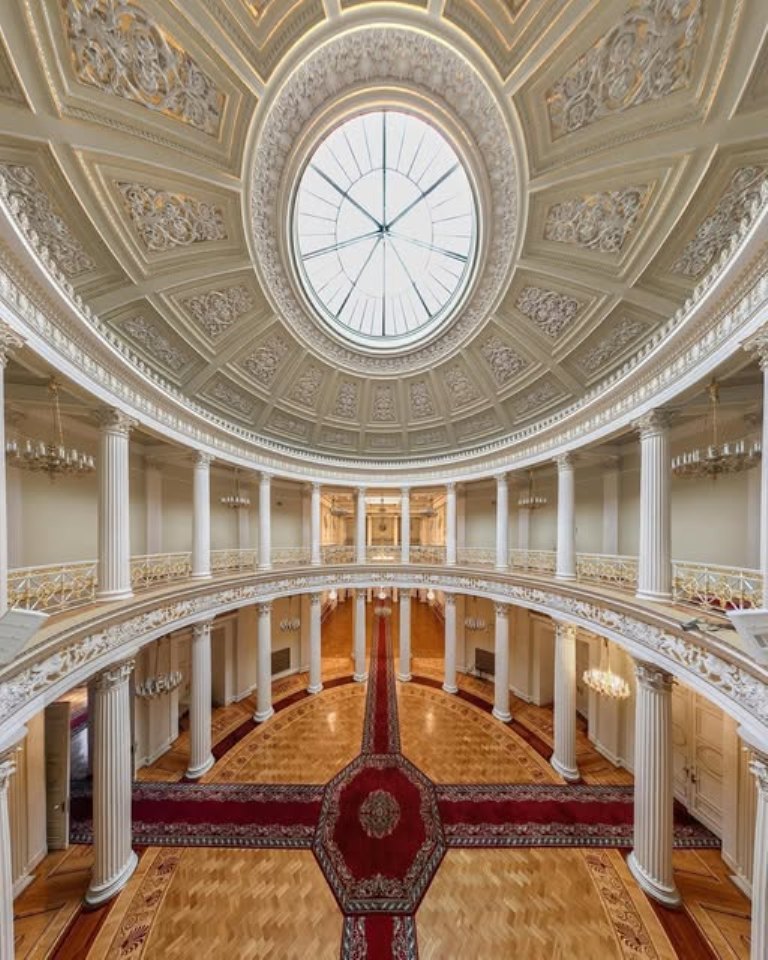
PHOTO: the Round Hall in the Mariinsky Palace, as it looks today

***

Ilya Yefimovich Repin (1844-1930)
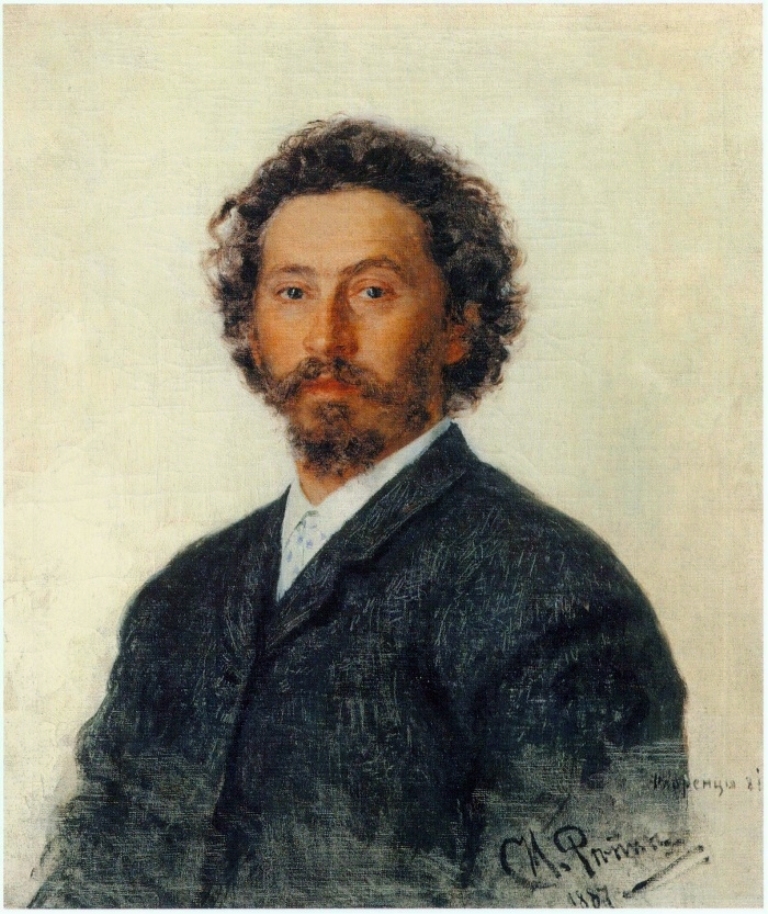
Self-portrait (1887
From the Collection of the State Tretyakov Gallery (Moscow)

Ilya Yefimovich Repin (1844-1930) was a Ukrainian-born Russian painter. He became one of the most renowned artists in Russia in the late 19th to early 20th centuries. His works can be seen today in some of Russia’s most famous museums, including the Tretayakov Gallery in Moscow, the State Russian Museum in St. Petersburg, and the artist’s country estate of Penates, near St. Petersburg, among many others.

Following the ascension of Nicholas II to the throne in 1894, Repin painted a number of ceremonial portraits of the new Emperor. One of these, painted especially for the State Duma in 1905, was lost (among many others) following the February and October 1917 Revolutions.

It is interesting to note that Repin, who was an anti-monarchist, didn’t seem to mind being paid handsomely for the numerous ceremonial portraits and other commissioned paintings by Emperor Nicholas II. One of his most famous works, is The Wedding of Nicholas II and Alexandra Feodorovna (1894), which today hangs in the State Hermitage Museum in St. Petersburg.

Repin warmly welcomed the February 1917 Revolution, which overthrew the autocratic monarchy and proclaimed a republic, an event for which he was very happy. Shortly after the October Revolution of 1917, Repin would regret his support of the overthrow of the monarchy. After Lenin and the Bolsheviks launched the first Red Terror, Repin abruptly changed the bias of his work from anti-monarchist to anti-Bolshevik.

Repin died on 29th September 1930, at the age of 86, and was buried at his country estate Penates, in Kuokkala, now Repino, St Petersburg. His home is now a museum and a UNESCO World Heritage Site.

© Paul Gilbert. 8 December 2024
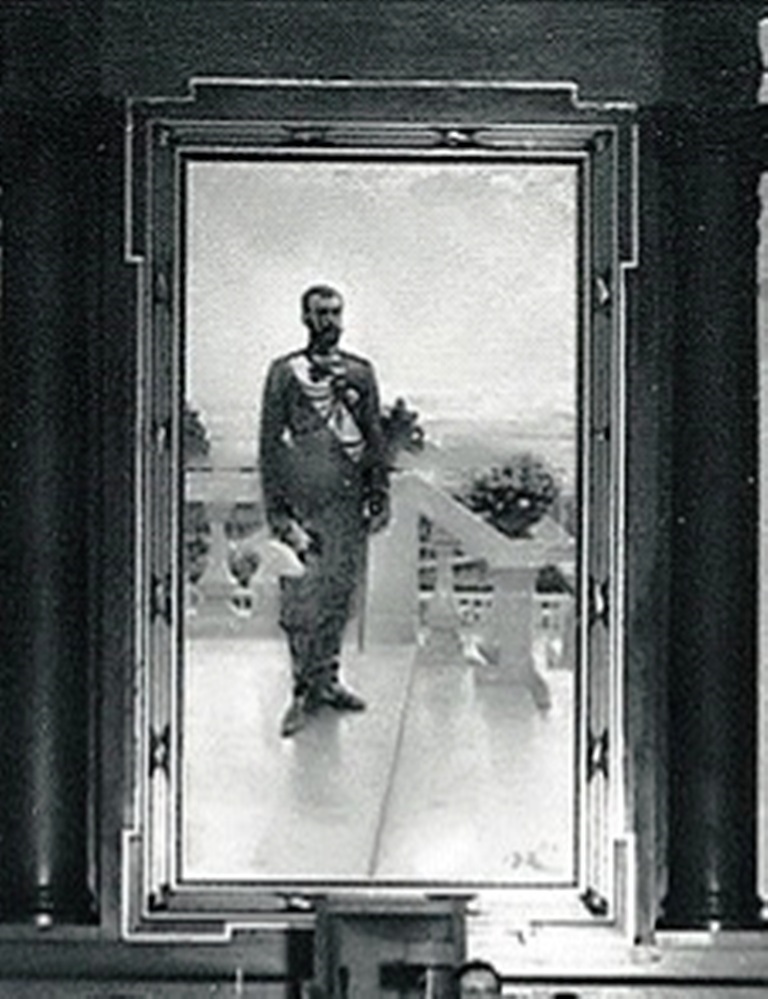
The fate of the Tsar’s portrait in the Duma

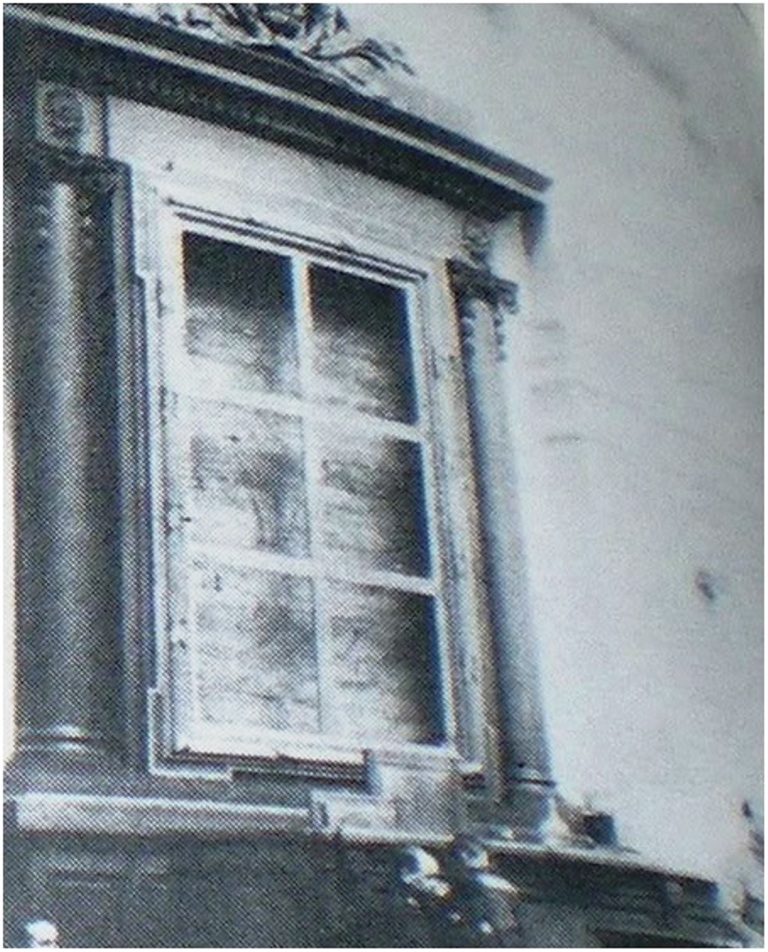
PHOTO: Ceremonial portrait of Nicholas II (1905) in the State Duma. Artist: Ilya Repin

NOTE: this article was updated on 20th May 2021 – PG

When in 1905 the Winter Garden in the Tauride Palace in St. Petersburg was converted into the State Duma Hall, it was decided to decorate it with a huge portrait of Nicholas II. The great Russian portrait artist Ilya Yefimovich Repin (1844-1930) was commissioned for the job. The artist quickly coped with the task, and the treasury paid him a fabulous sum of three thousand rubles. The portrait was installed behind the podium and seats for the leadership of the Duma.

Repin’s portrait depicts the Tsar standing on a balcony [possibly the Lower Dacha at Peterhof?]. Information on this portrait is scant, which is surprising, given that the artist was considered the most renowned Russian artist of the 19th century, and had painted a number of ceremonial portraits of the Emperor.

In 1916 Repin worked on his book of reminiscences, Far and Near, in which he acknowledges that he welcomed the Russian Revolution of February 1917. This is very disappointing to learn, given that he did not seem to mind accepting the enormous sums he was paid for the numerous portraits he did of Nicholas II after he ascended the throne in 1894.

So little is known about this wonderful portrait, however, my efforts to learn more about its fate, left me with practically nothing. I could not find any reference to the portrait in any of the online sites dedicated to Repin’s works. The only reference I could find was an article on the State Duma found on the web site of the Boris Yeltsin Presidential Library in St. Petersburg. Only a handful of photographs exist of the portrait.

In 2019, a large-scale exhibition of Repin’s works was presented at the State Tretyakov Gallery in Moscow. The exhibition, located on 3 floors in the largest exhibition halls, featured more than 180 paintings and more than 130 graphic works. Repin’s ceremonial portrait was absent, nor was there any reference made to it.

In May 1918, the Bolsheviks used the Tauride Palace to hold their 7th Congress, where they first named themselves the Russian Communist Party (Bolsheviks). It is most likely that Nicholas II’s portrait had been removed by the Provisional Government following the February 1917 Revolution. If not, it would most certainly have been destroyed by the Bolsheviks.

After an appeal to readers for information on the fate of the portrait, Mr. Robert Strom reached out to me, providing me with an eyewitness account of the fate of Repin’s ceremonial portrait which hung in the Duma.

The diarist Nikolai Nikolaevich Sukhanov (1882-1940) a Russian Menshevik Internationalist and chronicler of the Russian Revolution was a witness to the fate of the portrait. Sukhanov, who was napping in the gallery of the White Hall of the Tauride Palace was awaken by an unforgettable scene on the dais below:

“I was aroused by strange noises. I realized at once where I was, but could not explain these sounds to myself. I got up and saw two soldiers, their bayonets hooked into the canvas of Repin’s portrait of Nicholas II, rhythmically tugging it down from both sides. A minute later, over the chairman’s seat in the White Hall of the Duma there was an empty frame, which for many months continued to yawn in this revolutionary hall. …Strange ! It never came into my head to worry about the fate of this portrait –to this day I don’t know what happened to it. I was more interested in other things.

“A number of soldiers were standing on the upper levels of the chamber, at the height of my gallery. Leaning on their rifles they watched what their comrades were doing and quietly made their own comments. I went over to them and listened eagerly. …Twenty-four hours before, these rank-and-file soldiers had been the dumb slaves of the despot who was now thrown down, and at this moment the outcome of the revolution depended on them. What had taken place in their heads during those twenty-four hours ? What would they say to the shameful treatment of the portrait of the ‘adored monarch’ of yesterday ? It evidently made no strong impression –there was neither surprise, nor any sign of intense intellectual activity, nor a shadow of that enthusiasm from which even I myself was ready to catch fire. They were making remarks in a tranquil and matter-of-fact way, so down-to-earth they can’t be repeated. The break had been accomplished with a sort of fabulous ease. No better sign was needed of the definitive rottenness of Tsarism and its irremediable ruin. The hands of the large clock over the entrance doors of the hall pointed to 7.30. It was time to begin the ‘Second Day of the Revolution’.”

PHOTO: the ‘gaping yawn of chaos’

I am indebted to Mr. Robert Strom for his much valued assistance with this piece of Russian history.

© Paul Gilbert. 16 May 2021

Repin’s portraits of Alexander Kerensky

PHOTO: Repin’s first portrait of Alexander Kerensky, 1917. From the Collection
of the State Central Museum of Contemporary History of Russia in Moscow

The famous Russian realist painter Ilya Yefimovich Repin (1844-1930), was the most renowned Russian artist of the 19th century, when his position in the world of art was comparable to that of Leo Tolstoy in literature. He played a major role in bringing Russian art into the mainstream of European culture.

Repin was the first Russian artist to achieve European fame using specifically Russian themes. His paintings, made him the leader of a new movement of critical realism in Russian art. His contemporaries praised his paintings, for showing his feeling of personal responsibility for the hard life of the common people and the destiny of Russia. In the 1880s he produced many of his most famous works, and joined the Itinerants’ Society.

Among his vast works, are two little known portraits of Alexander Kerensky, both painted in the summer of 1917.

Alexander Kerensky (1881-1970), was a revolutionary and a key political figure in the Russian Revolution of 1917. In August 1917, it was Kerensky, who made the decision to move the Imperial Family from Tsarskoye Selo to a “safer” location – the town of Tobolsk in Western Siberia. Following the October 1917 Revolution, the Provisional Government was overthrown by the Bolsheviks, forcing Kerensky to flee Russia. He spent the remainder of his life in exile, in Paris and New York City, and worked for the Hoover Institution.

Repin, who was an anti-monarchist, warmly welcomed the February 1917 Revolution, which overthrew the autocratic monarchy and proclaimed a republic, an event for which he was very happy.

It is a well known fact that Kerensky loved to be in the spotlight, and while working on his portraits, Repin fell under the charm of Russia’s new ruler, he was, according to one art critic, “simply obsessed with Kerensky, admired his human and political qualities”.

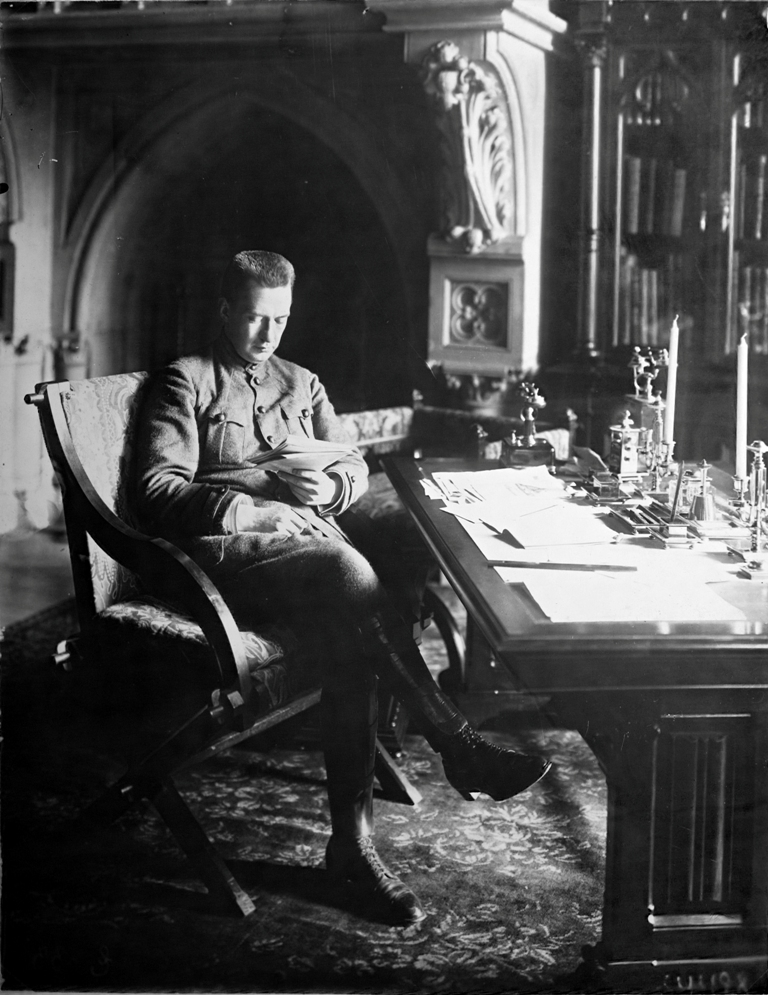
After the July 1917 suppression of the Bolshevik uprising, Kerensky got a taste of power. He moved into the Winter Palace in St. Petersburg, settling himself in the private apartments of Emperor Alexander III, rode in the former Imperial Train, drove about Petrograd in one of Nicholas II’s motorcars, and worked at the writing desk of Nicholas II in the Gothic Library of Nicholas II in the Winter Palace. It was here, that Repin sketched his first image of Kerensky in his album with watercolours and pastels.

PHOTO: Repin’s second portrait of Alexander Kerensky, 1917
Private collection

Between the months of July and October 1917, Repin made repeated visits to the offices of the Provisional Government in Petrograd, to complete his sketches. He bragged to Soviet artists who visited him at this home in Penates (now Repino in Finland) that “Kerensky’s portrait was painted from a sketch from life in the library of Nicholas II”.

Repin’s portrait of Kerensky, in which he is depicted posing in the library of Nicholas II in the Winter Palace had obvious political overtones; sitting in the chair of the deposed emperor, the new ruler of Russia thereby confirming his high status. In this regard, Repin noted that Kerensky “had the glory of almost an emperor, but in reality was a nonentity”.

Repin finished work on his portraits in 1918, shortly after Kerensky was overthrown as a result of the October Revolution. The first (114 × 84 cm) and the second (116 × 85 cm) portraits of Kerensky were painted in oil on linoleum.

Repin’s portraits are by no means flattering, especially when compared with his other works, particularly those of Emperor Nicholas II – of whom he painted on at least six occasions – including his famous painting depicting the wedding of Nicholas II to Grand Duchess Alexandra Feodorovna in the Grand Church of the Winter Palace in1894.

Both portraits of Kerensky are distinguished by a free and spontaneous manner of style, according to critics, bordering on impressionism or even expressionism. Repin painted Kerensky as a flabby, bilious, gray, devastated person, neurasthenic. Being a master of revealing the psychological state of the person being portrayed, his very being, the specifics of poses, gestures and facial expressions, Repin leads the viewer to the idea that Kerensky was in fact such.

PHOTO: Kerensky seated in Nicholas II’s Gothic Library in the Winter Palace, 1917

In the first portrait, Kerensky is depicted seated knee-deep in a chair, from which he looks as if he is ready to jump up. Kerensky slightly tilted his head in a sly half-smile and looks at the viewer with a piercing, sharp gaze. At the same time, peace and fatigue emanate at the same time, as if lacking sleep, and meanwhile he is relaxed – this still does not fit in with his real life, the life of the head of the government of revolutionary Russia, who took upon himself all the hardships of governing the young republic and cannot cope with this burden.

The second portrait seems to be more elaborate compositionally and artistically completed. The light now falls not on the face, but on his nervous, dry hands, one of which is wearing a black glove, which subtly focuses on Kerensky’s mysterious personality. It is noteworthy that politically Kerensky’s opponents mentioned the “greenish tint” of his appearance, hinting at a possible alcohol, morphine or cocaine addiction.

Shortly after the October Revolution of 1917, Repin would regret his support of the new order. After Lenin and the Bolsheviks launched the Red Terror, Repin abruptly changed the bias of his work from anti-monarchist to anti-Soviet.

After the establishment of Soviet power and the proclamation of Finland ‘s independence at the end of 1917, Repin remained stateless. His estate at Penates and his personal fortune were nationalized, and his most famous works remained in the Soviet Union, where they began to be used for propaganda purposes, often interpreted as ideal examples of socialist realism.

In 1926, Repin’s first portrait of Kerensky was presented to the Museum of the Revolution [the former aristocratic English Club] in Moscow – which is today known as the State Central Museum of Contemporary History of Russia. For many years, Repin’s second portrait of Kerensky was held in the Kerensky Archive at the Center for Humanitarian Research of the University of Texas. It was later sold at auction, and is now in a private collection in Russia.

© Paul Gilbert. 11 March 2021

A tale of three portraits of Russia’s last tsar

0280

History has preserved thousands of photographs and dozens of portraits of Nicholas II. The most titled artists of their time were honoured to paint the tsar’s portrait. Among them were both Russian and foreign artists, such as Ilya Repin, Valentin Serov, Boris Kustodiev, Lauritz Tuxen – and many others. Each master captured his own vision of the emperor on canvas. This article explores three of the most famous portraits of Russia’s last emperor and tsar by two of Russia’s most famous portrait artists: Ilya Repin and Valentin Serov.

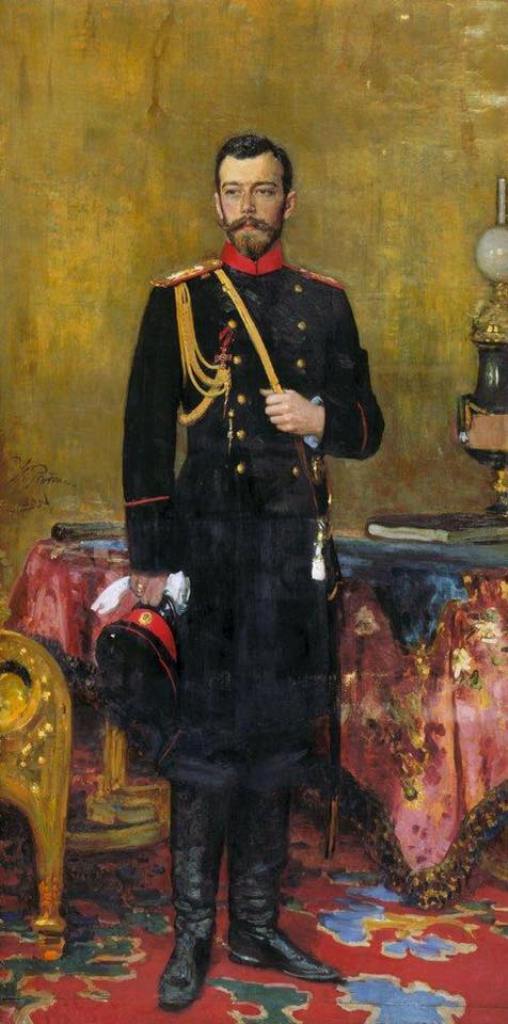
Portrait of Emperor Nicholas II by Ilya Repin (1895)

0280a

The above portrait of His Majesty the Sovereign Emperor Nicholas II was painted in 1895 by Ilya Yefimovich Repin (1844-1930) by order of the Dowager Empress Maria Feodorovna, mother of Nicholas. Up until 1917, the portrait hung in the Mariinsky Palace in St. Petersburg, in the very hall where meetings of the State Duma took place.

After the revolution, the painting was considered lost. It “surfaced” in the early 1980s in the collection of the famous St. Petersburg collector Nikolai Kozhevnikov. He claimed that he had found it during the Great Patriotic War (1941-45) in a garbage dump.

It is believed that many other works of art from the Tsarist period believed to be “lost” have in fact been squirreled away by private Russian collectors, all of whom are well aware of their historic value. This offers a ray of hope that other Romanov treasures may have survived the ravages of revolution and war, including the missing Faberge Imperial Eggs. 

In his letters, Repin recalled: “Last week, three sessions took place, that is, on Monday, the 28th, – the first session, one and a half hours; Tuesday, – an hour and half; and an hour yesterday. I arrived at the palace an hour earlier. The emperor comes at two o’clock, the empress accompanies him every time and stays here all the time during work.” Later he added: “I finished the Sovereign’s portrait; there were a total of seven sessions. The sovereign posed poorly, however, everyone likes my portrait and do not criticize.” This portrait was painted shortly after Nicholas II ascended the Russian throne following the death of his father Alexander III.

This portrait of Nicholas II is now in the Collection of the State Russian Museum in St. Petersburg.

Portrait of Emperor Nicholas II by Valentin Serov (1902)

0280b

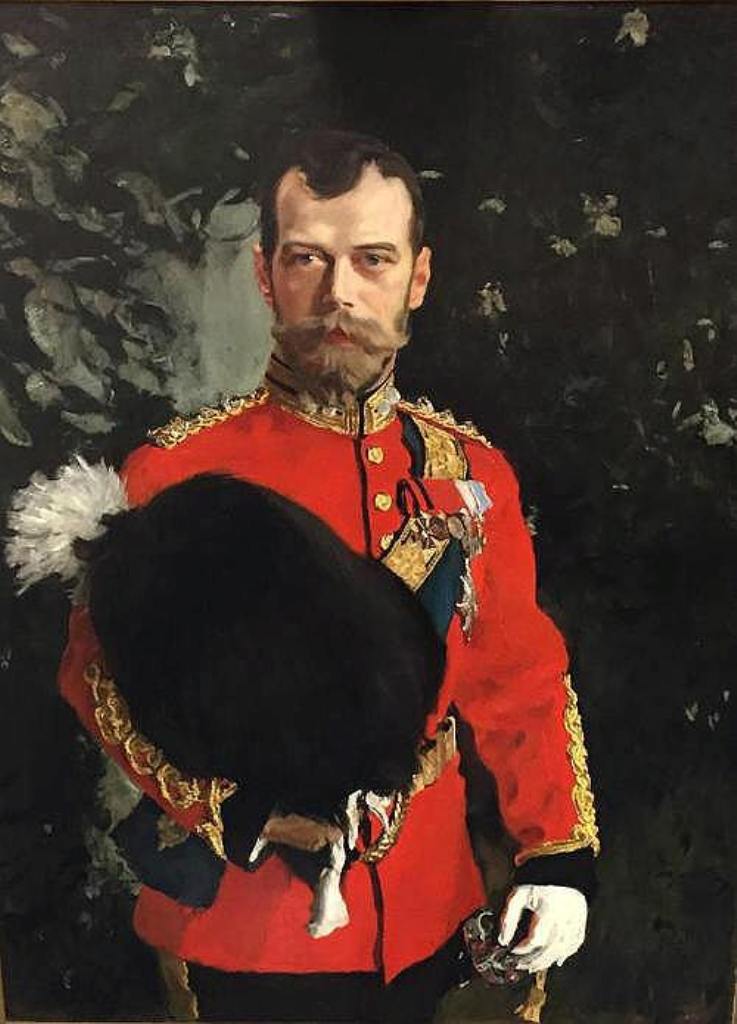
This portrait by Valentin Alexandrovich Serov (1865-1911), depicts the Emperor in the full uniform of Colonel-in-Chief (honourary head of the regiment) of the Royal Scots Greys. In 1902, Nicholas II ordered the artist Valentin Serov to paint the portrait as a gift to the regiment – one of the most famous in the United Kingdom.

Nicholas II was awarded this honour by Queen Victoria on the occasion of the wedding of her granddaughter Princess Alix of Hesse and by Rhine to the future Emperor of Russia. The portrait hangs in the Royal Scots Guards Regiment Museum in Edinburgh, Scotland. The ceremonial uniform is now in the Collection of the Tsarskoye Selo State Museum-Reserve.

Portrait of Emperor Nicholas II by Valentin Serov (1900)

0280c

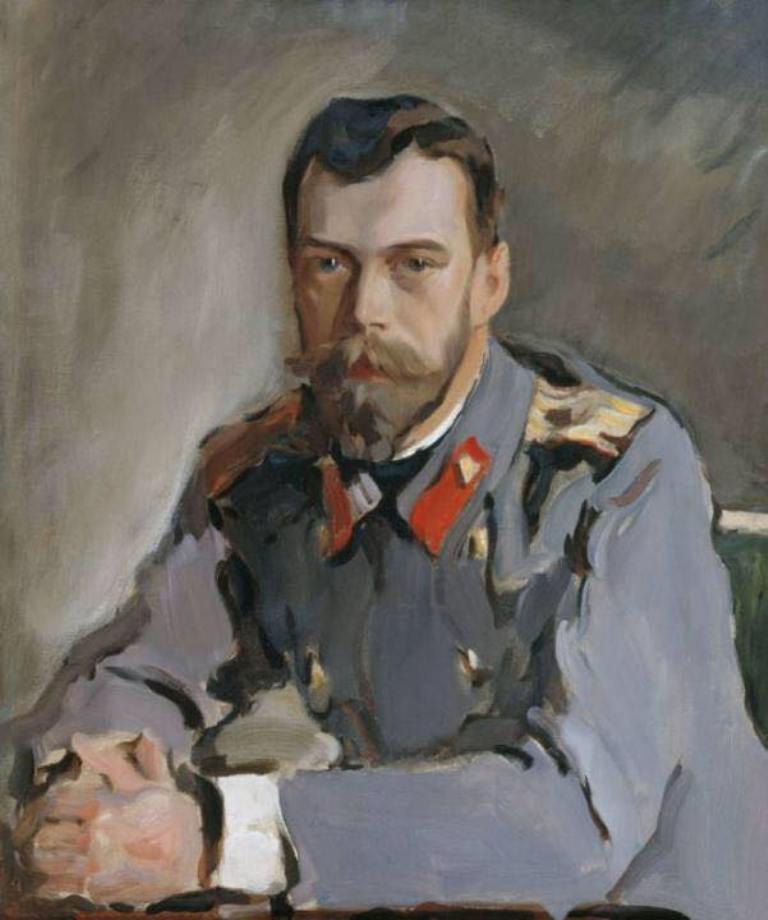
The artist Valentin Alexandrovich Serov (1865-1911) created the home portrait of Nicholas II, as a gift to Empress Alexandra Fedorovna in just two sittings with the emperor.

The original version of this portrait did not survive: the revolutionaries who stormed the Winter Palace destroyed the canvas with bayonets.

Thankfully, Serov, having just barely finished the portrait in 1900, immediately made a copy of it. He was worried about the fate of the painting, because the Empress did not like it very much. During his sessions with the Emperor, Alexandra Feodorovna closely watched the artist and generously distributed advice on how to “correct” the face of Nicholas II in the portrait. In the end, Valentin Serov could not stand it, handed the empress the palette with brushes and invited her to finish the work herself!

Some art historians believe that this portrait of Nicholas II looks incomplete: noting that it was painted with wide free strokes without subtle light transitions, the details of the canvas were not worked out. But the execution of the portrait itself reflects Serov’s vision, who (again) according to art historians wanted to depict a man who was tired in his service to Russia – although this remains highly unlikely. The canvas does not have the usual attributes of other royal portraits, which often include solemn interiors, ceremonial clothing, etc. Nicholas II is depicted in the jacket of the Preobrazhensky Life Guards Regiment, which he proudly wore every day.

The copy of the portrait is now part of the Collection of the State Tretyakov Gallery in Moscow.

* * *

Nicholas II. Portraits by Paul Gilbert

0280d

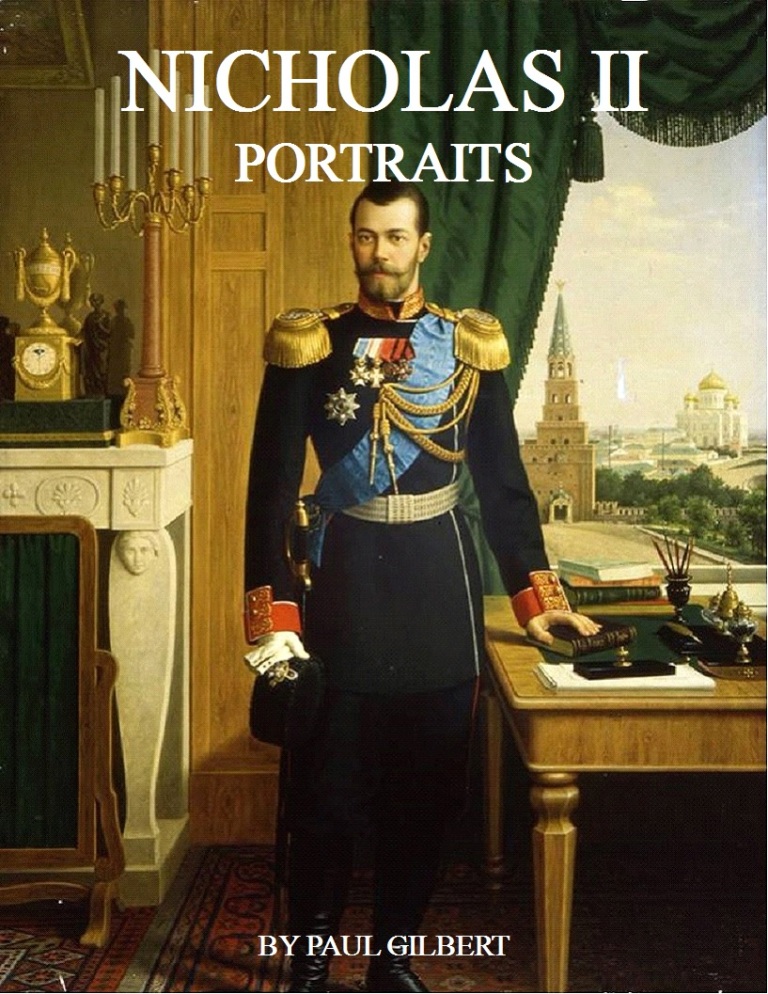
Published in 2019, this is the first book of its kind ever published! Nicholas II. Portraits by independent researcher Paul Gilbert explores a century of portraits of Russia’s last emperor and tsar.

It features beautiful colour covers, 140 pages, and richly illustrated with 175 black and white photographs, (many full-page), with detailed and informative captions.

This unique title features an introduction, as well as numerous short articles, including: Serov’s Unfinished 1900 Portrait of Nicholas II; A Nun’s Gift to Russia’s New Tsar. The Fate of a Portrait; Galkin’s Ceremonial Portrait of Nicholas II Discovered; and more!

Famous portraits and their respective artists are all represented, including Serov, Repin, Lipgart, Tuxen, Bakmanson, Becker, Bogdanov-Belsky, Kustodiev, among others.

The last section (28 pages) of the book is dedicated to the works of contemporary Russian artists, who have painted outstanding portraits of Nicholas II since the fall of the Soviet Union.

It is interesting to note that my research for this book was primarily from Russian sources, and I discovered portraits which were new, even to me!

Price: $25 + postage. Click HERE to order your copy of Nicholas II. Portraits

© Paul Gilbert. 5 July 2020