“Nicholas II showed himself as a responsible reformer” – Valentina Matviyenko
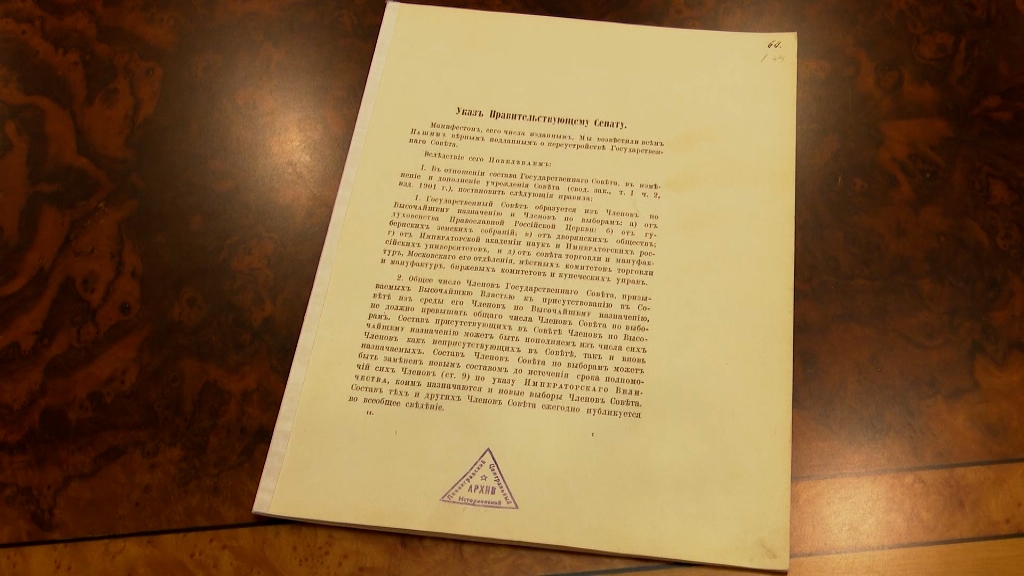
PHOTO: fist page of the Imperial Manifesto of Emperor Nicholas II
of 20th February (5th March, New Style), 1906
On 20th February 2026, Russia celebrates the 120th anniversary of the signing of the manifesto by Emperor Nicholas II, which marked the beginning of the modern bicameral organization of legislative power in Russia. On this important historic date, parliamentarians of various levels and all Russians were congratulated by Chairman of the Federation Council and Senator from St. Petersburg Valentina Matviyenko.
According to her, the decision of Nicholas II to transform the State Council from an advisory structure to a legislative one was a truly prophetic choice of the right model of the state structure of multinational and multi-confessional Russia.
“The Russian Emperor showed himself as a responsible reformer, who first thought not about protecting the sacredness of his power, his autocracy, but about the effectiveness of governing the country. Nicholas II consciously divided the legislative function between the two highest state institutions – the reformed State Council and the State Duma – and thus, laid down a bicameral domestic parliamentary tradition, which has been justifying itself for more than a century . . . “, she added.
In the historic manifesto, Nicholas II pointed out that the law could not come into force without the approval of both chambers. This rule is still preserved by the modern Russian parliament: after approval by the State Duma, the law goes to the Federation Council and after consideration by senators it goes to the President for signature.
Valentina Matviyenko held a meeting in the Upper House with the head of the Federal Archival Agency (Rosarkhiv) Andrei Artizov and the scientific director of the State Archives of the Russian Federation (GARF) Sergei Mironenko. They showed Matvienko the original of the manifesto of Emperor Nicholas II of 20th February (5th March, New Style), 1906, which laid the foundation for the modern bicameral organization of legislative power in Russia. It announced the reorganization of the State Council, with the granting of rights to it “in matters of legislation” and with the involvement of “elected representatives of the population”.
“This is a very important document for us, and a memorable date. In fact, it laid the foundation for a bicameral parliamentary system. Already on 27th April 1906, as you know, there was the first joint meeting of the State Council and the State Duma,” Matviyenko said.
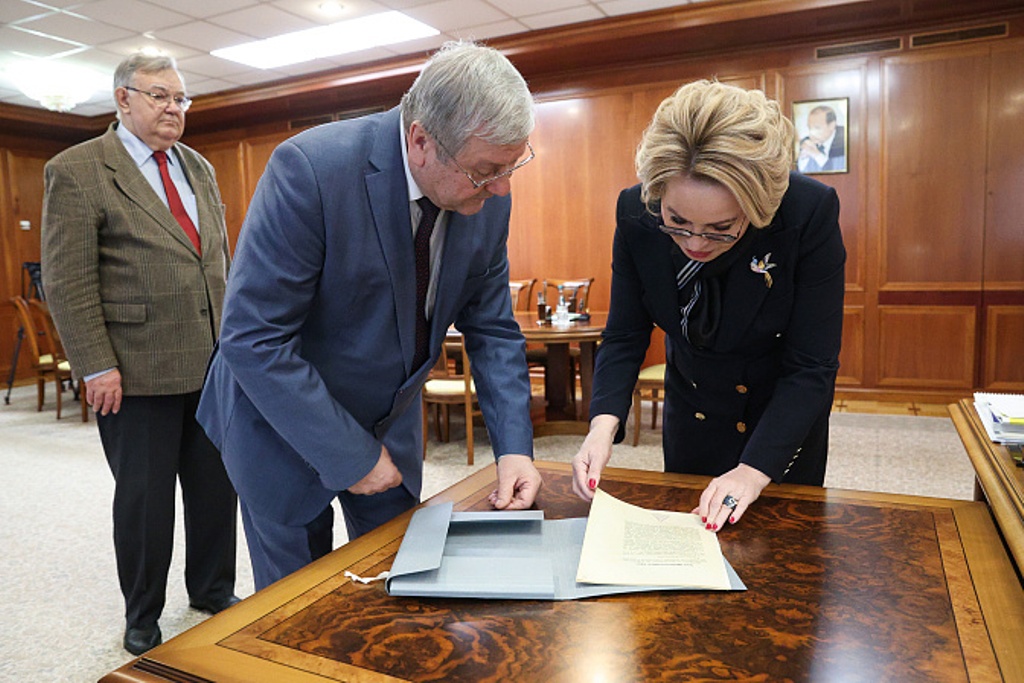
PHOTO: (above) Valentina Matviyenko familiarizes herself with the original of the Imperial Manifesto of Nicholas II; (below) Matviyenko meets with Andrei Artizov (left) and Sergei Mironenko (right).
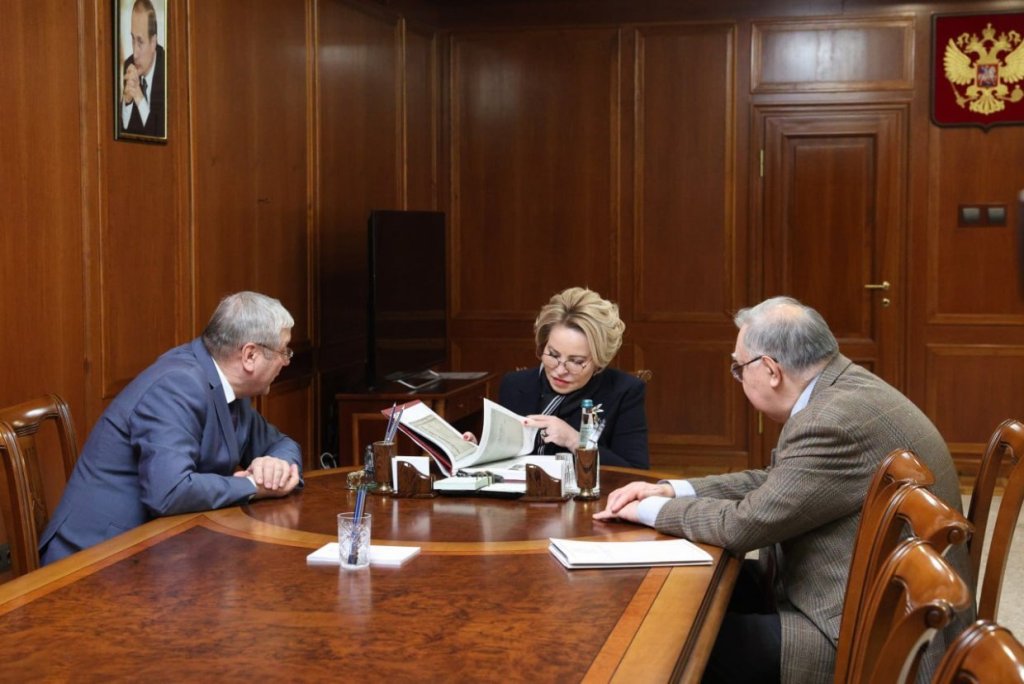
She thanked Artizov and Mironenko for the opportunity to hold this historic document in her hands and to get in touch with Russia’s history.
“I have great respect for those people who work in the archives, who preserve our documentary sovereignty, the history of our country. As a rule, they are very modest people, but they are devoted to their profession and their work. I understand and appreciated the significant dedication of preserving these archives”, she added.
During the meeting, the state and prospects of archival affairs in Russia were discussed. They recalled that in the early 1990s, noting the great contribution of Valentina Matviyenko to the preservation of priceless documents and the building of the State Archives.
Matviyenko proposed an archival exhibition for the 120th anniversary of parliamentarism in Russia, which would include the original copy of the manifestos of Nicholas II, which formed the legislative branch of power, in the Tauride Palace of St. Petersburg.
Earlier, the speaker said that in 2026, the spring session of both the Upper and Lower Chambers of the Federal Assembly has a special resonance in the history of Russian parliamentarism, which turns 120 this year. She noted the choice of the model of legislative power, which Nicholas II made 120 years ago, laying down a “bicameral domestic parliamentary tradition,” prescient.
© Paul Gilbert. 20 February 2026
 Nicholas II
You must be logged in to post a comment.