The death of Pyotr Stolypin at Kiev, 18th September 1911
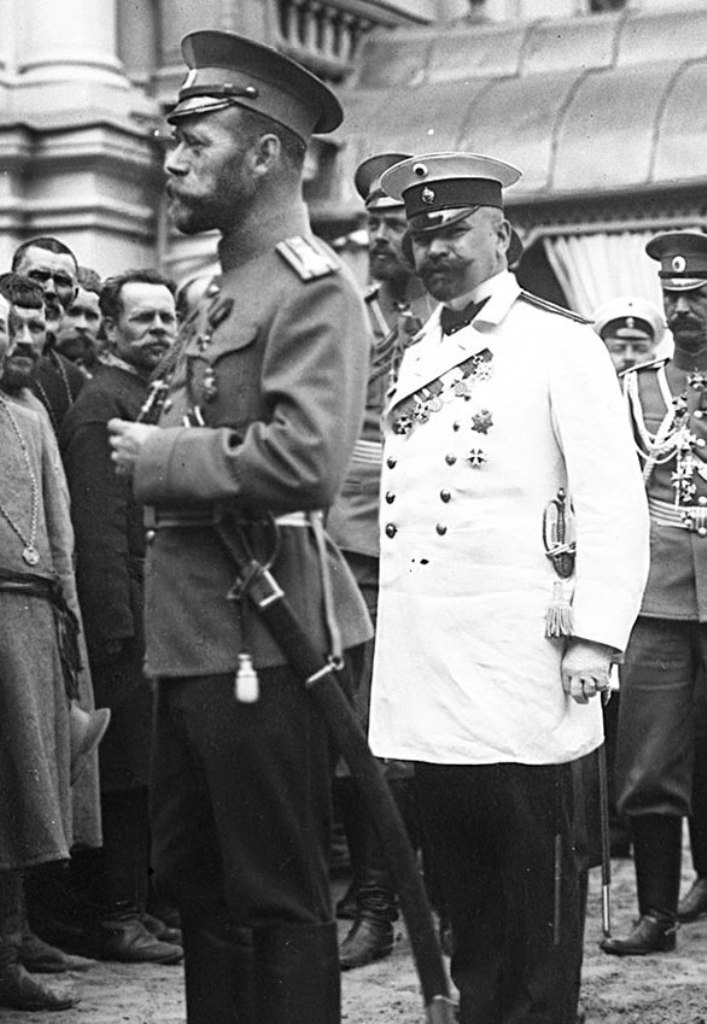
PHOTO: Emperor Nicholas II and Prime Minister Pyotr Stolypin (right) in Kiev. This photo was taken the day before an assassination attempt was made on Stolypin’s life in Kiev on O.S. 30th August 1911
During the reign of Emperor Nicholas II (1894-1917), politicians and police officers were murdered as a result of widespread revolutionary violence by leftist revolutionaries. There are no exact statistics on the number of politicians and police officers killed during Nicholas II’s reign, however, it can be argued that hundreds or even thousands of people were killed during this period due to the political violence that spilled over into the revolutionary movement.
One of the most tragic human losses occurred on 18th [O.S. 5th September] September 1911 – when Pyotr Arkadyevich Stolypin died, following injuries sustained during an attempted assassination in Kiev four days earlier.
Stolypin was a prominent and widely respected Russian politician. He was the third Prime Minister of Russia, and Minister of Internal Affairs of the Russian Empire from 1906 until his assassination in 1911.
Known as the greatest reformer of Russian society and economy, he initiated reforms that caused unprecedented growth of the Russian state.
“Give the state 20 years of internal and external peace, and you will not recognize today’s Russia,” he said. In an interview with one of the newspapers, Stolypin described the ongoing reforms, the main goal of which, according to him, was to create a class of small landowners, which was supposed to lead to the prosperity of the country.
Sadly, Stolypin’s reforms were complicated by the fact that they were not fully implemented due to the tragic death of Stolypin in 1911, the outbreak of the First World War in 1914, the February 1917 and October 1917 revolutions, and then the Civil War. Stolypin himself assumed that all the reforms he conceived would be carried out in a comprehensive manner (and not only in terms of agrarian reform) and would give the maximum effect in the long term (according to Stolypin, “twenty years of internal and external peace” were required
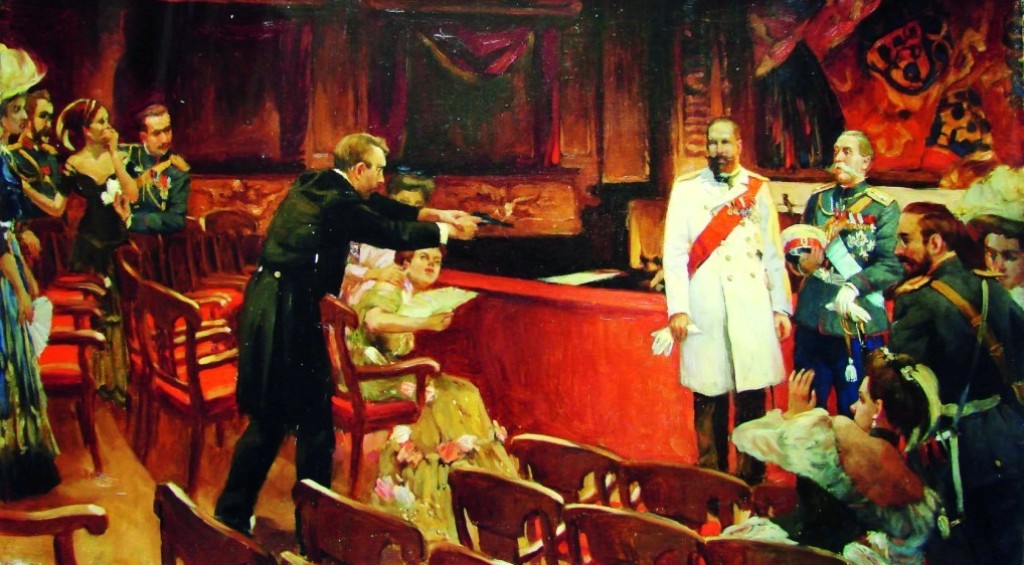
PHOTO: early 20th century painting depicting Dmitry Bogrov
shooting Stolypin at the Kiev Opera House. Artisting unknown
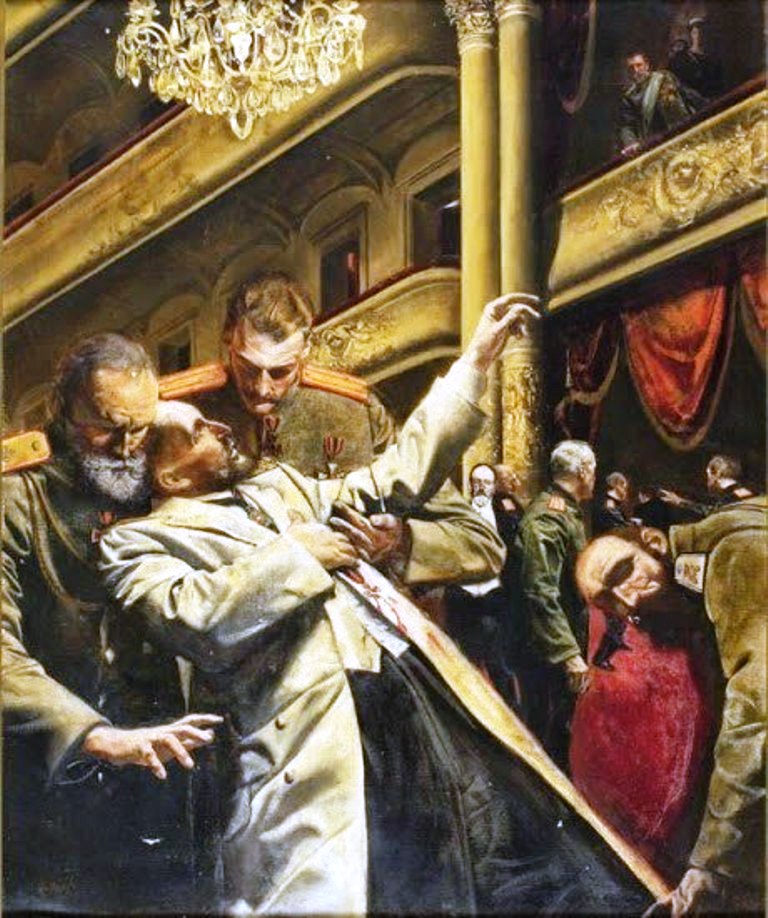
PHOTO: “Stolypin was standing. He slowly turned his face towards us and, with his left hand, made the sign of the cross in the air.” – letter from Nicholas II to his mother
In the autumn of 1911, Stolypin traveled to Kiev despite police warnings that an assassination plot was afoot as there had already been 10 attempts on his life! On 14th September [O.S. 1st September] 1911, there was a performance of Rimsky-Korsakov’s “The Tale of Tsar Saltan” at the Kiev Opera House in the presence of the Tsar and his two eldest daughters, the Grand Duchesses Olga and Tatiana Nikolaevna.
The theatre was occupied by 90 men posted as interior guards. According to Alexander Spiridovich – the head of Nicholas II’s secret personal guard – after the second act “Stolypin was standing in front of the ramp separating the parterre from the orchestra, his back to the stage. On his right were the Minister of the Imperial Court Count Vladimir Fredericks (1838-1927) and the Minister of War Vladimir Sukhomlinov[1] (1848-1926).” His personal bodyguard had stepped out to smoke.
Stolypin was shot twice, once in the arm and once in the chest, by Dmitry Bogrov, a leftist revolutionary. Bogrov ran to one of the entrances and was apprehended. Stolypin rose from his chair, removed his gloves and unbuttoned his jacket, exposing a blood-soaked waistcoat. He never lost consciousness, but his condition deteriorated. He died four days later.
There is a myth that the Tsar and his daughters witnessed the assassination attempt, however, this is not true. In a letter to his mother, Nicholas describes the chain of events on that fateful night:
“ . . . During the second interval we had just left the box as it was so hot, when we heard two sounds as if something had been dropped . . . I ran back into the box to look. To the right I saw a group of officers and other people. They seemed to be dragging someone along: women were shrieking, and directly in front of me in the stalls Stolypin was standing. He slowly turned his face towards us and, with his left hand, made the sign of the cross in the air. Only then did I notice that he was very pale and that his right hand and uniform were bloodstained. He slowly sank into his chair and began to unbutton his tunic . . .
“Olga and Tatiana came back into the box and saw what had happened . . . Then the theatre filled up again, the national anthem was sung, and I left with the girls at eleven. You can imagine with what emotions! Alix knew nothing about it till I told her. She took the news rather calmly. Tatiana was very much upset, she cried a lot and they both slept badly.”
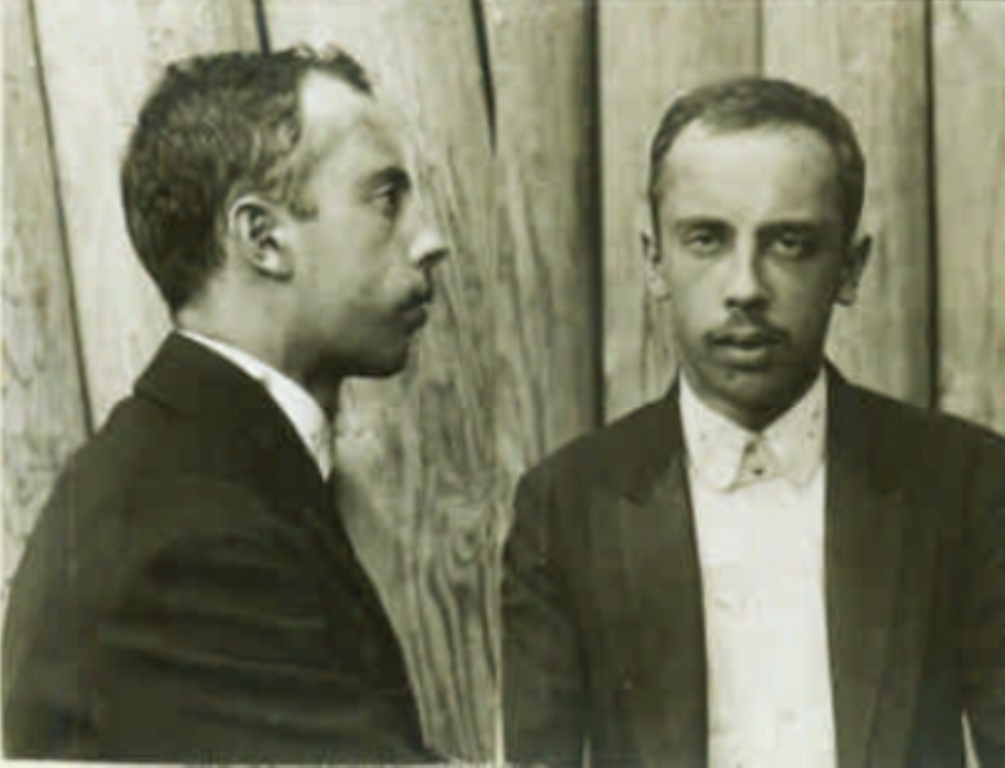
PHOTO: Dmitry Grigoryevich Bogrov (1887-1911)
Bogrov was hanged 10 days after the assassination. On his own request, Stolypin was buried in the Kiev-Pechersk Lavra (see photo below) on 22nd [O.S. 9th September] September 1911.
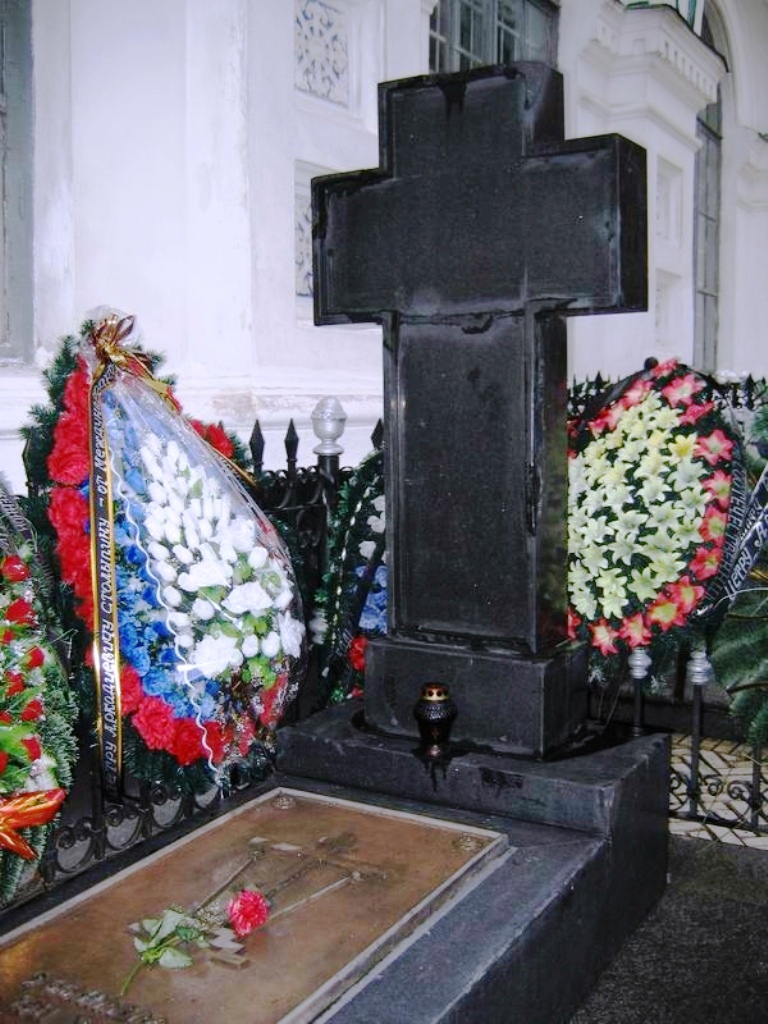
PHOTO: The grave of Pyotr Arkadyevich Stolypin in the Kiev-Pechersk Lavra
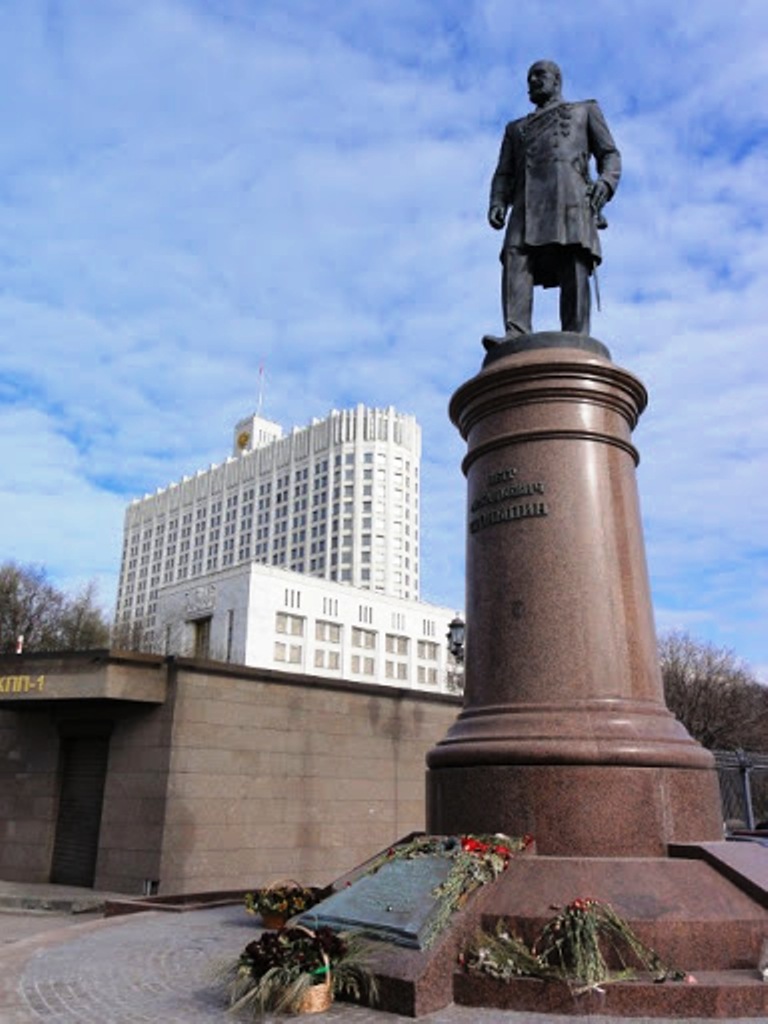
PHOTO: On 27th December 2012, a monument to Pyotr Stolypin was unveiled in Moscow, near the Russian White House, officially known as the House of the Government of the Russian Federation.
Memory Eternal! Вечная Память!
NOTES:
[1] Sukhomlinov was ousted as Minister of War amid allegations of failure to provide the Imperial Russian Army with necessary armaments and munitions for World War I and accused of responsibility for Russia’s defeats in the early Eastern Front. Sukhomlinov was tried for high treason, corruption, and abuse of power in a high-profile case that damaged the reputation of Russia’s fragile Imperial government. According to some historians, the Sukhomlinov scandal may have done more harm to the Romanov monarchy than the lurid scandals associated with Rasputin.
Sukhomlinov lived the remainder of his life in extreme poverty in Berlin, where he was found dead from exposure to cold on a park bench one morning on 2nd February 1926. Sukhomlinov was buried at the Berlin-Tegel Russian Orthodox Cemetery.
© Paul Gilbert. 18 September 2025
 Nicholas II
You must be logged in to post a comment.