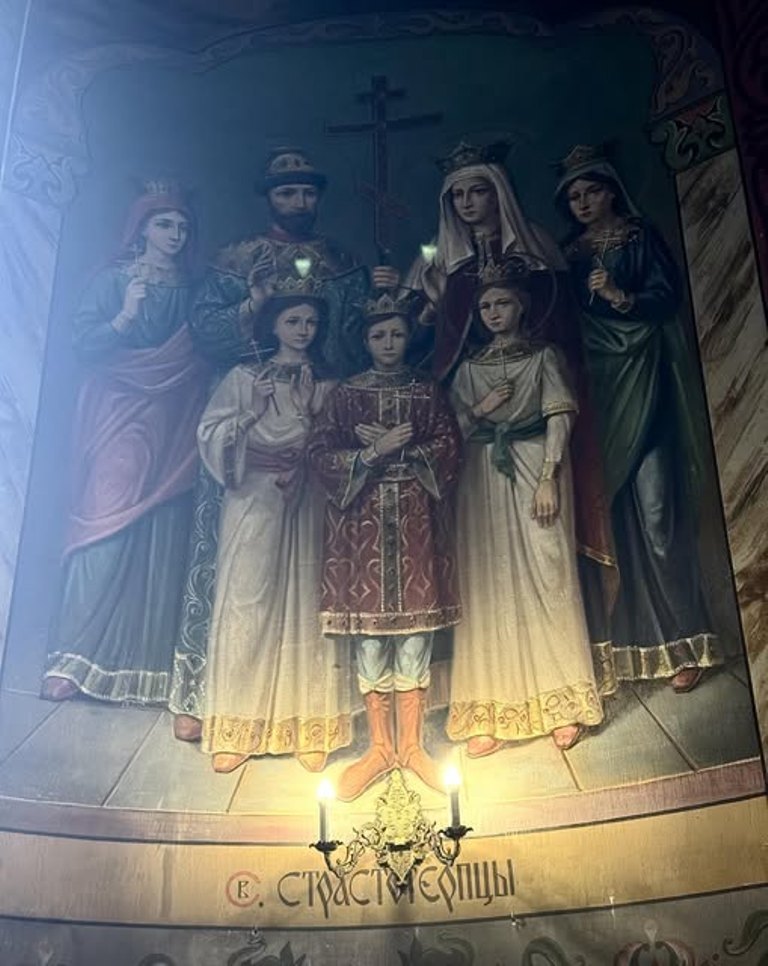
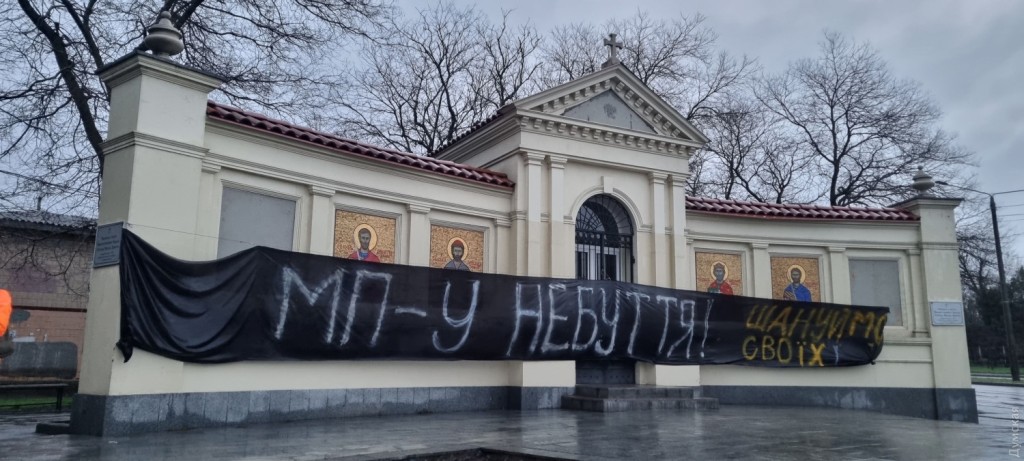
PHOTO: fresco depicting the Holy Royal Passion-Bearers on the wall of the Assumption [aka Dormition] Cathedral
The Assumption [aka Dormition] Cathedral in the Ukrainian city of Volodymyr (Vladimir) in the Volyn region, recently came under the jurisdiction of the Ukrainian Orthodox Church[1]. On 31st January 2026, a fresco depicting Emperor Nicholas II and his family was discovered during an inspection tour of the building.
According to People’s Deputy of Ukraine Ihor Huz, the fresco depicting the Holt Royal Passion-Bearers will be removed “as religious propaganda of an aggressor country.”
Recall that Nicholas II and his family were canonized as Holy Royal Passion-Bearers by the Moscow Patriarchate of the Russian Orthodox Church on 15th August 2000. Both Russian and Ukrainian Orthodox Christians venerate icons of the Holy Royal Passion-Beaers. Therefore, the move by Ukrainian authorities shows nothing but blatant disrespect for freedom of religion.
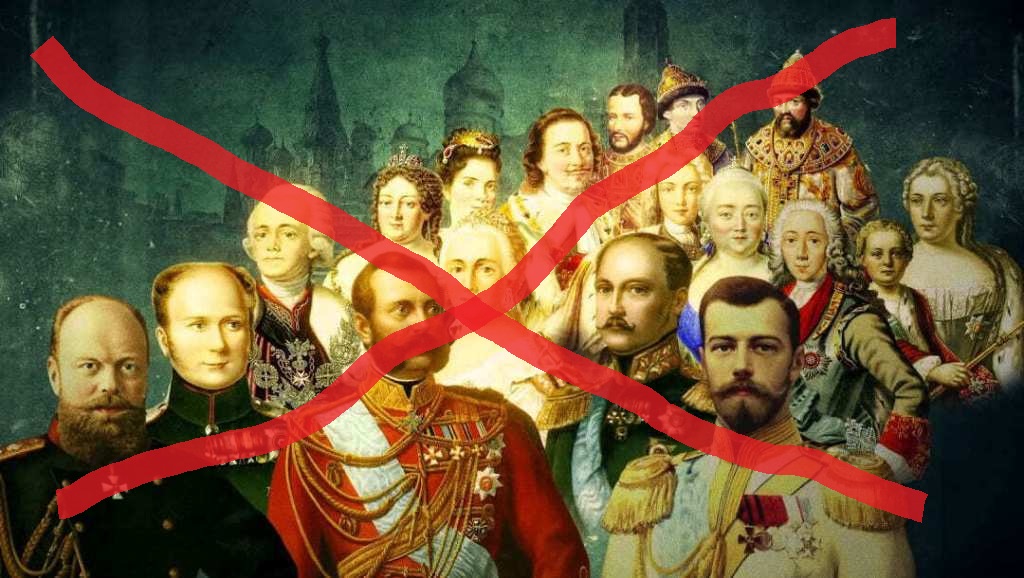
In recent years monuments, busts, icons and even church doors depicting members of the Romanov dynasty have been removed from sites in Ukraine, as part of the country’s mindless and shameful attempts to erase history.
Sadly, Ukraine’s actions mirror] that of the Bolsheviks in 1918, when Lenin ordered the removal of all symbols of Tsarist Russia, including the removal of all Tsarist symbols, such as double-headed eagles, the destruction of monuments, memorial plaques, the renaming of cities, towns, squares, buildings and street names.
NOTES:
[1] Until October 2025 the Assumption [aka Dormition] Cathedral was under the control of the Ukrainian Orthodox Church (Moscow Patriarchate). On 11th October 2025, by a court decision, the building was brought under state ownership. Clerics of the Moscow Patriarchate tried to prevent the entry of government official into the cathedral by barricading the central passage with benches. The (regional) state administration of Volyn Oblast handed the Assumption [aka Dormition] Cathedral to the Orthodox Church of Ukraine in January 2026.
The Ukrainian authorities have officially recognized the Romanov dynasty as a symbol of “Russian imperialism.” According to the current legislation, the authorities are obliged to carry out the so-called “decommunization” of all cultural heritage sites and geographical names associated with the Romanov dynasty.
During the 300+ year reign of the Romanov dynasty, there was a gradual inclusion of what are today, Ukrainian territories into the Russian state, and then the Russian Empire. The key event was the decision of the Pereyaslav Council in 1654, which consolidated the alliance of the Zaporozhye Army with the Russian Tsardom, after which Hetman Bohdan Khmelnytsky swore an oath of allegiance to Tsar Alexei Mikhailovich (1629-1676). Later, during the military conflicts with the Polish-Lithuanian Commonwealth and the Ottoman Empire, almost all the lands of modern day Ukraine gradually became part of the Russian Empire.
The decision of the Ukrainian authorities to “abolish” the Romanovs is perceived by many Ukrainians as an attempt to distort the historical past associated with the Russian Empire. The historical and cultural heritage of Ukraine was formed largely thanks to the Romanovs.
In addition to Tsars and Emperors, the Ukrainian Institute of National Memory[1] recognized a number of well-known statesmen and military figures of the Russian Empire, including writers, poets, composers and artists, as “symbols of Russian imperialism”.
The list include Field Marshall Mikhail Kutuzov (1745-1813), writer Ivan Bunin (1870-1953), author and poet Alexander Pushkin (1799-1837), playwright Alexander Griboyedov (1795-1829), literary critic and publicist Vissarion Belinsky (1811-1884), composer Mikhail Glinka (1804-1857), writer Nikolai Karamzin (1766-1826) among others. Together they to have been declated symbols of “Russian imperialism.” The document also indicates the need to eliminate all objects associated with these historical figures.
The purge actually began in the summer of 2022, when monuments to the Romanovs were removed by local authorities or vandalized by Ukrainian nationalists. Below, are just three of the casualties:
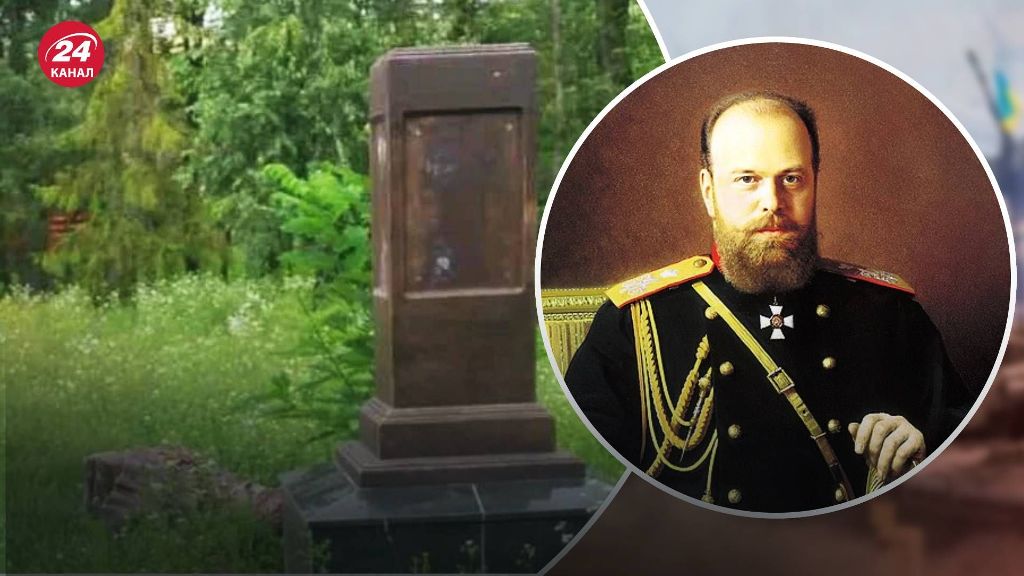
In July 2022, vandals destroyed a bust-monument to Emperor Alexander III in the village of Pershotravneve, located in the Kharkiv region of Ukraine. The bust of the “Tsar-Peacemaker” was knocked from its pedestal to the ground, while the plaque, which included Putin’s name was also removed from the front of the pedestal. The bust-monument was erected in 2013 on the occasion of the 400th anniversary of the Romanov dynasty and the 125th anniversary of the Borki Train Disaster in October 1888. On 29th October 1888, the Imperial Train carrying Tsar Alexander III and his family from Crimea to St Petersburg derailed at high speed at Borki.
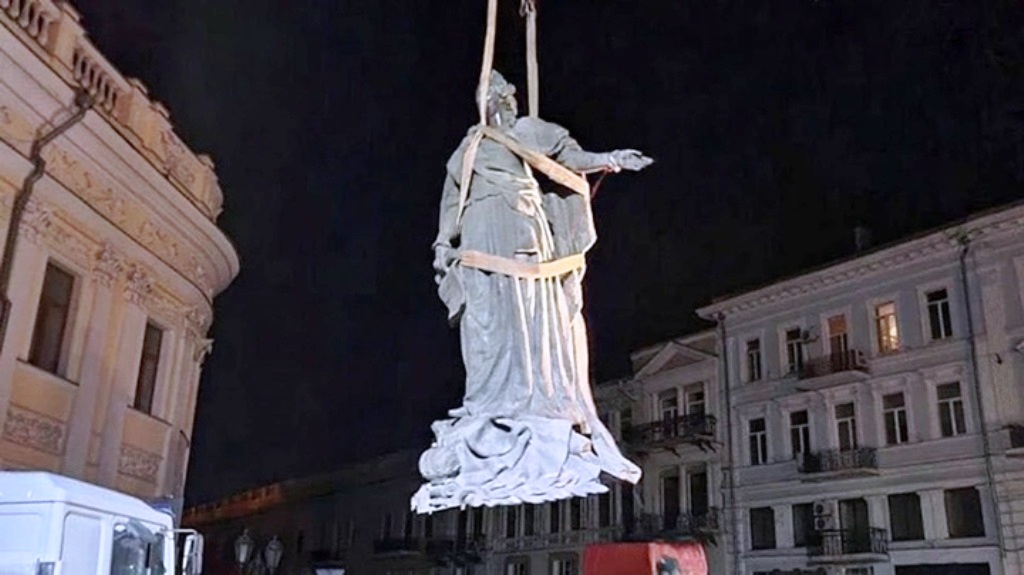
The original monument to Empress Catherine II (1729-1796) was built in 1900. The monument was toppled by the Bolsheviks in 1920, but was restored in 2007, with the private funds of Ruslan Tarpan, an Odesa businessman and member of the Odesa City Council
In July 2022, the monument to the Empress Catherine II, became the object of vandalism, it was repeatedly doused with red paint, an executioner’s cap was put over the empress’s head, and a hangman’s noose was attached to the hand of the empress’s sculpture. The monument became surrounded by a seven-meter-high fence.
As part of “derussification” in Ukraine, the monument was dismantled on 28th December 2022.
And where does this Russophobic attitude adopted by the Ukranian authorities end? Will they exhume the remains of Russian prime minister Pyotr Stolypin, who was assassinated in Kiev in 1911, and is now buried at the Kiev-Pechersk Lavra. This seems feasible, especially given that Ukrane has already banned the Russian Orthodox Church[2].
Sadly, Ukraine’s actions mirror] that of the Bolsheviks in 1918, when Lenin ordered the removal of all symbols of Tsarist Russia, including the removal of all Tsarist symbols, such as double-headed eagles, the destruction of monuments, memorial plaques, the renaming of cities, towns, squares, buildings and street names.
Ukrainian school children will now learn the Soviet version of Romanov history, who poisoned the minds of both children and adults on the Romanovs for much of the 20th century. To this day, the myths and lies created and distributed by the Bolsheviks and later the Soviets continue to distort the legacy of Russia’s last tsar, who reigned from 1894 to 1917.
And can you imagine what would happen to Livadia, if Ukraine regains control of Crimea? For years, the second floor of the palace has been a museum dedicated to Nicholas II and his family, this would most certainly be closed. In addition, all the monuments to the Romanovs which have been installed throughout Crimea, would be destroyed. These include monuments of Emperors Nicholas II and Alexander III, Empress Alexandra Feodorovna, Grand Duchess Elizabeth Feodorovna and Grand Duke Sergei Alexandrovich.
Lord have mercy!
NOTES:
[1] The Ukrainian Institute of National Memory is a central executive body operating under the Cabinet of Ministers of Ukraine. It was established on 31st May 2006 to restore and preserve the national memory of the Ukrainian people.
[2] Kiev is considered the birthplace of the Russian Orthodox Church, as it was the site of the Christianization of Kievan Rus’ in 988, during the reign of Vladimir the Great (958-1015). This event marked the introduction of Byzantine Christianity to the Eastern Slavic lands, leading to the establishment of the Russian Orthodox Church.
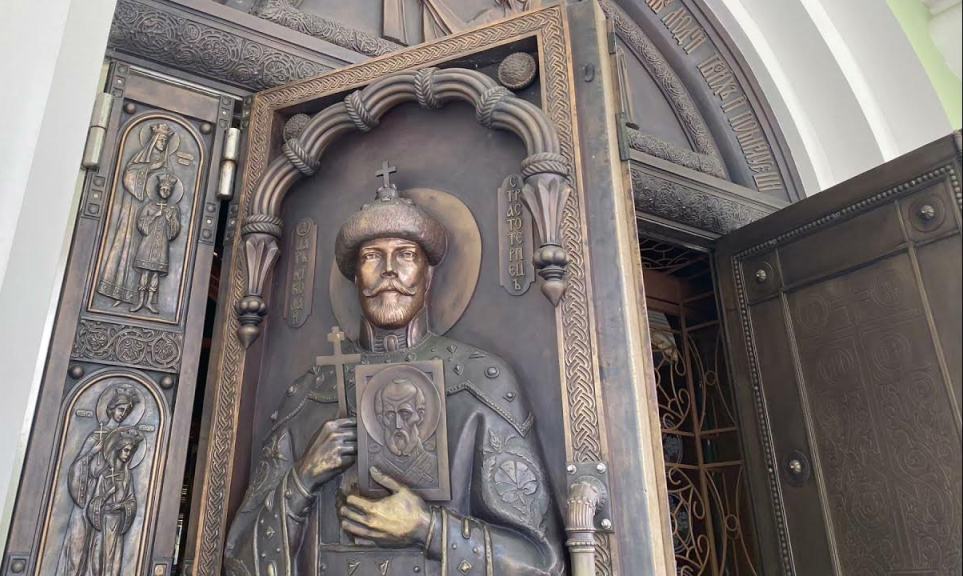
 Nicholas II
You must be logged in to post a comment.