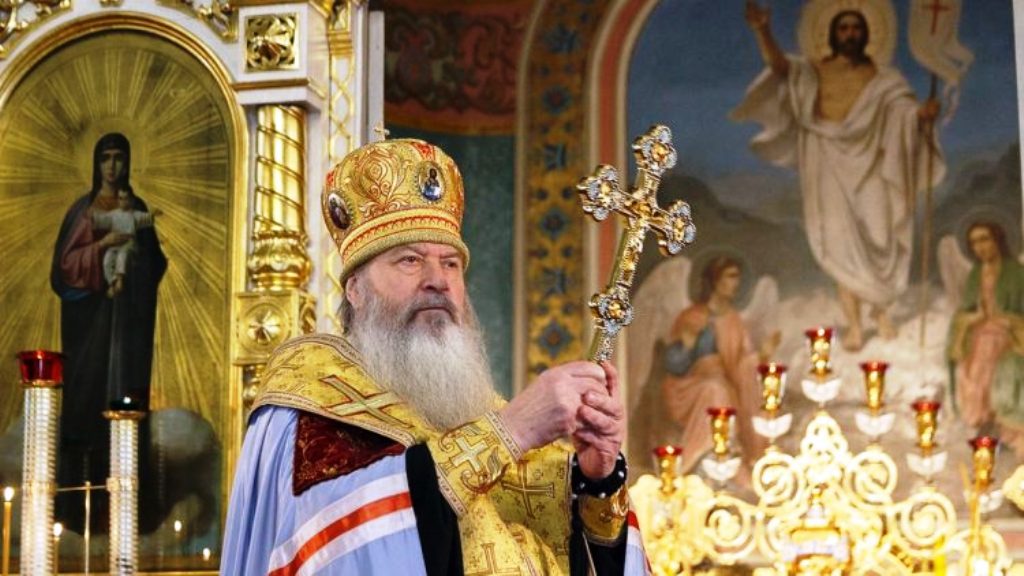
“Nothing prevents the ROC from recognizing the authenticity of the Ekaterinburg Remains” – Metropolitan Hilarion
The Russian Orthodox Church has no doubts about the authenticity of the remains of Emperor Nicholas II and his family, found near Ekaterinburg. Nothing prevents the recognition of their authenticity, Metropolitan Hilarion emphasized during an interview held today, on the program Church and World on the Russia 24 TV channel.

The head of the Synodal Department for External Church Relations of the Russian Orthodox Church added: “In my opinion, nothing today prevents the recognition of the authenticity of the Ekaterinburg Remains, but in order for them to be recognized as authentic, a conciliar decision of the Church is needed.”

This decision must be made by the highest leadership of the Church, and the highest leadership is the Council of Bishops of the Russian Orthodox Church, he explained. Metropolitan Hilarion emphasized that following the report of the Investigative Committee in June 2021 at a meeting of the Holy Synod, none of the bishops should have had any further doubts about the authenticity of the remains after the examinations.

The Bishops’ Council was scheduled to meet in Moscow 15th to 18th November 2021, however, this was postponed due to the COVID-19 situation in Russia. The Bishops’ Council will now convene from 26th to 29th May 2022.

“If the arguments in favour of the authenticity of the Ekaterinburg Remains prevail, then a final decision will be made,” Metropolitan Hilarion noted. He explained why a decision by the Holy Synod of the Russian Orthodox Church is important in this case. “If the Synod recognize the Ekaterinburg Remains as the remains of the Imperial Family, it means they are holy relics, it means they need to be venerated appropriately”.

Metropolitan Hilarion also said that the Council of Bishops will determine the final resting place of the Imperial family’s remains. It should be noted, that as Holy Relics, they cannot be returned to their tomb in St. Catherine’s Chapel [SS Peter and Paul Cathedral in St. Petersburg], as relics cannot be returned to the earth. They must be placed in reliquaries above ground which allows the faithful to venerate them.

In July 2020, the historical and archival examination, which was carried out as part of the investigation into the murder of the Imperial Family, confirmed the authenticity of the Ekaterinburg remains. Associate professor of the Historical Archive Institute of the Russian State Humanitarian University Evgeny Vladimirovich Pchelov, explained, genetics were involved in the identification of the remains. In addition, researchers analyzed over 2,000 historical documents: written sources, photographs, and audio recordings. The documents were collected from more than 15 Russian and foreign archives.

Vladimir Nikolaevich Soloviev, retired senior investigator and forensic expert at the Main Department of Criminalistics (Forensic Center) of the Investigative Committee of the Russian Federation, who from 1991 to 2015 led the investigation into the deaths of the Imperial Family, fully supports the decision of the Russian Church to recognize the Ekaterinburg Remains as authentic, considers it indisputable.

“I fully support this statement. I categorically say that these are the remains of the Imperial Family, geneticists told us with 100% accuracy,” Solovyov told Interfax on Saturday, commenting on the Russian Orthodox Church’s statement that there are no obstacles to recognizing the authenticity of the remains.

© Paul Gilbert. 22 January 2022
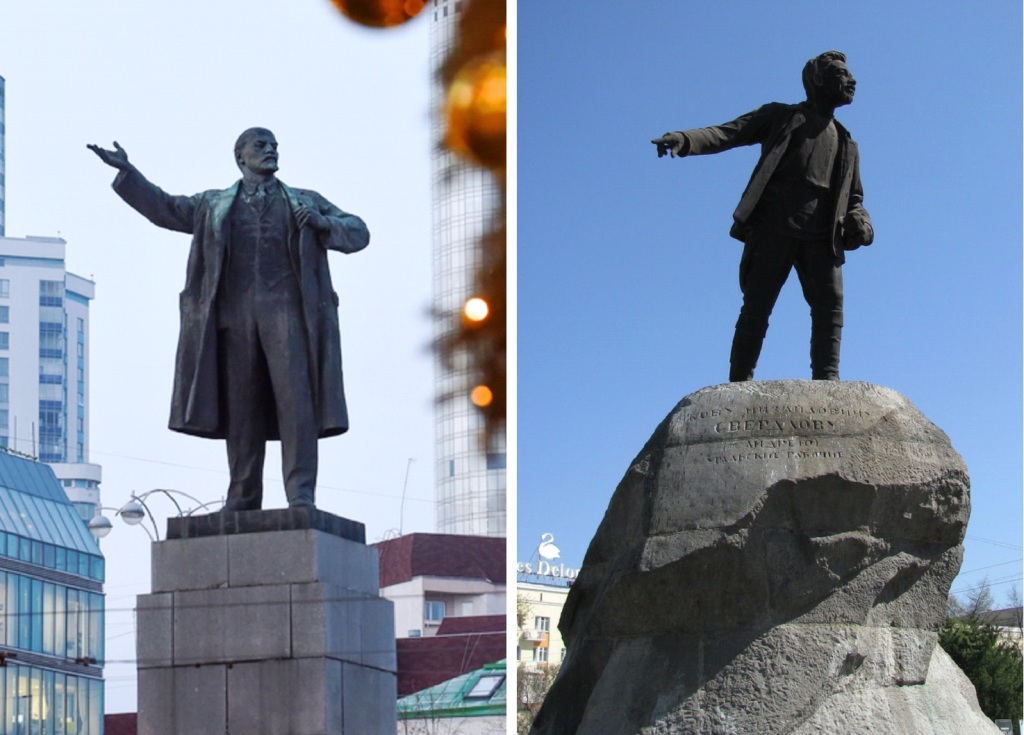
Russian sculptor proposes removal of monuments to Bolsheviks in Ekaterinburg

PHOTO: monuments to Lenin and Sverdlov in Ekaterinburg

The famous Russian sculptor Konstantin Vasilievich Grunberg has proposed replacing monuments of the Bolshevik leaders Vladimir Ulyanov (Lenin) and Yakov Sverdlov in Ekaterinburg with monuments to Emperor Alexander II (1818-1881) and *Empress Catherine I (1684-1727).

*Ekaterinburg was founded on 18th November 1723 and named after the Russian emperor Peter the Great’s wife, who after his death became Empress Catherine I, Yekaterina being the Russian form of her name.

Grunberg believes that by replacing the Bolshevik monuments will help solve the problem with city-planning concept. Although Ekaterinburg is called the capital of the Urals, little of the city’s history is reflected in the the center of Russia’s 4th largest city.

“Lenin’s monument should be removed from the 1905 Square, and in his place a bronze monument to Emperor Alexander II should be returned to its original pedestal” said Konstantin Grunberg.

In 1906, a monument to Alexander II [demolished by the Bolsheviks in 1917] was installed on Cathedral Square [renamed 1905 Square],near the Epiphany Cathedral [demolished by the Bolsheviks in 1930]. The monument to Lenin was installed on the site in the early 1950s.

Grunberg made the same proposal regarding the monument to Sverdlov [opened in 1927], which is situated on the Paris Commune Square in the middle of Lenin Avenue between the Ural Federal University and the Opera and Ballet Theater. The sculptor has proposed that a monument to Empress Catherine I would look more appropriate.

“Throw the monuments to Lenin and Sverdlov into a pit!” Grunberg suggested.

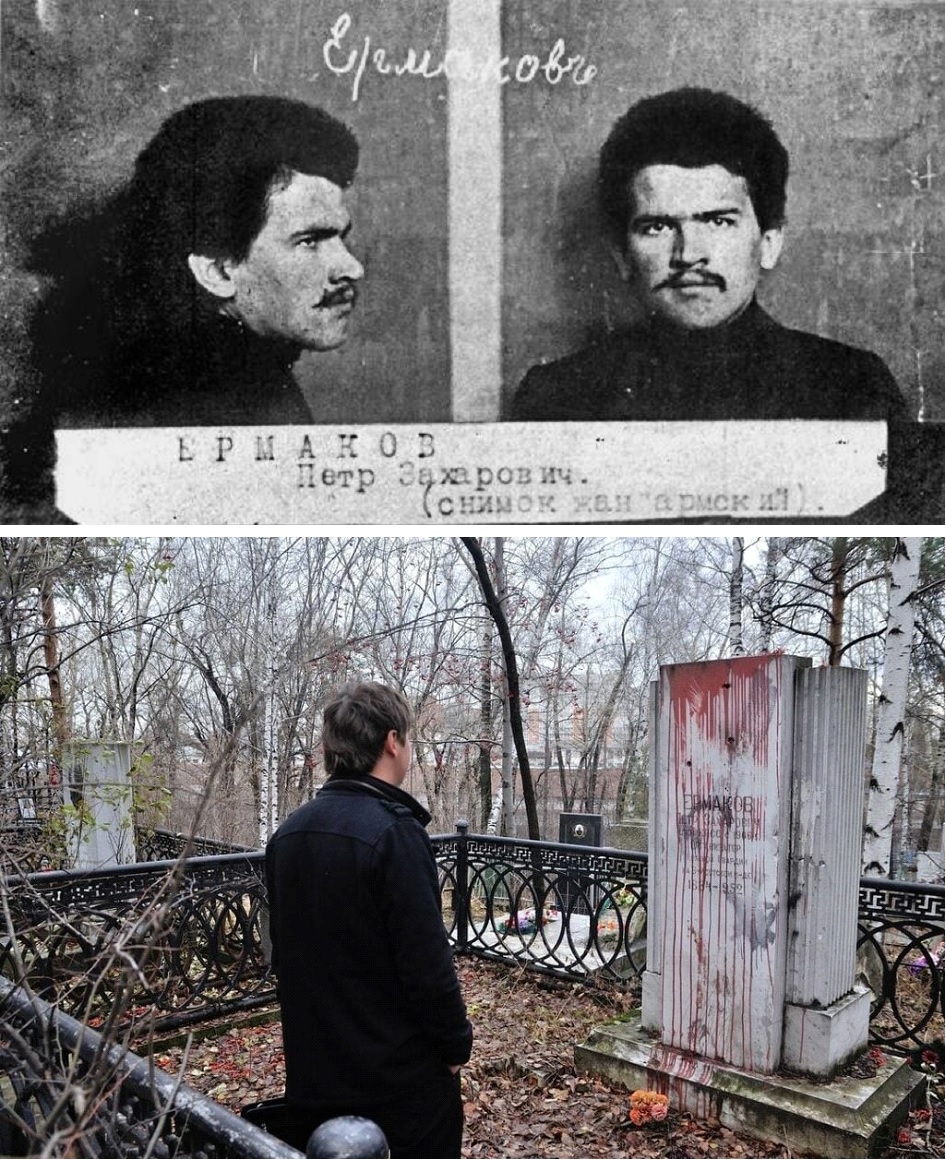
PHOTO: ‘You reap what you sow’ – local monarchists take revenge on the Bolshevik revolutionary and murderer Peter Zakharovich Yermakov (1884-1952), by dosing his grave with red paint symbolizing blood

Konstantin Grunberg also called for debunking the image of the revolutionary “hero” Pyotr Yermakov, who participated in the murder of the Imperial Family and whose grave is located in the cemetery next to the grave of the writer Pavel Bazhov. “People still bring flowers to his grave. We need to destroy this regicide’s grave!” the sculptor said.

Yermakov died in Sverdlovsk on 22 May 1952 from cancer at the age of 67 and was buried in Ivanovo Cemetery in Ekaterinburg.

In 1951, at a reception, which gathered all the local Party elite in Sverdlovsk, Yermakov approached Soviet Red Army General Georgy Zhukov [1896-1974] and held out his hand. Frowning in disgust Zhukov looked Yermakov in the eye, and muttered, “I do not shake the hands of the murderers.”

Yermakov’s Mauser revolver, which he alleges fired the fatal shot which ended the life of Russia’s last Tsar is preserved today in the Museum of History and Archaeology of the Urals in Ekaterinburg.

Every year, since the 1990s, Yermakov’s grave has been vandalized by local monarchists, who douse his gravestone with red paint.

The red paint symbolizes the blood which this evil man spilled, and his involvement in the brutal murder of Nicholas II and his family on 17th July 1918.

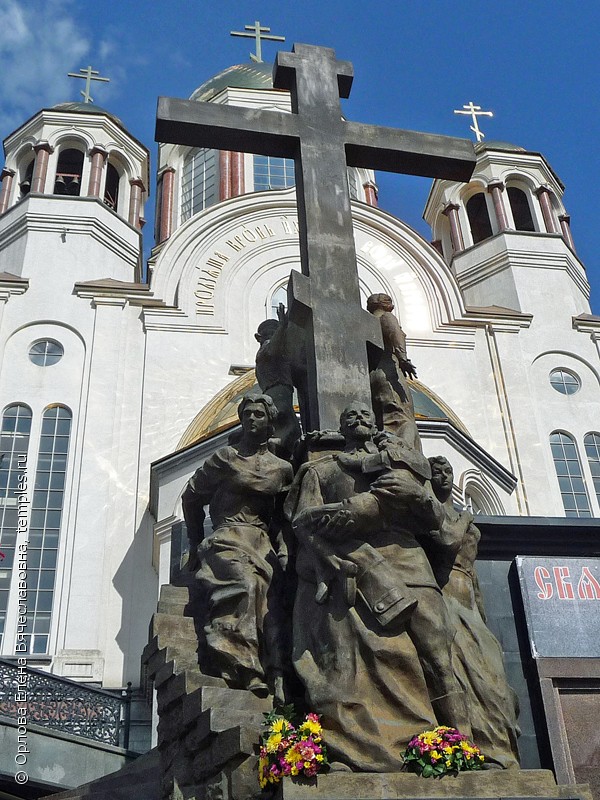
PHOTO: Grunberg’s monument to the Holy Royal Martyrs, Church on the Blood

Konstantin Vasilievich Grunberg [born in Sverdlovsk in 1944] is a famous Russian sculptor who has eight monuments to his credit. Among them is the sculptural composition of the Holy Royal Martyrs situated at the entrance to the Lower Church of the Church on the Blood in Ekaterinburg. The composition which was officially unveiled and consecrated on 28th May 2003, depicts the Imperial Family descending the 23 steps in the basement of the Ipatiev House, where they met their death and martyrdom on 17th July 1918.

© Paul Gilbert. 15 January 2022

Memorial plaque to Nicholas II and his mother unveiled in Kostroma

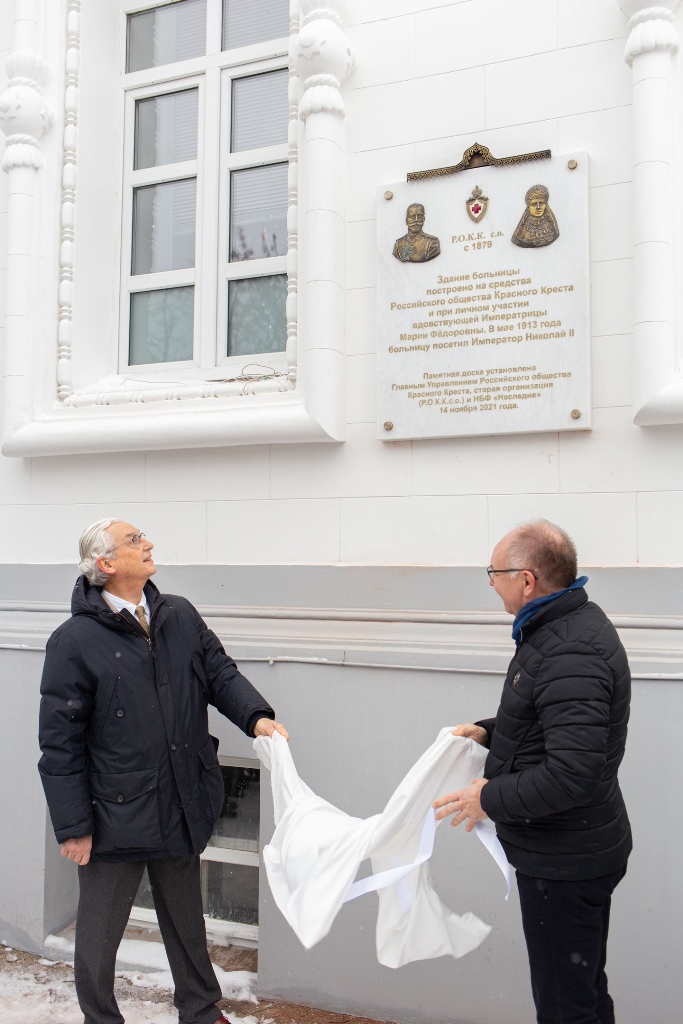
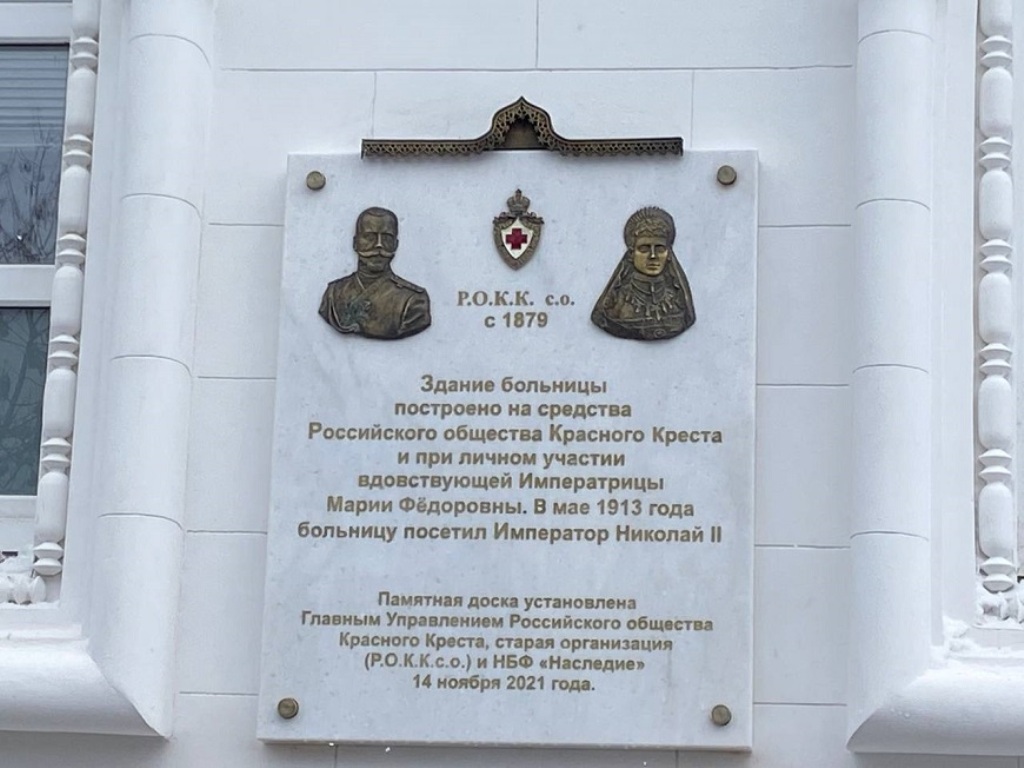
PHOTO: memorial plaque to Emperor Nicholas II and his mother Empress Maria Feodorovna unveiled and consecrated on 15th January 2022, on the facade of the Oncological Dispensary – the former Feodorovskaya Hospital in Kostroma

On 15th January 2022, a memorial plaque bearing the images of Emperor Nicholas II and his mother Empress Maria Feodorovna was officially unveiled and consecrated on the facade of the Oncological Dispensary – the former Feodorovskaya Hospital in Kostroma.

The memorial plaque was officially unveiled by the mayor of Kostroma, Yuri Zhurin, and the chairman of the Society of the Historical Russian Imperial Red Cross, Count Sergei Kapnist. At the end of the ceremony, Metropolitan Ferapont of Kostroma and Nerekhta consecrated the memorial plaque, sprinkling it with holy water.

Constructed in 1911-1913, the hospital fell under the administration of a community of sisters of mercy of the Red Cross in the name of the Feodorovskaya Icon of the Mother of God.

The hospital was considered one of the most advanced in Russia of the time. The hospital was under the patronage of the Dowager Empress Maria Feodorovna, who served as president of Russia’s Red Cross during the First World War.

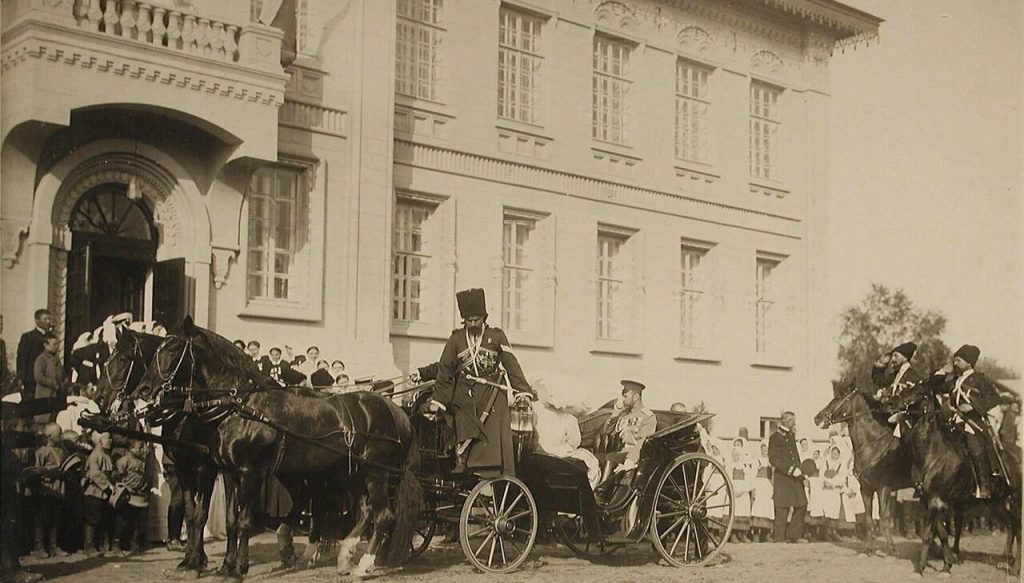
PHOTO: Nicholas II and his daughters visit the Feodorovskaya Hospital in Kostroma, 20th May 1913

During the celebrations marking 300th anniversary of the Romanov Dynasty in 1913, Emperor Nicholas II and his four daughters Grand Duchesses Olga, Tatiana, Maria and Anastasia visited the hospital on 20th May.

During the First World War, the hospital was used as an infirmary for wounded Russian soldiers. Currently, it is one of the buildings of the oncological dispensary.

The memorial plaque was made with the support of the Russian Red Cross Society and the Union of Historical and Educational Societies “Heritage of the Empire”, was installed on the building’s façade on 14th November 2021.

Repair and restoration work has been completed on the facade of the architectural monument. Funding was provided by the Kostroma Regional Anti-Cancer Charitable Foundation and the Heritage Charitable Foundation.

The inscription translated reads:

“The hospital building was built by the Russian Red Cross Society and with the personal participation of the Dowager Empress Maria Feodorovna. In May 1913, Emperor Nicholas visited the hospital.”

© Paul Gilbert. 16 January 2022

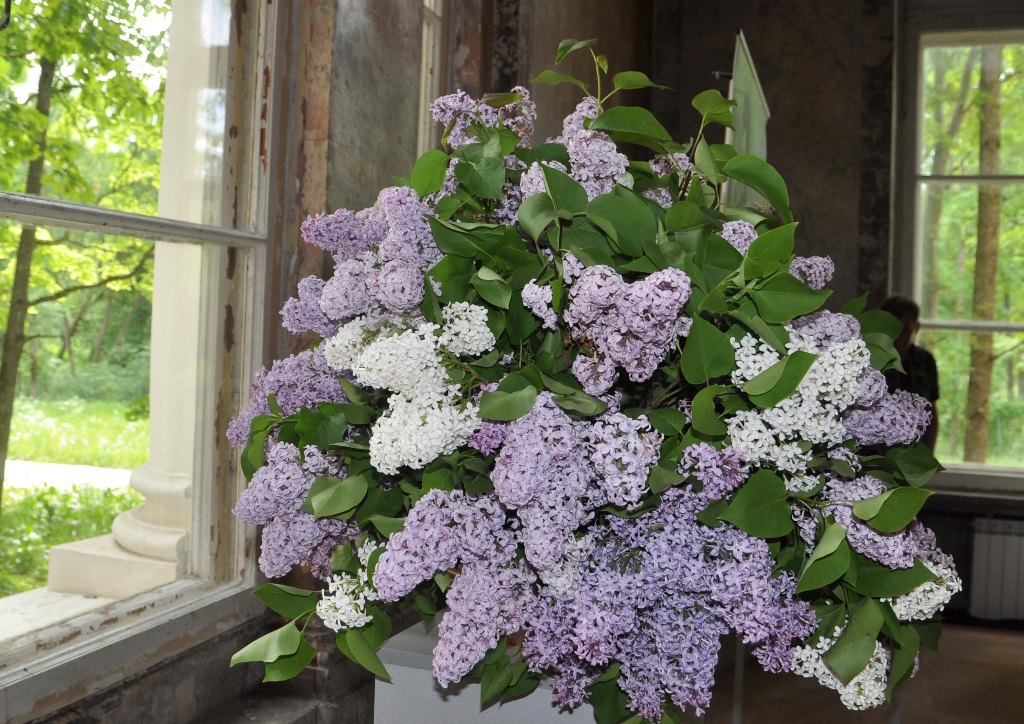
Lilacs return to the Alexander Palace

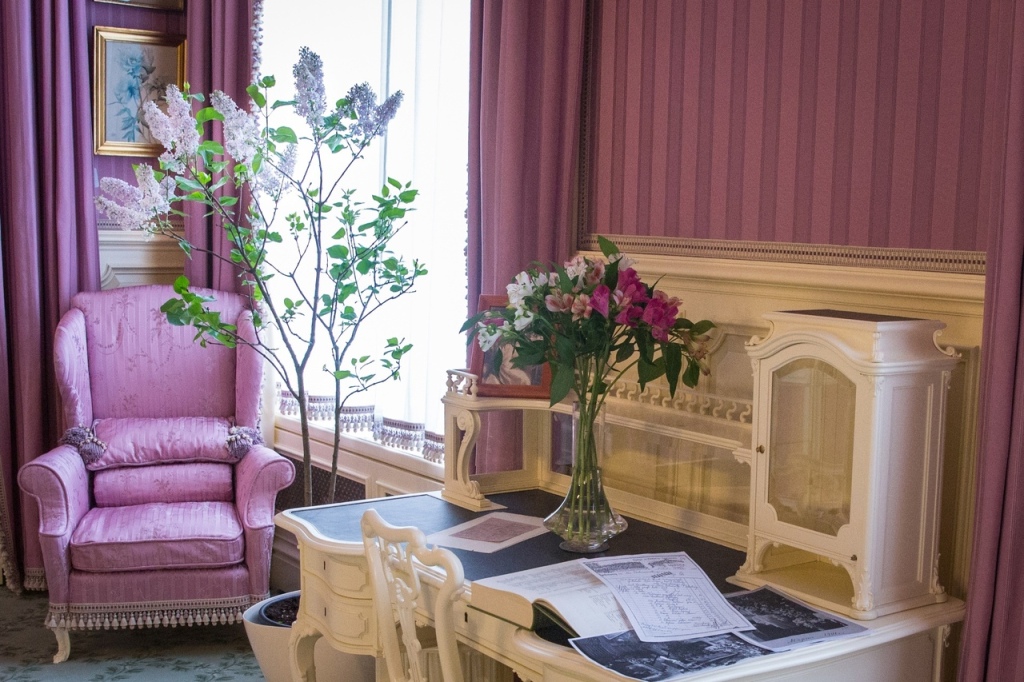
PHOTO: after more than a century, fresh lilacs once again decorate the recently restored interior of the Empress’s Mauve Boudoir in the Alexander Palace. © Tsarskoye Selo State Museum

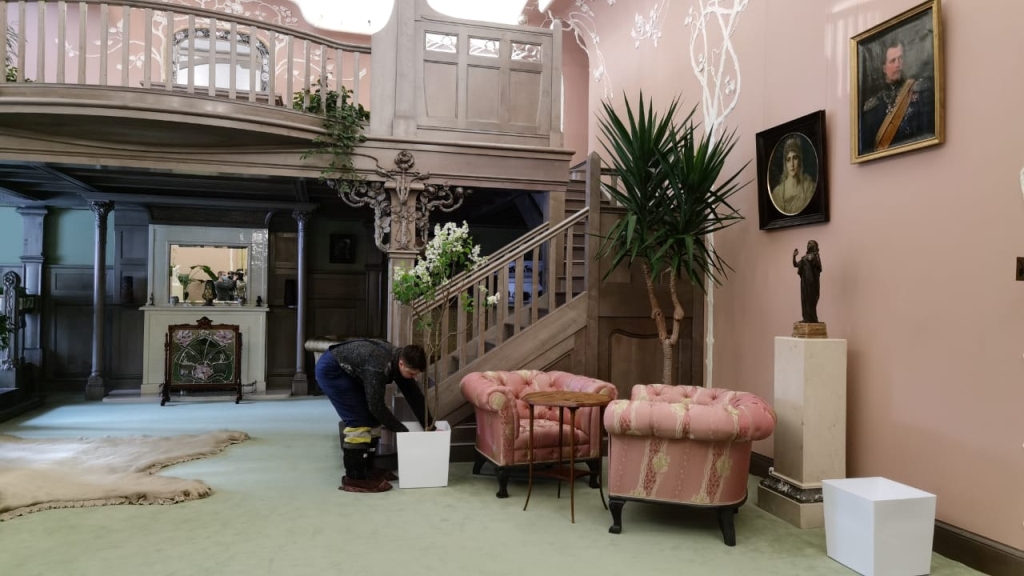
For the first time in more than a hundred years, the fragrant scent of lilacs once again fill the interiors of the Alexander Palace during the cold winter months. The Tsarskoye Selo State Museum have revived the tradition, by placing lilacs in the Mauve (Lilac) Boudoir and the Maple Drawing Room of the Alexander Palace.

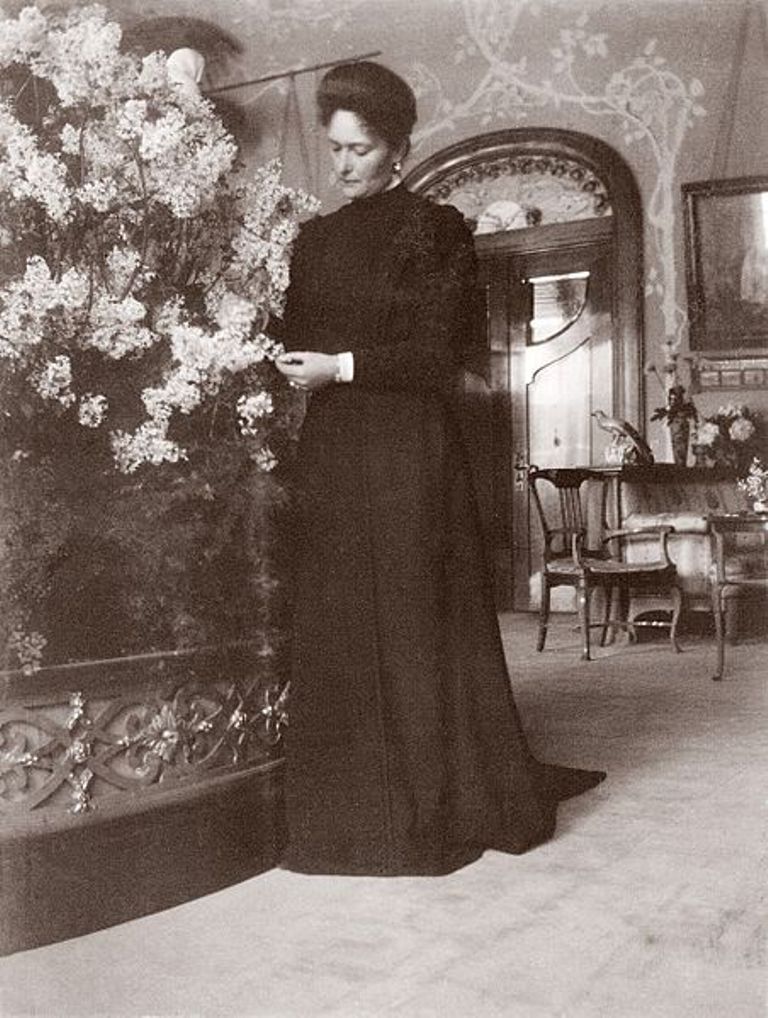
It was during the Imperial Family’s residence in the palace [between 1905-1917] that Empress Alexandra Feodorovna, filled her rooms fresh flowers year round. During the winter months, fragrant lilacs were grown in the greenhouses at Tsarskoye Selo. Even during the first few months of their house arrest in 1917, flowers remained in the interiors. Since “prisoners” were not entitled to any luxuries, the flowers were soon removed from the rooms by their captors.

PHOTO: fresh lilacs have also been placed in the recently restored interior of the Maple Drawing Room in the Alexander Palace. © Tsarskoye Selo State Museum

In order to provide fresh lilacs for the palace, the greenhouses at Tsarskoye Selo, as in the beginning of the last century, use a forcing technique, by which plants come out of dormancy, allowing them to bloom throughout the year. In the early 20th century, bushes were planted in greenhouse boxes, and lilacs began to be prepared for awakening in December, with the help of additional light. The interiors of the Alexander Palace were decorated with historical varieties, among them the famous white “Madame Lemoine” lilac, which was on the order lists of Tsarskoye Selo gardeners. It was from this variety that the cult of lilac began.

Empress Alexandra Feodorovna loved flowers – the rooms in her private quarter of the palace were decorated with fresh flowers all year round. Floral themes were also present in the wall upholstery, furniture, stucco reliefs on the walls and ceilings. The Empress was especially fond of lilacs. It is no coincidence that in her Mauve (Lilac) Boudoir, that the furniture and walls were decorated with lilac-colored silk, which reflected the Empress’s preferred lilac tones in clothes, and lilac-scented perfumes.

PHOTO: Empress Alexandra Feodorovna admiring a tub of lilacs in the Mauve Boudoir of the Alexander Palace, Tsarskoye Selo. 1909

Lilacs were placed everywhere in the palace: cut branches in a vase on a table by the window and bushes in a jardinière [a decorative flower box or planter] by the sofa in the Mauve (Lilac) Boudoir; magnificent lilac compositions decorated the Pallisander (Rosewood) and Maple Drawing Rooms.

In present day, between late spring – early summer, the Catherine and Alexander Parks are filled with lilacs, especially along Lilac Alley in the Catherine Park.

Lilacs first appeared at Tsarskoye Selo in the 18th century. Under Empress Elizabeth Petrovna, trees and shrubs were regularly planted in the parks of Tsarskoye Selo, including lilacs. Under Catherine II, parks and greenhouses were replenished with new species of plants, flowers and shrubs, including lilacs. Under Alexander I in 1817, at the direction of the architect Adam Menelas, the gardener Fyodor Lyamin planted lilacs in front of the palace and the colonnade, where they continued to bloom for over a hundred years. In the middle of the 19th century, the Lilac Alley was created, stretching from the Pink Guardhouse to the Krestovy Canal. In the 19th century, gardeners planted many new varieties of lilacs with various colors: white, mauve, purple and pink.

In the 19th century, many new varieties of lilac appeared with a variety of colors: white, mauve, purple and pink. A rich collection was formed at the end of the century in a small family company Lemoynov from the French city of Nancy. It was founded by Victor Lemoine, a master of ornamental plant breeding. He was not a supplier of the Russian Imperial Court, however, his varieties were purchased for Tsarskoye Selo, among them – “Madame Antoine Buchner” (terry lilac with dark pink buds, large, fragrant flowers from mauve-pink to pale whitish -pink), “Madame Lemoine” (lilac with white, large, double fragrant flowers).

PHOTO: each year, lilacs decorate the interiors of the Alexander Palace on 6th June, in honour of Empress Alexandra Feodorovna’s birthday. The photo above, shows the Marble (Mountain) Hall

In the years prior to the closing of the Alexander Palace for restoration between 2015-2021 – bouquets of fresh lilacs were placed in the former apartments of the Empress on her birthday: 6th June [O.S. 25th May]. Now that the restoration of the eastern wing of the Alexander Palace has been completed, let us hope that this annual tradition is also revived.

© Paul Gilbert. 12 January 2022
Bolsheviks and atheists oppose installation of a monument to Nicholas II in Vladimir

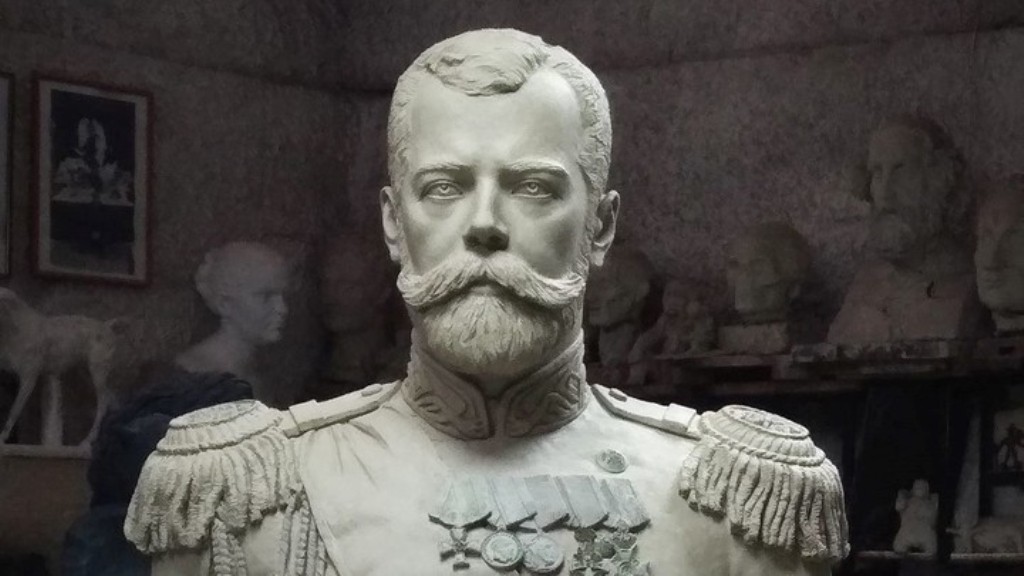
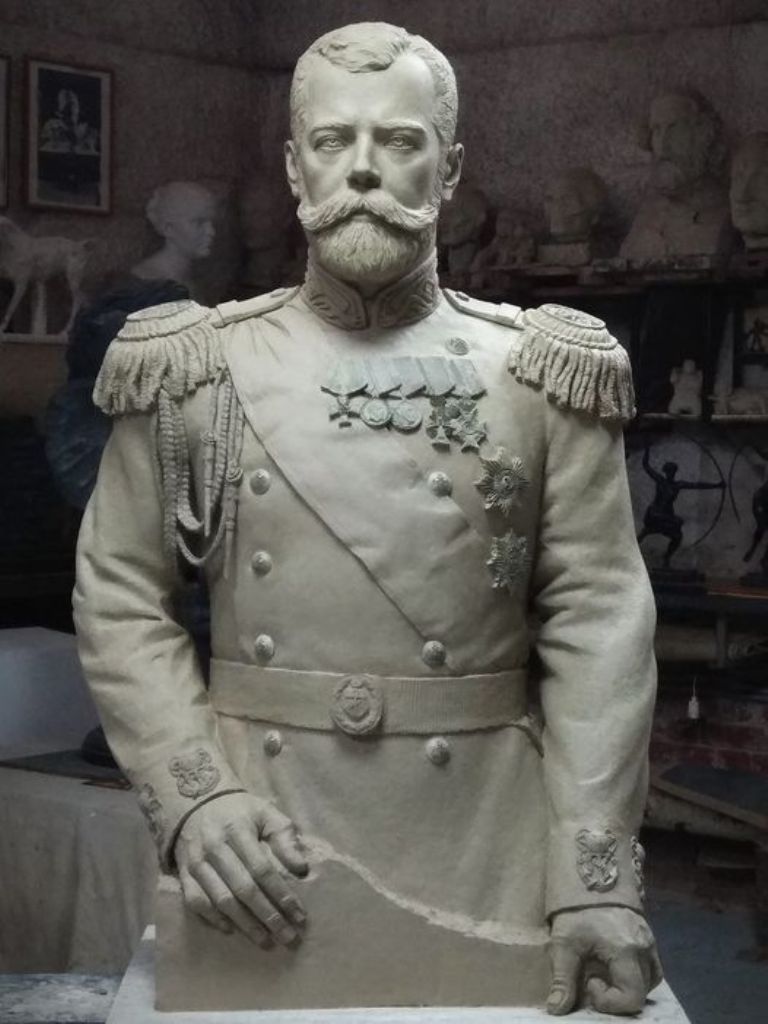
PHOTO: the clay model of the monument to Nicholas II by sculptor Ilya Shanin

Within 24 hours of the announcement of plans to install a new monument to Emperor Nicholas II this summer in Vladimir, opponents reared their ugly heads in protest. It should come as no surprise, that the statements issued by both communist and atheist opposition groups wreak of historical inaccuracies and hypocrisy.

According to Russian media sources, the initiative was first criticized by the regional branch of the Communist Party of the Russian Federation. The party’s statement says that local communists are “categorically opposed to perpetuating the memory of ‘Nicholas the Bloody‘ because he organized the mass execution of unarmed workers in St. Petersburg and dragged Russia into two unnecessary wars.

“The cynicism of the initiative is further aggravated by the fact that 2022 is the year marking the 100th anniversary of the formation of the Union of Soviet Socialist Republics, the most developed and fairest state in the world, thanks to whose legacy the Russian Federation still exists. The installation of a monument to the unfortunate tsar who denied his people civil rights and the Constitution looks like blasphemy and mockery not only of common sense, but also of the victorious people,” the regional branch of the Communist Party of the Russian Federation argued in a statement.

It is interesting to note that these same communists themselves work to immortalize the name of Stalin in Vladimir. In 2015, a bust of Stalin was installed near the offices of the Vladimir regional committee of the Communist Party of the Russian Federation. It was later moved to a private property, along with monuments to other Soviet leaders. Recently, they proposed to rename a street in honour of the Soviet dictator, or at least hang a memorial plaque in his honour.

It is interesting – and yet not surprising – that the communists prefer to overlook the fact that Joseph Stalin remains one of the most notorious figures in history, one whose legacy is stained with the blood of millions of innocent Russians, through collectivization, famine, terror campaigns, disease, war and mortality rates in the Gulag. Sadly, we may never know the actual numbers, but the number of victims is estimated to be in the millions.

PHOTO: Metropolitan Tikhon of Vladimir and Suzdal

In addition, the Vladimir branch of the All-Russian public organization “Atheists of Russia” have also voiced their opposition to the monument to Nicholas II in the city. The activists sent an appeal to Metropolitan Tikhon of Vladimir and Suzdal, in which they asked to prohibit the installation of the monument, even though the monument is to be installed on the grounds of the Church of the Life-Giving Trinity.

“In the history of Russia, perhaps, it is impossible to find rulers to whom society treated so negatively as to Nicholas Romanov, who received the nickname “bloody” among the people. The majority associate Nicholas Romanov with the powerlessness and illiteracy of the population of Russia, the shooting of peaceful demonstrators, obscurantism, failed wars, etc. “

Members of the organization believe that the implementation of the project may lead to conflicts on religious grounds in the Vladimir region. What nonsense!

It should be noted, that the installation of the proposed monument to Nicholas II on the grounds of the Church of the Life-Giving Trinity, has not yet been approved by Metropolitan Tikhon. Despite this, the rector of the church announced a fundraising initiative for its construction on 7th November 2021.

© Paul Gilbert. 11 January 2022
Grand Duke Kirill Vladimirovich: the “Soviet Tsar”

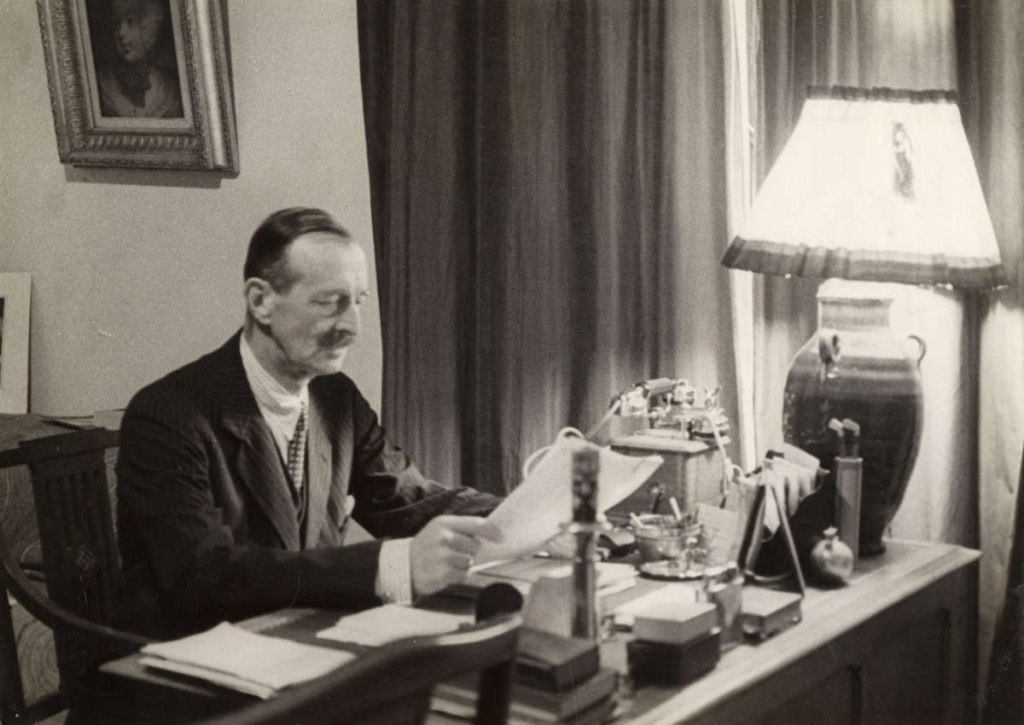
PHOTO: Grand Duke Kirill Vladimirovich in exile

On 31st August 1924, Grand Duke Kirill Vladimirovich (1876-1934) proclaimed himself Emperor of All Russia to the non-existent Russian throne under the name of “Kirill I”. He became known as the “Soviet Tsar” because in the event of a restoration of the monarchy, he intended to keep some of the features of the Soviet regime.

While living in exile, he was supported by a small group of émigrés who styled themselves “legitimists”, underlining the “legitimacy” of Kirill’s succession. [Note: the “legitimists” today support Kirill’s great-granddaughter Princess Maria Vladimirovna, born 1953].

The opponents of Kirill were known as the “un-predetermined”, which included Emperor Nicholas II’s mother: the Dowager Empress Maria Feodorovna, her daughters Grand Duchesses Xenia and Olga Alexandrovna, Grand Dukes Nicholas and Peter Nikolaevich, who believed that in the wake of the radical revolutionary events that the convening of a Zemsky Sobor was necessary in order to choose a new monarch for Russia.

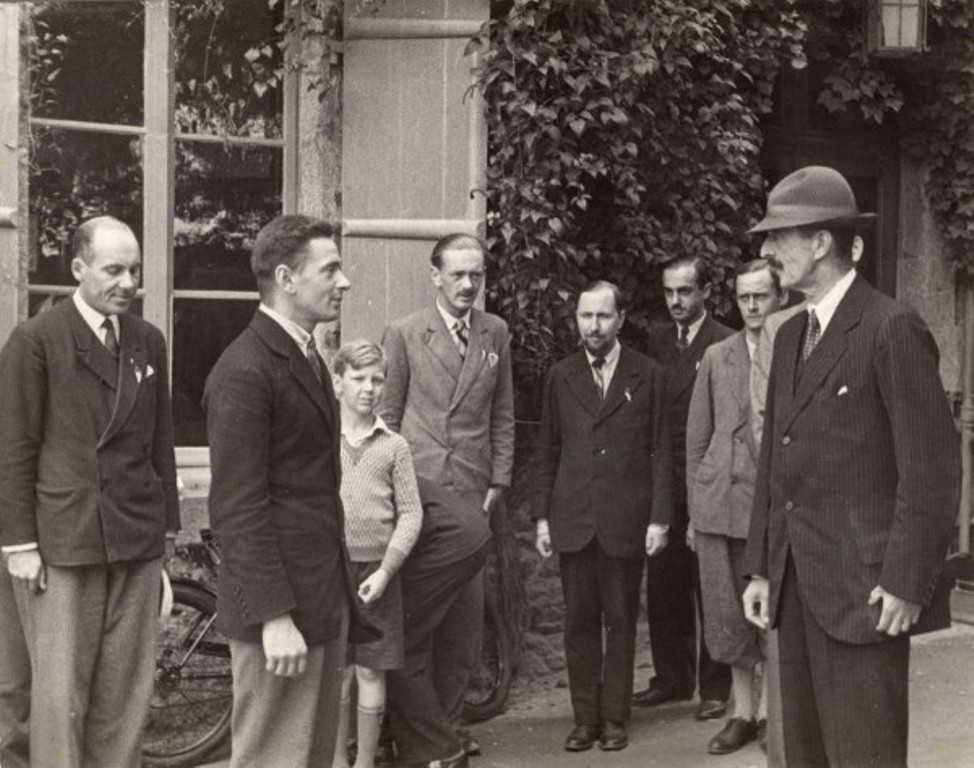
PHOTO: Grand Duke Kirill Vladimirovich meets with members of the Union of Mladorossi [Young Russians]

Kirill found his strongest support among a group of radical “legitimists” known as the Union of Mladorossi [Young Russians], a Russian émigré organization, who became heavily influenced by fascism. It is known, that the Young Russians group tried to flirt with the Nazis, however, their relationship with the latter was short lived. The fascist influence on the Young Russians was demonstrated not only by its doctrine but also be its visible use of the Roman salute used by Benito Mussolini and Adolf Hitler [the Sieg Heil].

In addition, the organization began to exhibit pro-Soviet sympathies, arguing that a hybrid of Russian monarchy and the Soviet Bolshevik system could peacefully coexist—their slogan being “Tsar and the Soviets”, a socialist version of the traditional “Tsar and People”.

According to the Young Russians, the revolution had given birth to a “new man” – a heroic type, capable of courage and self-sacrifice. They saw these virtues in Kirill Vladimirovich – the grand duke known for being a coward, lacking a moral compass, and a traitor to Emperor Nicholas II.

Kirill sent Grand Duke Dmitri Pavlovich (1891-1942), as his representative to the party leadership of the Young Russians. Kirill’s brother Grand Duke Andrei Vladimirovich (1879-1956), also took part in the activities of the Young Russians.

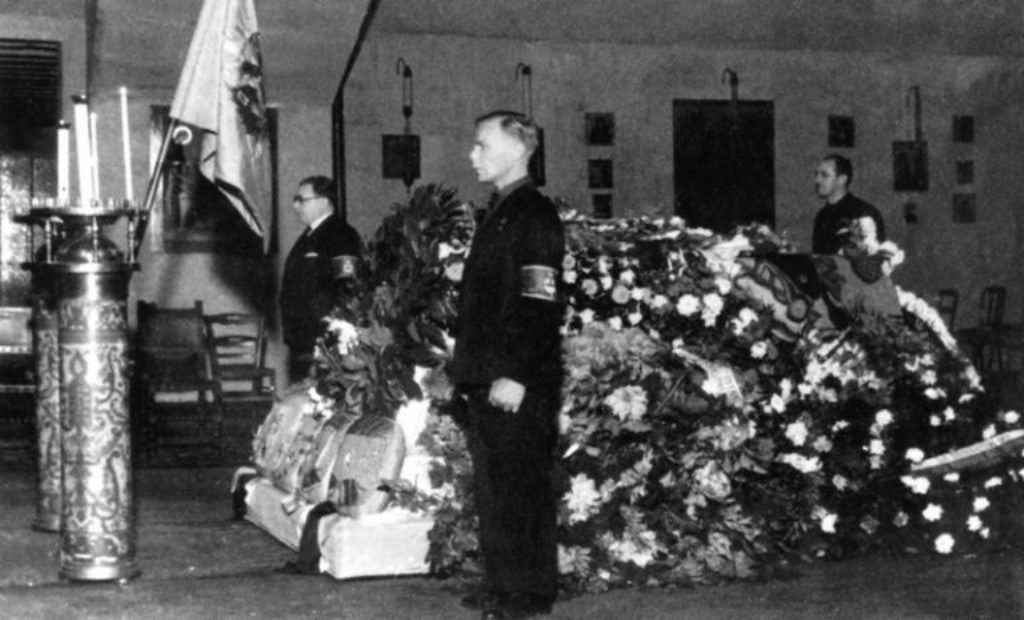
PHOTO: members of the Union of Mladorossi [Young Russians] provided an honour guard at the funeral of Grand Duke Kirill Vladimirovich, in Coburg in 1938

The bulk of the Russian emigration did not support the Young Russians movement, which openly communicated with the State Political Directorate (GPU), the Soviet intelligence and secret police service. According to various estimates, modern researchers of the Russian diaspora estimate their number from 2,000 to 5,000 members, which is in any case a very large figure for the politically active part of the emigration.

Upon the death of Grand Duke Kirill Vladimirovich on 12th October 1938, members of the Union of Mladorossi [Young Russians] provided an honour guard at his funeral in Coburg in 1938. Following the death of Kirill in 1938, and during the Second World War, his son Vladimir Kirillovich (1917-1992) maintained relations0 with the Mladorossi.

***

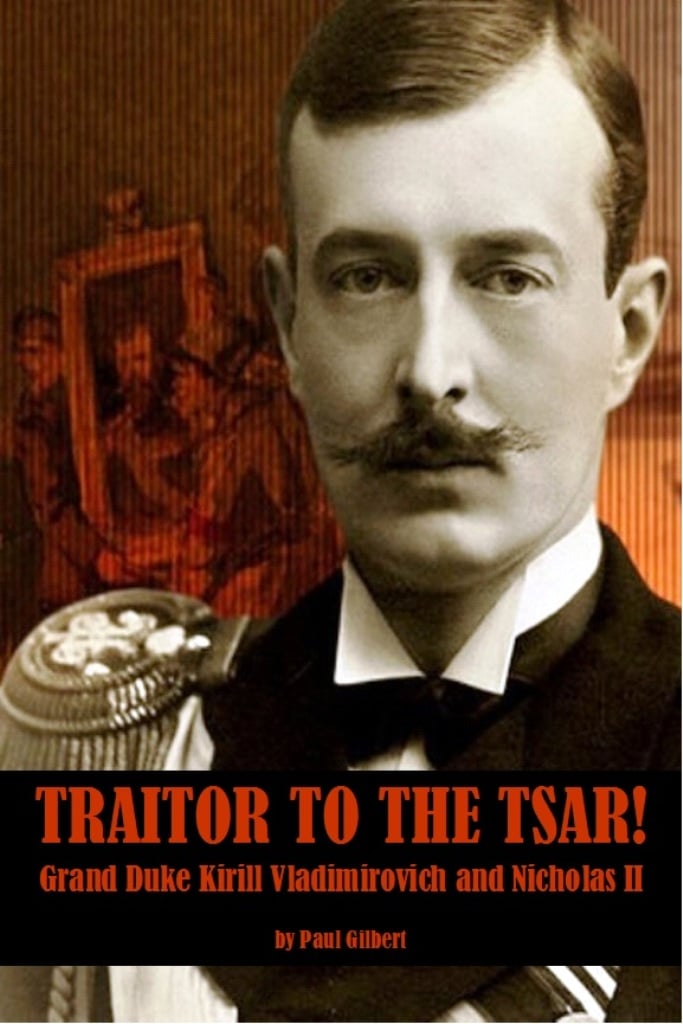
This article is just one of the many topics discussed in my forthcoming book ‘Traitor to the Tsar! Grand Duke Kirill Vladimirovich and Nicholas II’ – which will be made available on AMAZON later this year.

Traitor to the Tsar’ will be the first comprehensive study to examine the relationship between Grand Duke Kirill and his first cousin Tsar Nicholas II. It is based primarily on documents and letters retrieved from Russian archival and media sources, many of which will be new to the English reader.

Not only was Grand Duke Kirill a coward, he was clearly a man who lacked a moral compass and a traitor to his Sovereign and to Russia.

In this book I discuss his entering into an incestuous marriage with his paternal first cousin and a divorcee, Princess Victoria Melita of Saxe-Coburg and Gotha in 1905, defying both Nicholas II by not obtaining his consent prior, and the Russian Orthodox Church.

In addition, Kirill’s shameful infidelity—an affair which involved his behaviour or relationship far more sensational and unorthodox than a simple casual affair with another woman—a possible homosexual liaison perhaps?

Kirill’s act of treason during the February Revolution of 1917, is well known and for which he is most vilified. It was in Petrograd, that Kirill marched to the Tauride Palace at the head of the Garde Equipage (Marine Guard) to swear allegiance to the Russian Provisional Government, wearing a red band on his uniform. He then authorized the flying of a red flag over his palace on Glinka Street in Petrograd.

In June 1917, Grand Duke Kirill was the first Romanov to flee Russia. His departure was “illegal”, as Kirill was still in active duty as a rear admiral in active military service in a country at war, he had abandoned his honour and dignity in the process.

In 1922, Kirill declared himself “the guardian of the throne”, and in 1924, pompously proclaimed himself “Emperor-in-Exile”, creating a schism in monarchist circles of the Russian emigration.

In addition, I explore Kirill and Victoria’s alleged Nazi affiliations during their years in exile.

© Paul Gilbert. 10 January 2022
New monument to Nicholas II to be installed in Vladimir

PHOTO: the clay model of the monument to Nicholas II by sculptor Ilya Shanin

A new monument to Emperor Nicholas II will be installed later this year on the grounds of the Church of the Life-Giving Trinity in the Russian city of Vladimir.

The monument is created by the famous Vladimir sculptor Ilya Shanin. The pedestal will be created by Nikolai Andrianov, and the memorial plaques by Yuri Tumarkin and artist Olga Rozanova.

The emperor will be presented from the waist up wearing a ceremonial uniform, with a ribbon over his shoulder, crosses, orders and medals. The height of the sculpture without a pedestal is 125 centimeters [app. 4 ft.]. According to Shanin, the sculpture has been completed, the removal of the mould from the clay model will be done next. The monument will be cast from bronze at a plant in Smolensk.

The monument will be erected on the grounds of the Vladimir Trinity Church on Museum Street, to the left of the entrance. A pedestal will be erected for the sculpture, the area around monument will be landscaped.

It is planned that funds for the casting and installation of the monument will be collected with the help of donations. According to Ilya Shanin, the project will cost about 1.5 million rubles [$20,000 USD]. The sculptor estimates that the monument will be unveiled in the summer of 2022.

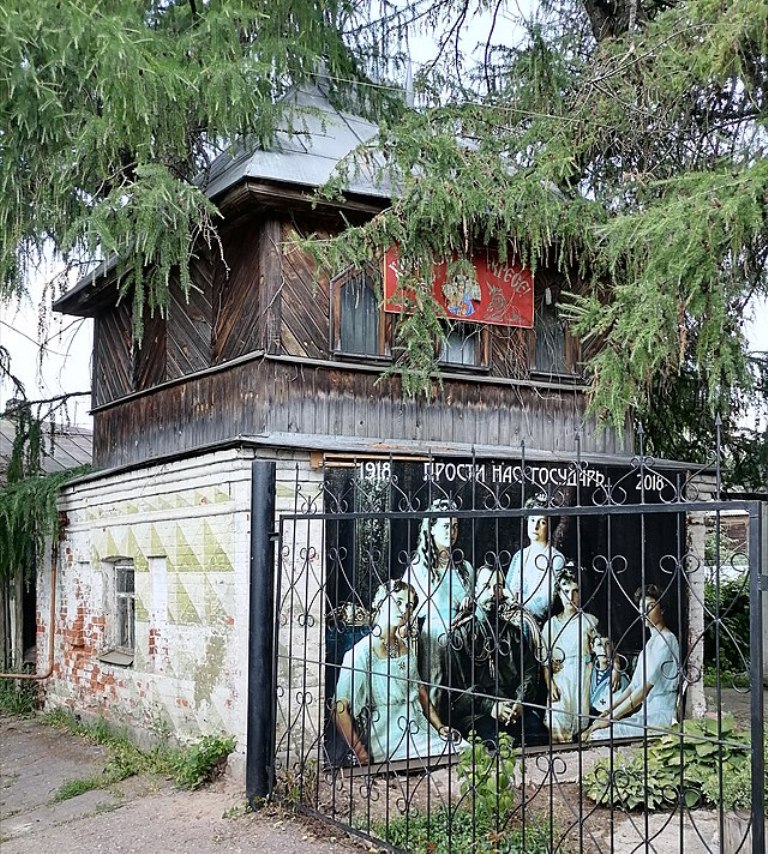
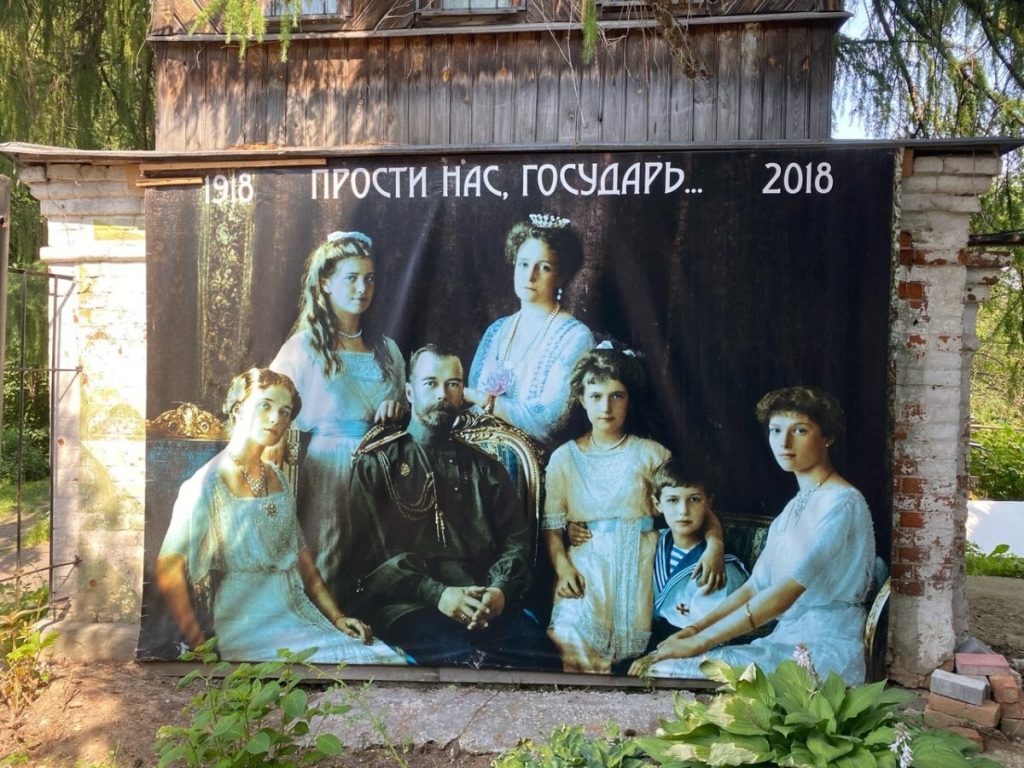
PHOTO: the wall of the cell of the gatekeeper of the Church of the Life-Giving Trinity in Vladimir, is decorated with a mural of marking the 100th anniversary of the death and martyrdom of the Imperial Family. The Russian caption reads 1918 прости нас государь 2018 / 1918 Forgive us Sovereign 2018

According to Shanin, the idea to install the monument of the Emperor near the Church of the Life-Giving Trinity, belongs to Father Eugene. During divine liturgies, he often prays for Nicholas II and his family, who were murdered in Ekaterinburg on 17th July 1918.

Ilya Shanin is a parishioner of the church. He believes that the numerous troubles and catastrophes of the Russian people during the 20th century are partly a punishment for the bloody murder of the Imperial Family in the Ipatiev House. The sculptor hopes that the monument to the emperor will give people a purpose to delve into history or start discussions about the life and reign of Nicholas II, but will also help people look into themselves, repent and to pray for forgiveness.

The installation of the monument to Nicholas II in Vladimir will be a first for the city. The only monument to a Russian monarch was that of Emperor Alexander II, which was installed in 1913 on Cathedral Square, in front of the bank building. After the February Revolution of 1917, it was removedfrom the pedestal, and replaced with a sculpture of the Bolshevik leader Vladimir Lenin.

Note that Nicholas II visited Vladimir once, on 16th May 1913. Together with members of the Imperial Family, he visited the ancient city in the year marking the 300th anniversary of the House of Romanov. It was on this day, that a solemn meeting was organized on the platform of the Vladimir railway station, after which Nicholas II visited the Assumption Cathedral.

© Paul Gilbert. 10 January 2022
Russia’s Treasure of Diamonds and Precious Stones 

CLICK ON THE LINK BELOW TO ORDER FROM AMAZON

HARD COVER EDITION @ $35 USD

PAPERBACK EDITION @ $25 USD

BOOK DESCRIPTION

Large format 8-1/2″ x 11″ hard cover and paperback editions, 206 pages + 100 black & white photos

* * *

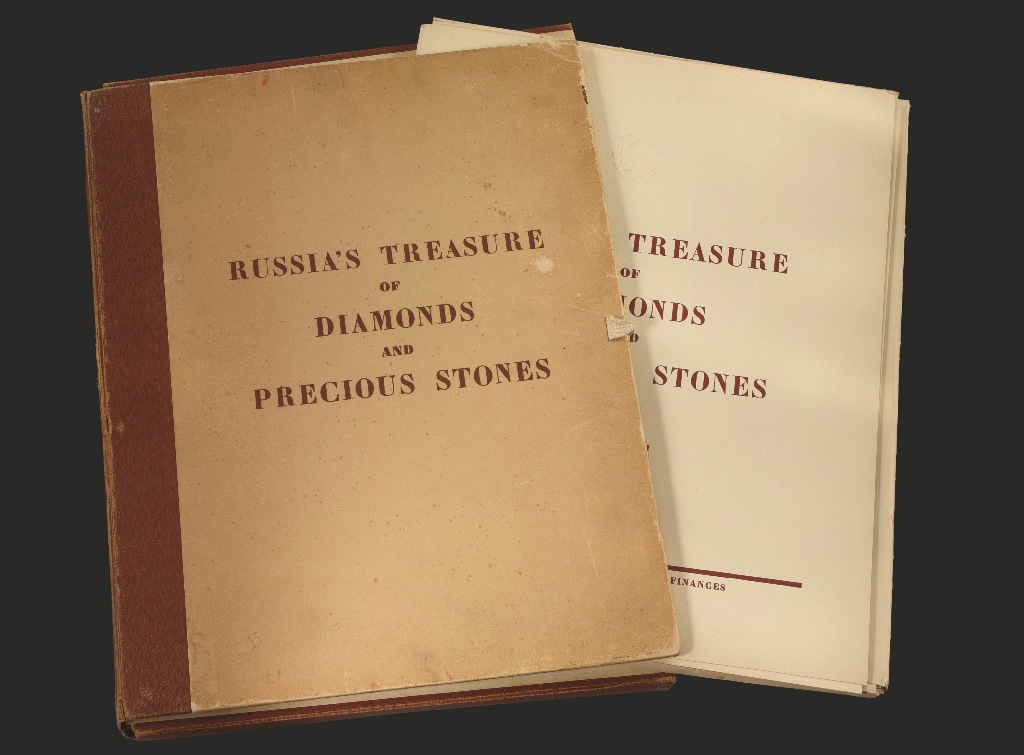
This is the first time that the original 1925 four-part folio, has been published in book format – both hard cover and paperback editions – a facsimile of the copy from the private collection of Paul Gilbert.

The spectacular gem and jewellery collection of the Romanov dynasty is documented in Russia’s Treasure of Diamonds and Precious Stones, documenting Russia’s regalia and crown jewels at the time of the overthrow of the tsarist government in 1917.

Published in 1925-26 by the Bolshevik government, the catalogue project was overseen by noted mineralogist Alexander Evgenevich Fersman (1883-1945), with the help of specialists, experts and jewellers including Agathon Fabergé from the House of Fabergé.

Of the 406 separate pieces in the treasure, 110 are documented as having come from the reign of Catherine II (1762-1796) and her son Paul I (1796-1801). The treasure is comprised of the Imperial Sceptre set with the approximately 190 carat (ct) Orlov diamond, the Imperial Globe set with an approximately 200 ct Ceylon (Sri Lanka) sapphire, the Great Imperial Crown featuring an approximately 402 ct spinel, the Imperial Nuptial Crown, chains, stars, crosses, emblems, diadems, necklaces, brooches, rings, earrings, as well as loose diamonds, emeralds, sapphires, rubies, spinels, pearls and alexandrites.

PHOTO: Russia’s Treasure of Diamonds and Precious Stones was originally published as a four-part folio in 1925. It is now available in a book format [both hardcover and paperback editions] for the very first time

The Fersman catalogue states that the jewels, considered national property, would never be “sold or done away with.” Because the new Soviet Union desperately needed capitol, however, copies of the catalogue were sent to potential jewellery buyers anyway. Although the treasure was later removed from the market, some of the pieces were sold to a syndicate and eventually wound up at auction at Christie’s London on March 16, 1927. The majority of the collection remains in Russia at the Kremlin Diamond Fund in Moscow.

Only 350 copies of the catalogue were printed in three languages: Russian, French and English, copies of which are highly sought after by collectors. At least 20 copies of the English language catalogue are known to exist today. As such, it is an exceedingly rare work in any of the three languages, and much desired by gemologists, jewellers, historians and collectors of books about the Romanovs.

Every now and then a copy has been offered by one of the auction houses, selling for up to tens of thousands of dollars. For instance: a copy in 2011 for £42,000 GBP [$56,000 USD]; in 2018 for $8,260 USD; in 2019 for £25,000 GBP [$33,500 USD].

I am pleased to present the original 1925 four-part folio in a book format for the very first time, a facsimile of the copy from my own private collection, and at a price which is affordable for all.

© Paul Gilbert. 3 January 2022
The Romanovs on ‘Seinfeld’?!

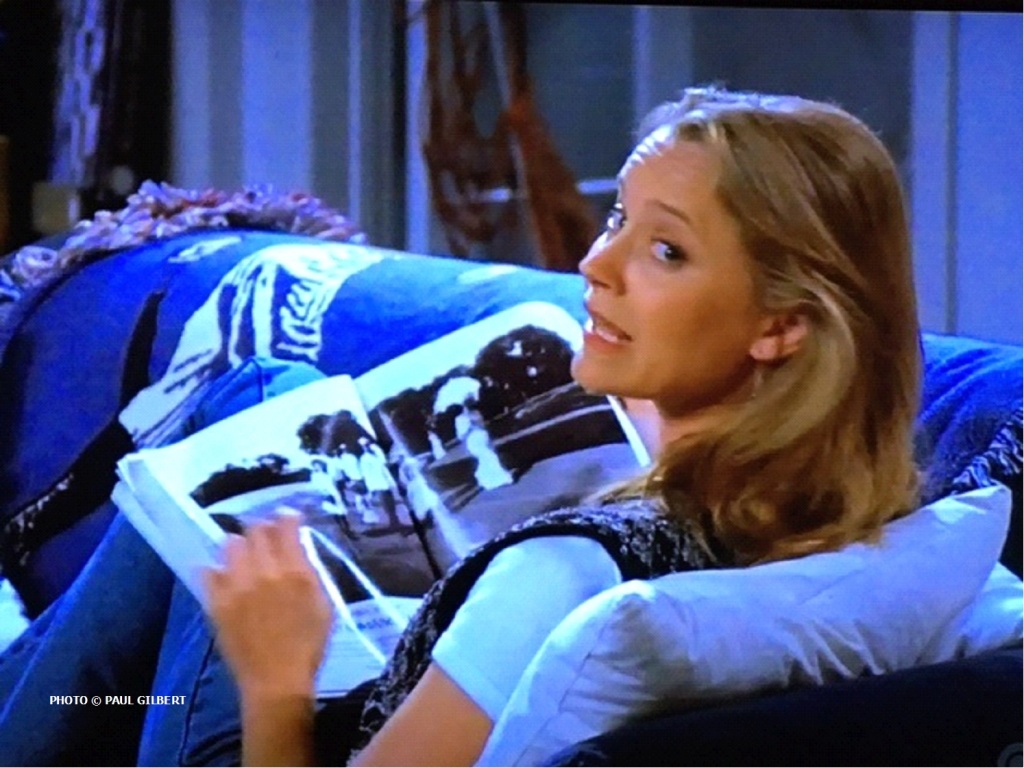
PHOTO: “Susan” leafing through an August 1995 issue of The New Yorker, which depicts a photo of Emperor Nicholas II and his family

Last night, I was watching an old 1995 episode of ‘Seinfeld’, when one particular clip grabbed my attention. “Susan Ross” (played by Heidi Swedberg, is seen relaxing on the sofa while flipping through a magazine. As she turned the page, I immediately recognized the photo of Nicholas II and his family walking through a park—possibly Alexandria at Peterhof or Livadia?

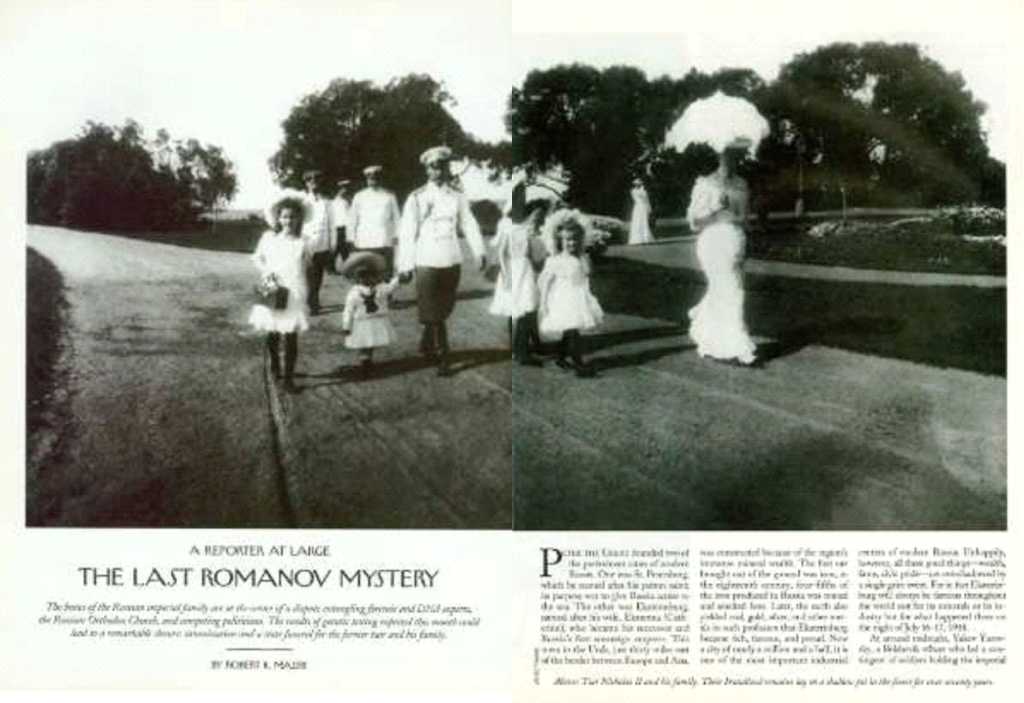
PHOTO: pages 72 and 73 of the August 21st, 1995 issue of The New Yorker

As it turns out, she is reading the August 21st, 1995 issue of The New Yorker magazine, which featured an excerpt from The Romanovs: The Final Chapter by Robert K. Massie, published by Random House the same year. The excerpt was titled The Last Romanov Mystery.

I immediately grabbed my iPhone and snapped the photo seen at the top of this article, and then compared it the issue of The New Yorker (seen above). Sure enough, the photo was published on pages 72 and 73.

I am delighted to share this interesting observation and little known television trivia.

© Paul Gilbert. 2 January 2022

The Romanov Restaurant in Tobolsk

PHOTO: entrance to the Romanov Restaurant, Hotel Slavyanskaya, Tobolsk

With the recent opening of the new airport in Tobolsk in September 2021, the popular although remote Siberian city is expecting to attract more visitors.

Founded in 1590, Tobolsk is the second-oldest Russian settlement east of the Ural Mountains in Asian Russia, and is a historic capital of the Siberia region. Tobolsk is rich in history. Aside from the beautiful Kremlin, numerous museums and other historic sights, the Museum of the Family of Emperor Nicholas II, which opened in 2018, has become a popular venue for visitors.

For any one pursuing their interest in the last Tsar and his family, the Hotel Slavyanskaya is the perfect place to stay. Opened in June 1994, the Hotel Slavyanskaya was the first European-level hotel in the region, located in the city center. It offers 177 rooms equipped with Italian handmade furniture in the style of Louis XV.

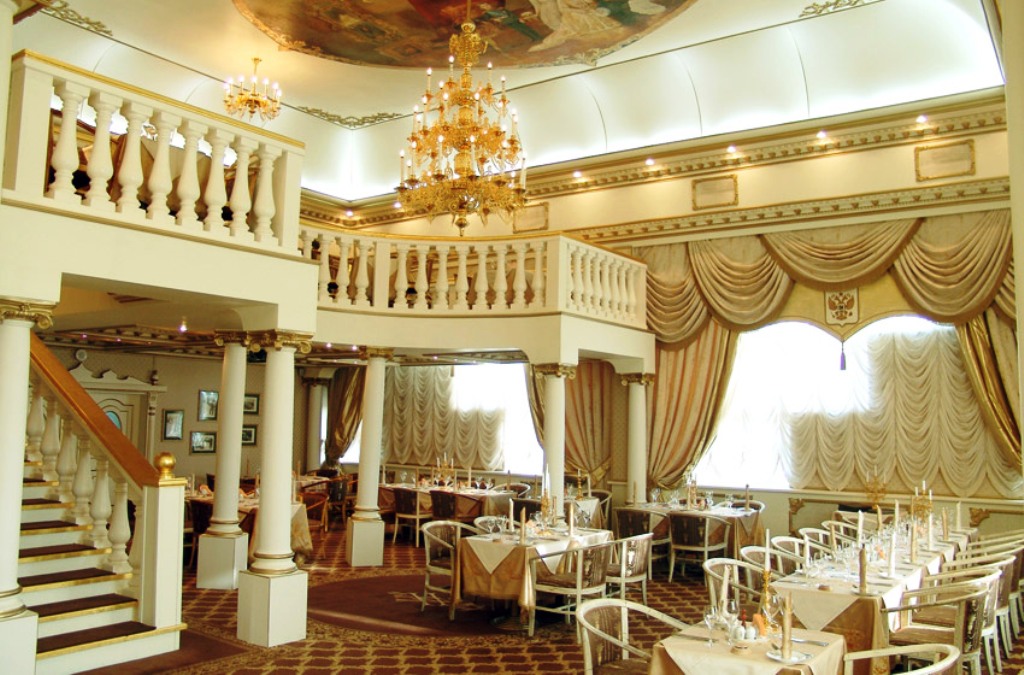
PHOTO: elegant interior of the Romanov Restaurant, Hotel Slavyanskaya, Tobolsk

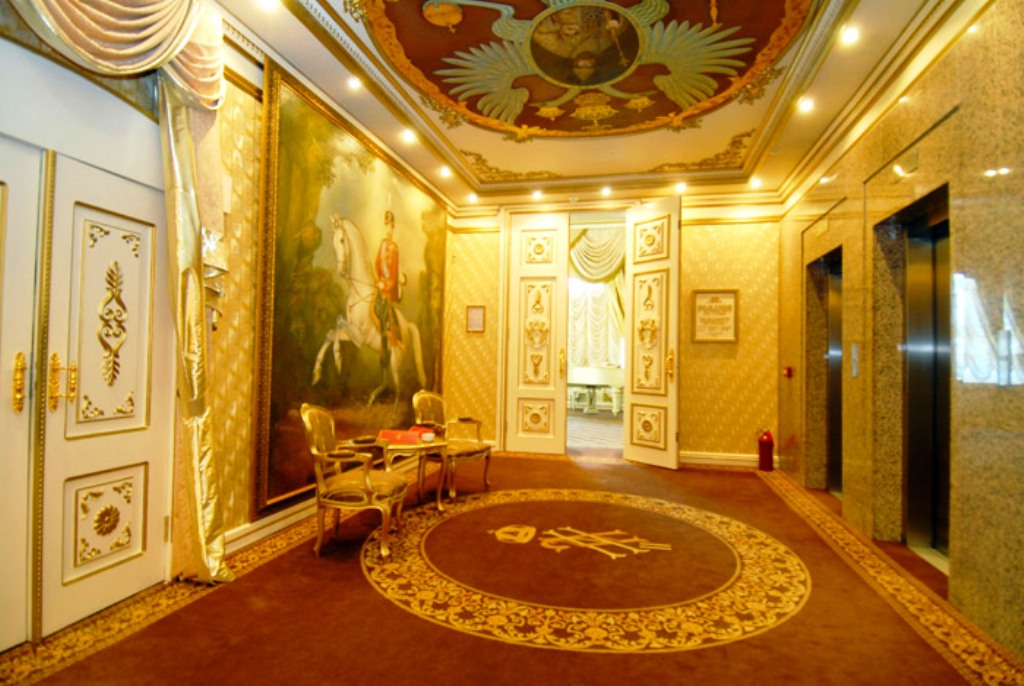
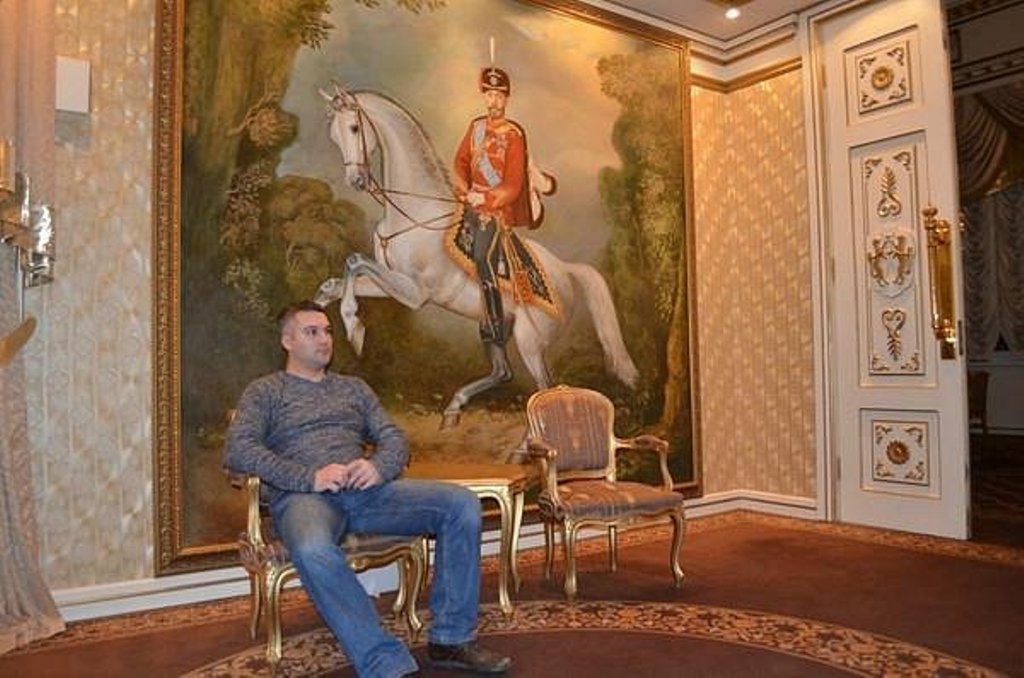
The Romanov Restaurant is located on the sixth floor of the Slavyanskaya. As you exit the lift, where guests are greeted by a large equestrian portrait of Emperor Nicholas II, and elegant heraldic symbols thus creating a regal atmosphere.

PHOTO: equestrian portrait of Emperor Nicholas II, outside the entrance to the restaurant

The interior is on two-levels, a grand staircase leading to the upper tier, the railings are covered with gold leaf. The decor of the hall is designed in light golden-beige tones with attributes of a royal theme. The walls are covered with panels draped in noble fabrics. And the exquisite design of the curtains on the windows give the hall the looks of a grand palace. The interior is complemented by Corinthian columns, cornices with gilded brackets.

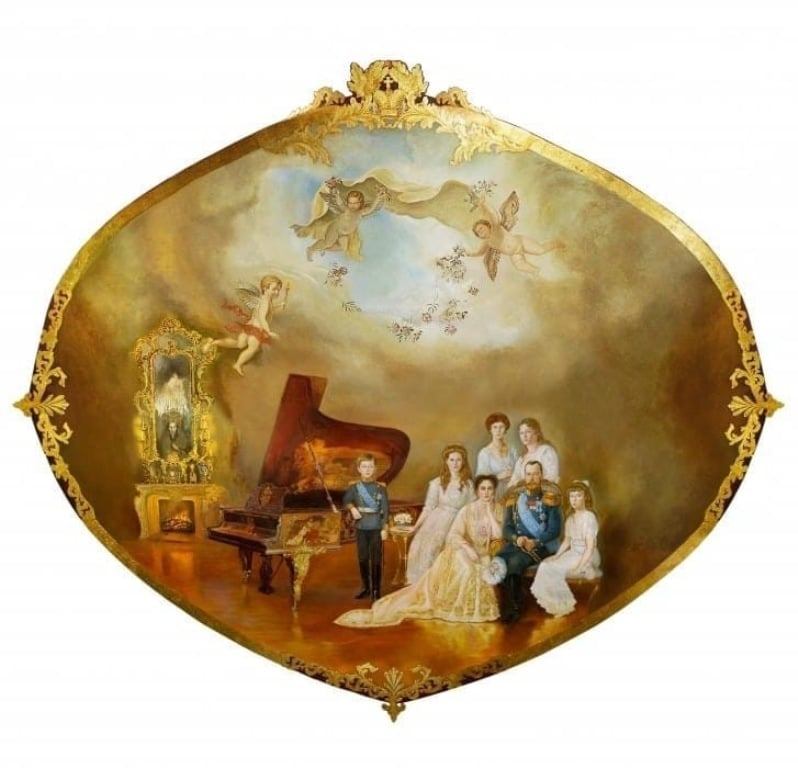
The stylized monogram of Nicholas II is present in many elements of decor, dishes, serving utensils, napkins, tablecloths, etc. The restaurant is also decorated with a large mirror in a carved gilded frame, and a restored ivory grand piano made by the world famous F. Muhlbach firm.

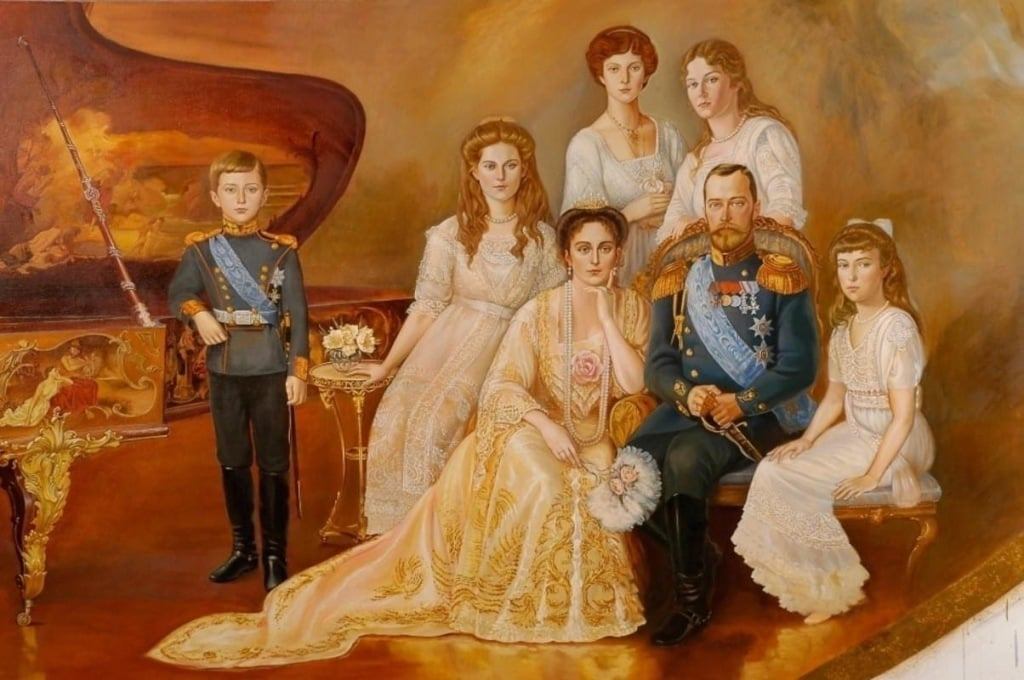
PHOTO: portrait of Nicholas II and his family by Ekaterina Masyutina

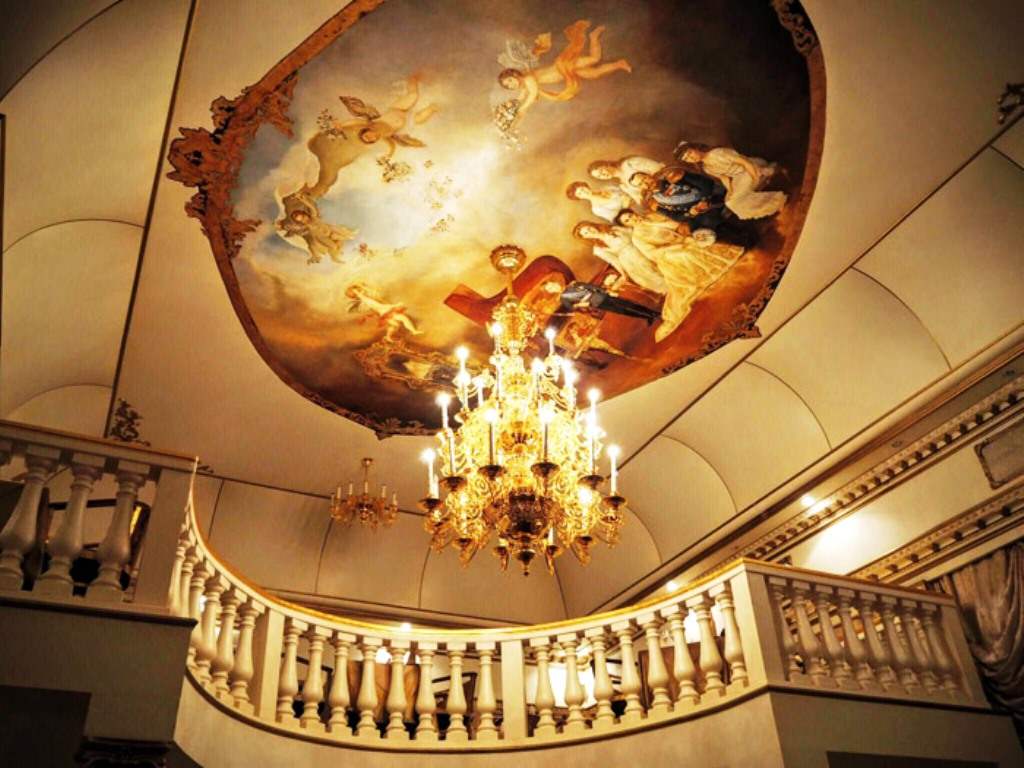
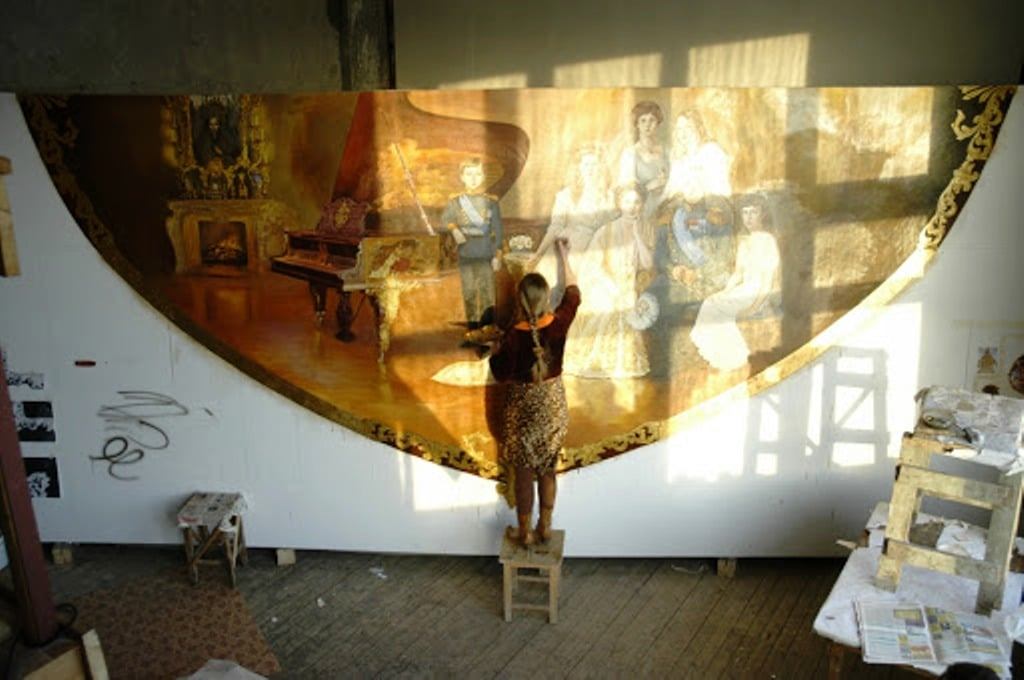
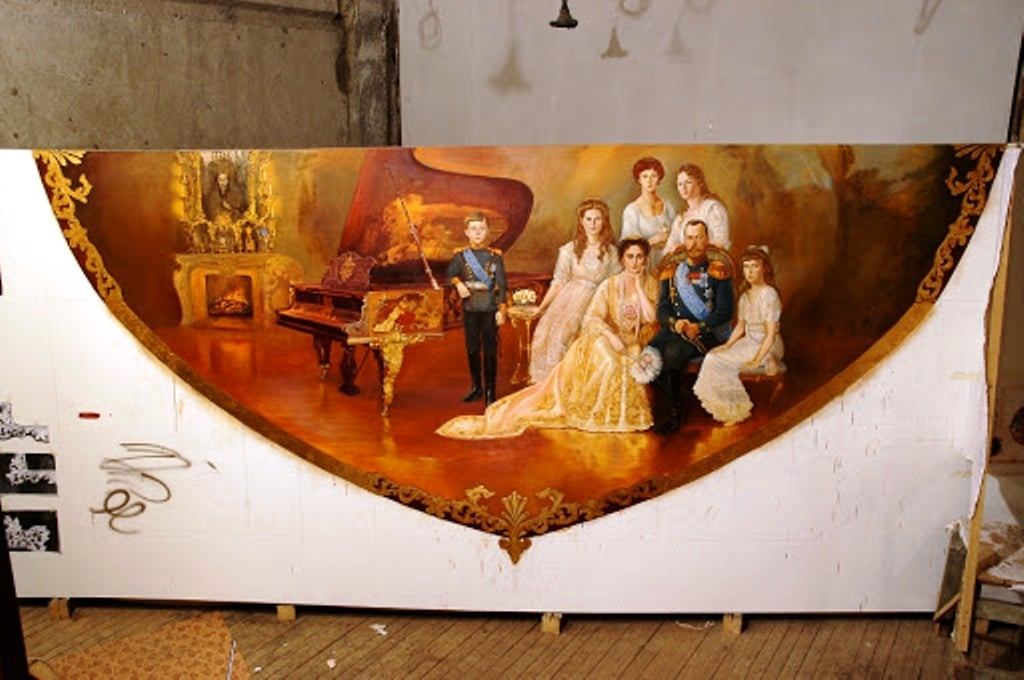
The most striking element of the Romanov Restaurant is the oval-shaped plafond with a group portrait of Emperor Nicholas II and his family, created by the Russian artist Ekaterina Masyutina.

PHOTOS: Artist Ekaterina Masyutina working on her portrait of the Imperial Family

PHOTO: detail of Emperor Nicholas II and his family

PHOTO: portrait of Emperor Nicholas II and his family, created by the Russian artist Ekaterina Masyutina, Romanov Restaurant, Hotel Slavyanskaya, Tobolsk

© Paul Gilbert. 1 January 2022