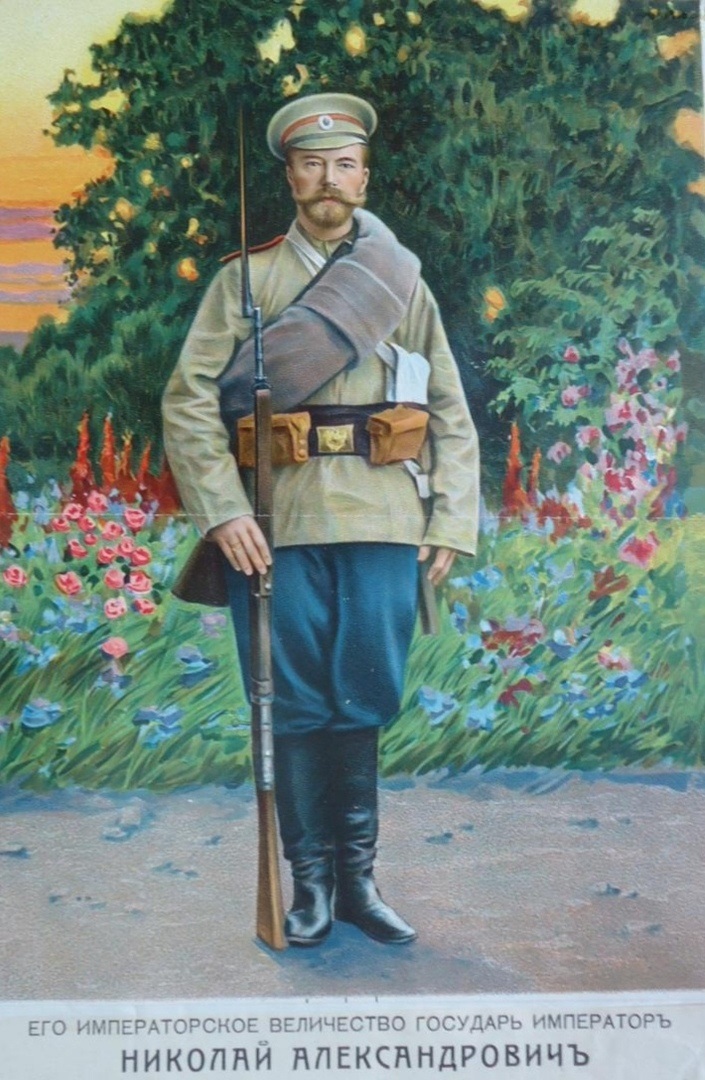
Emperor Nicholas II Fell Victim to Industry of Lies

0004

 Nicholas II under house arrest at Tsarskoye Selo after his abdication in March 1917

The Russian royal family and four of their servants was brutally murdered in July of 1918 in the basement of the Ipatiev house in the city of Yekaterinburg. Pravda.Ru talked about the terrible page in Russian history with Pyotr Multatuli, a historian, author of books about Nicholas II and also a great-grandson of Ivan Kharitonov, a senior cook of the imperial kitchen, who was executed with the royal family.

“Are you a monarchist and an Orthodox Christian? Do you approach the story about the death of the Russian royal family from this point of view?”

“I am an Orthodox Christian, and, of course, I am a monarchist. In political terms, I do not belong to any monarchist party, but I certainly believe that the Russian monarchy was the best form for the Russian government.”

“Do you assess the murder of the royal family as a conspiracy?”

“Yes, it was the result of a conspiracy to overthrow the Emperor. But I also approach it as the spiritual impoverishment of the Russian society during those years, when Russia moved away from orthodoxy, faith and dedication. This is one of the reasons why the czar was toppled and then savagely murdered.

“The aim of the ruling circles of Great Britain and certain circles in the United States was to overthrow and kill of the Russian royal family. The Provisional Government was clearly instructed not to let the royal family out of Russia – they did not want the Russian royal family to move to England.”

“Was it a betrayal of both a relative and an ally?”

“Of course, it was a betrayal. They betrayed Nicholas II in March 1917 and then betrayed him and the royal family again when they were sent to Tobolsk and then to Yekaterinburg. They knew everything. Representatives of Britain and French consuls were with the Bolsheviks in Yekaterinburg. Their telegrams prove that they were controlling the situation.”

“What do you think about the fact that all were opposed to the royal family? Nicholas II wrote in his memoirs that the only person that he could trust was his wife.”

“Many people in the emperor’s inner circle got involved in the political game, in which they were completely helpless. They were playing and thinking that they could make a Constitution, that they would play some role and preserve their preferences. Of course, they were in collusion with the State Duma, but not as direct conspirators, but as the people who were deprived of a moral compass.”

“But executing the whole family is cruel. There had been revolutions before the Russian one, when royal figures would be executed. For example, the wife of Louis XVI was executed. In Russia, was a despicable murder – they killed even those, who chose to stay with the royal family. By the way, your relative, senior cook of the imperial kitchen Ivan Kharitonov – was it his conscious choice to stay with the czar?” 

“Yes, of course, it was an absolutely conscious choice. It is generally believed that everyone in the Russian society betrayed the Russian czar – this is a lie. This is an attempt to distort history. Many people were dying for the czar. Basically, the whole story is about the betrayal by the elite. There was no inflation in Russia. Before February 1917, there were no food cards in Russia. In Germany and France, people were starving at that time. All these social and economic reasons are given to justify the murder of the royal family. 

“There are external forces that participated in the overthrow of the Russian emperor, but the main forces were internal ones. First of all, it was the Russian bourgeoisie – they were unhappy that the government stated controlling their excess profits. There was also the cadet opposition that was craving power. Those forces came into alliance with Western powers and masterminded the February Revolution.”

“But the Emperor had his errors. What about the bloody events on January 9?”

“The events on January 9 were nothing but a typical orange revolution, speaking the modern language. The Russian Empire before 1904-1905 was a terribly bureaucratic state. The czar was misinformed. Here was told that there would be a strike of about 120,000 workers. However, as many as 300,000 people took to the streets. It was the crowd that opened fire on the troops first. On the Vasilyevsky Island, there were four-meter barricades of barbed wire erected – it was a very well-prepared rebellion. Roughly speaking, it was a typical Maidan.”

“Many discuss such an aspect as the weakness of the czar.”

“The czar had a very clear, rigid will. He would not listen to anyone’s pieces of advice. He was capable of controlling the influence from the outside. He was just a man who would listening to all very attentively. He would double-check other people’s opinions before making his own decisions. There was no external influence. In general, one may say that there was a whole industry of lies created around the name of Nicholas II,

“The forces that came to power as a result of the coup had to justify their legitimacy. They were state criminals, who lived in enemy states during the time of the coup. 

“Lenin, for example was residing in Austro-Hungary and then in Switzerland. No wonder Stalin forbade any mentioning of the hideous crime in Yekaterinburg, because he was well aware that it was working against his regime.

“Stalin, too, was building his empire, but it was the empire that did not have anything in common with the Russian Empire. Stalin’s empire did not pursue interests of the Russian people. What was the nature of the Russian monarchy? There was God, the czar as the father of the people, and the people were his children, whom he loved, but whom he could also punish.”

© Igor Bukker @ Pravda.Ru. 15 January 2019

Photos 9 – 12 of Nicholas II

I must apologize for the quality of some of the photographs, however, this is something which I have no control over. Where possible, photographs have been chosen for their visual impact, but historical accuracy has made it vital to include a number of photographs whose quality is poor, but whose value as historical documents is considerable. Sadly, during the Soviet years, many photographs of the Imperial family were stored under poor conditions and their standard is low – PG

© Paul Gilbert. 16 January 2019

It Was Not the Revolution That Destroyed Emperor Nicholas II

0003

Nicholas II and Vladimir Lenin

NOTE: I would like to point out to readers that Pravda (Truth in English) is a Russian political newspaper associated with the Communist Party of the Russian Federation. The newspaper began publication in 1912 and emerged as a leading newspaper of the Soviet Union after the October Revolution. The newspaper was an organ of the Central Committee of the CPSU between 1912 and 1991. Given the Communist Party’s track record on “the truth” gives cause for speculation on anything published in Pravda – PG.

The great Russian Empire found itself in the vortex of the revolutionary abyss in only eight months. Pravda.Ru editor-in-chief Inna Novikova discussed the topic of the fall of the Russian Empire with Associate Professor at History Department of Moscow State University Fyodor Gaida.

IN – Today, there are many people who believe that the tsarist regime fell only because German Emperor Wilhelm II sent Lenin to Russia with a suitcase full of money in a sealed train car. What led Russia to Emperor’s abdication, and subsequently to the October Revolution?

FG – There is no documentary evidence to prove that Lenin was working to perform someone’s assignment. Having a picture of Vladimir Lenin in mind, one may say that he was acting solely on the basis of his own plans. As for the money, he would take it from anyone. Lenin was an unprincipled man who professed the principle “money does not smell.” Another thing is that at that moment in history the interests of Germany and Lenin coincided.

The German authorities thought that such a left radical as Lenin would help break imperial Russia, but would not be able to create anything himself. Germany was playing to weaken Russia to the maximum. Germany needed Lenin and all his slogans to weaken Russia, rather than to overthrow autocracy. Germany was always afraid of Russia. The Germans knew that Russian industry was capable of making a very serious breakthrough. Germany was very nervous.

Actually, Germany went to war in 1914 after it had finished the rearmament program. France was supposed to finish it in 1915, and Russia – in 1917. Time was not working for the Germans. Lenin was the person whose interests coincided with interests of Germany. Afterwards, Lenin continued to adhere to “pro-German” foreign policy. When the Treaty of Brest-Litovsk was signed, the Second Reich got a second wind. Until 1918, German troops attempted to advance on the Western Front, but in August 1918, the Germans gave up. Interestingly, Lenin’s attempted assassination was organized in August 1918 too.

The events that happened in Russia in 1917 were two phases of one and the same process.

With the beginning of the February Revolution, Russia started to fall apart. There was no real government in the country at that time. The government that the country had was nothing but a circus.

IN – So the Germans were attracted to Lenin’s call about the right of nations to self-determination. What attracted them to that slogan?”

FG – For Europe, with its multinational imperial organization, the practical version of this slogan would mean a new political map of the world and a severe crisis. Suddenly, a man appears on the horizon of political power, who raises its banner of the right of nations to self-determination, land and peace decrees, proclaiming a radical program in essence. The Germans realized that they had to support most radical forces in Russia.

IN – Historians talk a lot about the mistakes that Nicholas II made, about his weaknesses and shortsightedness. Did he have an opportunity to influence the situation?

FG – Let’s face it – Nicholas II was neither an outstanding statesman nor a military leader. He was not the wisest of the wise. He was a typical man of his time. He, unlike modern politicians, never gave unrealistic promises. After the defeat in the Russian-Japanese war, Nicholas II became a cautious figure in politics. Russia’s foreign policy after 1905 was relatively peaceful. Russia was fighting for zones of influence, realizing that one should not go too far. Just look at the Russian policies in Asia from 1905 to 1912. Russia had seriously expanded its area of influence, without quarrelling with anyone.

After 1905, other prominent figures in Russian politics began to consider themselves wiser than Nicholas II. By February 1917, the political class and generals saw the emperor as the main obstacle on the way of the development of the country.

As a result of this confrontation, the emperor abdicated from power.

The next moment everyone realized that the whole country was based on the emperor. It was the emperor who was the symbol of Russia’s unity. As soon as Nicholas II abdicated, all of his opponents vanished. They were removed from the political scene.

© Inna Novikova / Pravda and Paul Gilbert. 10 January 2019

Photos 5 – 8 of Nicholas II

I must apologize for the quality of some of the photographs, however, this is something which I have no control over. Where possible, photographs have been chosen for their visual impact, but historical accuracy has made it vital to include a number of photographs whose quality is poor, but whose value as historical documents is considerable. Sadly, during the Soviet years, many photographs of the Imperial family were stored under poor conditions and their standard is low – PG

© Paul Gilbert. 9 January 2019

The Reforms of Nicholas II and the Last Hurrah of the Imperial Uniform

0002

Nicholas II wearing the uniform of a Russian soldier

The last years of the 19th century saw Russian military dress becoming increasingly austere. But when Russia’s last tsar, Nicholas II, came to the throne, he decided that the uniforms were lacking in glamor and needed the incorporation of elements that reflected Russia’s past military glory.

During his 1881-1894 reign, Tsar Alexander III extended his taste for simplicity to his army too. Fancy braiding and plumes were stripped from the uniforms of soldiers and officers, and resplendent Guards outfits and other extravagant regular-issue items were consigned to the past.

Not for long, however. Alexander’s son Nicholas II, the last Russian Emperor, shared the passion of many of his predecessors for war games, parades and flashy uniforms, and began reviving some traditions.

Nicholas II regarded ceremonial uniform elements as an integral part of military life – and all the better if they bore reminders of past glories. Shortly after he took the throne in 1894, the new tsar initiated a reform of cavalry uniforms. The new outfits resembled those worn by the Russian troops who took Paris in 1814, with close-fitting, double-breasted jackets and colored trimming on the collar and cuffs. And in place of the simple leather sword belt introduced by Alexander III, the braided ceremonial galloon made a comeback.

However, in 1904 the landmark decision was also taken to develop khaki uniforms for soldiers and officers. In the meantime, the plain white army uniforms and caps of the previous reign were retained, with disastrous results: When the Tsar’s forces went into battle in the 1904-05 Russo-Japanese they made conspicuous targets for the enemy gunners. So much so that soldiers took to dying their own uniforms to reduce their visibility.

In 1907, the entire army was kitted out in khaki uniforms, and a peaked cap was finally adopted as the principal headgear. Wide fatigues that tucked into boots completely replaced tight britches, and only cavalrymen retained their gray britches with colored piping. The officers’ white tunic and shirt were replaced by drab uniforms with breast pockets and metal buttons, while soldiers were issued with tunics with pockets but sewn with buttons made of compressed leather.

The army was also issued with new dress uniforms for ceremonial occasions. Soldiers wore double-breasted jackets with colored piping, officers’ regiment numbers were embroidered in gold on their jackets, and generals wore a special decoration in the form of oak leaves.

In a bid to boost morale in the recently defeated forces, a number of more distinctive uniform elements harked back to Russia’s glorious military past.

Some units were issued with the long-forgotten shako cylindrical hat, modeled on those worn by Russian soldiers in 1812. The Grenadier Regiment received an 18th century-style gold braid aiguillette on the right shoulder bearing the monogram of Catherine II. Officers’ silver sash belts resembled those worn under the revered military commander Alexander Suvorov in the 18th century.

But the outbreak of the First World War in 1914 gave the Russian soldier no occasion to savor the new dress uniform, which was stored away since it had no application at the front.

Officers had to wear the soldier’s uniform, while all bright or shiny elements like buttons and stars on the shoulder straps were painted in drab colors to make them invisible to the enemy.

The braided sword belt was replaced with a leather one that crossed at the back and attached to a belt fitted with a revolver holster and a sheath for an edged weapon. The ranks also began to wear a tunic modeled on that worn by the allied British Army.

Material shortages also brought changes in uniform design. Troops on the Caucasian front were allowed to wear the traditional cherkeska homespun gray cloth jacket, while leather shortages led to the broad replacement of long boots with short boots and puttees.

But such was the confidence that Russian troops would again parade through the defeated enemy capitals of Berlin and Vienna that special dress outfits were made in advance.

In another echo of past eras, the tall budenovka felt hat was specially modeled on the ancient Russian warrior’s helmet for celebrations marking the anniversary of the Romanov dynasty. A long greatcoat sewn with a vertical array of straps also evoked the past archer’s caftan, and was meant to symbolize the triumph of the Slavic spirit over the perennial German enemy.

The war dragged on beyond all expectations, however, and ultimately led to the 1917 Revolution. The newly designed uniform was inherited by the Red Army, and in the years to come came to symbolize Soviet might.

© Alexander Vershinin / Russia Beyond the Headlines. 05 January 2019

Photos 1 – 4 of Nicholas II

I must apologize for the quality of some of the photographs, however, this is something which I have no control over. Where possible, photographs have been chosen for their visual impact, but historical accuracy has made it vital to include a number of photographs whose quality is poor, but whose value as historical documents is considerable. Sadly, during the Soviet years, many photographs of the Imperial family were stored under poor conditions and their standard is low – PG

© Paul Gilbert. 2 January 2019

The Reign of Nicholas II, Russia’s Last Emperor

0001

Emperor Nicholas II, 1896. Artist: Ilya Repin. The State Russian Museum, St. Petersburg

During the reign of Nicholas II in the late nineteenth and early twentieth centuries, Russia made considerable progress in all areas of life. Many predicted that Russia would have an important future and a more essential role to play in the world. It was in stark contrast to these predictions that the Empire came tumbling down in 1917 in a collapse that had dramatic consequences for the Russian people. Emperor Nicholas II, the last Russian tsar of the Romanov dynasty, ascended the throne on 1 November [O.S. 20 October] 1894.

In his will, his father, Emperor Alexander III, who died at the age of 49, wrote the following to instruct his son: “You will have to take from me and shoulder the heavy burden of government and bear it until your good hour, the way I have done it, the way our ancestors did it. Now, you will assume the God-given Empire, which I received from my father when he was bleeding to death 13 years ago… Your grandfather used his unlimited monarchical powers to carry out numerous reforms for the good of the Russian people. In reward, he got a bomb and death from Russian revolutionaries… On that tragic day, I was confronted with the question of what path I should follow. Was it to be the path that the so-called advanced society, which caught the pest of Western liberal ideas, urged me to take, or the path prompted by my own conviction, my supreme sacred duty of tsar, and my conscience? I have chosen my way. The Liberals called me reactionary. However, I was interested solely in the good of my people and the grandeur of Russia. I sought to secure peace both inside and outside Russia so that the state could develop freely and quietly, grow rich and prosper. Autocracy has created Russia’s historic identity. If autocracy tumbles down, God forbid, then all of Russia will collapse. A collapse of the originally Russian government will usher in an interminable era of trouble and bloody internecine strife. I bequeath you love for everything that will ensure the good, honour, and dignity of Russia. Protect dignity, but bear in mind that you are responsible for the future of your subjects to the Most High. Your belief in the holiness of your monarchical duty will underlie your life. You must be firm and courageous, and never show weakness. You must show independence in your foreign policy. You must never forget that Russia has no friends. Foreigners fear our hugeness. Avoid fighting wars. In your home policy, patronise the Church for it often saved Russia in the years of hardships. Strengthen the family, which is the basis of every state”.

Nicholas II ascended the throne when he was 26, and one must admit that, to his honour, he found the strength to assume responsibility for his enormous country without shifting it onto anybody else. In his first address to the people, Nicholas II said he would follow his deceased father’s behests, and that he would rule for the good and prosperity of his subjects. Emperor Nicholas II’s reign was not easy because by the early twentieth century the ruling circles and intellectuals adopted a negative position on the fundamentals, traditions, and ideas of Russian society. The educated circles, which copied liberal and Marxist ideas from Western Europe, denied Russia the right to its own way of development, sought to destroy its originality, and impose an alien model of Western European development on our country. Hence, they had hatred for the Tsar as the embodiment of autocracy, the traditional form of government in Russia. The liberals and democrats tried to slander Nicholas II, to draw an unseemly picture of his rule. The former French president Emil Louber wrote this about the Russian Tsar in his memoirs, published in Paris in 1910, “It is held that the Russian Emperor falls under outside influence. This is absolutely wrong. The Russian Emperor implements his own ideas. He has carefully thought-out plans that he continuously works to implement… Behind a mask of timidity, he has a strong soul and a courageous heart that is unflinchingly loyal. He knows where he is going to and what he wants”.

Under Tsar Nicholas, Russia experienced tremendous growth in its economy, one that it had never known before. Here are some figures to prove the point. Economic growth rates were among the highest in the world. The tsarist government’s protectionist policy spurred home market development. Russia was the world’s only nation that could exist autonomously, irrespective of its imports or exports, thanks to its mode of life. Russians manufactured all the goods they needed for home consumption. The Russian economy was not oriented to the foreign market. Russia produced only flax and butter commercially for export purposes. Production facilities sprang up; mineral resources were tapped. The Trans-Siberian Railway (some 7,416 kilometres in length) became a symbol of economic prosperity. Only a power that boasted a highly developed industrial potential could build this kind of trunk-railway on its own. Economic growth resulted in lavish fruits, namely the people’s incomes grew twofold. Russian workers boasted the world’s highest wages, which were second to those of US workers only. Russia had a deficit-free budget during the reign of Nicholas II. The taxes were the lowest in the world. The Russian rouble was truly gold, given that it was backed by gold reserves by more than 100%.

In 1912, Russia introduced a system of social insurance for workers and passed a number of other laws to make things easier for them. The then-US President William Taft said this in a comment on those laws. “The labour laws that Your Emperor has enacted are so perfect that no democratic country can boast anything similar”. Economic growth enabled the growth of the population, from 139 million people in 1902 to 175 million people in 1913. Russia became the world’s third-biggest nation in population, trailing only China and India. The prominent French economist Edmond Teri said that if the trends held, Russia would dominate Europe politically and financially by the middle of the twentieth century. What Russia did dominate at the time was the field of culture, which the French poet Paul Valerie described as one of the world wonders. Never before had this country produced such a great number of scientists, artists, actors, and musicians. Leo Tolstoy, Anton Chekhov, Ivan Bunin, Vassili Surikov, Pyotr Tchaikovsky, Nikolai Rimsky-Korsakov, Fyodor Chaliapin, and many others became world-famous. Russia had indeed achieved much, with even more impressive achievements lying in store for this country, provided, of course, that it had the time, and the country stayed united.

Western countries were concerned about Russia’s growing might and its increasing influence on the developments in the Far East. Russophobia became a factor in world politics. Japan was used as a tool to weaken Russia in the Far East. Great Britain and the United States incited Tokyo to attack Russia, and it launched an assault on the Russian Pacific squadron off Port Arthur in 1904. Russia lost throughout the first year of fighting, but then Japan exhausted itself, while Russia collected its strength to wage a full-scale war. It was clear that Japan’s defeat was a question of time, and it was at that very moment that Russia was stabbed in the back. This was the result of political disturbances in Russia caused by liberals and revolutionaries, and Emperor Nicholas II had to conclude an unequal peace treaty.

The great Russian writer Fyodor Dostoyevsky aptly described Russian revolutionaries as “demons”, since they were opposed to anything that was sacred to the Russian people, namely Orthodoxy, autocracy, and the Russian mode of life; and suggested replacing them with foreign ways or plainly utopian schemes. In their fight against autocracy, they did not hesitate to use criminals. These “demons” stirred up revolutionary unrest in 1905, and involved the workers and university students in them. By advancing the slogans “Down with Autocracy!” and “Long live freedom!” they struck at the very foundation of the state. Nicholas II could certainly have used force to suppress the revolt, but he chose a different way of appeasing the country. On 17 October 1905, he signed a Manifesto that granted citizens the liberty of conscience, the freedom of speech, of assembly, of association, personal immunity, sanctity of the home, as well as the right for all social strata to elect deputies to the State Duma, which was vested with lawmaking powers. The 17 October Manifesto took the edge off the heat of the revolution in Russia. The Tsar firmly held the reins of government; the country calmed down, and resumed its course of development. The well-known English writer Maurice Bering, who lived in Russia and knew it well, said in 1914 that Russia had never before prospered financially as well as it did under Nicholas II, when most Russians had fewer reasons for discontent than at any other moment in the past. A casual observer might be tempted to ask, what is there that the Russian people do not have? If there was discontent, it was in the upper classes. As for the other strata, the discontent that existed was not so intense as to bring temperature to the boiling-point.

However, it was precisely when Russia was poised for take-off that disaster struck; the major cause was the First World War, which broke out in August 1914. In 1907, Russia joined the Entente Cordiale, an alliance of Great Britain and France. Russia was compelled to make the move in the face of the growing expansion of the Triple Alliance of Germany, Austro-Hungary, and Italy. Europe had thus seen the formation of two military blocs that were doomed to clash some time. When they finally did, the world was plunged into the First World War. Unlike Great Britain and France, which pursued their national interests in the conflict, Russia only defended its territorial integrity. Therefore, for Russia the First World War was essentially a patriotic war. The war prompted an unprecedented growth of patriotic spirit in Russian society and united it. Nicholas II seized the opportunity to carry out a long-awaited reform, namely, banning the sale of alcoholic beverages. It was quite daring of the Government to give up one of the most profitable items of the budget amid a raging war. Fully honouring its pledges of an ally, Russia repeatedly saved Great Britain and France from crushing defeat at the cost of enormous sacrifices. The French Marshal Foch admitted that it was thanks to Russia that France had not been wiped off the map of Europe. In 1915, things on the front took a bad turn for Russia. Russian troops suffered heavy losses, and Germans wedged themselves deeply into Russian territory. The Emperor decided that he should assume the Supreme Command.

The war exacerbated the existing problems; the nation was growing tired of fighting. Those opposed to autocracy, specifically the social-democratic parties, used antiwar sentiment to step up their activities. While the Emperor was at the front, the State Duma energetically stirred up anti-monarchical and anti-government sentiment behind his back. The following is the chronology of the basic developments. On 23 February 1917, the revolutionary elements used expressly-organised problems in supplying Petrograd (formerly St Petersburg) residents with bread to stage an anti-government demonstration. People crowded the streets and chanted: “Bread! Bread!” The city police was bewildered since they knew that there the Russian capital did have food. The next day saw the continuation of the demonstration. In some places, red flags were waved and posters were carried with the slogans, “Down with the war!” and “Down with Autocracy!” On 24 February, 240,000 workers went on strike. Military units deployed in the capital swayed by social-democratic propaganda joined them. On 27 February, life in Petrograd came to a standstill. The rebellious workers and soldiers seized the greater part of the city and the Tauride Palace with the State Duma deputies inside. On the same day, the revolutionary elements set up a Council of working deputies. However, the State Duma decided it should not let power out of their hands at this moment and formed a Provisional Government.

When the Tsar learnt about the unrest in Petrograd, he ordered troops sent to the capital, but his order was ignored. Then, he decided to go to Petrograd in person to look into the situation there. However, his entourage, which betrayed him, bent every effort to prevent Nicholas II from reaching the capital. The Tsar realised that both the State Duma and Supreme Command had conspired to stage a coup. On 2 March, aboard a train, the Sovereign was compelled to sign his abdication in favour of his brother Grand Duke Michael Alexandrovich, and wrote this in his diary on the same day, “There is betrayal, cowardice, and lies all around me”. By abdicating in favour of his brother, the Tsar tried to save the autocracy, and he is not to blame for Michael’s refusal to ascend the throne and his decision to hand power over to the Constituent Assembly. That was the tragic end of the long era of autocracy in Russia, an end that had catastrophic consequences for this country.

© Lyubov Tsarevskaya @ Voice of Russia World Service. Edited by Paul Gilbert. 1 January 2019