Icon of the Tsar-Martyr Nicholas II and the Royal Scots Dragoon Guards
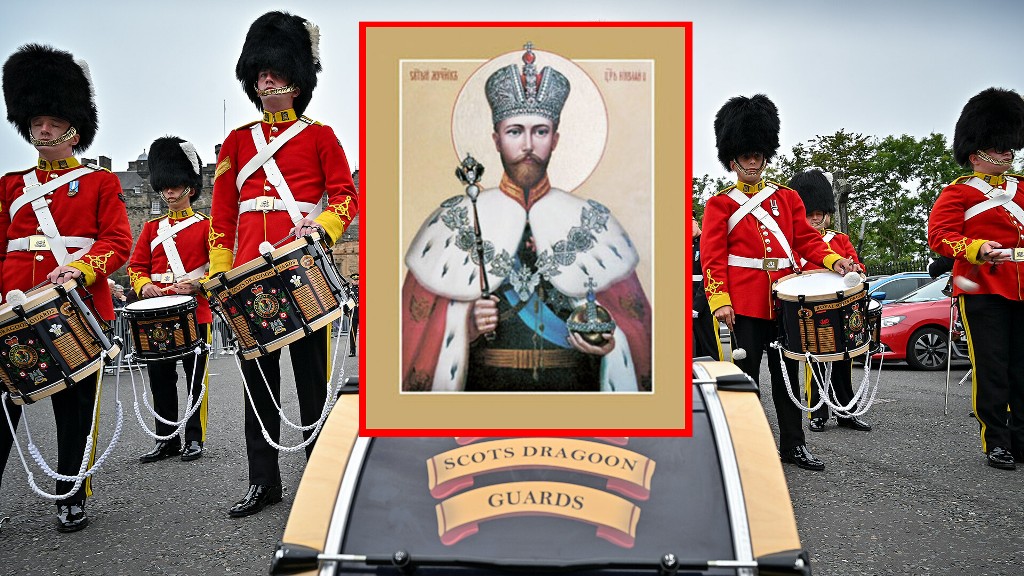
PHOTO: Scots Dragoon Guards marching with the icon of Tsar-Martyr Nicholas II

Lieutenant Colonel Johnny Biggart, commander of the elite Scottish military unit Scots Dragoon Guards, holds the icon of the Tsar-Martyr Nicholas II. This photo was taken in 2012 in Lashkar Gah, Afghanistan.

The icon was presented to the regiment in August 2001 by the Moscow Caledonian Club “on behalf of the Russian people”. The icon of the holy martyr Nicholas II accompanies the Scots Dragoon Guards Scottish regiment wherever they are deployed. 

Tsar Nicholas II was appointed Honourary Colonel-in-Chief of the Royal Scots Greys by Britain’s Queen Victoria in 1894, after he became engaged to Alexandra Feodorovna (Princess Alix of Hesse), who was Victoria’s granddaughter.

To this day Tsar Nicholas II is commemorated by the Royal Scots Dragoon Guards (which the Royal Scots Greys became in 1971), by the playing of the Russian Imperial anthem at certain mess functions. 
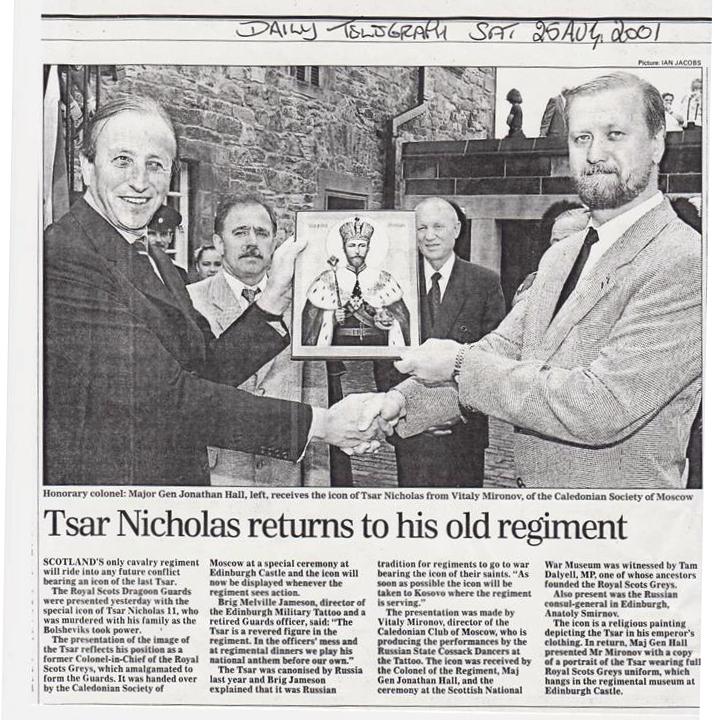
PHOTO: Newspaper shows Vitaly Mironov presenting icon to Major-General Hall

The Director of the Moscow Caledonian Club Vitaly Mironov notes that the idea to present an icon to the Scots Dragoon Guards Scottish regiment was one shared with historian Dr. Dmitry Fedosov, who then commissioned a church artist to paint this special icon. The icon was solemnly handed over by Mironov to the regimental commander on 24th August 2001, during a special ceremony in Edinburgh Castle in the presence of Mr. Smironov, the Consul General of the Russian Federation; the oldest member of the British Parliament Tam Dalyell; a large number of journalists and artists of the Russian Cossacks State Dance Company, who regularly perform in the Edinburgh Military Tattoo. 

When the producer of the Edinburgh Military Tattoo, Brigadier Melville Jameson asked Mironov “on behalf of whom do we want to present this icon to the regiment?”, he replied – “please mention that it was not done on our own behalf, but on behalf of ALL RUSSIAN PEOPLE.”

“This is extremely important for us,” added Mironov,  “because we considered the very fact of painting this icon and its presentation to the glorious Scottish regiment, as an act of the deepest repentance of ALL OF OUR PEOPLE for the greatest evil that our ancestors did to the Tsar, his family and members of the household … It is our history and our common historical memory.”
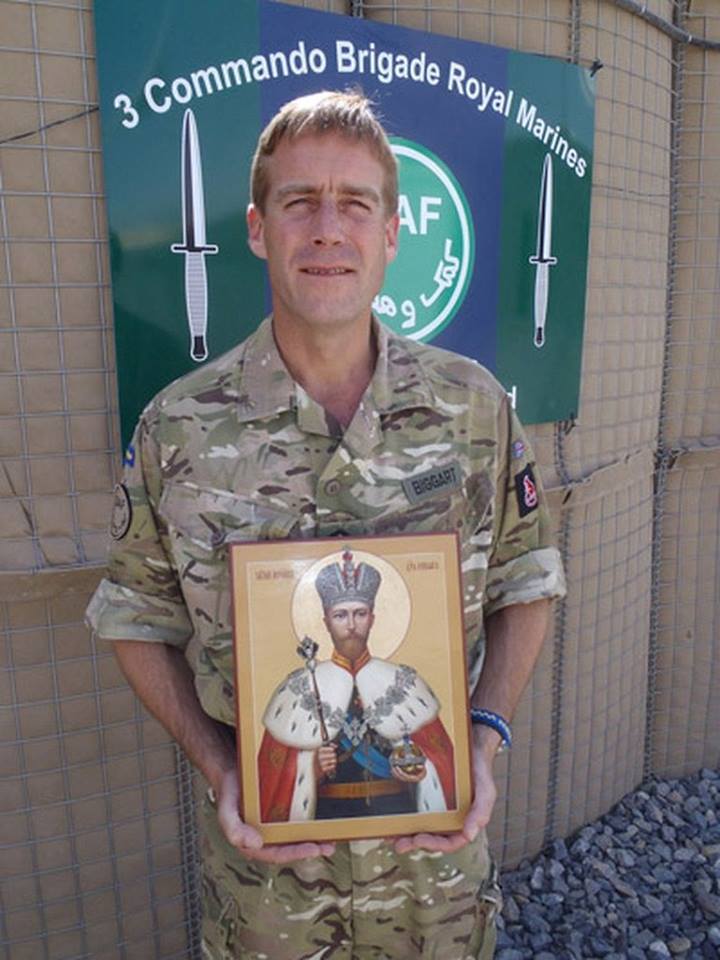
PHOTO: Lieutenant Colonel Johnny Biggart holds the icon of Tsar-Martyr Nicholas II
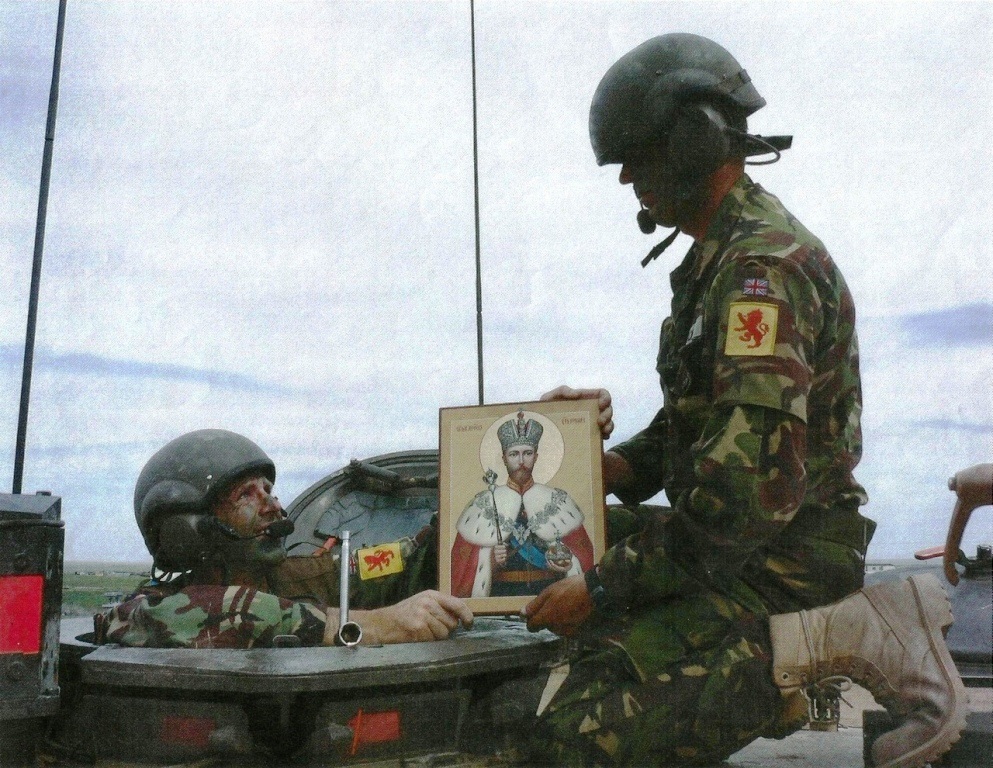
PHOTO: Scots Dragoon Guards holding the icon of Tsar-Martyr Nicholas II

I would like to take this opportunity to thank Vitaly Moronov for supplying me with this information and the importance of this icon of Tsar-Martyr Nicholas II.

Click HERE to read the article Bonded in the Old Faith: Saint Andrew, Nicholas II, and the Birdcatchers by Monk Theodore, published in Orthodox Life on 13th December 2020

© Paul Gilbert. 4 May 2021
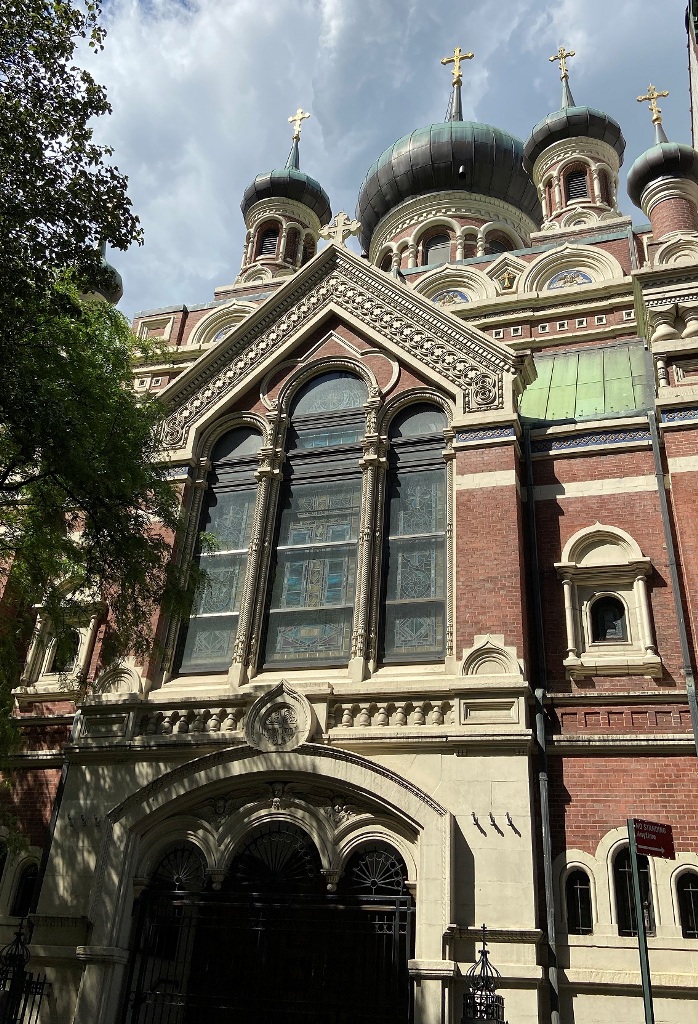
Historic link between Nicholas II and St. Nicholas Cathedral in New York

PHOTO: St. Nicholas Russian Orthodox Cathedral
was built in the Moscow Baroque style in 1902

This month marks the 124th anniversary of the laying of the foundation stone for St. Nicholas Russian Orthodox Cathedral, located in the Upper East Side of Manhattan, New York City. The cathedral serves as the administrative center of the Russian Orthodox Church in North America, and houses the representation of the Moscow Patriarchate in the United States.

On 25th August 1899, a plot of land of about 700 m² was purchased on 97th Street, between Madison and 5th Avenue, on which it was planned to build a cathedral that could accommodate 900 worshipers, as well as premises for a Sunday school, festive meetings and an apartment for clergy.

The cathedral was constructed in the Moscow Baroque style by the architect Ivan Viktorovich Bergezen. In 1900, permission to raise funds for the construction of the church was issued by Emperor Nicholas II, who on his own behalf donated 7,500 gold rubles to the project.

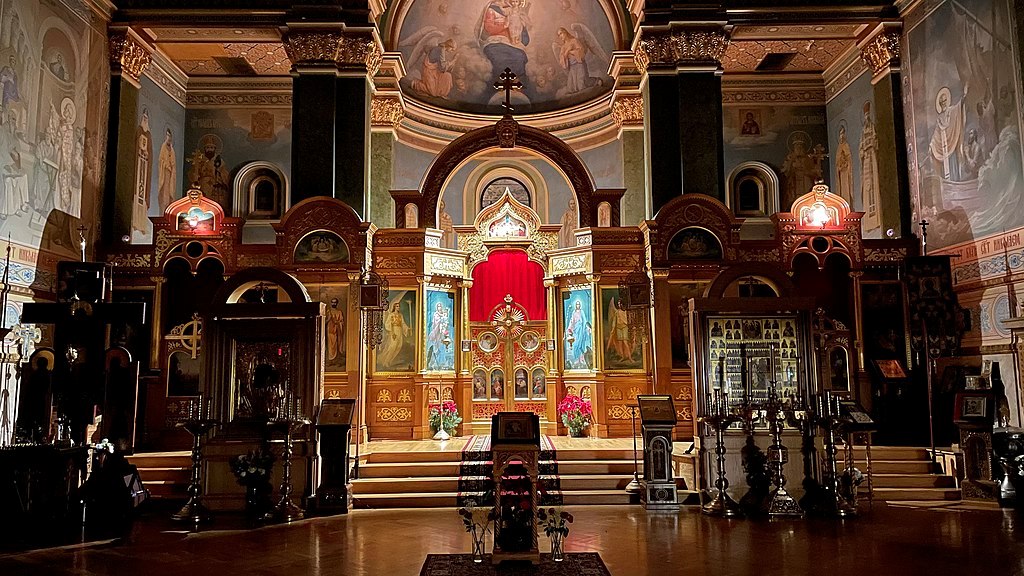
PHOTO: the iconostasis of St. Nicholas Russian Orthodox Cathedral

The foundation stone of the church was laid by Bishop Tikhon, the head of the Russian Church in the Aleutian Islands and North America – the future Patriarch of Moscow and All Russia Tikhon (1865-1925) on 22nd May 1901.

On 23rd November 1902, a consecration service, the first to be held in the completed church, was led by Bishop Tikhon. Bishop Charles Chapman Grafton, representing the Episcopal Church, participated in the service. The Russian Holy Synod elevated St. Nicholas Church to Cathedral status in December 1903, and the Diocesan Seat of North America was transferred from San Francisco to New York in 1905. Restoration work was carried out on the Cathedral between 1954 and 1960.

Today St. Nicholas Cathedral continues to serve the needs of the Russian Orthodox Church in this country as it has since its founding.

© Paul Gilbert. 4 May 2021

Memories of Nicholas and Alexandra’s love that have transcended time

PHOTO: aerial view of Schloss Wolfsgarten, near Darmstadt

Hidden away from the eyes of most visitors to Wolfgarten in Germany and the State Hermitage Museum in Russia, are two haunting mementoes etched into simple window panes of each of the two former royal residences. Despite revolution, two world wars and palace renovations, these glass windows with inscriptions written by Emperor Nicholas II and Empress Alexandra Feodorovna have miraculously survived to this day.

Wolfsgarten, Germany

Schloss Wolfsgarten is a former hunting seat of the ruling family of Hesse-Darmstadt, located in the German state of Hessen, situated 15 kilometers south of Frankfurt. The hunting lodge was established between 1722 and 1724 by Landgrave Ernst Ludwig of Hesse-Darmstadt. In 1768, Wolfsgarten was abandoned until the 1830s when the grand ducal family began to restore and expand the property. From 1879, Wolfsgarten became a favourite country retreat for Grand Dukes Ludwig IV and his son Ernst Ludwig, brother of Princess Alix, the future Empress Alexandra Feodorovna.

PHOTO: the years marking visits by Nicholas and Alexandra are etched in a window at Schloss Wolfsgarten

In November 1903 Nicholas II and Alexandra Feodorovna visited the *divorced and not yet remarried Grand Duke Ernst Ludwig. It was on this occasion, that the couple updated the record of their visits to Wolfsgarten, by carving the year on a glass window, as they had done on prior visits in 1896 and 1899 respectively. The Imperial couple returned to Wolfsgarten in 1910.

*On 19th April 1894 Ernst Ludwig married his cousin Victoria Melita von Edinburgh, among the European royals and nobility in Coburg. Ernst and Victoria divorced on 21st November 1901. Victoria married Grand Duke Kirill Vladimirovich on 8th October 1905.

On 9th October 1937, Ernest Louis died after a long illness at Schloß Wolfsgarten. He received what amounted to a state funeral on 16 November 1937 and was buried next to his daughter, Elisabeth, in a new open air burial ground next to the New Mausoleum he had built in the Rosenhöhe park in Darmstadt.

PHOTO: contemporary view of the Winter Palace (State Hermitage Museum)

Winter Palace, St. Petersburg

From December 1895, Emperor Nicholas II and Empress Alexandra Feodorovna, resided for periods during the winter in the Winter Palace. They extended and redesigned the rooms which had been prepared for Nicholas, as Tsesarevich two years earlier. The architect Alexander Krasovsky was commissioned to redecorate a suite of rooms in the northwest corner of the palace.

Following the events of Bloody Sunday in 1905, Nicholas II and his family abandoned the Winter Palace in favour of the more private Alexander Palace at Tsarskoye Selo. From this date until the fall of the monarchy, the Winter Palace was used only for formal state occasions.

PHOTO: Alexandra records a memory from March 1902 on a window in her Study

On 25th October 1917, following the Provisional Government’s arrest in the Small Dining Room of the Winter Palace, an eyewitness account records a systematic destruction of the Imperial apartments by the Bolsheviks. The only original interior to have survived to the present is Nicholas II’s Gothic Library. The remainder of the Imperial couple’s private apartments including the bulk of their contents have been lost.

One tiny memento, however, has survived. Hidden from view by a lace curtain in the former Study of Empress Alexandra Feodorovna, a memory was recorded by Alexandra. On 7th March 1902, taking her diamond ring, she etched the following in one of the windows: “Nicky 1902 looking at the Hussars. 7 March”.

In 1926 the former living quarters of the Imperial couple were handed over to the State Hermitage Museum for use as exhibition halls. The same year the décor of the Study was destroyed: the yellow damask wall covering was removed and the vault painting with flowers and garlands was painted over (it has since been restored). The viewing platform in the corner was dismantled, from which the Imperial couple liked to look at the Neva River at different times of the year from “Alix’s window” as Nicholas II used to call it in his diary.

Today, Room 185 houses the exhibition dedicated to the work of the famous St Petersburg furniture maker Heinrich Gambs. On view here are pieces of furniture and objects of decorative and applied art executed in the Classicism style.

CLICK on the VIDEO below, which shows not only the former Study of Alexandra Feodorovna, but also the view from the window, which will give you a better perspective of where the engraved window is exactly:

© Paul Gilbert. 4 May 2021