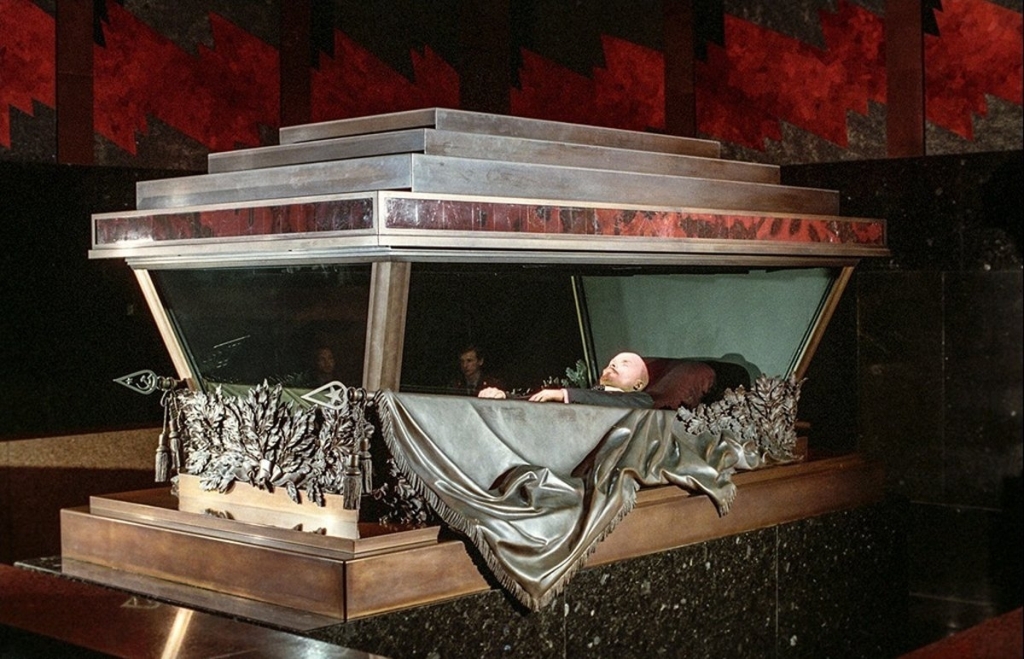
PHOTO: the remains of Bolshevik leader Vladimir Lenin
More than a century after his death, the body of Bolshevik leader Vladimir Lenin laying in a marble and granite mausoleum on Red Square continues to raise the ire of many Russians.
During the afternoon of 8th April 2026, upon entry to the “mourning hall” of Lenin’s mausoleum, an 18-year-old student began yelling screaming obscenities about the Bolshevik leader. He then took off one of his shoes and threw it, striking the glass-enclosed sarcophagus holding the remains of the Bolshevik leader.
Konstantin Sergeyevich Bodunov was promptly arrested by police, who stand guard both inside and outside the mausoleum. Bodunov appeared in Tverskoy District Court of Moscow and was sentenced to 10 days in jail. During the trial, the young man pleaded guilty to being in the mausoleum and throwing his shoe. He explained his actions by condemning Lenin’s “economic and religious policy.”
The incident is just one of a string of protests, made over the years by Russians, who share their hatred towards Lenin and the Bolsheviks. Many of these incidents never reach the Western media.
In February of this year, the Kuzminsky District Court of Moscow found Olga Fedosova guilty of threatening to “blow up Lenin’s Mausoleum and set fire to his corpse”. Fedosova was found guilty and sentenced to four years in prison.
On 18th June 2024, a man threw a Molotov cocktail at the Mausoleum, but it hit the fence and did not explode. He was detained on the spot by police officers. The Tverskoy Court of Moscow sentenced Konstantin Starchukov to four years in prison.
In May 2023, Kostya Starchukov, from the Trans-Baikal region, was detained by police on Red Square. The 37-year-old man had two bottles of gasoline on him, and told police that he wanted to set fire to Lenin’s Mausoleum.
Then, on the night of 6th February 2023, a man tried to get into Lenin’s Mausoleum with the intention of “stealing” Lenin’s corpse! The 42-year-old man, tried to open the door of the mausoleum, before he was detained by police. The detainee, who suffered from a mental disorder, admitted that he wanted to steal Lenin’s body.
Even when Lenin was alive, several attempts are known to have been made on his life. The most famous of them was committed on 30th August 1918, by the Socialist Revolutionary Party member Fanny Kaplan tried to assassinate Lenin.
During the Soviet years, several incidents took place against the remains of the Bolshevik leader.
In March 1934, a peasant managed to smuggle a gun under his shirt past the guards. He considered himself “deceived by the authorities and decided to seek revenge”. The man took out his gun in the “mourning hall” of the Mausoleum, and fired two shots at Lenin’s sarcophagous, but he missed. He then turned the gun on himself and committed suicide with the third shot.
In March 1959, a man threw a hammer into the glass of Lenin’s sarcophagus. The crack left by the hammer remains to this day. The man was declared mentally ill, and was subsequently sent to an institution for treatment.
In 1967, a man from Lithuania attempted to blow up an Lenin’s Mausoleum. An explosion thundered outside the building, how he managed to get an explosive past the guards remains a mystery to this day. The bomber later claimed that the guards “paid no attention to him”.
On 1st September 1973, a man with a briefcase went into the “mourning hall” of the mausoleum. Once inside, he joined two wires in the area of the shirt collar – a deafening explosion thundered. A married couple who were in close proximity to the man were killed, two soldiers of the Kremlin regiment and several schoolchildren were among the injured. The sarcophagus was not damaged.
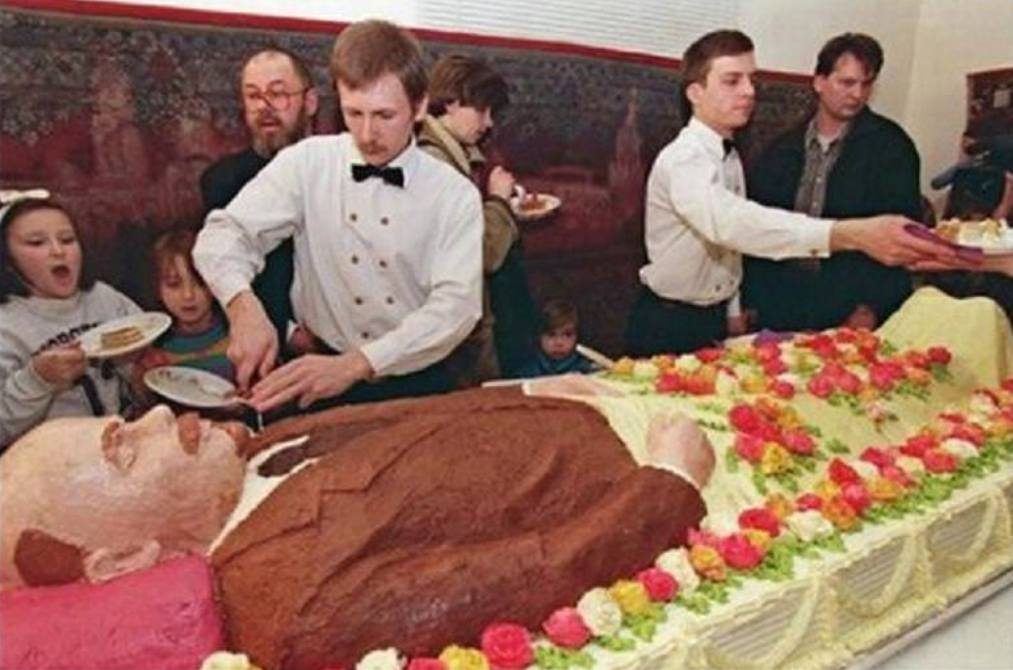
PHOTO: Yuri Shabelnikov life-size cake of Lenin’s body – see below
Why target Lenin?
It is widely agreed that the Bolshevik government came to power by criminal means, and that Lenin personally gave the order to murder Tsar Nicholas II and his family in 1918.
Not only was he responsible for the destruction of the Russian Empire, he was also responsible for the deaths and suffering of millions of innocent people when he unleashed the Civil War and the first Red Terror that followed.
His hatred towards religion led to endless violence and persecution against the Russian Orthodox Church. Lenin also signed the shameful Treaty of Brest-Litovsk with Germany on 3rd March 1918.
Since the fall of the Soviet Union in 1991,there have been numerous calls for the removal of Lenin’s remains from Red Square. The topic is a “hot potato”, one of which even Vladimir Putin does not want to address, for fear of a backlash from Russian Communists.
On the morning of 1st April 1997, at 05:25 am, a monument to Emperor Nicholas II near Moscow, was blown up by members of the left-wing extremist organization Revvoensovet [named after the Revolutionary Military Council of 1918]. Their reason, was their opposition to a proposal to remove Lenin’s corpse from the mausoleum in Red Square.
In 1998, Russian president Boris Yeltsin actually considered removing Lenin’s body and burying his remains next to that of his mother in the Volkovskoye Cemetery in St. Petersburg, as the Bolshevik leader had requested prior to his death. Yeltsin’s plan was never carried out.
Lenin’s body was ultimately embalmed and placed in a marble and granite mausoleum on Red Square instead. It is interesting to note that the architect Alexey Viktorovich Shchusev (1873-1949), is the same architect who designed the Church of the Intercession of the Virgin in the Marfo-Mariinsky [Martha and Mary] Convent, founded in Moscow by Grand Duchess Elizabeth Feodorovna (1864-1918).
Up until the collapse of the Soviet Union in 1991, the preservation of Lenin’s remains was funded by the Soviet government. After 1991, the government discontinued financial support, after which the mausoleum was funded by private donations – mostly Communist sympathizers. In 2016 the Russian government reversed its earlier decision and announced it would spend 13 million rubles [$171,000 USD] to preserve Lenin’s body.
In 1998, a provocative event staged by the Russian artist Yuri Shabelnikov at the Dar Gallery in Moscow, titled “Lenin is in You and in Me”. Shabelnikov created a life-size cake (see photo above) shaped like Lenin’s embalmed body, presented as if lying in a coffin, and invited guests to eat it. The act turned a once-sacred revolutionary icon into something fleeting and consumable, symbolizing how Lenin’s ideological authority had faded in the 1990s and become an object of irony rather than reverence. Such an event would have been unimaginable during Soviet rule. [Source: Constantine Goh]
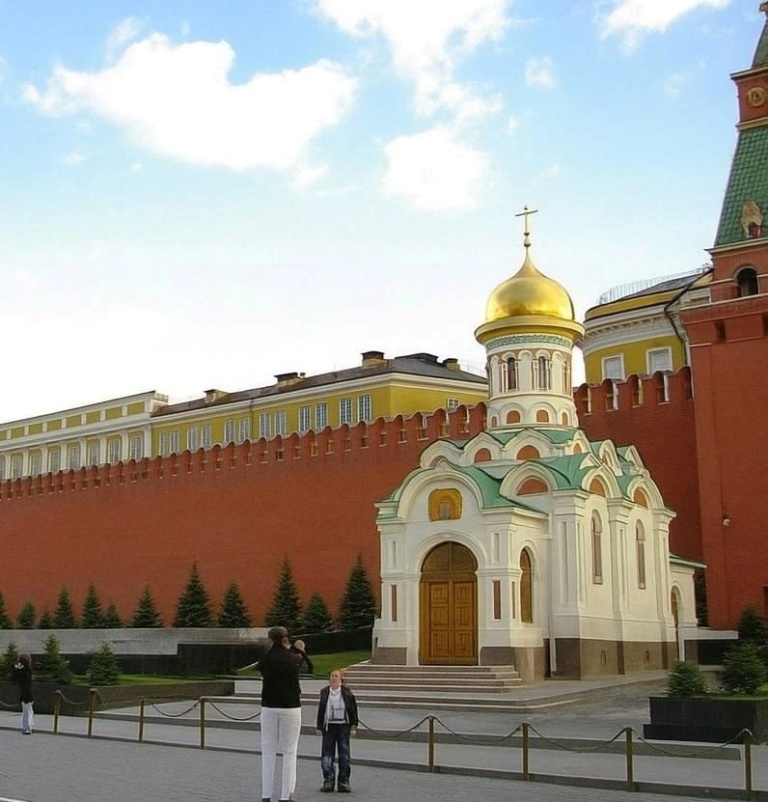
PHOTO: artist concept of the Church of the New Martyrs
proposed for the site of Lenin’s Mausoleum on Red Square
“Sooner or later, Lenin’s body will be buried”
In October 2020, a Prominent representative of the Russian Orthodox Church (ROC) spoke out on the burial of Lenin
“Vladimir Lenin has no place in Red Square. Nevertheless, one should proceed with caution in the matter of his burial.” This statement was made by the head of the Department for External Church Relations of the Moscow Patriarchate, Metropolitan Hilarion, on the Russia 24 TV channel.
“I have no doubt that sooner or later Lenin’s body will be buried. It is another matter, however, when this will take place, and under what circumstances,” he said.
The high ranking representative of the Russian Orthodox Church called Lenin a “traitor to the Motherland” who came to Russia on German money. In his opinion, Lenin was a revolutionary who should be judged according to ordinary laws.
“In 1918 Lenin unleashed the Red Terror, which resulted in the repression and mass killings of the Russian population, therefore, the Bolshevik leader has no place in Red Square, he has no connection to it whatsoever,” the Metropolitan added.
“Lenin’s funeral will take place only when the communist ideology finally fades into the past. And this will still take some time,” the priest said.
The Metropolitan proposes to leave the mausoleum as is, since it is the work of the outstanding architect Alexey Viktorovich Shchusev (1873-1949). He supports the idea of converting it into a museum of mass repression during the Bolshevik years.
In September 2025, Advisor to the Prosecutor General of the Russian Federation demanded the renaming of all toponyms in Russia bearing the name of the former Bolshevik leader Vladimir Lenin . . .
Natalia Poklonskaya sent a letter to the Cabinet of Ministers with a proposal to rename all toponyms in Russia bearing the name of Vladimir Lenin: streets, squares, parks, as well as the demolition of monuments to the Bolshevik leader, who ordered the murder of Russia’s last Tsar and his family.
“Each of us recalls the horrors of the Red Terror and the shooting of the Imperial Family,” she noted. “It’s time to get rid of the symbol of the Bolsheviks and Soviet era . . . “
As a replacement for Lenin, Poklonskaya proposed to assign toponyms the names of Nicholas II, Paul I, Catherine II and other Russian monarchs.
In July 2025, a Russian Orthodox social media group proposed the demolition of the Lenin Mausoleum on Red Square in Moscow, and replacing it with a Church of the New Martyrs (see photo above).
The author of this article supports such an idea, and I am sure that I pray and speak for many others, that we shall live to see the day when both Lenin’s corpse and Mausoleum are permanently erased from the Russian landscape!
© Paul Gilbert. 19 April 2026


You must be logged in to post a comment.