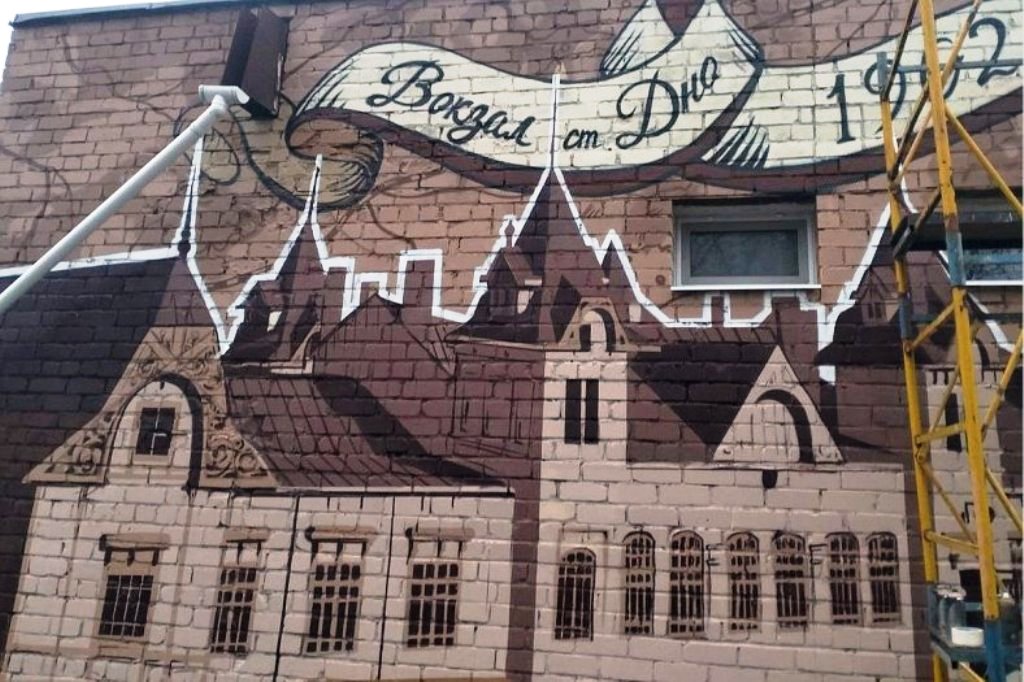
PHOTO: modern-day murual depicting the train stain in Dno
On 14th (O.S. 1st) March 1917, at 15:00, Emperor Nicholas II arrived at Dno on the Imperial Train, where an urgent telegram from State Duma Chairman Mikhail Rodzianko[1] awaited him:
“Dno station. To His Imperial Majesty. I am now leaving for Dno Station by emergency train to report to you, Sire, on the state of affairs and the necessary measures to save Russia. I earnestly ask you to wait for my arrival, for every minute counts.“
Without waiting for Rodzianko, the Tsar ordered the Imperial Train[2] to proceed on to Pskov, where he would meet up with Rodzianko, however, the chairman never arrived. On the night of 1st/2nd March, during a conversation with General Ruzsky[3] Rodzianko explained his “non-arrival” by the impossibility of leaving Petrograd in a situation where the revolutionary events in the capital threatened to develop into anarchy.
Emperor Nicholas II abdicated the following day, on 15th March (O.S. 2nd) March 1917, bringing an end to more than 300 years of the Romanov dynasty and the monarchy in Russia.
The Sovereign abdicated in the heartfelt belief that his abdication would save the honour of the army, prevent civil war and keep Russia in the war against Germany.
Sadly, it did not. In his diary, Nicholas wrote: “I am surrounded by betrayal, cowardice, and deceit.”
In memory of Emperor Nicholas II’s historic stop at Dno in March 1917, a mural of the pre-war railway station has been recreated, on the building of the museum and exhibition center in Dno. The artists of the mural are Ivan and Nikita Trakhov, both of whom are residents of Pskov.
“The mural will remind everyone of our history, the station, which Nicholas II saw from the window of his train,” said Mikhail Shaurkin, who serves as the head of the Dnovsky district .
The idea for the mural was conceived by the head of the museum Sergey Egorov. He wanted to recreate the historic look of the station as it looked more than a century ago. According to him, “many tourists, as well as residents of the city, are surprised to learn that there was a railway station in Dno before the Great Patriotic War.”
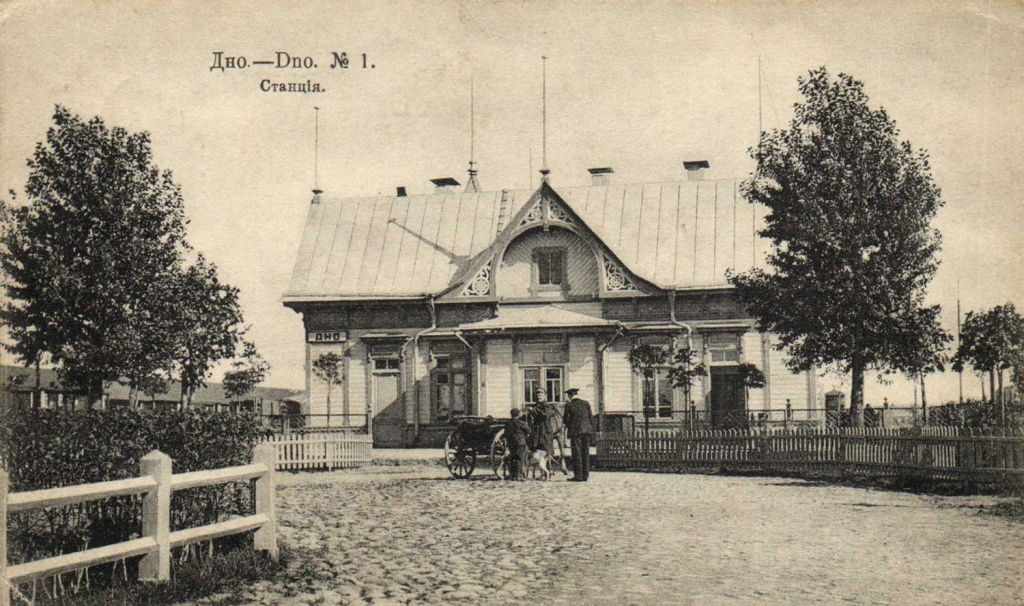
PHOTO: early 20th century postcard depicting the old wooden station at Dno
The original train station at Dno was constructed of wood in the Art Nouveau style. During the Great Patriotic War (1941-45) the building was destroyed by fire. After the war, a new station was built, which stands to this day.
NOTES:
[1] In an open act of treason against the Emperor, Grand Duke Kirill Vladimirovich wearing a red ribbon on his shoulders, under which the Marine of the Guard followed their commander, marched to Petrograd, where he presented himself at the State Duma, where he reported to Duma Chairman Mikhail Rodzianko. “I have the honour of appearing before Your Excellency,” said the Grand Duke . . . “I am at your disposal, as is the entire nation. I wish Russia only good.”
[2] With the outbreak of World War I, the Imperial Train became both a travelling residence for the Emperor, as well as a military field office, equipped with telephone and telegraph communications. A telephone network was installed for communication between all cars, each carriage having it’s own telephone.
[3] Nikolai Vladimirovich Ruzsky (1854-1918) was a Russian general, member of the state and military councils, best known for his role in World War I and the abdication of Tsar Nicholas II. He was shot by the Bolsheviks on 18th October 1918.
© Paul Gilbert. 10 December 2024
 Nicholas II
You must be logged in to post a comment.