Nicholas II’s stop at Dno, one day before his abdication in 1917
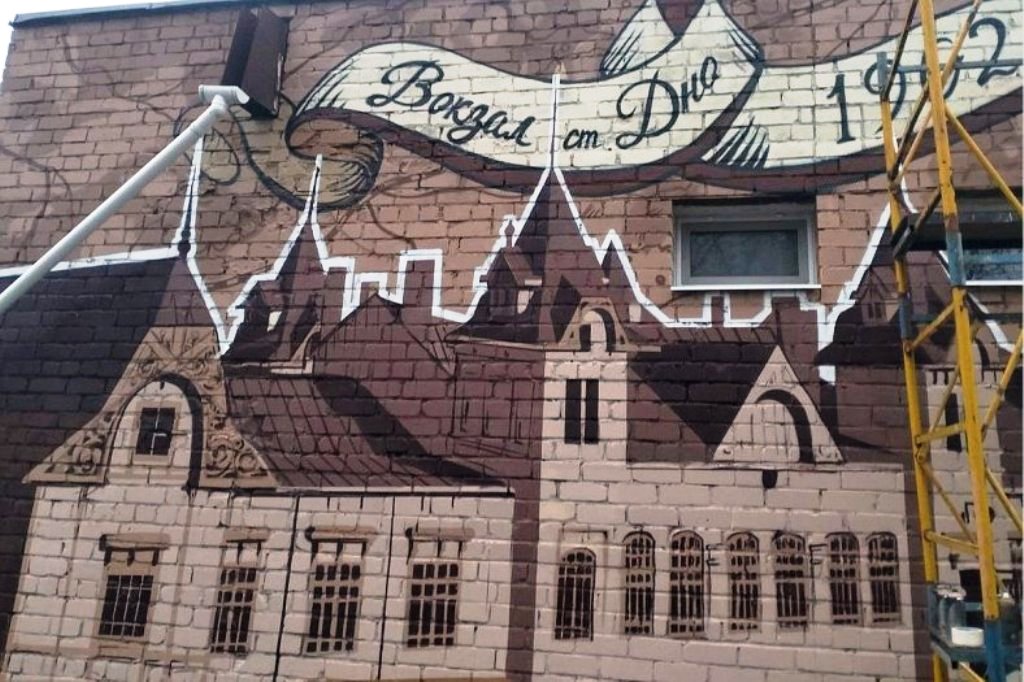
PHOTO: modern-day murual depicting the train stain in Dno

On 14th (O.S. 1st) March 1917, at 15:00, Emperor Nicholas II arrived at Dno on the Imperial Train, where an urgent telegram from State Duma Chairman Mikhail Rodzianko[1] awaited him:

Dno station. To His Imperial Majesty. I am now leaving for Dno Station by emergency train to report to you, Sire, on the state of affairs and the necessary measures to save Russia. I earnestly ask you to wait for my arrival, for every minute counts.

Without waiting for Rodzianko, the Tsar ordered the Imperial Train[2] to proceed on to Pskov, where he would meet up with Rodzianko, however, the chairman never arrived. On the night of 1st/2nd March, during a conversation with General Ruzsky[3] Rodzianko explained his “non-arrival” by the impossibility of leaving Petrograd in a situation where the revolutionary events in the capital threatened to develop into anarchy.

Emperor Nicholas II abdicated the following day, on 15th March (O.S. 2nd) March 1917, bringing an end to more than 300 years of the Romanov dynasty and the monarchy in Russia.

The Sovereign abdicated in the heartfelt belief that his abdication would save the honour of the army, prevent civil war and keep Russia in the war against Germany.

Sadly, it did not. In his diary, Nicholas wrote: “I am surrounded by betrayal, cowardice, and deceit.”

In memory of Emperor Nicholas II’s historic stop at Dno in March 1917, a mural of the pre-war railway station has been recreated, on the building of the museum and exhibition center in Dno. The artists of the mural are Ivan and Nikita Trakhov, both of whom are residents of Pskov.

“The mural will remind everyone of our history, the station, which Nicholas II saw from the window of his train,” said Mikhail Shaurkin, who serves as the head of the Dnovsky district .

The idea for the mural was conceived by the head of the museum Sergey Egorov. He wanted to recreate the historic look of the station as it looked more than a century ago. According to him, “many tourists, as well as residents of the city, are surprised to learn that there was a railway station in Dno before the Great Patriotic War.”
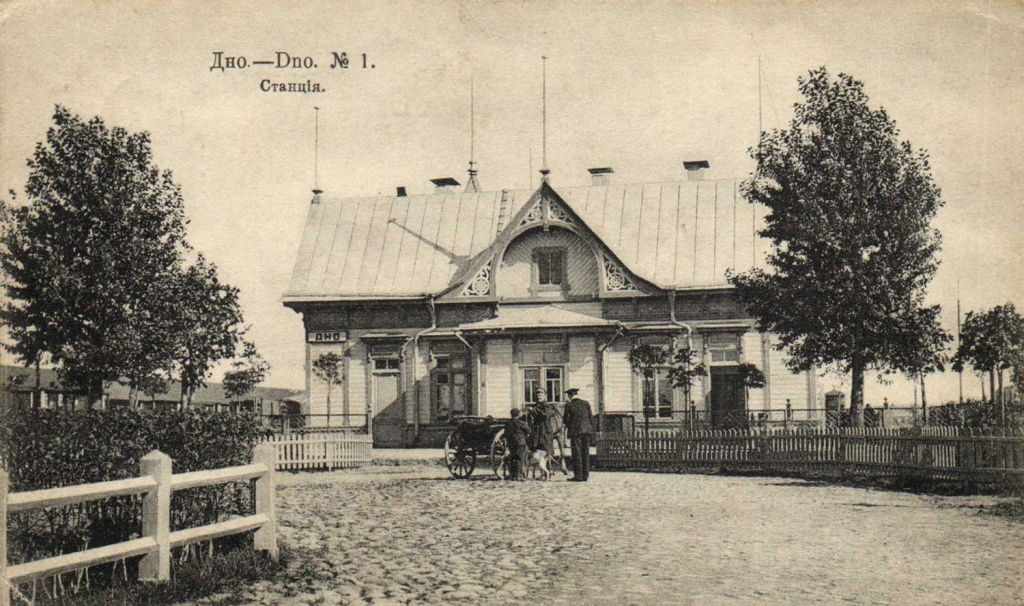
PHOTO: early 20th century postcard depicting the old wooden station at Dno

The original train station at Dno was constructed of wood in the Art Nouveau style. During the Great Patriotic War (1941-45) the building was destroyed by fire. After the war, a new station was built, which stands to this day.

NOTES:

[1] In an open act of treason against the Emperor, Grand Duke Kirill Vladimirovich wearing a red ribbon on his shoulders, under which the Marine of the Guard followed their commander, marched to Petrograd, where he presented himself at the State Duma, where he reported to Duma Chairman Mikhail Rodzianko. “I have the honour of appearing before Your Excellency,” said the Grand Duke . . . “I am at your disposal, as is the entire nation. I wish Russia only good.”

[2] With the outbreak of World War I, the Imperial Train became both a travelling residence for the Emperor, as well as a military field office, equipped with telephone and telegraph communications. A telephone network was installed for communication between all cars, each carriage having it’s own telephone.

[3] Nikolai Vladimirovich Ruzsky (1854-1918) was a Russian general, member of the state and military councils, best known for his role in World War I and the abdication of Tsar Nicholas II. He was shot by the Bolsheviks on 18th October 1918.

© Paul Gilbert. 10 December 2024

‘The True Story of the Romanov Family’ – UPDATED!

HOW TO ORDER THIS BOOK

NOTE: the English language edition of this book is now available in both hard cover and paperback editions. You can now order this book direct from the following suppliers in the United States:

AMAZON

St. Paisius Monastery Gift Shop 

In addition, you can order this book directly from the publisher in Romania. Books are shipped by mail or courier (DHL). I had NO problem ordering a copy, and received it promptly.

HOW TO ORDER FROM THE PUBLISHER: the order page is a bit confusing, because the actual order instructions located at the bottom of the page are in Romanian. Simply use Google (or similar) to translate, the rest is simply.

Click HERE to order your copy. Scroll down to the bottom of the page. Select ‘COVER TYPE’ – hard cover or paperback. To the left of the ‘ADD TO CART’ button, you must select how many copies you want. Click on ‘VIEW CART’ and ‘CONTINUE TO CHECKOUT’. payment is in Euros, credit cards accepted – PG

***

The publishing division of the Diaconești Monastery in Moldavia, Romania, have published an exiting new title: The True Story of the Romanov Family.

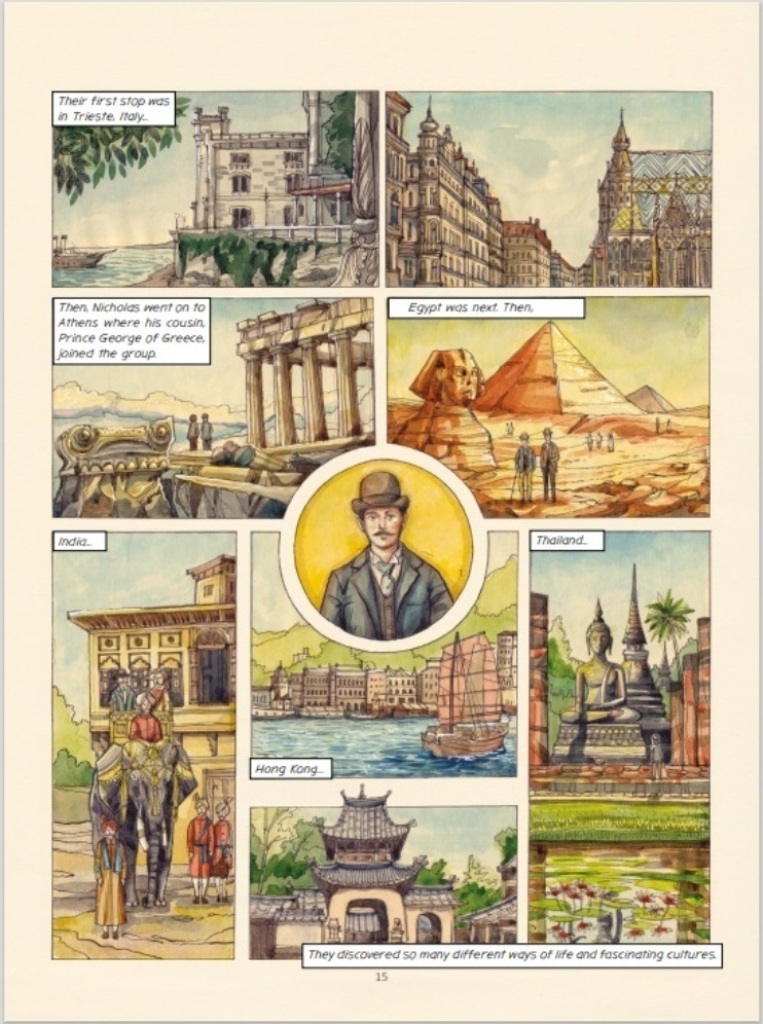
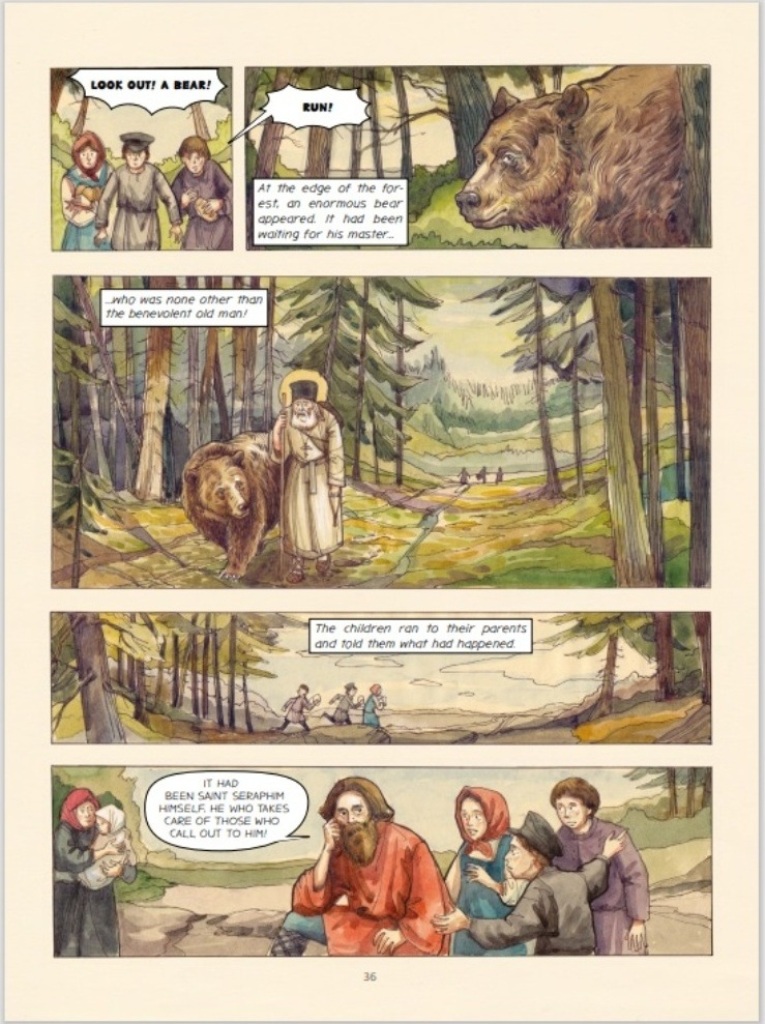
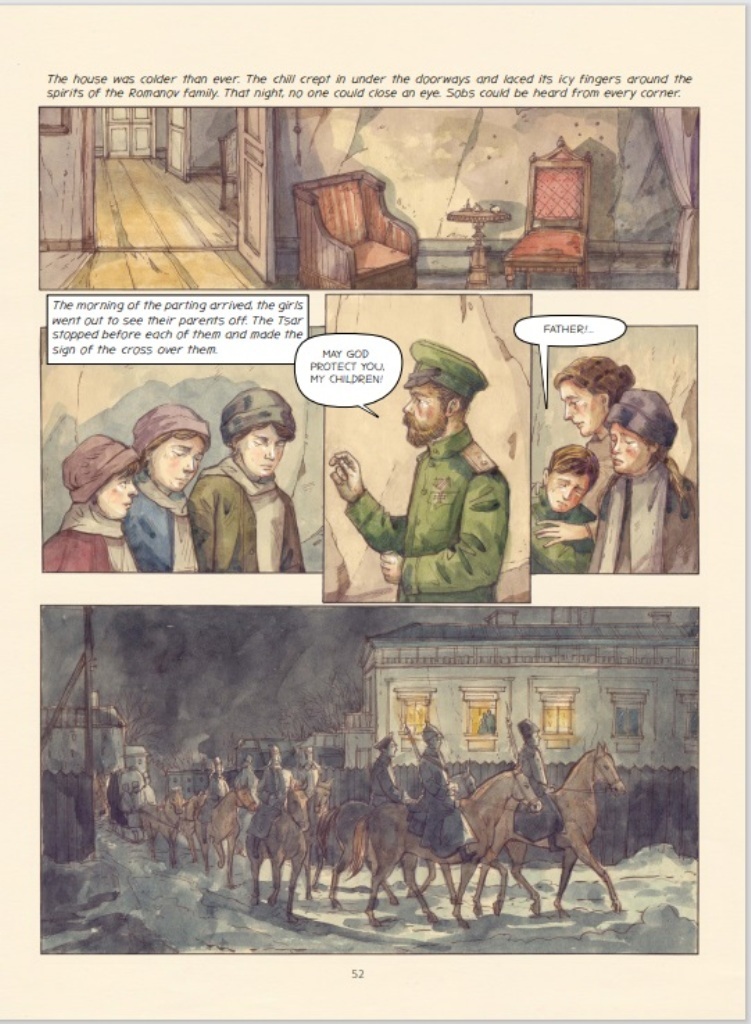
Although an abundance of books have been written about the Imperial Family, the present work is an unparalleled graphic study. Drawing from a wealth of historical sources, including memoirs, diaries, letters and scholarly works on the Imperial Family, the publisher has painstakingly recreated key moments in their private and public lives. In addition, eleven Faberge eggs, meticulously painted by Romanian artist Ovidiu Gliga are prominently featured in the book.

The text of the book is complimented by Ovidiu Gliga’s artwork. Over the past four years, the publisher has collaborated closely with this exceptional artist, whose artwork helps envelope the reader. His work for this book is showcased in the video found at the end of this summary. This book has been issued in both English and Romanian editions, in both hard cover and paperback formats.

CLICK on each image below, to enlarge and view page in greater detail

According to the publisher, “this project has been a labour of love, driven by our admiration for these revered saints and our desire to present their lives in a visually engaging format suitable for readers of all ages. We believe it fills a significant void in the literature about the Imperial Family, offering a detailed exploration of their lives and the enduring impact on Russia’s history.”

It is interesting to note, that the monastery’s inspiration for this project was profoundly influence by the popular book The Romanov Royal Martyrs: What Silence Could Not Conceal, published in 2019 by the Mesa Potamos Monastery in Cyprus, which the nuns of the Diaconești Monastery translated into Romanian.

The Romanian-based publisher has prepared a 2-minute English language video, which will give readers a sample of this unique publishing project, including a glimpse of it’s content and Ovidiu Gliga’s beautiful colour illustrations.

CLICK on the red arrow below to start the VIDEO . . .

© Paul Gilbert. 27 September 2024

Repin’s painting of Nicholas II and the State Council installed in the Mariinsky Palace

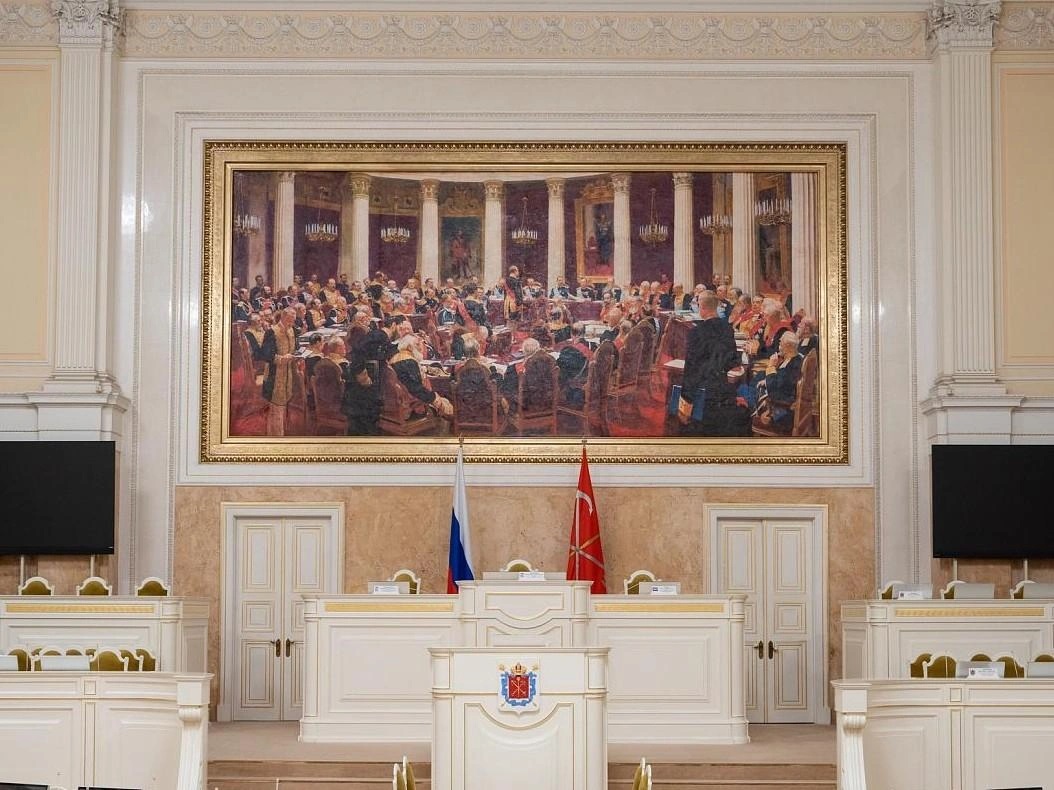
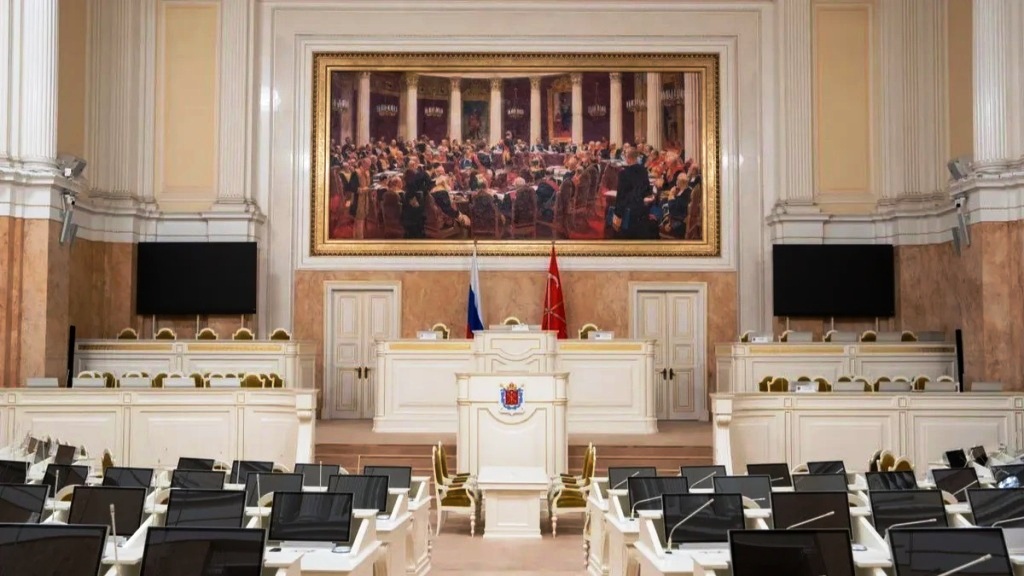
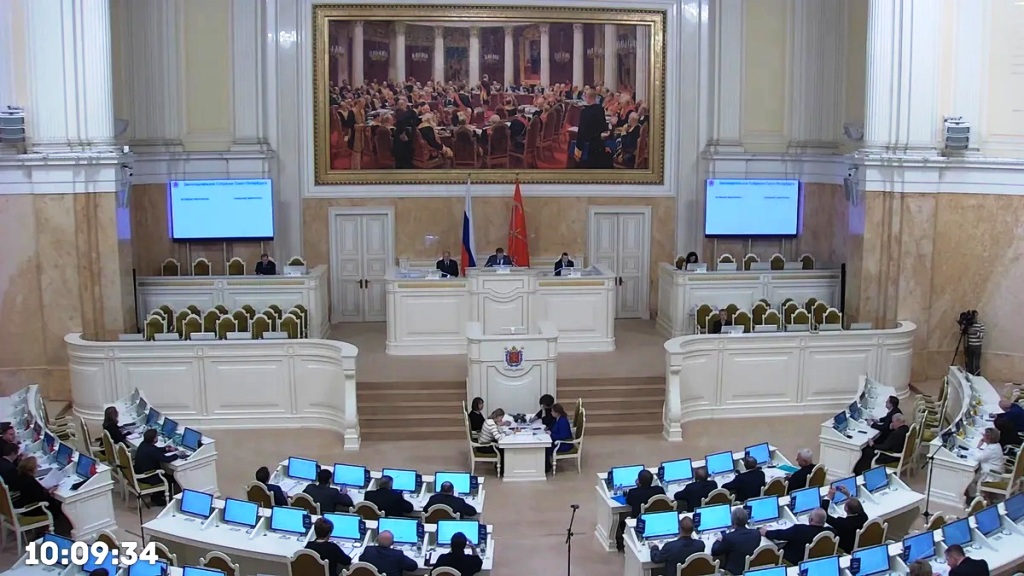
PHOTOS: in December 2024, a copy of “The Ceremonial Meeting Of The State Council 7 May 1901” by Ilya Repin, was installed in the Great Hall of the Mariinsky Palace in St. Petersburg

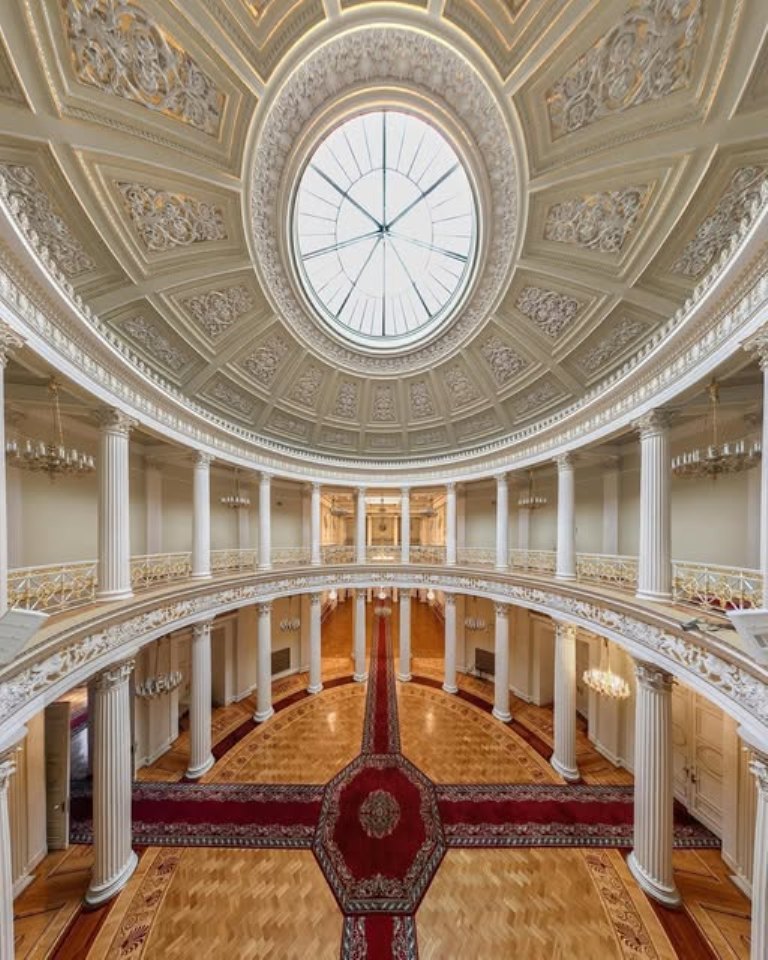
One of the most iconic paintings which reflects the splendour of the Russian Empire has to be “The Ceremonial Meeting Of The State Council 7 May 1901”, by Ilya Yefimovich Repin (1844-1930). A copy of the great Russian artist’s masterpiece was recently installed in the Great Hall of the Mariinsky Palace in St. Petersburg. The palace has been the site of the Legislative Assembly of Saint Petersburg since 1994.

An exact copy of Repin’s painting was a gift from the St. Petersburg artist Oleg Lukyanov for the 30th anniversary of the city parliament. “We thank Oleg Lukyanov, and the director of the State Russian Museum Alla Manilova for this wonderful gift,” said Speaker Alexander Belsky at the opening of the legislature on 4th December 2024.

The chairman of the Legislative Assembly also noted that specialists worked on the painting for more than two months, while the final touches took an additional six days. An exact copy of the canvas is made in the technique of “urban fresco”, which makes it possible to achieve full compliance with the original painting.

Ilya Repin’s masterpiece was first presented to the public in St. Petersburg on 4th January 1904. The painting depicts Emperor Nicholas II and members of the State Council after the emperor read out a charter in honour of the centenary of the establishment of the Indispensable Council (the predecessor of the State Council).

PHOTOS: two views of copy of “The Ceremonial Meeting Of The State Council 7 May 1901” by Ilya Repin, was installed in the Great Hall of the Mariinsky Palace, in St. Petersburg

***

A brief history of Repin’s masterpiece

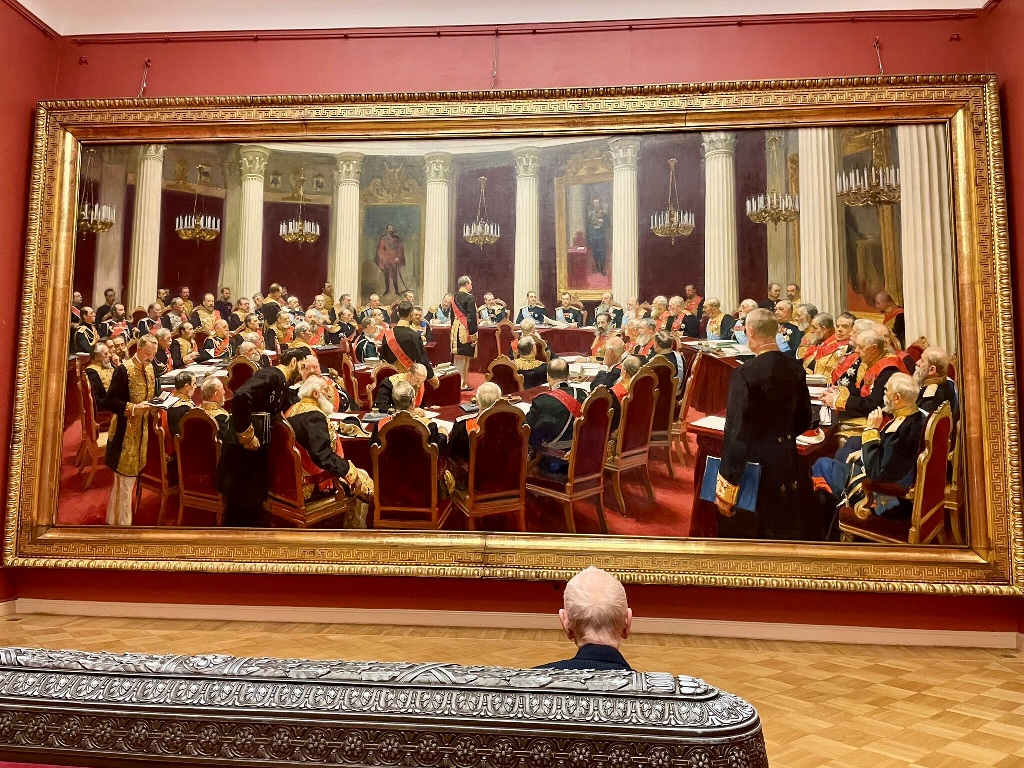
PHOTO: the original “The Ceremonial Meeting Of The State Council 7 May 1901” by Ilya Repin, today hangs in the State Russian Museum in St. Petersburg. The canvas is so large, that it takes up an entire wall, in a hall dedicated to Repin’s masterpiece.

The original “The Ceremonial Meeting Of The State Council 7 May 1901” by Ilya Repin, has been in the collection of the State Russian Museum since 1938. The canvas is so large, that it takes up an entire wall, in a hall dedicated to Repin’s masterpiece.

It is among the most significant and largest paintings from the collection of the State Russian Museum: the large-format canvas measuring 4 by 8 meters [ 13 ft. by 26 ft.].

Painted under a state order, the painting truly conveys the splendor of the Russian Empire. More than a century ago, the political and bureaucratic elite in uniforms attend a solemn meeting in the Round Hall of the Mariinsky Palace. Secretaries are carrying anniversary medals, the future Minister of Internal Affairs Vyacheslav Plehve is standing in front of Tsar Nicholas II, who has finished reading a charter on the occasion of his 100th anniversary. The canvas was created specifically for the Mariinsky Palace, where meetings of the State Council were held.

The Ceremonial Meeting Of The State Council 7 May 1901” is a collective portrait featuring no less than 81 figures. It was painted one hundred and twenty one years ago (1903), in which Repin was paid a large fee. The customer of the canvas, Emperor Nicholas II, was pleased with the result.

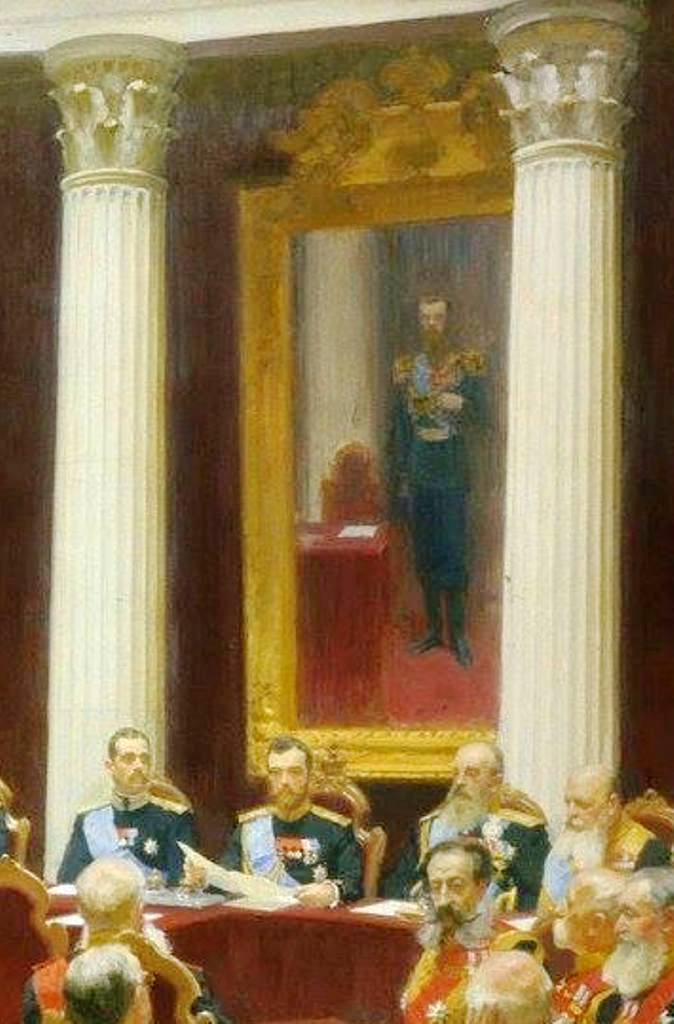
PHOTO: detail from Repin’s painting, which shows Emperor Nicholas II seated between two pillars, under a ceremonial portrait of himself – also by Ilya Repin – painted in 1895. His brother Grand Duke Mikhail Alexandrovich is seated to his right, and Grand Duke Mikhail Nikolayevich (1832-1909), who served as Chairman of the State Council, from 1881 to 1905, is seated to his left.

Founded in 1801 by Emperor Alexander I (1777-1825), the State Council celebrated its centenary with a ceremonial sitting in the Round Hall of the Mariinsky Palace in St. Petersburg on 7th May 1901. All the members of the State Council and the State Chancellery attended in full-dress uniform. Emperor Nicholas II and senior members of the Imperial Family are flanked by their ministers. Repin painted the scene from behind the chairs on the right (next to the columns.

He rapidly sketched the original modello on a canvas on which the perspective of the hall had already been marked out, working from a previously selected point. The artist later turned this study into a large picture with the help of two students from the Imperial Academy of Arts: Boris Kustodiev (1878-1927) and Ivan Kulikov (1875-1941). Every member of the State Council is depicted in natural and diverse poses, with strong physical resemblances.

PHOTO: the Round Hall in the Mariinsky Palace, as it looks today

***

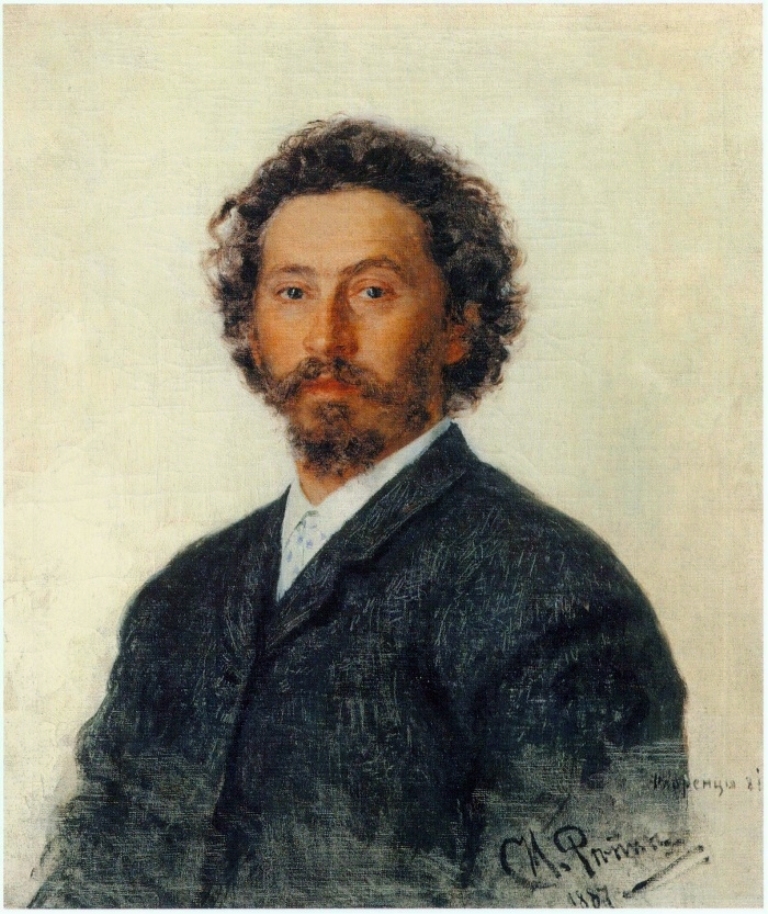
Ilya Yefimovich Repin (1844-1930)

Self-portrait (1887
From the Collection of the State Tretyakov Gallery (Moscow)

Ilya Yefimovich Repin (1844-1930) was a Ukrainian-born Russian painter. He became one of the most renowned artists in Russia in the late 19th to early 20th centuries. His works can be seen today in some of Russia’s most famous museums, including the Tretayakov Gallery in Moscow, the State Russian Museum in St. Petersburg, and the artist’s country estate of Penates, near St. Petersburg, among many others.

Following the ascension of Nicholas II to the throne in 1894, Repin painted a number of ceremonial portraits of the new Emperor. One of these, painted especially for the State Duma in 1905, was lost (among many others) following the February and October 1917 Revolutions.

It is interesting to note that Repin, who was an anti-monarchist, didn’t seem to mind being paid handsomely for the numerous ceremonial portraits and other commissioned paintings by Emperor Nicholas II. One of his most famous works, is The Wedding of Nicholas II and Alexandra Feodorovna (1894), which today hangs in the State Hermitage Museum in St. Petersburg.

Repin warmly welcomed the February 1917 Revolution, which overthrew the autocratic monarchy and proclaimed a republic, an event for which he was very happy. Shortly after the October Revolution of 1917, Repin would regret his support of the overthrow of the monarchy. After Lenin and the Bolsheviks launched the first Red Terror, Repin abruptly changed the bias of his work from anti-monarchist to anti-Bolshevik.

Repin died on 29th September 1930, at the age of 86, and was buried at his country estate Penates, in Kuokkala, now Repino, St Petersburg. His home is now a museum and a UNESCO World Heritage Site.

© Paul Gilbert. 8 December 2024
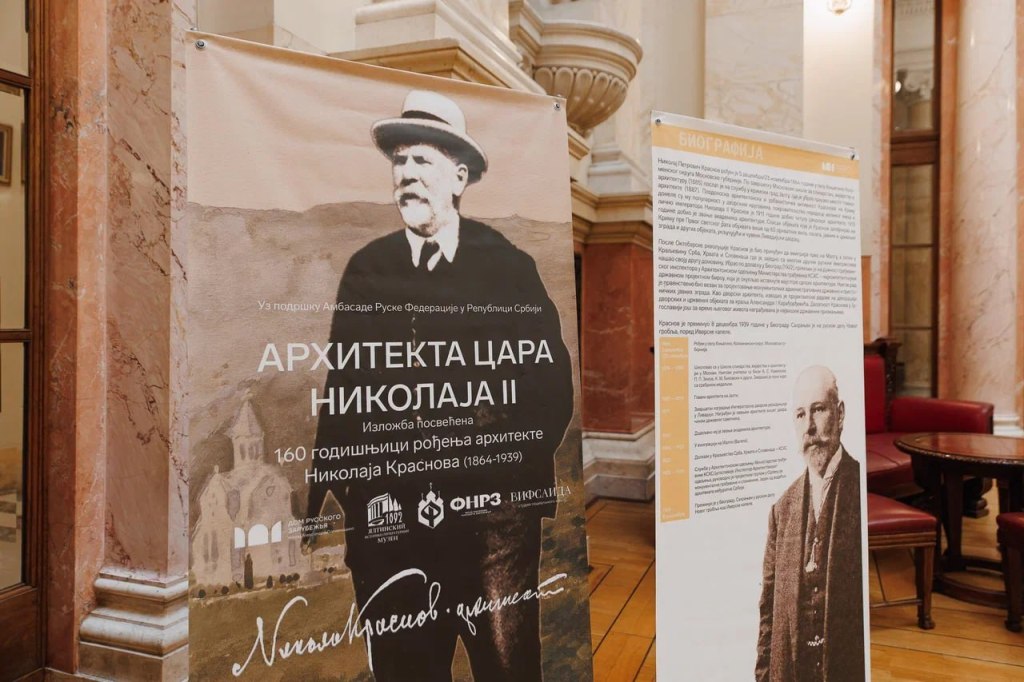
Nikolai Krasnov exhibition opens in Crimea

On 6th December 2024, a new exhibition dedicated to Nikolai Petrovich Krasnov (1864-1939), opened at Livadia Palace in Crimea. The exhibition is timed to the 160th anniversary of the birth of the outstanding Russian-Serbian architect and painter.

Krasnov is best known as the architect who planned and constructed many of the Romanov estates which dotted the southern coast of Crimea, during the late 19th and early 20th centuries. His masterpiece, of course, is the white Italian-style palace at Livadia, the Imperial Residence of Emperor Nicholas II and his family, during their stay in Crimea.

NOTE: click on the images below to enlarge and view each photo in greater detail.

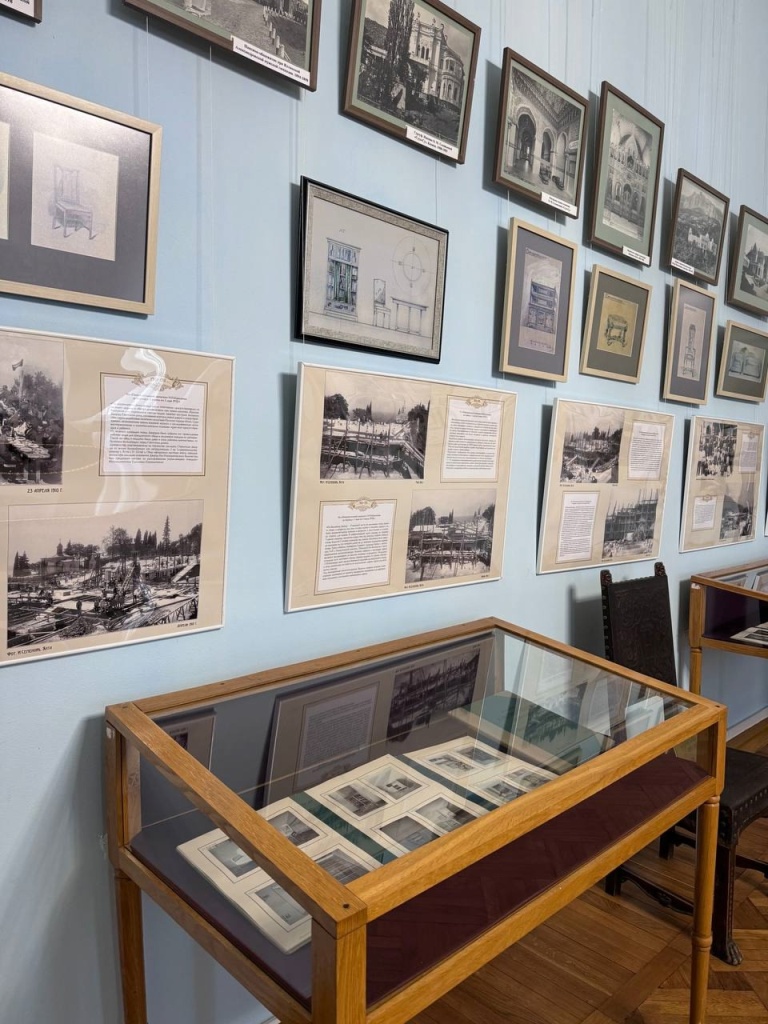
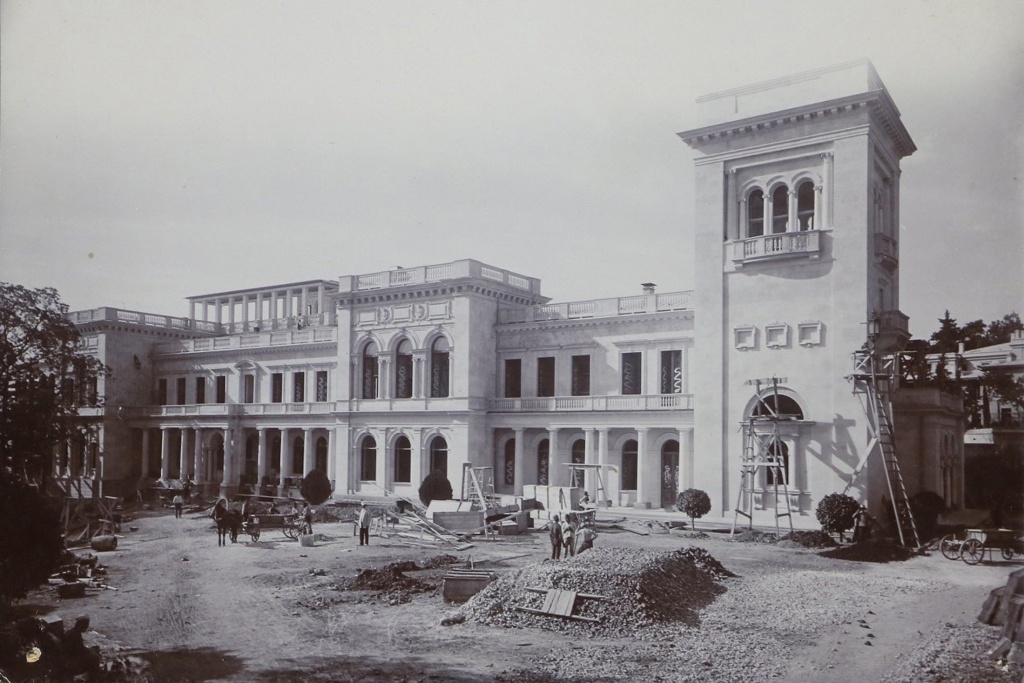
The exhibition features photographs by the famous Yalta photographer and Supplier to the Imperial Court Ivan Ivanovich Semyonov, which depict the stages of the construction of the Livadia Palace. In total, Semenov took about 500 such photos.

Each photo on display in the exhibition includes an explanatory note, outlining the progress of construction, of which Krasnov regularly sent to St. Petersburg to the Ministry of the Imperial Court and Appanages for subsequent approval by the Emperor.

Some of these photos were placed in a special album “Construction of ‘Livadia’ the New Grand Palace in the Name of His Imperial Majesty 1910-1911“, which was presented to the Imperial Family. Fortunately the album has survived to the present day, and is now in the collection of the Livadia Palace Museum.

PHOTO from the exhibition: Livadia Palace under construction. 1911.
Photo: Ivan Ivanovich Semyonov

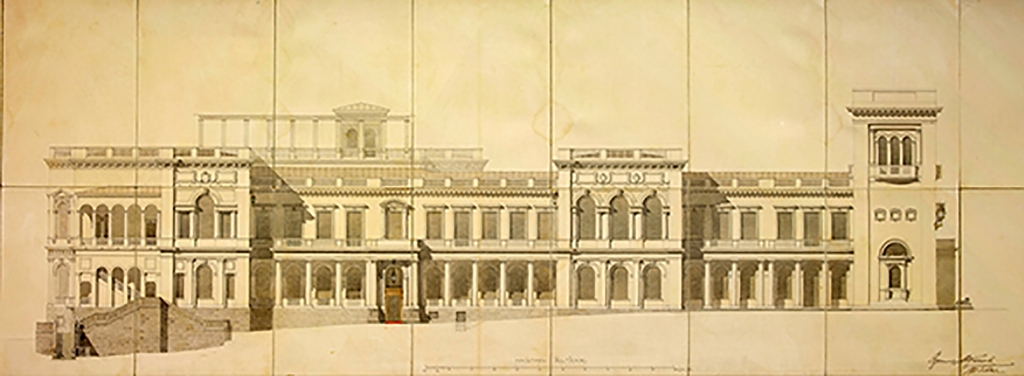
PHOTO: Nikolai Krasnov’s drawing of the Livadia Palace (1910)

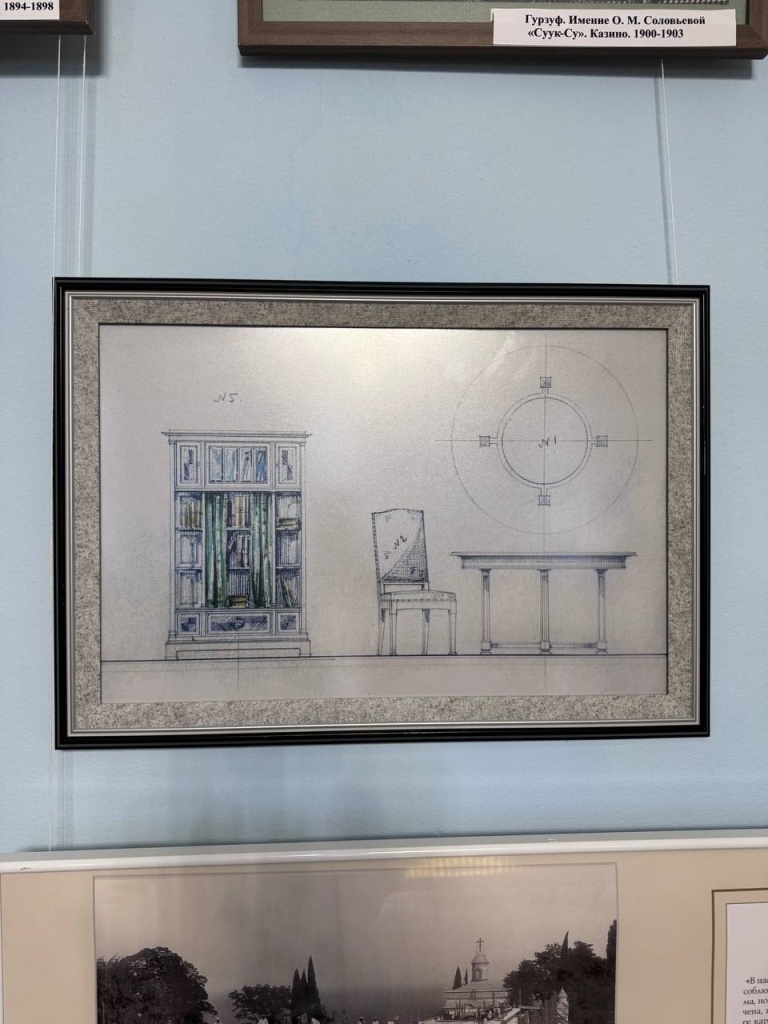
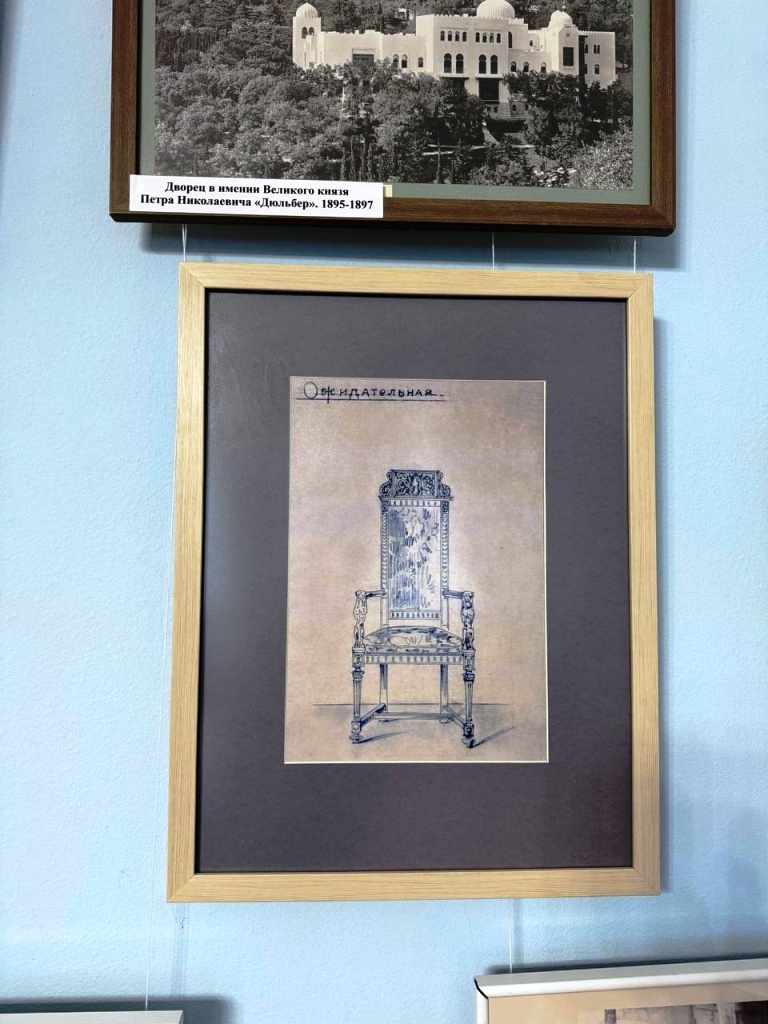
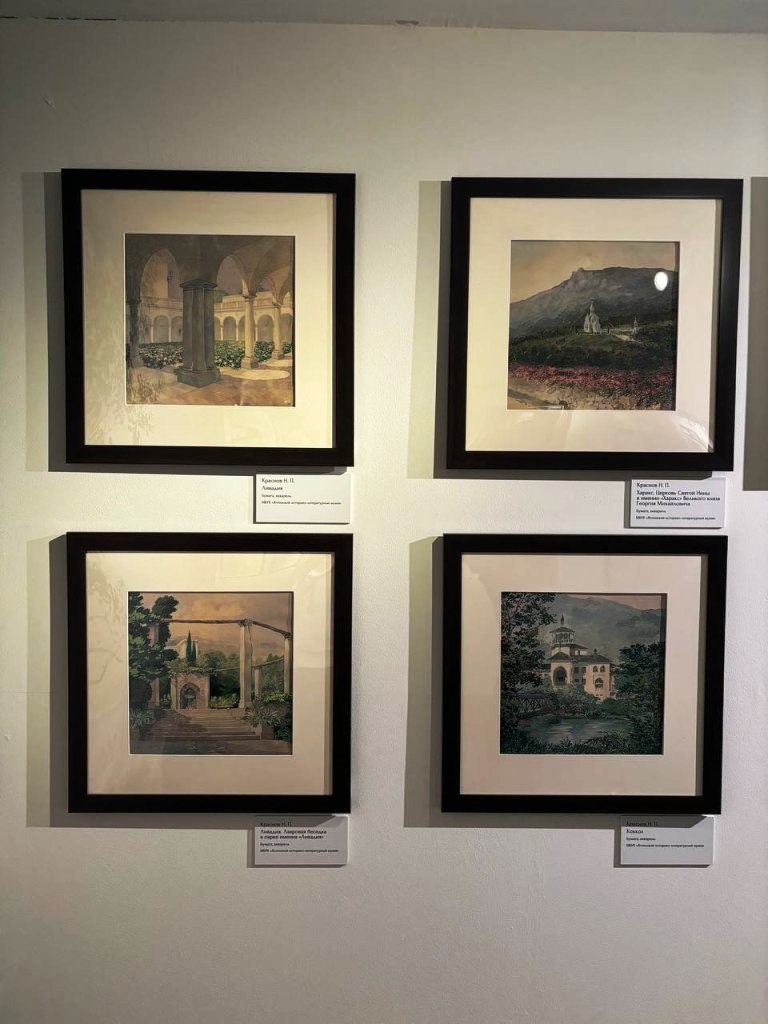
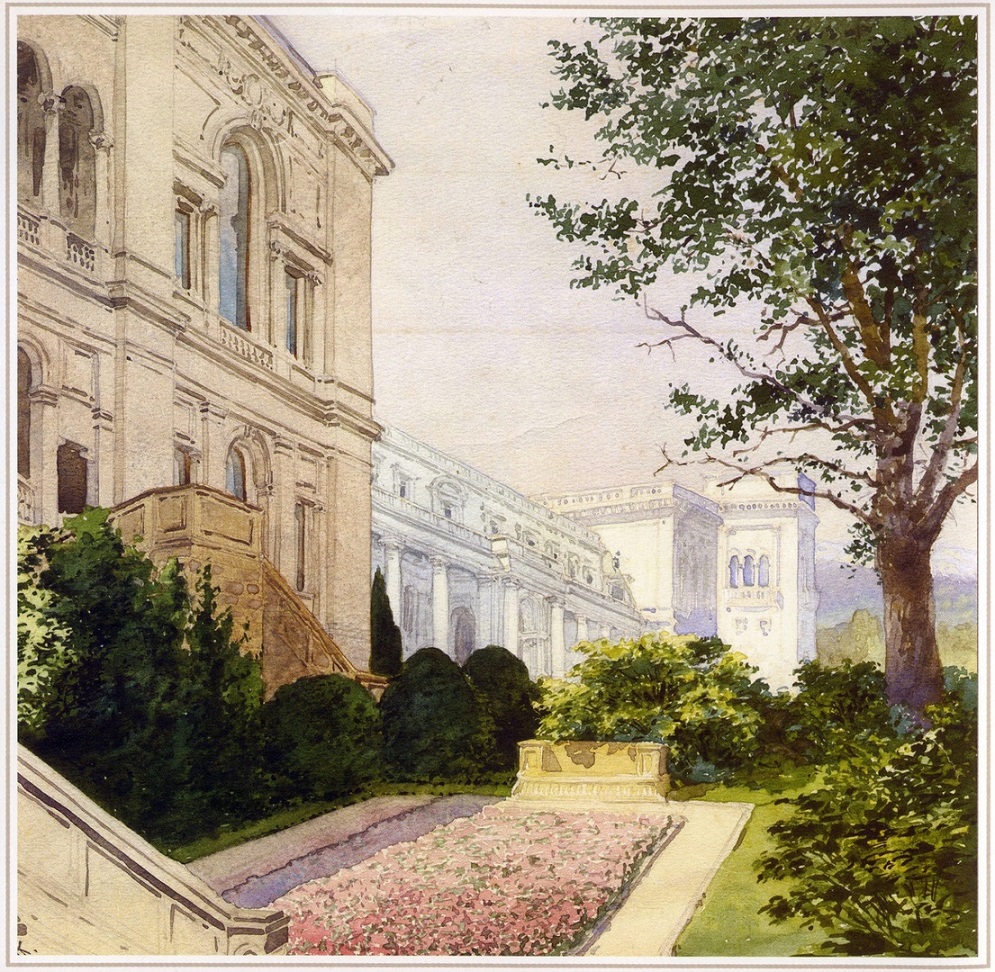
In addition to the photographs are a materials related to the life and work of the architect, including his drawings of his projects, and a collection of beautiful watercolours of the Livadia Palace and gardens, painted by Nikolai Krasnov – NOTE: click on the link to view 10 of Krasnov’s watercolours – PG.

PHOTO: Northern facade of the Livadia Palace
Watercolour by Nikolai Petrovich Krasnov (1864-1939)

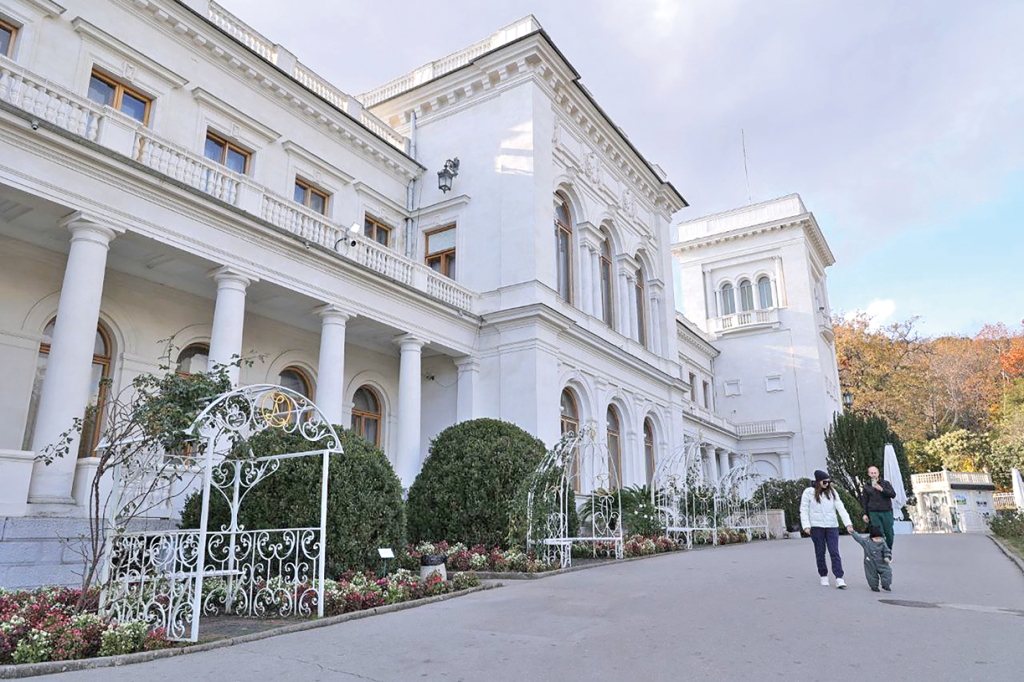
PHOTO: view of the Livadia Palace as it looks today

Livadia must have been beautiful before the First World War and the Russian Revolution. Krasnov had begun working on the project since the autumn of 1909. The new palace was built on the site of the old Large (Bolshoi) wooden Palace. Construction on the new white limestone palace began on 21st January 1910, and after 17 months of construction.

The palace was built in the Italian Renaissance style, and consisted of 116 rooms, with interiors furnished in different styles, . Emperor Nicholas II spent about 4 million gold rubles on the palace. Livadia Palace was inaugurated on 11th September 1911.

In November 1911 Grand Duchess Olga Nikolaevna celebrated her 16th birthday at Livadia. The Imperial family visited and stayed in their new Livadia Palace on only four occasions: in the autumn of 1911 and 1913 and in the spring of 1912 and 1914, where they took up residence for several months at a time. The Tsar even considered moving the capital of the Russian Empire to Yalta.

On 30th April, 1918, German troops entered Livadia and immediately began to plunder the palace. In 1993 the Livadia Palace received the status of a museum. In July 2022, Livadia Palace celebrated it’s 100th anniversary as a museum – NOTE: the link features 18 colour photos of the palace and it’s interiors, as they look today – PG.

***

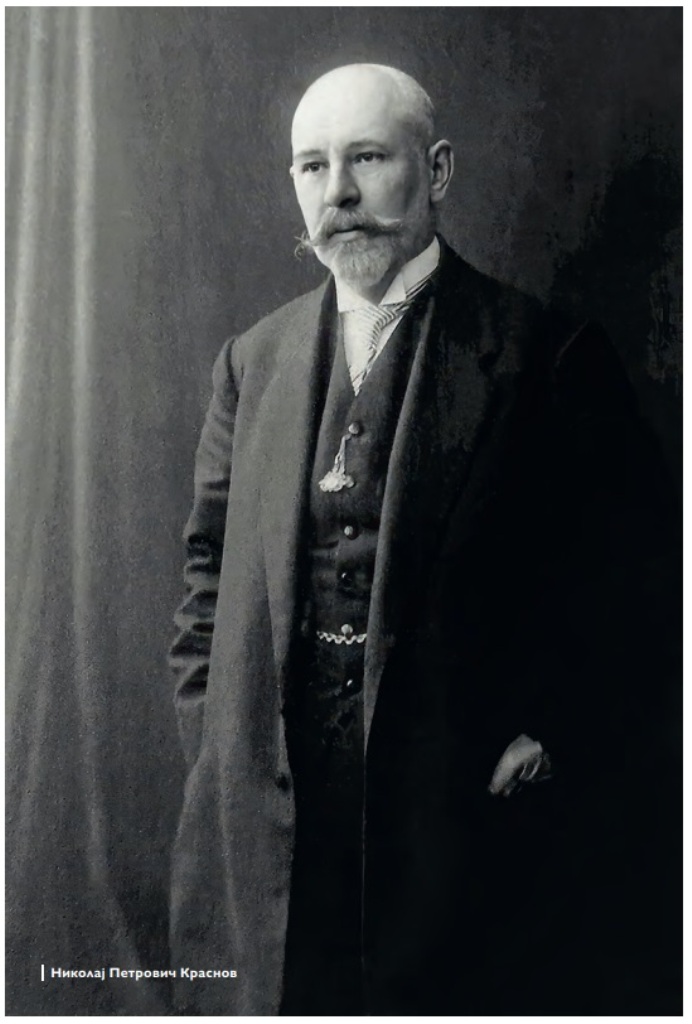
PHOTO: Nikolai Petrovich Krasnov (1864-1939)

Nikolai Petrovich Krasnov was born on 5th December (O.S. 23rd November) 1864, in the village of  Khonyatino, situated in the Kolomna district.

In 1876, at the age of 12, Nikolai entered the School of Painting, Sculpture and Architecture in Moscow, where he studied for 10 years. From 1887 to 1899 he served as the chief architect of Yalta. From 1889 to 1911 he ran his own architecture firm. The young architect was fully responsible for solving a wide range of issues related to the rapid development of Yalta as an all-Russian resort city.

In recognition for his work on Livadia Palace, on 5th October 1911, Krasnov was granted the title of Architect of the Highest Court and awarded the Order of St. Vladimir. On 6th December of the same year, he was assigned to the Main Directorate of Appanages of the Imperial Court, with the assignment of technical supervision of all construction and furniture and wallpaper work in the palaces and adjacent buildings, which were planned in the following years in Livadia. 

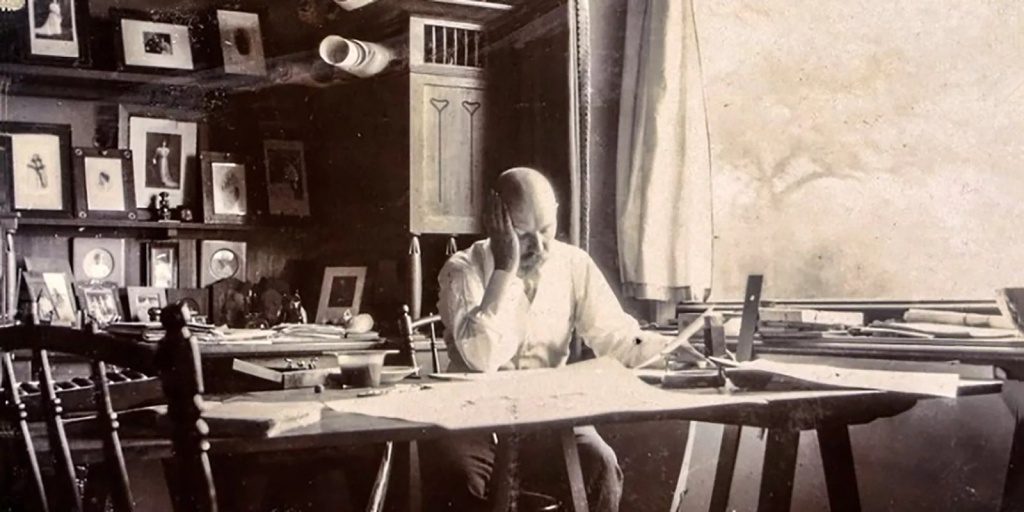
PHOTO: Nikolai Krasnov in his office in Yalta

Following the Bolshevik Revolution in 1917, in 1919, Nikolai Krasnov emigrated with his wife and daughter. They first lived in Malta for several years, before settling in Belgrade, Serbia in 1922. For the next seventeen years, Krasnov served as an inspector for the Architectural Division. He left a significant mark in the architecture of present-day Serbia.

Nikolai Krasnov died on 8th December 1939 in Belgrade, Serbia. He was buried in the Russian sector of the New Cemetery in Belgrade. 

To this day, the Serbian people deeply revere the memory of the Yalta architect, most famous for Livadia Palace, the Crimea residence of Nicholas II and his family.

© Paul Gilbert. 7 December 2024
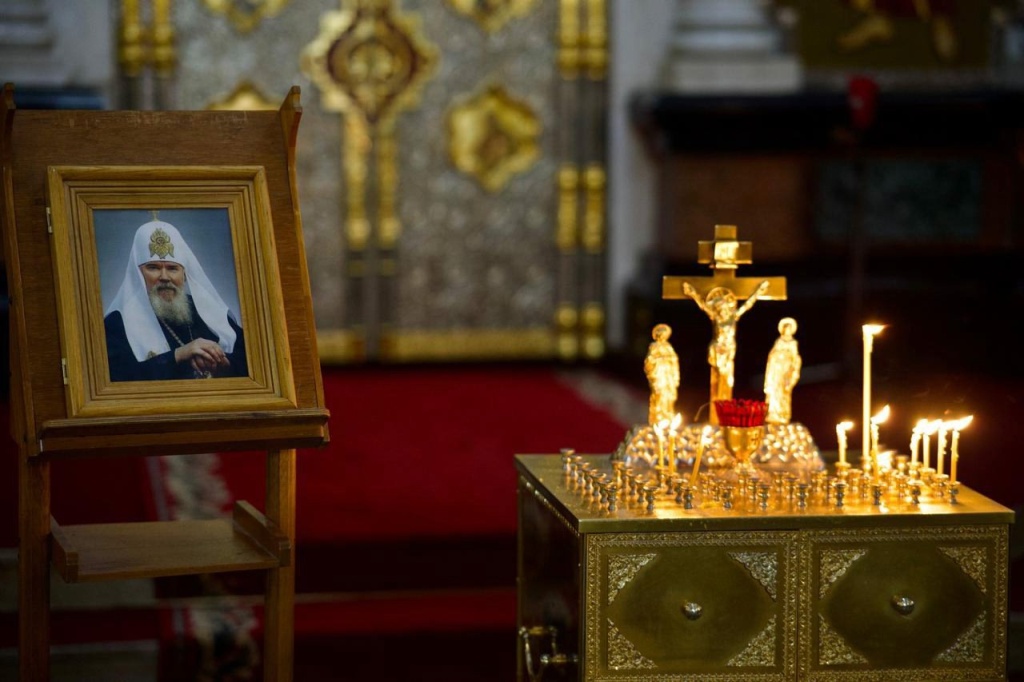
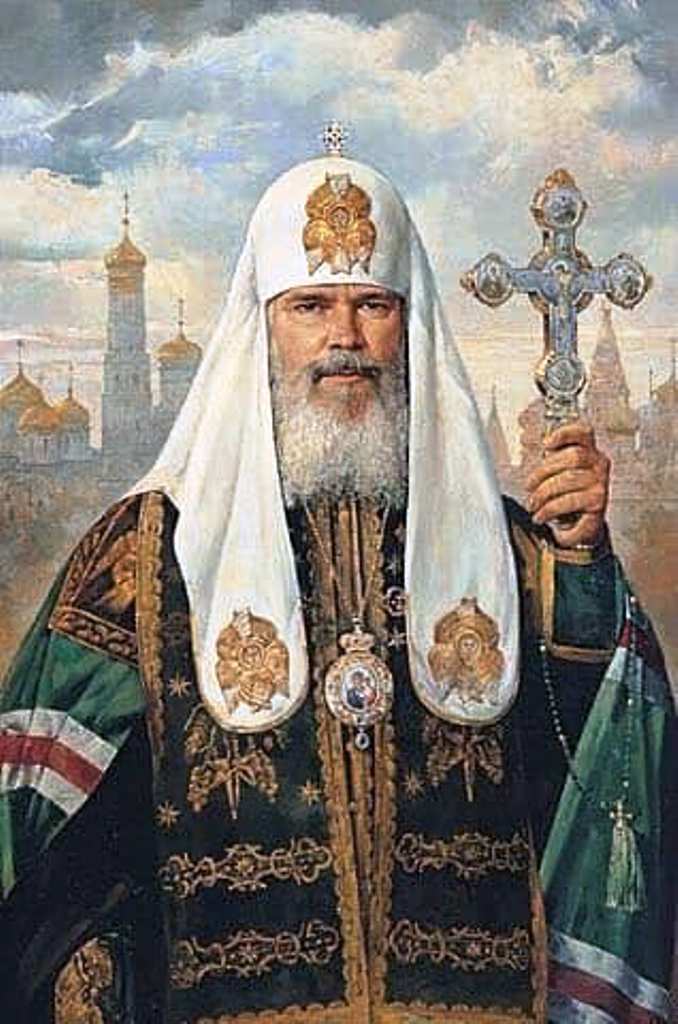
Obituary: His Holiness Patriarch Alexei II of Moscow and All Russia (1929-2008)

PHOTO: His Holiness Patriarch Alexei II of Moscow and All Russia

On this day – 5th December 2008 – His Holiness Patriarch Alexei II of Moscow and All Russia (1929-2008) died in Peredelkino, at the age of 79.

Alexei Mikhailovich Rüdiger was born in Tallinn, Estonia on 23rd February 1929. He was elected Patriarch of Moscow eighteen months prior to the fall of the Soviet Union in 1991. He became the first Russian Patriarch of the post-Soviet period to be chosen without government pressure; candidates were nominated from the floor, and the election was conducted by secret ballot.

In July 1998 Alexei II decided not to officiate at the funeral of Emperor Nicholas II and his family in the Saints Peter and Paul Cathedral in St. Petersburg, citing doubts about the authenticity of their remains. He also banned bishops from taking part in the funeral ceremony.

In the face of skepticism, Patriarch Alexei II was obliged to profess agnosticism over the identity of the bodies, as a way to avoid massive internal rifts within the church. He also claimed that the Church had been sidelined in the investigation.

The funeral was attended by Russian president Boris Yeltsin, Prince Michael of Kent and more than 50 descendants of the Romanov dynasty. Maria Vladimirovna Romanova, her son and her mother, were the only Romanov descendants who refused to participate, also citing doubts about the authenticity of the Rkaterinburg remains.

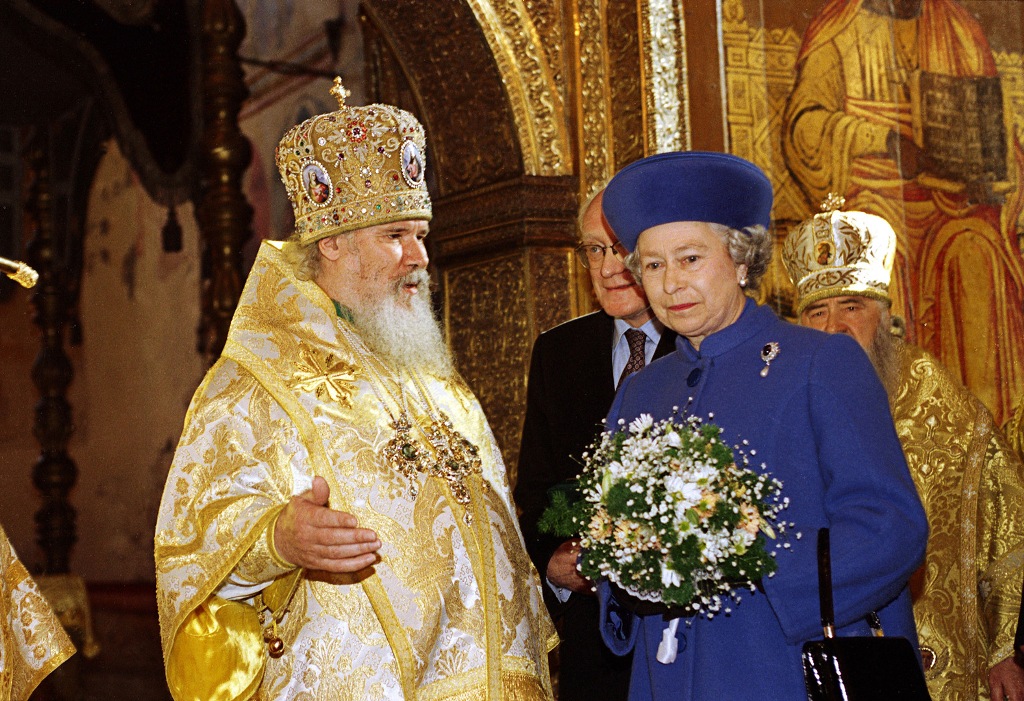
PHOTO: Patriarch Alexei and Queen Elizabeth II. Moscow, 18th October 1994

Instead, Patriarch Alexei II, Maria Vladimirovna Romanova, her son George Hohenzollern, and her mother Leonida Georgievna (1914-2010) attended a liturgy for the murdered Imperial Family at the Trinity Lavra of St. Sergius, the most important Russian monastery and the spiritual centre of the Russian Orthodox Church, situated in the town of Sergiyev Posad [named Zagorsk during the Soviet years], about 70 km north-east of Moscow.

Under His Holiness’s leadership, the New Martyrs and Confessors of Russia who suffered under Communism were glorified, beginning with the Grand Duchess Elizabeth, Metropolitan Vladimir, and Metropolitan Benjamin (Kazansky) of Petrograd in 1992.

In 2000, after much debate, the Council of Bishops of the Russian Orthodox Church glorified Emperor Nicholas II and his family, as Passion-Bearerss[1][2]. Their canonization took place on 20th August 2000, at the Christ the Saviour Cathedral in Moscow.

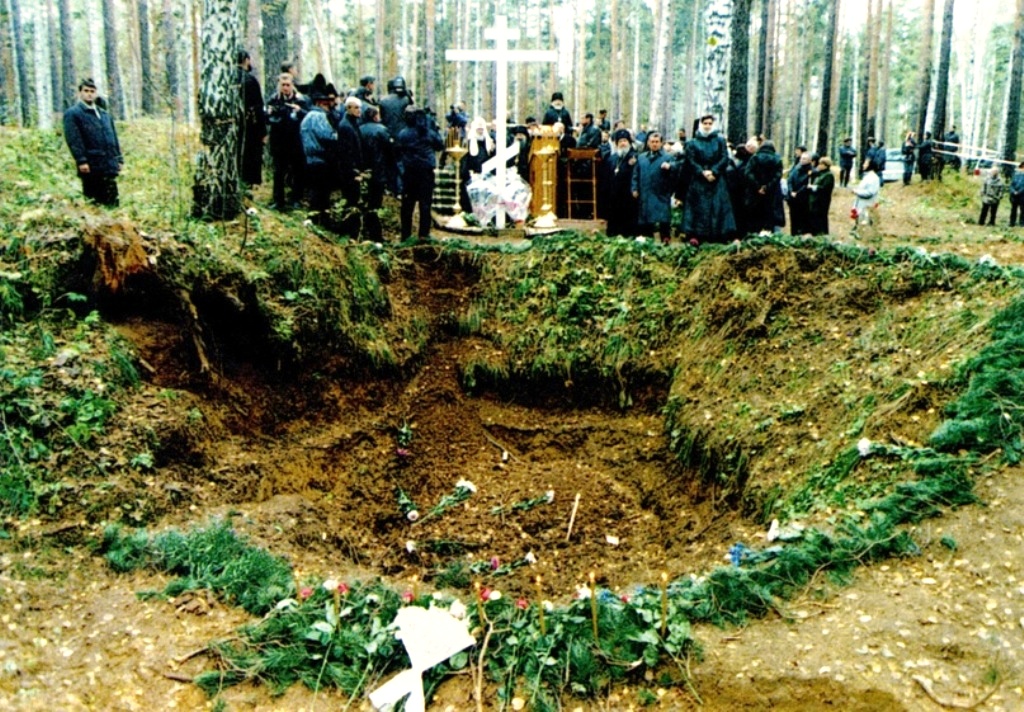
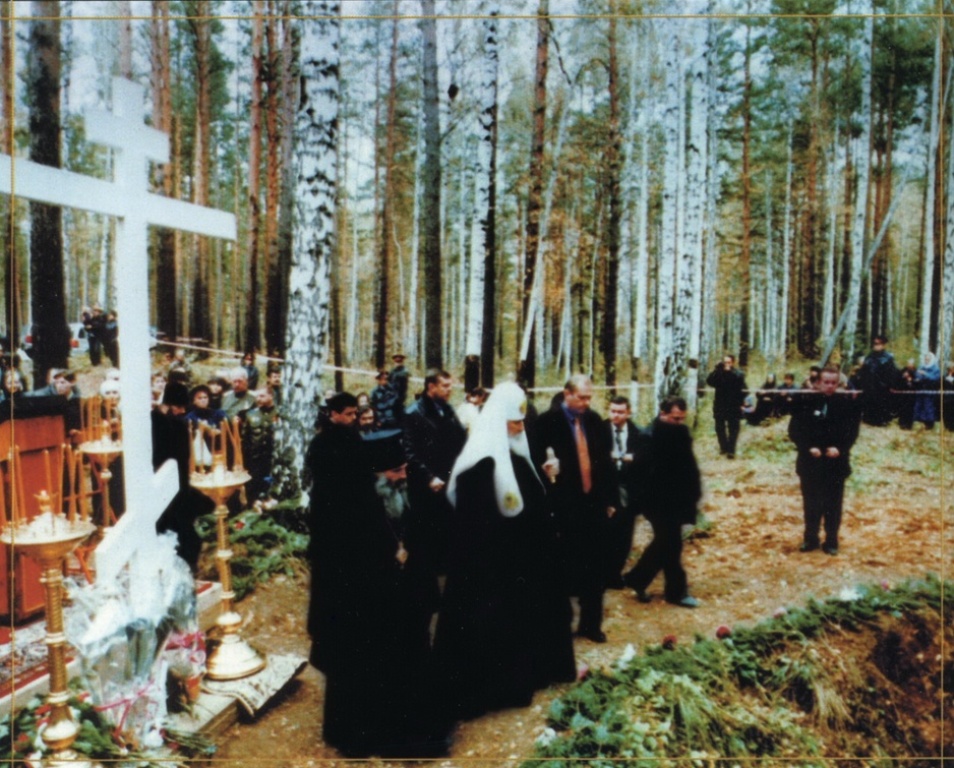
PHOTO: two very sombre photos of Patriarch Alexei standing at Mine No. 7 (collapsed) at Ganina Yama[3]. It was around this place, that the Monastery of the Holy Royal Passion-Bearers was built.

On 23rd September of the same year, during his visit to the Urals, Patriarch Alexei II laid a memorial capsule in the eastern wall of the foundation of the future church. The construction of the Church on the Blood in Ekaterinburg. The church, which was completed in 2003, was built on the site of the Ipatiev House, where the Imperial Family along with four faithful retainers were murdered on 17th July 1918. The Ipatiev House was demolished in September 1977.

On the same day, His Holiness visited the Ganina Yama[3] tract [situated 15 km (10 miles) north of Ekaterinburg] and, having blessed the establishment of the monastic monastery, put his signature on the master plan of the monastery. The first stone of the monastery was laid on 1st October 2000. On 27th December, the Holy Synod officially “blessed the opening of a monastery in the name of the Holy Royal Martyrs in the Ganina Yama[3] tract”. On 28th December, the all-male Monastery of the Holy Royal Martyrs was established here.

His Holiness Patriarch Alexei II of Moscow and All Russia died at his home in Peredelkino [southwest of Moscow] on 5th December 2008, from heart failure, aged 79. He died 80 days short of his 80th birthday.

The funeral service for His Holiness was performed at the Cathedral of Christ the Saviour in Moscow, he was buried in the Cathedral of the Epiphany, the vicarial church of the Moscow Patriarchs in Yelokhovo, located in the Basmanny district of Moscow.

Memory Eternal! Вечная Память! 

NOTES:

[1] Despite their official designation as “passion-bearers” in 2000, by the Council of Bishops of the Russian Orthodox Church, Emperor Nicholas II and his family are often referred to as “martyrs” in Church publications, icons, and in popular veneration by the people.

[2] Emperor Nicholas II and his family were canonized as martyrs by the Russian Orthodox Church Outside of Russia (ROCOR) in 1981.

[3] Ganina Yama is the generally accepted name of the abandoned Isetsky mine, located in the Four Brothers tract, overgrown with birch and pine forests, situated situated in the Sverdlovsk region.

© Paul Gilbert. 5 December 2024