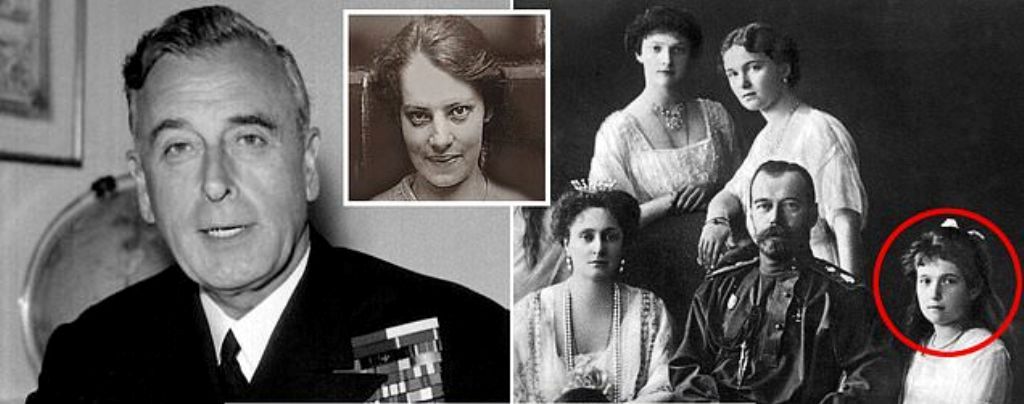
PHOTO: Lord Louis Mountbatten, Anna Anderson,
the Imperial Family and Grand Duchess Anastasia Nikolaevna
The story of the death of the last Russian emperor and his family gave rise to one of the most tenacious legends of the 20th century – the myth of the miraculous salvation of Grand Duchess Anastasia Nikolaevna. Against this background, dozens of impostors tried to pass themselves off as one of the surviving Romanovs, but none of them caused more of a stir than that of Anna Anderson. And none of the relatives of the Imperial Family fought against her claim as fiercely as did Lord Louis Mountbatten (1900-1979), the nephew of Empress Alexandra Feodorovna and maternal uncle of Prince Philip, Duke of Edinburgh (1921-2021).
Epidemic of imposters following the regicide in Ekaterinburg
Recall that on the night of 16/17 July 1918, the Emperor Nicholas II and his family were brutally murdered by a group of deranged Bolshevik thugs in the basement of the Ipatiev House in Ekaterinburg. For many decades following the regicide, the fate of their remains remained a mystery: the first official excavations began only in 1991, and the remains of two children – Maria and Alexei – were discovered years later, in 2007.
This veil of secrecy was to become fertile ground for myths and conspiracy theories. Throughout the 20th century, as historians note, dozens of “false Alexei’s”, “false Olga’s”, “flase Maria’s” and “false Anastasia’s” appeared. One of the most famous, however, was a certain Anna Anderson, who declared herself the youngest daughter of Nicholas II who had miraculously survived the regicide.
Anastasia or Franziska?
Anna Anderson, who at one time was a patient of a psychiatric hospital in Berlin. According to Anderson’s version, given in the publication ’50 Famous Mysteries of the History of the Twentieth Century’ by V. M. Sklyarenko, I. A. Rudycheva and V. V. Syadro, Anderson, claimed that during the shooting in the Ipatiev House, she lost consciousness, and was saved by a Red Army soldier Alexander Tchaikovsky. Together they fled to Bucharest, Roumania. The book claims that Anderson gave birth to a child from Tchaikovsky. The book further claims that the child was immediately taken from the mother and given to an orphanage. Subsequently, the Red Army soldier was killed in a street fight, and Anna ended up in Germany.
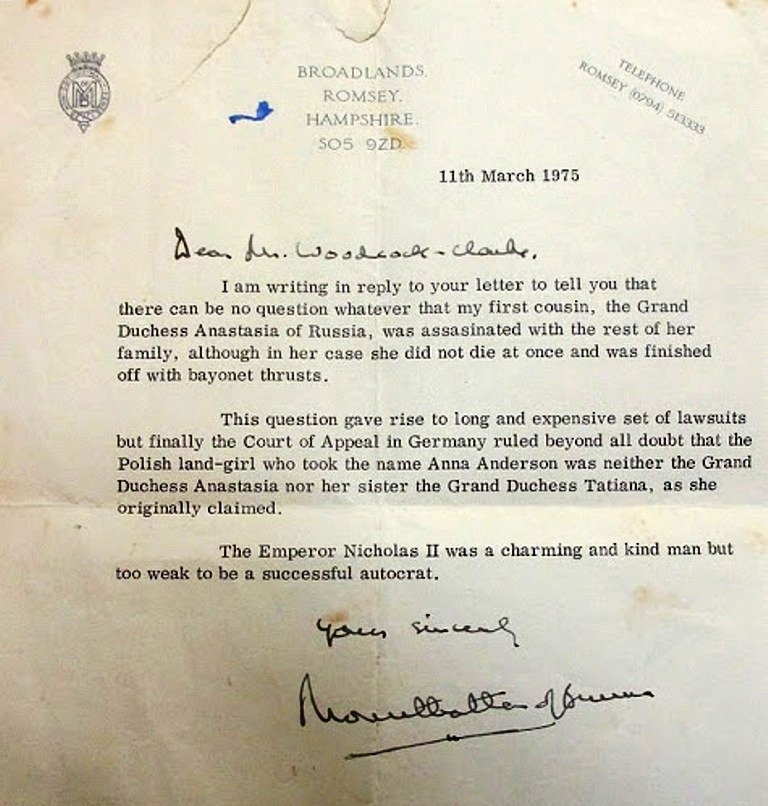
PHOTO: letter from Lord Louis Mountbatten to Mr. Woodcock-Clark,
dated 11th March 1975
Many White Russian emigrants gladly believed in Anna Anderson’s story and supported this “false Anastasia” in every possible way. So, according to Viktor Kuznetsov, the author of the book ‘Russian Golgotha’, the “Grand Duchess” in Anna Anderson was recognized by Gleb (1900-1969) and Tatiana (1898-1986) Botkin – the son and daughter of the Tsar’s personal physician, Dr. Evgeny Botkin (1865-1918). The siblings support empowered Anderson: she desperately defended her relationship with the Romanovs in various European courts for more than one decade.
It was only after the DNA analysis did everything fall into place. It turned out that Anna Anderson, or rather Franziska Schanzkovskaya, was not related to the last Russian Imperial Family. However, there are those who even today doubt the results of the scientific evidence of the DNA analysis and continue to believe that Szankowska was really the youngest daughter of Nicholas II.
The Empress’s Nephew vs. False Cousin
According to Anthony Summers and Tom Mangold, the authors of the book ‘The File on the Tsar’ (published in 1976), one of Anderson’s main opponents was the nephew of Empress Alexandra Feodorovna, Louis Mountbatten. Mountbatten took an active part in gathering evidence to expose Anderson as an imposter. He spent thousands of pounds on legal costs, challenging the claims of the pseudo-Anastasia. Anna Anderson lost in the courts, but thanks to litigation, she became famous. However, Mountbatten tried to prevent Anderson’s fame as well. In 1958, he successfully persuaded the BBC to refuse an interview with her.
Some historians maintain that some of the surviving Romanovs in exile and their British and European royal relatives, who believed Anna Anderson’s claim, but simply did not want to accept “Anastasia” into their circle. However, a letter written by Lord Mountbatten, dated 11th March 1975, puts an end to the controversy regarding the identity of Anna Anderson, and also refutes other conspiracy theories.
In this letter (seen in full, in the above photo), addressed to a certain Mr. Woodcock-Clark a collector from Nottingham, England, but about whom little else is known, Mountbatten stated: “There can be no doubt that my cousin Anastasia was murdered with the rest of her family. However, unlike the others, she did not die immediately, but was finished off with bayonets.”
The letter, according to The Daily Mail, the letter was found among the possessions of the late collector. It sold for £200 GBP [$270 USD] including fees at Unique Auctions of Lincolnshire. in October 2020. Terry Woodcock, auctioneer at Unique Auctions, said: ‘It was a fantastic piece of history and we are pleased it has found a new home. . . . This letter is a useful insight into this facet of his momentous life’
‘Anastasia was Mountbatten’s first cousin and he had stayed with the Tsar and his family in the summer of 1908. Their murder in July 1918 deeply shocked him and he carried out extensive correspondence with investigators and writers on the subject throughout his life.
Lord Mountbatten was known to have a particular soft spot for Anastasia’s sister Maria – the third daughter of Nicholas II – and kept a photo of her all his life.
He and his family, especially his mother Princess Victoria of Hesse and by Rhine (1863-1950), who was a sister of both Empress Alexandra Feodorovna (1872-1918) and Grand Duchess Elizabeth Feodorovna (1864-1918), felt great bitterness that the Nicholas II and his family had been allowed by their Allies to perish and he held strong views about the Bolsheviks as a result.
In 1975 – the same year he wrote the letter – he visited Russia. He later wrote: ‘I was over-powered by the emotion of going back to a country I had known fairly well as a child, where so many of my closest family had lived in such tremendous splendour, and then been murdered in this ghastly way. ‘I felt it all the way through, and I was quite exhausted when I came back.’
FURTHER READING:
The ghost of Anna Anderson continues to haunt us + PHOTOS
Louis Mountbatten on his Romanov relatives
© Paul Gilbert. 13 September 2025
***

I am committed to clearing the name of Russia’s much slandered Tsar. In exchange for this 18-page booklet, please consider making a small $5 or $10 donation in aid of my research. These donations are of great assistance in helping me offset the cost of obtaining and translating documents from Russian archival sources, which are often paid for out of my own pocket. It is these documents which help present new facts and information on the life and reign of Nicholas II. In addition, my research continues to debunking many of the myths and lies which exist more than a century after his death and martyrdom.
Please note, that there is NO obligation, thank you for your consideration!
 Nicholas II
You must be logged in to post a comment.