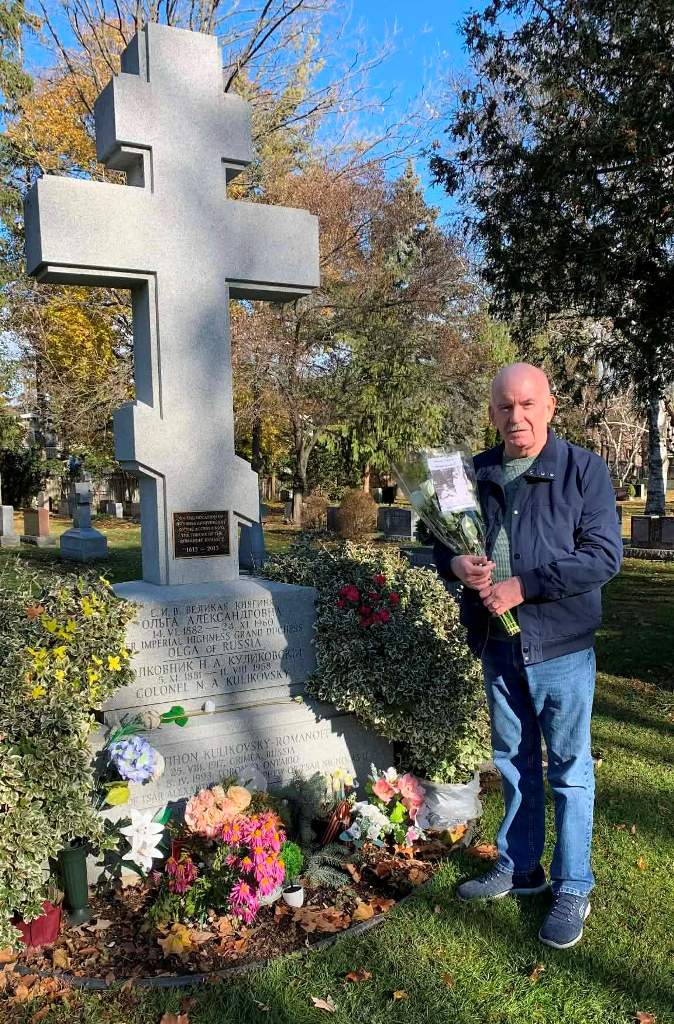
PHOTO: Paul Gilbert, author of this post and administrator of this blog, at the grave of Grand Duchess Olga Alexandrovna in York Cemetery, on 24th November 2025, the day marking the 65th anniversary of her death. Paul Gilbert © 2025
Today, 24th November 2025, marks the 65th anniversary of the death of Grand Dycgess Olga Alexandrovna, the youngest child of Emperor Alexander III and Empress Maria Feodorovna, and youngest sister of Emperor Nicholas II.
Today, I travelled into Toronto, where I visited York Cemetery located in the North York area of of the city. It was a beautiful morning, the sun was shining, a slight breeze, but overall, a perfect autumn day.
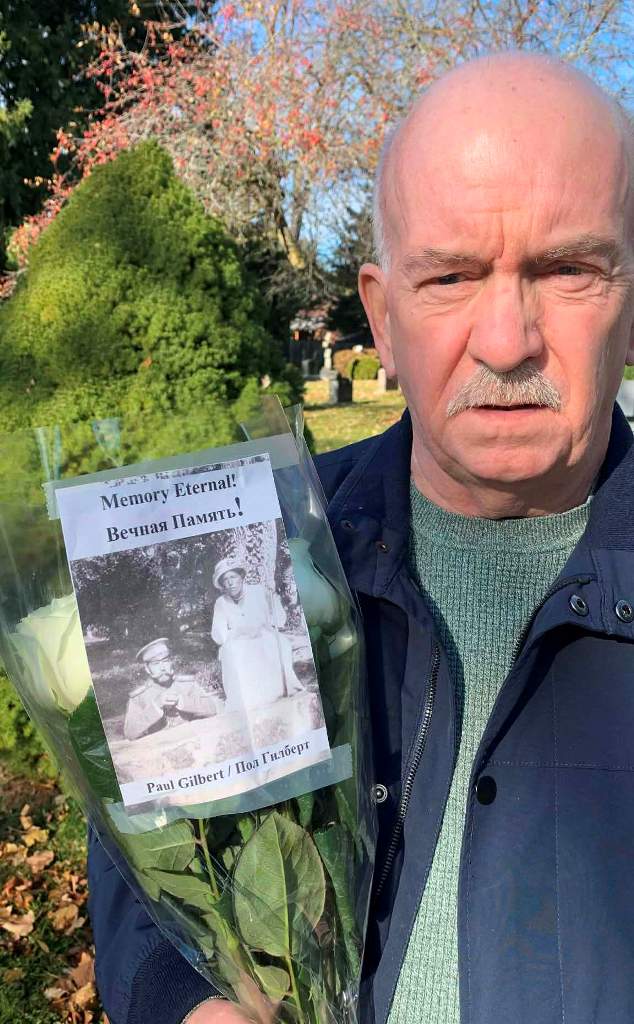
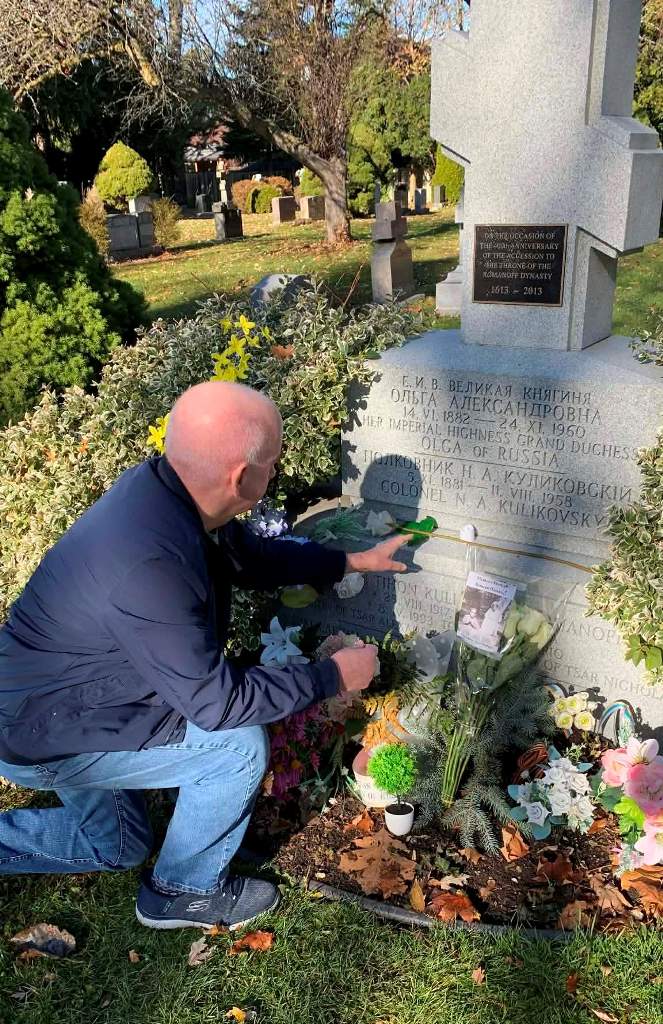
I laid a bouquet of a dozen white roses on the grave of Russia’s last grand duchess, and offered prayers. I was both surprised and somewhat saddened that no one else was at the grave, nor was there much in the way of fresh flowers left at her gravesite.
I attached a small photo (see below) the outside of the bouquet, depicting Olga in happier times, with her brother Emperor Nicholas II, taken in the lower Massandra Park, Crimea in the Autumn of 1913.
Paul Gilbert © 2025
Paul Gilbert © 2025
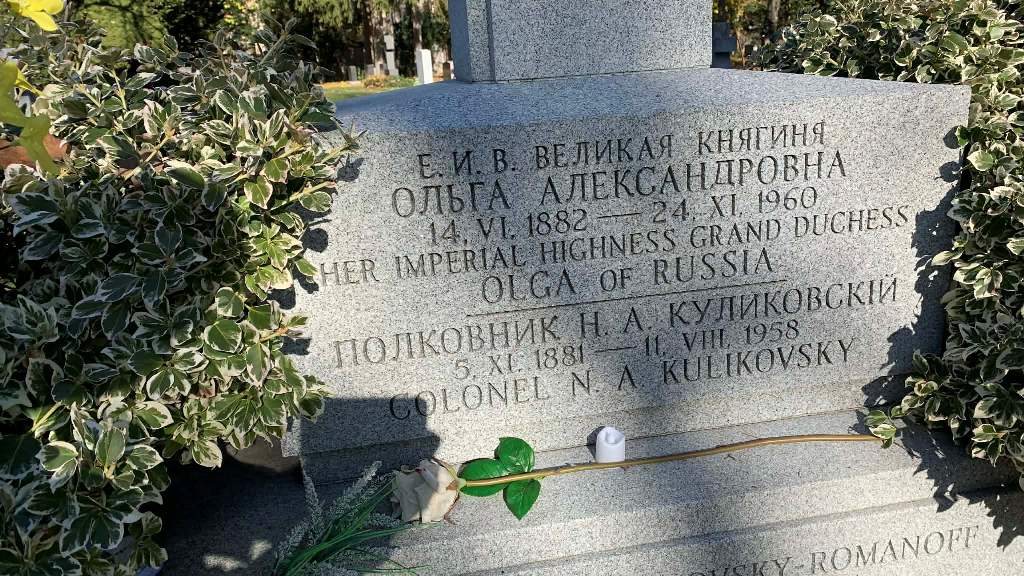
Grand Duchess Olga is interred in the Russian Orthodox section of the cemetery, Section 15. Her grave is marked by a large white marble cross with Cyrillic script and is a site of historical interest, with memorial services occasionally held there by Russian Orthodox clergy, attended by members of Toronto’s Russian Orthodox community and Russian diplomats.
There are four persons buried in the grave: Grand Duchess Olga Alexandrovna, her husband Captain Nikolai Kulikovsky, their eldest son Tikhon Kulikovsky and his wife Olga Kulikovsky.
Paul Gilbert © 2025
I was 4 years old when Olga died. I was just a young child, so I had no idea of who she was, but ironically, the apartment in which she died on Gerard Street in Toronto, was just blocks away from where I grew up as a child at Gerard and Parliament Streets.
Little did I realize then, that the family and extended family of Russia’s last Tsar, would play such an important part in my life. For more than 35 years, I have dedicated my life to the study and writing of the Romanov’s, in particular, clearing the name of Russia’s much slandered Tsar. My many years of research have resulted in books, magazines, a conference, lectures and 29 journeys to Russia, visiting palaces, museums and archives associated with Nicholas II and his family.
All this combined, is my reason for laying flowers at Olga’s grave today.
Give rest, O Lord, in blessed repose to the soul of Thy handmaiden, the Right-Believing
Sovereign Grand Duchess Olga Alexandrovna, and make her memory to be eternal.
***
The death of Grand Duchess Olga Alexandrovna
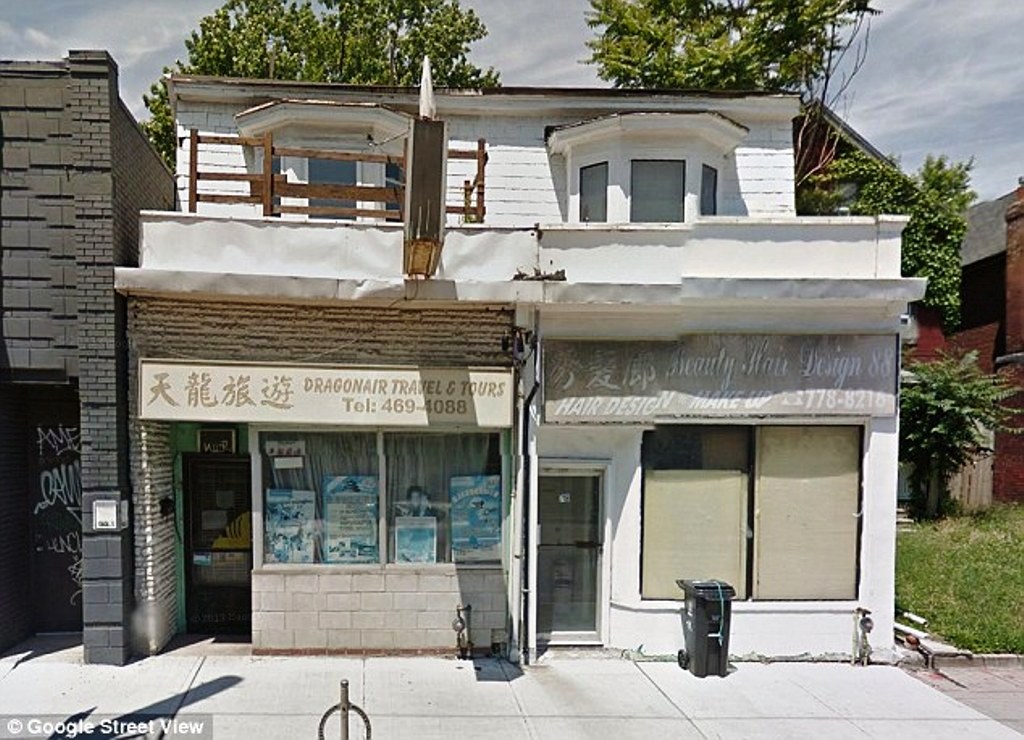
PHOTO: The house (left) at 716 Gerrard Street, where Grand Duchess Olga Alexandrovna died in Toronto, Canada on 24th November 1960. The property, which is now dilapidated and in need of repair, has served as a beauty salon, a travel agency and a religious building, as well as an “imperial” residence.
Following her husband Nikolai Kulikovskys’ death in 1958, Olga became increasingly infirm. In April 1960, she was hospitalized at Toronto General Hospital, located on University Avenue in downtown Toronto. It was here, that Olga was diagnosed with cancer.
Olga was not informed (or she was not aware) that her elder sister, Grand Duchess Xenia Alexandrovna [b. 1875], had died in London during that month [20th April 1960] at the age of 85.
Unable to care for herself, Olga went to stay with Russian émigré friends, Konstantin and Zinaida Martemianoff, in their second-floor apartment above a beauty salon at 716 Gerrard Street East, Toronto. The main reason that she chose Konstantin and his wife was that Konstantin had been a member of the Akhtyrsky Hussar Regiment, of which Olga served as the honorary Commander-in-Chief in Russia.
On 21st November, 1960, Olga slipped into a coma, and died on 24th November at the age of 78.
It is interesting to note, that although she lived simply, bought cheap clothes, and did her own shopping and gardening, her estate was valued at more than 200,000 Canadian dollars (about $1.5 million as of 2013) and was mostly held as stock and bonds.
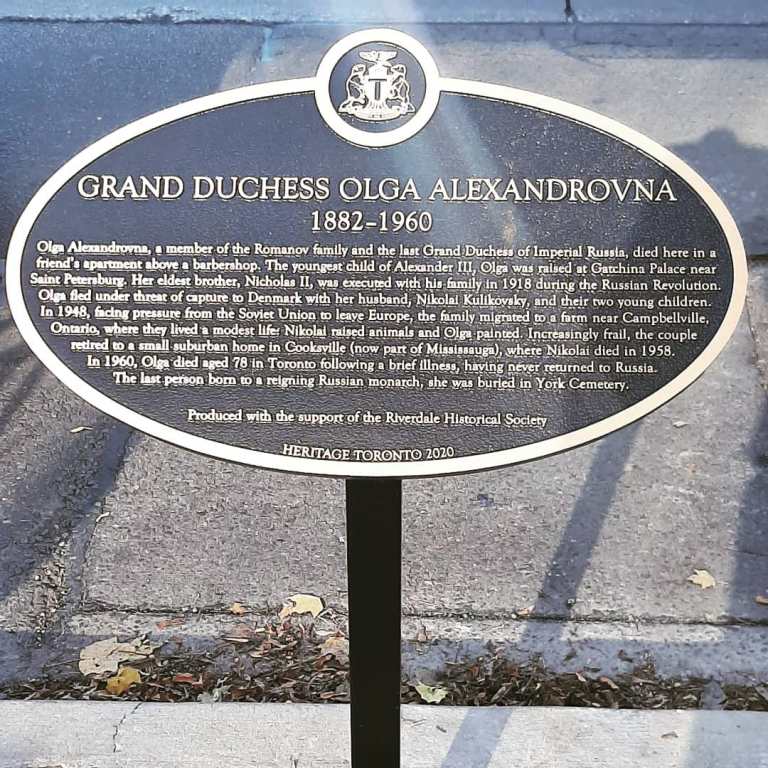
On 13th November 2020, a memorial plaque in honour of Grand Duchess Olga Alexandrovna, was unveiled outside 716 Gerrard Street, where she died in Toronto, Canada on 24th November 1960.
The plaque is a joint project of Heritage Toronto and the Riverdale Historical Society.
***
The funeral of Grand Duchess Olga Alexandrovna
VIDEO: VIDEO (click on image above to play – duration: 42 seconds)
On 30th November 1960 – the funeral for Grand Duchess Olga Alexandrovna was held in Toronto, Canada. Grand Duchess Olga’s body lay in state in Christ the Saviour Cathedral in Toronto. The Union Jack and Russian imperial standard hung from each corner of the platform where the coffin sat. Officers of the Akhtyrsky Hussars and the Blue Cuirassiers stood guard in the church.
The service was performed by the Mitred Archpriest John Diachina (1904-1976). Parishoners filled Christ the Saviour Cathedral to capacity – more than 500 mourners attended. In fact, the church could not contain all those who attended the services.
Wreaths were sent by King Frederik IX and Queen Ingrid of Denmark, King Olav V of Norway and Queen Elizabeth II of Great Britain; imperial guardsmen from the 12th Hussars Ahtyrsky Regiment were the pallbearers.
Olga was buried next to her husband Nikolai Alexandrovich Kulikovsky (1881-1958) , in the Russian Section of York Cemetery. The Grand Duchess’ friend, Bishop John of San Francisco, sprinkled Russian earth on her grave.
Grand Duchess Olga Alexandrovna was the soul and the heart of the Toronto parish, and her death in 1960 created a void within the Russian community, leaving none of the parishioners untouched, many regarding her passing as a personal tragedy.
Legacy
Born on 13th June [O.S. 1st June] 1882, Olga endured much loss during her life, outliving her entire family, including her beloved father Emperor Alexander III (1894); her brother George (1899); her brother Michael (1918); her brother Emperor Nicholas II and his entire family (1918); her mother Dowager Empress Maria Feodorovna (1928); her sister Xenia (April 1960); and was forced to flee Russia with her husband and two sons in 1919. She lived in Denmark until 1948, when she emigrated to Canada.
In addition, following the 1917 Revolution, Olga and her family were forced to flee the Bolsheviks, and then in 1948, feeling threatened by Stalin, she and her family were forced to flee Denmark for Canada.
Of course, the main characteristic of Olga Alexandrovna was her attitude towards the people around her. Her non-exclusive kindness towards everyone, her openness and her welcoming heart left a deep imprint in the memory of those who knew her.
To this day, Grand Duchess Olga Alexandrovna remains one of the most beloved members of the Russian Imperial family. Her memoirs ‘The Last Grand Duchess’ were written by Ian Vorres in 1964.
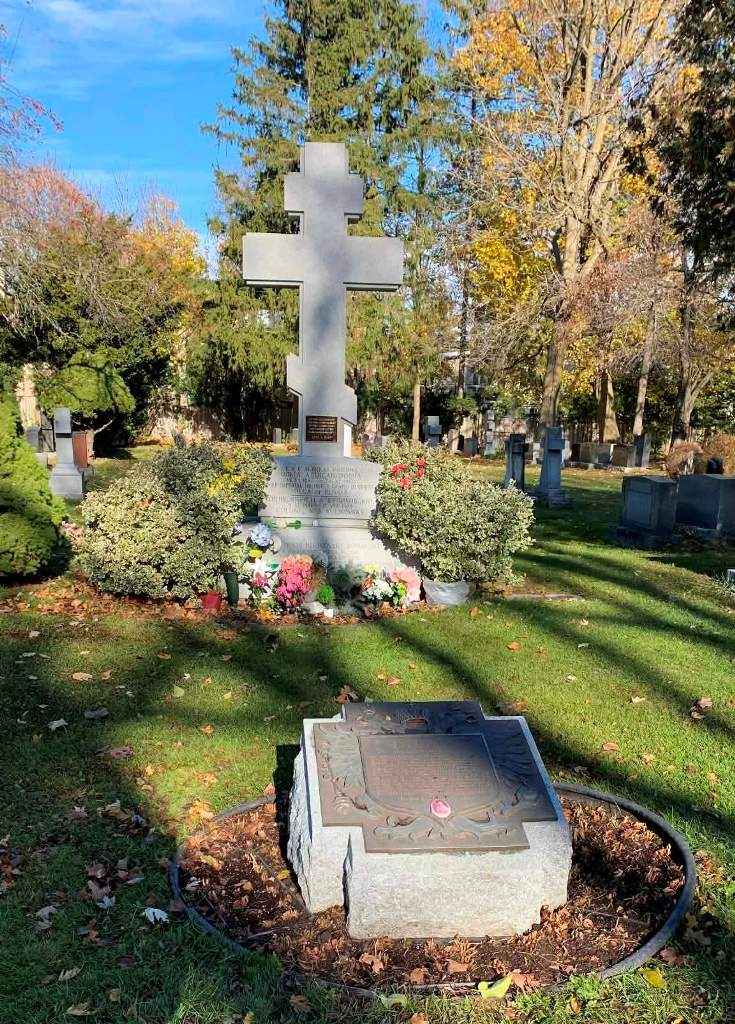
PHOTO: Grand Duchess Olga Alexandrovna’s grave in York Cemetery, North York.
Paul Gilbert © 2025
Memory Eternal! Вечная Память! 
***
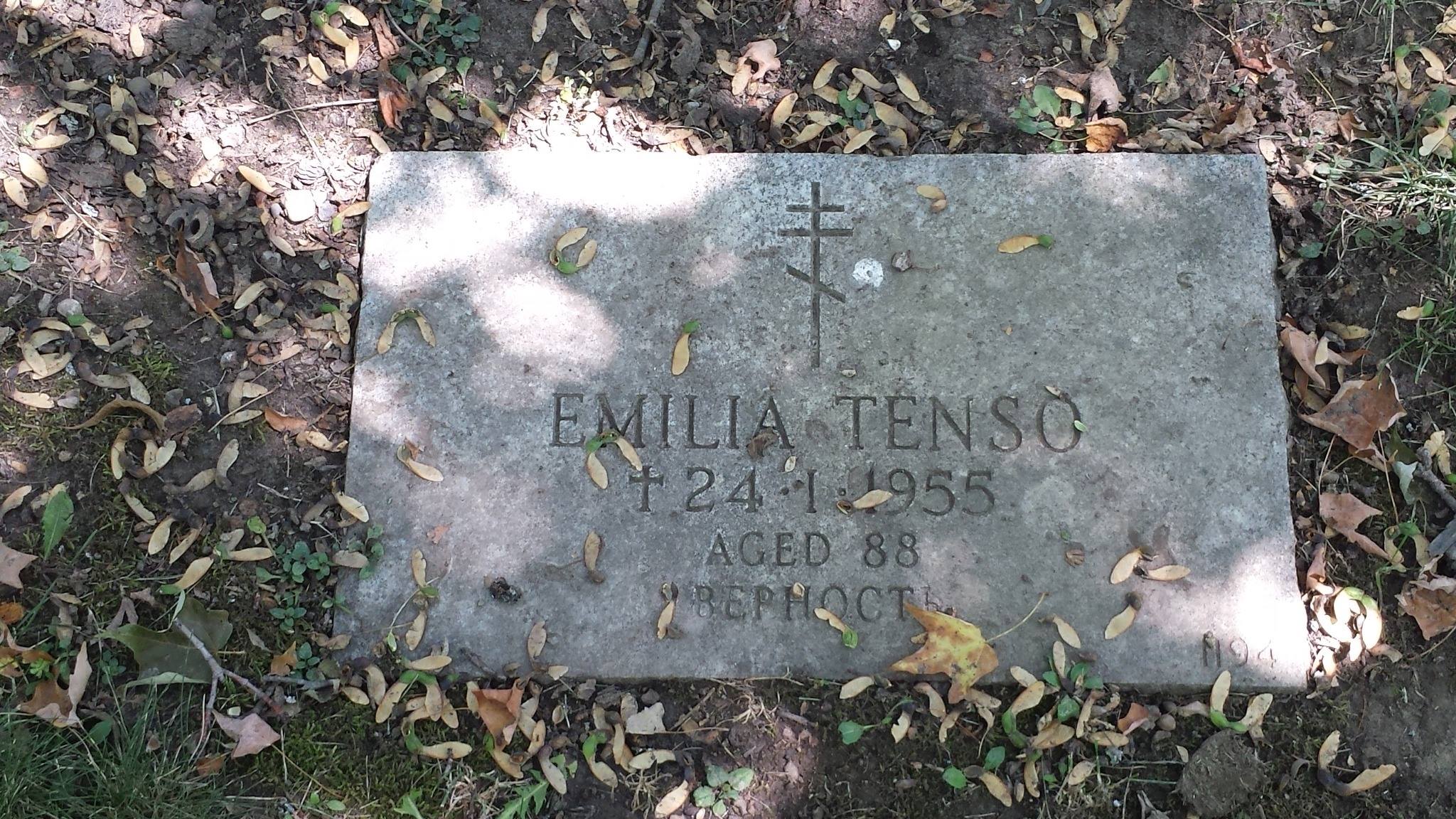
Grand Duchess Olga’s devoted companion and former maid Emilia Tenso (“Mimka”) is buried near the grand duchess’s grave in York Cemetery, Toronto.
Ian Vorres notes in his book ‘The Last Grand Duchess’ that she died in 1954, however, the date on her gravestone shows 24th January 1955.
FURTHER READING:
Olga: Nicholas II’s younger sister + PHOTOS
Russia’s Ambassador to Canada attends memorial service for Grand Duchess Olga Alexandrovna + PHOTOS
Queen Elizabeth II receives Grand Duchess Olga Alexandrovna in 1959 + PHOTOS
 Nicholas II
You must be logged in to post a comment.