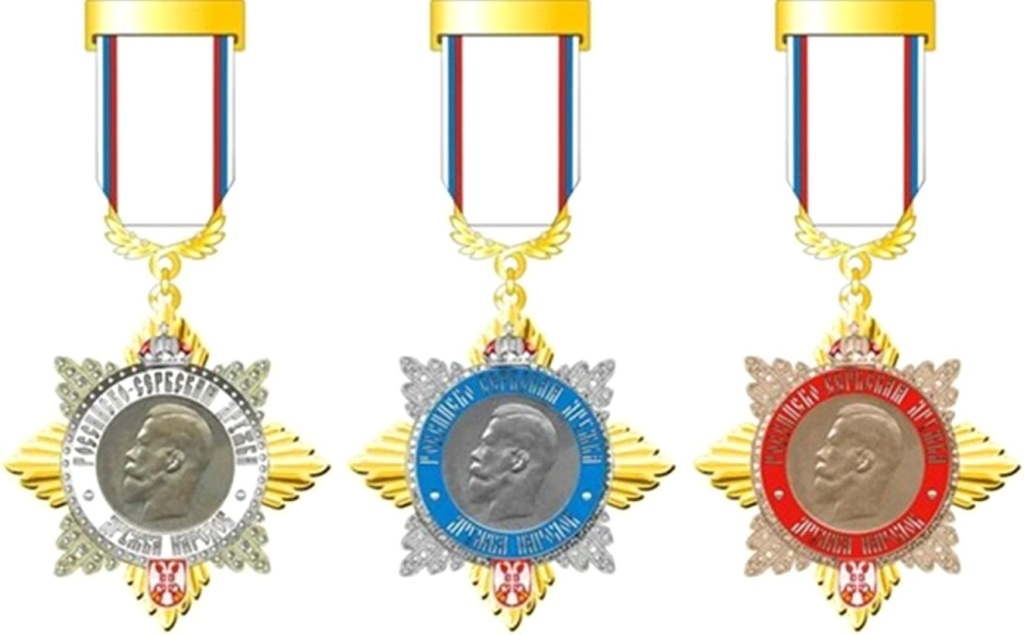
PHOTO: Orders of the Holy Tsar Nicholas II – 1st, 2nd and 3rd Class
Tsar Nicholas II (1868-1918) was canonized by the Serbian Orthodox Church in 1938 – 43 years BEFORE the Russian Orthodox Church Outside Russia (ROCOR) in 1981 and 62 years BEFORE the Moscow Patriarchate of the Russian Orthodox Church in 2000.
The Order of the Holy Tsar Nicholas II is a contemporary Order. The historical prerequisites for the use of the image of Nicholas II in the Order for merits in the development of Russian-Serbian friendship and co-operation.
“In 1914, the very existence of Serbia as a state was at stake. On 11th July, Austria presented the Serbian government with an ultimatum that was completely unacceptable for an independent state.
On the same day, Emperor Nicholas II received a telegram from the Prince Regent of Serbia Alexander Karađorđević. It said: “We cannot defend ourselves. Therefore, we beg Your Majesty to help us as soon as possible… We firmly hope that this call will resonate in your Slavic and noble heart.”[1]
Three days later, the Russian Emperor sent a reply to Serbia. “As long as there is the slightest hope of avoiding bloodshed,” he wrote, “all our efforts must be directed towards this goal. If, contrary to our sincere wishes, we do not succeed in this, Your Highness can be sure that in no case will Russia remain indifferent to the fate of Serbia.”
In a reply telegram, Prince Alexander wrote: “Difficult times cannot but seal the bonds of deep affection by which Serbia is bound to Holy Slavic Russia, and the feelings of eternal gratitude for Your Majesty’s help and protection will be sacred in the hearts of all Serbs.”
On 15th July, Austria declared war on Serbia. It subjected Belgrade to artillery shelling, which killed many civilians. In response, Russia carried out a partial mobilization, a few days later – a general mobilization was carried out. Austria had to transfer most of its troops to the eastern front, and thus Serbia was saved. The Serbian people call Emperor Nicholas II their savior”.
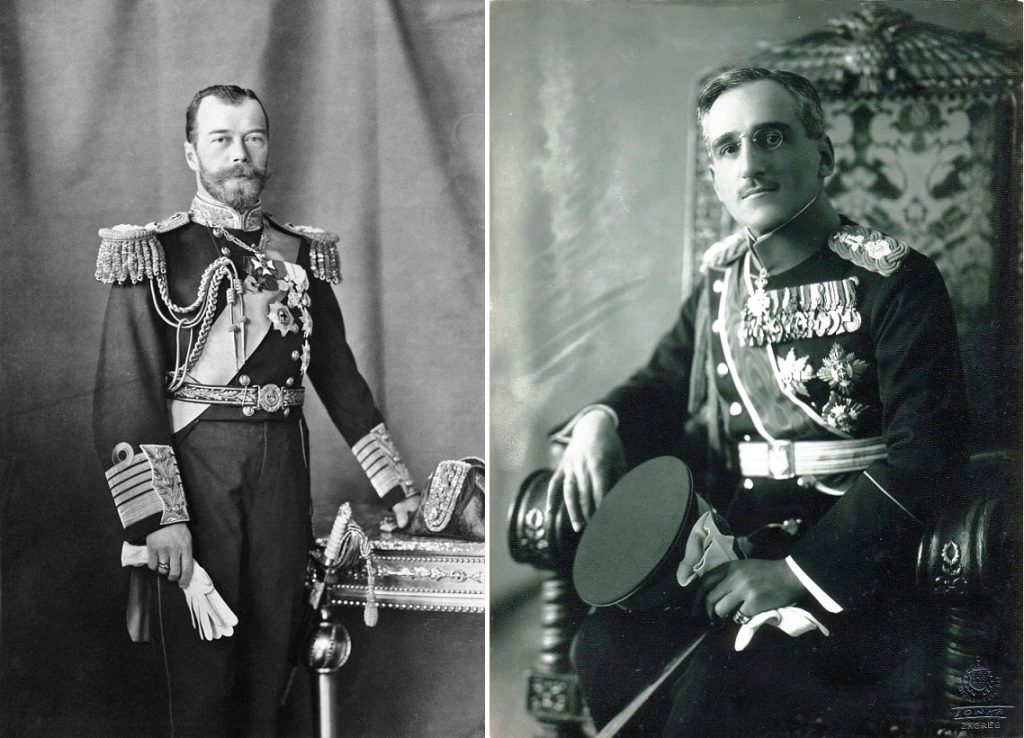
PHOTO: Emperor Nicholas II and Prince Regent Alexander
***
The Order of the Holt Tsar Nicholas II has three classes. The highest class of the Order is the First Class. The order is made of precious metal, as well as non-ferrous metal. Diameter 52 mm.
The main colour of the Order is white, a symbol of peace, truth and goodness, divinity and sacrifice. It is no coincidence that the Order has the shape of an eight-pointed star. This form is the most common for the insignia of Orders in all European Christian states.
The eight-pointed star is, in fact, two four-pointed stars (two crossed crosses), which symbolizes the religious and spiritual community of the Serbian and Russian peoples: “Perhaps of all the peoples living on earth, the closest and dearest to us Russians is the Serbian people. We are united by a living faith in Christ, prayer for each other and a community of destinies. Remembering the tragic similarity of the history of Serbia and Russia, one begins to understand well the depth of the innermost spiritual ties that unite our brotherly peoples”.
1st Class
The badge of the Order is made of 585 yellow and white gold with diamond inserts. The Order is an octagonal star in the form of rays diverging from the center with rounded angular endings. The octagonal star is made up of two quadrangular stars, the rays of the smaller of which are decorated with diamonds.
In the center of the Order is a large circle framed by diamonds. In the center of the large circle is a small circle made of metal, which depicts a bas-relief of Tsar Nicholas II in profile. Between the large and small circles against the background of white enamel is the inscription “RUSSIAN-SERBIAN FRIENDSHIP”. “FRIENDSHIP OF PEOPLES”.
In the upper part of the Order is the Great Imperial Crown of the Russian Empire. In the lower part of the Order is the national symbol of Serbia – a double-headed eagle against the background of a shield filled with red enamel. On the reverse of the Order is its serial number, the manufacturer’s hallmark, the class (1st class) and a pin.
2nd Class
The badge of the Order is made of silver with cubic zirconia inserts. The Order is an octagonal star in the form of rays diverging from the center with rounded angular endings. The octagonal star is made up of two quadrangular stars, the rays of the smaller of them are decorated with inserts of white cubic zirconia.
In the center of the Order is a large circle framed by cubic zirconia. In the center of the large circle there is a small circle made of metal, which depicts a bas-relief of Tsar Nicholas II in profile. Between the large and small circles against the background of blue enamel is the inscription “RUSSIAN-SERBIAN FRIENDSHIP”. “FRIENDSHIP OF PEOPLES”.
In the upper part of the Order is the Great Imperial Crown of the Russian Empire. In the lower part of the Order is the national symbol of Serbia – a double-headed eagle against the background of a shield filled with red enamel. On the reverse of the Order is its serial number, the manufacturer’s mark, the class (2nd Class) and a pin (screw).
3rd Class
The badge of the Order is made of non-ferrous metal with cubic zirconia inserts. The Order is a double octagonal star in the form of rays diverging from the center with rounded angular ends. The octagonal star is made up of two quadrangular stars, the rays of the smaller of them are decorated with inserts of white cubic zirconia.
In the center of the Order is a large circle framed by cubic zirconia. In the center of the large circle there is a small circle made of metal, which depicts a bas-relief of Tsar Nicholas II in profile. Between the large and small circles against the background of red enamel is the inscription “RUSSIAN-SERBIAN FRIENDSHIP”. “FRIENDSHIP OF PEOPLES”.
In the upper part of the Order is the Great Imperial Crown of the Russian Empire. In the lower part of the Order is the national symbol of Serbia – a double-headed eagle against the background of a shield filled with red enamel. On the reverse of the Order is its serial number, the manufacturer’s hallmark, the class (3rd Class) and a pin (screw).
NOTES:
[1] Emperor Nicholas II embodied the traditional role of the Tsar as the first among believers and God’s chosen ruler. as a “Supreme Defender” and patron of the Russian Orthodox Church.
FURTHER READING
Contemporary Russian Orders honouring Nicholas II +14 colour PHOTOS
© Paul Gilbert. 20 December 2025
 Nicholas II
You must be logged in to post a comment.